

March 3, 2026 · Texas Autopsy Services
What Families Should Know About My Path to Forensic Pathology
A guide to the top colleges for forensic pathologist fellowships in the U.S. Learn the steps from undergraduate to board certification from an expert.

On this page
- 1. UT Southwestern Medical Center + Southwestern Institute of Forensic Sciences (Dallas, TX)
- 2. Harris County Institute of Forensic Sciences + UTHealth Houston (Houston, TX)
- 3. University of New Mexico School of Medicine – Office of the Medical Investigator (Albuquerque, NM)
- 4. University of Tennessee Health Science Center + West Tennessee Regional Forensic Center (Memphis, TN)
- 5. University of Maryland + Maryland Office of the Chief Medical Examiner (Baltimore, MD)
- 6. Wayne State University + Wayne County Medical Examiner’s Office (Detroit, MI)
- 7. NYC Office of Chief Medical Examiner (OCME) + Academic Appointments (New York, NY)
- Finding Your Place in Forensic Pathology
- Frequently Asked Questions
As a board-certified forensic pathologist and the founder of Texas Autopsy Services, I've performed over a thousand autopsies. A common question I get isn't about my work, but how one enters this field. The path is long and specific, requiring far more than a simple college degree. It involves an undergraduate education, medical school, a pathology residency, and finally, a specialized forensic pathology fellowship.
- A forensic pathologist is a medical doctor who completes an undergraduate degree, medical school, a pathology residency, and a specialized forensic pathology fellowship.
- The phrase "colleges for forensic pathologist" is a misnomer; the true specialization occurs in a post-medical school fellowship, not during undergraduate studies.
- My training as a forensic pathologist involved board certifications in Anatomic Pathology, Clinical Pathology, and Forensic Pathology from the American Board of Pathology.
- This guide highlights top-tier fellowship programs that provide the hands-on training necessary to conduct independent, ethical, and precise cause of death investigations.
- My goal is to demystify this complex educational journey for aspiring professionals and for families who rely on our expertise.
Many aspiring forensic pathologists I meet, especially here in Texas, are searching for a clear map of this journey. You don't major in forensic pathology as an undergraduate. Instead, you build a strong scientific foundation to prepare for medical school. The true specialization happens much later, transforming a medical doctor into a forensic specialist capable of providing definitive, evidence-based answers for families and the justice system. My own journey was built on this exact structure, culminating in my board certifications from the American Board of Pathology.
To fully appreciate the journey, it's beneficial to understand the broader medical training timeline. A comprehensive guide can provide a clear roadmap on how to become a physician, detailing each critical stage from pre-med to practice. This article builds on that foundation, focusing specifically on the final, crucial steps.
This guide outlines that specialized training pathway. It highlights some of the nation's premier forensic pathology fellowship programs, including top-tier options right here in Texas. Each program featured is a center of excellence that provides the hands-on training necessary to conduct independent, ethical, and precise cause of death investigations, a responsibility I uphold every day at Texas Autopsy Services.
1. UT Southwestern Medical Center + Southwestern Institute of Forensic Sciences (Dallas, TX)
For pathology residents committed to a career in forensic pathology, the fellowship program is the final and most critical stage of training. The ACGME-accredited fellowship offered by UT Southwestern Medical Center, in partnership with the Southwestern Institute of Forensic Sciences (SIFS), is a premier choice in Texas. This one-year program immerses fellows directly into the high-volume environment of the Dallas County Medical Examiner's Office, providing an unmatched depth of practical experience.

This isn't a purely academic exercise; it's a frontline training ground. Fellows are expected to complete approximately 200 to 250 autopsies over the year. This hands-on work takes place within a jurisdiction that investigates around 4,200 deaths annually, ensuring exposure to a wide spectrum of cases, including violent deaths, complex natural disease, and subtle toxicological findings. The co-location of the medical examiner's office with a full-service crime lab is a significant advantage, allowing fellows to see firsthand how evidence from the autopsy table integrates with toxicology, DNA analysis, and other forensic disciplines.
Program Highlights and What to Expect
The UT Southwestern fellowship website provides a clear portal for prospective applicants. You can find detailed information about the curriculum, faculty, and application requirements.
- Integrated Learning: The program structure emphasizes collaboration. Fellows participate in structured didactics and case conferences that involve consultants in forensic odontology (dental evidence), anthropology (skeletal remains), and pediatric pathology.
- Courtroom Experience: An essential part of a forensic pathologist's job is testifying in court. This fellowship provides practical training and opportunities to present findings in a legal setting, a crucial skill for board certification and professional practice.
- Application Process: All applications are managed through the national fellowship match program. Key requirements include eligibility for a Texas medical permit or license and successful completion of an anatomic pathology (AP) or combined anatomic/clinical pathology (AP/CP) residency.
Key Insight: The high case volume is the program's defining feature. Graduating from a program like UT Southwestern/SIFS signals to employers that you are prepared to handle the demands of a busy metropolitan medical examiner's office from day one.
While the two funded fellowship positions each year make it a competitive program, the quality of training is exceptional. For those seeking to become a forensic pathologist, this fellowship represents a direct path to acquiring the skills and experience needed for a successful career.
Visit the UT Southwestern Forensic Pathology Fellowship Website
2. Harris County Institute of Forensic Sciences + UTHealth Houston (Houston, TX)
For those looking for forensic pathology training in one of the nation's largest and most diverse metropolitan areas, the fellowship at the Harris County Institute of Forensic Sciences (HCIFS) is an exceptional choice. This one-year, ACGME-accredited program, affiliated with the McGovern Medical School at UTHealth Houston, provides a deep and varied training experience. Fellows work within a 'one-roof' model where the medical examiner's office and comprehensive crime laboratories are fully integrated.
The program's location in Houston guarantees a high volume and wide spectrum of casework. What truly sets this fellowship apart is its emphasis on cross-disciplinary forensic training. Fellows don't just perform autopsies; they gain firsthand experience through structured rotations in toxicology, firearms, drug chemistry, DNA analysis, and forensic investigations. This integrated approach ensures graduates understand how their findings fit into the larger medicolegal investigation, a critical skill for any aspiring forensic pathologist. As a major teaching site, the institute hosts residents and students, creating a rich academic environment.
Program Highlights and What to Expect
The HCIFS fellowship website clearly outlines the program's structure and application details. It serves as a direct resource for pathology residents planning their next steps toward specialization.
- Broad Forensic Rotations: Beyond the autopsy suite, fellows rotate through the institute's extensive crime lab sections. This provides practical knowledge of how different types of evidence are processed and analyzed, from toxicology samples to ballistics.
- Academic Integration: The affiliation with UTHealth Houston means fellows are involved in teaching pathology residents and medical students, reinforcing their own knowledge and developing valuable academic skills.
- High-Volume Urban Casework: The sheer diversity of cases seen in Harris County prepares fellows for nearly any scenario they might encounter in their future careers, from common accidents to complex homicides.
- Application Details: Similar to other leading programs, applications are processed through the national fellowship match. Applicants must have completed an AP or AP/CP residency program and be eligible for a Texas medical license.
Key Insight: The 'one-roof' model with integrated crime labs is the defining strength. Fellows graduate not just as autopsy experts, but as well-rounded forensic scientists who understand the entire investigative workflow, making them highly competitive candidates for jobs in a variety of settings.
While the stipend is listed only as "competitive" and the limited number of fellowship slots ensures a tough application process, the depth of training is hard to match. This program is ideal for those who want to become a forensic pathologist with a strong foundation in all aspects of a modern forensic science center.
Visit the HCIFS Fellowship Opportunities Website
3. University of New Mexico School of Medicine – Office of the Medical Investigator (Albuquerque, NM)
For pathology residents seeking a fellowship with significant procedural autonomy, the University of New Mexico School of Medicine program is a standout choice. It operates in partnership with the state’s Office of the Medical Investigator (OMI), a centralized, statewide medicolegal death investigation system housed directly on the UNM campus. This unique structure provides fellows with a consistent and diverse caseload drawn from across New Mexico, offering exposure to a wide array of urban, rural, and culturally specific case types. The program is known for giving its fellows a high degree of graduated responsibility.

Unlike programs tied to a single county, the OMI model ensures a steady stream of complex and varied cases, from industrial accidents to high-altitude deaths. With four funded fellowship positions available annually, it's one of the larger programs, fostering a collaborative environment among trainees. Fellows are not just observers; they are integral to the system, taking on cases with robust supervision and growing independence as their skills develop. This model is ideal for those who want to build confidence and be prepared for the realities of working as a solo or lead pathologist after graduation.
Program Highlights and What to Expect
The fellowship’s website is a direct portal into the OMI’s educational mission, offering clear details on the curriculum, faculty, and application logistics. Aspiring fellows can gain a solid understanding of the program's unique academic and practical blend.
- Statewide Caseload: Training within a statewide system provides a breadth of experience that is hard to replicate. Fellows encounter everything from common natural diseases to intricate homicides and uncommon environmental-related deaths.
- Graduated Autonomy: The program is structured to build confidence through increasing responsibility. Fellows start with direct supervision and progress to managing their own cases, a key step in becoming a competent and independent forensic pathologist.
- Application Process: The program participates in the National Resident Matching Program (NRMP) and accepts applications through the Electronic Residency Application Service (ERAS). This streamlined process is standard for most competitive fellowships.
Key Insight: The emphasis on graduated responsibility is a core strength. Fellows from the UNM/OMI program are known for their procedural confidence and ability to work independently, a direct result of being entrusted with significant casework under expert guidance.
While the location in Albuquerque may be a consideration for those set on a major coastal city, the quality of training is exceptional. The larger class size and statewide model make this a premier destination to complete final training. Advance planning is often necessary, as positions can be filled several application cycles ahead.
Visit the UNM Forensic Pathology Fellowship Website
4. University of Tennessee Health Science Center + West Tennessee Regional Forensic Center (Memphis, TN)
For residents seeking a forensic pathology fellowship that offers a strong balance of high-volume casework and direct supervision, the program at the University of Tennessee Health Science Center (UTHSC) is an excellent option. This one-year, ACGME-accredited fellowship is run in partnership with the West Tennessee Regional Forensic Center (WTRFC) in Memphis, placing fellows directly in a busy medical examiner’s office environment while maintaining close academic ties.
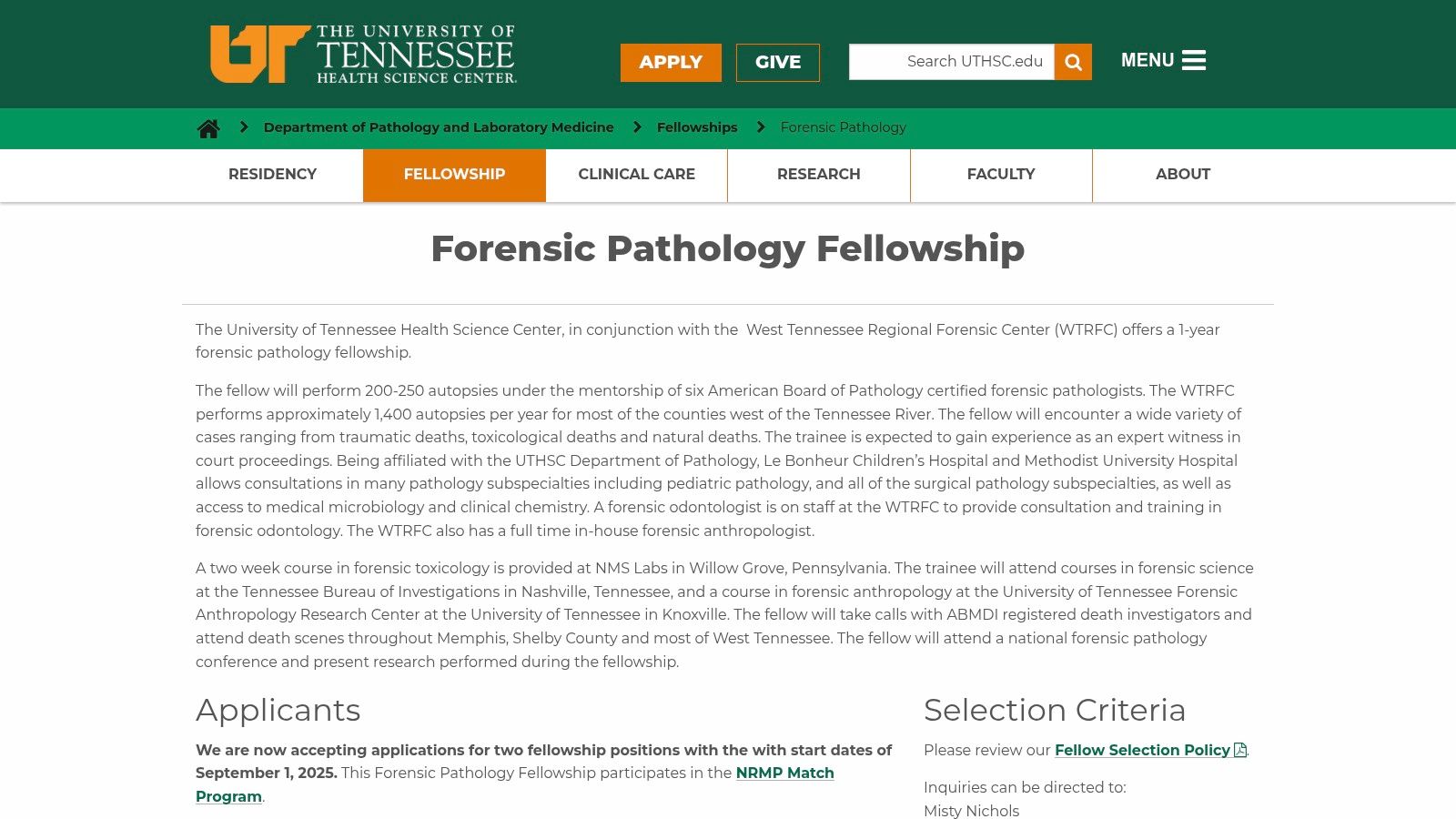
This program is designed to build confidence through mentored practice. Fellows are expected to complete approximately 200 to 250 autopsies over the year, a volume that ensures broad exposure without sacrificing the quality of instruction. The six board-certified forensic pathologists on faculty provide deep supervisory support, creating a learning atmosphere where complex cases can be thoroughly explored. Fellows gain experience with a wide variety of death investigations and have access to in-house experts in forensic odontology, toxicology, and anthropology.
Program Highlights and What to Expect
The UTHSC fellowship website lays out the program structure, faculty bios, and application details clearly for prospective candidates. It highlights a curriculum focused on practical skill acquisition and scholarly development.
- Subspecialty Consultation: A key strength is the program’s access to subspecialty consultants from affiliated hospitals like Le Bonheur Children’s Hospital and Methodist University Hospital. This gives fellows critical exposure to complex pediatric and surgical pathology cases.
- Scholarly Activity: Beyond casework, the program emphasizes academic contribution. Fellows are expected to engage in a quality-improvement project or other scholarly work, preparing them for the academic and research aspects of a forensic pathology career.
- Courtroom Preparation: The fellowship provides direct experience in courtroom testimony, a non-negotiable skill for any practicing forensic pathologist. This training is integrated into the curriculum to build competency and confidence in a legal setting.
- Application Process: The program participates in the national fellowship match. Applicants must have completed an AP or AP/CP residency program and be eligible for a Tennessee medical license. With typically one fellowship position available each year, it is a competitive opportunity.
Key Insight: The program's standout feature is its balanced approach. It combines the rigorous caseload of a metropolitan ME’s office with a supportive, teaching-focused environment, making it an ideal choice for residents who value mentorship alongside practical experience.
For those looking for fellowship programs that offer a well-rounded and robust training experience, the UTHSC fellowship in Memphis provides a solid foundation for a successful career.
Visit the UTHSC Forensic Pathology Fellowship Website
5. University of Maryland + Maryland Office of the Chief Medical Examiner (Baltimore, MD)
The forensic pathology fellowship offered by the University of Maryland School of Medicine in partnership with the Maryland Office of the Chief Medical Examiner (OCME) is one of the nation's most respected and long-standing training programs. Located in Baltimore, this program operates within a centralized, statewide medical examiner system. This unique structure provides fellows with an incredibly diverse caseload, drawing from urban, suburban, and rural jurisdictions across Maryland, which reports approximately 18,000 deaths annually.
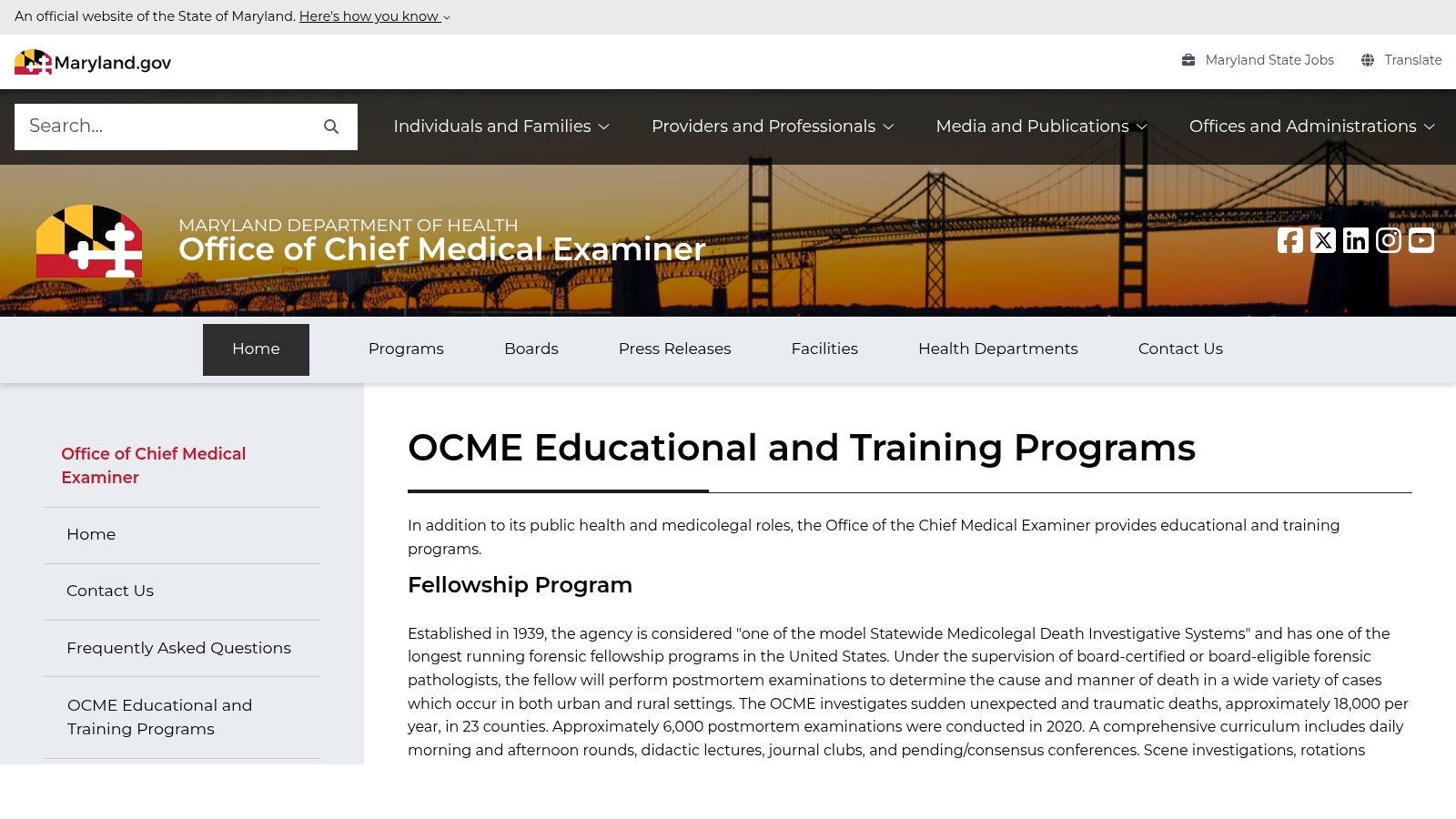
Training at the Maryland OCME is an immersion into a high-volume, academically rigorous environment. Fellows are not just observers; they are integral to the office's daily operations, performing autopsies under direct supervision and taking on increasing responsibility as their skills develop. The facility itself is a major asset, housing an in-house toxicology laboratory that provides immediate, integrated feedback on cases. This direct access helps fellows build a strong foundation in interpreting toxicological findings, a critical skill for any forensic pathologist.
Program Highlights and What to Expect
The OCME's website for education and training outlines the deep curriculum that makes this program a top choice for aspiring forensic pathologists. It serves as a clear entry point for understanding the fellowship's structure and requirements.
- Diverse Rotations: The program includes formal rotations in forensic anthropology, neuropathology, and cardiovascular pathology, giving fellows specialized training that is often unavailable in smaller programs. Scene investigation training is also a core component.
- Structured Academics: Learning is reinforced through daily morning rounds, didactic lectures, journal clubs, and consensus conferences where complex cases are discussed among faculty and fellows.
- Reputation and Network: As one of the oldest programs in the country, it boasts a strong national reputation and an extensive alumni network, which can be invaluable for career development and mentorship.
Key Insight: The program's strength lies in its statewide system. Fellows are exposed to the full spectrum of death investigation, from common natural diseases to complex homicides and multi-fatality incidents, all managed under one highly organized and academically oriented roof.
While the workload is demanding, as is typical for a busy statewide office, the breadth of experience gained is exceptional. For pathology residents looking for comprehensive training that prepares them for any professional setting, this fellowship is a premier choice.
Visit the Maryland OCME Education & Training Website
6. Wayne State University + Wayne County Medical Examiner’s Office (Detroit, MI)
For pathology residents looking for a high-volume urban fellowship, the program at Wayne State University, in partnership with the Wayne County Medical Examiner’s Office, is an excellent training ground. This one-year, ACGME-accredited fellowship places residents directly within the Detroit Medical Center complex, offering a robust caseload in a major metropolitan area. The program accepts two fellows annually, ensuring personalized mentorship while providing significant hands-on experience.
This fellowship is built on a foundation of practical, supervised work. Fellows are responsible for performing autopsies and managing cases from start to finish. A key feature is the defined autopsy cap of approximately 250 cases per fellow. This structure ensures that trainees have a manageable workload, allowing them to focus on the quality and depth of each investigation rather than just volume. The program provides comprehensive exposure to a wide range of forensic subspecialties, giving fellows a complete picture of a modern medical examiner's office.
Program Highlights and What to Expect
The Wayne State Pathology department website clearly outlines the fellowship's structure, goals, and application details. It serves as a direct portal for prospective fellows to understand the unique training environment in Detroit.
- Multidisciplinary Exposure: The curriculum is designed to provide experience beyond the autopsy suite. Fellows work with forensic anthropology, odontology, radiology, and toxicology experts and also gain experience in crime scene investigation.
- Academic and Research Opportunities: The program encourages fellows to engage in research projects and present their findings at national conferences like NAME and AAFS. This academic component is critical for building a strong professional profile.
- Courtroom Testimony: Practical experience in a legal setting is a core part of the training. Fellows are prepared for the realities of providing expert testimony, a necessary skill for any practicing forensic pathologist.
- Application Details: To be eligible, applicants must have completed or be on track to complete an ACGME-accredited residency in anatomic pathology (AP) or anatomic and clinical pathology (AP/CP). The program participates in the national fellowship match.
Key Insight: The program's explicit autopsy cap is a significant advantage. It promotes a focus on high-quality case ownership and thorough investigation, preventing burnout and ensuring each case serves as a valuable learning opportunity.
While the program's next available opening is for the 2027-2028 academic year, requiring long-term planning, its position within a high-volume urban office provides outstanding training. For residents seeking to become a forensic pathologist prepared for the demands of a busy city, this fellowship offers a direct path to competence and confidence.
Visit the Wayne State Forensic Pathology Fellowship Website
7. NYC Office of Chief Medical Examiner (OCME) + Academic Appointments (New York, NY)
For aspiring forensic pathologists who want to train at the epicenter of medico-legal death investigation in the United States, the program at the NYC Office of Chief Medical Examiner (OCME) is a top-tier destination. This is the nation’s largest forensic pathology fellowship, accepting four to six fellows annually. It offers an experience defined by immense volume, case diversity, and access to world-class resources, preparing graduates for any challenge in the field.

The scale of this program is its most significant feature. Fellows are immersed in an office that handles around 40,000 death reports and performs approximately 7,000 autopsies each year. This isn't just a high number; it represents an extraordinary spectrum of cases, from routine natural deaths to the most complex homicides and mass-casualty incidents. The OCME also houses massive public DNA and molecular genetics labs, giving fellows direct insight into how cutting-edge science integrates with traditional pathology.
Program Highlights and What to Expect
The NYC OCME fellowship website is a direct portal for applicants, clearly outlining the program's structure and extensive resources. Fellows receive faculty appointments at the NYU Grossman School of Medicine, adding a strong academic component to the practical training.
- Unmatched Subspecialty Exposure: The OCME provides deep resources in forensic anthropology, toxicology, and more. A key benefit is the option for a second-year subspecialty fellowship in areas like forensic neuropathology or cardiovascular pathology, allowing for deep specialization.
- Structured Education: The curriculum is rigorous and well-organized. It includes daily case reviews, formal Grand Rounds, journal clubs, and rotations to death scenes, ensuring a well-rounded educational experience that goes far beyond the autopsy suite.
- Application and Compensation: Entry is competitive and managed through the national fellowship match. The OCME is transparent about compensation; the 2024 starting salary for a fellow (City Medical Examiner I) is published at approximately $155,000 with full NYC benefits. This is a notable advantage, though applicants must consider NYC's high cost of living.
Key Insight: Graduating from the NYC OCME program is a powerful credential. The sheer volume and complexity of cases, combined with opportunities for subspecialty training, signal to employers that a pathologist is prepared for a high-pressure leadership role in any major metropolitan jurisdiction.
While the program's intensity and the competitiveness for a spot are significant factors, the training is exceptional. For those aiming to be a top forensic pathologist, this fellowship provides a direct path to acquiring elite skills and a strong national placement record.
Visit the NYC OCME Forensic Pathology Fellows Program Website
Finding Your Place in Forensic Pathology
The path to becoming a forensic pathologist is a marathon, not a sprint. It’s a journey that demands more than a decade of intense focus, academic dedication, and deep personal commitment. I’ve structured this guide to provide a clear road map, from selecting an undergraduate major to securing a fellowship, because I often meet students and residents who are passionate about the field but unsure of the specific steps. My goal was to demystify the process and highlight some of the nation’s standout programs, including several right here in Texas.
Your education doesn’t stop with a diploma or a board certification. It’s a continuous process of learning from every case, every piece of evidence, and every family you serve. The programs we’ve discussed, from UT Southwestern to the NYC OCME, are not just places of learning; they are environments where you forge your professional identity.
Key Takeaways for Your Journey
As you reflect on the information presented, keep these core principles in mind. They were critical in my own training and remain central to my work today at Texas Autopsy Services.
- Undergraduate Foundation: Your choice of major is less important than your commitment to a strong pre-med curriculum. Majors like biology, chemistry, and forensic science build the essential scientific framework needed for medical school.
- Medical School Matters: Excelling in medical school is non-negotiable. Focus on building a strong academic record, securing high USMLE scores, and gaining exposure to pathology early through rotations and research. This is where you prove you have the discipline for the path ahead.
- Residency is Your Proving Ground: Anatomic and Clinical Pathology (AP/CP) residency is where you become a pathologist. It’s a demanding period where you learn the foundations of tissue diagnosis and laboratory medicine that are essential for forensic work.
- The Fellowship Specializes Your Skill: Your forensic pathology fellowship is the final, critical step. Look for programs with high case volume, diverse case types (homicides, accidents, natural deaths), and, most importantly, dedicated mentors. Your fellowship director and attending pathologists will shape the kind of expert you become.
Choosing the Right Program for You
There is no single "best" college for a forensic pathologist. The right path is the one that aligns with your learning style, career goals, and personal circumstances. When evaluating residencies and fellowships, consider the program’s culture. Do the residents and fellows seem supported? Is there a strong emphasis on academic teaching alongside casework?
In my experience, the strongest training programs are those that treat you as a junior colleague. They push you to take ownership of your cases while providing the supervision and guidance necessary to build unshakable confidence in your findings.
As you consider the financial side of this long educational path, it’s helpful to understand the earning potential across the broader forensic science field. While the roles are different, reviewing a Crime Scene Investigator Salary Guide can offer useful context on compensation in related careers, helping you build a complete picture of your financial future.
Ultimately, this career is a calling. It is a profound responsibility to speak for the deceased and provide answers to the living. The long years of study are an investment in your ability to deliver truth with precision and compassion. For those who feel drawn to this work, I can say with certainty that it is one of the most rewarding paths in medicine.
Frequently Asked Questions
Can I become a forensic pathologist without going to medical school?
No, a forensic pathologist is a medical doctor (MD or DO). The job requires completing a full medical school education, followed by a multi-year residency in pathology, and then a specialized one-year fellowship in forensic pathology. This extensive medical training is necessary to accurately determine the cause of death.
What should I major in as an undergraduate to become a forensic pathologist?
There is no required major. The most important thing is to complete all the pre-medical requirements for medical school, which typically include courses in biology, chemistry, physics, and mathematics. Common majors include biology, chemistry, or even forensic science, but your primary focus should be on building a strong academic record to gain acceptance into medical school.
How long does it take to become a forensic pathologist?
After completing a four-year bachelor's degree, you can expect the following timeline:
- 4 years of medical school (MD or DO)
- 3-4 years of residency in Anatomic and Clinical Pathology (AP/CP)
- 1 year of fellowship training in Forensic Pathology In total, it takes approximately 12 to 13 years of education and training after high school.
What is the difference between a forensic pathologist and a coroner?
A forensic pathologist, like myself, is a physician who has specialized training in determining cause of death by performing autopsies. A coroner is often an elected official who may or may not have medical training. In Texas, a medical examiner (who is a physician, usually a forensic pathologist) performs these duties in larger counties, while a justice of the peace may act as coroner in smaller counties. Forensic pathologists provide the medical expertise that coroners rely on.
If you are a medical professional, attorney, or county official in need of forensic pathology expertise, or a family seeking answers through a private autopsy, my team and I at Texas Autopsy Services are here to provide clear, objective, and compassionate answers. My practice is built on the same principles of rigor and service that I encourage every aspiring forensic pathologist to pursue. You can reach my office directly for guidance at (806) 230-1889.


