November 18, 2025 · Texas Autopsy Services
Understanding Private Autopsies in Texas
I'll guide you through a pathology report example, explaining each section to help families and attorneys in Texas understand the findings.
On this page
As a forensic pathologist, I know that an autopsy report is far more than a medical document. It’s often the final chapter in a person’s story, a collection of medical facts that must provide clear, unbiased answers for families and legal professionals. My work is to find the objective truth within that story.
In my practice at Texas Autopsy Services, I’ve found that families and attorneys often seek a private autopsy for one of two reasons: either the death was unexpected and no official examination was planned, or an initial finding just doesn’t seem to fit the circumstances. They need an independent, expert opinion to get the full picture. This guide will explain what a private autopsy is, how the process works, and what you can expect from the final report.
- A private autopsy is an independent medical examination requested by a family or legal representative to determine the cause and manner of death.
- The examination is performed by a board-certified forensic pathologist to provide objective, evidence-based findings.
- The final report is a confidential, comprehensive document detailing all medical evidence, from external observations to microscopic analysis.
- This process is fully compliant with Texas laws, including the Texas Health & Safety Code, ensuring ethical and legal integrity.
- My role is to provide precise medical answers with the compassion and clarity families deserve during a difficult time.
What is a Private Autopsy and When Is It Needed?
A private autopsy is an independent medical examination performed by a forensic pathologist at the request of the legal next-of-kin or their legal counsel. Unlike autopsies conducted by a medical examiner's office, which are required by law for specific types of deaths, a private autopsy is a choice. It’s a decision families make when they need definitive answers that they can’t get anywhere else.
Families or attorneys typically request an independent autopsy in several situations:
- Unexplained Death: When a loved one dies suddenly and the cause is unclear, a private autopsy can provide a conclusive medical reason.
- Seeking a Second Opinion: If the family disagrees with or is uncertain about the findings of an initial autopsy or death certificate, an independent examination offers a fresh, unbiased review.
- Legal and Insurance Matters: Attorneys often require a forensic autopsy to provide objective evidence for civil litigation, insurance claims, or workers' compensation cases.
- Concerns About Medical Care: If there are questions about the medical treatment a person received before their death, a private autopsy can clarify the role of underlying disease versus potential medical complications.
My work as a board-certified forensic pathologist is to conduct a thorough, objective investigation into the cause of death. Every examination adheres to the highest standards set by the American Board of Pathology and complies with all Texas regulations.
How a Private Autopsy Works
The autopsy process is a systematic and meticulous investigation. It starts with gathering information and ends with a comprehensive report that provides clear answers. Here’s a step-by-step overview of what families and attorneys can expect.
1. Authorization and Consultation
The process begins when the legal next-of-kin provides written consent. I always start with a detailed consultation to understand the family’s concerns, review the deceased’s medical history, and explain what the examination can and cannot determine. This conversation establishes a foundation of trust and transparency.
2. The Examination
The physical examination itself is a careful, respectful process. It includes three main parts:
- External Examination: I document every detail of the body’s exterior, including height, weight, identifying marks like scars or tattoos, and any signs of injury or medical intervention.
- Internal Examination: I examine each internal organ, noting its size, weight, and appearance. This is what we call the "gross examination"—what is visible to the naked eye.
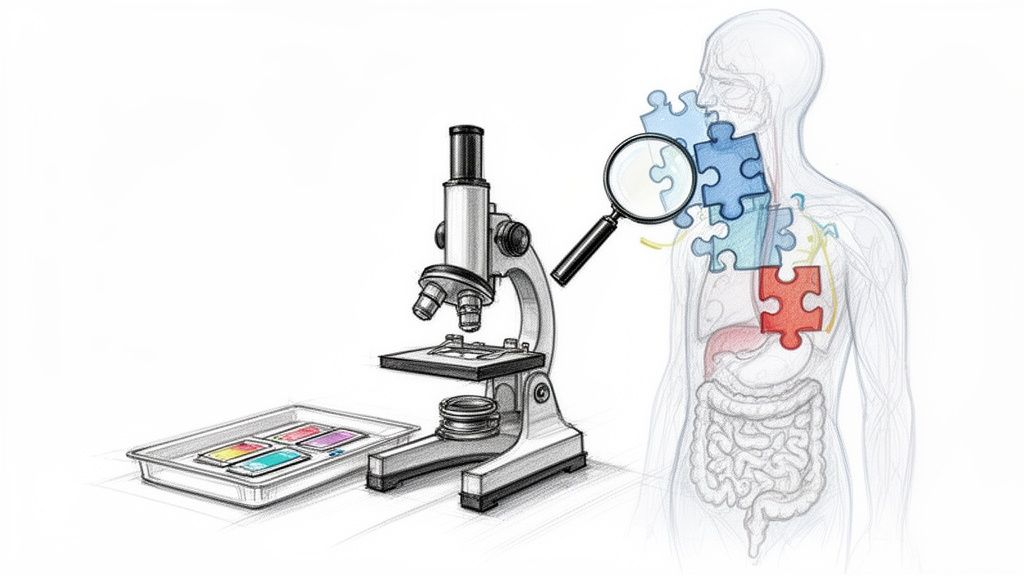
- Ancillary Studies: I take tissue and fluid samples for further testing. This almost always includes toxicology to screen for drugs or other substances and histology, where I examine tissue samples under a microscope to find evidence of disease at a cellular level.
3. Analysis and Reporting
After the physical examination, the detailed work of analysis begins. I review all the microscopic slides, toxicology results, and other data to connect the findings. This is how I form a conclusion about the cause and manner of death.
The final report is a comprehensive legal and medical document that presents all the evidence in a clear, logical format. It includes:
- Clinical Summary: A brief overview of the person's medical history and the circumstances surrounding their death.
- Gross Findings: A detailed description of the external and internal examinations.
- Microscopic Findings: An analysis of what the tissue samples revealed at a cellular level.
- Ancillary Test Results: The complete toxicology report and findings from other specialized tests.
- Final Pathologic Diagnosis: A summary listing the official cause of death and any contributing factors.
My commitment is to deliver a report that is not only scientifically sound but also understandable to a non-medical audience.
The Role of Independence and Objectivity
In any cause of death investigation, objectivity is everything. As an independent forensic pathologist, my only duty is to the evidence. I am not affiliated with a hospital, insurance company, or government agency, which ensures my findings are completely unbiased. This independence is critical, especially when legal questions are involved.
After performing over 1,000 autopsies, I’ve seen firsthand how an objective second opinion can bring peace of mind to a family or provide the crucial evidence needed in a legal case. My conclusions are based solely on the medical facts discovered during the examination.
Common Misconceptions About Autopsies
There are many myths about autopsies, and I think it’s important to address them directly.
- Myth: An autopsy will disfigure the body. This is untrue. The examination is a surgical procedure performed with great care and respect. Any incisions are carefully closed, and the body is suitable for a traditional viewing and funeral service.
- Myth: Autopsies are only for criminal cases. While medical examiners handle criminal investigations, private autopsies are for families seeking answers about natural disease, medical complications, or accidents.
- Myth: We can’t have an autopsy because of our religion. Most major religions permit autopsies when they are necessary to determine a cause of death. I am always respectful of a family’s cultural and religious beliefs and will discuss any concerns with them beforehand.
Ethical and Legal Safeguards in Texas
My practice, Texas Autopsy Services, operates in strict compliance with Texas law. This includes adherence to the Texas Health & Safety Code, which governs autopsy consent, and regulations from the Texas Funeral Service Commission (TFSC). All examinations are performed with the dignity and respect the deceased deserves, and the final report is a confidential document released only to the authorizing party.
Frequently Asked Questions
After years of speaking with families and attorneys, I've found a few questions come up consistently. Here are some clear answers.
How long does it take to get a final autopsy report?
While the physical examination is usually completed within a day, the ancillary studies like toxicology and microscopic analysis take time. You can generally expect to receive the final, comprehensive report in 30 to 60 days. A more complex case might take longer, but I always prioritize accuracy over speed.
Can a private autopsy be done after the deceased has been embalmed?
Yes, it is possible to perform an autopsy after embalming. While the process can alter some tissues and makes certain tests (like toxicology on blood) more difficult, a skilled forensic pathologist can still uncover a great deal of information. It is always preferable to perform the autopsy before embalming if possible.
What is the difference between cause of death and manner of death?
These terms are often confused but have distinct meanings.
- Cause of Death is the specific medical disease or injury that led to death (e.g., "coronary artery disease").
- Manner of Death is the classification of how the death occurred. There are five categories: Natural, Accident, Suicide, Homicide, or Undetermined.
My report will clearly state both based on the evidence.
Who can authorize a private autopsy in Texas?
In Texas, the authority to consent to an autopsy typically follows the order of next-of-kin. This usually starts with a surviving spouse, then an adult child, then a parent, and so on. A legal representative with durable power of attorney for healthcare can also provide authorization.
I hope this guide has provided some clarity on the private autopsy process. Navigating a loss is difficult enough without the added burden of unanswered questions. My role is to provide objective medical truths with compassion and respect.
If you have questions or believe a private autopsy could help your family, please contact my office directly. My team and I are here to offer the expert support you need. For a personal consultation, you can find us at https://www.texasautopsyservices.com.