October 30, 2025 · Texas Autopsy Services
Why Do Autopsies Take So Long
why do autopsies take so long? A pathologist explains the steps, checks, and delays behind the process.

On this page
- The Investigation Behind Every Autopsy
- The First 24 Hours A Race Against Time
- A Look Inside the Multi Stage Examination
- The Role of Specialized Laboratory Testing
- Putting All the Pieces Together Crafting the Final Report
- What Else Can Affect Autopsy Timelines?
- Answering Your Questions About the Autopsy Process
As a forensic pathologist, one of the first questions families and attorneys ask me is, "Why is this taking so long?" It's a fair question. When you're waiting for answers after a loss, every day feels like an eternity. A proper autopsy isn't a single event—it's a meticulous investigation with multiple stages. Rushing it means risking an incorrect conclusion or missing a detail that changes everything.
- An autopsy is a multi-stage investigation, not a single procedure. The timeline reflects the diligence required for accuracy.
- The initial 24 hours after death are critical for preserving evidence before natural cellular breakdown begins.
- Specialized lab tests, especially toxicology and histology, are the most time-consuming steps and can take several weeks.
- Administrative tasks like securing legal authorization and gathering medical records add necessary delays.
- The final report requires careful synthesis of all data to create a medically sound and legally defensible document.
The Investigation Behind Every Autopsy
The quick resolutions you see on television are fiction. A comprehensive cause of death investigation begins with the physical examination but quickly branches into a series of detailed lab analyses that simply can't be hurried. Each step is designed to build a complete, accurate picture that will hold up under legal scrutiny. As a board-certified forensic pathologist, my commitment is to provide a definitive, medically sound answer, and that level of certainty takes time.
The Four Main Reasons Autopsies Take Time
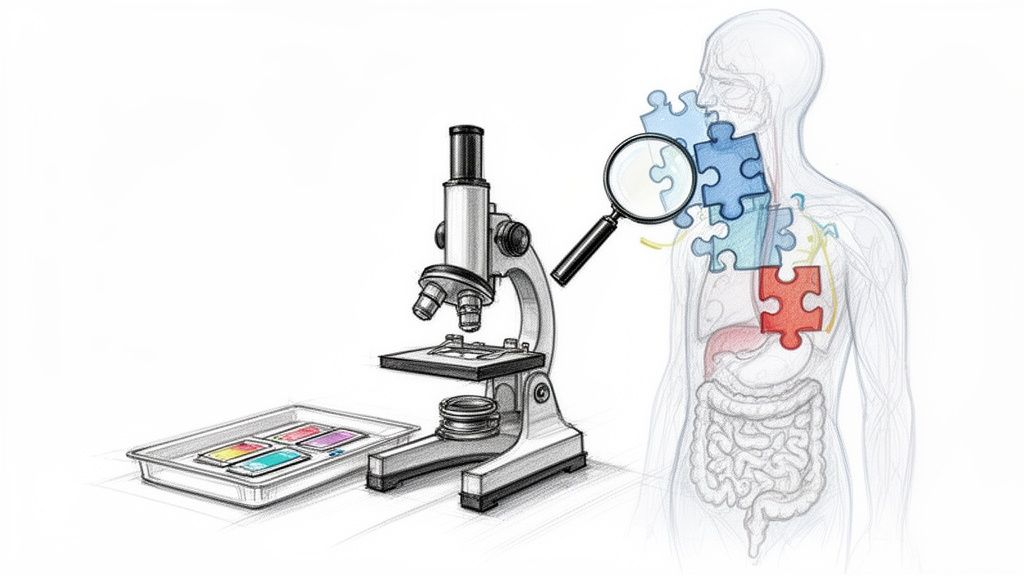
The total timeline is a sum of its parts. While some tests can run concurrently, many steps depend on the one before. It's like a puzzle—you can't see the full picture until every piece is in its proper place.
| Phase | What It Involves |
|---|---|
| 1. The Initial Examination | This is the hands-on part of the process. I conduct a detailed external and internal inspection, document every finding, and collect tissue and fluid samples for later analysis. This is just the beginning. |
| 2. Microscopic Analysis (Histology) | Small tissue samples from major organs are preserved, processed into thin slices, and mounted on glass slides. Examining these under a microscope is essential for identifying diseases or injuries invisible to the naked eye. |
| 3. Specialized Lab Testing | This is often the longest part of the process. Toxicology screenings for drugs or medications, along with cultures to check for infections, are sent to specialized labs. These tests can take several weeks or longer. Understanding the factors influencing fast lab result turnaround in a clinical setting helps explain why forensic tests, which demand absolute confirmation, often take even more time. |
| 4. Final Report Synthesis | Once all lab results are back, I synthesize every piece of data into a single, comprehensive legal document. This is where I connect physical findings with microscopic and toxicological data to form a solid, defensible conclusion. |
Every phase is methodical and essential. Each test gives me one more piece of the puzzle, bringing us closer to a complete and accurate answer. The wait can be frustrating, but this careful process ensures the final report provides the clarity your family deserves. To better understand what to expect, you can learn more in our detailed guide on how long it takes to get autopsy results.
The First 24 Hours A Race Against Time
The moment someone passes, a critical window opens. From my perspective as a forensic pathologist, this initial 24-hour period is crucial. To get the clearest answers, an autopsy should happen within this timeframe, before the body’s natural processes begin to obscure the evidence.
As soon as life ceases, the body's cells begin to break down in a process called autolysis. It’s a natural shutdown, but it can quickly erase or alter the evidence needed to determine the cause of death.
How Delays Can Complicate the Investigation
Once we pass the 24-hour mark, the quality of tissues starts to decline. This makes it much harder to analyze samples under a microscope and can force the use of more complex, time-intensive tests to find a conclusive answer. The cellular structures I rely on to identify disease or injury become degraded, making it difficult to separate what happened before death from what happened after.
At Texas Autopsy Services, my goal is always to work within this 24-hour window. The reality, however, is that logistics often create delays, which is a significant reason why autopsies can take time.
Several factors can slow things down:
- Transportation: Moving the decedent to our facility, especially from across a state as large as Texas, takes time and careful coordination.
- Legal Authorization: We must have legal consent from the next of kin before we can proceed. This is a vital step that requires sensitivity and cannot be rushed.
- Coordination: My work requires coordinating schedules with hospitals, funeral homes like our partners at Waterloo Mortuary, and sometimes law enforcement.
The Science Behind the Guideline
This 24-hour rule isn’t a preference; it’s grounded in science. As tissues break down, evidence fades. A major international study underscored this, finding that tissue degradation accelerates over time and makes a precise diagnosis more difficult.
The research showed that 75.9% of autopsies conducted within the first 24 hours provided the best possible evidence. The other 24.1%, performed later, came with far greater challenges. You can read more about the study's findings on postmortem examination timing on Nature.com.
Every hour that passes can complicate the investigation. By moving quickly, we give ourselves the best opportunity to deliver clear, definitive answers to families and legal authorities.
A Look Inside the Multi Stage Examination
Most people picture an autopsy as a single event—the physical examination. In reality, that's just the first step. The entire process is a meticulous, multi-stage workflow, and understanding these layers is key to seeing why a final report takes time. The clock starts the moment a decedent is brought into my care.
First comes a thorough external examination. I document every detail: physical characteristics, identifying marks, and any visible signs of injury or illness. Then, I move to the internal examination. This is a careful, respectful dissection where I inspect each organ system, weighing and examining every major organ before taking precise samples.
From Tissue Sample to Microscopic Slide
The small tissue samples I collect from organs like the heart, lungs, liver, and brain are the real storytellers. These are preserved in a formalin solution and sent to a specialized lab for processing.
There, technicians undertake a delicate process called histology. They embed the tissue in wax, slice it into sections thinner than a human hair, and mount them on glass slides. This work is what allows me to see what the naked eye can't.
Under the microscope, I can spot subtle signs of a heart attack, find hidden infections, or identify early-stage cancers. Each slide adds a crucial piece to the puzzle. To see how these components fit together, you can read our breakdown of the steps in an autopsy.
This infographic shows just how critical the initial timeline is for preserving the evidence I need for that microscopic analysis.

As you can see, cellular breakdown accelerates after the first 24 hours, which can make it much harder to get clear answers from the tissue samples.
The Time Commitment for Thoroughness
So, how much time does this all take? It’s significant. A major academic institution might perform around 360 autopsies a year, and each one can easily stretch over several days. That time isn't just for the physical exam; it includes all the lab processing and the careful interpretation of complex findings.
And some cases are even more demanding. Pediatric autopsies, which can make up as much as 30% of cases in some facilities, often require a far more exhaustive analysis simply because of their complexity. It’s a job that cannot be rushed.
The Role of Specialized Laboratory Testing
Sometimes, what I can see with the naked eye during an autopsy doesn't tell the whole story. This is where specialized lab testing comes in, and it's one of the biggest reasons why autopsies take so long. The answers are often hidden at a microscopic or chemical level.
My initial physical examination draws the map. The detailed lab tests guide us to the final destination. These tests, which include toxicology, microbiology, and sometimes genetics, are sent to different labs that specialize in each area. Each follows its own meticulous, time-consuming process.

Toxicology and Microbiology Timelines
A toxicology screen, which looks for drugs, alcohol, or other substances, is a common step that can add several weeks to the timeline. Labs run broad initial screenings first. If anything is detected, they must run more specific confirmation tests to be absolutely certain. We go into more detail on this in our guide explaining why toxicology reports take so long.
If an infection is a possible cause, I'll send samples for microbiology. Growing bacteria or viruses in a lab is a natural process that cannot be rushed. It often takes days, and sometimes weeks, before we get a clear answer.
I cannot finalize my cause-of-death determination until every one of these results is back. Integrating these findings with my physical examination is the only way to build a complete, medically sound, and legally defensible conclusion.
Genetic and Molecular Testing
In certain tragic cases, like a sudden and unexplained death in a young person, the answer might be in their DNA. Genetic testing is a powerful tool that can uncover inherited heart conditions or metabolic disorders that leave no physical evidence.
These molecular tests are incredibly specialized and can introduce the longest delays, sometimes taking a few months to get results. While each of these external tests adds to the total timeline, they are essential for getting to the truth. The wait is a necessary part of the thoroughness the process demands.
Putting All the Pieces Together Crafting the Final Report
We've now reached the final and most intensive phase: writing the autopsy report. This is where every piece of the puzzle—every observation, test result, and microscopic slide—comes together. This isn't just a summary; it's a meticulously constructed legal and medical document that must tell a complete, coherent story.

I must take all the disparate pieces of information—the physical exam notes, the lab reports, the tissue analysis—and weave them into a single, logical narrative. Each finding is a piece of evidence that must support the final conclusion.
Building a Conclusion That Holds Up
The final report has one critical job: to logically connect every dot, leading to the cause and manner of death. This involves a painstaking review of every detail. I go back through every slide, double-check every toxicology number, and read every note I made to ensure nothing contradicts the final picture.
I am responsible for integrating several key components:
- External and Internal Exam Findings: This includes everything I documented with my own eyes, from visible injuries down to the specific weight and condition of each organ.
- Microscopic (Histology) Descriptions: This is the cellular-level story, revealing evidence of disease or injury that was invisible during the physical exam.
- Ancillary Test Results: Here, I incorporate the full toxicology, microbiology, and any other specialized reports from outside labs.
- Final Cause of Death: This is my ultimate professional opinion, backed by the combined weight of all the evidence.
In Texas, a forensic pathologist’s report must be precise enough to withstand rigorous scrutiny in a court of law. It needs to provide clear, unambiguous answers for families while meeting strict legal and medical standards. This commitment to accuracy is non-negotiable and requires careful, unhurried analysis.
For families who have requested a private autopsy in Texas, this report is the definitive answer they have been waiting for. For lawyers and law enforcement, it becomes the cornerstone of their case. This final stage of analysis and careful documentation takes significant time, but it’s essential to ensure the report is accurate, thorough, and ultimately, provides the truth.
What Else Can Affect Autopsy Timelines?
Beyond the complex science happening in the lab, external factors can stretch the timeline for a final autopsy report. These are often logistical and administrative hurdles that, while crucial for a legally sound investigation, add days or even weeks to the process.
One of the biggest issues we face is a nationwide shortage of trained, board-certified forensic pathologists. This scarcity creates backlogs, especially in government facilities. When a family chooses an independent private autopsy in Texas, my own schedule and availability become a central part of the timing.
Juggling Paperwork and People
The administrative side of a death investigation is something families don't see, but it takes up a significant amount of time. Before I can start, I must secure legal authorization from the next of kin. This step alone can be a bottleneck as a family works through an incredibly difficult decision.
Once I have authorization, the next step is to gather all relevant medical records. This means contacting every hospital, clinic, and doctor who treated the deceased. Tracking down and waiting for these documents to arrive can add days or weeks to the front end of the process.
For county-level forensic cases, there's an added layer of complexity. We must coordinate closely with law enforcement and follow strict chain of custody rules for every piece of evidence. It's a necessary delay, but a delay nonetheless.
Every single one of these external steps—from getting consent to coordinating with legal authorities—is there to protect the integrity of the investigation. While it can be frustrating to wait, these procedures are non-negotiable for upholding the high standards required in Texas.
The Ripple Effect of Fewer Autopsies
It might sound strange, but the fact that autopsies are less common today contributes to delays. Decades ago, autopsies were routine. Rates have plummeted from around 40% in the 1960s to single digits in many places today.
This massive drop means fewer resources, less funding, and a smaller pool of trained experts are dedicated to the field. When a detailed investigation is suddenly needed, these bottlenecks become immediately apparent. You can read more about this historical decline in autopsy rates at Wikipedia.
Answering Your Questions About the Autopsy Process
When families and attorneys reach out to me, they often have similar questions. It's a confusing and overwhelming time, and my hope is to offer some clarity about what you can expect from a private autopsy here in Texas.
Can an autopsy be done after embalming?
Yes, it's possible, but it’s far from ideal. The embalming process fundamentally changes the body's tissues and fluids. This can create major hurdles for certain tests, especially toxicology screens, which look for drugs or other substances.
While I can often still find a cause of death, the results might not be as clear-cut as they would have been otherwise. For the most accurate and reliable answers, the autopsy should always happen before any embalming. That way, we're working with a completely unaltered picture of what was happening inside the body.
Will an autopsy interfere with the funeral or an open casket?
This is one of the first things families ask, and it’s a valid concern. I want to assure you that I perform every examination with the deepest respect for the person who has passed away. The incisions are placed strategically and sutured with the same care as in a surgical operation.
In nearly every case, there is no issue with having a traditional viewing or an open-casket service. I coordinate closely with funeral directors, including our partners at Waterloo Mortuary, to make sure everything is handled with dignity and care.
It is my professional and ethical duty to treat every decedent with the same care and respect I would want for my own family. Preserving dignity is a cornerstone of my practice.
What's the difference between the cause and manner of death?
People often use these terms interchangeably, but in forensic pathology and law, they mean very different things.
- The Cause of Death is the medical reason a person died. It's the specific disease or injury that led to death, like a heart attack, a gunshot wound, or pneumonia.
- The Manner of Death is the legal classification of how the death happened. There are only five official categories: natural, accident, suicide, homicide, and undetermined.
My job as a forensic pathologist is to pinpoint the medical cause of death. That information then helps the medical examiner or justice of the peace make the final determination on the manner of death for the official death certificate.
If you have more questions or need to determine if an independent autopsy is the right step for your family, please don't hesitate to get in touch. The team at Texas Autopsy Services is here to offer clear, compassionate guidance. You can contact my office directly for a confidential consultation.