April 5, 2026 · Texas Autopsy Services
Medical History Review in Cause-of-Death Analysis
How a medical record review shapes an autopsy and its conclusions: what records matter, how findings are reconciled with the clinical course, and the limits.
On this page
An autopsy answers what the body shows. A medical history review answers what the body cannot show on its own — what was already wrong, what was being treated, what changed in the days before death, and whether the clinical record and the physical findings tell the same story.
In most cases the two are examined together. Texas Autopsy Services treats the record review as part of the examination rather than an add-on, because a finding at autopsy frequently only becomes meaningful once it is set against what was known about the person while they were alive.
What a Medical History Review Covers
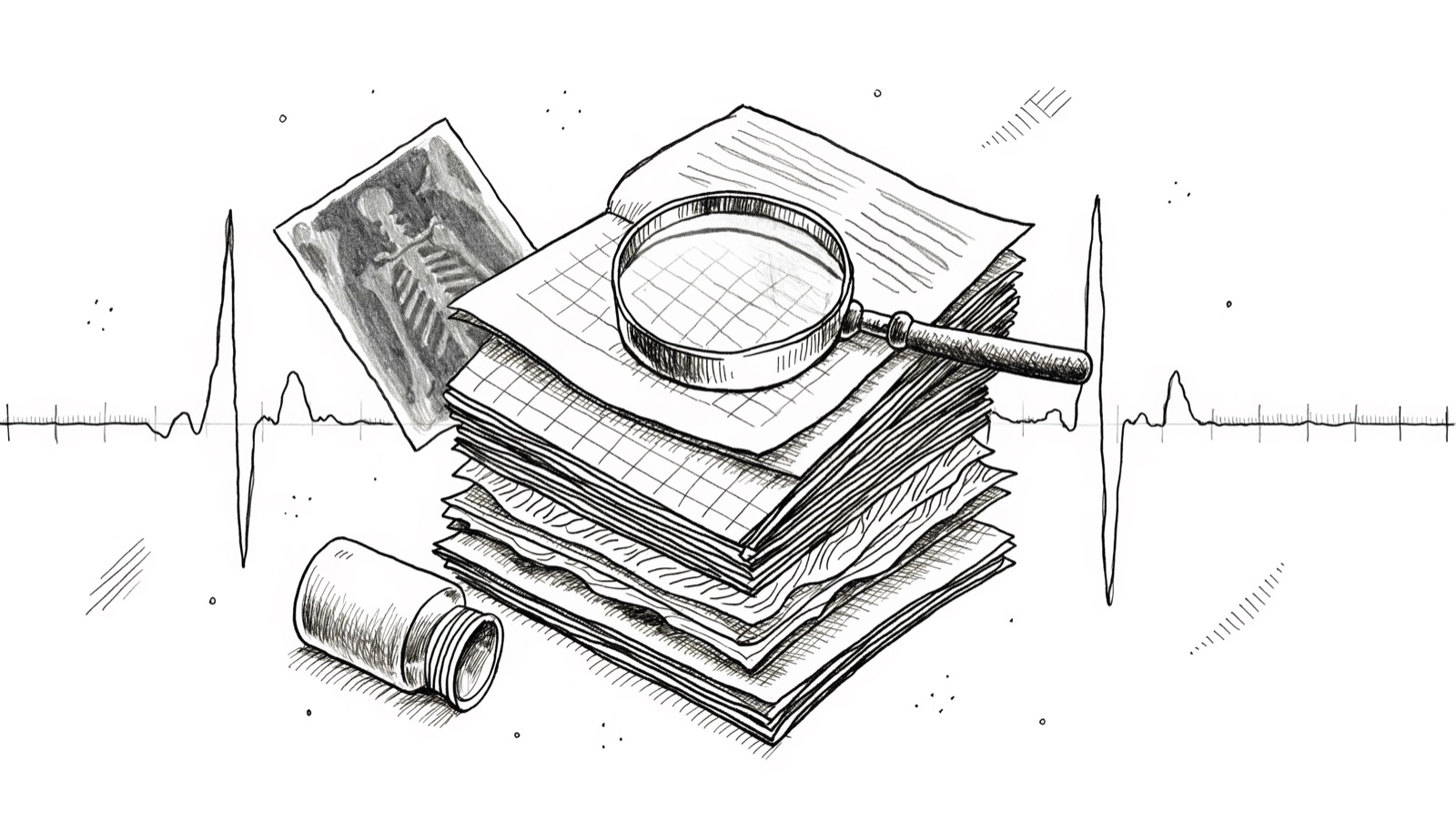
A thorough review reaches wider than a hospital discharge summary. The records that most often change a conclusion include:
- Hospital and emergency department records — admission notes, vital sign trends, nursing observations, and the timing of interventions.
- EMS and first responder run sheets — often the only contemporaneous account of the scene and of the person's condition before hospital arrival.
- Primary care and specialist notes — the chronic conditions, and how well controlled they were.
- Medication and pharmacy history — what was prescribed, at what dose, dispensed when, and what interactions were possible.
- Imaging and laboratory results — the actual studies where available, not only the reports.
- Prior surgical and procedural records — anatomy altered by past surgery is readily misread at autopsy without them.
Gaps in the record are themselves informative. A missing interval, an undocumented deterioration, or a medication with no corresponding prescription can each be the detail that reframes a case.
How History Shapes the Examination Itself
Record review is most valuable before the examination, not after. History determines what the pathologist looks for and what is preserved.
A documented seizure disorder means the brain warrants particular attention and specific tissue retention. A recent orthopaedic procedure directs examination toward thromboembolism. A history of anticoagulant therapy changes how a modest volume of bleeding should be interpreted. A known cardiac history determines which vessels are sectioned and how extensively the conduction system is sampled.
Without that context, an examination can be technically complete and still miss the question that mattered — because nobody knew to ask it while the tissue was still available.
Reconciling the Record With the Findings
The analytical work is in the comparison. Four patterns recur:
The record and the findings agree. A documented condition is confirmed anatomically. This is the most common outcome, and for many families it is the reassurance they were seeking.
The findings reveal something the record missed. An undiagnosed condition, an occult injury, or a disease process further advanced than clinical notes suggested.
The record describes something the findings do not support. A clinical diagnosis not borne out anatomically. This does not automatically indicate error — some conditions are genuinely difficult to confirm postmortem — but it requires explanation rather than assumption.
Both are incomplete, and the answer sits in the sequence. Timing carries the weight: whether a finding preceded or followed an intervention, and whether deterioration was recognised when it should have been.
Where Record Review Carries Legal Weight
In medical negligence and wrongful death matters, the reconciliation between record and findings is frequently the case. Whether a condition was detectable, whether documented signs should have prompted action, and whether the outcome would plausibly have differed are questions answered from the record read alongside the anatomy.
The review also establishes what an examining physician actually knew at each point in time — a distinction that matters when hindsight makes a missed diagnosis look more obvious than it was.
Where death has already been certified without an autopsy, a record review may be the only avenue remaining. It cannot substitute for an examination, and it will not establish findings that were never documented, but it can identify whether the certified cause is consistent with the clinical course, which is often enough to determine whether further steps are warranted.
The Limits Worth Stating Plainly
A record review is bounded by what was written down. It cannot recover an observation nobody recorded, resolve a question that requires tissue when no tissue was retained, or convert an ambiguous clinical picture into certainty.
It is also not a second opinion on treatment in the abstract. It addresses whether the documented course and the findings cohere — a narrower and more answerable question than whether different care would have produced a different outcome.
Where a review cannot answer the question put to it, saying so plainly is more useful to a family or to counsel than an opinion stretched past what the material supports.
Frequently Asked Questions About Medical History Review
Is a medical history review the same as an autopsy?
No. An autopsy is a physical examination of the body; a records review is an analysis of documentation. They are most powerful together, and where an autopsy is no longer possible, a review may be the only route to an informed opinion.
What records should a family gather?
Hospital and emergency records, EMS run sheets, primary care notes, the full medication list, and any imaging performed in the final months. Under HIPAA a personal representative of the estate may request these; gathering them early matters, because retention periods and facility transitions can make later requests harder.
Can a review be done if the death was years ago?
Often yes, provided records still exist. Retention requirements vary by facility and record type, so availability is the practical constraint rather than the passage of time itself.
Will a review say whether a doctor made a mistake?
A review addresses whether the documented course and the physical findings are consistent, and identifies where they diverge. Whether a divergence represents a breach of the standard of care is a separate opinion, normally given by a specialist in the relevant clinical field.
How long does a review take?
It depends chiefly on record volume and how quickly facilities respond to requests. The analysis is rarely the bottleneck; assembling a complete record usually is.