April 30, 2026 · Texas Autopsy Services
Medical Examiner Austin TX: Medical Examiner Austin TX:
Understand the role of the medical examiner austin tx. Learn about death investigations & private autopsy options.
On this page
- Answering the Call A Forensic Pathologist's Introduction
- The Role of the Travis County Medical Examiner's Office
- Medical Examiner vs Coroner A Key Distinction in Texas
- The Official Investigation Process What Families Can Expect
- When You Need More Than an Official Report The Case for a Private Autopsy
- The Independent Autopsy Process Our Commitment to Answers and Dignity
- Legal and Professional Considerations for Autopsy Reports
- Frequently Asked Questions About Autopsies in Texas
When a death happens suddenly, families usually need two things at once. They need clear information, and they need someone to explain it without making an already painful moment harder. Attorneys often face the same problem from a different angle. They need to know what the public system can do, what it cannot do, and when an independent forensic opinion becomes important.
At Texas Autopsy Services, every examination is performed by a board-certified forensic pathologist experienced in medicolegal death investigations. Our work centers on one principle: follow the evidence carefully, explain it plainly, and treat the deceased and their family with respect.
- The Travis County Medical Examiner’s Office handles public death investigations, not private family-requested autopsies.
- A medical examiner and a coroner are not the same thing in Texas. The distinction matters because it affects medical expertise, case review, and evidentiary reliability.
- An official investigation may answer the legal question without answering every family question. That’s often when a private autopsy or second opinion becomes appropriate.
- A complete postmortem evaluation goes beyond the physical examination. Toxicology, histology, records review, and proper documentation often determine whether the final opinion is ultimately useful.
- Families and attorneys should act early if they are considering an independent autopsy, because the timing affects what testing and documentation are possible.
Answering the Call A Forensic Pathologist's Introduction
A common Austin scenario looks like this. A loved one dies in a hospital, at home, or shortly after an emergency event. Someone says the case “went to the medical examiner,” while someone else says it “wasn’t accepted,” and the family is left trying to understand what that means in practical terms.
That confusion is normal. Individuals only encounter the death investigation system once or twice in a lifetime, and they encounter it while grieving. The language can sound official but unclear. Terms like jurisdiction, cause of death, manner of death, and chain of custody are precise in forensic work, but they are not everyday words for most families.
My role in those moments is to bring order to a process that can feel disorienting. The public medical examiner system exists for an important legal and public health purpose. It investigates deaths that fall under medicolegal authority. That system is essential, and it serves the community well within its mandate. But many deaths do not fall inside that mandate, and even when a case is accepted, the official report may not address every question a family or attorney has.
The terms that matter most
- Cause of death means the disease or injury that led to death.
- Manner of death means the classification of how the death occurred, such as natural, accident, suicide, homicide, or undetermined.
- Chain of custody means documented control over specimens, evidence, and materials so the integrity of the case can be defended later.
Families often think an autopsy is a single event. In practice, it is a medical, legal, and laboratory process.
If you are searching for medical examiner austin tx, the most useful starting point is understanding where the public process begins, where it ends, and when a separate independent review may provide the clarity you still need.
The Role of the Travis County Medical Examiner's Office
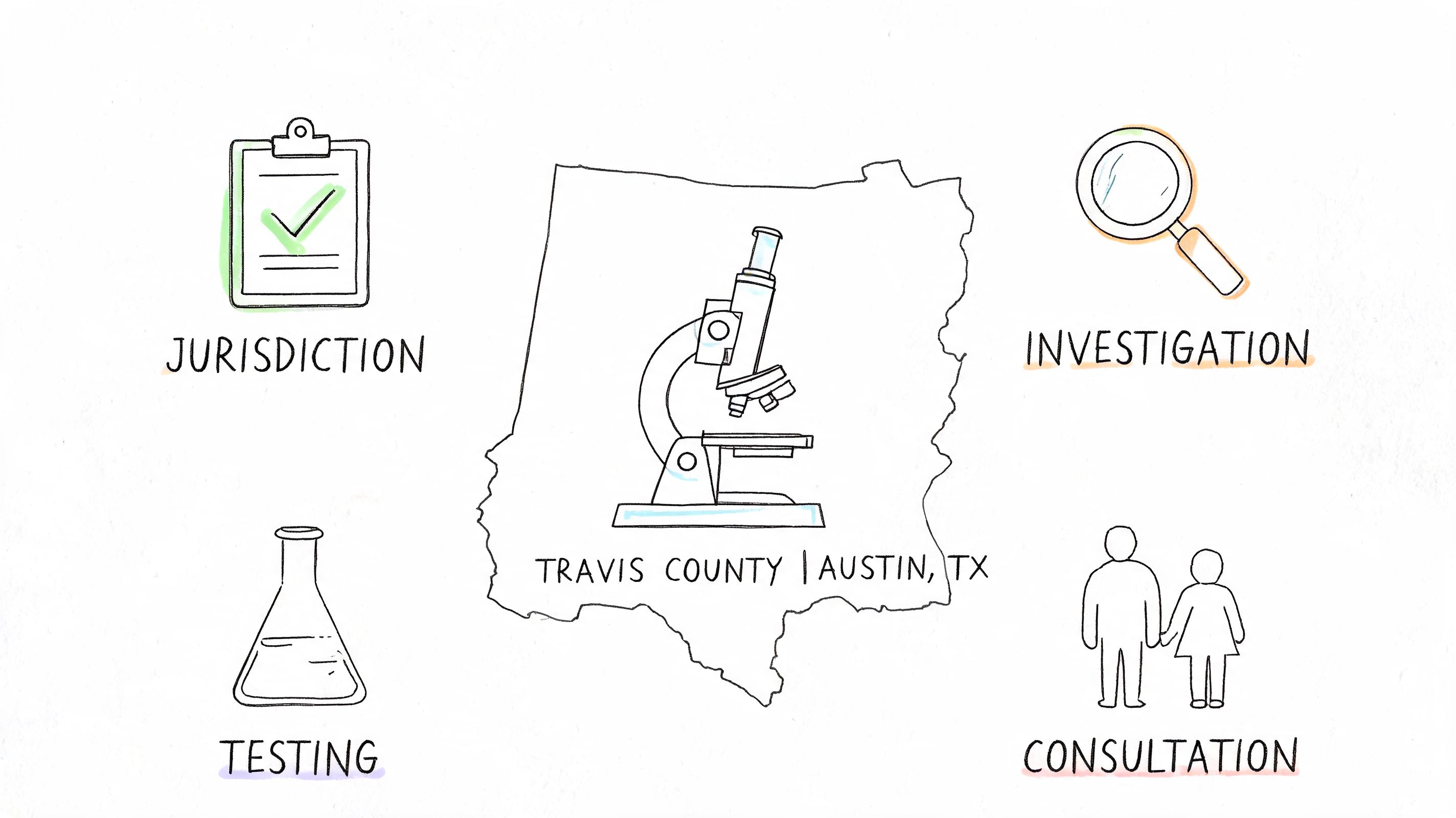
The Travis County Medical Examiner’s Office, often shortened to TCME, is the public office responsible for medicolegal death investigation in Austin and the surrounding region. It does not exist to review every death. Its duty is to investigate deaths that fall under legal public authority, including deaths that are sudden, unexpected, violent, suspicious, or otherwise unnatural under Texas practice.
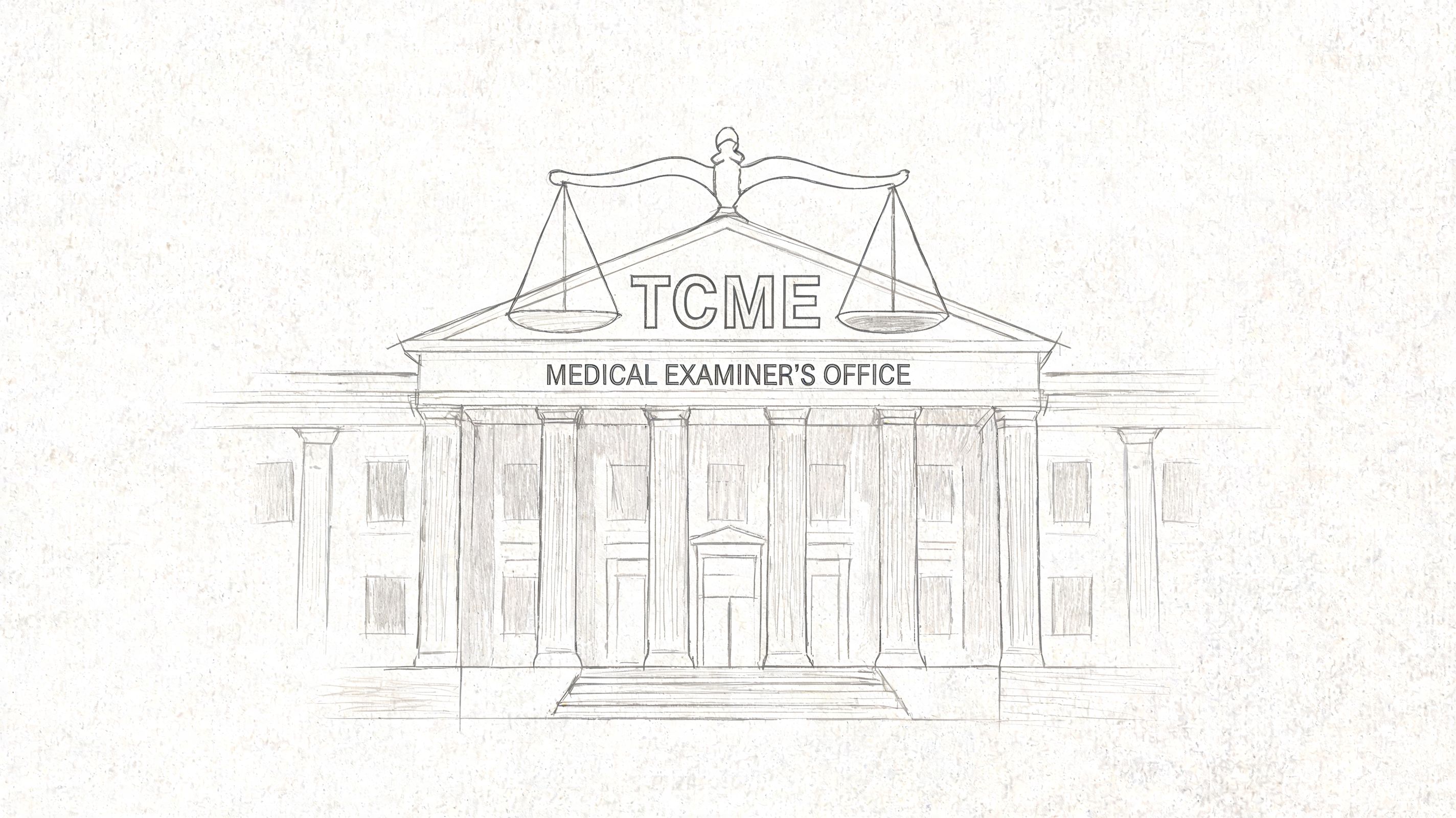
TCME is not a small local office handling only city cases. It functions as a regional hub. According to reported 2024 figures, the office managed 7,855 cases, averaging 22 cases per day, and only 2,706 advanced to a full physical examination. That same report explains why triage is unavoidable in a public system operating at this scale and under accreditation expectations for workload management, as described in this review of TCME's 2024 caseload.
What that workload means for families
Those numbers tell families something important. If your case is reviewed by the public office, that doesn’t automatically mean a full autopsy will occur. Public offices must sort cases carefully. Some deaths require full examination, some require an external examination, and some can be certified through other lawful medical channels.
That is not neglect. It is how a public medical examiner system remains functional and compliant while serving a large region. The office in Travis County also serves surrounding counties, and that broad service area increases the pressure on intake, transport, investigation, pathology review, and laboratory coordination.
The public office serves the community first
A medical examiner office has obligations that extend beyond any one family. It must support death certification, criminal investigation, public health surveillance, and court proceedings. That public mission is different from the mission of a private family-requested review, which is often narrower and more personal.
People looking for reliable local information often have to sort through unrelated search results, directory listings, and general medical marketing. For clinics and healthcare organizations trying to help patients find accurate local information online, this overview of local SEO for medical practices is useful because it shows how location-specific health information can become easier to find and less confusing.
For readers trying to understand the local office specifically, this discussion of the Travis County coroner and medical examiner framework helps clarify how the public system is structured in practice.
Practical rule: If the public office declines jurisdiction, that does not mean your concerns are invalid. It usually means the case does not fit the legal category the office is required to investigate.
Medical Examiner vs Coroner A Key Distinction in Texas
Families often use medical examiner and coroner as if they mean the same thing. They don’t. In Texas, that difference matters because it affects who is making the determination and what kind of scientific training stands behind the final opinion.
A medical examiner system is physician-based. In practice, that means death investigation leadership is grounded in medicine and pathology. A coroner system can operate very differently, and in some jurisdictions outside Texas the coroner may be an elected official who is not a physician.
Why the distinction matters
When a physician trained in forensic pathology reviews a death, the process is anchored in anatomy, disease, injury interpretation, laboratory findings, and medicolegal standards. That is different from a system where the lead official may rely more heavily on outside consultants for the medical component.
For families, this distinction affects confidence. For attorneys, it affects the weight and defensibility of a death determination. The more medically grounded the process is at the outset, the stronger the foundation tends to be for later review, testimony, and case analysis.
What Texas families should take from this
If you are dealing with a death in Austin, the correct public framework is the medical examiner model, not the coroner model. That means the system is built around medical judgment, not solely administrative authority.
That still doesn’t mean every case will receive the same depth of public review. Jurisdiction controls that. But when the office does investigate, the structure is designed around scientific medicine.
For a fuller explanation of how that works statewide, this article on the Texas medical examiner system is a useful reference.
The Official Investigation Process What Families Can Expect
When the medical examiner accepts jurisdiction, the process becomes formal very quickly. Families often experience that speed as disorienting. The office, however, is following a sequence designed to preserve evidence, document findings, and support a defensible final determination.
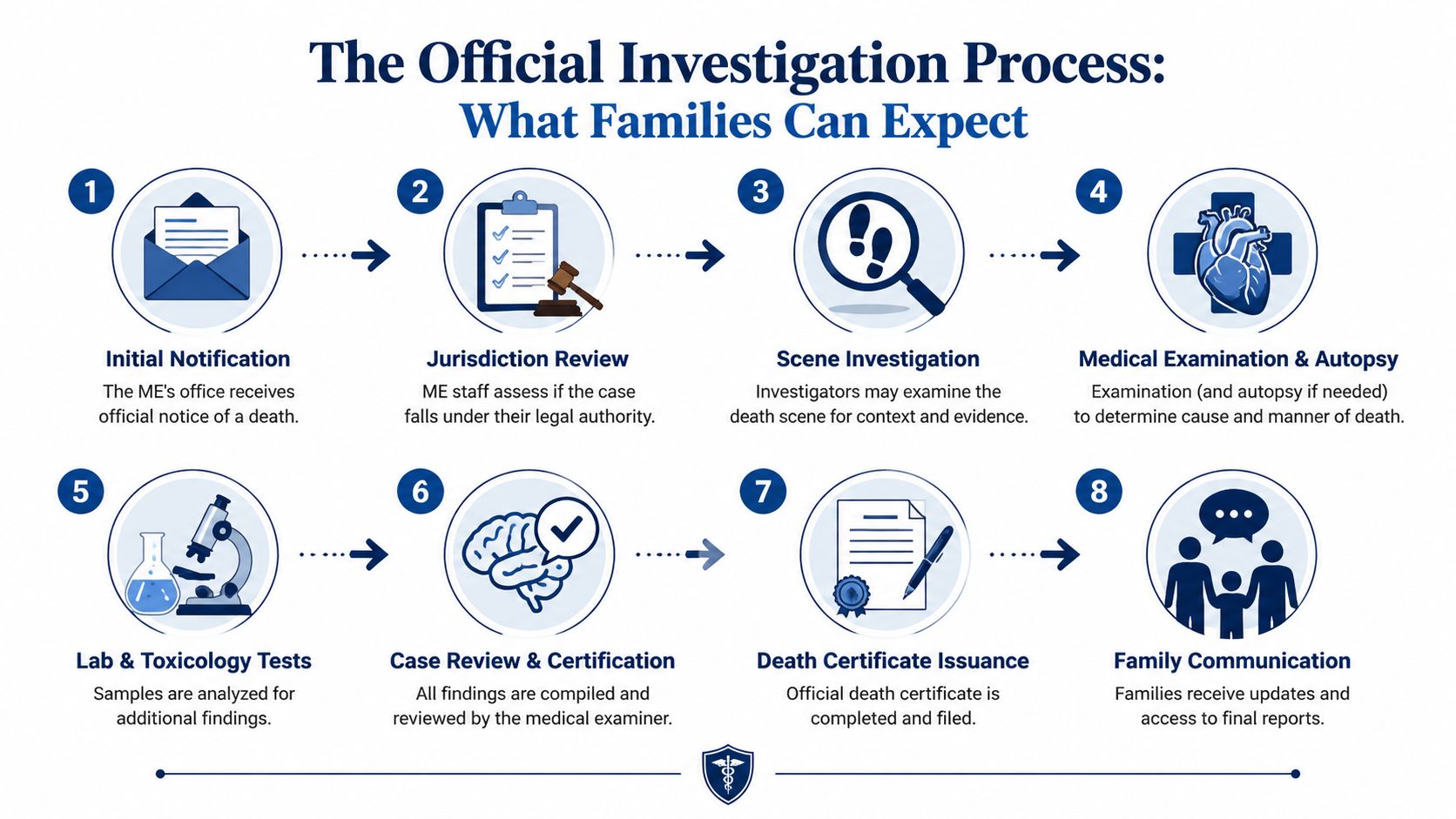
How a public case usually moves
Notification arrives
A hospital, law enforcement agency, emergency service, or other authorized reporter notifies the office of the death.Jurisdiction is reviewed
Staff determine whether the death falls under medicolegal authority. This decision controls everything that follows.Scene and circumstance information is gathered
Investigators may review scene details, witness accounts, medical history, and law enforcement observations.The body is transported for examination when needed
Depending on the case, that may lead to an external examination, full autopsy, or additional review.Laboratory testing is ordered when needed
Toxicology, histology, and other analyses may be required before a final opinion can be issued.A physician completes the final certification
The medical examiner integrates anatomy, records, testing, and circumstances into a cause and manner of death opinion.
Full autopsy vs external examination
Families often assume there are only two possibilities, either “no exam” or “full autopsy.” In reality, there are intermediate levels of review. An external examination may document injuries, medical devices, identifying features, and condition of the body without a full internal dissection. A full autopsy includes internal examination and specimen collection.
The choice depends on the legal question being asked. If the available records, scene findings, and history answer that question adequately, a full autopsy may not be necessary in the public setting.
Why accreditation standards matter
The public often sees accreditation as paperwork. In forensic pathology, it affects case quality. The National Association of Medical Examiners sets an important benchmark: individual forensic pathologists should perform fewer than 250 autopsies annually because higher caseloads are associated with lower autopsy quality, including problems with diagnostic accuracy and evidence documentation, as noted in the NAME accreditation materials.
That benchmark matters because a proper autopsy is not only dissection. It requires careful photography, specimen selection, documentation, interpretation, and correlation with records and scene facts.
If a case is complex, the most time-consuming work often happens after the examination table, during slide review, toxicology interpretation, and final opinion drafting.
What families should expect emotionally and practically
- Communication may feel limited at first because staff are gathering facts and preserving the integrity of the case.
- The final death certificate may not be immediate if testing remains pending.
- The official report answers a public question first. It determines the medically and legally supported cause and manner of death.
- It may not answer every personal question about treatment, timing, inherited disease, or whether a different clinical decision might have changed the outcome.
That last point is where many families begin considering a separate review.
When You Need More Than an Official Report The Case for a Private Autopsy
An official report can be accurate and still leave important questions unanswered. That is the point many families struggle to express. They are not always disputing the public office. Often, they are asking a different question than the public office was tasked to answer.
The public medical examiner system is not designed for private family requests. According to the Travis County Medical Examiner information page, offices like TCME investigate sudden, unexpected, or violent deaths and do not perform private autopsies for families. That leaves a real gap for people seeking a second opinion or answers in deaths that fall outside the public office’s scope.
Situations where a private autopsy may be appropriate
A private autopsy is often worth considering when the death involves one of the following:
Declined jurisdiction
The death may have occurred in a hospital or nursing setting, or it may be viewed as natural for public purposes, even though the family still has unresolved concerns.Concern about medical care
Families and attorneys may want an independent postmortem review when there are questions about diagnosis, treatment, delay, communication, or procedural complications.Need for more detail
Some official conclusions are necessarily concise. A family may want more explanation about organ disease, toxicology, inherited risk, or the sequence of events.Legal preparation
Attorneys may need an independent forensic record developed with litigation in mind, especially when early documentation and specimen handling will matter later.
Public investigation vs private review
| Feature | Public Medical Examiner | Private Autopsy Service |
|---|---|---|
| Primary purpose | Public duty, legal death investigation, certification | Family, attorney, or institutional questions |
| Case acceptance | Limited by legal jurisdiction | Based on lawful authorization by the proper party |
| Scope of questions | Focused on official cause and manner of death | Can address broader diagnostic and records-based concerns |
| Family request model | Not a private service | Specifically designed for independent review |
| Report focus | Official medicolegal determination | Detailed explanatory analysis for the requesting party |
The difference is not about one system being better than the other. It is about purpose. Public offices answer the questions the law requires. Private forensic review answers questions the family or attorney still needs addressed.
Why timing matters
The most common mistake I see is delay. Families spend days trying to decide whether asking for an independent autopsy means they are being confrontational. It does not. It means they recognize that once burial, cremation, embalming, or tissue degradation progresses, some opportunities for examination become more limited.
For readers in the Austin area weighing that decision, this page on private autopsies in Travis County outlines the local context in practical terms.
A private autopsy is not an accusation. It is a request for a separate medical analysis.
The Independent Autopsy Process Our Commitment to Answers and Dignity
When a family chooses an independent autopsy, clarity begins with process. A proper private examination should never feel improvised. It should be orderly, documented, respectful, and medically thorough.
Authorization comes first
The first requirement is legal authority. In Texas, a private autopsy must be authorized by the proper next of kin or other legally authorized party. That step matters because postmortem examination is both a medical act and a legally sensitive one. If there is disagreement among relatives, that issue should be resolved before the examination proceeds.
What a complete private autopsy includes
A meaningful private autopsy is more than a physical inspection. As described in the Travis County pathology overview, a thorough postmortem evaluation may involve specimen collection for CLIA-certified toxicology, histologic tissue analysis, and review of medical records, all integrated by a physician trained in both pathology and forensic work through this Travis County pathology description.
In practice, the workflow commonly includes:
Initial consultation
The pathologist identifies the specific questions the family or attorney needs answered.Case document review
Hospital records, EMS records, imaging, and other available materials are gathered when relevant.External and internal examination
The body is examined systematically, with documentation of natural disease, injury, medical intervention, and identifying findings.Specimen collection
Blood, tissue, and other appropriate samples are retained for toxicology, microscopy, and related testing when needed.Correlation and reporting
The final opinion is based on anatomy, testing, circumstances, and records, not on one isolated finding.
What families often find most helpful
Families usually benefit most from two things. The first is a clear explanation of what was found. The second is a direct explanation of what was not found. Absence of evidence can be just as important as a positive finding, especially when people fear overdose, hidden trauma, or an overlooked disease.
A careful private process should also protect dignity at every stage. Respectful handling, proper transfer arrangements, and plain-language communication are not extras. They are part of ethical forensic practice.
For readers who want to understand the broader service model, Private Autopsies explains the general process, and the Waterloo Mortuary Partnership shows how facility coordination supports respectful examination logistics.
Legal and Professional Considerations for Autopsy Reports
For attorneys, an autopsy report is not merely a medical summary. It may become evidence. For families, it may influence insurance disputes, probate issues, institutional review, or civil litigation. That is why the report’s preparation, documentation, and evidentiary handling matter so much.
Chain of custody in plain language
Chain of custody means there is a documented record showing who collected each specimen, how it was labeled, where it was stored, and who handled it afterward. If toxicology, tissue blocks, slides, photographs, or retained materials may become part of a legal proceeding, that documentation protects the integrity of the evidence.
Weak chain of custody creates avoidable problems. It gives opposing counsel room to challenge the reliability of the sample or the identity of the material tested. Strong chain of custody does the opposite. It shows continuity, control, and professional discipline.
Why qualifications matter in contested cases
A forensic opinion is only as useful as the training behind it. In a legal setting, the court and the parties will look closely at board certification, pathology training, report quality, methodology, and the witness’s ability to explain complex findings in a disciplined way.
That level of expertise is reflected in the profession itself. In Austin, average salaries for medical examiners were reported at $319,073 as of April 2026 in this Austin medical examiner salary analysis. I do not cite that figure to suggest cost equals quality. I cite it because the market recognizes how much training and responsibility are attached to precise, legally defensible postmortem analysis.
What attorneys should look for in a report
- Clear cause of death language that is medically specific and internally consistent
- A stated manner of death when the facts support one
- Documented basis for opinions, including records, examination findings, and testing
- Retention and labeling practices that can withstand scrutiny
- Plain but exact writing that a jury, judge, or adjuster can follow
Good forensic writing does not sound dramatic. It sounds controlled, specific, and supportable.
Attorneys should also remember that not every strong case begins with disagreement. Sometimes the value of an independent report is confirmation. A well-supported second opinion can narrow the dispute, identify the core issue, and prevent a case from moving in the wrong direction.
Frequently Asked Questions About Autopsies in Texas
Who can request a private autopsy in Texas
The legally authorized next of kin or another person with proper legal authority generally must approve the examination. If family members disagree, that dispute should be resolved before proceeding. In attorney-involved matters, counsel may help confirm who has authority, but the legal authorization still matters.
Can an autopsy still be done if the medical examiner declined the case
Yes. A declined public case is one of the most common reasons families seek an independent review. Public declination usually means the case falls outside medicolegal jurisdiction. It does not mean there is no medical value in a postmortem examination.
Will a private autopsy change the death certificate
Sometimes it may support a request for amendment or further review, but that depends on the facts and the governing process. A private report is an independent medical opinion. Whether a death certificate is changed involves the relevant authorities and documentation standards. Families should avoid assuming that any private examination automatically rewrites the official record.
How long does the process take
The honest answer is that it varies. A straightforward examination may move more quickly than a case that requires broad records review, toxicology confirmation, histology, consultation, or legal coordination. Families deserve realism here. A careful forensic opinion should not be rushed at the expense of accuracy.
Can an autopsy be performed after embalming
In some cases, yes, but embalming changes the body and can limit certain observations and tests. It is far better to ask before embalming, cremation, or final disposition if there is any chance you will want an independent examination.
What if I live outside Austin or in a rural county
That concern is common and valid. Access to specialized forensic pathology is not equal across the state. Texas includes many Medically Underserved Areas, and the Texas Department of State Health Services recognizes that access to specialized services can be limited in some communities through its underserved population site information. Independent statewide providers help bridge that gap for families in both rural and urban settings.
What should families gather before they call
A few items help immediately:
- Basic identifying information about the deceased and current location of the body
- Timeline of events surrounding the death, including hospital transfer or emergency response if applicable
- Any known medical records or discharge paperwork
- Specific concerns such as possible overdose, injury, treatment complication, hereditary disease, or disagreement with an official conclusion
The clearer your questions are, the more focused the review can be.
What should attorneys gather before requesting review
Attorneys usually help the process by collecting records early and defining the legal issue precisely. In some matters, the key question is causation. In others, it is timing, mechanism of injury, standard of care context, or whether natural disease fully explains the death. An autopsy is strongest when the forensic question is clearly framed from the beginning.
If you need calm, direct guidance after a death, contact Texas Autopsy Services. I understand that families and attorneys often call at a moment of confusion and grief. A clear explanation of your options, including whether a private autopsy or second opinion is appropriate, can help you make a careful decision with dignity and confidence.