April 15, 2026 · Texas Autopsy Services
Travis County Coroner: Role, Investigations, & Autopsy
Travis county coroner - Understand the Travis County Coroner's role, process, and family navigation of death investigations. Explore private autopsy options
On this page
- An Introduction for Families Navigating a Loss
- The Travis County Medical Examiner Explained
- When the Medical Examiner Investigates a Death
- The Official Death Investigation Process Step by Step
- How Families Interact with the ME Office
- When a Private Autopsy Provides Deeper Answers
- Frequently Asked Questions About Death Investigations
When a family searches for travis county coroner, it usually means something difficult has already happened. A police officer, hospital staff member, funeral director, or investigator may have said that the death must be reported to the county. The next hours often feel administrative and personal at the same time.
At Texas Autopsy Services, every examination is performed by a board-certified forensic pathologist experienced in medicolegal death investigations. Our work centers on one principle: follow the evidence carefully, explain it plainly, and treat the deceased and their family with respect.
Families often come to me with the same first concern. They want to know who has their loved one, why the government became involved, and whether they’ll receive a clear explanation. Attorneys usually need to understand the official process before deciding whether a second opinion is necessary.
TL;DR
- In Travis County, the correct office is the Medical Examiner, not a coroner.
- A Medical Examiner investigates certain deaths because Texas law requires a medicolegal review in specific circumstances, not because foul play is automatically suspected.
- The official process may include scene review, records review, an external exam, a full autopsy, toxicology, and a final death certificate opinion.
- Families should expect a formal process focused on the public record, which doesn’t always answer every personal or legal question.
- A private or second-opinion autopsy may help when the official investigation is limited, delayed, or too narrow for the family’s needs.
An Introduction for Families Navigating a Loss
The call usually comes without warning. A relative dies at home, in an emergency room, after a fall, in custody, or after a sudden collapse. Someone then says, “The county has to be notified.” Many families hear that sentence and assume a criminal investigation has begun.
Often, that isn’t what it means.
A medicolegal death investigation is a formal medical and legal review used when the cause of death is not yet clear, when the death appears sudden or unnatural, or when the law requires official involvement. That process can feel cold if no one explains it plainly. Grief already makes details hard to absorb. New terminology makes it harder.
Why the wording matters
In Texas, people commonly search for travis county coroner, but Travis County uses a Medical Examiner system. That distinction matters because a medical examiner is a physician, and the investigation is built around medical findings, not just administrative procedure.
For a grieving family, that means the office is not merely taking custody of the body. It is making a formal determination about cause of death and manner of death.
Here is the plain-language difference:
- Cause of death means the specific disease, injury, drug effect, or combination of conditions that led to death.
- Manner of death is the classification used in death investigation. The categories are natural, accident, suicide, homicide, or undetermined.
- Chain of custody means documented control over the body, samples, and evidence so that records remain reliable for public health, court, and family review.
Practical rule: If the Medical Examiner is involved, that does not by itself mean anyone is accused of wrongdoing. It means the death meets criteria for official review.
What families usually need first
Most families don’t need jargon on day one. They need a simple sequence:
- Who is in charge of the case
- Whether an examination will occur
- When the body can be released to the funeral home
- What information will be available later
- Whether more review is needed beyond the official case
Attorneys need one more thing. They need to know whether the official investigation answers the legal question at issue, or only the minimum public question required for certification.
That difference is where confusion often begins. It’s also where private forensic review sometimes becomes necessary.
The Travis County Medical Examiner Explained
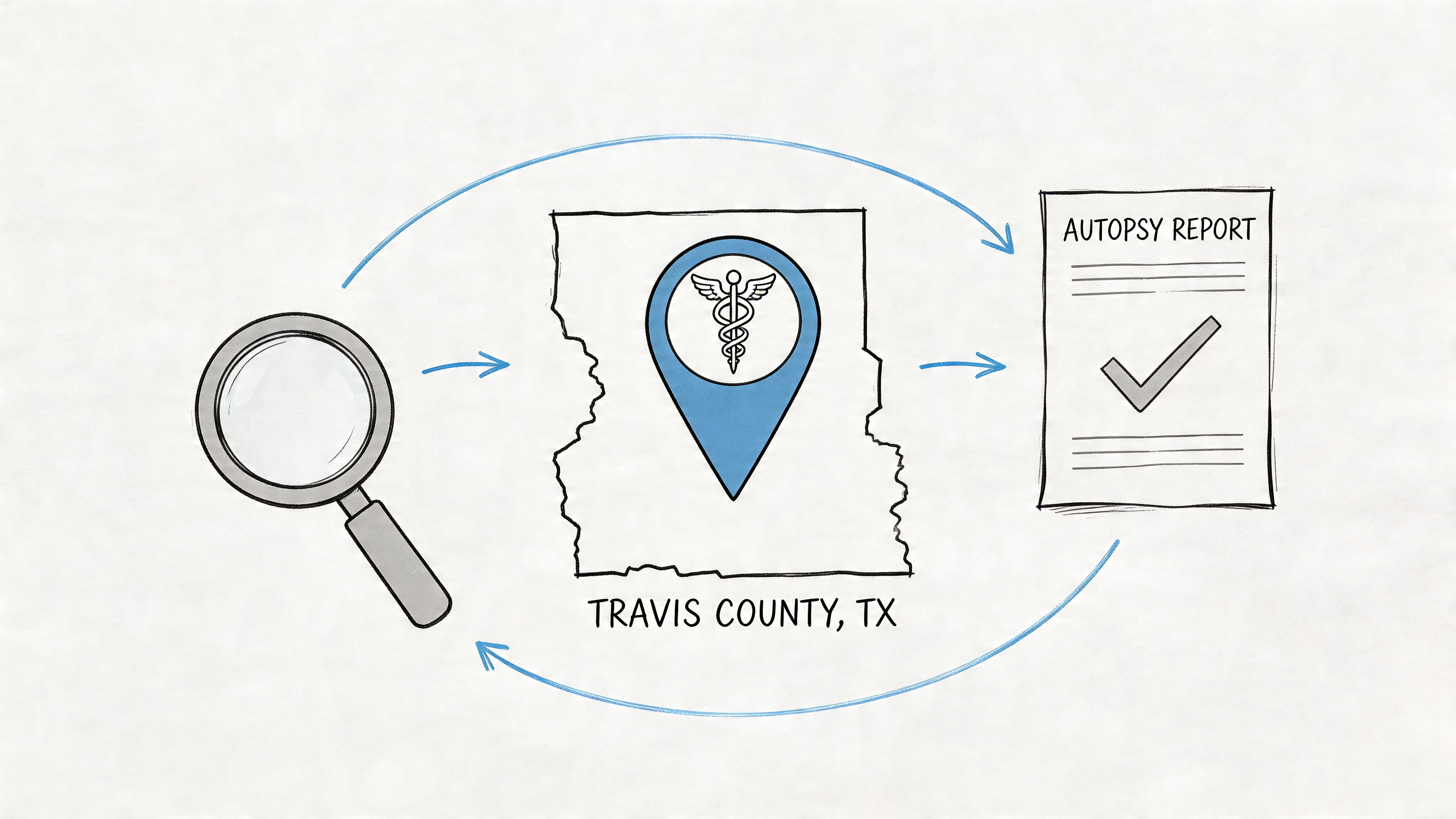
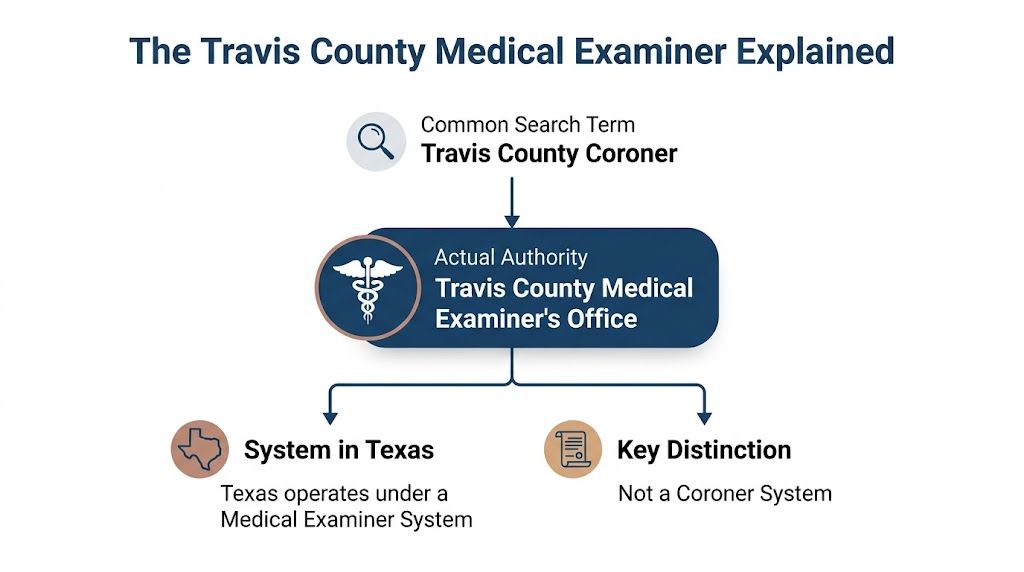
If you searched for travis county coroner, the first point to clear up is simple. Travis County does not operate a coroner’s office. It has a Medical Examiner’s Office.
Why people use the word coroner
“Coroner” is a common public term, and many people use it to mean any office that investigates deaths. In practice, the distinction is important. A medical examiner system places the investigation in a physician-led setting.
I’ve explained that difference in more detail in my article on coroner vs medical examiner in Texas.
What the Travis County office covers
The Travis County Medical Examiner’s Office investigates deaths across 989 square miles of land and 33 square miles of water in Travis County, and it also serves 43 surrounding counties, according to the Travis County Medical Examiner brochure.
That’s a wide regional role. It means the office is not only serving Austin and nearby communities inside Travis County. It also functions as a referral center for surrounding jurisdictions that need forensic pathology services.
Why the office can feel hard to reach
A high-volume public office must balance family communication, scene response, examination work, evidence handling, toxicology, record review, court duties, and regional service obligations. That doesn’t excuse poor communication, but it helps explain why families often experience the process as slower and less personal than they expected.
The same brochure states that in 2019 the office performed 987 Travis County autopsies and 1,006 out-of-county autopsies, for a total of more than 1,993, and that the workload reached 291 autopsies per doctor, above the national 250-case limit cited there, with seven forensic pathologists and six toxicologists on staff in the broader service structure described by the office’s public materials and brochure linked above.
A family usually experiences this as silence between updates. From the office’s side, it reflects the reality of a physician-led death investigation system handling both local and regional demand.
What that means in plain terms
A Medical Examiner’s Office is responsible for public truth, not private reassurance. Those goals overlap, but they are not identical.
The office must answer questions such as:
| Public question | Why it matters |
|---|---|
| Who has legal jurisdiction over the death | This determines which office makes the official decision |
| Is an autopsy or other exam needed | This determines how the cause and manner of death will be evaluated |
| Does the death raise criminal or public health concerns | This affects law enforcement and public reporting |
| What goes on the death certificate | This creates the official record |
Families often need a different set of answers:
- What exactly happened in the final hours
- Was anything missed medically
- Should relatives worry about a hereditary condition
- Do the injuries match the reported events
- Is the official explanation complete enough for litigation
Those are reasonable questions. They just don’t always fit neatly inside the government office’s mandate.
When the Medical Examiner Investigates a Death
Most families aren’t prepared for how quickly jurisdiction can shift after a death. A person may die in a hospital, nursing facility, home, roadside setting, jail, or workplace. Even then, the attending staff may not be able to sign the death certificate immediately.
Common reasons a case is reported
The Medical Examiner investigates when the death falls into a medicolegal category. In plain language, that usually includes deaths that appear:
- Sudden when no clear medical explanation is immediately available
- Unexpected in someone not known to be near death
- Violent or traumatic, including crashes, falls, shootings, or other injuries
- Suspicious, where the circumstances are unclear
- Unnatural, such as suspected overdose or environmental exposure
- Unattended, where no physician can comfortably certify the death from known medical history alone
A report to the Medical Examiner is a legal and procedural step. It is not a final conclusion.
A simple example
Consider a middle-aged person found unresponsive at home. There may be no signs of struggle. There may also be no physician willing to certify the death because the person was not under active treatment for a clearly fatal condition. In that setting, the case may have to be reported.
The same is true after a vehicle collision, a workplace incident, a death in custody, or a sudden death after apparent drug use. The office’s involvement doesn’t tell you the answer yet. It means the answer requires official review.
How the case begins
A case usually starts with information from the scene, emergency responders, police, hospital staff, or a Justice of the Peace from another county. An investigator gathers the basic facts, confirms identity, reviews available medical history, and coordinates transport if the office accepts jurisdiction.
That opening stage matters because the body alone rarely tells the whole story. A forensic pathologist interprets findings together with circumstances, records, and laboratory testing.
Some of the most important facts in a death investigation come from the scene and medical history, not just the autopsy table.
Why attorneys should pay attention early
For attorneys, the first question is often whether the official case theory was shaped early by scene assumptions. Sometimes it was. Sometimes it wasn’t. Either way, early documentation matters.
If your case may involve civil injury, malpractice, product liability, or a contested insurance claim, it helps to understand the broader role of medical experts in evaluating injury patterns, records, causation, and mechanism. Death investigations often intersect with those same issues.
What families should take from this
Families often hear “the ME has the case” and assume the worst. I’d frame it differently.
The Medical Examiner investigates because the law requires a structured review when the circumstances are not straightforward. That review protects the public, preserves evidence, and creates an official medical opinion. It can also leave emotional gaps, because the process is designed for accuracy first, not comfort first.
The Official Death Investigation Process Step by Step
A family may hear at 10 a.m. that the body has reached the Medical Examiner, and by 2 p.m. someone is already asking, “Do we know what happened yet?” In real death investigation, those are usually two different timelines. One timeline is the physical handling of the body. The other is the medical proof needed to support an official opinion.
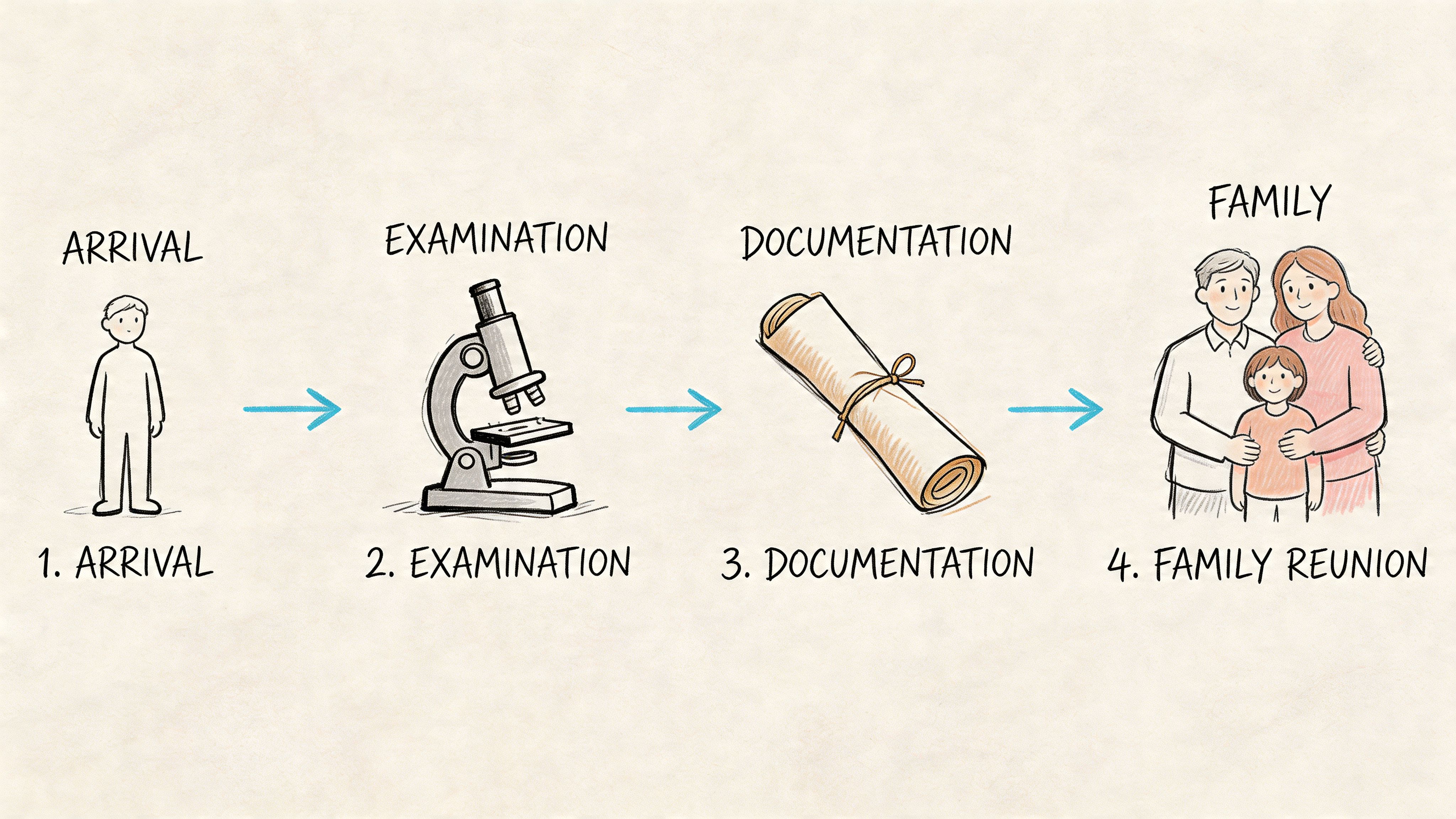
Step one: intake and case review
The first stage is controlled, methodical, and heavily documented. Staff verify identity, record the condition of the body and property, and match the decedent to the scene report, transport paperwork, and any preliminary history already gathered.
Families sometimes assume this is routine paperwork. It is more than that. If identity, case number, medications, or scene details are linked incorrectly at the start, every later opinion can be affected.
This stage also frames the question the pathologist is trying to answer. A person found unresponsive at home, a driver after a crash, and a hospitalized patient after a complicated injury may all arrive at the same facility, but the medical and legal questions are very different.
Step two: deciding the level of examination
The office does not perform the same type of examination in every case. The pathologist chooses the level of review based on the circumstances, the known history, visible findings, and what still needs to be proved.
| Examination level | What it means |
|---|---|
| External examination | The body is examined externally for injury, medical devices, scars, and identifying features |
| Imaging review | CT imaging may reveal fractures, foreign objects, gas patterns, or internal findings |
| Full autopsy | Internal examination of the organs and body cavities is performed |
| Ancillary testing | Toxicology, histology, and other laboratory studies are added as needed |
A useful comparison is a hospital workup. Some patients need only an exam and a chest X-ray. Others need CT scans, blood testing, and surgery. Death investigation works the same way. The office uses the least invasive method that can still answer the official question with medical reliability.
That choice has limits, and families should understand them. An external exam can document injuries and identifying features, but it cannot fully evaluate the heart, lungs, brain, coronary arteries, or internal bleeding. CT imaging can be very helpful, but it does not replace tissue examination, toxicology, or direct inspection in every case. If you want a plain-language explanation of what a full internal examination involves, this guide on the procedure of an autopsy explains the mechanics.
Step three: determining cause and manner
This is often the most misunderstood part of the process.
A cause of death is the medical explanation for why the person died, such as coronary artery disease, fentanyl toxicity, gunshot wound, pneumonia, or blunt force injuries. A manner of death is the medicolegal classification assigned to the death:
- Natural
- Accident
- Suicide
- Homicide
- Undetermined
Those terms are technical. They do not always match everyday conversation. “Homicide,” for example, means death at the hands of another person. It does not decide criminal guilt. “Undetermined” does not mean the pathologist ignored the case. It means the available medical and investigative evidence did not support a more definite classification.
Many cases also have two answers at different times. A preliminary opinion may be based on the scene, the exam, and early records. The final opinion may change after toxicology, microscopy, or more complete records arrive. That is not inconsistency. It is the normal process of updating an opinion when better evidence comes in.
Step four: release and final reporting
Once the required examination is complete, the body is usually released to the funeral home before the final report is finished. Families are often surprised by that sequence. The release decision and the final medical opinion are related, but they are not the same event.
A report may remain pending while the pathologist waits for:
- Toxicology results
- Microscopic tissue review
- Medical records
- Police reports or scene clarification
- Specialty consultation when needed
That waiting period can be frustrating, especially if insurance issues, estate matters, or litigation are already starting. In a civil case, a family or their wrongful death lawyer may need to know whether the official opinion is still preliminary before relying on it in a claim, demand letter, or court filing.
Practical points that reduce confusion
A few early steps help families avoid preventable problems:
- Use one family contact so communication stays consistent.
- Choose the funeral home promptly because release usually depends on that designation.
- Write down names, dates, and reference numbers after each call.
- Ask whether the cause of death is preliminary or final before repeating it to insurers, attorneys, or relatives.
- Preserve medical records and photographs if there is any concern about malpractice, trauma, neglect, or disputed causation.
The official process is designed to produce a legally defensible medical opinion. It is not designed to answer every question a family may have. If the public investigation remains narrow, if no full autopsy is performed, or if the final report leaves important medical gaps, a private or second-opinion autopsy may be the step that provides the fuller explanation families thought the official process would provide on its own.
How Families Interact with the ME Office
A family’s experience with the Medical Examiner is often shaped less by the science than by the communication. Who can call. Who can authorize release. Who gets records. Who is told what, and when.
In a busy public office, these questions matter because inconsistency slows everything down.
The most useful first step
Pick one spokesperson for the family. That person should keep a list of conversations, reference numbers, and contact names. If five relatives call separately, the office may give cautious, limited responses because staff need to protect confidentiality and avoid contradictory instructions.
This is especially important in sudden deaths where family members disagree about funeral plans, legal concerns, or whether a second opinion should be sought.
Why updates may feel slow
The Travis County Medical Examiner’s office managed 7,855 cases in 2024, averaging 22 cases per day across the year, with 2,706 physical exams, according to this review of the office’s annual activity at Cremation Green’s Travis County Medical Examiner caseload summary. That volume helps explain why direct communication and report finalization may feel delayed.
A delay does not always mean something is wrong with the case. It often means the office is balancing scene work, examinations, toxicology, court obligations, and family contact across many cases.
What families usually need to handle
Some tasks are administrative, but they matter a great deal:
- Body release: The family or legal next of kin usually needs to designate a funeral home.
- Property questions: Personal effects may be released through a separate process depending on where they were collected.
- Records requests: The autopsy report, if one exists, may not be complete for some time.
- Clarification calls: Families often want to know whether an autopsy occurred, whether toxicology was ordered, and whether the cause of death is pending.
If funeral planning is underway, coordination with the receiving funeral provider is often the most practical next move. In some situations, families also look at care pathways that connect pathology coordination with funeral arrangements, such as the Waterloo Mortuary Partnership, depending on their local needs.
When the official process may not be enough
Here is where I want to be candid. A public office’s job is to create an official medicolegal answer. That answer may be accurate and still not be complete enough for a family’s personal concerns or an attorney’s evidentiary needs.
A few situations often trigger that concern:
| Situation | Why families seek more |
|---|---|
| No full autopsy was performed | They want a deeper anatomical review |
| The report is pending for a long period | They need answers for planning or litigation |
| The cause sounds too broad | They want a more detailed explanation |
| The family disputes the circumstances | They want an independent review |
When litigation is already being considered, the attorney may also need early guidance from a wrongful death lawyer who understands how official records, expert review, and preservation issues fit together.
Families should not assume that the public report, by itself, answers every civil, medical, or evidentiary question that may arise after death.
When a Private Autopsy Provides Deeper Answers
A family often reaches this point in a very specific moment. The county has finished its part, or the body has been released, yet the hardest questions are still unanswered. An attorney may be asking about causation. A spouse may be asking whether this could happen to a child or sibling. Those are different questions from the ones a public office is required to answer.
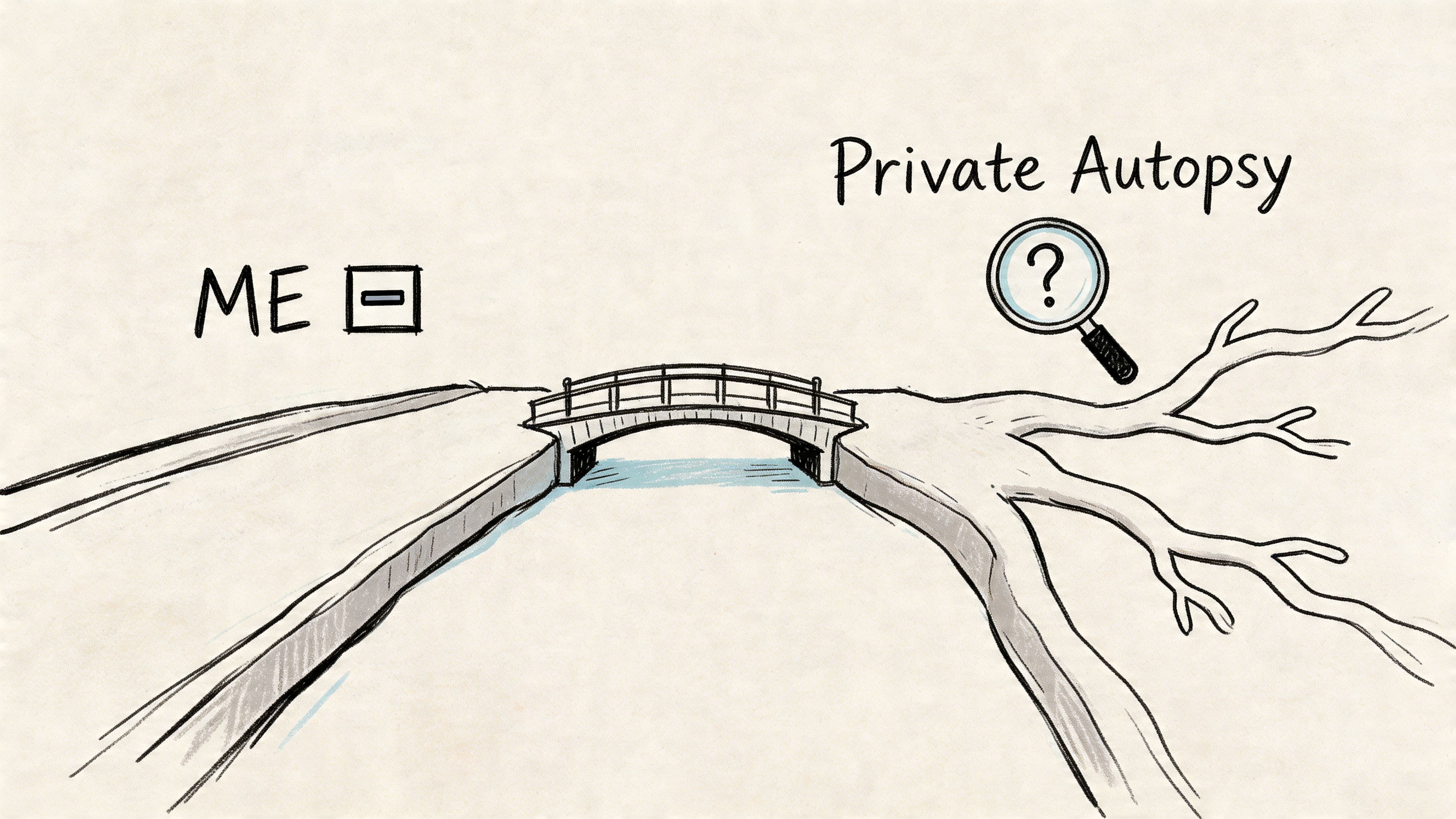
What a private autopsy is actually for
An official medicolegal investigation is designed to produce the county’s cause and manner of death opinion for the public record. A private autopsy serves a narrower and more personal purpose. It examines the questions the family, and sometimes counsel, still need answered.
The difference matters. An official opinion can be medically sound and still leave important gaps.
For example, a death certificate may list a broad cause such as heart disease, drug toxicity, or complications of restraint. That may satisfy the legal certification process. It may not explain whether there was an inherited condition, whether the injuries fit the reported history, or whether the record is detailed enough for civil litigation. Families are often surprised by that distinction, and the surprise is understandable.
Where the official process can reach its limit
The county’s role is defined by law and by workload. It must decide jurisdiction, document findings, and issue an official opinion. It is not built around extended family consultation, litigation strategy, or detailed hereditary risk counseling.
A private review becomes reasonable when the unanswered question is specific.
Common examples include:
- concern that no full internal autopsy was done
- a cause of death that sounds too general to guide the family
- possible medical malpractice, neglect, restraint, or custody issues
- the need to preserve independent findings early for a legal claim
- concern about a cardiac, metabolic, or neurologic condition that surviving relatives may share
In practice, families are often asking for a different level of resolution. The public process answers, “What is the official cause and manner of death?” A private forensic pathologist may be asked, “What exactly happened in the body, what else should be ruled in or out, and what does this mean for the family or the case?”
Timing can change what is still possible
Time matters here. Once burial, cremation, or significant delay occurs, some options narrow. Certain findings can still be reviewed later through records, photographs, slides, and prior reports, but a fresh independent examination usually has the most value before those opportunities are lost.
That is why families and attorneys should ask the question early, even if they have not yet decided. Waiting is sometimes reasonable. Waiting without understanding the consequence is where problems arise.
What a private examination may add
A private forensic pathologist can tailor the work to the actual concern at issue. That may include a full autopsy, a second-opinion review of the official autopsy, a focused organ examination, or correlation of pathology with medical records, EMS records, imaging, and witness accounts.
Here is the practical benefit of that approach:
| Private review focus | Why it may help |
|---|---|
| Independent body examination | Documents findings outside the county process |
| Record-by-record medical analysis | Tests whether the pathology fits the clinical history |
| Closer injury interpretation | Helps assess timing, mechanism, and consistency with reported events |
| Family-centered questions | Addresses hereditary risk or specific concerns left open by the public record |
| Litigation-oriented documentation | Gives counsel a medically grounded opinion on causation and damages issues |
Families considering that route often start by learning how private autopsies in Travis County are arranged and what type of review fits the case. Depending on the circumstances, Texas Autopsy Services may perform a private autopsy, a second-opinion case review, or consultation after the official process is complete.
What a private autopsy cannot do
A private autopsy does not cancel the county’s opinion. It creates an additional medical opinion based on independent examination and analysis. Sometimes it confirms the official findings. Sometimes it adds detail. Sometimes it identifies an issue that deserves legal review or further expert analysis.
That is not a conflict with the public system. It is a separate medical function.
The standard should always be the same: objectivity, documentation, and conclusions that can be defended from the evidence. For a grieving family, that may provide clarity. For an attorney, it may provide the level of medical analysis the official record was never designed to supply.
Frequently Asked Questions About Death Investigations
Families and attorneys often ask direct questions that official websites answer only briefly. The table below addresses some of the most common points of confusion in plain language.
FAQ on Autopsy Procedures and Family Rights
| Question | Answer |
|---|---|
| Is there a Travis County coroner? | No. Travis County uses a Medical Examiner system. People often search for “travis county coroner,” but the official authority is the Travis County Medical Examiner’s Office. |
| Does Medical Examiner involvement mean the death is suspicious? | Not necessarily. Many deaths are reported because the law requires review when the death is sudden, unattended, violent, unnatural, or otherwise not ready for routine physician certification. |
| Can the family stop a Medical Examiner autopsy? | When the office has legal jurisdiction, the official examination is governed by that authority. A family may still seek legal advice and may later pursue an independent review if appropriate. |
| Will the body be released before the final report is done? | Often, yes. The examination and release process may occur before toxicology, microscopic review, and final report completion. Final conclusions may remain pending until those materials are reviewed. |
| What if the family still has questions after the county finishes? | A private or second-opinion autopsy may be considered if more detail is needed for personal closure, hereditary concerns, or litigation review. Timing matters, especially before burial or cremation. |
A few terms worth remembering
Some terms carry technical meanings that can sound harsher than they are.
- Homicide is a forensic manner-of-death category. It does not itself decide criminal guilt.
- Undetermined means the available evidence does not support a single confident classification.
- Pending means the pathologist is waiting for more information before giving a final opinion.
If you are a family member
Write down every question as it comes to you. Grief makes memory unreliable. It’s normal to forget what you were told two hours earlier.
Ask for clarity on whether you are hearing a preliminary impression or a final opinion. Those are not the same thing.
If you are an attorney
Preserve records early. Confirm whether tissue, toxicology samples, photographs, and radiology exist. If an independent review may be needed, evaluate that question before disposition narrows the available evidence.
The best time to consider whether a second opinion is needed is usually before you are certain you need one.
If your family or your client is facing a death investigation in Travis County and you need a clear medical explanation of the options, you can contact Texas Autopsy Services for a confidential discussion. My role is to help people understand the process, the limits of the official system, and whether an independent forensic review may be appropriate.