September 11, 2026 · Texas Autopsy Services
Forensic Pathology History and How It Shapes Modern Autopsy
Explore forensic pathology history from medieval coroners to modern board-certified practice and how it shapes autopsy today in Texas.

On this page
- Introduction Why History Helps Families Understand Todays Autopsy
- What Forensic Pathology Is and How It Answers Cause and Manner of Death
- Early Roots From Medieval Coroners to Renaissance Anatomy
- How Forensic Pathology Became a Recognized Medical Specialty in the United States
- Technology That Changed the Autopsy From Microscope to Molecular Testing
- Why History Matters Now Declining Autopsy Rates and Access to Expertise
- What Modern Forensic Practice Means for Families Attorneys and Texas Counties
A family receives a death certificate, but the wording doesn't answer the questions that matter most. An attorney may have medical records, emergency notes, and an official report, yet still need to understand whether the documented cause fits the physical findings. In Texas, a county official may also face a death that requires careful medicolegal review when local resources or jurisdictional limits make the next step unclear.
Forensic pathology history helps explain why modern autopsy practice looks the way it does. The field developed gradually, from organized coroner systems and early postmortem examinations to microscopic tissue analysis, toxicology, medical imaging, and molecular testing. Each advance addressed a weakness in the methods that came before it.
At Texas Autopsy Services, we explain that history because families and attorneys deserve to understand the basis for a modern independent autopsy. An examination today isn't an observation of the body alone. It combines medical findings, scene and clinical history, laboratory testing when appropriate, documentation, and legal safeguards. The purpose is to reach a medically supportable and objectively communicated conclusion while treating the deceased with dignity.
Introduction Why History Helps Families Understand Todays Autopsy
A death can be medically documented without being fully understood. A hospital record may describe the final treatment, but it may not resolve whether an underlying disease, medication, injury, poisoning, or another condition caused the death. A county investigation may also reach a conclusion that leaves a family or attorney seeking an independent review.
Those concerns are part of why forensic pathology became a distinct discipline. Early death investigations focused heavily on legal responsibility and visible findings. Over time, physicians and investigators developed more systematic ways to compare the circumstances of death with internal injuries, disease, and tissue changes. The modern forensic pathologist uses that accumulated knowledge to assess both medical and legal questions.
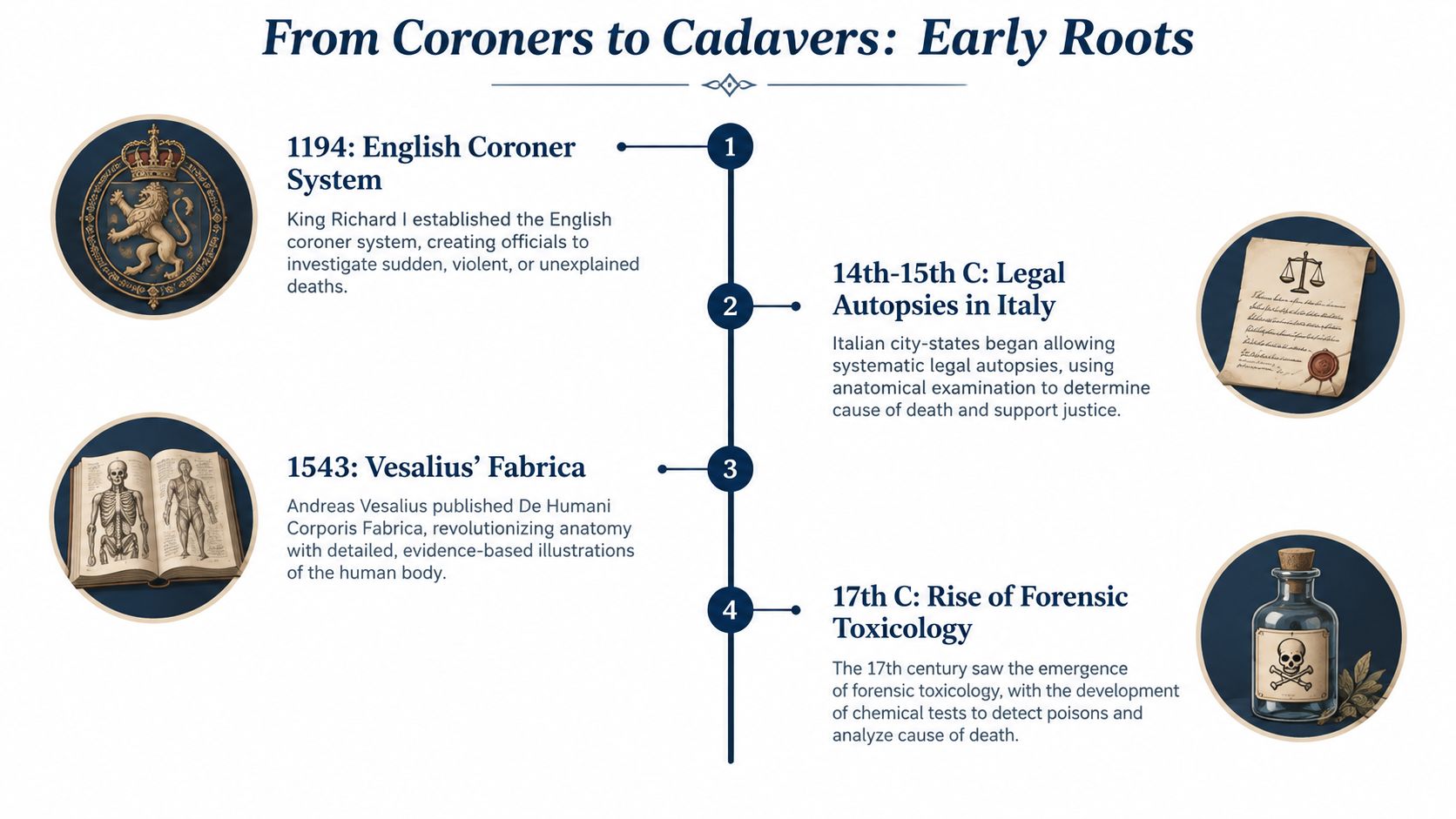
The timeline is long. Organized death investigation includes medieval coroner systems in 12th-century England, while Renaissance advances helped establish more systematic autopsy methods. A widely cited modern milestone occurred in 1959, when the American Board of Pathology recognized forensic pathology in the United States and began board certification that year. These developments are described in the historical overview of forensic pathology.
Why the timeline affects present decisions
History matters because every stage added a form of accountability. An external examination records what can be seen without opening the body. An internal examination identifies injuries and disease that may not appear on the surface. Histology examines tissue under a microscope, while toxicology evaluates substances that may contribute to death. Documentation allows another professional to understand how the conclusion was reached.
Practical point: A modern autopsy is a reasoned investigation, not a single visual impression.
Our board-certified forensic pathologists apply these principles for families, attorneys, healthcare professionals, and Texas county officials. We provide independent autopsy and second-opinion services when a family needs additional clarity, when an attorney needs an objective medical opinion, or when a county needs forensic pathology support.
The sections that follow trace the field from early coroners to current forensic tools. They also explain why declining autopsy use and a limited workforce make independent access important for people seeking a careful cause-of-death investigation today.
What Forensic Pathology Is and How It Answers Cause and Manner of Death
Forensic pathology is the medical specialty that examines deaths with legal, public-health, or unexplained circumstances. A forensic pathologist considers the body, medical history, scene information, laboratory findings, and investigative records together. The work differs from clinical care because the patient is deceased, and the central task is to reconstruct what happened medically and communicate the conclusion in a form that can withstand professional and legal review.
Three terms help clarify the process:
- Cause of death: The disease, injury, poisoning, or other medical condition that produced the death.
- Manner of death: The broader classification describing how the cause arose, such as natural, accident, suicide, homicide, or undetermined, when the available facts support that classification.
- Chain of custody: The documented record showing who handled evidence, when it was transferred, how it was secured, and whether its identity and integrity were maintained.
A hospital chart review can be useful, but it isn't the same as an autopsy. Medical records describe symptoms, treatment, test results, and clinical impressions during life. An autopsy directly examines the body and may correlate external findings, internal lesions, histology, and toxicology with those records.
The basic forensic workflow
Our team begins by reviewing available information and confirming the legal authority for the examination. The forensic pathologist then conducts an external examination, documents identifying features and injuries, and determines whether internal examination and ancillary testing are needed.
Histology can help distinguish disease or injury at the tissue level. Toxicology may identify alcohol, drugs, medications, poisons, or other substances when those questions are relevant. Imaging, microbiology, or molecular testing can add information in selected cases, but the appropriate testing depends on the facts and findings.
Secure evidence handling supports every stage. Clothing, specimens, photographs, records, and other materials must be identified and preserved so that conclusions remain traceable. For attorneys and county officials, this documentation can be as important as the medical interpretation because it shows how the evidence moved from collection to reporting.
Digital records also require careful organization and security. Professionals who manage health information may find background on health care IT services useful when considering how sensitive medical and forensic records are stored and exchanged.
A video can provide a visual introduction to the subject:
A forensic conclusion should state what the evidence supports, identify meaningful limitations, and avoid claiming more certainty than the examination allows. That restraint protects families, legal proceedings, and the integrity of the death investigation.
Early Roots From Medieval Coroners to Renaissance Anatomy
The earliest organized death investigation was closely connected to law and government. In 12th-century England, medieval coroner systems created a formal role for investigating deaths that might affect the Crown or the community. The coroner's work wasn't equivalent to modern forensic pathology. It established an important principle, however, that certain deaths required an organized inquiry rather than private explanation.
The body became one source of evidence within that inquiry. Investigators considered visible injuries, witness accounts, circumstances, and other facts available at the time. Their tools were limited, and many internal causes of death couldn't be distinguished reliably from external observation alone.
From observation to internal examination
The history of forensic pathology also includes early pathological anatomy. One historical review identifies 1286 as the date of the first recorded pathological anatomy autopsy, as discussed in a review of the development of pathological anatomy and forensic pathology. That early examination didn't create the modern specialty, but it illustrates the growing effort to connect disease with findings inside the body.
During the Renaissance, systematic anatomical dissection changed medical understanding. Physicians gained a clearer view of organs, vessels, and structural abnormalities. The broader development of anatomy during the 16th and 17th centuries allowed postmortem examination to move beyond description toward comparison and causal reasoning.
This shift was significant for death investigation. A visible wound could be considered alongside internal bleeding. An enlarged organ could be assessed in relation to symptoms recorded before death. A damaged structure could be compared with the reported circumstances. The examiner began to ask not only what the body looked like, but how the findings fit together.
The importance of microscopy
Microscopy added another layer. Gross anatomy could reveal large injuries and obvious disease, but tissue-level changes often require histologic examination. Microscopic methods helped distinguish disease and injury that might otherwise appear similar during a visual inspection.
That technical development supported the workflow used today. The forensic pathologist correlates scene history, external findings, internal lesions, tissue changes, and laboratory results. The conclusion becomes stronger when independent forms of evidence point in the same direction.
The historical development of the profession also shaped public understanding. Readers interested in the people and traditions associated with the field can explore Texas Autopsy Services' background on famous forensic pathologists, while remembering that modern conclusions depend on documented evidence rather than reputation or narrative appeal.
The central lesson is simple. Medieval coroners established organized inquiry, Renaissance anatomy expanded direct examination, and microscopy made tissue-level analysis possible. Modern forensic pathology combines those ideas with legal documentation and laboratory science.
How Forensic Pathology Became a Recognized Medical Specialty in the United States
Formal recognition gave forensic pathology a defined professional identity in the United States. In 1959, the American Board of Pathology first recognized forensic pathology and began board certification that year, marking a widely cited milestone in the specialty's history. Recognition mattered because it distinguished forensic pathology from general medical knowledge or informal postmortem experience.
Certification also created an external standard. The American Board of Pathology requires forensic pathology applicants to complete 12 months of training in an ACGME-accredited forensic pathology program and to have performed at least 30 autopsies by the time the certification application is submitted, according to the board's official requirements.
Texas and the move toward medical examiner systems
Texas illustrates how legal authority and medical expertise developed together. Texas Attorney General guidance describes a major system change in 1965, when the justice of the peace in Tarrant County retained authority to conduct inquests and order autopsies until a medical examiner office was established and a duly qualified officer was appointed by the commissioners' court. The guidance is available in the Texas Attorney General opinion on Tarrant County.
That transition shows why the structure of death investigation matters. A justice of the peace may have legal authority over an inquest, while a forensic pathologist supplies specialized medical interpretation. In some counties, the system may rely on county officials, physicians, or contracted forensic services.
Texas law gives a justice of the peace discretion to obtain the opinion of a county health officer or physician about whether an autopsy is needed. An autopsy is required when the justice determines it is necessary to determine or confirm the nature and cause of death, when a child death falls under Family Code Section 264.514, or when directed by the district attorney, criminal district attorney, or county attorney if there is no district or criminal district attorney, as summarized by the Texas public health law resource on coroner authority.
What certification signals
Board certification doesn't eliminate the need for careful records, complete history, or appropriate testing. It signals that the examining forensic pathologist has met a defined specialty training and experience standard.
For families and attorneys, that distinction is important. A cause-of-death opinion should come from a qualified forensic pathologist, not from someone who has seen a body or reviewed a death certificate. At Texas Autopsy Services, every examination is performed by a forensic pathologist certified by the American Board of Pathology.
Readers who want more context on the relationship between elected officials and death investigation can review why coroners are elected. The governing structure varies, but the medical question remains the same: what does the evidence support?
Technology That Changed the Autopsy From Microscope to Molecular Testing
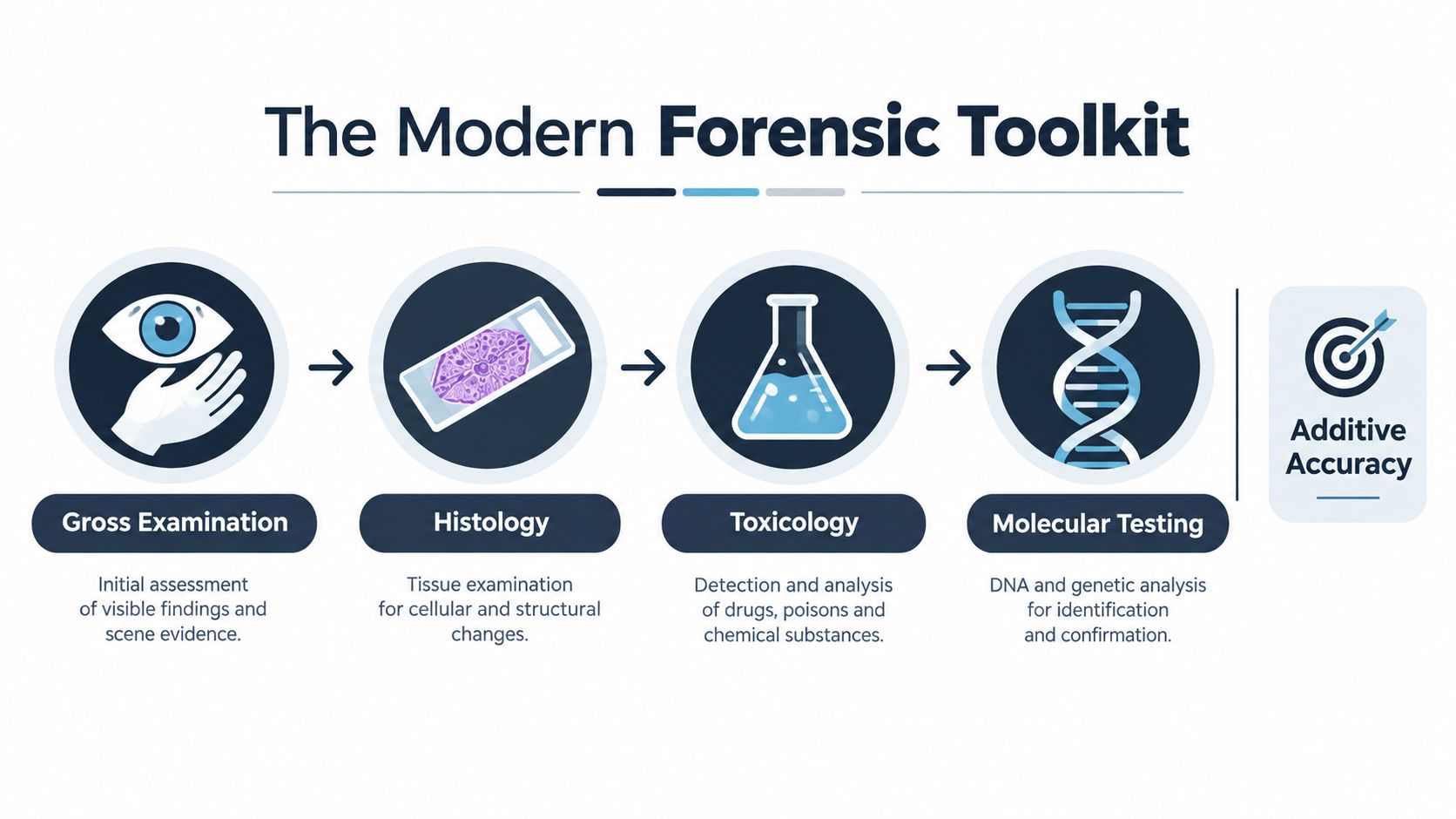
Traditional dissection remains central, but modern forensic pathology uses several additional forms of evidence. The historical progression moved from gross examination to microscopy, then expanded to toxicology, radiology, digital documentation, and molecular methods. These tools don't all answer the same question, and none should be treated as an automatic substitute for a complete examination.
Comparing the tools
Gross examination identifies visible injuries, organ abnormalities, disease, and other structural findings. It provides the physical foundation for the autopsy.
Histopathology examines tissue under a microscope. It can reveal changes that aren't visible to the unaided eye and can help distinguish disease from trauma or postmortem change.
Toxicology analyzes specimens for substances that may contribute to or explain death. Results must be interpreted alongside the medical history, scene circumstances, and autopsy findings. Detection alone doesn't always establish causation.
Postmortem CT and MRI can document fractures, gas, foreign material, and other internal features without relying only on dissection. Newer imaging approaches, including photon-counting CT, are being considered within the broader development of virtual autopsy.
Molecular autopsy and multi-omics examine genetic, biochemical, or other molecular information, particularly in selected sudden unexplained death investigations. These methods may help identify findings that aren't visible anatomically.
A practical explanation of one part of this developing field appears in molecular testing after death.
Why newer methods remain additive
Current reviews describe growing interest in virtual autopsy, AI-assisted interpretation, multi-omics, molecular autopsy, postmortem CT and MRI, microbiome analysis, and genomic testing. They also note that many AI studies rely on limited datasets and lack external validation, which means promising research findings don't automatically establish routine forensic practice. The current technology discussion is summarized in this review of forensic pathology methods.
Evidence standard: New technology can add information, but it still needs appropriate validation and medical interpretation.
Traditional autopsy remains essential because disease, infection, subtle cardiac abnormalities, and tissue-level findings may require direct sampling. The strongest examination may combine dissection with imaging, histology, toxicology, or molecular testing rather than choosing one method in isolation.
For families, this means a modern autopsy isn't defined by a single machine or laboratory panel. The forensic pathologist chooses tools based on the circumstances and findings, documents the reasoning, and explains limitations in the final report.
Why History Matters Now Declining Autopsy Rates and Access to Expertise
The history of forensic pathology includes a present-day contradiction. Scientific methods have become more capable, but autopsy use in the United States has declined sharply. The CDC reported that the autopsy rate fell from 19.3% of deaths in 1972 to 8.5% in 2007, a decline of more than half, and later national data showed the hospital autopsy rate at 7.4% in 2020. These figures appear in the CDC's national vital statistics report.
Those snapshots mean that fewer than 1 in 10 deaths were autopsied in those modern United States data points. A separate review describes hospital autopsy rates falling from about 50% of deaths in the 1950s to 7.4% by 2020, while also describing autopsy as the gold standard for cause-of-death determination. That review is available through the National Library of Medicine.
What declining use can affect
When fewer autopsies occur, some differences between a clinician's presumed cause and the cause identified through postmortem examination may remain uncorrected. That can weaken mortality data and affect public-health decisions, medical quality review, and medicolegal analysis.
The decline also makes specialized forensic evaluation more important when a death is unexplained, disputed, sudden, or legally significant. Clinical records may be extensive, but they can't always answer questions that require direct examination of the body.
Access is affected by workforce limitations as well. Recent reporting states that only about 850 forensic pathologists practice in the United States, roughly 400 fewer than needed, and describes a Royal College workforce report finding no growth in consultant numbers for a decade despite more complex caseloads. The reporting also connects shortages with service delays, uneven coverage, triage, teleforensics, and county liaison programs. These details are discussed in coverage of the forensic pathologist shortage.
Why independent services have a role
A private autopsy doesn't replace a county investigation or change the legal authority of a justice of the peace or medical examiner. It can provide an independent medical examination or second opinion when the family, attorney, healthcare professional, or county official needs additional review.
Statewide logistics matter in Texas. Texas Autopsy Services operates from Elgin and provides private autopsy services and county forensic support across all 254 Texas counties, with in-house licensed transport. The purpose is practical access to qualified forensic pathology when local arrangements don't provide the examination or independent review a case requires.
What Modern Forensic Practice Means for Families Attorneys and Texas Counties
Centuries of development produced a process that joins medical examination with legal accountability. Modern forensic pathology draws on organized death investigation, anatomy, microscopy, toxicology, imaging, and molecular science. It also depends on careful records and a clear explanation of what the evidence can and cannot establish.
What families and attorneys should expect
An independent autopsy or second-opinion autopsy may involve:
- Initial review: Our team gathers available identification, medical records, death investigation materials, and authorization information.
- Examination planning: A board-certified forensic pathologist determines which parts of the examination and testing fit the circumstances.
- Evidence control: Specimens, photographs, records, and other materials are documented under a full chain of custody.
- Laboratory support: Histology, toxicology, imaging, or molecular testing may be considered when medically appropriate.
- Written reporting: The report explains the findings, cause of death, manner of death when supportable, and relevant limitations in clear language.
Families may seek a private autopsy because an official examination wasn't performed, because a medical examiner declined the case, or because the family wants an independent review. Attorneys may need a second opinion, medical interpretation for litigation, or testimony based on a defensible report. County officials may need forensic autopsy services when their system lacks a medical examiner.
Texas standards and communication
The process must be handled in a manner consistent with applicable Texas requirements, including the Texas Funeral Service Commission and Texas Health & Safety Code Chapters 711, 716, and 651. Legal authority, consent, cremation status, transportation, records, and evidence handling can affect what is possible in a particular case, so families and attorneys should obtain case-specific guidance rather than rely on general online information.
Our approach is direct and measured. We explain the available options, communicate with the authorized decision-makers, maintain documentation, and provide a court-admissible report without promising a particular outcome. Most cases are completed within 24 to 48 hours, though the actual process depends on transportation, authorization, records, laboratory testing, and the complexity of the examination.
The history of the field supports a clear expectation. A modern independent examination should be performed by a qualified forensic pathologist, use appropriate medical tools, preserve evidence, and communicate conclusions without exaggeration. That standard serves grieving families, attorneys, healthcare professionals, and Texas counties alike.
Texas Autopsy Services provides independent autopsies, second-opinion reviews, and county forensic autopsy support across all 254 Texas counties, with every examination performed by a forensic pathologist certified by the American Board of Pathology. If you need help understanding whether an examination or review may clarify a cause of death, visit Texas Autopsy Services to contact our team directly and discuss the next appropriate step.