January 19, 2026 · Texas Autopsy Services
An Autopsy, Step by Step: What Actually Happens
A forensic pathologist explains the autopsy step by step, from initial consent to the final report, offering a compassionate guide for Texas families.
On this page
When a loved one passes away unexpectedly, the need for clear, definitive answers can feel overwhelming. A private autopsy is a careful, methodical medical examination designed to find those answers by determining the cause and manner of death with scientific precision. Each phase, from initial review to final report, is handled with the deepest respect for the deceased and their family.
- A private autopsy provides an independent, objective cause-of-death determination when questions remain.
- The examination is performed by a forensic pathologist, a medical doctor with specialized training in disease and injury.
- Families and attorneys receive a transparent, comprehensive report detailing all medical findings.
- The process is confidential and fully compliant with all Texas legal and ethical standards.
- An open-casket funeral is almost always possible following the examination.
A Path to Clarity When It Matters Most
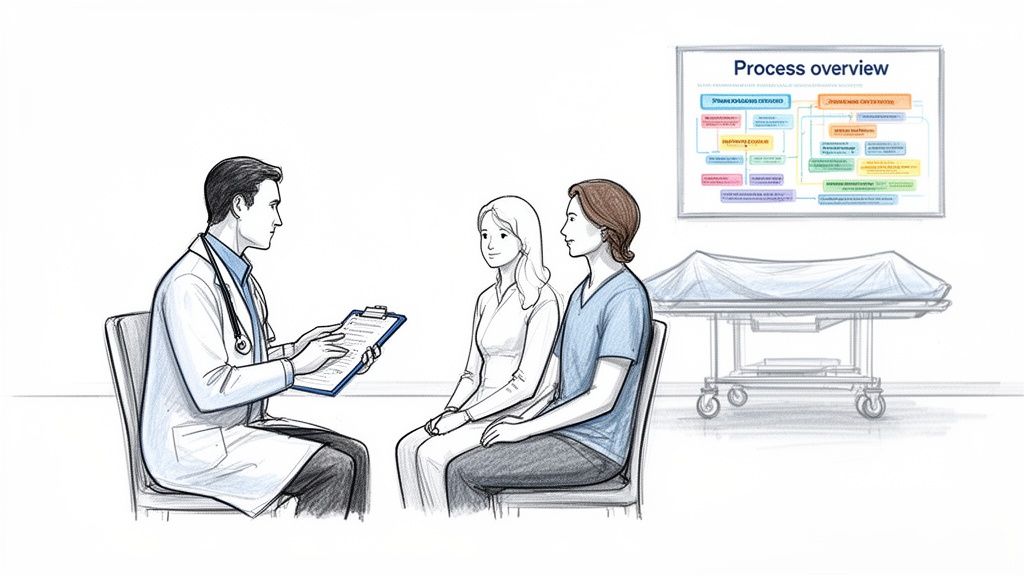
I often speak with families and attorneys here in Texas who feel the medical explanations they received were incomplete. They are left with unanswered questions and a persistent feeling that a crucial piece of the story is missing. For them, a Private Autopsies is the only path to true clarity.
My role as a forensic pathologist is to provide that clarity through a respectful and controlled examination. It’s important to pull back the curtain on this process and explain what an autopsy step by step actually involves. It isn’t what you see on television; it’s a quiet, focused, and scientific search for truth. From the moment legal authorization is given to the day the final report is delivered, your loved one is treated with dignity.
The Foundation of Trust and Expertise
My work is built on my background as a forensic pathologist, board-certified by the American Board of Pathology in Anatomic, Clinical, and Forensic Pathology. This provides a broad and deep medical foundation to draw from in every examination.
Having performed over 1,000 autopsies, I’ve handled cases ranging from seemingly straightforward natural deaths to complex forensic investigations that required courtroom testimony. This specialized training ensures that I can identify the subtle but critical details that might otherwise be missed. I’ve written more about the specific qualifications that define who performs autopsies and why this level of expertise is so crucial for an independent autopsy.
A Commitment to Clarity and Compassion
My goal is always the same: to provide unbiased, medically sound answers. But that commitment goes beyond the technical work. It means communicating clearly with the family, following Texas legal standards to the letter, and always respecting your loved one.
The purpose of a private autopsy extends beyond the clinical findings. It is about restoring a sense of control and providing definitive answers during a time of great uncertainty and grief.
Whether I'm working with a family in Central Texas seeking peace of mind or an attorney building a case, the process is unchanged. It is a search for facts, guided by science and delivered with compassion. Let’s walk through each step together.
A Brief History of Finding Answers
To appreciate what a modern autopsy can reveal, it helps to understand where the practice came from. It wasn't born in a modern lab; it evolved over centuries, shifting from a forbidden act to a cornerstone of medicine and justice. The search for truth after death is an ancient human need, and its history has shaped the very way I work today.
The procedures I perform at Texas Autopsy Services are the result of this long journey. This history isn't just academic—it's a reminder that my work is built on a foundation of scientific rigor, refined over generations, and applied with the best tools we have today. It’s a legacy of providing families with answers they can trust.
From Ancient Rome to the Renaissance
One of the earliest recorded postmortem exams occurred in 44 B.C. After Julius Caesar's assassination, a physician named Antistius examined his 23 stab wounds and identified the single fatal one. That act was a groundbreaking moment—the beginning of using medical examination to uncover truth in a legal context. If you're interested in diving deeper, Popular Mechanics has a great overview of autopsy history.
It took centuries for the practice to gain acceptance. A major step forward came in 1302, when a magistrate in Bologna, Italy, ordered the first official legal autopsy to investigate a suspicious death. This set a crucial precedent. By the 15th century, physicians like Antonio Benivieni in Florence were performing autopsies to connect a person's illness with his findings after their death, directly challenging old medical theories.
The Birth of Modern Pathology
Things truly began to formalize in 1761 thanks to Giovanni Morgagni, who is widely considered the father of modern pathology. He meticulously documented 700 cases in his book On the Seats and Causes of Diseases, systematically linking a patient's symptoms to his anatomical findings. This was a significant shift. It meant evidence from the body itself became more important than unproven ideas.
Later, in the 19th century, a Viennese pathologist named Karl Rokitansky took things even further. He personally conducted over 30,000 autopsies and oversaw thousands more. He was the one who truly standardized the process, creating methodical protocols that remain the bedrock of the modern exam.
The core steps Rokitansky established are largely the same ones I follow today: the external examination, the Y-incision, the careful dissection of each organ, and the respectful reconstruction of the body. His system ensures that every examination is consistent, thorough, and scientifically sound.
Upholding a Legacy of Truth in Texas
This rich history is present in every private autopsy I perform for a grieving family and every forensic case I handle for Texas counties. The tools have improved, but the fundamental goal hasn't changed: to provide clear, unbiased answers through a meticulous, hands-on examination.
At Texas Autopsy Services, we carry that legacy forward, blending time-honored methods with advanced diagnostic tools. My work is backed by my board certification from the American Board of Pathology and a firm commitment to the ethical standards set by the Texas Funeral Service Commission. This applies whether I'm providing County Forensic Autopsies or a second opinion autopsy for a family. The mission remains the same: bringing clarity and closure, just as Antistius did for Caesar. The process has been refined, but the purpose is timeless.
A Detailed Walkthrough of the Examination
For most families I work with, the idea of the autopsy itself can be a source of anxiety. It's an unfamiliar process, often colored by dramatic depictions that are a far cry from the careful, respectful, and methodical examination I perform.
My goal here is to demystify the autopsy step by step. I want you to understand not just what happens, but why each part is crucial for finding accurate answers. At Texas Autopsy Services, this isn't just a technical procedure; it’s a final act of care for your loved one.
The External Examination
The very first part of any autopsy happens before a single incision is made. It’s called the external examination, and it's a meticulous, head-to-toe documentation of the body's condition. This is where I start building the foundation of the case.
I note basic information like height and weight, but also look for unique identifying features—scars, tattoos, or old surgical marks. I'm also carefully searching for any visible signs of injury or illness, like subtle bruising or abrasions. These details can offer the first clues into the circumstances surrounding the death. In many ways, it's like a clinical physical but with a specific forensic lens, similar to the systematic head-to-toe assessment techniques used by clinicians.
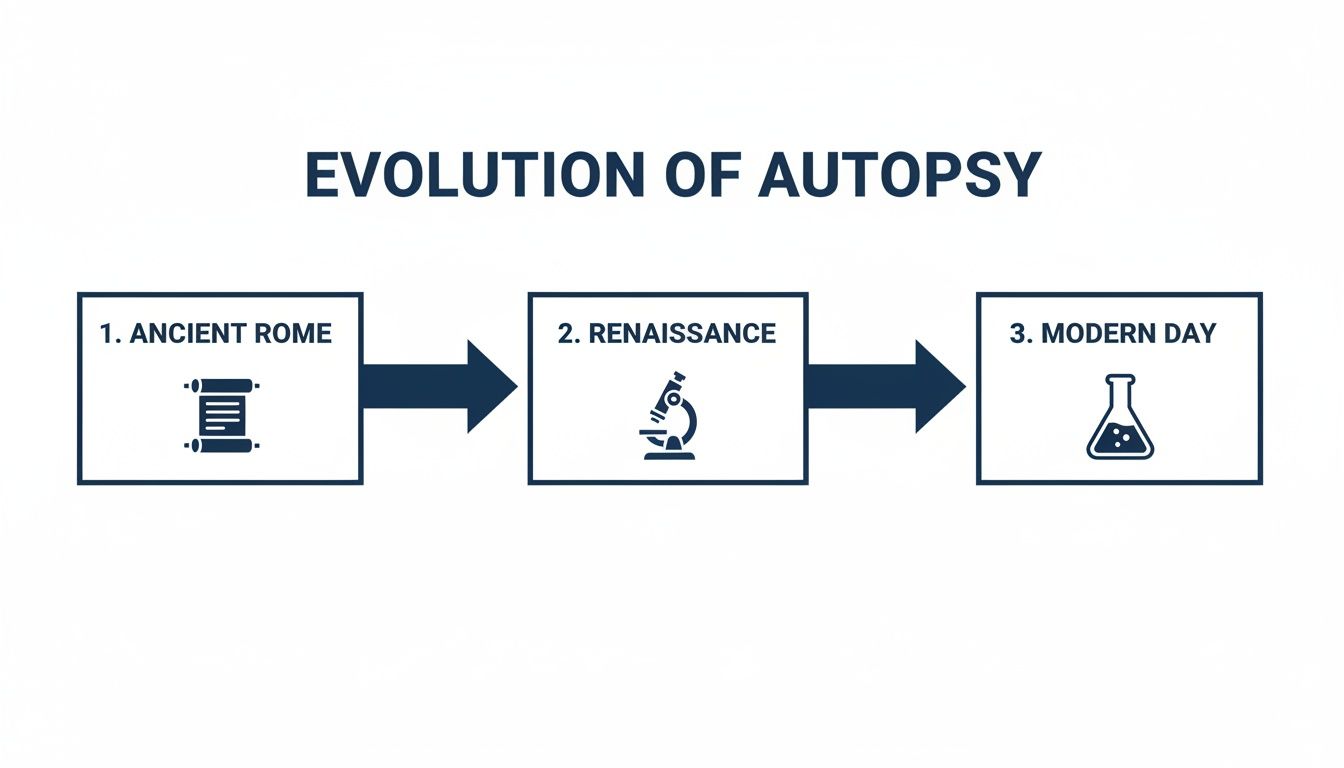
While our tools have become incredibly advanced, the fundamental principle of a systematic search for truth has been the core of this practice for centuries.
The Internal Examination
Once the external review is complete, the internal examination begins. This is done through a standard "Y-incision," which runs from each shoulder, meets at the center of the chest, and continues down to the pubic bone. I use this specific incision because it gives full access to the chest and abdominal organs while minimizing any disruption to the body's appearance.
Inside, I examine each organ system exactly as it rests in the body before I carefully remove, weigh, and dissect each one. This process is essential. For instance, an enlarged heart might point directly to a long-term cardiac condition, or a liver showing signs of disease can provide answers that were invisible from the outside.
As I examine each organ, I take small tissue samples for microscopic analysis—a critical step called histology.
A question I get all the time is whether an open-casket viewing is still possible after an autopsy. The answer is almost always yes. Every incision is made with care, and the reconstruction is handled with the utmost respect to ensure your loved one is presented suitably for funeral services.
Collecting Samples for Ancillary Studies
A huge part of the modern autopsy involves collecting fluid and tissue samples for specialized lab tests. These "ancillary studies" are often what provide the most definitive answers.
- Toxicology: We screen for prescription medications, illegal drugs, alcohol, and other substances. Toxicology results can be the key to understanding if a substance contributed to or directly caused the death.
- Histology: Those tiny tissue samples I mentioned get sent to a lab, sliced paper-thin, and examined under a microscope. This lets me see disease or injury at a cellular level, confirming things like heart disease, hidden infections, or cancer.
- Microbiology: If I suspect an infection played a role, cultures can be taken to identify the exact bacteria or virus responsible.
All these tests are sent to accredited labs to ensure the results are completely accurate and reliable. You can read a bit more about this initial phase in our guide, which answers the common question: what is the first step in an autopsy?
To give you a sense of the precision involved: we document postmortem changes like rigor mortis, which typically sets in 2-6 hours after death, and the body temperature drop of about 1.5°F per hour. During the internal exam, I'll sequentially remove, weigh, and sample organs like the heart (averaging 300g in males) and the liver (around 1.5kg). Toxicology tests are influential in approximately 70% of rulings in suspicious deaths, showing just how vital this data-driven approach is.
Synthesizing the Findings
The final, and most important, phase is putting all the pieces of the puzzle together. I take the gross findings from the external and internal exams and combine them with the lab results from histology, toxicology, and any other tests we ran.
This comprehensive analysis is what allows me to determine the cause of death—the specific injury or disease that started the chain of events leading to the person's passing. It's a conclusion based purely on medical evidence, not speculation. The goal is always to provide a final report that is clear, accurate, and gives you the answers you need.
Understanding the Findings in the Final Report
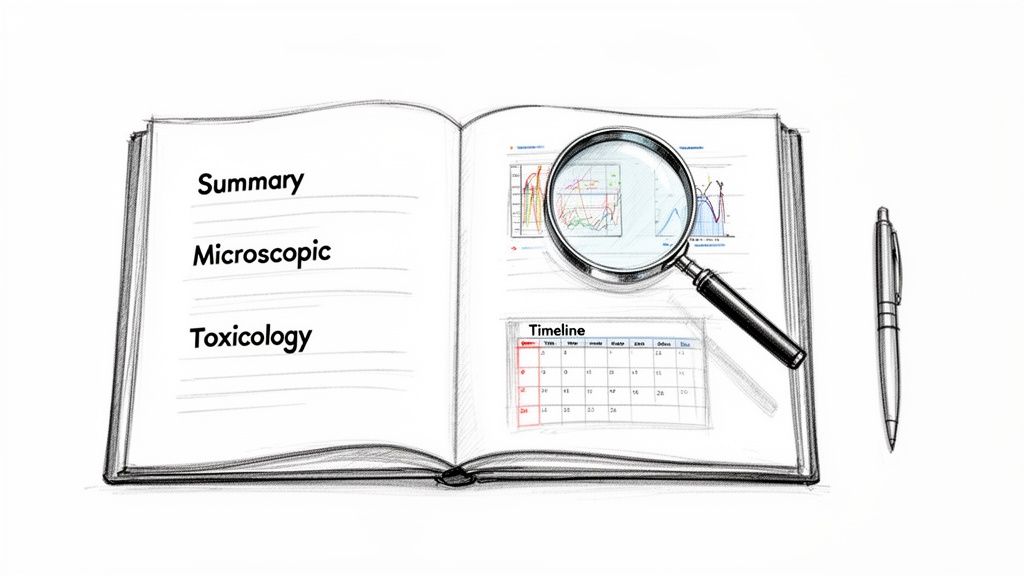
The physical examination is just the beginning. All the observations, samples, and tests come together in the final autopsy report—a single document that provides the answers you’re looking for. This is where every piece of evidence from the external and internal exams is woven together with the toxicology and histology results.
My promise to every family and attorney I work with is to deliver a report that is meticulous, objective, and built to withstand any level of medical or legal scrutiny. It serves as the definitive record of the examination and, hopefully, a foundation for understanding and closure.
Breaking Down the Autopsy Report
When you get a final report from Texas Autopsy Services, you'll see it’s laid out for complete clarity. Every section logically builds on the last, guiding the reader from initial observations to final, evidence-based conclusions.
Here’s what you’ll find inside:
- Summary of Findings: Right at the beginning, you’ll see a concise overview of the most important discoveries. This gives you immediate context before diving into the details.
- Microscopic Descriptions: This is where I detail what was seen in the tissue samples under the microscope. It's often where we confirm conditions like chronic heart disease or find evidence of a hidden infection.
- Toxicology Results: You’ll get a full list of all substances we tested for, along with the concentrations of any that were found. This includes prescription drugs, alcohol, and illicit substances.
- Final Anatomic Diagnoses: This is a clear, numbered list of every pathological finding, starting with the primary cause of death and including any other incidental conditions.
This structure is designed so that doctors, lawyers, and family members can all follow the path from evidence to conclusion. For a more detailed walkthrough, our article on how to read a pathology report can be a helpful guide.
Defining Cause and Manner of Death
Two of the most crucial elements in any report are the "cause" and "manner" of death. They might sound similar, but they represent very different conclusions, and it's essential to understand the distinction.
The cause of death is the specific injury or disease that started the chain of events that led to death. Think of things like a "gunshot wound to the chest" or an "acute myocardial infarction"—what most people call a heart attack.
The manner of death, on the other hand, is a classification of how the death happened. In forensic pathology, we use five categories:
- Natural: Caused exclusively by disease or the natural aging process.
- Accident: The result of an unintentional event.
- Suicide: A death caused by an intentional, self-inflicted act.
- Homicide: The death of one person caused by another person.
- Undetermined: Used when the evidence doesn't point clearly to one of the other manners.
My job is to determine these classifications based only on the medical evidence collected. The findings must speak for themselves, without any speculation or outside influence.
Timelines and What to Expect
One of the first questions I'm always asked is how long it will take to get the final report. While the hands-on examination is typically done within a day, the lab tests—especially toxicology and histology—take time. Rushing those steps would compromise the accuracy of the entire investigation.
In most cases, you can expect the final, comprehensive report within 4-8 weeks. This window allows the necessary time for all lab results to come back, get analyzed, and be carefully integrated into a single, cohesive document. This deliberate pace is a non-negotiable part of conducting a proper autopsy. As findings from reports like these are formalized, they often need to be integrated into broader healthcare systems, which relies on standardized data structures. For those interested in the technical side, you can explore the principles of healthcare common data models.
Upholding Ethical and Legal Standards in Texas
When families and attorneys contact me, they are often in the middle of a difficult time. Trust is everything. They need to know that every step I take is grounded in an unwavering commitment to ethical conduct and legal compliance. My entire practice is built on transparency and strict adherence to the laws that govern my profession here in Texas.
It all starts with proper authorization. Nothing moves forward without the explicit, legally valid consent of the next of kin. This isn't just a professional courtesy; it’s a non-negotiable legal requirement.
Staying Within the Lines of Texas Law
In Texas, the law is very clear about who has the right to authorize an autopsy. My team and I operate in full compliance with these state statutes, ensuring the rights of the deceased and their families are protected from start to finish.
The key legal frameworks that guide our work include:
- Texas Health & Safety Code Chapter 711: This chapter lays out the order of priority for who controls the disposition of a decedent's remains. This directly impacts who can legally give consent for a private autopsy.
- Texas Health & Safety Code Chapter 716: This section gets very specific about autopsies and inquests, providing the legal structure for all postmortem examinations in the state.
Following these statutes is the bedrock of my practice. It guarantees that every examination I perform is legally sound and ethically justified, which is critical for any legal proceedings that might follow.
The Critical Importance of Chain of Custody
When an autopsy may be part of a legal investigation, the integrity of every piece of evidence is paramount. This is where the chain of custody comes in. Think of it as a meticulous, unbroken paper trail that documents the handling of everything from tissue samples to toxicology specimens.
From the moment I collect a sample until the final report is completed, every person who handles it is documented. This rigorous process guarantees that the evidence is exactly what was collected during the exam, with no chance of contamination or tampering. It’s a vital safeguard that upholds the credibility of my findings.
For attorneys, a well-documented chain of custody can be the difference between evidence being admitted or being thrown out of court. My process is designed from the ground up to meet the highest standards of legal and forensic scrutiny.
Professional Accountability and Trusted Partnerships
My ethical commitment goes beyond just state law. As a board-certified forensic pathologist, I am accountable to the high standards set by the American Board of Pathology. This organization ensures its members maintain a specific level of expertise and ethical conduct throughout their careers.
My practice also follows the guidelines of the Texas Funeral Service Commission (TFSC), which regulates all aspects of death care in the state. This shapes how we coordinate with funeral homes and mortuary services to ensure the deceased is treated with dignity and respect at all times.
This commitment is why I choose my partners so carefully. For example, my Waterloo Mortuary Partnership ensures that the entire process, from transportation to the final disposition, is handled with professionalism and complete compliance. It’s one more layer of accountability that gives families peace of mind.
Common Questions About the Autopsy Process
In my conversations with families and attorneys across Texas, a lot of the same questions come up. The process can feel mysterious, so I always aim to give direct, clear answers to help manage expectations and ease concerns. Here are some of the most common things people ask.
Can We Still Have an Open Casket Funeral?
This is almost always the first thing families ask, and I completely understand why. The answer is yes. I want to reassure you that every examination is performed with the utmost respect for the deceased.
The incisions we make are carefully placed so they can be hidden by clothing. Once the examination is over, we perform a meticulous reconstruction. My team and I take great pride in our work, ensuring your loved one can be presented for viewing in a dignified way. This allows your family to have the traditional farewell you want.
How Long Does It Take to Get the Results?
There are two timelines to consider. The physical examination itself usually only takes a few hours. The final, comprehensive report, however, takes longer.
The wait is due to the detailed lab work that happens behind the scenes. We send samples for toxicology and histology (microscopic tissue analysis) to highly specialized, accredited labs. These tests are incredibly sensitive and can't be rushed if you want accurate results.
A complete, accurate report is worth the wait. While I can often provide preliminary verbal findings much sooner, the final, legally defensible document typically takes four to eight weeks to finalize.
Why Do We Need an Autopsy If the Hospital Gave a Cause of Death?
That's a fair question. A cause of death listed on a hospital record is usually based on the person's clinical history and what happened just before they passed away. While often correct, it's not the same as a conclusion drawn from a full internal examination. A private autopsy provides a much deeper, more thorough cause of death investigation.
An independent autopsy can:
- Confirm or correct the presumed cause of death. It is not uncommon to find something unexpected.
- Identify underlying conditions that were never diagnosed while the person was alive.
- Provide crucial details for legal matters, like sorting out insurance claims or navigating potential litigation.
- Uncover genetic information that could be important for the health of living family members.
Ultimately, a private autopsy gives you a level of certainty that a clinical summary just can't match.
Who Can Legally Authorize a Private Autopsy in Texas?
In Texas, the law is specific about who has the authority to consent to an autopsy. It follows a clear hierarchy of next-of-kin, which is laid out in the Texas Health & Safety Code Chapter 711.
Generally, the order of priority goes like this:
- A surviving spouse.
- Any surviving adult child.
- Either surviving parent.
- Any surviving adult sibling.
Authorization has to come from the person with the highest priority on that list. My office will walk you through the entire process to make sure every legal requirement is met before we proceed.
If you have questions that weren't answered here or wish to discuss your specific situation, my team and I are here to help with compassion and clarity. For a confidential consultation, please call Texas Autopsy Services at (806) 230-1889 or visit our website for more information.