September 25, 2026 · Texas Autopsy Services
Should I Get a Second Opinion on an Autopsy
Wondering should i get a second opinion on an autopsy? Learn when it helps, what it costs, and how Texas families and attorneys navigate the process.
On this page
- When Families and Attorneys Question an Autopsy Report
- Why Second Opinions Often Change Outcomes
- What Makes a Second-Autopsy Review Meaningful
- Confirmation Versus Disagreement in Second Opinions
- Texas Laws and Procedures That Shape Private Reviews
- How Independent Forensic Pathology Strengthens Decisions
- Next Steps for Requesting a Second-Opinion Review
A death has occurred, the initial autopsy report has arrived, and one part of the explanation still doesn't make sense. The cause of death may seem too general, the manner of death may not fit the known circumstances, or the report may leave important records and observations unexplained. Families often hesitate because they don't want a second opinion to appear accusatory. Attorneys may hesitate because they need to understand whether another review can add reliable evidence rather than merely create a competing conclusion.
For many people asking, “Should I get a second opinion?”, the answer depends on the purpose of the review, the quality of the available evidence, and the consequences of accepting the first report. A second-opinion autopsy can confirm the original findings, refine them, identify overlooked information, or explain why the available evidence doesn't support a firm conclusion. It can also leave some questions unresolved. That uncertainty is part of an honest forensic process.
- A second opinion is a quality review, not automatically an accusation or challenge.
- The review may confirm, refine, or change the original cause or manner of death.
- Records, photographs, toxicology, histology, and investigative materials can be as important as the first report.
- The value of a review rises when evidence is incomplete, degraded, disputed, or legally significant.
- Texas procedure depends on jurisdiction, including the role of a medical examiner or justice of the peace.
- Families and attorneys should ask direct questions about independence, limitations, chain of custody, reporting, and cost before proceeding.
When Families and Attorneys Question an Autopsy Report
A family may receive an autopsy report after weeks of waiting and find that the conclusion doesn't answer the question they've been carrying since the death. The report may use unfamiliar medical language, distinguish between cause and manner of death, or reach a conclusion that seems inconsistent with medical records, witness accounts, photographs, or the circumstances known to the family. An attorney may see a similar problem when the report doesn't clearly connect its conclusion to the evidence.
That reaction doesn't prove the original examiner acted improperly. It means the report deserves careful review. In medicine, patients often seek another opinion after a serious diagnosis because the consequences of the next decision are significant. A postmortem review serves a related purpose. It gives an independent forensic pathologist an opportunity to examine the reasoning, supporting materials, and limitations behind the first conclusion.
A second opinion is a transparency step
A second opinion may be appropriate when:
- The cause of death is disputed: The medical explanation conflicts with known history, scene information, or other evidence.
- The manner of death is unclear: The classification as natural, accident, suicide, homicide, or undetermined appears difficult to reconcile with the record.
- The findings seem incomplete: The report doesn't adequately address injuries, disease, toxicology, medications, or other relevant issues.
- The death has legal consequences: The findings may affect a civil claim, criminal investigation, insurance matter, guardianship dispute, or county decision.
- The family needs understandable reasoning: The first report may be technically correct but too limited to explain how the conclusion was reached.
Our team also sees value in distinguishing a request for explanation from an allegation of error. Some families want to understand the report and reach closure. Others need an independent assessment because a conclusion appears unsupported or contested. Both reasons can justify an objective review.
A practical discussion of how postmortem findings are assessed can also help families understand the broader role of independent review. The hospital mortality review resource offers related context, although a private autopsy review and a hospital quality review serve different purposes.
Practical rule: Seek another review when the answer matters enough that accepting an unclear conclusion could affect your family, your legal position, or the integrity of the official record.
Why Second Opinions Often Change Outcomes
A second opinion isn't valuable only when the first examiner made an obvious mistake. Independent review can change the diagnostic label, refine the interpretation, identify a different explanation, or show that the original conclusion was well supported. The underlying value is disciplined comparison between the evidence and the conclusion.
A systematic review reported that different advice on diagnosis or treatment appeared in 10% to 62% of cases, while another synthesis found discrepancies ranging from 2% to 51% across oncology studies. A Mayo Clinic study highlighted by Yale Medicine's discussion of second opinions found that 21% of patients received a completely new diagnosis, 66% had the diagnosis refined or redefined, and 12% received a diagnosis that fully matched the first one. These figures concern medical diagnosis rather than autopsy reports, but they show why an independent expert review can affect the name given to a problem and the decisions that follow.
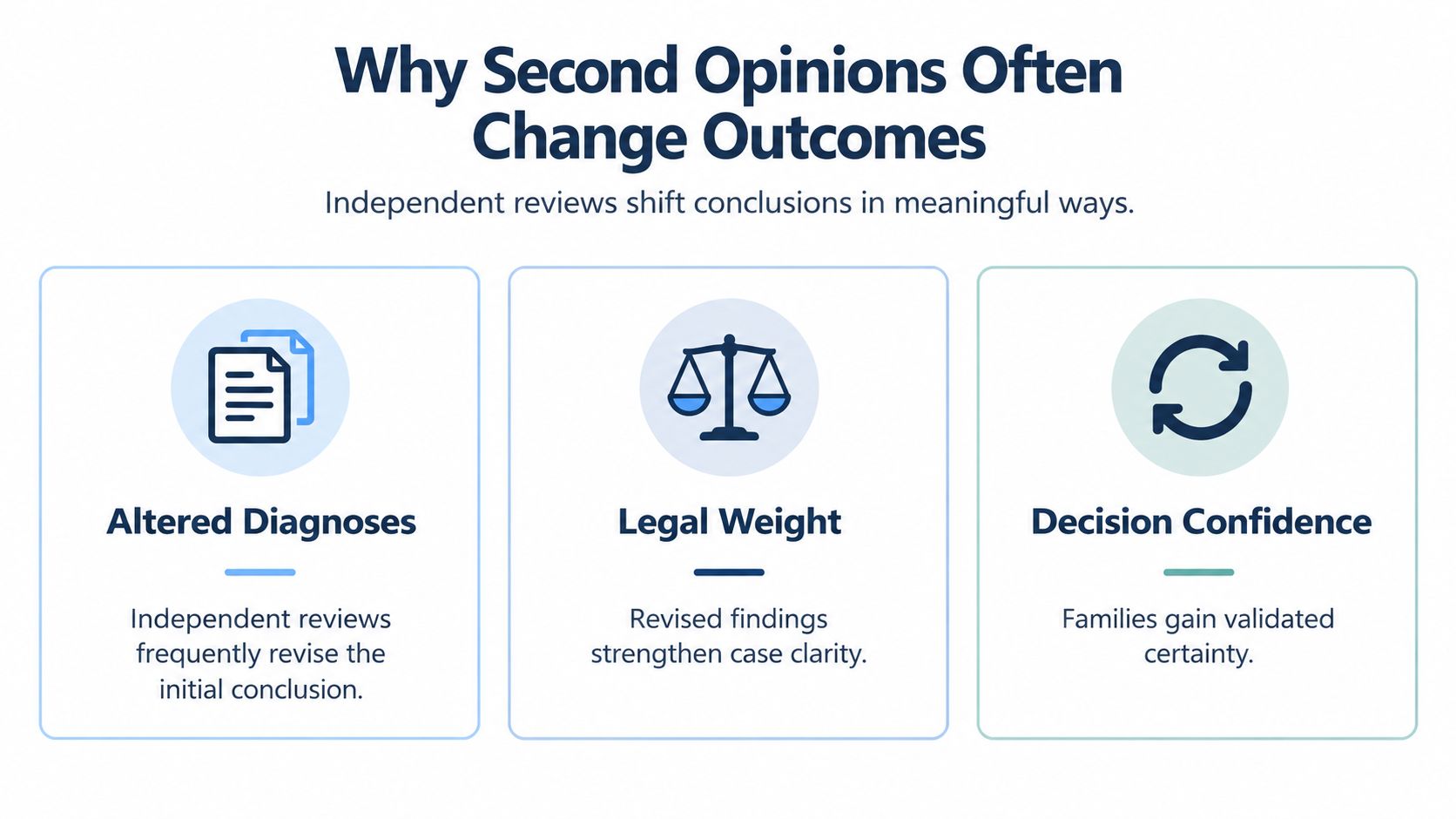
Complex cases create more room for interpretation
Cancer provides a useful comparison because pathology, staging, and treatment decisions often depend on detailed interpretation. In a 70-patient breast cancer study, multidisciplinary second-opinion review changed the diagnosis in 43% of cases and changed pathology interpretation in 20%, as reported in this review of second opinions in oncology. The point isn't that every autopsy review will produce a changed conclusion. It's that expert interpretation can materially affect the final understanding of complex evidence.
The same principle applies to forensic pathology. A cause of death is a medical conclusion about the disease, injury, or toxic exposure that produced death. A manner of death is the classification describing how the death occurred, such as natural, accident, suicide, homicide, or undetermined. A second examiner may find that the cause is supportable but the manner requires clarification, or that the evidence supports only a more limited conclusion.
Additional review can reduce misclassification risk
A review of diagnostic discrepancies found disagreement in 25% to 37% of histopathology cases and reported that second opinions can change diagnosis, treatment, or prognosis. In a simulation cited in that literature, adding one second opinion reduced an error rate from 50.1% to 25.8%, while adding two reduced it to 16.0%. The figures come from medical diagnostic research, not a promise about any individual autopsy, but they demonstrate why independent review can be a rational quality safeguard. The supporting analysis is available in the peer-reviewed review of second-opinion accuracy.
For families and attorneys, the practical result is straightforward. A second opinion may not overturn the first report, but it can show whether the conclusion follows from the evidence, where uncertainty remains, and which additional materials would be needed for a stronger determination.
What Makes a Second-Autopsy Review Meaningful
The strongest second-autopsy reviews begin with a realistic assessment of what evidence still exists. A second examination is technically harder than the original examination because the body may have undergone embalming, decomposition, tissue disruption, burial, or other postmortem changes. The reviewing pathologist may need to rely heavily on the first autopsy report, photographs, diagrams, histology, toxicology, medical records, scene information, and investigative documents.
That limitation doesn't make the review meaningless. It changes the question the reviewer must answer. The task may be to determine whether the first conclusion is supported by the available materials, whether an overlooked finding changes the interpretation, or whether the record is too limited to support a definitive opinion.
Circumstances that justify closer review
A second opinion deserves serious consideration when:
- The cause or manner is disputed. A disagreement supported by specific evidence is more useful than a general feeling that the report is wrong.
- The documentation is incomplete. Missing photographs, slides, toxicology, medical records, or scene information can prevent a reviewer from testing the original reasoning.
- The evidence has degraded. Embalming and decomposition can reduce what a later examination can establish, so the available documentation becomes more important.
- The findings and history conflict. A reported injury, disease, medication, or event may not fit the final conclusion.
- The case has substantial legal or public consequences. Independent review can clarify what the evidence does and doesn't establish before a party takes a formal position.
The National Association of Medical Examiners describes a second autopsy as a form of peer review. Its guidance states that the second examiner should produce a complete report describing the body as received, the limitations of the examination, the records requested, and whether enough information exists to support a cause- and manner-of-death determination. That framework appears in the National Academies reference on second autopsies.
A meaningful review doesn't hide limitations. It identifies them and explains how they affect the opinion.
What a reviewer should examine
A qualified forensic pathologist should evaluate the first report alongside the underlying evidence where available. That may include photographs, histology slides, toxicology results, medical records, death-scene documentation, witness information, and records concerning transport or disposition. The reviewer should also separate what was directly observed from what was inferred.
A careful conclusion may be definitive, qualified, or unable to resolve the issue. Each outcome can be useful if the reasoning is clear and the limits are stated openly.
Confirmation Versus Disagreement in Second Opinions
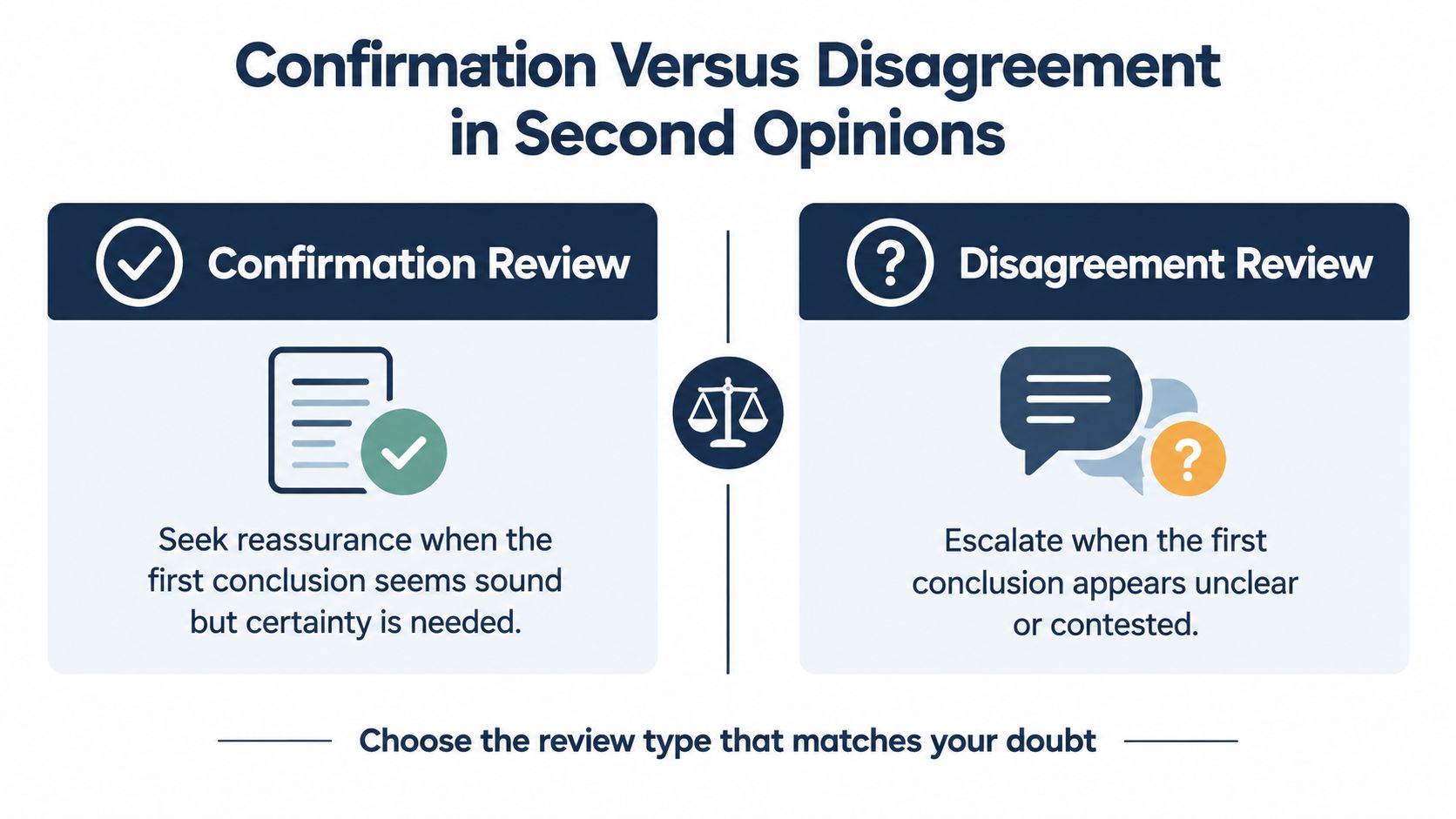
Families often ask whether they need a second opinion only when they believe the first report is wrong. That standard is too narrow. A review may be requested for confirmation, meaning the first conclusion appears reasonable but the family or legal team needs independent reassurance. It may also be requested because of disagreement, meaning specific evidence suggests the conclusion is incomplete, inconsistent, or unsupported.
Neither purpose is improper. The review type should match the uncertainty.
Confirmation review
A confirmation review may fit when the first report appears sound but the consequences are serious. The family may need an independent explanation before accepting the conclusion. An attorney may need to understand whether the report provides a reliable foundation for advising a client. A healthcare professional or county official may need another forensic pathology assessment before closing an unsettled question.
Confirmation can still produce useful changes. The reviewer may refine the cause of death, clarify the manner, explain an apparently contradictory finding, or identify uncertainty that the first report didn't communicate clearly. Medical literature describes second opinions as affecting diagnosis, treatment, or prognosis in up to 69% of cases, according to the systematic discussion of second-opinion outcomes. That does not mean every review changes an autopsy conclusion. It does show that independent review often contributes more than simple agreement.
Disagreement review
A disagreement review begins with a defined concern. The concern might involve an injury that wasn't addressed, a toxicology result that appears inconsistent with the conclusion, a missing differential diagnosis, or a manner-of-death classification that doesn't fit the documented circumstances. Attorneys should identify the disputed issue and provide the records that support it.
The reviewer's job isn't to adopt the family's or attorney's preferred outcome. It's to test the conclusion against the evidence. Sometimes the result strengthens the original report. Sometimes it supports a different conclusion. Sometimes it shows that the available evidence cannot resolve the issue. That independence is what makes the opinion useful.
Texas Laws and Procedures That Shape Private Reviews
Texas postmortem investigations involve different authorities, and the governing process depends on the location, circumstances, and jurisdiction of the death. A private review doesn't automatically replace the official investigation. Families and attorneys should first determine whether the case is under a medical examiner, justice of the peace, or another authorized authority, and whether the body or records remain available for examination.
Texas guidance states that a justice of the peace may seek a physician's opinion about whether an autopsy is necessary. The justice of the peace may then direct a physician to perform an autopsy or certify that no autopsy is needed. The same guidance states that a justice of the peace may not order an autopsy for deaths caused by Asiatic cholera, bubonic plague, typhus fever, or smallpox. The CDC summary of Texas coroner law provides that jurisdictional context.
Timing can affect what remains possible
Texas law provides a timing rule for postmortem examinations authorized in certain cases. The physician must be authorized by the medical examiner, justice of the peace, or county judge, and must perform the examination or autopsy not less than 24 hours and not more than 48 hours from the specified time trigger, as set out in the Texas postmortem examination statute. The exact legal application depends on the circumstances and authority involved, so this information isn't legal advice.
A private second opinion may be a records-based consultation, a re-examination when legally and practically possible, or a combination of both. The reviewing practice should explain what can be done with the evidence that remains rather than imply that every case permits a new full autopsy.
Standards and professional qualifications matter
Every examination performed by our practice is conducted by a forensic pathologist certified by the American Board of Pathology. The American Board of Pathology certification information identifies forensic pathology as a subspecialty certificate and describes a certification pathway that requires anatomic pathology/clinical pathology or anatomic pathology certification and 12 months of training in an ACGME-accredited forensic pathology program.
Texas Autopsy Services also works within the compliance context of the Texas Funeral Service Commission and Texas Health & Safety Code Chapters 711, 716, and 651. Families and attorneys should ask how the practice handles authorization, transport, records, specimen custody, privacy, reporting, and communication with the responsible authority.
How Independent Forensic Pathology Strengthens Decisions
A useful second opinion is built around evidence, not a predetermined answer. Our board-certified forensic pathologists review the original report and the materials behind it, identify the questions that can be answered, and separate supported findings from unresolved possibilities. That approach can help a family understand the official conclusion without turning the process into a confrontation.
Consider a report that lists a broad cause of death but doesn't explain how toxicology, medical history, and scene circumstances were weighed. A records-based review might confirm the conclusion while explaining the reasoning in plain language. In another case, photographs or histology may show that a finding was interpreted differently by the second examiner. The report then gives the family or attorney a documented basis for understanding the difference.
What independence should look like
Independence doesn't mean ignoring the first examiner. It means reviewing the evidence without being employed by the office that issued the original conclusion and without promising a preferred result. A responsible forensic pathology practice should state what materials it received, what it didn't receive, and how missing evidence limits the opinion.
A professional report should address:
- Cause of death: The disease, injury, or toxic exposure that directly produced death.
- Manner of death: The classification describing how the cause arose.
- Evidence reviewed: Reports, photographs, slides, toxicology, medical records, and investigative materials.
- Limitations: Missing, degraded, altered, or unavailable evidence.
- Reasoning: The medical and forensic basis for the conclusion.
- Chain of custody: The documented record of who possessed evidence, when it was transferred, and how it was protected.
A documented chain of custody matters because attorneys, agencies, and courts need to know whether evidence was handled and transferred in a traceable manner. It doesn't make a conclusion correct by itself, but it supports confidence in the integrity of the review.
The same principle applies when a second opinion confirms the first report. Independent reporting can explain how investigators reached the conclusion, identify overlooked information, or show why a question remains unanswered. Independent reporting about second autopsies has described those purposes while also emphasizing that a second autopsy may not replace the official investigation. Postmortem investigation literature has reported that at least 25% of autopsies reveal clinically missed diagnoses related to the cause of death, as discussed in this review of postmortem investigation.
For attorneys, the practical benefit is a clearer evidentiary record. For families, it may be a better explanation. Neither outcome should be guaranteed before the materials are reviewed.
Independent second opinions can materially change conclusions because diagnostic discrepancies between first and second expert reviews are common. Simulation studies reported that adding one second opinion reduced an error rate from 50.1% to 25.8%, while adding two reduced it to 16.0%, as described in the supporting peer-reviewed analysis. In a forensic case, that evidence supports obtaining a qualified review when the situation calls for it, but it doesn't predict the result of a particular examination.
Attorneys seeking a focused medical-legal assessment may also review the practice's information about forensic consultant services. The scope should be defined before work begins, especially when the request concerns testimony, a written report, or a review of disputed evidence.
Next Steps for Requesting a Second-Opinion Review
Start by gathering the first autopsy report and every related record available. Useful materials may include photographs, toxicology, histology, medical records, death-scene information, investigative reports, and documentation showing where evidence or specimens were held. A reviewer can assess the case more effectively when the question is specific and the record is complete.
Ask the practice:
- What type of review is possible? Records-only review, re-examination, or both.
- Who will perform the examination? Every examination should be performed by a forensic pathologist certified by the American Board of Pathology.
- What limitations apply? Embalming, decomposition, missing records, or unavailable specimens may affect the opinion.
- What will the written report address? Cause, manner, evidence reviewed, reasoning, and limitations.
- How are fees and logistics handled? Confirm whether pricing is flat-rate and all-inclusive, and ask about transport, storage, testing, and reporting.
Families may also want independent legal guidance if the review relates to a claim or dispute. A general resource on whether you need a lawyer for a minor car accident illustrates the kind of early legal decision-making resource some families use, although an attorney should assess the specific facts of a death investigation.
Texas Autopsy Services can also discuss whether a case is suitable for review through its case review information. Direct communication helps families and attorneys understand the available evidence, likely limitations, costs, and next steps without pressure.
Texas Autopsy Services provides independent second-opinion reviews and private autopsy services across all 254 Texas counties, with every examination performed by a forensic pathologist certified by the American Board of Pathology. To discuss an existing report, available records, transport, chain of custody, or a possible re-examination, contact our team directly or visit Texas Autopsy Services.