June 18, 2026 · Texas Autopsy Services
Hospital Mortality Review: Texas Rights & Autopsy Clarity
Understand the hospital mortality review process, its limitations, and your Texas rights. Discover when an independent or second-opinion autopsy offers clarity.

On this page
- Understanding Hospital Mortality Review
- The Mortality Review Committee and Its Purpose
- Data and Reporting in Mortality Reviews
- Limitations and Blind Spots of Internal Reviews
- When an Independent Autopsy Provides Answers
- Understanding Family and Legal Rights in Texas
- Practical Checklists for Hospitals and Families
- Frequently Asked Questions
A hospital death often leaves families with two different kinds of questions. The hospital may ask whether anything can be learned for future patients. The family usually wants something more personal and immediate. What exactly caused this death, and do the records tell the whole story?
Those are not the same inquiry. A hospital mortality review is an internal quality process. An independent autopsy is a separate medical examination that can answer a different set of questions. When people understand that distinction early, they make better decisions about records, timelines, and whether an outside investigation is necessary.
- Hospital mortality review is primarily an internal quality-improvement process, not a family-centered investigation.
- Modern programs often aim to review every inpatient death, and structured review can identify communication and care-process gaps.
- Internal reviews have limits, especially when the concern is a specific adverse event or the precise medical cause of death.
- An independent autopsy can provide objective postmortem findings, including cause of death, manner of death, and documented chain of custody.
- Texas families and attorneys should understand authorization rights early, because timing matters when postmortem examination is being considered.
Understanding Hospital Mortality Review
A common situation looks like this. A patient enters the hospital seriously ill, treatment intensifies, family meetings happen quickly, and death follows before everyone feels they fully understand what changed and when. In the days after, a relative may hear that the case will go through a hospital mortality review and assume that means someone is deciding whether malpractice occurred.
That usually isn't what the process is for.
A hospital mortality review is typically a formal internal review of a patient death for quality improvement. Hospitals use it to examine care delivery, communication, timing, escalation, and system issues. In many institutions, the review is routine rather than exceptional. A death doesn't have to imply wrongdoing for the case to be examined.
Hospital mortality review is designed to help a hospital learn from a death. It isn't the same as an independent forensic investigation for the family.
This distinction matters because families often expect a direct explanation, while the hospital is often asking a broader operational question. Was the course of care consistent with standards, available information, and institutional processes? That can produce useful lessons, but it may still leave the family wanting a more direct medical answer.
Hospitals also connect mortality review to larger patient-safety work, including communication practices, handoffs, and other effective medical error prevention strategies. For a plain-language overview of related internal review concepts, our readers may also find this discussion of what medical review means in practice helpful.
The Mortality Review Committee and Its Purpose
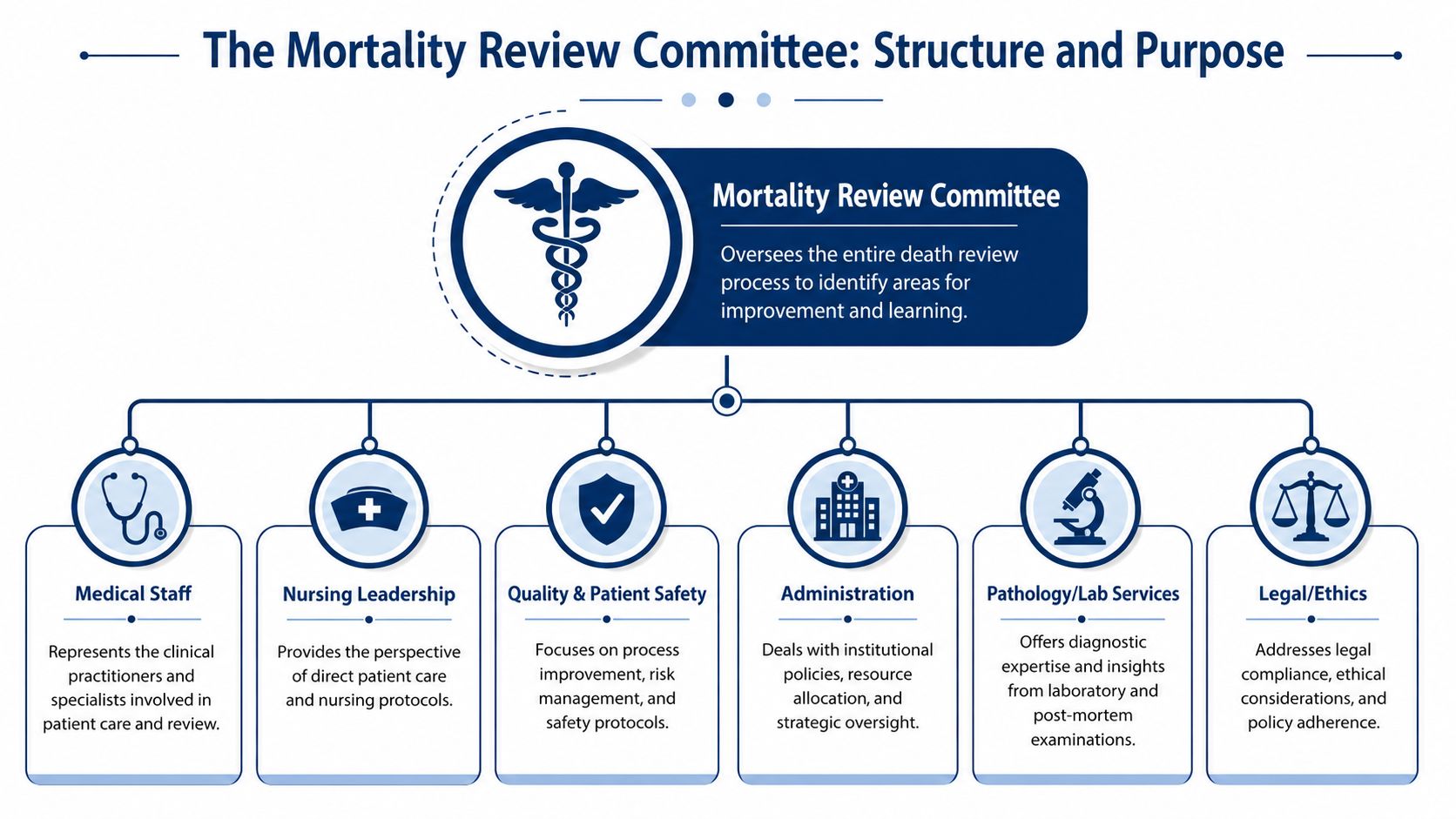
A mortality review committee is usually multidisciplinary. That matters because a single chart can look very different depending on whether it's read by a bedside nurse, a physician, a pharmacist, a quality specialist, or a pathologist. Good committees are built to compare those perspectives instead of relying on one person's impression.
Who usually participates
Most committees include representatives from several functions inside the hospital.
- Medical staff review diagnosis, treatment decisions, escalation, and specialty input.
- Nursing leadership evaluates bedside observations, communication, and adherence to care protocols.
- Quality and patient safety personnel look for recurring patterns, reporting issues, and process failures.
- Administration and legal or ethics personnel consider policy, compliance, and institutional response.
- Pathology or laboratory services may contribute diagnostic context when available.
The committee's purpose is not usually to assign personal blame. Its job is to identify whether the case shows an avoidable delay, a communication failure, a documentation problem, or some other pattern worth correcting.
What a structured review looks like
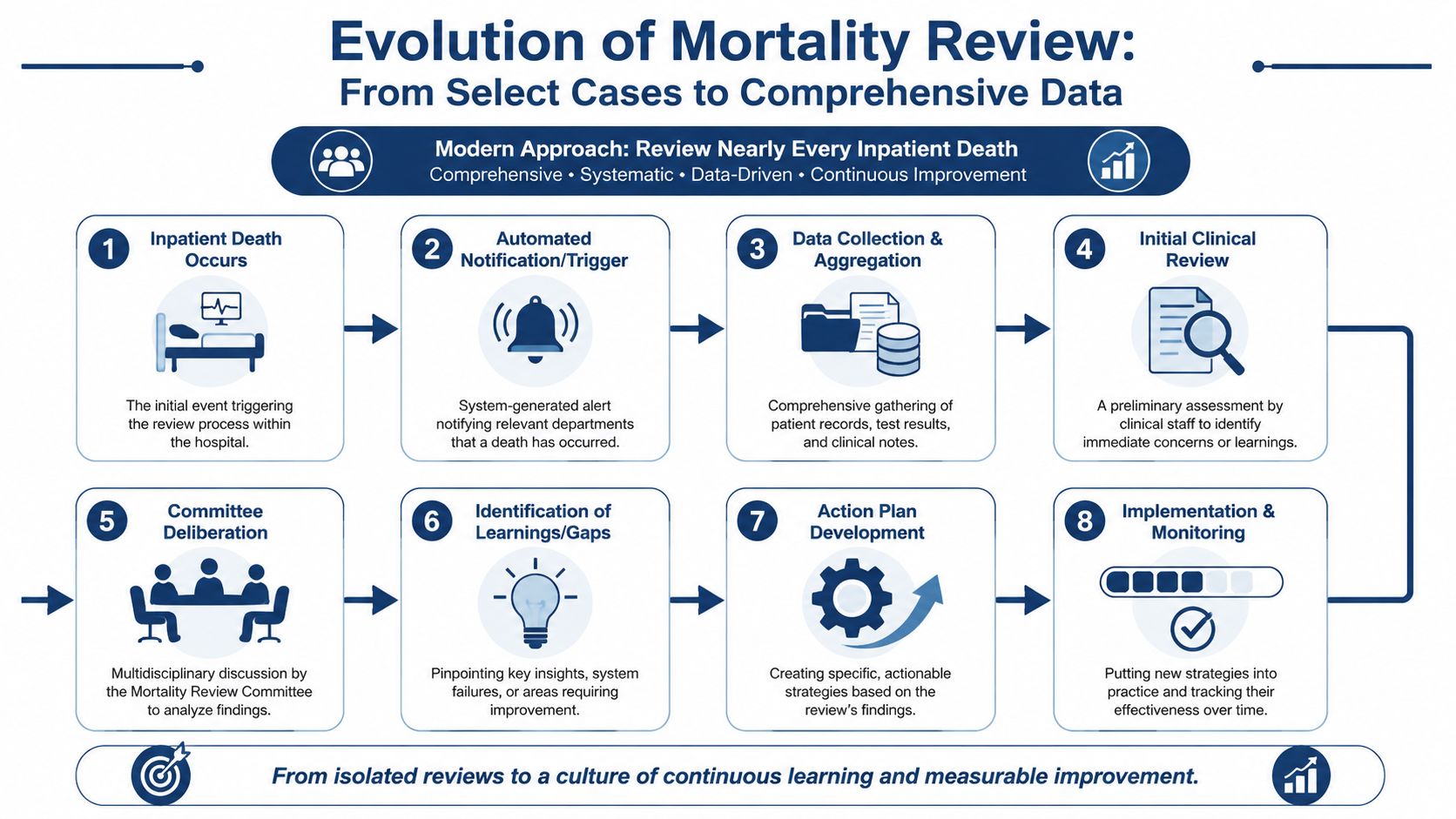
The strongest programs don't rely on informal discussion after a difficult case. They use a repeatable workflow. A good example comes from Duke Health, where the program sends death notifications within 24 hours, uses a structured review instrument, escalates selected cases to centralized committee review, and uses aggregated findings to identify trends and process-improvement targets, as described in Duke Health's mortality review workflow presentation.
That structure changes the value of the process. Without standard triggers and a consistent form, committees tend to focus on the most dramatic cases and miss the quieter but repeated failures. With a standard process, a hospital can compare cases across services and over time.
Practical rule: A mortality review program becomes useful when it turns individual deaths into patterns the hospital can act on.
For families, though, this same structure explains the limitation. The committee is trying to detect trends across many deaths. The family is focused on one death.
Data and Reporting in Mortality Reviews
A family may hear that the hospital "reviewed the case" and assume that means every relevant question has been answered. In practice, the answer depends on what data the review captured, how the case was classified, and what the committee was asked to measure.
Why complete case capture matters
Modern mortality review works best when a hospital examines every inpatient death under the same method. The Agency for Healthcare Research and Quality supports 100% mortality case review, and one hospital-wide implementation reported 427 consecutive deaths over 3 months among 12,819 admissions, with an overall mortality risk of 3.3%, in this BMJ Quality and Safety study on hospital-wide mortality review.
Reviewing all deaths reduces a predictable bias. Selective review tends to pull in the most dramatic cases and miss quieter failures such as delayed reassessment, unclear escalation plans, or poor documentation of goals-of-care discussions. Full capture also gives the hospital a denominator, which matters if leaders want to know whether a problem is isolated or recurring.
For families and attorneys, that denominator has a different use. It helps explain what the hospital review can and cannot answer. Internal review is designed to sort a death into quality categories inside a larger patient-safety system. If the concern is whether one patient suffered a medication effect, aspiration event, occult hemorrhage, or another mechanism of death, that concern may call for a different kind of investigation, including an independent medical malpractice case review.
What hospitals usually track
A structured mortality review usually records more than the fact of death. It asks whether the death was expected during that admission, whether there was an opportunity for improvement, whether communication about prognosis and treatment limits was documented, and whether delays in diagnosis or treatment changed the course of care.
In the same study, reviewers judged 33 of 427 deaths (7.7%) to be unanticipated and found 100 cases (23.4%) with an opportunity for improvement. The same study also found that communication problems, especially inadequate goals-of-care discussions, appeared more often than dramatic technical mistakes.
That pattern is familiar to practicing pathologists who review adverse outcomes. Families often come in expecting the central question to be "Was there a surgical error?" Many times, the harder and more consequential issue is whether the record shows timely recognition of decline, clear communication of prognosis, and a documented plan that matched the patient's condition and wishes.
| Review element | What it usually shows |
|---|---|
| Case capture | Whether every inpatient death entered the review process or only selected deaths |
| Expected vs. unanticipated death | Whether the death fit the clinical course described at admission and during treatment |
| Opportunity for improvement | Whether reviewers identified a gap in care, timing, supervision, communication, or documentation |
| Goals-of-care documentation | Whether the chart reflects meaningful discussion of prognosis, patient preferences, and treatment limits |
| Trend reporting | Whether similar issues recur across units, services, or time periods |
The reporting side matters as much as the review form. A useful program aggregates findings by service line, contributing factor, and type of lapse, then sends those results back to clinical leaders for corrective action. Those reports are quality tools. They are not a substitute for a family's need to understand exactly what happened in one death.
Hospitals also have to handle privacy correctly when they share review findings internally or with authorized parties. Teams that need a practical reference can Navigate HIPAA regulations before circulating case summaries, committee materials, or quality reports.
Limitations and Blind Spots of Internal Reviews
Families often assume that if a hospital performs a mortality review, the process will naturally uncover whatever went wrong. That assumption is too broad. Internal chart review can be valuable, but it doesn't answer every question well.
Why internal review and family answers can diverge
A Canadian study of 354 deaths among 4,544 discharged patients over 1 July 2020 to 30 June 2021 found an overall mortality rate of 7.8%, yet only 2% of cases revealed a clinical adverse event that directly contributed to a poor or unexpected outcome, with more than half of those events related to nosocomial COVID-19 transmission, as reported in this Canadian mortality chart review study.
That doesn't mean internal review is pointless. It means routine mortality chart review can have a low yield for detecting some direct adverse events in general inpatient populations. If a family or attorney is focused on a specific concern, such as aspiration, missed hemorrhage, medication effect, device complication, or unrecognized infection, the internal review may not be the most precise tool.
The hospital is usually evaluating process and safety signals inside the existing record. It is not performing a new medical examination of the body.
Another blind spot is built into the data source itself. Internal reviewers generally work from the chart the hospital already has. If the central issue is something the chart doesn't resolve clearly, the review may remain inconclusive.
Privacy, access, and the practical problem
Internal findings also aren't always shared with the family in a detailed way. Hospitals must manage patient privacy, peer review protections, and legal constraints. Anyone trying to understand records access and confidentiality rules should have a basic grasp of how to Navigate HIPAA regulations before making broad assumptions about what a hospital can disclose.
When legal review is being considered, it also helps to understand the difference between internal quality review and external claim analysis. This overview of a medical malpractice review is often where families and counsel begin sorting those issues.
When an Independent Autopsy Provides Answers
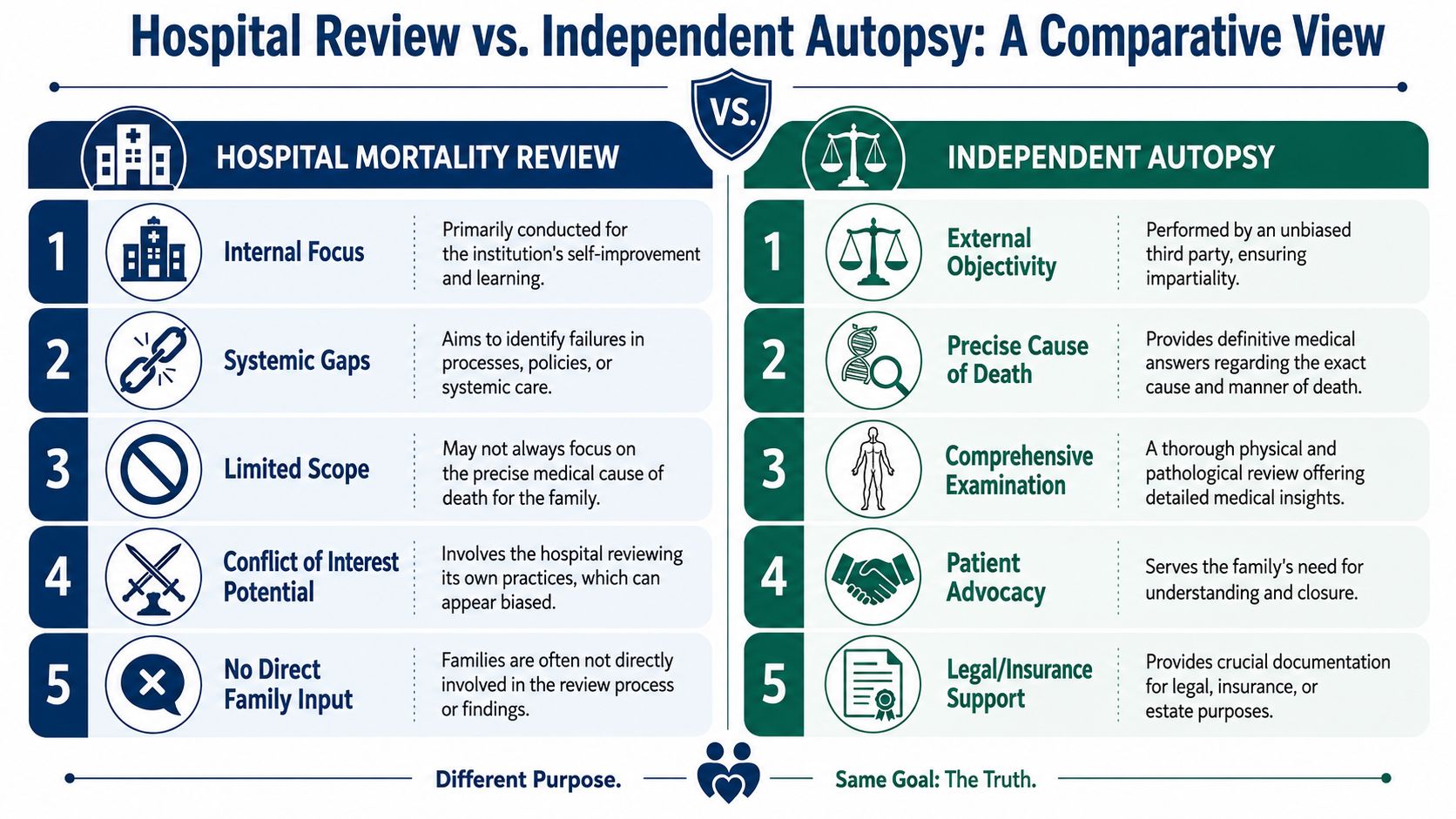
An independent autopsy serves a different purpose from a hospital mortality review. It is not a committee discussion about institutional learning. It is a direct postmortem medical examination aimed at determining what physically caused death and whether the body shows findings that clarify or contradict the clinical record.
What an autopsy can establish
A cause of death is the specific disease or injury that resulted in death. In plain language, it answers the question, "What medically killed the person?"
A manner of death describes the circumstances category surrounding the death, such as natural, accident, suicide, homicide, or undetermined. Not every private autopsy setting uses those categories in the same legal way as a medical examiner, but the concept remains important.
A chain of custody is the documented handling of the body, specimens, and evidence from transfer through examination, testing, storage, and reporting. That documentation matters because it supports the reliability and legal defensibility of the findings.
For families seeking a fuller explanation, a Private Autopsy can include external and internal examination, specimen retention where appropriate, toxicology or other ancillary testing when needed, and a formal written report. Unlike a chart-only review, this process examines the body itself.
A short visual overview can help make that distinction concrete.
Why independence matters
Independence matters for the same reason outside forensic analysis matters in other disputed settings. The examiner is not reviewing their own institution's actions. The job is to assess the medical facts objectively.
That doesn't mean an independent autopsy automatically proves negligence. Often it doesn't. Sometimes it confirms that the clinical course was medically consistent with a severe natural disease. In other cases, it identifies a complication, missed diagnosis, or mechanism of death that wasn't clear from the chart alone.
Clinical reality: A family may need both forms of review. The hospital may need an internal quality process, while the family needs an independent medical answer.
Attorneys sometimes compare this to using a neutral outside investigator when facts are contested. The principle is similar to the broader idea discussed in this guide to finding truth in Derby, even though the medical standards and evidence handling in postmortem work are distinct.
Understanding Family and Legal Rights in Texas
In Texas, a hospital death does not automatically mean an autopsy will occur. If the death is not under the jurisdiction of a medical examiner or justice of the peace for a medicolegal investigation, the question often becomes who has legal authority to authorize a private examination.
Who can authorize an autopsy
The practical starting point is the person who has the legal right to control disposition of remains under the Texas Health & Safety Code. That authority often determines who can authorize a private autopsy, though the exact facts matter and family disagreements can complicate the analysis.
For many families, the most useful first step is confirming the legally authorized next of kin or designated agent before making arrangements. This overview of who can request an autopsy is a useful plain-language starting point.
If the death is under county authority, the process may be different because a justice of the peace, coroner system where applicable, or medical examiner structure may control the next steps. In those settings, county procedures and statutory duties can shape what is allowed and when.
How families and counsel usually proceed
A practical sequence in Texas often looks like this:
- Confirm jurisdiction. Determine whether the death is a hospital case under routine release, or a medicolegal case under public authority.
- Identify the authorizing person. Hospitals and funeral providers will usually need clear legal authorization.
- Communicate quickly. Timing matters because postmortem examination is easier to arrange before final disposition.
- Coordinate logistics carefully. Transportation, consent, testing scope, and documentation all need to line up.
- Preserve records. Counsel should request the full medical record and keep a written timeline of calls and decisions.
Families sometimes also need to understand county-side procedures. For that context, our readers may review how County Forensic Autopsies fit into Texas death investigation practice.
Practical Checklists for Hospitals and Families
Some readers need policy guidance. Others need a next-step list they can act on today. Both groups benefit from a simple checklist.
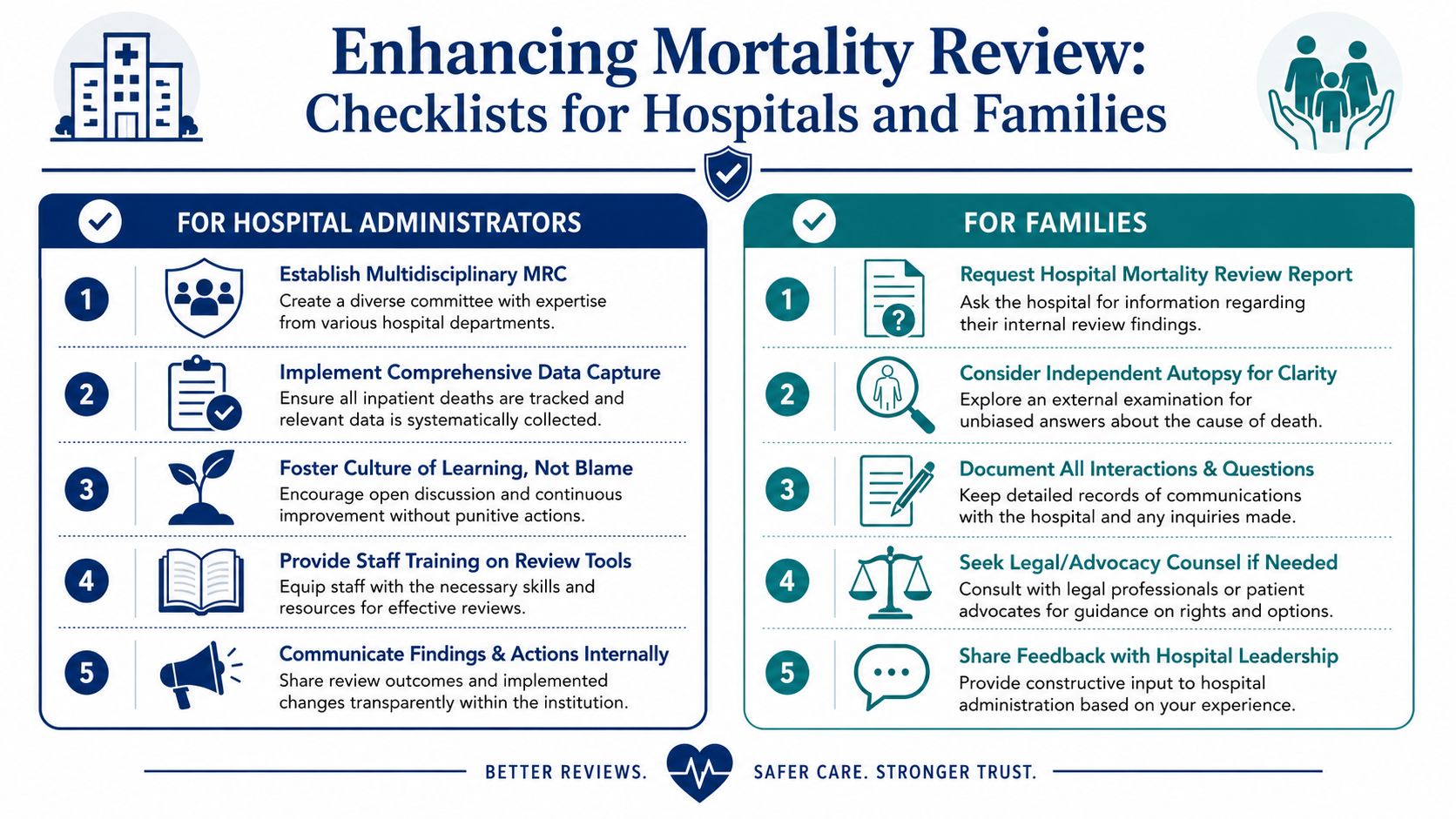
For hospitals
- Use a standard trigger for every inpatient death so review doesn't depend on memory or personalities.
- Build a multidisciplinary committee with clinical, nursing, quality, pathology, and administrative input.
- Track communication failures separately from technical care problems, especially around prognosis and treatment limits.
- Escalate selected cases to centralized review when they show recurring patterns or high concern.
- Turn findings into action by assigning policy, training, or workflow changes instead of just recording conclusions.
For families and attorneys
- Request the complete medical record as early as possible, including notes, orders, labs, imaging reports, and discharge or death documentation.
- Write down every conversation with the hospital, funeral home, and any public authority involved.
- Clarify whether an internal hospital mortality review is occurring and ask what information, if any, may later be shared.
- Decide quickly whether an independent autopsy is needed because timing affects options.
- Ask focused questions about cause of death, testing scope, specimen handling, reporting, and chain of custody.
- Preserve paperwork related to consent, transport, release of remains, and insurance or legal notice.
Families usually do better when they treat the first day after death as a documentation day. Names, times, and decisions become important very quickly.
Frequently Asked Questions
Can a hospital prevent a family from obtaining a private autopsy?
In many situations, no, not if the legally authorized person provides proper consent and the death is not being held under government jurisdiction. The exact answer depends on who has authority over the remains and whether a public investigation controls the case.
Is a hospital mortality review the same as proof of malpractice?
No. A hospital mortality review is generally an internal quality process. It may identify concerns, or it may not. It is not the same as a legal finding, and it is not the same as an independent forensic examination.
How quickly should an independent autopsy be arranged?
As soon as possible. Timing affects body condition, logistics, and whether final disposition has already been scheduled. Most cases can be coordinated within 24–48 hours, but no responsible practice should promise that unconditionally because release status, transport, and authorizations all matter.
What does a private autopsy usually include?
That depends on the scope authorized, but families should expect a defined examination plan, documentation of findings, options for additional testing when appropriate, a written report, and clear chain-of-custody procedures.
Will a private autopsy always show that the hospital made a mistake?
No. Sometimes it confirms a natural disease process. Sometimes it clarifies a complication or reveals findings that were uncertain from the chart alone. The point is objectivity, not a predetermined conclusion.
When questions remain after a hospital death, clear information helps families and counsel make careful decisions. Texas Autopsy Services provides independent autopsy and forensic pathology services across Texas, with every examination performed by a forensic pathologist certified by the American Board of Pathology. If you need guidance on timing, authorization, transport, or whether an independent examination is appropriate, our team can speak with you directly and explain the process with care and precision.