July 4, 2026 · Texas Autopsy Services
Deposition Preparation: Expert Guide 2026
Expert deposition preparation for forensic pathology. Our pathologists guide you on preparing evidence, testimony, & teams for legal proceedings.
On this page
- The Role of the Forensic Pathologist in Legal Testimony
- Gathering Your Team and Essential Documents
- Working with Your Forensic Pathology Expert
- Mock Questioning and Testimony Coaching
- Navigating Common Pitfalls in Testimony
- A Commitment to Clarity and Truth
- Frequently Asked Questions About Autopsy Depositions
Deposition Preparation for Autopsy Testimony in Texas
- Deposition preparation starts early. Substantial preparation should begin 60 to 90 days before trial so the expert can review the full record, map opinion formation, and prepare to explain both findings and limits with clarity, as discussed in this forensic expert witness preparation guide.
- The autopsy report is only part of the file. Reliable testimony depends on reviewing records, scene materials, laboratory results, witness information, and chain of custody documentation.
- Attorney-directed review matters. A forensic expert should review only materials provided by counsel. Independent chart access can create ethical and legal problems, including HIPAA concerns.
- Mock questioning helps experts stay clear and natural. Practice examination, including videotaped rehearsal where appropriate, helps refine concise, accurate testimony.
- Good testimony is disciplined testimony. Strong experts avoid speculation, define medical terms plainly, and answer only the question asked.
- In Texas, consent rules differ for government and private autopsies. Some autopsies may be ordered without family consent under law, but a private autopsy requires written consent from the legal next of kin.
A family is waiting for answers after a death that still doesn't make sense. An attorney is reviewing an autopsy report and knows opposing counsel will examine every sentence. Both need the same thing from the forensic pathologist. They need careful, objective testimony that can stand on the medical facts.
In our field, deposition preparation isn't a side task added at the end of a case. It's part of the work itself. When a forensic pathologist gives testimony, that testimony reflects the entire investigation, from the records reviewed to the specimens examined to the final written opinions. For families, that process can affect understanding and closure. For attorneys, it can shape how the medical evidence is received.
A private autopsy is an independent postmortem examination arranged outside a government medical examiner system. In some matters, families seek that examination for clarity. In others, attorneys need an independent forensic pathology expert to assess cause of death, manner of death, injuries, timing, or whether a prior opinion is medically supported. Every examination we perform is done by a forensic pathologist certified by the American Board of Pathology, with attention to chain of custody, documentation, and court-admissible reporting.
The Role of the Forensic Pathologist in Legal Testimony
An attorney sits with an autopsy report, prior records, and a growing list of likely deposition questions. The issue isn't only what the report says. The issue is whether the pathologist can explain, step by step, how the medical opinion was formed and why competing explanations were rejected or left open.
Why testimony carries the full weight of the investigation
A deposition is a formal test of the scientific integrity behind the report. In forensic pathology, that means the expert may need to account for the condition of the body, injury patterns, toxicology, histology, scene information, investigative records, and the limits of what medicine can and cannot answer. Good testimony doesn't improve weak work. It reveals whether the work was careful in the first place.
That is why deposition preparation must begin well before the deposition room. The expert has to understand not only the final opinion, but the path taken to reach it. Attorneys often find it useful to review how a forensic expert witness approaches that process in practical terms, including this discussion of forensic pathologist expert witness work.
A sound opinion is not just a conclusion. It is a documented chain of reasoning that can be explained under oath.
The same principle matters to families. A clear deposition can help show that the findings were not casual, rushed, or shaped to fit a legal theory. They were grounded in medical examination and supporting records.
What families and attorneys need from the expert
The forensic pathologist's role is not to advocate for one side. The role is to teach the medical facts accurately and in plain language. Attorneys need that because juries and judges don't decide cases from jargon. Families need it because legal proceedings can already feel distant and opaque.
For deaths that involve unattended scenes or post-death environmental issues, families and counsel sometimes need non-medical context as well. A practical example is the 360 Hazardous Cleanup resource, which explains the separate responsibilities of law enforcement, coroner or medical examiner functions, and scene cleanup. That kind of distinction helps people understand where forensic pathology fits and where it does not.
Gathering Your Team and Essential Documents
The call often comes after the report is finished. A deposition is set, counsel is preparing, and a family wants to know whether the testimony will reflect the full medical truth. At that point, the answer depends less on polish than on the file itself. If a supplement is missing, a photograph is mislabeled, or the timeline is incomplete, those gaps surface quickly under oath.
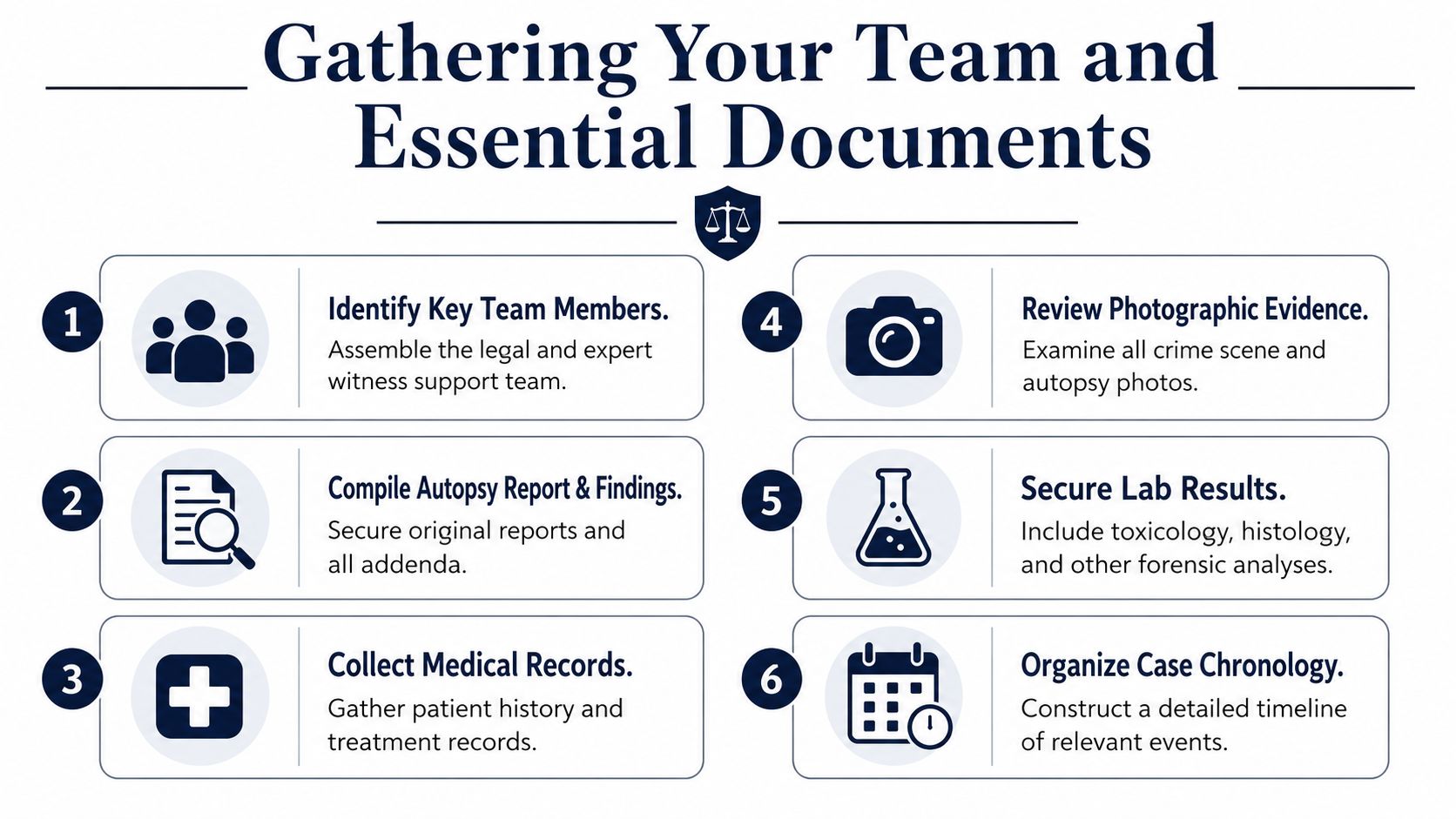
For autopsy cases, preparation starts with disciplined collection. We ask counsel to assemble the full record early enough for careful review, comparison, and correction. That includes making sure every item provided to the expert is the item counsel intends the expert to rely on. In forensic pathology litigation, that boundary matters as much as the records themselves.
Build the record set before shaping testimony
Deposition preparation is a team task. The attorney manages the production record and legal theory. The forensic pathologist reviews only the materials formally provided through counsel. A paralegal or case manager often tracks versions, Bates ranges, and late-arriving supplements. Families may also have records, photographs, or personal timelines that clarify treatment history or events before death.
That last point deserves care. In private autopsy matters, families are often the people who can identify what is missing. They may know that a hospitalization occurred at a different facility, that resuscitation records are incomplete, or that a scene photograph set is not the final one. Their input can improve accuracy without turning them into a substitute records department.
A sound file usually includes:
- Autopsy materials: The original report, addenda, photographs, diagrams, and any retained specimen documentation.
- Medical records: Prior treatment records, emergency department records, operative notes when relevant, and records from the terminal event.
- Field documentation: EMS reports, law enforcement reports, scene photographs, dispatch logs, and witness statements if they are part of the produced file.
- Laboratory results: Toxicology, histology, microbiology, and other testing tied to the death investigation.
- Case chronology: A dated timeline that places symptoms, treatment, collapse, pronouncement, and postmortem findings in sequence.
When families need help collecting and organizing records for counsel, Family Folder's guide to medical sharing is a practical reference.
Records do different jobs
In deposition work, not all documents carry the same weight. Some records establish chronology. Others test whether the history matches the body, the microscopy, or the toxicology. Good preparation identifies which documents support the opinion, which ones limit it, and which ones may create fair areas for cross-examination.
| Record type | Why it matters in deposition preparation |
|---|---|
| Scene photographs | They provide context for body position, visible injuries, lividity, environmental factors, and whether the reported history fits the physical setting. |
| EMS and law enforcement records | They often fix timing, initial observations, resuscitative efforts, and statements made close to the event. |
| Histology and toxicology | They may support the proposed cause of death, narrow alternatives, or show where medicine cannot answer a disputed question with certainty. |
| Witness statements | They can supply history, but they must be tested against objective findings and not treated as medical proof by themselves. |
For counsel who want a broader view of how these materials are used in litigation, this overview of pathology expert witness work explains the relationship between record review, opinion formation, and testimony.
Chain of custody affects opinion strength
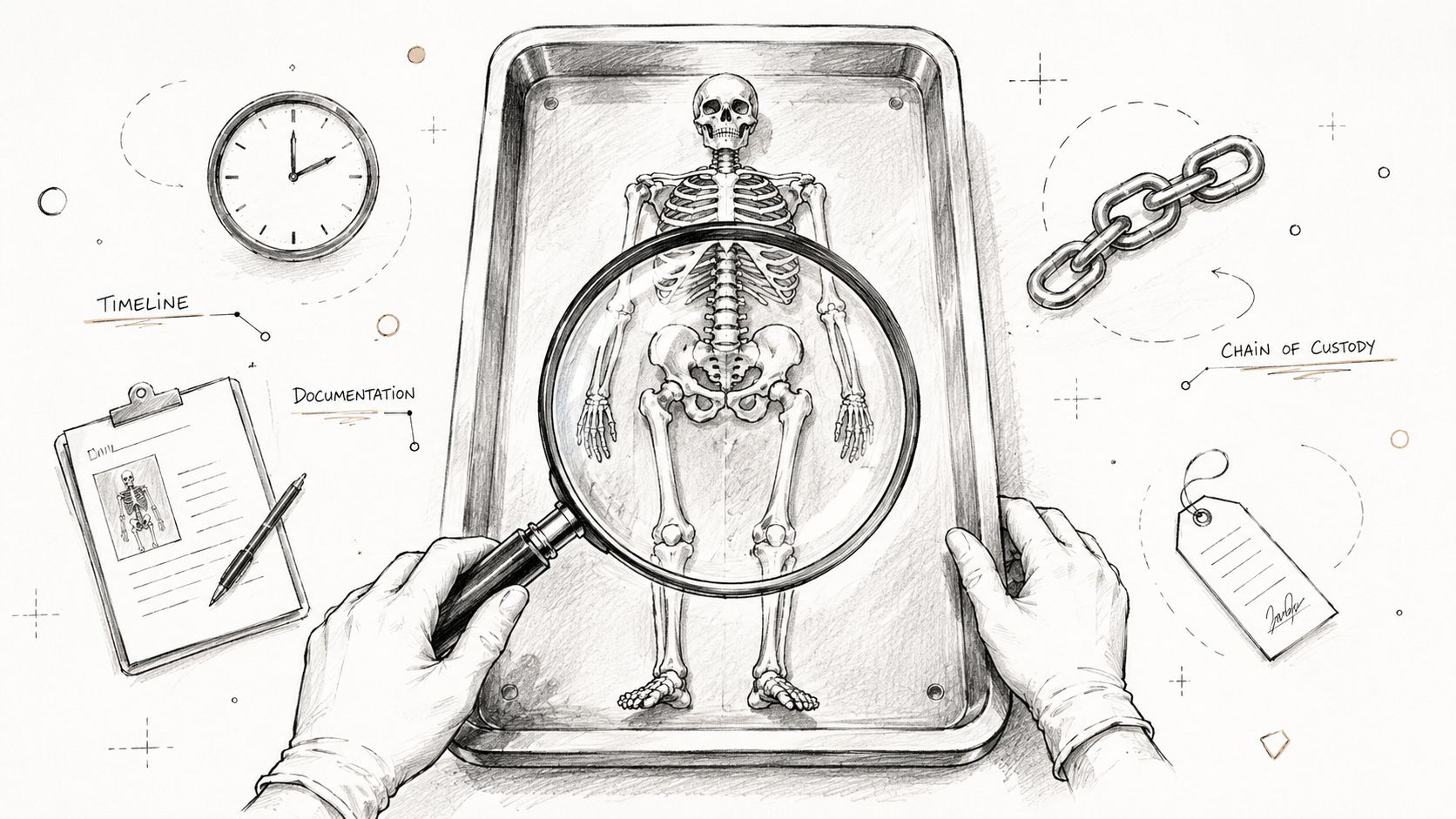
Chain of custody is the documented handling of evidence from collection through examination and reporting. In practice, it answers simple questions with serious consequences. What was collected, by whom, when, how was it labeled, where was it stored, and can the item examined later be shown to be the same item collected earlier?
In forensic pathology, that documentation protects credibility. If a toxicology specimen, photograph set, or retained tissue sample cannot be traced cleanly, opposing counsel will question the foundation for the opinion that relies on it. We have seen depositions shift from medical substance to record integrity in minutes.
The same principle applies to medical records. Experts should not independently search for outside records, download charts on their own, or fill gaps through informal channels. Counsel must provide the review set. That rule is often overlooked in generic deposition advice, but in our field it protects both fairness and the expert's independence.
Working with Your Forensic Pathology Expert
A pre-deposition conference works best when it is direct and candid. Counsel should expect more than a summary of the report. The meeting should walk through what was reviewed, what objective findings support the opinion, what alternative explanations were considered, and where the evidence has limits.
What happens in a pre-deposition conference
The most productive attorney-expert meetings are not performative. They are working sessions. Counsel may ask why one injury was significant and another was not. The pathologist may explain why a laboratory result changes the framing of a death but does not answer every disputed issue.
That conference is also where definitions should be stabilized. If the case will turn on medical language, the expert should be ready to explain it plainly. A jury may eventually hear terms like cause of death, manner of death, or postmortem interval, but the deposition often reveals whether those concepts can be taught clearly.
For attorneys evaluating whether an opinion will hold up under scrutiny, it can help to review how pathology testimony is developed in litigation settings, including this overview of pathology expert witness work.
The boundary that protects credibility
One issue deserves special attention because it is often missed in generic deposition advice. A forensic expert should review only the materials provided by retaining counsel. A pathologist should not independently enter a patient's chart or retrieve medical records outside that attorney-directed file.
That boundary is not a technicality. It protects the integrity of the testimony. As discussed in this article on provider deposition preparation and unauthorized chart review, accessing a patient's chart without authorization can raise HIPAA and professional ethics concerns and can damage credibility or even disqualify testimony.
Attorney-directed preparation is part of forensic discipline. Thoroughness does not mean independent chart access. It means careful review of the vetted evidentiary record.
For families, that rule can seem counterintuitive. Many assume the most prepared expert is the one who pulls every possible record from every source. In legal testimony, that's not always true. The credible expert is the one who stays inside the proper record and can explain exactly what was reviewed.
Mock Questioning and Testimony Coaching
The night before a deposition, the weak point is rarely the pathology. It is usually communication under pressure. In our work, mock questioning is how we find that weak point before testimony begins, especially in private autopsy matters where scientific precision and family sensitivity both matter.
Practice for direct and cross
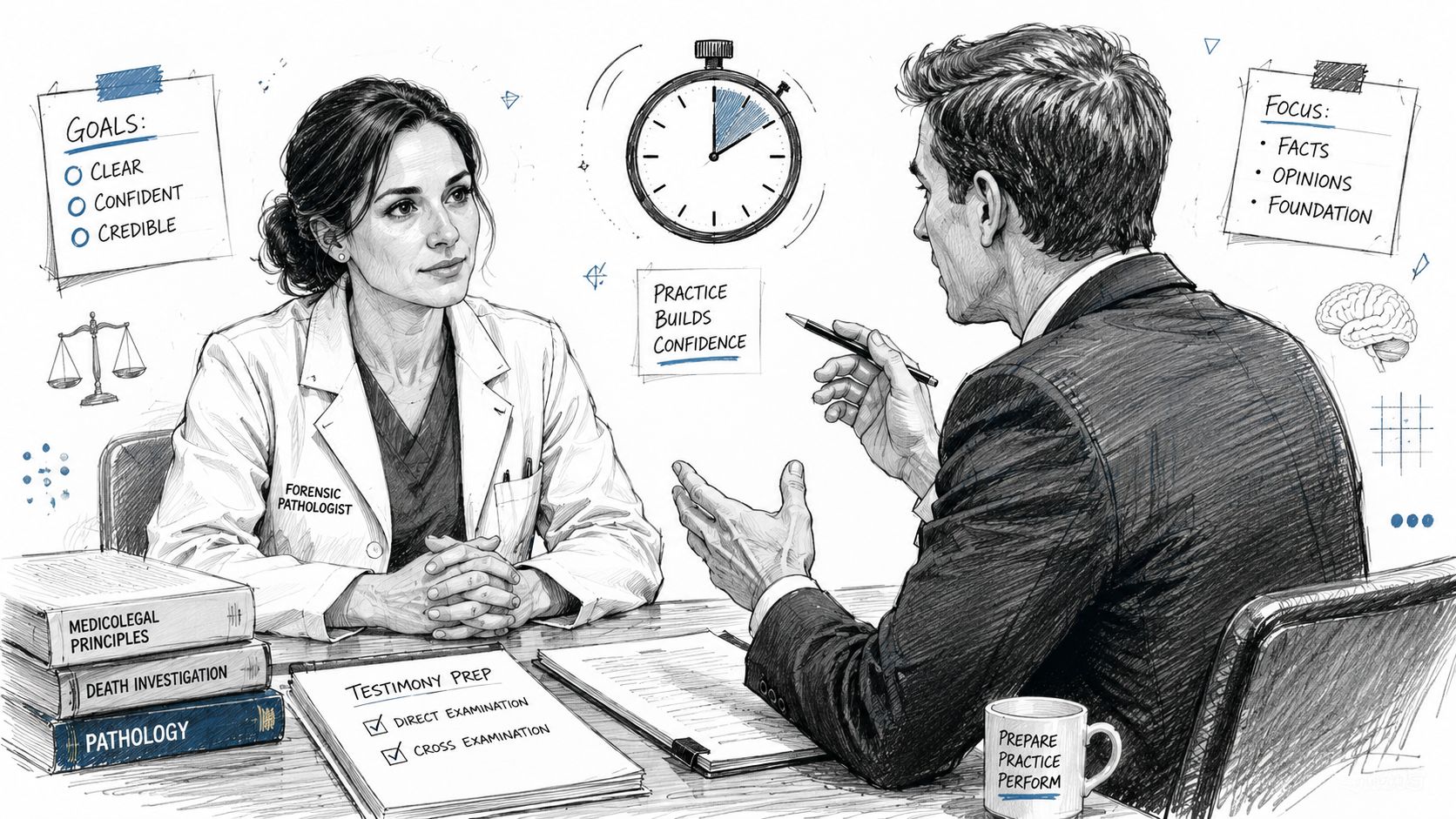
A useful rehearsal does more than review opinions. It tests whether the pathologist can explain the opinion in plain, disciplined language while staying inside the record provided by counsel. That boundary matters in forensic pathology depositions. An expert should be ready to say exactly what materials were reviewed, what findings support the opinion, and what remains outside the available record.
On direct examination, we want a clear sequence. The witness should be able to explain the autopsy findings, the medical records and other materials supplied by counsel, the differential considerations, and the reasoning that leads to the final conclusion. In family-centered cases, that same explanation must stay understandable to non-physicians. Technical accuracy is required. So is language a family member could hear without feeling shut out of the process.
Cross-examination tests different skills. Opposing counsel may shorten a question, remove context, press for yes-or-no answers to nuanced medical issues, or suggest certainty where the science allows only probabilities. Good preparation addresses those pressure points directly. We practice answering the question asked, correcting incomplete premises when necessary, and stopping once the answer is complete.
Our guide to expert witness preparation for forensic pathology testimony discusses this in more detail, particularly the difference between being well prepared and sounding scripted.
Why video rehearsal can help
When the stakes justify it, video practice is useful. The National Institute of Justice explains in its legal guide for forensic experts on deposition preparation that a videotaped rehearsal lets counsel test substance and presentation at the same time.
That matters more than many attorneys expect.
A forensic pathologist may have a sound opinion and still appear uncertain if the pace is rushed, the answer starts before the question ends, or the witness slips into unexplained medical shorthand. Video makes those habits visible. It also helps the expert hear where an answer becomes too long, too defensive, or too abstract for a jury or family member following the case.
The value of rehearsal is easier to see when the process is observed in action:
The best-prepared expert stays accurate when a question is awkward, incomplete, or unfairly framed, and keeps that accuracy without losing clarity or compassion.
Navigating Common Pitfalls in Testimony
Many weak depositions do not fail because the science is weak. They fail because the delivery creates avoidable problems. A careful expert can still lose clarity by talking too much, filling silence with speculation, or answering with language that only another specialist would understand.
The mistakes that weaken good science
The most common errors are familiar. A witness volunteers information that was not asked for. A witness guesses instead of acknowledging uncertainty. A witness starts debating counsel instead of answering the question. A witness uses technical terms without defining them.
Those are not minor style issues. They can make a measured opinion look defensive or overstated.
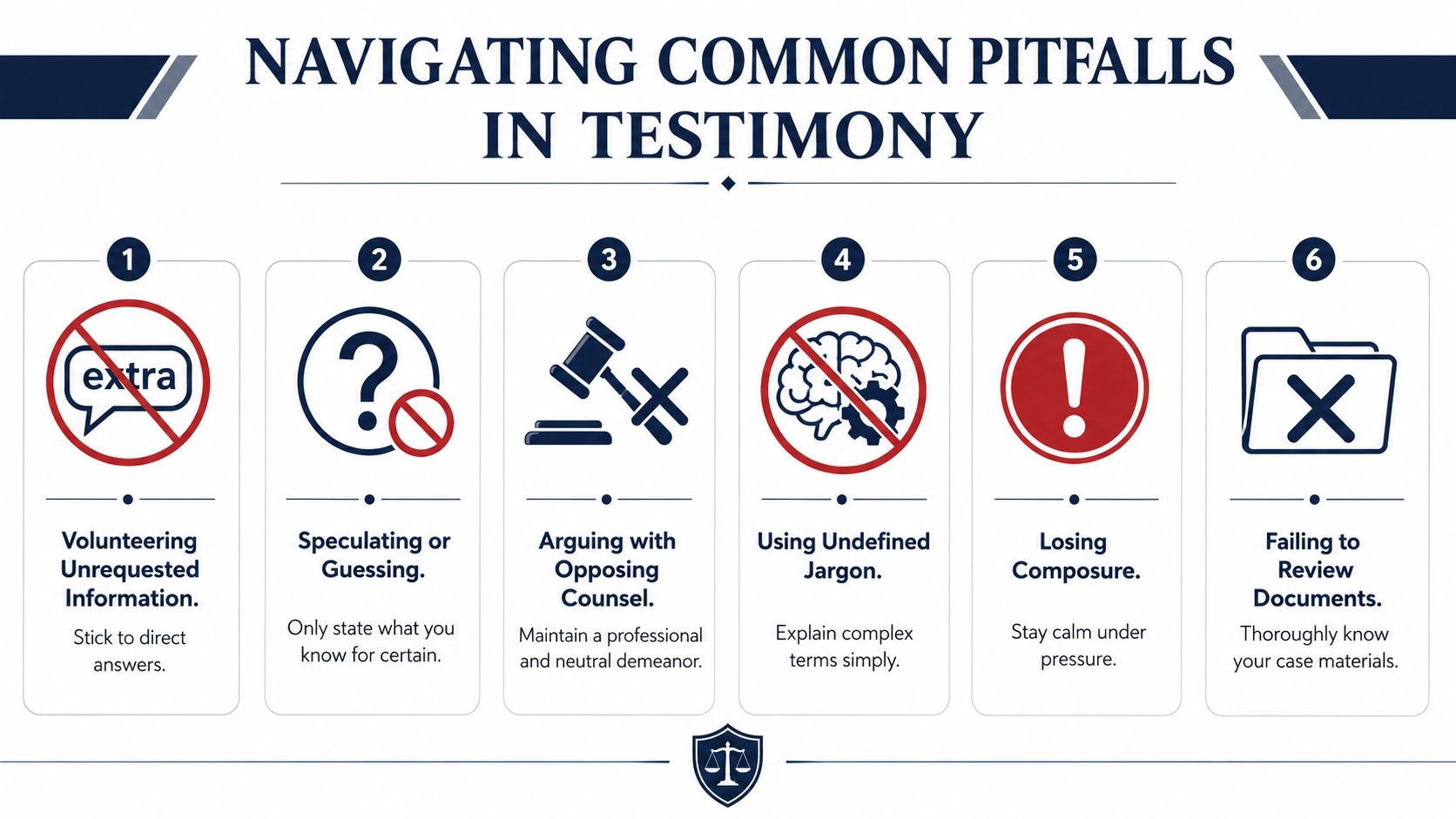
As noted in this expert tips checklist for deposition preparation, common pitfalls include volunteering unrequested information, guessing or speculating, using technical jargon, and arguing or becoming defensive. The same guidance emphasizes listening carefully, answering only what is asked, and saying "I don't know" when appropriate.
The habits that strengthen credibility
Good testimony usually sounds simpler than the preparation behind it. That simplicity comes from discipline.
- Pause before answering. A short pause helps the witness hear the exact question and avoid answering the version they expected instead.
- State limits plainly. "I don't know" is often stronger than a qualified guess. So is "that issue is outside the materials I reviewed."
- Translate technical language. If a medical term must be used, define it in ordinary language immediately.
- Stay neutral in tone. An expert is there to educate the record, not to win an exchange with opposing counsel.
A brief comparison captures the difference:
| If the witness does this | The testimony usually becomes this |
|---|---|
| Volunteers extra information | Broader, less controlled, and easier to challenge |
| Answers only the actual question | Tighter, clearer, and more reliable |
| Uses unexplained jargon | Harder for non-medical listeners to trust |
| Defines terms in plain language | Easier for counsel, court, and family to follow |
A Commitment to Clarity and Truth
Careful deposition preparation is one part of a larger professional obligation. The work is to present medically sound findings clearly, acknowledge limitations truthfully, and keep the testimony anchored to the evidence.
That standard matters whether the audience is a family seeking a clearer understanding of a death or an attorney preparing a case around disputed medical facts. A well-prepared expert does not make the evidence say more than it can support. The expert also does not shrink from explaining firm conclusions when the findings justify them.
For families considering an independent examination, a Private Autopsy can provide an objective postmortem review performed under a documented and legally compliant process. When questions remain, direct communication and careful explanation matter just as much as technical accuracy.
Frequently Asked Questions About Autopsy Depositions
How should families handle communication during a legal case
Families usually benefit from routing legal communications through their attorney. That keeps the record organized and reduces the risk of confusion about who is requesting information, what materials have been shared, and what issues are under review.
We also recognize that grief and legal process often overlap in difficult ways. Families deserve clear answers delivered respectfully, but legal strategy should remain with counsel.
What is the difference between cause of death and manner of death
Cause of death is the specific medical reason a person died. Examples can include a disease process, a toxic exposure, or an injury. The wording should identify the medical mechanism or condition responsible for death.
Manner of death is the classification of the circumstances. In forensic practice, common categories include natural, accident, suicide, homicide, and undetermined. The manner is not a moral judgment. It is a medicolegal classification based on the investigation as a whole.
Can an autopsy happen without family consent in Texas
Yes, in some situations. Under Texas Code of Criminal Procedure Article 49.25, autopsies may be legally required without next-of-kin consent in certain cases, including deaths caused by inflicted injury, unexpected or unexplained deaths in children under 18, or deaths associated with law enforcement action, as discussed in this explanation of Texas autopsy authority and consent.
A private autopsy, however, is different. It requires written consent from the legal next of kin. That distinction is important for families comparing government-ordered examinations with independent services such as County Forensic Autopsies, which operate under separate legal authority.
What does chain of custody mean in plain language
Chain of custody is the documented history of how evidence was handled. It shows what was collected, who handled it, when it changed hands, and whether it remained secure and identifiable.
In postmortem work, that can apply to specimens, photographs, personal effects, and records. If chain of custody is weak, confidence in the related conclusions may also weaken.
Are all autopsies performed the same way
No. Standards and legal authority differ by setting. The National Association of Medical Examiners states in its Forensic Autopsy Performance Standards that a forensic pathologist must personally perform all autopsies and all dissections of removed organs, while directly supervising others involved in the procedure. In Texas, private facilities also operate under separate statutory requirements from medical examiner offices, including provisions in Texas Health & Safety Code Chapter 671A.
For families and attorneys, the practical point is simple. Ask who performed the examination, what legal framework applied, and how the evidence was documented.
If you need guidance about autopsy findings, expert testimony, or the process for an independent examination, contact Texas Autopsy Services. Our team serves all 254 Texas counties, and every examination is performed by a forensic pathologist certified by the American Board of Pathology. We communicate with medical precision and compassion, and we can help you understand the process, the legal boundaries, and the next practical step.