May 23, 2026 · Texas Autopsy Services
A Forensic Pathologist's Expert Witness Preparation Guide
My guide to expert witness preparation for attorneys and experts. Learn a forensic pathologist's process for vetting, reports, deposition, and trial testimony.
On this page
When people contact me about expert testimony, they are often already under pressure. An attorney may have a deposition date approaching. A family may be trying to understand whether the medical findings in a death investigation were fully addressed. A hospital, agency, or county may need a forensic pathologist who can review the record carefully and then explain it in plain language.
That moment is where expert witness preparation either helps the case or hurts it.
At Texas Autopsy Services, every examination is performed by a board-certified forensic pathologist experienced in medicolegal death investigations. Our work centers on one principle: follow the evidence carefully, explain it plainly, and treat the deceased and their family with respect.
TL;DR
- Expert witness preparation starts with the record. In forensic pathology, every opinion has to trace back to documented facts, medical findings, and a reliable method.
- A strong expert is more than a CV. Credentials matter, but so do prior testimony, consistency, communication, and transparency about compensation and limits.
- The written report is the backbone of testimony. It should explain the basis for each opinion in language lawyers, judges, and jurors can follow.
- Mock examination matters. Rehearsing direct and cross helps the expert stay concise, accurate, and natural under pressure.
- Forensic pathology testimony requires special care. Complex medical findings, sensitive images, and cause-of-death opinions must be presented with both precision and respect.
The Foundation of Credible Testimony
A common situation looks like this. An attorney has records, scene photographs, an autopsy report, and several competing theories. The lawyer does not need an expert who can say, “I disagree.” The lawyer needs an expert who can explain why, identify what facts support the opinion, and state where the evidence stops.
That is where real expert witness preparation begins.
Under the modern Federal Rule 702 standard, an expert may testify only if the court finds it more likely than not that the testimony is based on sufficient facts or data, is the product of reliable principles and methods, and reflects a reliable application of those methods to the case facts. In practice, that means I cannot rely on instinct, reputation, or experience alone. I have to show my work.
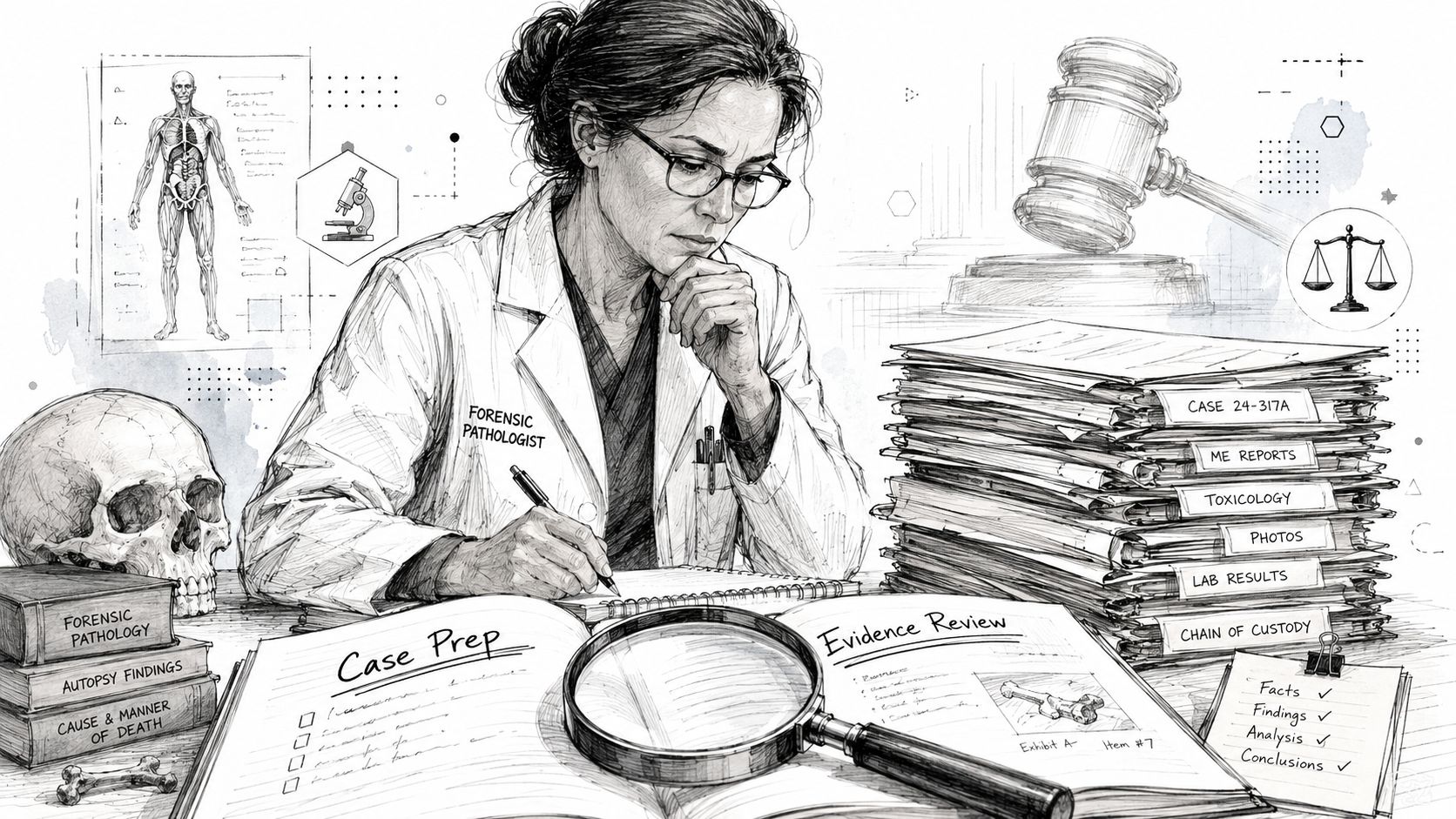
Start with shared definitions
In forensic pathology, precision starts with vocabulary.
- Cause of death means the disease or injury that set the fatal process in motion.
- Manner of death means the classification of how the death occurred, such as natural, accident, suicide, homicide, or undetermined.
- Chain of custody means the documented handling of evidence from collection through review, so the parties can account for what was examined and by whom.
If those terms are loose, the rest of the testimony will be loose too. I often find that what looks like a disagreement in a case is really a disagreement about definitions, assumptions, or the scope of the question.
Preparation is not scripting
I don't prepare by memorizing polished lines. That approach usually fails under real questioning. A better method is to work from first principles. What did I review. What findings are established. What inferences are reasonable. What alternative explanations were considered and rejected, and why.
Practical rule: If an opinion cannot be traced back to identified records, photographs, specimen findings, toxicology, or other documented facts, it is not ready for testimony.
Attorneys and experts also need to know whether the underlying material is dependable. For lawyers sorting through mixed records, a basic guide to source credibility is useful because not every document in a file carries the same weight. A draft note, a final pathology report, an EMS narrative, and a family statement may all matter, but they do not play the same role.
I've written elsewhere about the working relationship between pathology and legal review in a pathology expert witness discussion. The short version is simple. Credible testimony is built before anyone enters the courtroom. It is built in the file, in the report, and in the discipline to stay within the evidence.
More Than a CV The Vetting Process
A resume can tell you whether an expert has training. It cannot tell you whether that expert will hold up well in deposition, remain fair under pressure, or explain a difficult opinion without sounding evasive.
I expect careful lawyers to look beyond credentials, even though credentials matter. I am board-certified by the American Board of Pathology in Anatomic Pathology, Clinical Pathology, and Forensic Pathology. I have performed over 1,000 autopsies across adult, pediatric, and complex forensic cases. Those qualifications establish foundation. They do not answer every practical question an attorney should ask.
What a sharp attorney should examine
The most useful vetting is concrete.
| Question | Why it matters |
|---|---|
| Has the expert stayed within the actual scope of training and case experience? | Overreach creates avoidable impeachment risk. |
| Can the expert explain conclusions in plain English? | Juries rarely reward technical obscurity. |
| Has the expert taken positions in prior cases that create obvious inconsistency? | Opposing counsel will look for it. |
| Is the fee structure clear and defensible? | Hidden ambiguity can be framed as bias. |
| Does the expert acknowledge limits when the record is incomplete? | That often strengthens credibility. |
One of the more underused steps is a pre-testimony audit. Judicial guidance supports reviewing prior opinions, publications, discipline history, and compensation structure, then preparing the expert to explain any apparent inconsistency in plain language in high-stakes medical and forensic matters, where consistency and transparency may be more persuasive than polished certainty, as discussed in California courts' direct examination guidance for experts.
Red flags I take seriously
Some warning signs show up early.
- Absolute language without support. If an expert speaks in certainty where the record is mixed, cross-examination will expose it.
- An argumentative posture. The courtroom is not the place for ego.
- A vague methodology. “Based on my experience” is not enough by itself.
- Unfamiliarity with prior work. If the expert has not reviewed prior publications or testimony that may be used for impeachment, preparation is incomplete.
The most persuasive expert is often the one who sounds least interested in advocacy and most committed to accuracy.
This is why I tell attorneys to think in categories, not labels. A physician is not automatically the right forensic expert. A pathologist is not automatically the right testifying witness. The fit depends on the issue, the records, and the expected lines of attack. That distinction is important in broader discussions about types of expert witness roles, especially in death investigation work where medicine and legal standards meet.
From Case File to Defensible Report
A forensic pathology opinion starts to fail long before trial if the file review is superficial. I have seen that happen when an attorney receives a polished conclusion built on partial records, missing scene context, or toxicology read in isolation. The report then becomes the weak point because every omitted fact is available for cross-examination.
In my practice, preparation starts with the whole evidentiary record. That means medical records, EMS and law enforcement documentation, scene photographs, witness statements when they bear on timing or mechanism, autopsy findings, histology, toxicology, and any later supplements or corrections. If evidence passed through several custodians, I track chain of custody closely because mishandled specimens and unclear transfers can affect both the medical interpretation and the testimony that follows.
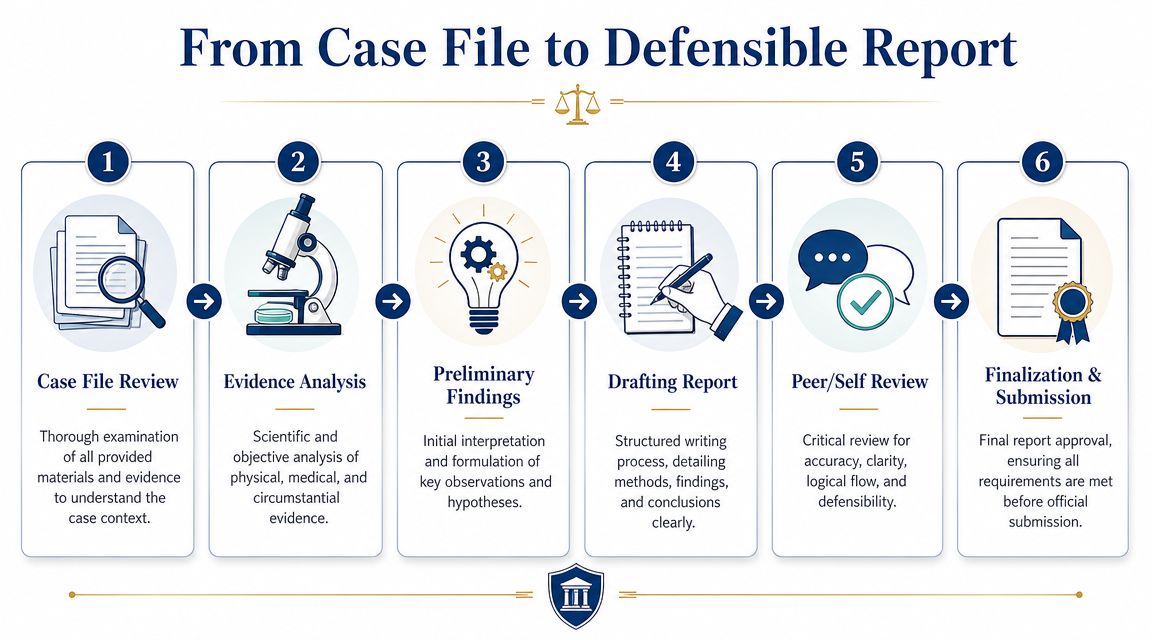
What I look for in the record
I read the file in chronological order first, then by issue.
That second pass matters. A timeline may look coherent until the photographs are compared against the body diagram, the EMS run sheet is checked against the hospital record, or the toxicology panel is matched to the collection site and postmortem interval. In forensic pathology, those details are not clerical. They shape opinions on cause of death, manner of death, injury timing, survival interval, and whether an alternative explanation still fits.
I also look for silence in the record. Missing temperatures, undocumented specimen sources, absent microscopy, and vague scene descriptions can narrow the confidence of an opinion even when the final conclusion remains unchanged. A careful report has to reflect that trade-off. Overstating certainty may satisfy a client in the short term, but it makes the testimony easier to attack.
Large files create their own problems. Version control, exhibit labeling, and annotation systems help attorneys keep the review organized, and some firms use legal tech for lawyers for exactly that reason. I still verify the substance myself. No platform can decide whether a lividity pattern matches the reported body position or whether a drug level is being interpreted outside its proper context.
How a defensible report is built
A defensible report lets the reader trace the path from evidence to opinion without guessing how the conclusion was reached.
I write with a clear separation between observation and interpretation. The report should identify the materials reviewed with enough detail to show the foundation for the opinion. It should state the objective findings first, then explain the medical reasoning, then address limitations, competing explanations, and any point that remains uncertain. That structure matters in forensic pathology because the same set of injuries can raise different legal questions depending on timing, mechanism, and surrounding circumstances.
The strongest reports also say what the evidence does not establish. If toxicology supports exposure but not impairment at a specific moment, I say that. If the autopsy supports blunt force injury but does not by itself identify who inflicted it, I say that too. Those limits do not weaken the opinion. They make it more credible.
A useful way to see that structure is this example of a pathology report. Attorneys preparing a forensic expert should expect that level of organization, especially in cases where the medical findings will later be tested line by line in deposition or at trial.
A sound forensic report answers the medical question and shows the steps that support the answer.
As noted earlier, the current Rule 702 framework puts pressure on the expert to show adequate facts, a reliable method, and a reliable application of that method to the case. In practice, that means a report cannot read like advocacy with citations to follow later. It has to function as a medical analysis that can survive legal scrutiny.
Mastering the Narrative Deposition and Direct Exam
The best direct examination I've seen did not sound rehearsed. It sounded orderly.
The attorney started with qualifications, moved quickly to the materials reviewed, then built the testimony around the opinion formation process rather than around isolated conclusions. That sequence matters because jurors usually trust a conclusion more when they understand the road that led there.
Building the testimony around method
A useful preparation approach is to begin well before the final pretrial rush. A practical model is to start expert preparation 60 to 90 days before trial and to map the expert's opinion formation process early, then build the deposition or trial narrative around the underlying data, methodology, assumptions, and limitations, as explained by Courtroom Sciences.
In forensic pathology, that often means the direct exam follows a pattern like this:
- What records and materials were reviewed.
- What objective findings were established.
- What medical principles applied.
- What competing explanations were considered.
- Why the final opinion is the best supported one.
That order keeps the testimony anchored. It also reduces the chance that the expert sounds like a partisan advocate who arrived with a fixed answer.
Translating medical detail for a lay audience
An effective direct exam usually avoids jargon unless the term is necessary and then defined immediately.
For example, instead of stating that “the decedent had petechial hemorrhages and visceral congestion consistent with asphyxial physiology” and leaving it there, I would explain the observed findings and then state what those findings may suggest, while also clarifying that no single finding should be interpreted in isolation. The jury does not need a lecture in pathology terminology. The jury needs a reliable explanation.
A strong attorney also uses exhibits carefully. A diagram, timeline, or selected image can clarify an injury path or medical sequence. Too many visuals, or poorly chosen ones, can distract or inflame. In death cases, restraint matters.
The direct examination should make the science easier to understand, not heavier to carry.
When preparation goes well, the testimony sounds calm and conversational. The expert knows the file well enough to answer naturally, correct small misstatements without defensiveness, and return to the evidence when the question gets abstract. That is usually more persuasive than polished language. Jurors tend to notice when an answer sounds lived-in rather than memorized.
Anticipating the Attack Cross-Examination Strategy
Cross-examination is not a surprise event. The themes are usually visible in advance.
In forensic pathology cases, the likely attacks are familiar. Bias. Compensation. Incomplete review. Alternative cause of death. Prior testimony. A phrase from the report taken out of context. A demand for a yes or no answer to a question that requires conditions or limits.
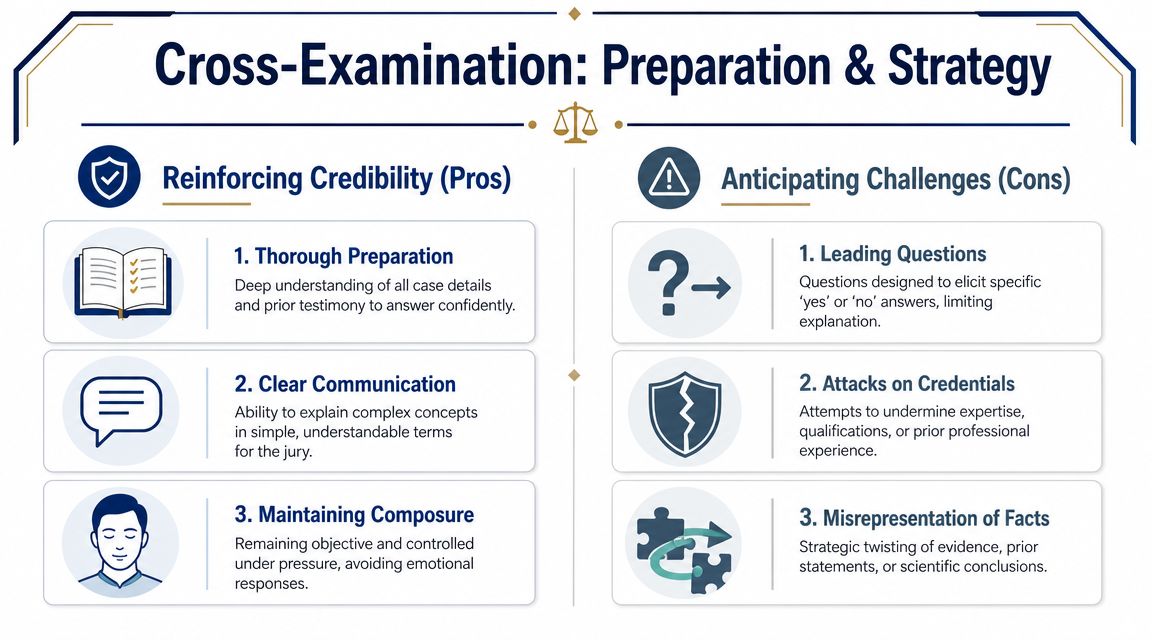
What works under pressure
The most reliable cross-examination habits are simple.
- Listen to the full question. Many errors happen because the witness starts answering too soon.
- Answer only the question asked. Volunteering extra material often opens new attack points.
- Keep the answer short when the question is narrow. Long answers can sound evasive.
- Acknowledge limits directly. If the record does not support certainty, say so.
- Correct inaccuracies calmly. The tone matters almost as much as the correction.
Mock examinations are often used to benchmark the behaviors that tend to build jury trust, including concise, question-specific answers, plain-language explanations, and clear acknowledgment of uncertainty when the record does not support a firm opinion, as described in IMS Legal's preparation guidance. The caution is important too. Over-coaching can make testimony sound mechanical or biased.
What usually hurts credibility
I see the same mistakes repeatedly when experts are poorly prepared.
| Mistake | Likely effect |
|---|---|
| Fighting every premise, even a fair one | Makes the witness look defensive |
| Guessing when the record is incomplete | Creates impeachment material |
| Using technical language to avoid a direct answer | Looks evasive |
| Arguing with counsel | Shifts focus away from the evidence |
| Treating every question as hostile | Prevents clear teaching moments |
Cross can strengthen the expert's credibility when the witness remains measured and grounded. If opposing counsel presses a point that is fair, I agree with it. If counsel overstates the record, I narrow the answer back to what is supported. In cases involving public agency review, including some county forensic autopsy matters, that discipline becomes even more important because the testimony may be scrutinized well beyond the courtroom itself.
The witness who says “I don't have a basis to go further than that” often sounds more trustworthy than the witness who tries to win every exchange.
The Forensic Pathologist on the Stand
A jury is looking at an autopsy photograph. Counsel asks for the cause of death in one sentence. The answer has to be medically exact, legally responsive, and understandable to people with no training in pathology.
That is the job on the stand.
Forensic pathology testimony asks the witness to convert a physical examination, scene information, records review, and laboratory findings into testimony that can survive scrutiny in court. Preparation in this field is structured for a reason. IBISWorld projects the U.S. Expert Witness Consulting Services industry will include 11,925 businesses by 2025 and reach a market size of $789.5 million by 2026, according to its industry report on expert witness consulting services. In a discipline like forensic pathology, that demand reflects a practical reality. Good testimony usually comes from a repeatable method, not courtroom improvisation.
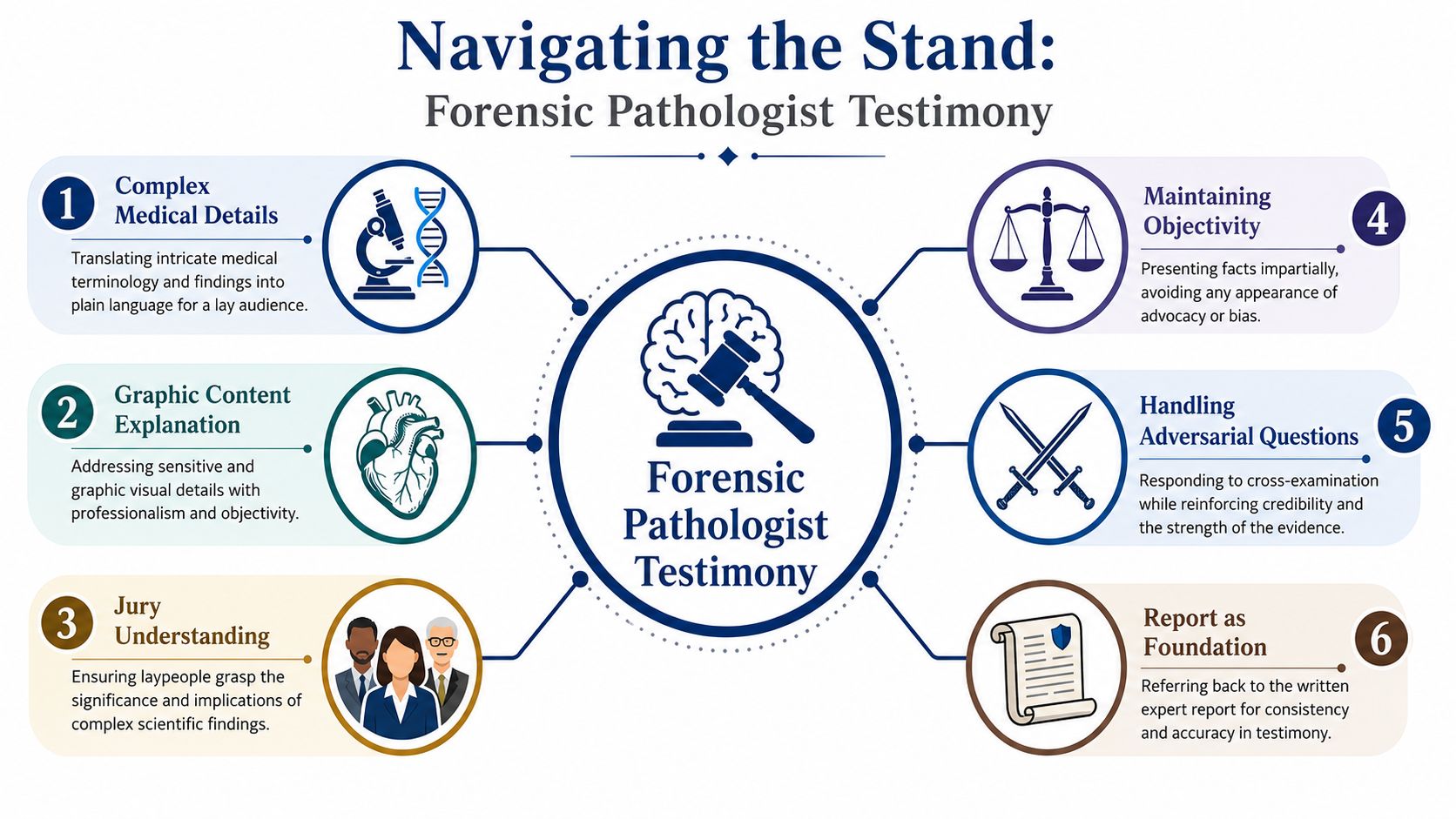
Explaining sensitive findings without losing the jury
Death investigation presents a specific problem that generic expert-witness advice often misses. The medical facts are developed through an examination of a deceased person, often with graphic findings, layered timing questions, and opinions that depend on pathology, toxicology, and investigative context together. By the time those facts reach a courtroom, the pathologist has to teach from that record without overwhelming the fact finder or blunting the science.
I handle that by separating three things with care. What was observed. What was measured or documented. What can reasonably be inferred from those findings. Jurors usually follow difficult testimony well if the structure is disciplined.
Graphic material needs the same discipline. If a photograph or autopsy image is used, it should answer a defined question such as wound location, injury track, or the basis for identifying disease or trauma. It should not appear just because it is available in the file. Respect for the deceased matters. Respect for the jury matters too.
The examination setting shapes that later testimony. Careful documentation, accurate measurements, and proper handling of the body determine whether an opinion remains defensible months or years later. That standard of dignity and documentation also applies in the postmortem setting, including work performed through the Waterloo Mortuary Partnership, where the examination environment must support careful documentation and respectful handling.
The stand requires translation, not simplification
An autopsy report is written for physicians, investigators, and lawyers. Testimony is different. On the stand, I cannot assume the listener knows the difference between contusion and abrasion, therapeutic and toxic drug levels, or immediate cause of death and mechanism of death. Those distinctions still matter, so the language has to change while the opinion stays exact.
That is a disciplined translation process.
I use concrete terms, short definitions, and sequencing that mirrors how the medical conclusion was reached. For example, if the opinion depends on neck findings, scene circumstances, and toxicology together, I say that directly and explain the contribution of each source. If one finding is suggestive but not diagnostic by itself, the jury should hear that plainly. That approach protects the science and makes cross-examination less likely to distort the opinion.
This short video offers a useful courtroom-oriented perspective on expert testimony dynamics.
Objectivity is the center of it. The forensic pathologist is not on the stand to advocate for a preferred narrative. The task is to explain what the autopsy showed, how the medical record and investigative record affect interpretation, what conclusions the findings support, and where the evidence stops. In Texas, that testimony also sits within a legal and regulatory framework that includes the Texas Health and Safety Code and the professional standards that govern postmortem practice.
Frequently Asked Questions About Expert Preparation
When should expert witness preparation begin
Earlier than is typically preferred. The strongest preparation starts when the record is still being organized and the weaknesses can still be identified. Waiting until the last stretch before testimony often leaves too little time to test assumptions, review prior statements, and refine the language of the opinions.
What is the most common mistake
Late engagement. A close second is incomplete record review. An expert who has not seen the critical records, scene material, or prior reports is vulnerable from the start.
Does preparation mean rehearsing exact answers
No. It means understanding the file, the basis for each opinion, the likely areas of challenge, and the limits of the evidence. Scripted testimony usually sounds scripted.
What should attorneys ask a forensic pathology expert before retention
Ask what materials the expert needs, what methodology will be used, whether there are any likely scope limits, and whether prior testimony or publications may create impeachment issues. Ask how the expert handles uncertainty. That answer tells you a lot.
Can a forensic pathologist help without testifying
Yes. Case review, report analysis, and second-opinion pathology work can clarify medical issues even if the matter never reaches deposition or trial.
If you need careful review of a death investigation, autopsy findings, or forensic pathology issues tied to litigation, Texas Autopsy Services can provide direct guidance on whether an independent review is appropriate. Families, attorneys, medical professionals, and agencies often benefit from an early conversation that clarifies the records available, the questions being asked, and the limits of what forensic pathology can responsibly answer.