April 6, 2026 · Texas Autopsy Services
Types of Expert Witness in Death and Injury Cases
The expert witnesses retained in Texas death and injury cases, what each is qualified to say, and where the boundaries between their specialties fall.
On this page
When a death or serious injury reaches litigation, the facts rarely speak for themselves. They are interpreted for the court by expert witnesses, and which experts a case needs is one of the first strategic decisions counsel makes.
This guide sets out the categories of expert most often retained in death and injury matters in Texas, what each one is actually qualified to say, and where the boundaries between them lie. Retaining the wrong specialty, or asking the right specialty to opine beyond its field, is a common and avoidable way for testimony to be excluded.
What Makes Someone an Expert Witness in Texas
Under Texas Rule of Evidence 702, a witness qualified by knowledge, skill, experience, training, or education may offer opinion testimony if it will help the trier of fact. Texas courts assess reliability under the framework set out in E.I. du Pont de Nemours & Co. v. Robinson, the state analogue to the federal Daubert standard.
Two thresholds follow from that, and they are separate. Qualification asks whether this witness is entitled to opine on this subject. Reliability asks whether the method behind the opinion is sound. An eminent expert opining outside their field fails the first; a well-qualified expert relying on an untested methodology fails the second.
Medical and Death-Investigation Experts
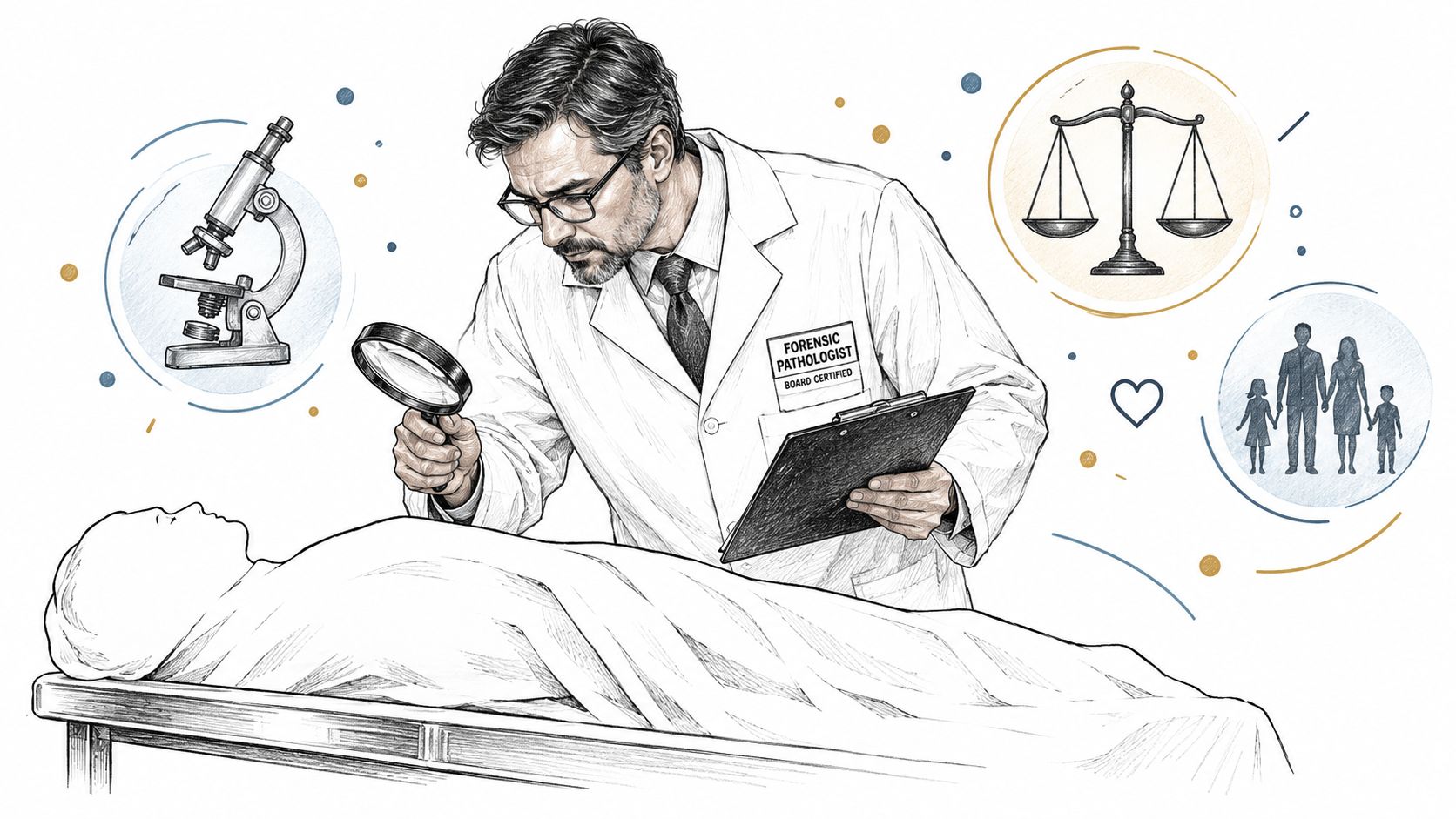
Forensic pathologist. Determines cause and manner of death from autopsy findings, scene context, and medical history. Central to any case where the mechanism of death is disputed, where an official ruling is challenged, or where injury timing and sequence are at issue.
Forensic toxicologist. Interprets drug, alcohol, and poison findings — not merely what was present, but at what concentration, by what route, and with what likely effect. Postmortem redistribution means a raw laboratory number is frequently misleading without this interpretation.
Treating physician. Testifies to what they observed and did. A treating physician is often a fact witness first, and courts scrutinise the point at which their testimony crosses into retained-expert opinion about causation.
Forensic anthropologist. Works from skeletal remains where soft tissue is unavailable — biological profile, trauma analysis, and postmortem interval. Relevant in exhumation, decomposition, fire, and unidentified-remains cases.
Forensic odontologist. Identifies remains through dental comparison, and in some matters analyses bite-mark evidence — an area where the scientific literature has grown notably more cautious, and where reliability challenges are common.
Scene, Physical, and Engineering Experts
Crime scene reconstructionist. Integrates physical evidence into a sequence of events, addressing whether a proposed account is consistent with what the scene shows.
Bloodstain pattern analyst. Interprets the size, shape, and distribution of stains to address mechanism and position. Like bite-mark analysis, this discipline has faced substantial methodological scrutiny, and its limits should be understood before it is relied upon.
Accident reconstruction engineer. Applies physics to vehicle collisions, falls, and industrial incidents — speeds, forces, and whether a stated mechanism could produce the observed injuries.
Digital forensics examiner. Recovers and authenticates electronic evidence: device data, location history, message content, and metadata establishing timing.
Damages and Care Experts
Life care planner. Projects the future medical and support needs of a surviving injured party, and the cost of meeting them.
Forensic economist. Quantifies economic loss — lost earnings, benefits, household services — reduced to present value.
Legal nurse consultant. Analyses medical records for standard-of-care issues and chronology. Frequently a consulting rather than a testifying role.
Choosing Between Overlapping Specialties
The categories above overlap at their edges, and the overlap is where cases are won or lost. A few boundaries worth holding clearly:
- A forensic pathologist can testify that an injury pattern is consistent with a fall from height. An engineer, not a pathologist, addresses the mechanics of how the fall occurred.
- A toxicologist interprets what a drug concentration means. Whether that drug caused death is a cause-of-death determination, which sits with the pathologist.
- A treating physician describes the care given. Whether that care met the standard is normally the province of a retained expert in the same specialty.
Where a death is central to the case, the forensic pathologist's opinion often anchors the others: toxicology, engineering, and economic testimony are typically built on a determination of how and when the person died.
How an Independent Examination Fits
Where an official cause-of-death determination is disputed, incomplete, or was made without an autopsy, an independent examination can establish an evidentiary record before litigation positions harden. Texas Autopsy Services performs independent forensic autopsies and case reviews for families and counsel across Texas, and can provide expert testimony where a matter proceeds to deposition or trial.
Frequently Asked Questions About Expert Witnesses
How many types of expert witness might a single death case need?
Most turn on one to three. A contested overdose might need a forensic pathologist and a toxicologist; a fatal collision might add an accident reconstruction engineer and an economist. Retaining more experts than the issues require invites inconsistency between them.
What is the difference between a consulting and a testifying expert?
A consulting expert advises counsel and is generally not disclosed; a testifying expert offers opinions in deposition or at trial and is subject to disclosure and cross-examination. The same person can begin in one role and move to the other, which has discovery consequences worth planning for.
Can the same expert work for either side?
An expert may be retained by plaintiffs in one matter and defendants in another. What matters is that the methodology and conclusions do not shift with the retaining party. An expert who only ever reaches one side's conclusion is straightforward to impeach.
What gets expert testimony excluded in Texas?
Most commonly, opining outside the witness's field, relying on a methodology that has not been tested or accepted, or an analytical gap between the data and the conclusion that the expert cannot bridge. Under Robinson, the trial court decides these questions before the jury hears the opinion.
When should an expert be retained?
Earlier than most cases do. Where a death is involved, some evidence degrades with time and some — such as an examination before burial or cremation — becomes far harder to obtain later.