June 27, 2026 · Texas Autopsy Services
Reasonable Medical Certainty in Texas Autopsies
Learn what 'reasonable medical certainty' means in a Texas autopsy report. Our forensic pathologists explain this legal standard for families and attorneys.

On this page
- The Role of the Board-Certified Forensic Pathologist
- What Reasonable Medical Certainty Actually Means
- How Pathologists Apply This Standard in an Autopsy
- Reasonable Certainty in Court and Texas Law
- Critical Misunderstandings That Impact Legal Cases
- Guidance for Families and Attorneys
- Frequently Asked Questions
- Reasonable medical certainty is a legal phrase, not a scientific measurement.
- It does not mean absolute certainty, and it is not a fixed percentage in medicine.
- The strength of an autopsy opinion comes from the evidence behind it, including the examination, records, toxicology, microscopy, and scene or investigative context when available.
- Texas cases often turn on whether the expert can explain why one conclusion is medically preferable, especially when more than one possible cause exists.
- Families and attorneys should focus less on magic words and more on method, documentation, and objectivity.
A family has just lost someone unexpectedly. An attorney has a report on the desk that answers some questions but leaves others open. A county official may need an outside review in a death that could face scrutiny later. In each of those situations, the same phrase often appears and creates confusion: reasonable medical certainty.
We see that confusion often. People assume the phrase has a fixed scientific definition, or that an expert opinion is unreliable unless it includes those exact words. Neither assumption is correct. In autopsy work, the fundamental issue is whether the opinion is grounded in careful forensic pathology, supported by the available evidence, and stated clearly enough to withstand legal review.
The Role of the Board-Certified Forensic Pathologist
Who is qualified to render the opinion
Before anyone weighs a phrase like reasonable medical certainty, it helps to understand who is rendering the opinion in the first place. In death investigation, that matters.
Forensic pathology certification in the United States requires 4 years of training in anatomic and clinical pathology followed by a 1-year fellowship specifically in forensic pathology, before the physician can pass the certification examination administered by the American Board of Pathology, as explained by the Harris County Institute of Forensic Sciences. That training path is specific. It is not interchangeable with general pathology work.
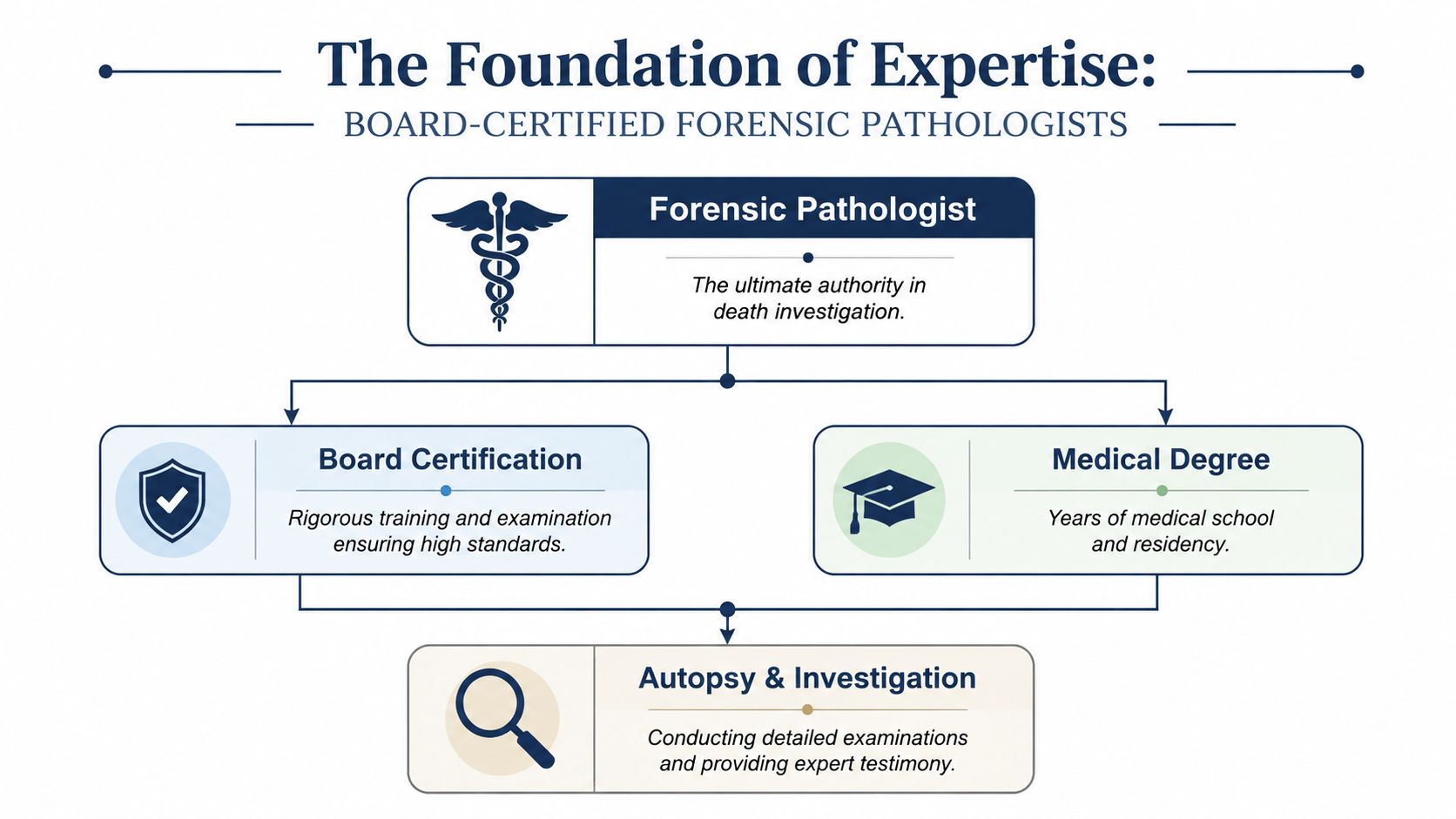
A forensic pathologist is trained to investigate deaths that may involve injury, intoxication, neglect, delayed complications, unclear timelines, or competing explanations. That is different from identifying disease in a tissue sample. It requires medical judgment that can hold up both medically and legally.
For readers who want a deeper explanation of the credential itself, our discussion of the board-certified pathologist standard explains why certification is more than a title.
Why specialization matters in death investigation
The phrase reasonable medical certainty can sound abstract. The work behind it is not. A forensic opinion usually rests on a series of disciplined steps:
- External and internal examination: The pathologist documents injuries, disease, treatment effects, and natural findings.
- Ancillary testing: Toxicology, microscopy, imaging, and other studies can confirm or challenge an early impression.
- Records review: Hospital records, EMS documentation, and prior medical history often change how findings are interpreted.
- Medicolegal reasoning: The pathologist must sort cause from coincidence and explain why one conclusion fits better than another.
Practical rule: In forensic pathology, confidence comes from the quality of the investigation, not from dramatic wording.
That distinction is important for families and lawyers alike. A conclusion about cause of death answers what medical condition or injury started the fatal process. Manner of death classifies the circumstances, such as natural, accident, suicide, homicide, or undetermined. Chain of custody refers to the documented handling of the body, specimens, and evidence so the integrity of the case is preserved. Those are plain terms, but they carry serious consequences in court.
A provider claiming forensic quality should also have systems behind the medical opinion. The AP checklist requires an autopsy quality management program for autopsy services, including review of report quality and access to consultation in specialty areas such as forensic neuropathology and odontology, along with services like toxicology, imaging, and secure trace evidence retention, as summarized by CAP Today's review of autopsy service checklist requirements. In practice, that means the opinion should come from a disciplined process, not from a guess dressed up in legal language.
What Reasonable Medical Certainty Actually Means
A legal term, not a lab value
Reasonable medical certainty is best understood as a legal term of art, not a scientific formula. That point gets lost constantly.
According to Neurosurgery Medical Legal Services, the term "reasonable degree of medical certainty" is a legal term of art, not a scientific standard, and has no underlying scientific meaning. It is not required by the Federal Rules of Evidence, and its legal meaning is ambiguous and potentially misleading to jurors. That captures the problem well. The phrase sounds precise, but it often is not.
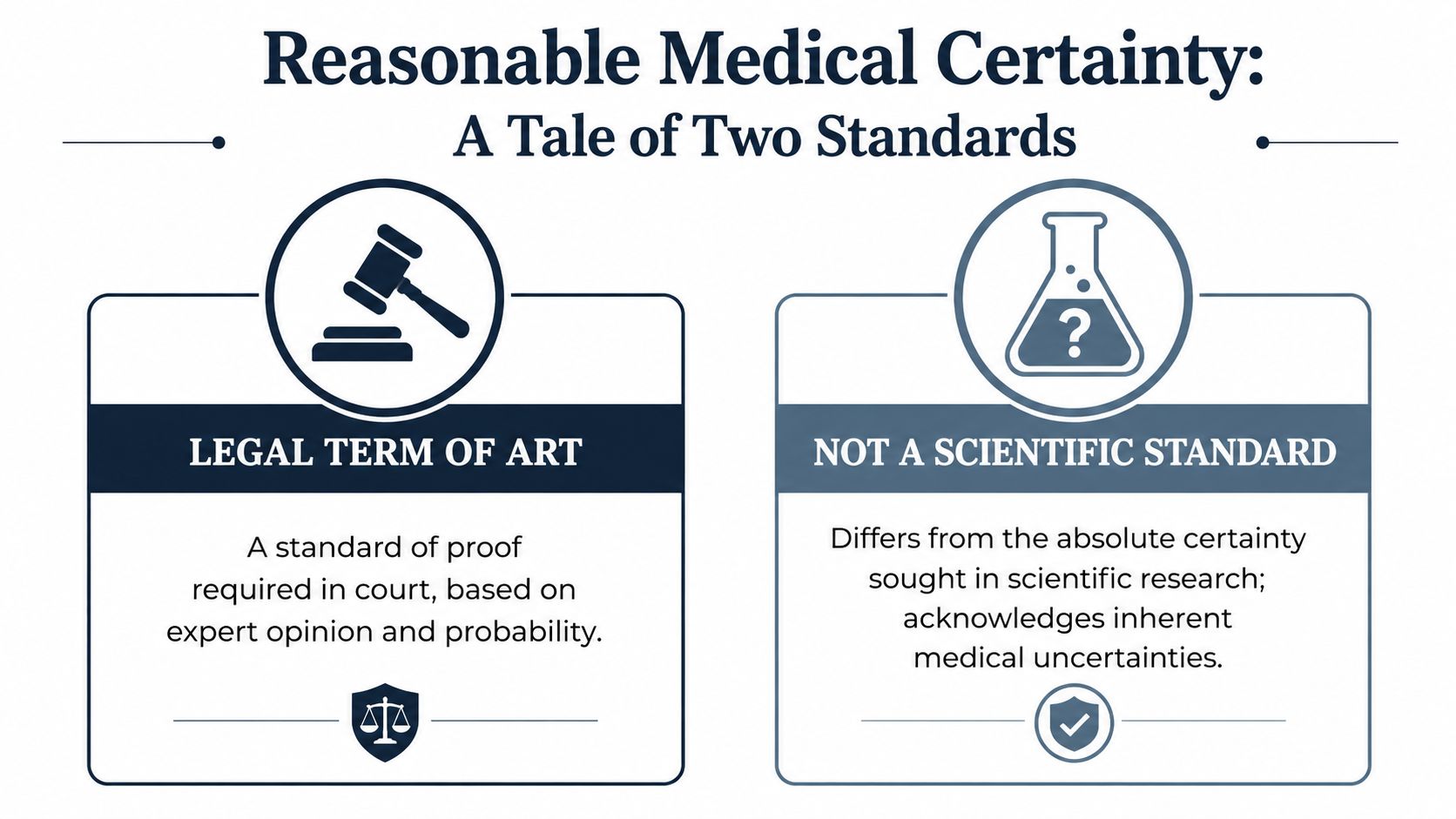
In medicine, we work from observations, testing, differential diagnosis, and exclusion of alternatives. In court, lawyers and judges often want a phrase that signals the opinion is more than speculation. Those are related goals, but they are not the same thing.
A useful comparison is this. A thermometer gives a measurement. A legal phrase does not. Reasonable medical certainty does not operate like a blood pressure reading or a toxicology concentration. It is a courtroom label applied to an opinion that is supposed to be well supported.
How it differs from absolute certainty
Medicine rarely offers absolute certainty, especially after death, when the pathologist may be reconstructing a timeline from anatomy, records, investigative material, and laboratory findings. That does not make the opinion weak. It means the opinion must be honest about what the evidence does and does not show.
Many experts and courts tie causation in civil settings to a more likely than not standard. The Horvitz & Levy analysis notes that many experts interpret the phrase in legal use as requiring at least a 51% probability, meaning the conclusion is more likely than not, while also emphasizing that courts have not given the phrase a single explicit definition and that it has no scientific meaning across disciplines in the way lay readers often assume, as discussed in this review of reasonable medical certainty.
The danger is not uncertainty itself. The danger is pretending that a legal phrase solves uncertainty.
That is why the best forensic opinions do not depend on ritual wording. They explain the medical basis for the conclusion, the alternatives considered, and the reasons those alternatives were rejected or left open. That approach helps grieving families understand what happened and helps attorneys evaluate whether the opinion is strong.
How Pathologists Apply This Standard in an Autopsy
The opinion is built from evidence
In an autopsy, the final opinion is the endpoint of a process. It is not a phrase inserted at the end of a report to make the report sound stronger.
A pathologist typically evaluates several layers of information before reaching a defensible conclusion:
| Component | What it contributes |
|---|---|
| Examination findings | Documents injury, disease, treatment effects, and anatomic abnormalities |
| Microscopy | Tests whether tissue-level changes support or contradict the gross findings |
| Toxicology | Identifies alcohol, medications, drugs, or poisons that may have contributed |
| Medical records | Clarifies treatment course, symptoms, timing, and preexisting conditions |
| Investigative context | Helps interpret whether the death fits the medical findings |
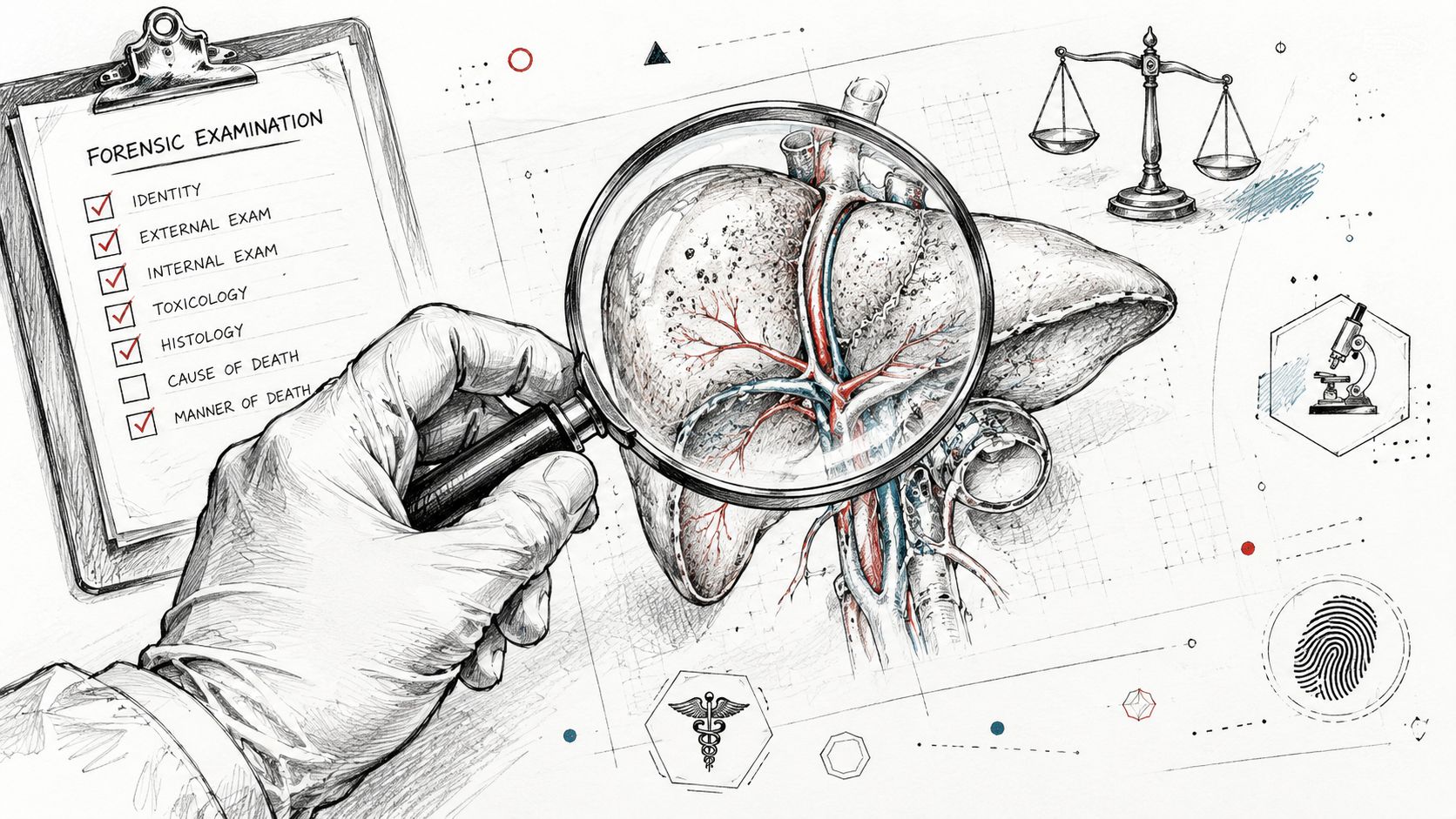
When those parts line up, the opinion becomes stronger. When they conflict, a careful pathologist has to say so. That may lead to a narrower conclusion, an undetermined manner, or a report that explains unresolved limitations instead of overstating confidence.
Why percentages can mislead
Readers often want a number. They ask whether reasonable medical certainty means 90 percent, 51 percent, or something else. The honest answer is that the phrase does not function as a universally fixed scientific percentage.
A 2024 article in the National Library of Medicine notes that the phrase is commonly interpreted by medical experts as a 90% or greater probability, but that the threshold is not universally fixed. It also notes that in homicides and suicides, forensic pathologists demand higher certainty than simple probability above 50%, and the standard is achieved when no other reasonable possibility or explanation for death remains, as described in this forensic discussion of reasonable degree of medical certainty.
That is a practical point, not just a semantic one. If a death may be due to trauma, intoxication, natural disease, or a mix of those factors, the pathologist does not reach for a preset number and stop. The pathologist weighs the evidence and asks whether reasonable alternatives have been excluded.
- In a straightforward natural death: The medical history and autopsy findings may align cleanly.
- In a mixed-cause case: The opinion may require careful explanation of contribution, sequence, and competing mechanisms.
- In a suspicious death: The pathologist may demand a tighter fit between evidence and conclusion before assigning a manner such as homicide.
A strong autopsy opinion reads like a chain of reasoning. It should not read like a slogan.
For families, that means a careful report may sound more measured than expected. For attorneys, it means the best testimony usually comes from transparent reasoning, not from pushing the expert toward an artificial percentage.
Reasonable Certainty in Court and Texas Law
Courts are looking for reliability
Courtrooms still use traditional phrasing, but modern admissibility analysis has moved toward reliability and method. The key issue is not whether an expert recites a familiar line. The key issue is whether the opinion is grounded in sufficient facts and sound reasoning.
The Hawaii Supreme Court's decision in State v. DeLeon (2014) confirmed that trial courts should not require experts to testify to a reasonable degree of scientific certainty before admitting opinions, reinforcing the modern view that the phrase is not a mandatory condition for admissibility, as discussed in this Washington and federal evidence review.
That matters in practice. An autopsy report can be medically careful and legally useful even if it does not lean on formulaic wording. What courts increasingly want is a report and testimony that show how the expert got from the evidence to the conclusion. Our broader discussion of expert witness preparation in forensic cases addresses that challenge directly.
Why Jelinek matters in Texas
Texas lawyers should pay close attention to how competing causes are handled. In Texas, the important question often becomes whether the expert can explain why one conclusion is medically preferable when more than one possible cause exists.
A report might state, in substance, that the cause of death is best attributed to one mechanism because the injuries, timing, records, and testing support that explanation more convincingly than the alternatives. That is very different from asserting the conclusion is held to a reasonable medical certainty.
In litigation, explanation usually carries more weight than incantation.
This is one reason detailed reports matter so much in a private autopsy in Texas. When the report walks through anatomy, records, toxicology, and exclusions in a disciplined way, the legal argument becomes clearer. When the report skips the reasoning and relies on broad conclusory language, it becomes easier to attack.
This discussion is educational only and is not legal advice. Case strategy depends on the governing court, the claims at issue, and the facts available in the record.
Critical Misunderstandings That Impact Legal Cases
The burden is not symmetrical
One of the most damaging misconceptions is the idea that every expert in a case must meet the same certainty threshold in the same way. That is often wrong.
According to Drug & Device Law's discussion of reasonable certainty and defense evidence, over 90% of jurisdictions explicitly allow defense experts to rebut claims using possibilities or probabilities lower than the plaintiff's standard. The same discussion notes that in Texas, the Jelinek ruling requires that when multiple causes exist, experts must explain why their conclusion is medically preferable using verifiable evidence, not just certainty.
That asymmetry matters. A plaintiff's expert may need to affirmatively establish causation. A defense expert may be allowed to show that the plaintiff's causation theory is not the only reasonable explanation. Those are different tasks. If an attorney rejects a second opinion because the expert did not frame it in the same certainty language expected from the opposing side, that can be a strategic mistake.
The fixed 90 percent rule is a myth
Another common error is treating 90 percent as if it were a universal legal or scientific rule. It is not.
Some experts do use that shorthand. Others do not. The phrase has been interpreted in different ways by different legal and medical audiences, and the legal literature has long recognized that it lacks a single accepted definition. If a family member or lawyer hears, "the expert did not say 90 percent," that alone does not tell you whether the opinion is weak. It may only tell you that the expert is avoiding a misleading oversimplification.
A short practical example helps. If one pathologist says a death was due to drug toxicity and another says the better-supported explanation is cardiac disease with incidental drug presence, the issue is not who sounded more certain. The issue is whose analysis is better supported by anatomy, records, testing, and exclusion of alternatives.
This is a useful discussion to hear explained verbally as well:
For counties, lawyers, and agencies reviewing a county forensic autopsy, this distinction can change how evidence is evaluated. The question is not whether the report sounds forceful. The question is whether it is medically reasoned and legally usable.
Guidance for Families and Attorneys
What families should listen for
Families usually want a direct answer, and that is understandable. They are also often hearing legal-medical language at a moment of grief, which makes jargon even harder to process.
The most helpful question is usually not, "Did the report use the phrase reasonable medical certainty?" It is, "What findings support this conclusion, what alternatives were considered, and what remains uncertain?" A careful autopsy can provide clarity even when every detail cannot be resolved. Honest limits are part of trustworthy forensic work.
If you are also handling practical matters after a death, a plain-language guide on how to obtain a death certificate can help with the administrative side while the medical review proceeds.
What attorneys should ask for
Attorneys should press for the foundation of the opinion. Ask what records were reviewed, what testing was performed, whether tissue sections and toxicology support the gross findings, and how competing causes were analyzed. In Texas, that last point is often where the main dispute lies.
A well-prepared forensic report should also preserve chain of custody and document the process clearly enough for deposition or trial use. Under Texas Health & Safety Code and the broader compliance environment involving the Texas Funeral Service Commission, that procedural integrity matters along with the medical analysis.
For second opinions, independent review can be especially important when the initial report is brief, conclusory, or internally inconsistent. Our overview on when to review my case addresses the kinds of circumstances that often justify a fresh forensic look.
Respectful handling is part of the process too. When transport and logistics are involved, some families need support that coordinates pathology with mortuary services such as the Waterloo Mortuary partnership. The goal is straightforward. Preserve dignity, preserve documentation, and preserve the integrity of the evidence.
Frequently Asked Questions
Does an autopsy report always have to use the phrase reasonable medical certainty?
No. An autopsy opinion does not become reliable merely because it uses that phrase, and it does not become unreliable merely because it does not. Courts increasingly focus on the underlying facts, methods, and reasoning. The stronger question is whether the report shows how the conclusion was reached.
What happens if two pathologists reach different conclusions about the cause of death?
That can happen, especially in complicated deaths involving treatment complications, intoxication, delayed effects of injury, or significant natural disease. The answer is not to count which expert sounded more confident. The answer is to compare the factual basis, the quality of the examination, the testing performed, and how each expert dealt with alternative explanations.
Is reasonable medical probability the same as reasonable medical certainty?
They are often used interchangeably in litigation, but they are not always understood the same way. In plain language, reasonable medical probability is often tied to a more likely than not concept. Reasonable medical certainty is often treated as a higher-confidence phrase, but it does not have a universal definition and should not be mistaken for a scientific measurement.
Why does chain of custody matter in an independent autopsy?
Chain of custody is the documented handling of the body, specimens, photographs, slides, and other evidence from one step to the next. If that documentation is weak, a sound medical opinion can still face avoidable legal challenges. In a forensic setting, process supports credibility.
What should families or attorneys request when they need a second opinion autopsy?
Ask for clarity about the scope of review. That may include the original report, photographs, slides, toxicology, medical records, or a full independent autopsy if one is still possible. Ask who will perform the examination, whether every examination is performed by a forensic pathologist certified by the American Board of Pathology, and how the report will explain the medical reasoning in plain language.
If you need help understanding an autopsy finding, arranging an independent review, or discussing a death with legal implications, Texas Autopsy Services is available to speak with you directly and confidentially. We serve families, attorneys, medical professionals, and county officials across Texas with respectful communication, full chain of custody, and examinations performed by a board-certified forensic pathologist.