June 22, 2026 · Texas Autopsy Services
Board Certified Pathologist: Ensure Accurate Autopsy Results
Learn about board certified pathologists. Their expertise is vital for autopsies in Texas. Verify credentials for a trusted cause of death investigation.
On this page
- What Board Certification in Pathology Truly Means
- The Rigorous Path to Becoming Certified
- Why Certification Is Critical for Autopsy and Forensic Cases
- The Role of Forensic Pathologists in Texas
- How to Verify a Pathologist's Credentials
- Key Questions to Ask When Seeking Autopsy Services
- Frequently Asked Questions About Autopsy Services
When a family or attorney calls after a death, the same concern often sits underneath every question. They need an answer they can trust. Not just a report, but a medically sound conclusion that can guide next steps, withstand scrutiny, and be explained in plain language.
That's where the phrase board certified pathologist starts to matter. It can sound like a line on a résumé. In reality, it signals a formal professional standard. In private autopsy services Texas families and lawyers rely on, that standard can affect how confidently a cause of death investigation is performed, documented, and discussed.
A credential alone doesn't replace careful work, compassion, or independence. But in forensic pathology, it tells you the physician has met a nationally recognized benchmark in a field where the findings may influence legal claims, insurance disputes, family decisions, and public investigations.
What Board Certification in Pathology Truly Means
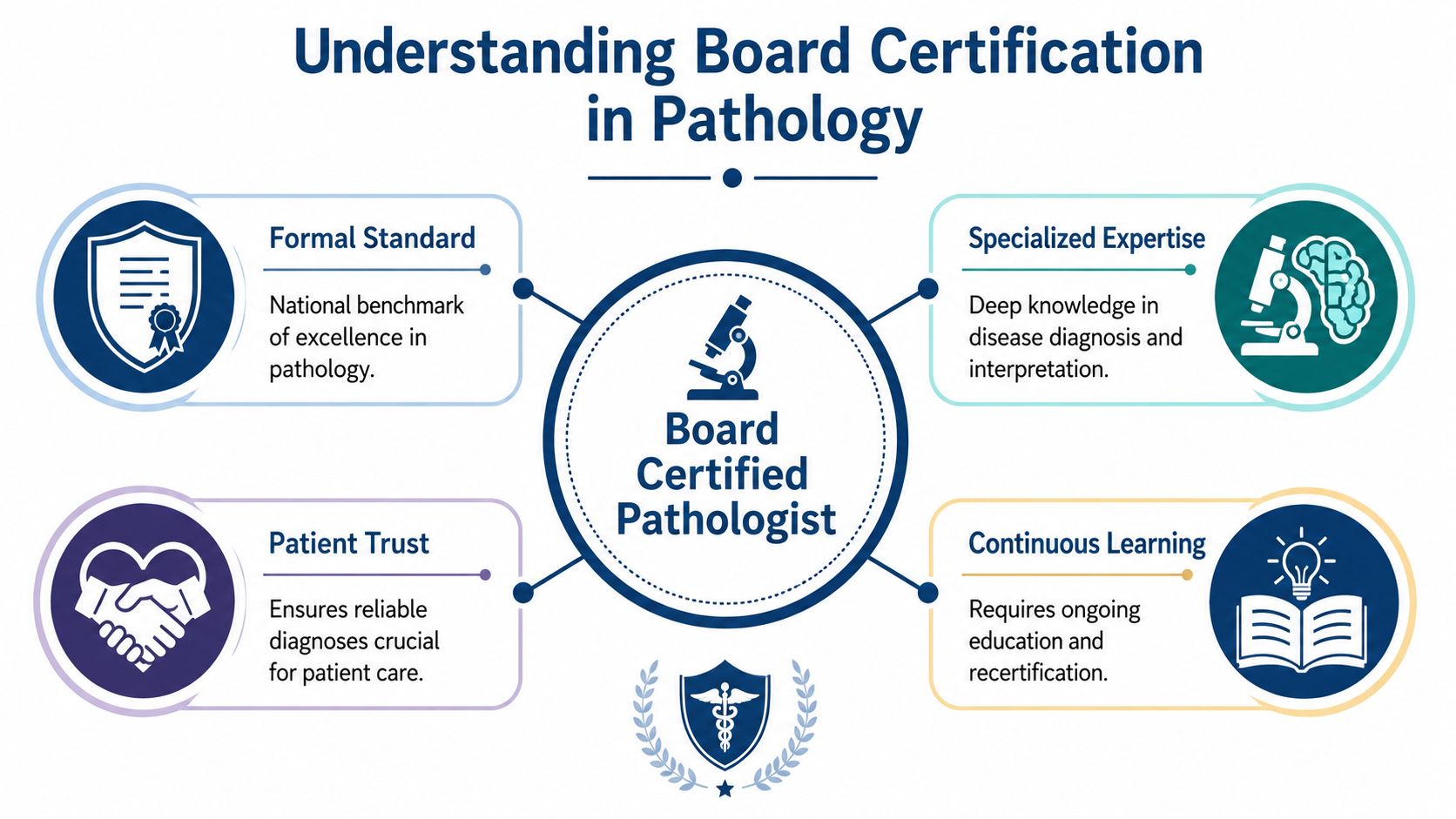
A board-certified pathologist is a physician who has completed specialty training and passed a rigorous certification process that the American Board of Pathology says demonstrates superior knowledge, judgment, and skills in the physician's area of practice, according to the American Board of Pathology. That definition matters because it separates a general medical background from verified specialty qualification.
The American Board of Pathology is not a private badge created by a local group. It is part of the national specialty certification system physicians use across the United States. For families and attorneys, that means the credential is tied to an established professional standard, not marketing language.
Why this credential carries weight
People often hear “board certified” and assume it means licensed. It doesn't. A medical license allows a physician to practice medicine under state law. Board certification is a specialty-level confirmation that the physician has met additional standards within a defined field.
In pathology, that distinction is important because the work often depends on close interpretation. A pathologist reviews tissues, injuries, disease processes, and medical evidence to reach conclusions that other people will rely on. In an autopsy setting, those conclusions can influence litigation, estate questions, insurance review, or a family's understanding of what happened.
Practical rule: If the findings may be disputed, reviewed by insurers, or introduced in court, the qualifications of the physician become part of the case.
What it means in forensic work
Forensic pathology is not just pathology performed after death. It is a specific medical-legal specialty focused on sudden, unexpected, suspicious, violent, and legally defined deaths, as described by the American Board of Pathology. That is why the words matter in full: board-certified forensic pathologist.
In practice, this affects how the examination is approached. The physician must think not only about disease, but also about injury patterns, scene history, records, toxicology, documentation, and legal review. Families usually feel this difference in the clarity of the explanation. Attorneys usually feel it in the structure and defensibility of the report.
A board-certified pathologist does not guarantee the answer a caller hopes for. It does mean the answer is more likely to come from a disciplined and recognized professional standard.
The Rigorous Path to Becoming Certified
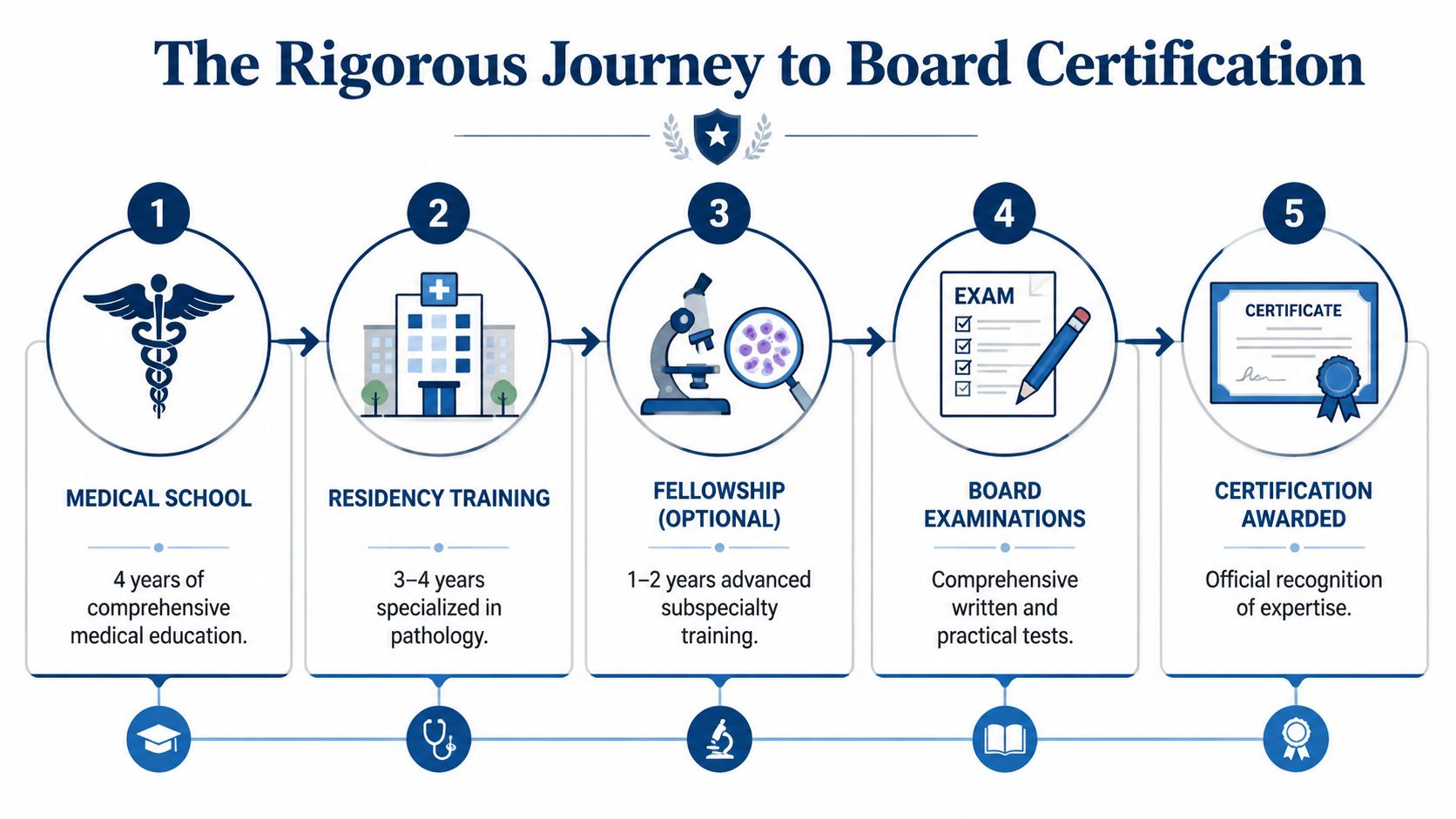
The title is earned through years of medical education, supervised specialty training, and formal testing. That matters because autopsy findings are not produced by software or by a checklist alone. They depend on judgment developed over time.
Most readers don't need every training detail to make a sound decision. But it helps to understand that pathology certification sits at the end of a long professional path, not at the beginning.
Training comes before the title
A physician first completes medical school. After that comes residency training in pathology, where the doctor learns how disease and injury are examined and interpreted. Many physicians then pursue additional fellowship training in a subspecialty such as forensic pathology.
That sequence matters because pathology is broad. Some pathologists focus on surgical specimens and biopsies. Some focus on laboratory medicine. A forensic pathologist works in the medical-legal setting of death investigation and medicolegal autopsy.
A simple way to think about it is this:
| Area | Main focus |
|---|---|
| Anatomic pathology | Examination of organs, tissues, and bodily changes related to disease or injury |
| Clinical pathology | Laboratory medicine and testing systems |
| Forensic pathology | Investigation of death in a medical-legal setting |
Readers who want a plain-language walkthrough of that training path can compare it with our overview of the steps to becoming a forensic pathologist.
Why the standard matters in the real world
The American Board of Pathology is one of the 24 member boards of the American Board of Medical Specialties, and the board reports it has certified 39,124 U.S. pathologists from its founding through 2024, according to the American Board of Medical Specialties profile for the American Board of Pathology. That tells readers two useful things at once. The standard is national, and it is widely used.
This is not a niche credential held by a tiny corner of medicine. It has become a major professional benchmark in pathology. When hospitals, laboratories, courts, attorneys, and families look for a recognized way to judge expertise, this is one of the clearest signals available.
Board certification doesn't replace independence or careful documentation. It establishes that the physician has met a recognized specialty threshold before the work even begins.
That is especially important in autopsy work. The report may need to speak clearly to grieving relatives, but it may also need to stand up to a legal challenge months later.
Why Certification Is Critical for Autopsy and Forensic Cases
A family may be deciding whether to accept the first explanation for a death. An attorney may be deciding whether an autopsy report can survive scrutiny in court. In both situations, the pathologist's credentials affect what happens next.
Accuracy starts with method
Autopsy work is careful reconstruction. The pathologist gathers records, studies injuries and disease, reviews laboratory findings, and tests whether the pieces fit one medical explanation or several competing ones. A board-certified forensic pathologist has been trained and examined on that method, which helps reduce the risk of overstatement, missed alternatives, or conclusions that outrun the evidence.
That difference becomes tangible quickly. For families, it often means a clearer explanation of cause and manner of death, including what can be said with confidence and what cannot. For attorneys, it often means a report that shows its work, uses accepted terminology, and can be followed by judges, insurers, and opposing experts.
In private and forensic autopsies in Texas, those details are not abstract. They can affect whether a second autopsy is requested, whether tissue or toxicology testing is preserved, and whether a disputed death is reviewed with the level of care a later legal challenge will require.
Legal review changes the stakes
Once an autopsy opinion may be used in litigation, the standard rises. The issue is no longer only whether the conclusion sounds persuasive. The issue is whether the examination, specimen handling, photographs, records review, and written report were done in a way that another expert can evaluate and a court can trust.
Chain of custody means the documented handling of remains, specimens, and evidence from one point to the next so others can verify integrity and control. It works like a signed handoff log in any high-stakes setting. If the record is incomplete, confidence in the evidence weakens.
The same basic rule appears outside medicine. This discussion of how texts hold up in court shows why authenticity and documentation matter before evidence carries weight. Autopsy findings follow that same logic. A well-qualified physician who documents each step carefully gives the opinion a stronger foundation for admissibility and cross-examination.
Independence matters to families and attorneys
A private autopsy or independent autopsy is often requested because the family or lawyer needs a fresh review outside the original treating institution. Independence does not mean taking sides. It means the opinion should rest on medical evidence, documented procedure, and a willingness to explain uncertainty plainly.
That is why practical questions matter. Who will personally perform the examination. Is that physician board certified in pathology or forensic pathology. How are records obtained and reviewed. What specimens will be retained. How is the final opinion written if the report later becomes part of a lawsuit or insurance dispute.
Formal qualification is treated as a real benchmark in regulated medical settings. For instance, updated CMS personnel rules, summarized by McDermott Will & Emery in this review of CMS personnel rule updates, require a physician laboratory director of a nonwaived lab who holds an MD or DO to be certified in anatomic pathology, clinical pathology, or both by the American Board of Pathology or the American Osteopathic Board of Pathology. Board eligibility alone is no longer enough.
Families and counsel in Texas often apply that same common-sense standard when choosing private autopsy or record-review services. They want to know whether the doctor's qualifications will support diagnostic accuracy, credible testimony, and respectful communication during a difficult process. Readers comparing service models across the state can also review our explanation of forensic pathology associates and statewide coverage in Texas. In Central Texas, some families also encounter forensic services through professional care networks such as the Waterloo Mortuary Partnership, where coordination and documentation matter as much as the final written opinion.
The Role of Forensic Pathologists in Texas
Texas is large, legally varied, and operationally uneven in how death investigation happens. Some communities have direct access to established systems. Others rely on arrangements that can be more limited, especially when a case needs specialized postmortem review.
That local reality affects families and attorneys in very practical ways. Access, transportation, scheduling, and who can perform the examination often matter before anyone reaches the medical questions.
Texas does not have one uniform county system
Across Texas, counties do not all operate the same way in medicolegal death investigation. That can confuse families who assume every county has the same office structure and the same local access to forensic autopsy services.
When a death raises medical-legal concerns, officials may need outside forensic expertise depending on local resources and authority. That is one reason independent forensic pathology services can play an important role, especially when a county needs access to qualified examination and reporting outside a large urban system.
For readers trying to understand how those service models work across the state, our discussion of forensic pathology associates and statewide coverage gives additional context.
Why access can be difficult
The shortage is not just local. It is national. The American Society for Clinical Pathology reported in 2023 that forensic pathology is “one of the most understaffed pathology subspecialties” and estimated a workforce of only 500 to 600 MD pathologists in the field, according to the ASCP report on underserved forensic pathology areas. That helps explain why some communities face delays or uneven access to expert autopsy services.
For families, this may mean that obtaining a forensic review is not as simple as calling the nearest hospital. For attorneys, it can affect case timing and expert availability. For county officials, it can shape operational decisions about referral, transport, and outside contracting.
Access is part of quality. A strong standard has limited value if qualified forensic expertise is hard to reach when a case needs timely review.
This is one reason statewide logistics matter in Texas. The medical questions may be complex, but the practical issues are often just as important. A provider must be able to coordinate transport, preserve documentation, communicate clearly, and work within Texas legal requirements. Without that structure, even a needed second opinion autopsy can become much harder to obtain.
How to Verify a Pathologist's Credentials
A family may be asked to approve a private autopsy within hours. An attorney may need to decide whether an expert opinion will hold up under scrutiny months later. In both situations, credentials should be checked early, and checked through sources outside the provider's own website.
Start with board certification verification
Board certification works like a professional quality filter. A medical license allows a physician to practice medicine. Board certification in forensic pathology shows additional specialty training, examination, and ongoing professional standing tied to death investigation work.
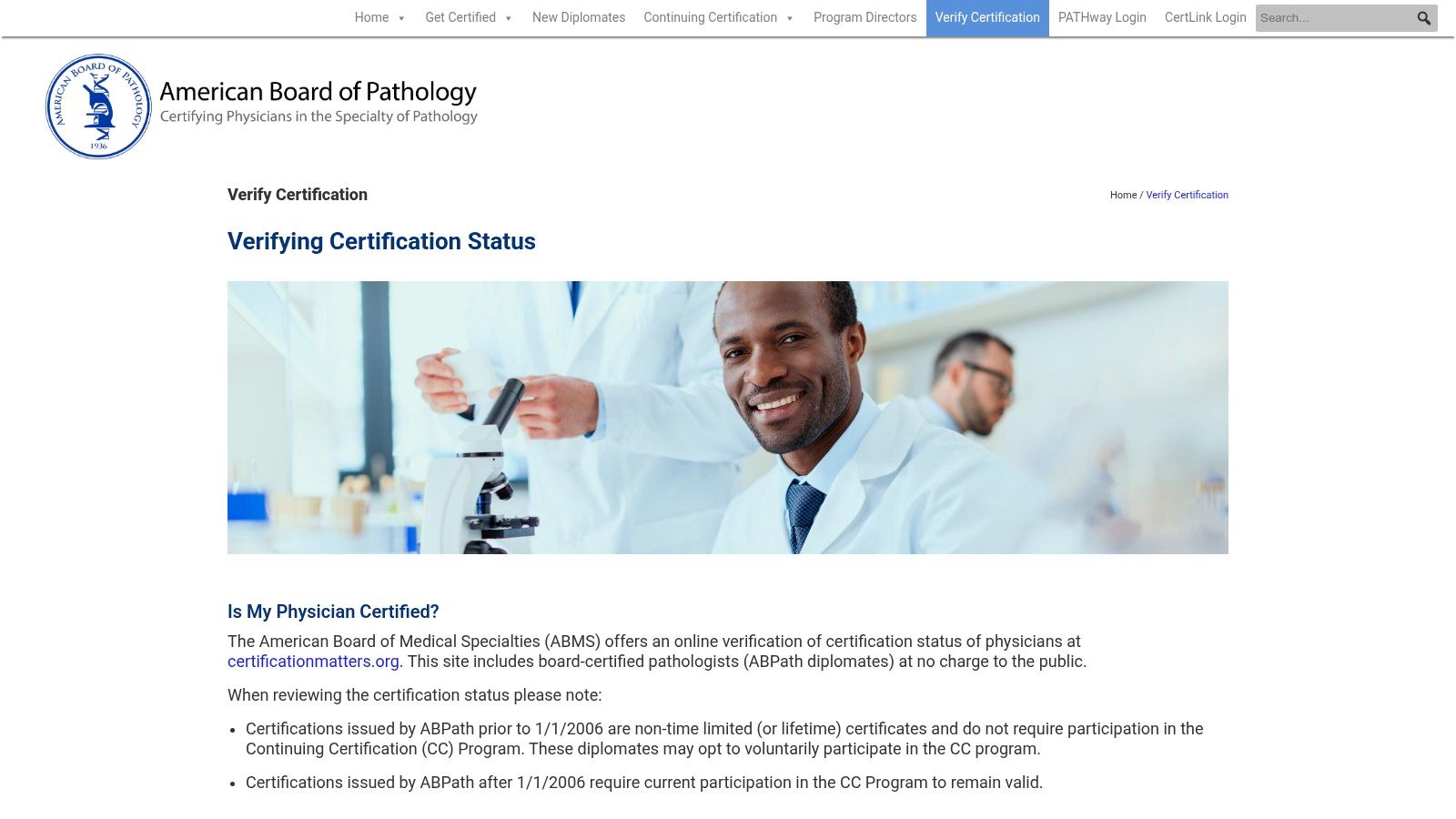
Ask a direct question first: is the physician who will perform or sign the autopsy report certified by the American Board of Pathology in forensic pathology? Then verify it through the board's public certification lookup. A careful provider should answer that question plainly and give the physician's full name for confirmation.
A simple checklist helps:
- Confirm the certifying body. The relevant credential is certification by the American Board of Pathology.
- Verify before the examination. It is much easier to confirm qualifications before opinions are issued and relied on.
- Match the specialty to the assignment. A private or forensic autopsy in Texas calls for training in medicolegal death investigation, not only general pathology or a general medical license.
That match matters in practical ways. If a report is later reviewed by a court, insurer, or opposing expert, the physician's training will be one of the first things examined.
Then confirm the practical details
Certification is the starting point. It is not the whole picture.
You should also confirm that the physician holds a current Texas medical license through the Texas Medical Board. After that, ask who will physically perform the examination, who will sign the final report, and whether the same physician can explain and defend the findings if testimony is needed. Those questions help families avoid confusion and help attorneys assess whether the opinion is likely to be usable in litigation.
This is similar to checking both a pilot's license and the flight plan. The title matters, but so does knowing who is in control, what records are reviewed, how specimens are handled, and how conclusions are documented.
It is also reasonable to ask about process. Will the pathologist review hospital records, scene information, and prior medical history? How are photographs, tissue samples, and retained specimens stored? How clearly will findings be explained to the family? In private autopsies, compassionate communication matters. In forensic and civil cases, documentation and chain of information matter just as much.
Some families compare providers such as Texas Autopsy Services, which states that examinations are performed by board-certified forensic pathologists and explains its reporting and statewide logistics. The same rule should apply to any practice you consider. The credentials should be specific to forensic autopsy work, easy to verify, and strong enough to support both medical accuracy and legal reliability.
Key Questions to Ask When Seeking Autopsy Services
The quality of an autopsy provider often becomes clear from the questions they answer plainly. Families usually need clarity. Attorneys usually need detail. A reliable provider should be able to offer both.
Questions about qualifications
Ask these early, before authorizing anything:
Will the examination be performed by a board-certified forensic pathologist
This is the clearest threshold question. It addresses specialty qualification, not just general medical training.Who signs the final report
The person responsible for the opinion should be clearly identified as the physician providing the forensic conclusion.Do you handle medical-legal cases, private family cases, or both
The answer helps you understand whether the provider is used to the level of documentation and scrutiny your matter may require.
A short conversation can reveal a lot. Vague answers are a warning sign. Specific answers usually indicate a more structured process.
Questions about process and reporting
Other questions should focus on how the work is done:
What records or background information do you need
A careful cause of death investigation often depends on hospital records, scene information, and prior medical history.What is included in the written report
Ask whether the report includes findings, interpretation, and a clear opinion on cause of death and, when applicable, manner of death.How do you protect chain of custody
This is especially important when tissues, toxicology samples, clothing, or other materials may later matter in litigation.How is transport coordinated
In Texas, logistics can shape the entire process, especially when the decedent is far from the examination site.What should we expect on timing
A careful provider should explain that timing depends on the case and on any additional testing. If they discuss early verbal findings, they should also explain that final reporting may depend on pending studies. Most cases may be completed within 24–48 hours, but that should be presented as a case-dependent estimate, not a guarantee.
Families deserve direct answers. Attorneys need a process they can document. A good autopsy provider should respect both needs without evasiveness.
The most helpful answers are usually the least dramatic. They explain what can be done, what cannot be promised, and what information the provider will need from you.
Frequently Asked Questions About Autopsy Services
What is the difference between cause of death and manner of death
Cause of death is the medical reason a person died, such as an injury, disease, or complication. Manner of death is the category used in death investigation to describe how the death occurred, such as natural, accident, suicide, homicide, or undetermined.
People often confuse the two. A report may identify a medical cause clearly while the manner remains disputed or under review.
Is a private autopsy the same as a hospital autopsy
No. A hospital or clinical autopsy is generally performed for medical understanding within a healthcare setting. A forensic autopsy addresses medical-legal questions and is structured for situations where the findings may matter beyond clinical review.
A private autopsy can be requested by a family or attorney when an independent examination is needed. Depending on the circumstances, it may focus on cause of death, injuries, complications of care, or a second review of an earlier conclusion.
Can a second opinion autopsy review help after an earlier examination
Sometimes, yes. A second opinion autopsy does not always require repeating every step of the original examination. In some cases, a forensic pathology expert can review the prior autopsy report, photographs, slides, records, or retained specimens and offer an independent opinion.
That can be useful when a family has unanswered questions or when counsel needs a fresh review before litigation decisions are made.
How long does the autopsy process take
Timing depends on the facts of the case and whether additional studies are needed. Toxicology, microscopy, or outside testing can extend the process. Many families want one date up front, but a careful provider should explain what can be known early and what may require more time.
Where appropriate, providers may say that most cases are completed within 24–48 hours, but that should never be treated as an unconditional promise.
What does chain of custody mean
Chain of custody is the record of who handled the body, specimens, and related evidence at each step. In a forensic setting, that documentation helps show that materials were preserved, tracked, and not altered outside normal procedures.
This becomes especially important if the findings may be reviewed in court, by insurers, or by other experts later.
For families facing a sudden loss, and for attorneys or county officials working through urgent decisions, clear guidance matters. If you need help understanding whether an independent autopsy, second-opinion review, or forensic consultation is appropriate, our team at Texas Autopsy Services is available to answer questions directly and explain the process with care.