October 6, 2026 · Texas Autopsy Services
Forensic Pathology and Autopsy What Families Should Know
Understand forensic pathology and autopsy in Texas. Learn the process, types of examinations, toxicology testing, and how private autopsies provide independent
On this page
- When Families Seek Answers After a Death
- Understanding Forensic Pathology and Its Role
- Types of Autopsy Examinations Available
- The Autopsy Process From Examination to Report
- Why Independence and Objectivity Matter
- Common Misconceptions About Autopsies
- Legal and Ethical Safeguards in Texas
- How to Proceed When Questions Remain
Approximately 7.4% of U.S. deaths undergo an autopsy today, down from 19.1% in 1972. That decline has created a significant gap in direct postmortem examination, and an independent examination can help address unanswered questions when an official investigation is limited, declined, or disputed.
A family in Texas may receive a death certificate that lists a broad or uncertain cause. Another family may learn that the medical examiner will not perform an autopsy because the death falls outside that office's jurisdiction. Attorneys may receive an official report that doesn't address the medical issue central to a civil claim. In each situation, the next decision can feel urgent and unfamiliar.
At Texas Autopsy Services, we approach forensic pathology and autopsy work with medical precision, careful documentation, and respect for the family. Our practice is based in Elgin, Texas, and supports families, attorneys, healthcare professionals, and counties throughout the state.
- Private autopsies can provide an independent examination when questions remain after a death.
- Cause of death identifies the disease, injury, abnormality, or poisoning that precipitated death.
- Manner of death addresses whether the death was natural, accidental, suicidal, homicidal, undetermined, or pending.
- Toxicology requires context, including specimen type, collection site, preservation, medical history, and autopsy findings.
- Every examination is performed by a forensic pathologist certified by the American Board of Pathology.
When Families Seek Answers After a Death
A family may be sitting in a county office hallway with a death certificate in hand, trying to understand words that don't explain what happened. The listed cause may be incomplete, the manner may be undetermined, or an official office may have declined an examination. Sometimes the family has a specific concern about medication, an injury, a hospital treatment, or an unexpected death that the initial records don't resolve.
The broader context matters. U.S. National Vital Statistics data show that the proportion of recorded deaths followed by an autopsy fell from 19.1% in 1972 to 7.4% in 2020, a reduction of approximately 61% (U.S. National Vital Statistics data). These figures cover all recorded deaths, not only hospital deaths or forensic cases, so they don't measure the workload of medical examiner systems. They do show that fewer deaths receive direct postmortem examination than in prior generations.
The decline was especially pronounced before 1994, when the rate had fallen to 9.4%, and it continued afterward even though autopsy remains a definitive method for investigating cause of death. Historical U.S. hospital autopsy rates were approximately 50% in the 1950s, compared with 7.4% for all deaths in 2020. A death certificate and clinical impression may be accurate, but uncertainty can remain when a person dies unexpectedly, has complex medical conditions, may have been exposed to drugs, or has possible trauma.
What an independent examination can address
A private autopsy doesn't replace the authority of a medical examiner or justice of the peace. It provides a separate medical examination or review that can clarify findings for the family, attorneys, or another authorized party. The work may help assess whether the documented cause is supported by the physical evidence, whether additional testing was appropriate, or whether the available records leave an important question unanswered.
The decision should be made promptly because preservation, transport, cremation, burial, and the availability of tissues or specimens can affect what can still be examined. We help families understand those practical factors without promising a particular result. The purpose is not to force certainty where the evidence doesn't support it. The purpose is to establish what the evidence can and cannot show.
Understanding Forensic Pathology and Its Role
Forensic pathology is the medical specialty that examines deaths involving unexpected, unexplained, violent, suspicious, or potentially legally significant circumstances. A forensic pathologist evaluates the body alongside medical records, investigative information, scene circumstances, photographs, laboratory testing, and witness or treatment history when available.
At Texas Autopsy Services, every examination is performed by a forensic pathologist certified by the American Board of Pathology. The American Board of Pathology requires forensic pathology certification applicants to complete 12 months of training in an Accreditation Council for Graduate Medical Education-accredited forensic pathology program and at least 30 autopsies before submitting the certification application (American Board of Pathology certification requirements). Those requirements distinguish dedicated forensic pathology training from a general statement that someone has worked in pathology.
A practical explanation of the specialty is available in our resource on what a forensic pathologist does. The work involves more than observing an organ or recording a laboratory result. It requires connecting physical findings to the circumstances of death while identifying limitations in the evidence.
Cause and manner are different findings
The cause of death is the disease, injury, abnormality, or poisoning that precipitated death. A terminal mechanism such as cardiac arrest, respiratory arrest, shock, or heart failure isn't a sufficient cause by itself because every death ultimately involves failure of vital functions.
The manner of death describes how the death occurred. CDC guidance identifies the classifications as:
- Natural: Death resulted from disease or a natural process.
- Accident: Death resulted from an unintentional event.
- Suicide: Death resulted from an intentional self-inflicted act.
- Homicide: Death resulted from the actions of another person.
- Undetermined or pending: The available evidence doesn't support a more definitive classification, or the investigation remains incomplete.
The official certifier for a medicolegal death is generally the medical examiner or coroner with jurisdiction. A private forensic pathologist can provide an independent medical opinion, but that opinion doesn't automatically change the official death certificate or override the legal authority responsible for certification.
Types of Autopsy Examinations Available
Families often use the word autopsy to describe several different pathways. The authority requesting the examination, the purpose of the examination, and the questions being asked determine which pathway is appropriate.
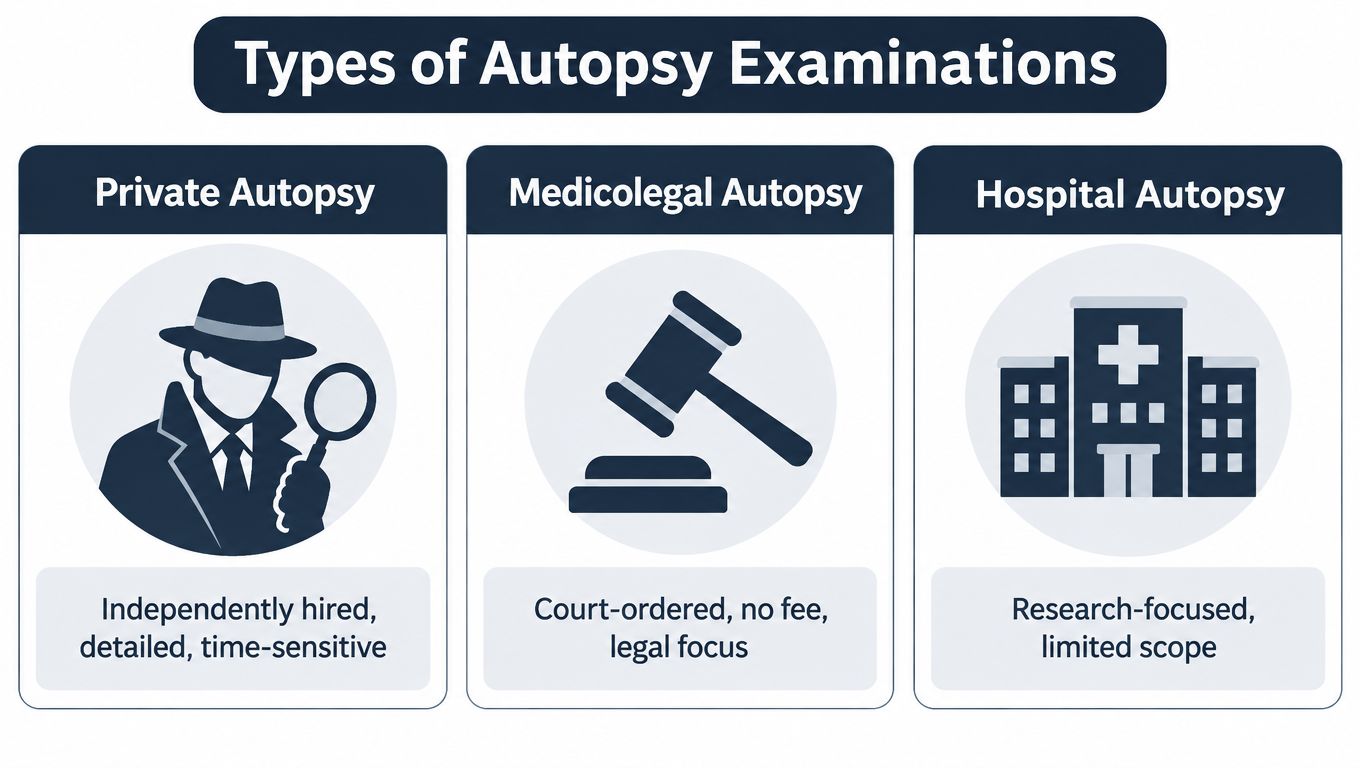
A medicolegal autopsy is conducted under the authority of a medical examiner, coroner, justice of the peace, or another official system with jurisdiction. It focuses on deaths that may affect public health, public safety, criminal investigation, or legal proceedings. The family usually doesn't commission it directly.
A private autopsy is commissioned by an authorized family member, attorney, insurer, institution, or another legally appropriate party. It may be considered when an official office declines to examine, when questions persist after an official autopsy, when a second opinion is needed, or when a legal team needs an independent review of medical evidence. A private examination can include external and internal examination, histology, toxicology, molecular testing when indicated, review of photographs and records, and a written report.
Choosing the appropriate pathway
A hospital autopsy is generally arranged through a hospital and may focus on clinical education, quality review, research, or clarification of a disease process. It doesn't necessarily address every forensic or legal question, and it may have a more limited scope than a medicolegal examination.
Fetal and perinatal examinations require particular care because the medical questions, records, gestational history, placental findings, and family circumstances differ from adult cases. The examination may help evaluate developmental conditions, infection, placental disease, congenital abnormalities, or other causes that aren't apparent from external observation alone. Permission, handling, religious considerations, and communication should be addressed before the examination begins.
A second-opinion review is different from a new examination. Review may involve the prior autopsy report, photographs, radiographs, histology slides, toxicology, medical records, and investigative materials. A new examination may be possible only if the body remains available and preservation conditions permit it. We explain those distinctions before accepting a case.
The Autopsy Process From Examination to Report
A professional autopsy begins with identification, documentation, and review of the available history. The examination itself usually proceeds from the outside of the body to the inside. The pathologist records identifying features, injuries, medical interventions, scars, lividity, and other relevant observations before making internal incisions.
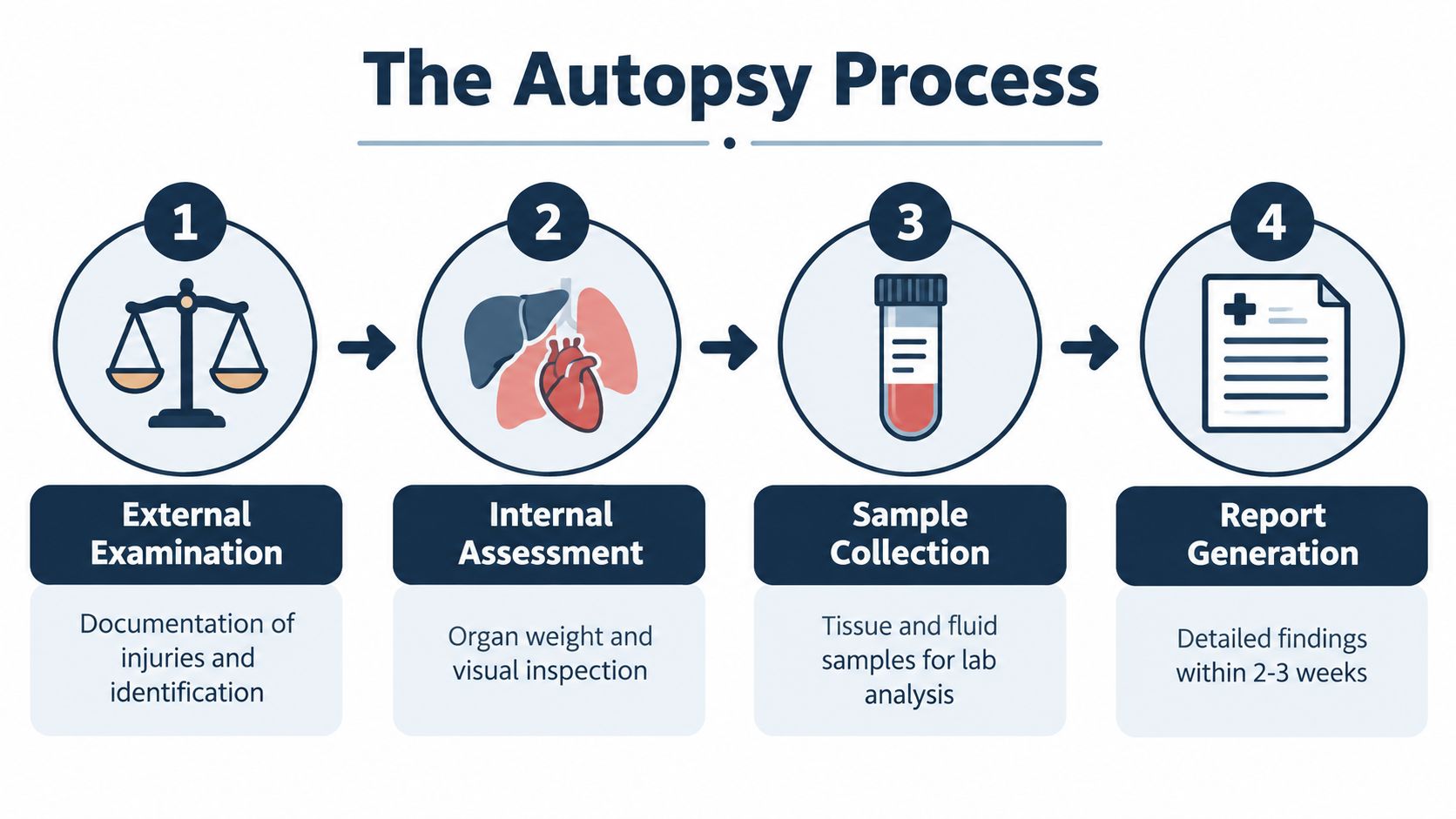
Internal examination evaluates organs, body cavities, injuries, disease, and possible complications of treatment. Tissue may be retained for histology, while fluid, blood, urine, vitreous humor, or tissue may be collected for toxicology and other laboratory testing. Molecular or targeted testing may be considered when the medical history, autopsy findings, or circumstances indicate that routine testing won't answer the central question.
For a fuller explanation of the sequence, see our guide to the autopsy process.
Why toxicology needs context
A detected drug isn't proof by itself that the drug caused death. After death, concentrations can change through postmortem redistribution, decomposition, bacterial activity, and differences between collection sites. Tolerance, therapeutic use, mixed substances, disease, timing, and laboratory limitations also affect interpretation.
Peripheral femoral blood is generally preferred for quantitative interpretation because it is less vulnerable to redistribution from organs than central blood. Central blood, urine, vitreous humor, and tissue samples provide complementary evidence, but their results aren't interchangeable. Collection tubes should include an anticoagulant such as potassium oxalate and a preservative such as potassium fluoride, and specimens should be refrigerated near 4°C when feasible.
Laboratories must also account for matrix effects. Co-extracted compounds can suppress or enhance ionization in liquid chromatography and mass spectrometry, which may alter measured concentrations. The appropriate report identifies the matrix, anatomical collection site, preservation conditions, analytical method, and relationship to the autopsy findings (postmortem toxicology practice review).
The final report separates an immediate mechanism, such as arrhythmia, hemorrhage, or respiratory failure, from the underlying disease or injury that initiated the fatal sequence. When the evidence remains insufficient, a defensible report preserves uncertainty rather than assigning an unsupported single cause.
Why Independence and Objectivity Matter
Families sometimes worry that a private autopsy is adversarial or conflicts with an official investigation. It doesn't have to be. A private examination can complement the work of the medical examiner, coroner, hospital, or law enforcement agency by asking focused questions and documenting evidence from an independent position.
Independence means that our pathologists don't work for the hospital, law enforcement agency, insurer, or opposing legal party involved in the dispute. It doesn't mean that the examination is designed to reach a preferred conclusion. A medically sound opinion may confirm the official findings, identify a limitation, or conclude that the available evidence remains inconclusive.
What the evidence shows
Autopsy can identify clinically important disease that wasn't recognized before death. A major university- and community-hospital study found major unexpected findings that could probably have improved survival in approximately 11% and 12% of cases, respectively, and concluded that clinicians couldn't reliably predict which deaths would produce a high-yield autopsy (New England Journal of Medicine study). That finding supports a systematic examination strategy rather than relying only on an apparent diagnosis.
Practical rule: A second opinion should examine the evidence, not promise a different conclusion.
For attorneys, the value of an independent examination often lies in the documentation. A complete chain of custody, specimen identification, photographs, laboratory records, and a clear report allow other experts and the court to evaluate the work. A private finding may support litigation, but it doesn't override the official certifier's jurisdiction or decide questions of criminal intent, liability, or damages.
Reviews can be as important as new examinations
When a prior autopsy has already occurred, a second-opinion review may be the safer and more practical option. Our team can assess the prior report, medical records, photographs, toxicology, histology, and other available materials. If the original examination didn't address a potentially decisive question, the review can identify that limitation and explain whether any further examination is medically feasible.
Reports should be written for the intended audience. Families need plain language. Attorneys need methods, findings, limitations, and opinions that can be evaluated. Courts need a transparent foundation rather than advocacy disguised as medical certainty.
Common Misconceptions About Autopsies
Autopsy decisions are often made while families are grieving, and inaccurate assumptions can create unnecessary fear. Clear information helps people decide without minimizing the seriousness of the procedure.
An autopsy automatically prevents timely funeral arrangements. Timing depends on jurisdiction, transport, authorization, preservation, testing, and the funeral provider's arrangements. We don't guarantee a turnaround because each case has different requirements. In many cases, most work is completed within 24–48 hours, but additional testing and review can extend the process.
The deceased cannot be viewed afterward. Viewing may remain possible after an examination. Funeral professionals can use restorative techniques, and the appropriate approach depends on the examination, injuries, condition of the body, and family preferences. Families should discuss those preferences with the funeral home and examination provider before arrangements are finalized.
What an autopsy can and cannot establish
Autopsies are only useful for traumatic deaths. Unexpected natural deaths can also reveal heart disease, infection, neurological disease, medication effects, or other conditions that weren't identified during life. A careful examination may clarify why a person died even when there are no obvious external injuries.
A detected drug proves intoxication. Toxicology must be interpreted with the specimen, collection site, postmortem changes, medical history, autopsy findings, and analytical limitations. A negative result doesn't rule out poisoning in every case because substances may not be included in a screening panel, may degrade, or may be difficult to detect in a particular specimen.
Forensic standards ignore religious and cultural concerns. Ethical practice requires respectful communication about timing, handling, organ and tissue retention, viewing, burial, cremation, and religious objections. Those considerations must be balanced with the authority of the official death investigation and applicable Texas requirements. Families should raise concerns immediately so the available options can be explained.
Legal and Ethical Safeguards in Texas
Autopsy services in Texas operate within a legal and regulatory setting that includes the Texas Funeral Service Commission and the Texas Health & Safety Code, including Chapters 711, 716, and 651. The appropriate authority depends on the circumstances of death, the location, the person requesting the examination, and whether an official investigation has jurisdiction.
A private examination doesn't give a provider authority over a medicolegal death. The medical examiner, coroner, justice of the peace, or other authorized official may control release of the body, evidence access, records, or decisions affecting the investigation. Families and attorneys should request records and photographs promptly and ask whether tissues, organs, slides, or specimens were retained.
Documentation protects the evidence
Chain of custody is the documented history of who collected, transferred, stored, examined, and released an item of evidence. It connects a specimen or record to the case and helps establish that the material wasn't altered, substituted, or handled without documentation.
A responsible process records authorization, identity, transport, condition on receipt, specimen collection, storage, laboratory submission, and disposition. Temperature-controlled storage and appropriate preservation can matter, particularly in toxicology cases where postmortem change may affect interpretation. Reports should also identify which findings were directly observed and which conclusions depend on records or outside testing.
Texas families can review practical authorization issues in our guide to who can request an autopsy. The answer may differ between a private examination and an official medicolegal autopsy, so a family shouldn't assume that next-of-kin status alone resolves every legal question.
Death certification and retained findings
CDC instructions distinguish between whether an autopsy was performed and whether autopsy findings were available when the cause of death was determined. A complete or partial autopsy is recorded separately from the question of whether those findings were available to the certifier. This distinction matters when an initial death certificate was completed before laboratory or autopsy information became available (CDC death certification instructions).
Families should ask which agency has authority, whether the body may be released, what records can be obtained, whether cremation has been scheduled, and whether any testing remains pending. These questions protect both the family's interests and the integrity of the official investigation.
How to Proceed When Questions Remain
A private autopsy may be appropriate when an official office declines to examine, when an official examination leaves a significant medical question unanswered, when the family or attorney needs an independent second opinion, or when litigation requires a documented forensic review. It may also be appropriate when the available records don't reconcile the reported cause with the circumstances of death.
The first step is to preserve information. Request the death certificate, autopsy report, toxicology, medical records, photographs, imaging, investigative report, and laboratory materials as soon as possible. Tell the funeral home and relevant authority that an independent review is being considered, particularly if cremation or burial arrangements are pending.
Practical arrangements in Texas
Texas Autopsy Services supports cases across all 254 Texas counties from its Elgin, Texas practice. Our team provides in-house licensed transport, direct communication, flat-rate all-inclusive pricing, chain-of-custody documentation, and thorough reporting. Every examination is performed by a forensic pathologist certified by the American Board of Pathology, with services available for families, attorneys, healthcare professionals, and county officials.
A new examination isn't always the right answer. Sometimes a records-based second opinion is more appropriate, especially when the original examination was complete and the remaining dispute concerns interpretation. Other cases require additional testing, review of photographs and slides, or a careful assessment of whether the original findings support the certified cause and manner.
Frequently asked questions
Can a private autopsy change the official death certificate?
A private report can provide independent medical findings, but it doesn't automatically amend an official death certificate. The agency or certifier with jurisdiction determines whether a certificate is changed.
What does a second-opinion autopsy involve?
It may involve reviewing the prior autopsy report, medical records, photographs, imaging, toxicology, histology, and investigative materials. If the body remains available, a new examination may also be considered.
Does finding a drug prove it caused the death?
No. Toxicology must be interpreted with the specimen type, collection site, preservation, postmortem changes, medical history, autopsy findings, and validated laboratory methods.
Can an autopsy support a legal case?
It can provide documented medical findings that attorneys may evaluate with other evidence. It doesn't determine criminal guilt, legal intent, or civil liability.
How quickly should a family request help?
Families should seek guidance as soon as questions arise, especially before cremation, burial, or release of records and specimens. Timing depends on jurisdiction, authorization, preservation, transport, and the testing required.
Texas Autopsy Services provides private autopsies, independent second-opinion reviews, and forensic pathology services throughout Texas, including licensed transport and court-ready reporting. If you need help understanding an unexplained death or deciding whether an examination is appropriate, contact Texas Autopsy Services directly for a confidential, compassionate discussion of the available options.