February 20, 2026 · Texas Autopsy Services
What Families Should Know About The Autopsy Process in Texas
A board-certified forensic pathologist explains the process of autopsy from review to report, helping families and attorneys understand each step.
On this page
TL;DR: Key Takeaways on the Autopsy Process
- An autopsy is a detailed medical examination performed by a forensic pathologist to determine the cause and manner of death.
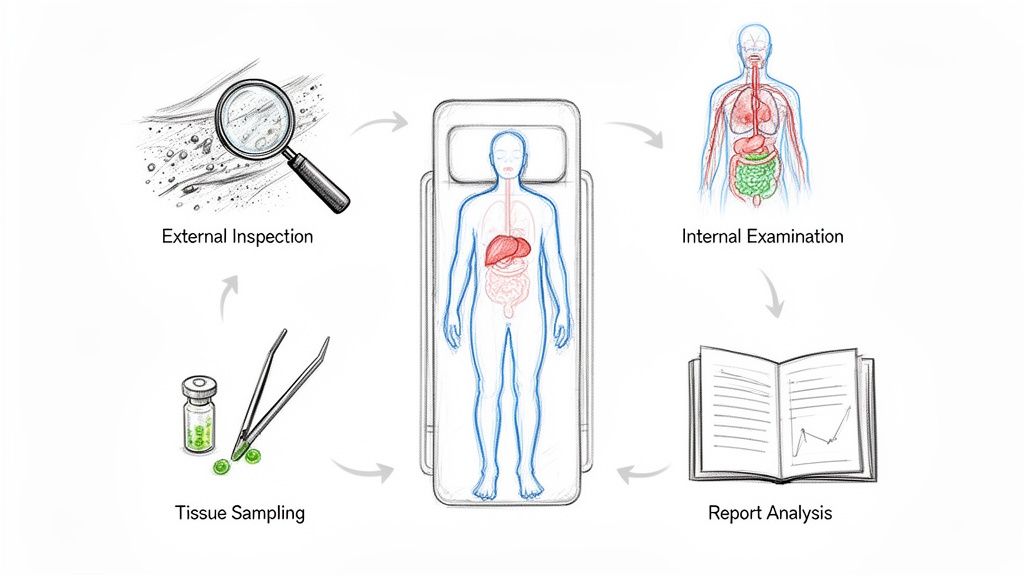
- The process includes a review of medical history, a thorough external and internal examination, and laboratory analysis of tissue and fluid samples.
- I perform every examination with the highest respect for the deceased, ensuring that traditional funeral arrangements, including an open-casket viewing, are still possible.
- The final autopsy report is a comprehensive legal document that provides a definitive, evidence-based explanation of what happened.
- In Texas, a private autopsy can only proceed with written consent from the legal next-of-kin.
When a loved one passes away unexpectedly, the need for answers can feel overwhelming. As a board-certified forensic pathologist in Texas, I’ve worked with hundreds of families and attorneys seeking clarity during these difficult times. An autopsy isn’t about what you see on television; it’s a quiet, meticulous, and respectful medical procedure designed to replace uncertainty with fact. It provides a definitive account of what happened, offering a foundation for peace of mind or legal action.
For families who need these answers privately and with absolute certainty, a private autopsy is often the best path forward. It’s an independent investigation focused entirely on uncovering medical truths with the utmost respect and care. My role is to provide an unbiased, scientifically sound determination of the cause and manner of death.
Finding Answers When They Matter Most
The initial shock of a loss often gives way to a pressing need to understand why. These questions might surface after a sudden health decline, or perhaps there are lingering concerns about the medical care a loved one received. In other cases, legal matters may hinge on having definitive proof.
A private autopsy provides a clear path to those answers. It’s a very different process from an autopsy performed by a government agency.
- Jurisdictional Autopsies: These are conducted by a Medical Examiner or Justice of the Peace and are required by law in situations like suspected crimes or accidents. Their primary goal is to serve the public interest.
- Private Autopsies: These are specifically requested and paid for by the family or legal next-of-kin. The investigation is entirely focused on your need for information, offering a dedicated and confidential examination into the cause of death.
The Role of an Independent Examination
When I conduct an autopsy, my job is to provide an unbiased, meticulous examination of the cause and manner of death. Because my practice, Texas Autopsy Services, is independent, my findings are based purely on medical and scientific evidence. There are no potential conflicts of interest that might arise in a hospital or other institutional setting. That objectivity is everything.
This detailed examination can confirm a suspected medical condition, bring a previously undiagnosed illness to light, or clarify the impact of a known disease. For families, this can mean understanding potential hereditary risks or simply having the peace that comes from knowing the truth. You can learn more about my role in our detailed article on what a forensic pathologist does.
For attorneys, the findings from a private autopsy provide the solid, factual foundation needed to build a case for medical malpractice, insurance claims, or other legal proceedings. At its core, the autopsy process is about replacing uncertainty with facts.
The Autopsy Process Step By Step
A real autopsy is a quiet, methodical, and deeply respectful medical procedure. The process doesn't start on the examination table. The first thing I do is a deep dive into the person's history. This means meticulously reviewing all available medical records, speaking with the doctors who provided care, and understanding the circumstances leading up to death. This foundational work is crucial; it helps build a comprehensive picture before the physical examination even begins.
This flow chart gives a clear overview of how a private autopsy is structured to guide a family from having difficult questions to finding clear answers and, ultimately, a sense of peace.
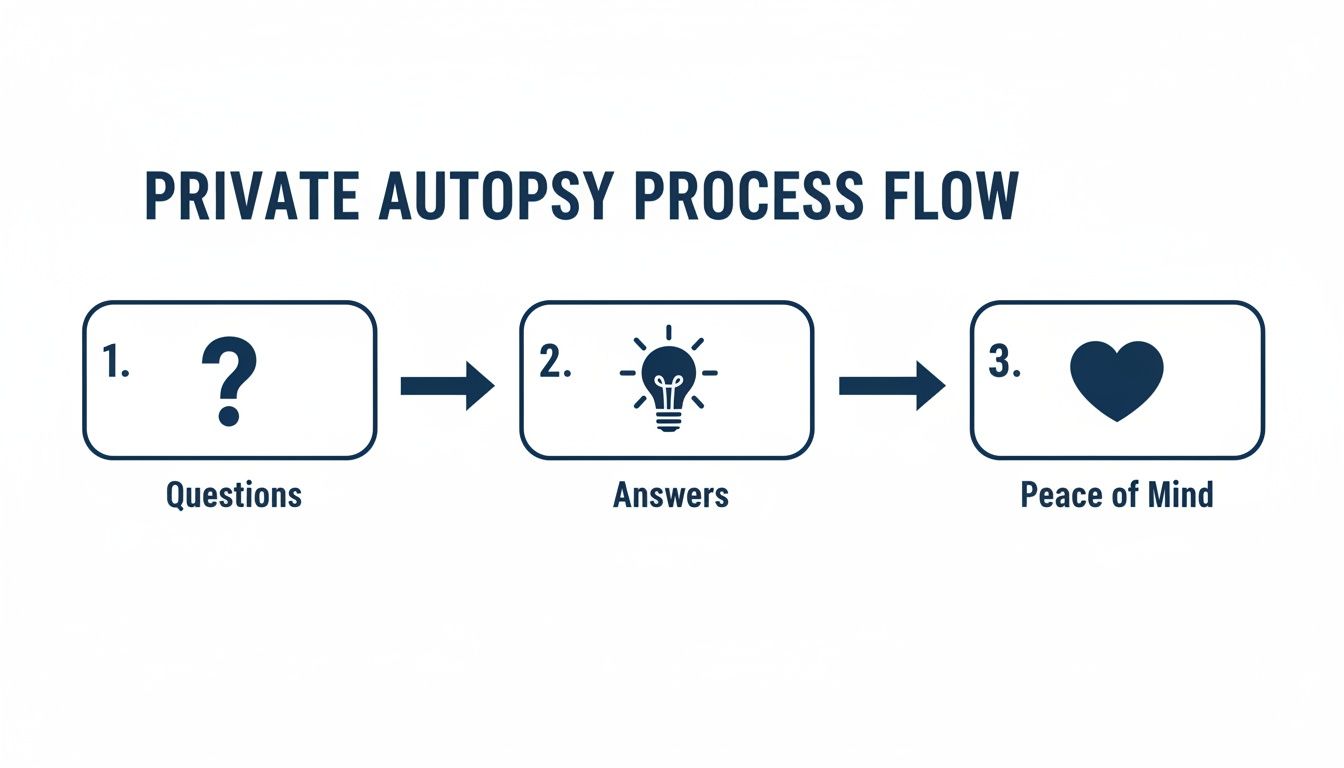
As you can see, each stage logically follows the last, ensuring the final conclusions are built on solid facts, not guesswork. The autopsy itself consists of several key phases. The following table outlines what happens at each stage.
Key Phases of the Autopsy Process
| Phase | Objective | Key Activities |
|---|---|---|
| 1. Comprehensive Review | To build a complete medical and circumstantial history before the physical examination. | Analyzing all medical records, police reports (if any), and speaking with family and physicians. |
| 2. External Examination | To document the body's external condition and identify any signs of injury or disease. | Measuring height and weight, noting scars/tattoos, photographing and documenting any external findings. |
| 3. Internal Examination | To inspect all internal organs and systems for abnormalities, disease, or injury. | Careful, respectful dissection and visual examination of each organ system. |
| 4. Specimen Collection | To gather samples for specialized laboratory testing. | Taking small tissue samples for histology, fluid samples for toxicology, and other samples for microbiology or genetic testing as needed. |
| 5. Laboratory Analysis | To conduct microscopic and chemical tests that reveal information not visible to the naked eye. | Histology (microscopic tissue review), toxicology (drug/chemical analysis), and other specialized lab work. |
| 6. Synthesis & Reporting | To integrate all findings into a final, comprehensive report explaining the cause and manner of death. | Correlating all data from the review, exams, and lab tests to form a final, evidence-based conclusion. |
This systematic approach ensures that every piece of the puzzle is examined before the final picture is revealed.
The External Examination
After the background review, the physical part begins with a detailed external examination. I carefully document everything—height, weight, identifying features like scars or tattoos, and any medical devices still in place. I also meticulously search for any signs of illness or injury visible on the skin. Every observation is recorded with photographs and detailed notes. This step provides a crucial baseline and often uncovers clues that point me in the right direction.
The Internal Examination and Ancillary Studies
Next is the internal examination, performed with the same care as any major surgery. I examine each organ and organ system one by one, looking for any signs of disease, damage, or other abnormalities. A critical part of any modern autopsy is collecting very small samples for more advanced analysis. This is where we get many definitive answers.
- Histology: I take tiny tissue sections from major organs. These are sent to a lab where they're preserved, thinly sliced, stained, and put under a microscope. This microscopic view can reveal hidden diseases like cancer or infections that are invisible to the naked eye.
- Toxicology: Bodily fluid samples, like blood and urine, are collected for toxicological testing. This analysis tells us if any prescription drugs, alcohol, or other chemicals were in the system and at what concentration.
- Other Studies: Depending on the case, I might also collect samples to test for infectious bacteria or viruses (microbiology) or genetic conditions to get a complete picture.
Every step is guided by a systematic approach. The goal is not just to find a single cause of death but to understand the entire sequence of events that led to it.
Once the examination is over, all incisions are carefully closed. We work directly with the family's chosen funeral home to ensure everything is handled smoothly. The care we take preserves the person's appearance, so an open-casket viewing is still an option if that is the family's wish. You can explore a more in-depth look at the full procedure of an autopsy in our detailed guide.
Why Clinical Assumptions Aren't Enough
Modern medicine has incredible diagnostic tools, yet the cause of death listed on a death certificate is often a clinical impression, not a pathological fact. A death certificate is typically an educated guess based on the medical history available before death. It's an assumption.
This reliance on clinical summaries has become the norm because hospital autopsies are now so rare. Decades ago, they were a standard part of medical quality control. That is no longer the case.
The Decline of the Medical Audit
Historically, the autopsy was medicine’s ultimate audit. It was the final check to confirm a diagnosis and learn from unexpected findings. But hospital-based autopsy rates have plummeted. Today, fewer than 8% of deaths in the United States are verified through this kind of detailed examination. This has created a massive gap in our collective medical knowledge.
Our modern mortality data is built almost entirely on death certificates filled out by clinicians. With so few autopsies being performed, we're relying on incomplete information to track disease trends. When the primary document is a death certificate, the potential for widespread error in global mortality statistics is huge. You can learn more about how global mortality statistics are compiled and their limitations. For individual families, this can leave painful, critical questions unanswered.
Closing the Gap with Certainty
This is exactly where a private autopsy comes in. It’s designed to close that gap between assumption and fact. It provides a definitive, evidence-based answer by moving beyond what was thought to be true and establishing what is true. My role as an independent forensic pathologist is to conduct this final medical audit with total objectivity. The examination I perform can confirm what was suspected, but in many cases, it reveals something entirely different and corrects the record.
This level of certainty is essential in a few key situations:
- Hereditary Conditions: If a family is worried about genetic diseases, knowing the precise cause of a relative's death provides irreplaceable health information.
- Medical Malpractice Cases: For an attorney, an independent examination provides the concrete, unbiased evidence needed to establish what truly happened.
- Unexplained Decline: Sometimes, a loved one’s health goes downhill rapidly without a clear reason. An autopsy can often uncover the underlying conditions that were missed.
An independent autopsy is the only way to replace a clinical impression with scientific proof. It provides a factual foundation that a medical summary or death certificate alone cannot guarantee.
The Value of a Second Opinion Autopsy
This same need for certainty applies even when a prior examination has been done. A second opinion autopsy acts as a crucial verification step. It can either validate the initial findings or, in some cases, challenge them. When I conduct a second opinion autopsy, I’m bringing a fresh, impartial set of eyes to the evidence. This is especially important when the first report doesn't seem to line up with the person's medical history. The goal is always the same: to provide the truth, based on rigorous science.
The Importance Of An Independent Pathologist
When a family needs answers, or a legal case hinges on medical facts, objectivity is everything. As an independent pathologist, I operate as an impartial medical detective, whether I'm working with a family directly or assisting a Texas county.
I’m not an employee of a hospital that might be concerned about its reputation, nor am I on the payroll of a government agency that could face outside pressure. My sole focus is on the scientific truth. This setup ensures the entire process is protected from any potential bias.
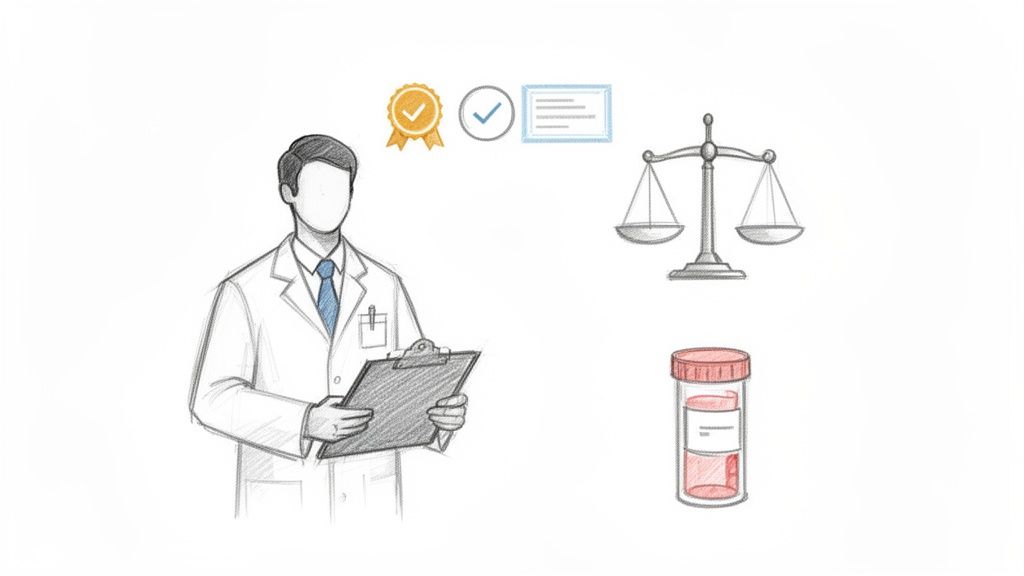
Having an impartial expert is particularly vital when the findings could have major legal or financial implications. Families and their attorneys must have complete confidence that the conclusions are based on solid, unbiased science.
The Role of Board Certification
My commitment to the highest standards is backed by board certification from the American Board of Pathology. This means I've met rigorous national standards of excellence in Anatomic, Clinical, and Forensic Pathology. It's a guarantee of quality and expertise. Each certification represents years of dedicated training:
- Anatomic Pathology: The study of tissues under a microscope to diagnose disease.
- Clinical Pathology: Analyzing lab tests on bodily fluids to understand what was happening inside the body.
- Forensic Pathology: Applying medical knowledge to legal questions, specifically to determine the cause and manner of death.
Holding all three gives me a comprehensive view that’s essential for piecing together complex cases. I can connect the dots between the physical evidence from the body and the data from toxicology or lab reports.
Navigating Conflicts of Interest
One of the biggest worries for families is a potential conflict of interest. If the hospital where a loved one was treated also performs the autopsy, it can create the appearance of a conflict, even if the work itself is sound. Choosing an independent pathologist sidesteps this issue entirely. You get a truly objective third-party evaluation, which is crucial for a second opinion autopsy or any case that might end up in court. I founded Texas Autopsy Services on this principle of unwavering impartiality.
I also perform County Forensic Autopsies for jurisdictions across Texas. Even then, I’m an independent contractor, not a government employee. This structure maintains the integrity of the investigation, ensuring every death is examined with the same objective eye. It all comes down to trust.
Understanding Your Autopsy Report
After the examination is done, the final autopsy report brings everything together. This document carefully pieces together every finding—from the external and internal exams to the microscopic analysis and toxicology tests—to create a clear picture. The entire report builds toward a definitive, evidence-based conclusion. It will clearly state the cause of death, which is the specific injury or disease that started the chain of events leading to death. It will also determine the manner of death, which is the official classification of how the death occurred.
The Five Manners of Death
In forensic pathology, every death is categorized into one of five manners. This is a conclusion based on all the evidence gathered.
- Natural: The death was caused solely by a disease process, like a heart attack or cancer.
- Accident: The death resulted from an unforeseen and unintentional event, such as a fall.
- Suicide: The death was caused by an intentional, self-inflicted act.
- Homicide: The death occurred at the hands of another person.
- Undetermined: This category is used only when there isn’t enough evidence to confidently place the death into one of the other classifications.
When I write a report, I'm always thinking about two different audiences. It must be clear enough for family members and their attorneys to understand, but it also needs the technical detail for other doctors to review. My goal is always to be transparent and straightforward. For a deeper dive, you can also look at our guide on how to read a pathology report.
Structure of a Typical Report
An autopsy report is a formal medical-legal document with a standard format. This structure ensures that all the crucial information is presented logically.
The report is more than a document; it is the final chapter of a medical story. My responsibility is to ensure that chapter is written with precision, clarity, and respect for the individual it represents.
A complete report will almost always include these sections:
- Case Summary: A brief overview of the person's history and the circumstances of their death.
- External Examination Findings: A head-to-toe description of the body's condition.
- Internal Examination Findings: A detailed, organ-by-organ account of any disease or injury found inside the body.
- Microscopic Findings: A summary of what the tissue samples revealed under a microscope.
- Toxicology Results: A list of any drugs, alcohol, or other substances detected.
- Final Diagnoses and Opinion: The concluding section that provides the official cause and manner of death.
Once the report is finished, I make it a priority to be available to discuss the findings directly with the family or their legal counsel. This conversation is an essential part of the service I provide. It's my chance to make sure you truly understand what the findings mean.
Navigating Legal And Ethical Standards In Texas
Conducting a private autopsy demands strict adherence to Texas law. At Texas Autopsy Services, every step I take is guided by state statutes, like the Texas Health & Safety Code, and the rules set by the Texas Funeral Service Commission. These are critical safeguards that protect the dignity of the deceased, the rights of the family, and the integrity of the final report.
The absolute starting point is consent. Before I can begin, the legal next-of-kin must provide clear, written permission. This is non-negotiable. It ensures the family is fully informed and in control.
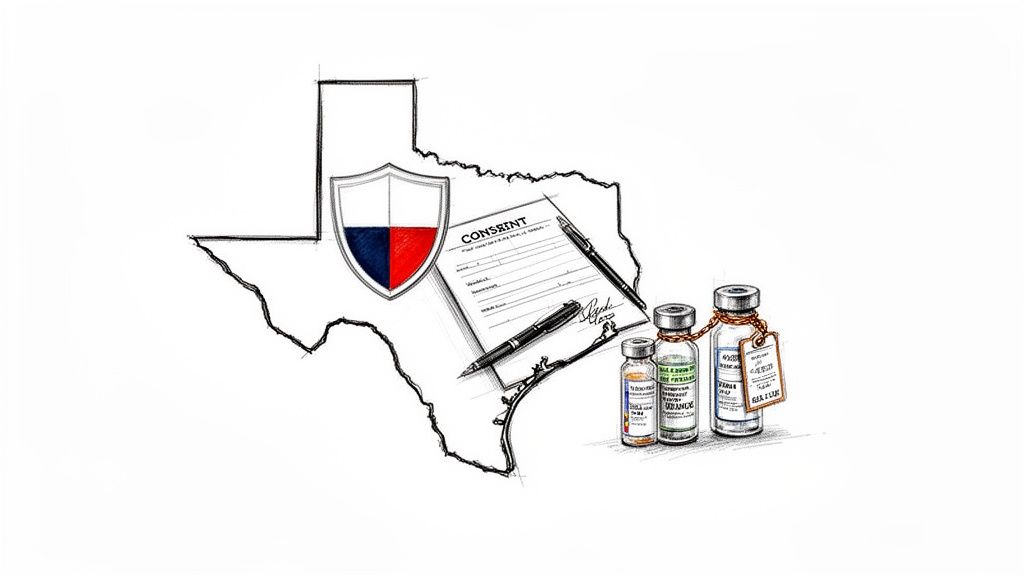
Upholding Confidentiality And Chain Of Custody
Once the family gives the go-ahead, the entire process is held in the strictest confidence. We follow a meticulous chain of custody for every single sample and piece of evidence collected. This is a formal, documented trail that tracks an item from collection to final analysis, ensuring nothing is ever compromised.
This rigorous documentation is what makes the findings legally sound and admissible in court. Without a proper chain of custody, the answers we find could be challenged. In addition to Texas regulations, we also follow federal laws governing HIPAA compliance in medical data handling to protect patient privacy.
My Ethical Commitment
Beyond the law, my work is guided by two core principles: unwavering respect for the deceased and transparent, compassionate communication with their family. Every action I take is done with the intention of honoring the person whose final story I am helping to write. Adhering to these legal and ethical standards is non-negotiable. It ensures that my findings are not only medically accurate but also legally defensible, providing families with reliable information.
Answering Your Questions About the Autopsy Process
When you're considering a private autopsy, I know you have a lot of questions. Here are my straightforward answers to the questions I hear most often.
How Much Does a Private Autopsy Cost in Texas?
The cost for a private autopsy in Texas can change depending on how complex the case is and what kind of testing is needed. At Texas Autopsy Services, my pricing is clear and all-inclusive from the start. A single fee typically covers transport, the complete professional examination by me, standard toxicology and histology, and the final, comprehensive report. When you call my office, we'll talk through your specific needs and I’ll give you a firm, final price.
Will an Autopsy Interfere With Funeral Plans?
Not at all. I handle every examination with the same level of care and respect as a surgeon. My work is done in a way that allows for a traditional viewing and funeral, including an open casket if that's what the family wants. We work closely with your chosen funeral home through our partnership with Waterloo Mortuary to make sure everything is handled smoothly and without delay.
Is a Private Autopsy Really Necessary?
This is a decision only a family can make, but getting a clear, medically certain answer can be priceless. The decline in hospital autopsies is one of the biggest changes in modern medicine. By 2020, the rate had dropped to just 7.4 percent—an 85 percent reduction over the last 70 years. Research, including these findings from the CDC, shows that autopsy findings change the final cause of death in 9 to 10 percent of cases. An autopsy is the final quality check in medicine. When a family is left with unanswered questions or needs solid proof for legal purposes, a private exam is often the only path to definitive answers.
Who Can Authorize a Private Autopsy?
In Texas, the law is very clear: only the legal next-of-kin can give permission for a private autopsy. This is a strict requirement under the Texas Health & Safety Code. The legal order of authority is typically the surviving spouse, then an adult child, then a parent, then an adult sibling. We must have written authorization from the correct person before we can begin.
How Long Does It Take to Get the Results?
The physical examination itself is usually done within a day. What takes time are the specialized lab tests, like toxicology and the microscopic analysis of tissues. I can often provide a preliminary verbal update much sooner, but the final, detailed written report is generally ready within 30 to 60 days. Some complex cases might take longer, but I will keep you and your family updated every step of the way.
If you have questions that I didn't cover here, or if you simply need to discuss your situation, please don't hesitate to call my office. The team at Texas Autopsy Services is here to listen and provide answers with compassion and clarity.