February 28, 2026 · Texas Autopsy Services
Why an Autopsy Matters: Finding Answers When You Need Them Most
Discover the importance of autopsy in delivering answers for families, informing legal outcomes, and safeguarding public health.
On this page
- An autopsy provides definitive, science-based answers about the cause and manner of death, offering closure to grieving families.
- As a board-certified forensic pathologist, I conduct independent autopsies to deliver unbiased findings for families, attorneys, and Texas counties.
- The process is respectful, confidential, and fully compliant with Texas laws, ensuring the deceased is treated with dignity at all times.
- An independent autopsy is crucial in cases involving sudden death, questions about medical care, or when a second opinion is needed.
- Autopsy findings not only serve families but also contribute vital data for public health and safety.
As a forensic pathologist who has performed over 1,000 autopsies, I've learned that a postmortem examination can offer something priceless to a grieving family: truth. When a loved one passes away, especially unexpectedly, the mind floods with painful questions. An autopsy is a quiet, careful process designed to find solid answers when so much is clouded by uncertainty. It’s about providing closure, uncovering critical evidence, and gathering information that ultimately keeps our communities safer.
I often speak with families in Central Texas who are reeling from a loss. They want to know if a diagnosis was correct, if an accident could have been prevented, or if a genetic condition played a role. An autopsy is the single best tool we have to answer these difficult questions with scientific and medical certainty. It isn't the dramatic scene you see in movies. It's a respectful and detailed examination performed to understand exactly how and why someone died. For many families, that accuracy is the first step toward finding a way to heal.
A Case of Unanswered Questions
I recall a case involving a middle-aged man who passed away suddenly at home. His doctors had been treating him for what they assumed was a chronic respiratory issue, but his rapid decline didn't add up. His family was heartbroken and felt a deep need for real answers, so they requested a private autopsy.
My examination uncovered something no one had expected: a rare, hereditary heart condition that had been completely missed. This discovery didn't just correct his medical record; it gave his children vital information about their own health risks. The autopsy honored their loved one by revealing the truth and armed the living with knowledge to safeguard their own health. That's the profound, dual purpose an autopsy can serve.
Bringing Clarity in Legal and Medical Contexts
The value of an autopsy extends well beyond personal closure. The findings are often essential in legal and insurance situations, offering objective evidence that can settle disputes or validate claims.
- For Attorneys: A forensic pathologist’s report provides an unbiased, scientific foundation for cases involving medical malpractice, workplace accidents, or personal injury.
- For Families: It can provide the clear answers needed to settle life insurance policies or workers' compensation claims, cutting through red tape with hard facts.
At its core, a postmortem examination is a service of clarification. It replaces assumptions with facts, helping families, lawyers, and even doctors see the full picture. It’s a process rooted in deep respect for the deceased and genuine compassion for the living. As a forensic pathology expert, my job at Texas Autopsy Services is to deliver that truth with precision and care.
The Alarming Decline In Autopsies and Its Consequences
Fewer autopsies are performed today than at almost any point in the last 50 years. As a forensic pathologist in Texas, I see the real-world impact of this trend every day, and it has serious consequences. The importance of autopsy as a tool for medical accuracy has never been greater, yet we're using it less and less.
When an autopsy isn't performed, the cause of death written on a death certificate is often an educated guess based on the person's medical history. While doctors do their best, those guesses can be wrong. Those errors create a quiet but powerful ripple effect that goes far beyond a single family.
This visualization breaks down the core benefits an autopsy provides—from emotional closure for families to critical information for legal and public health matters.
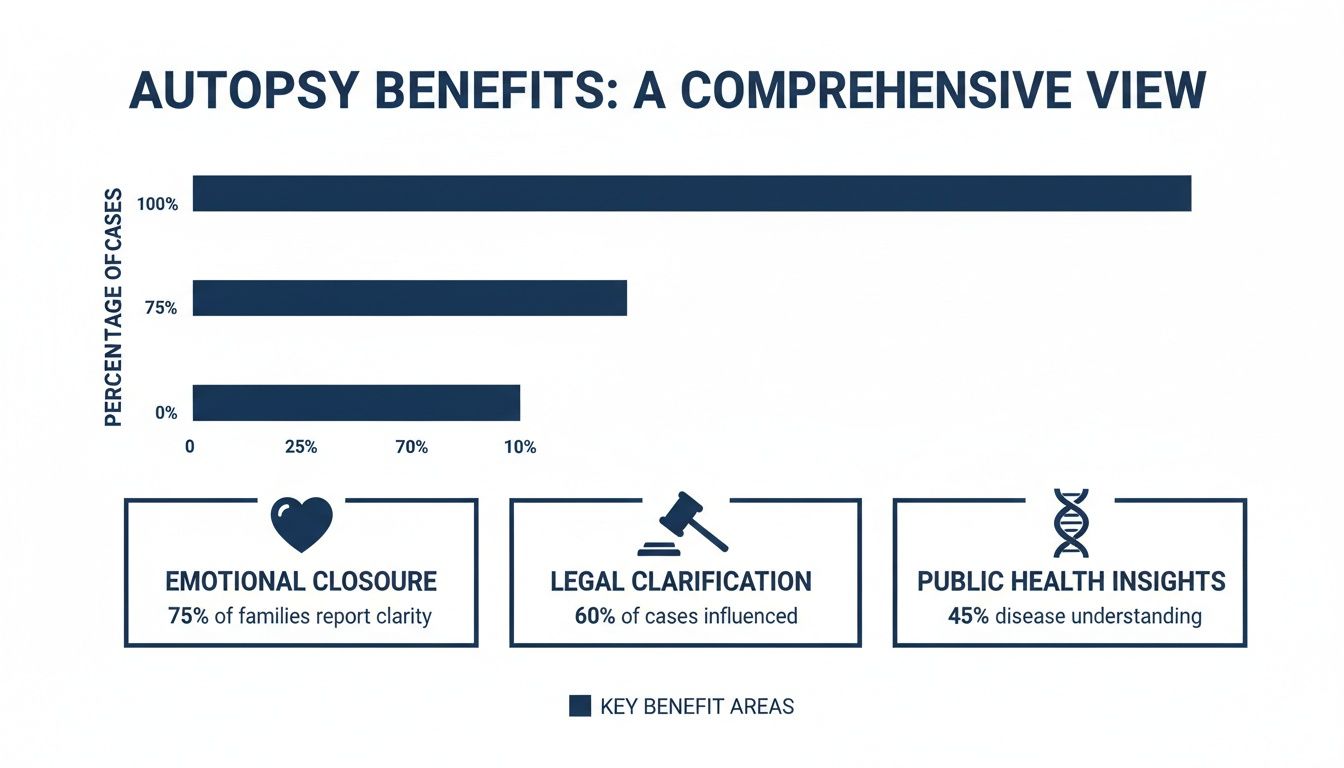
Personal peace, legal truth, and community well-being all depend on the accurate answers that only a thorough postmortem examination can provide.
A Disturbing National Trend
The numbers tell a stark story. In the United States, autopsy rates have plummeted. We've gone from 19.1% of all deaths in 1972 down to 7.4% by 2020. This freefall represents a massive gap in our understanding of why people die. In the 1940s and 1950s, hospitals performed autopsies in up to 50% of deaths. A combination of rising medical costs, family hesitation, and doctors' fears about legal liability have all contributed to the downturn. You can explore this trend in the CDC's National Vital Statistics Reports.
The effects are clear. Without these examinations, death certificates are filled with significant errors. Studies consistently show that autopsies reveal major, completely unexpected findings in 9-10% of cases—a statistic that holds true even for stillbirths and infant deaths.
The Public Health Impact of Inaccurate Data
When we lose the precise data that autopsies provide, we lose a vital tool for public health. Inaccurate death records can mask the early signs of a disease outbreak or hide the emergence of environmental health risks.
- Tracking Disease: Autopsies give public health officials an accurate picture of how common conditions like heart disease, cancer, and infections truly are, which helps them allocate resources where they're needed most.
- Evaluating Treatments: They offer definitive feedback on whether medical treatments are working, helping doctors save more lives in the future.
- Ensuring Accountability: The autopsy acts as a quality control check for our healthcare system by identifying diagnostic errors and showing us where we can improve.
As autopsies decline, the foundation of our public health data crumbles. It becomes harder to spot trends, measure the impact of new therapies, and protect our communities from emerging threats.
Why This Matters to You and Your Family
Ultimately, the consequences of this trend are deeply personal. An incorrect cause of death can rob a family of critical information about genetic conditions that might affect their own health. It can also complicate legal matters or insurance claims that hinge on an accurate determination.
Because of this decline, families and their lawyers often have to take the initiative themselves to seek out a second opinion autopsy to find the truth. The true importance of an autopsy lies in its power to set the record straight and provide definitive answers during an incredibly difficult time. Without it, we're left with incomplete stories and preventable gaps in our collective medical knowledge.
Uncovering the Truth: How Autopsies Correct the Record
An autopsy's most important job is to give families a clear, unbiased answer about why and how a loved one died. Medical teams do their absolute best with the information they have, but sometimes, the full picture only becomes clear after death. As a forensic pathologist, I’ve seen that an autopsy is often the only way to confirm or correct what was believed to be true.
This final examination can uncover diagnostic discrepancies and bring clarity to confusing medical events. It’s not about finding fault; it’s about establishing the facts. For instance, a massive heart attack can present similarly to a pulmonary embolism. Both are sudden and tragic, but their root causes are completely different. For a family, knowing the difference could be critical, especially if there's a risk of a hereditary condition. An autopsy provides that definitive answer.
The Power of a Complete Picture
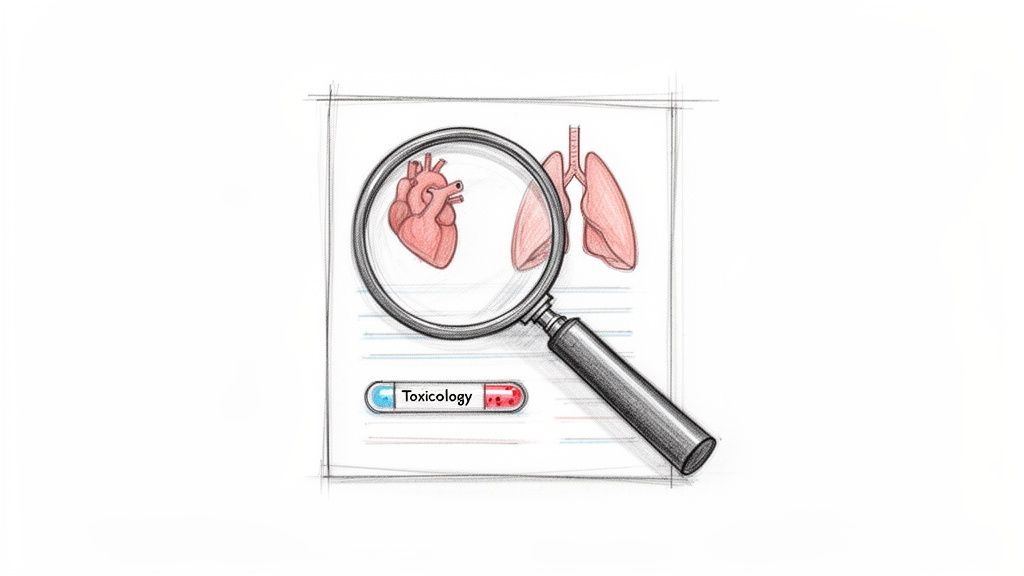
A huge piece of the puzzle often comes from toxicology testing. This specialized analysis identifies medications, alcohol, or other substances in the body and measures their exact levels. The results help paint a complete picture of the circumstances leading up to a death.
For instance, toxicology can answer questions that would otherwise be left to speculation:
- Was a prescribed medication being taken at the correct, therapeutic level?
- Did an unexpected drug interaction cause a fatal problem?
- Were any other substances involved that contributed to the death?
This information isn't just for a cause of death investigation; it helps families truly understand what happened. At Texas Autopsy Services, these findings are essential to delivering a report that is as thorough and accurate as possible.
Correcting the Record When It Matters Most
The accuracy an autopsy provides is simply indispensable. Study after study has shown that autopsies uncover major diagnostic errors that were missed while the person was still alive. Worldwide data shows that a basic physical exam alone fails to find the cause of death in about 10% of cases. That number only improves to between 1% and 5% when details from the person's history and the scene are included.
The impact is even more profound for the youngest among us. Research confirms that autopsies change the clinical cause of death in a significant 9-10% of infant and stillbirth cases. These findings directly affect how a family grieves and what kind of genetic counseling they might need. You can dig deeper into these statistics by exploring the published research. With hospital autopsy rates on the decline, the need for these precise, independent services has never been more critical. An autopsy is the final check on medical accuracy. It ensures that the story of a person's life and death is recorded with truth and precision.
In many situations, an independent autopsy is the only way for families to get the full story. The table below highlights just a few scenarios where this examination provides answers that might otherwise be missed.
| Scenario | Why an Autopsy Is Important | Potential Outcome of Examination |
|---|---|---|
| Sudden, Unexpected Death at Home | The immediate cause isn't clear, and first responders may make an assumption. | Reveals an underlying, undiagnosed condition like a genetic heart defect or a ruptured aneurysm. |
| Questions About Medical Care | A family feels that a medical error or negligence may have contributed to the death. | Provides objective evidence to either confirm or rule out concerns about the quality of care received. |
| Death During a Routine Procedure | A seemingly low-risk medical or surgical procedure ends in an unexpected fatality. | Can identify a rare allergic reaction to anesthesia, an accidental injury, or another unforeseen complication. |
| Concerns About Environmental/Workplace Exposure | A person's death may be linked to exposure to toxins or hazardous conditions at work. | Toxicology and tissue analysis can identify harmful substances and link them to the cause of death for legal or workers' comp claims. |
In any legal matter, an accurate cause of death is the bedrock of the entire case. The objective findings of a forensic pathologist are often the most powerful piece of evidence. This is why having an independent examination is so important. An autopsy performed by an outside expert, like those we conduct for private clients and Texas counties, is focused on one thing: delivering objective facts, free from any institutional bias.
The Role Of An Independent Autopsy In Texas
When a family or an attorney needs clear answers about a person’s death, objectivity is everything. That’s precisely why an independent autopsy or private autopsy is such a critical option in Texas.
A hospital's autopsy may focus on internal quality control or academic research. My role as an independent forensic pathologist is different. My work is dedicated to one thing: answering my client's questions, directly and honestly. The point of an independent examination is to have a truly unbiased, third-party perspective. As the owner of Texas Autopsy Services, I’m not tied to the institutional pressures or potential conflicts of interest that can arise in a large hospital system. This independence means the final report you receive is a straightforward, factual document built to stand up to any legal or medical review.
When Is An Independent Examination Necessary?
Certain situations demand the clarity that only an independent autopsy can bring. I often hear from families and legal teams when the circumstances around a death are complicated, disputed, or confusing.
Here are a few common scenarios where you may be searching for "autopsy near me":
- Concerns about medical care: When a family believes medical malpractice or negligence played a part in their loved one’s death, an independent review is essential.
- Workplace or environmental incidents: A private autopsy can uncover evidence needed to connect a death to a specific workplace accident or exposure, which is vital for insurance or legal claims.
- Questions about a previous finding: If a family disagrees with the cause of death provided by a hospital or a justice of the peace, a second opinion autopsy can provide resolution.
- Sudden death of a healthy individual: When a seemingly healthy person dies without a clear reason, an independent exam can uncover hidden genetic conditions or other underlying factors.
In every one of these cases, the importance of an autopsy is its power to deliver an impartial, science-based conclusion.
Upholding Objectivity And Independence
My commitment as a forensic pathologist is to the evidence. Being board-certified in Anatomic, Clinical, and Forensic Pathology by the American Board of Pathology means my work meets the highest standards in the field. I have no stake in the outcome other than finding the truth. My findings are based entirely on a systematic and thorough examination, which often includes toxicology and microscopic tissue analysis to get the full picture.
The core value of an independent autopsy is its integrity. It's a process designed to provide a medically sound and unbiased report that serves the family or attorney who requested it, free from outside influence. Families deserve to know that the answers they get are the complete, unvarnished truth. At the same time, attorneys need evidence that is solid, objective, and defensible in a legal setting. By operating independently, I can serve both of those needs.
What to Expect From the Autopsy Process
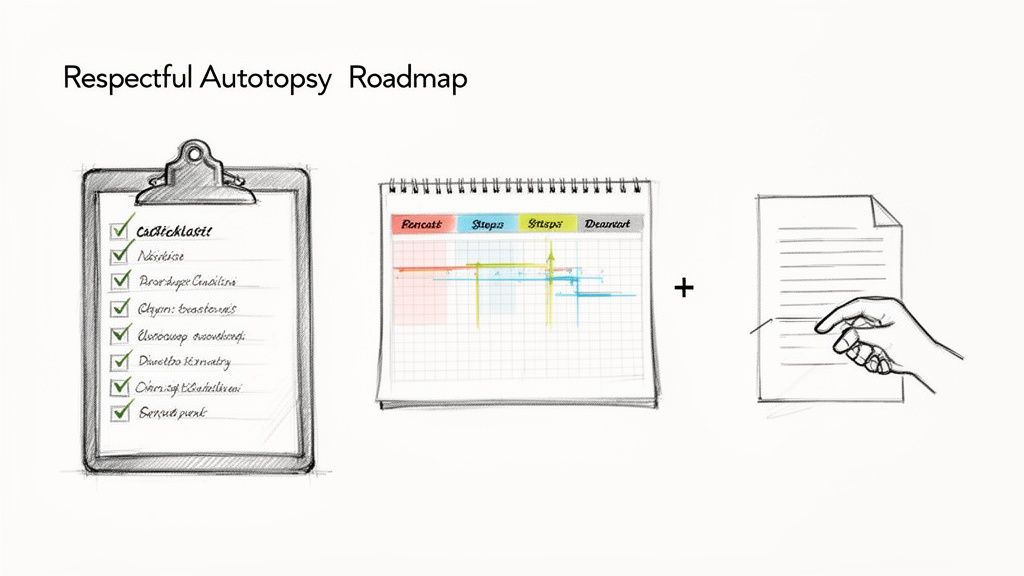
Making the decision to have an autopsy is never easy. It almost always comes at a time of incredible grief and confusion. As a forensic pathologist, my role is to guide families and their legal teams through a process that can feel overwhelming. My goal at Texas Autopsy Services is to give you a clear, compassionate roadmap.
It all begins with a conversation. We’ll talk about your loved one, the circumstances of their passing, and what questions you need answered. Clear communication is everything.
Authorizing the Examination
The first step is giving official permission for the autopsy. This is a legal requirement under the Texas Health & Safety Code, ensuring the examination is done only with the consent of the next of kin or another legally authorized person. We provide all the necessary forms and will walk you through them, so you feel confident about what you’re signing.
The Examination Process Itself
Once authorization is complete, we arrange for your loved one to be brought to our facility. Throughout their time with us, they are treated with dignity and care, a standard mandated by the Texas Funeral Service Commission (TFSC).
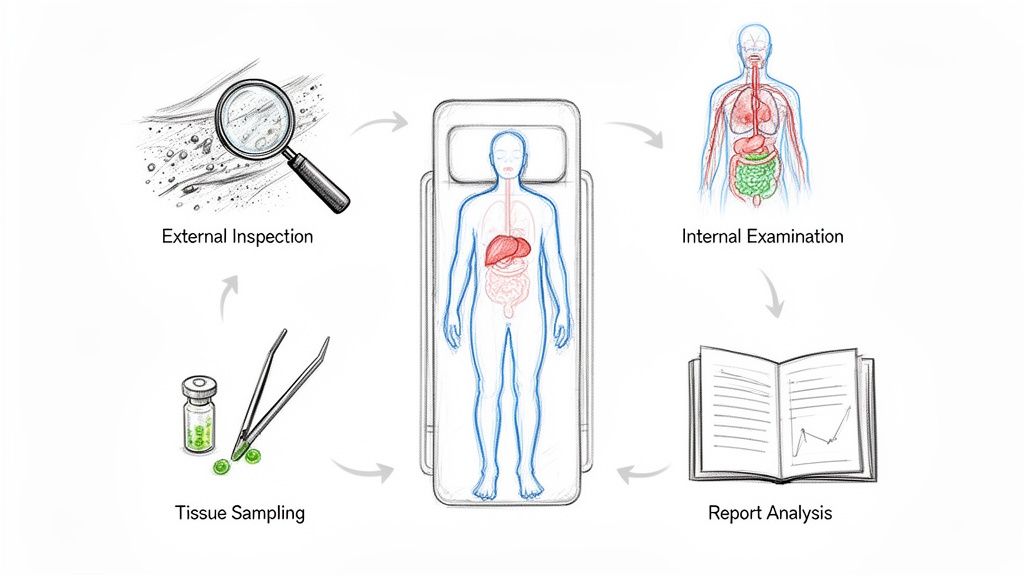
The examination itself is a systematic investigation. As a board-certified forensic pathologist, I conduct every examination with precision. It includes a detailed external review and a careful internal examination of each organ system. We may also collect small tissue and fluid samples for specialized lab testing to ensure a complete cause of death investigation.
Understanding Cause and Manner of Death
One of the most important outcomes of the autopsy is determining the cause and manner of death. These terms refer to two distinct things:
- Cause of Death: This is the specific medical reason a person died, such as a heart attack, a gunshot wound, or an infection like pneumonia.
- Manner of Death: This places the cause of death into a legal context. There are five official categories: natural, accident, suicide, homicide, and undetermined.
My job is to find the medical cause and provide the evidence needed to determine the manner. This distinction is crucial for legal cases, insurance claims, and for giving families a complete and truthful answer.
Receiving the Final Report
The physical examination usually takes a few hours, but the real analytical work happens afterward. It can take several weeks to get results back from toxicology tests and microscopic analysis. Once all the information is in, I compile a comprehensive written report.
This document details all of my findings in precise medical language, but I also include a summary in plain English that's easy to understand. The final report is a legally sound document that presents the facts of the case, and it’s delivered directly to you. I always make myself available to review the report with you and your attorney, so you can ask any questions and get the clarity you deserve.
How Autopsy Findings Support Public Health and Safety
While I often focus on providing answers to a single family, the importance of autopsy is much bigger than any one case. Every examination I perform is part of a larger story, building a critical foundation for community health and public safety right here in Texas. Think of each autopsy as a single piece of a puzzle. Together, they reveal trends and dangers we’d never see otherwise.
Accurate cause-of-death information is the bedrock of smart public health policy. It’s the raw data officials depend on to track disease outbreaks, pinpoint environmental hazards, and see if safety programs are working. Without the precise data we get from autopsies, public health leaders are essentially flying blind.
From Individual Cases to Community Protection
The knowledge we’ve gained from postmortem examinations has directly shaped the world around us. For example, early autopsies on people killed in car accidents helped engineers understand specific injury patterns. That knowledge led directly to lifesaving inventions like seatbelts and airbags.
It’s the same story with workplace safety. Autopsies on workers who died suddenly uncovered hidden links to toxic chemicals, which pushed for stronger regulations that protect countless people on the job today. This is especially true when I'm performing County Forensic Autopsies, where my findings are essential for both the legal system and for maintaining the accurate public health records our lawmakers rely on.
The Foundation of Accurate Health Statistics
When an autopsy isn't performed, the cause of death on a certificate is often a physician's best guess. These doctors mean well, but their assumptions can be wrong, leading to skewed public health data.
Autopsies set the record straight. Getting the cause of death right has a ripple effect with several key benefits:
- Identifying Disease Clusters: Accurate data helps epidemiologists spot an unusual spike in deaths from a specific illness, which could be the first warning sign of an outbreak.
- Tracking Chronic Illnesses: It allows us to monitor the true impact of long-term conditions like heart disease, diabetes, and Alzheimer's on our population. You can learn more in our article on death certificates and cause of death.
- Guiding Medical Research: Reliable mortality statistics point researchers toward the most urgent health threats, helping them focus their efforts where they're needed most.
My work as a forensic pathologist is a service not just to a family, but to society. We learn from every life to better protect the living.
Frequently Asked Questions About the Autopsy Process
When families reach out, they have urgent questions and need straight, compassionate answers. Here are a few of the most common ones I receive.
Who can authorize a private autopsy in Texas?
Texas law is very clear about who can authorize an autopsy. The authority belongs to the deceased person's legal next of kin. This follows a specific order of priority, starting with a surviving spouse. If there's no spouse, it moves to an adult child, then a parent, and so on. My team and I can walk you through the specifics of the Texas Health & Safety Code to ensure every legal detail is handled correctly.
Will an autopsy prevent an open-casket funeral?
This is a common worry, and the answer is no, it will not. An autopsy is a surgical procedure performed with the highest level of respect. All incisions are made so they won't be visible once your loved one is dressed. Afterward, they are meticulously closed. We work closely with our partners, such as Waterloo Mortuary, to ensure everything is handled with dignity, allowing you to proceed with your plans for a viewing and funeral.
How much does a private autopsy cost?
The cost of a private autopsy in Texas depends on the complexity of the case. Some situations require extensive toxicology tests or genetic analysis, which can affect the final price. At Texas Autopsy Services, we are committed to being completely transparent. We provide a single, all-inclusive quote before we begin, so you know exactly what to expect. This price covers everything from transportation to the delivery of the final report. There are no hidden fees.
How long does it take to get autopsy results?
While the physical examination is usually done in a day, the detailed lab work, like analyzing tissues under a microscope or running toxicology screens, is a meticulous process. Generally, you can expect the final, comprehensive autopsy report within 6 to 8 weeks. However, I always provide the family or their attorney with preliminary findings in just a few days to give you immediate answers while we complete the in-depth analysis.
If you have other questions or need to discuss your specific situation, please don't hesitate to reach out to my office. I'm here to offer professional guidance with the compassion you and your family deserve.