January 6, 2026 · Texas Autopsy Services
What Families Should Know About the Cause of Death on a Texas Death Certificate
Discover what the cause of death on death certificate means, how it's determined, and how it affects records and benefits.
On this page
- Why an Accurate Cause of Death Matters
- How to Read the Cause of Death on a Death Certificate
- How a Forensic Pathologist Determines a Cause of Death
- When the Official Cause of Death Seems Wrong
- The Process for Amending a Texas Death Certificate
- Distinguishing Between Cause and Manner of Death
- Frequently Asked Questions About Death Certificates
Receiving a death certificate is a difficult, formal part of the grieving process. It’s a document that distills the end of a life into a few clinical lines. In my experience as a forensic pathologist, it often leaves Texas families with more questions than answers. The listed cause of death can feel abrupt, incomplete, or simply incorrect, planting seeds of doubt during an already devastating time.
- A private autopsy provides an independent, objective cause-of-death determination when the official record seems wrong.
- As a board-certified forensic pathologist, I conduct a meticulous investigation to provide unbiased, scientifically sound opinions.
- An accurate cause of death is critical for emotional closure, settling legal matters like life insurance, and ensuring public health data is correct.
- Texas law outlines a specific process for amending a death certificate using new evidence from a private autopsy.
- Understanding the difference between cause (the medical reason) and manner (the circumstances) of death is essential.
My goal is to bring clarity. At Texas Autopsy Services, I help families, attorneys, and medical professionals make sense of this complex document. A medically accurate conclusion is essential for both emotional and legal closure. It’s about turning uncertainty into understanding.
Why an Accurate Cause of Death Matters
A death certificate is far more than a bureaucratic step for burial or cremation; it is a foundational legal document with real-world consequences.
- Emotional Closure: For many people, knowing the precise medical reason for a loved one's passing is a vital part of healing. An accurate cause of death can put to rest nagging questions about their final moments.
- Legal and Financial Processes: This certificate is the key to settling estates, claiming life insurance benefits, and accessing survivor benefits. An incorrect cause of death can create significant delays and legal complications.
- Public Health: On a broader scale, data from death certificates helps officials track mortality trends, identify public health threats, and direct resources where they are most needed.
The Forensic Pathologist’s Role in Providing Clarity
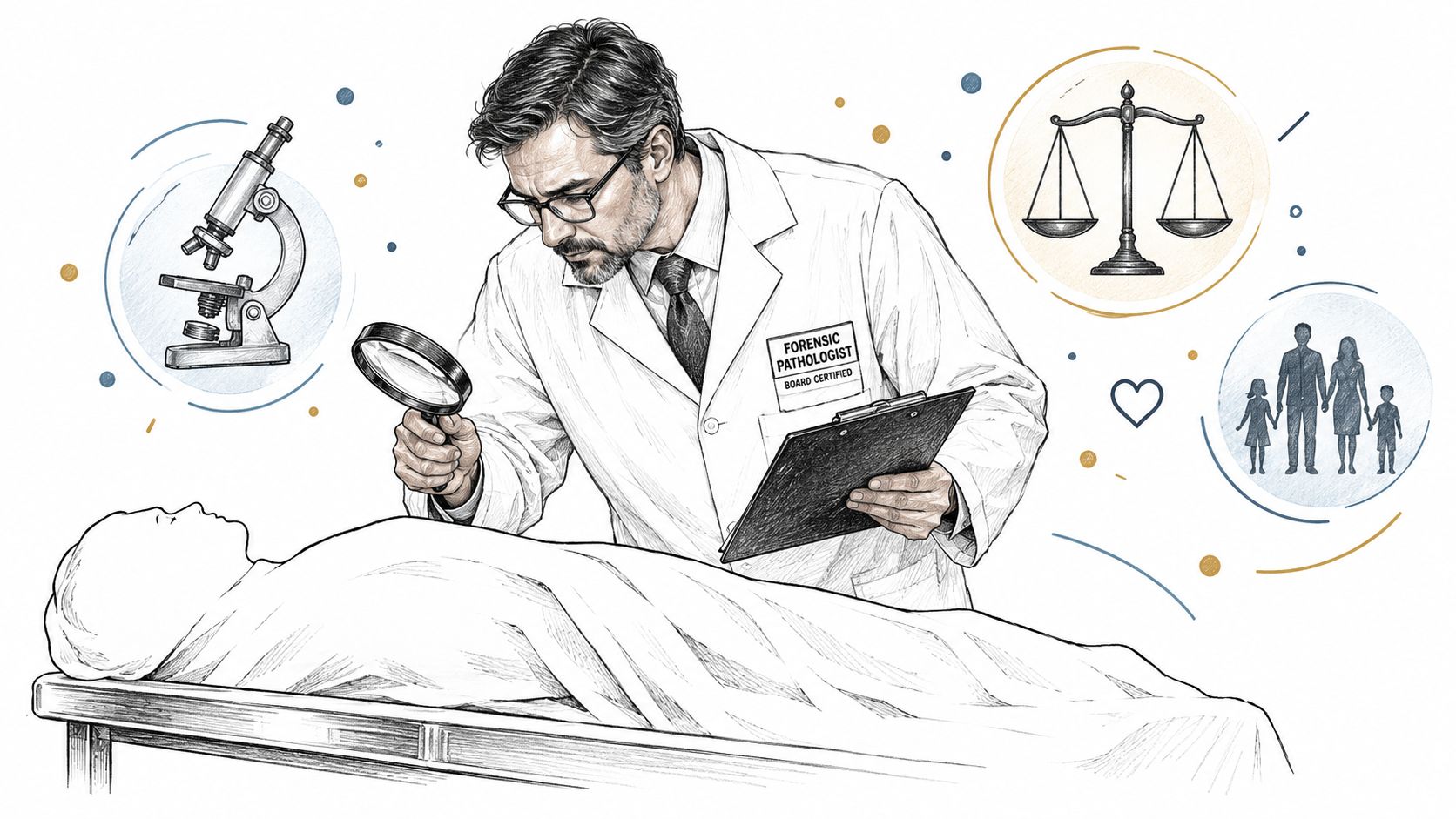
When the official cause of death doesn't seem to fit a person's health history or the circumstances of their passing, an independent review is the next logical step. As a forensic pathologist with board certification from the American Board of Pathology, my job is to offer an unbiased, scientifically sound opinion. This is often accomplished through Private Autopsies, which provide the most definitive way to confirm, clarify, or correct the findings on a death certificate.
The death certificate is the final medical opinion on a person’s life. Ensuring its accuracy is a matter of respect for the deceased and a crucial service to the living. It provides a trusted foundation for families to move forward.
Whether I'm working directly with a family or providing forensic services for Texas counties, my work is grounded in medical precision and a compassionate understanding of what is at stake. This guide will explain how a cause of death is determined and how you can find answers when you need them.
How to Read the Cause of Death on a Death Certificate
The heart of the death certificate is the cause of death section. It functions less as a single statement and more like a short sequence of events—a series of medical dominoes where one event leads to the next.

This document is essential for providing closure, settling legal matters like life insurance and inheritance, and sometimes for public health investigations.
Part I: The Direct Chain of Events
The first section, Part I, lays out the direct path to death. It is written in reverse, starting with what happened at the very end and working backward to the initial problem.
- Immediate Cause: This is the final complication or condition that directly resulted in death. It’s the last domino to fall. Common examples include "acute respiratory failure" or "cardiac arrest."
- Intermediate Cause(s): These are the conditions that link the immediate cause back to the root problem. There may be one, several, or none, depending on the situation.
- Underlying Cause: This is the single most important line on the certificate. It’s the disease or injury that started the entire chain reaction. Legally and medically, this is considered the official cause of death.
For example, an elderly person has an accidental fall, breaks their hip, and is hospitalized. While recovering, they develop pneumonia and ultimately die from respiratory failure. The underlying cause was the fall. To see where each piece of information goes, it helps to understand what info is on a death certificate in its entirety.
Here is a table breaking down how that information is organized.
How to Read the Cause of Death Section
This table simplifies the medical portion of a standard U.S. death certificate.
| Certificate Part | What It Means | Example Scenario (Pneumonia from a Fall) |
|---|---|---|
| Immediate Cause | The final event that happened right before death. | Septic Shock |
| Intermediate Cause | The condition(s) that led to the immediate cause. | Pneumonia |
| Underlying Cause | The disease or injury that started the whole sequence. | Hip Fracture due to an accidental fall |
This structure creates a clear, logical progression from the initial incident to the final outcome.
Part II: Other Significant Conditions
Part II lists any other major health issues the person had that may have contributed to their death but were not part of the direct chain of events in Part I. These are conditions that weakened the person or complicated their final illness but did not directly cause the sequence that led to death.
For instance, someone with long-term diabetes who dies of a heart attack. The diabetes did not directly cause the heart attack, but it worsened the person's overall health and likely contributed to the poor outcome.
Understanding the difference between Part I and Part II gives you the full context of your loved one's health. Sometimes, a family might feel a condition listed in Part II was more important than the certifier realized, which is a common reason people seek a second opinion.
How a Forensic Pathologist Determines a Cause of Death

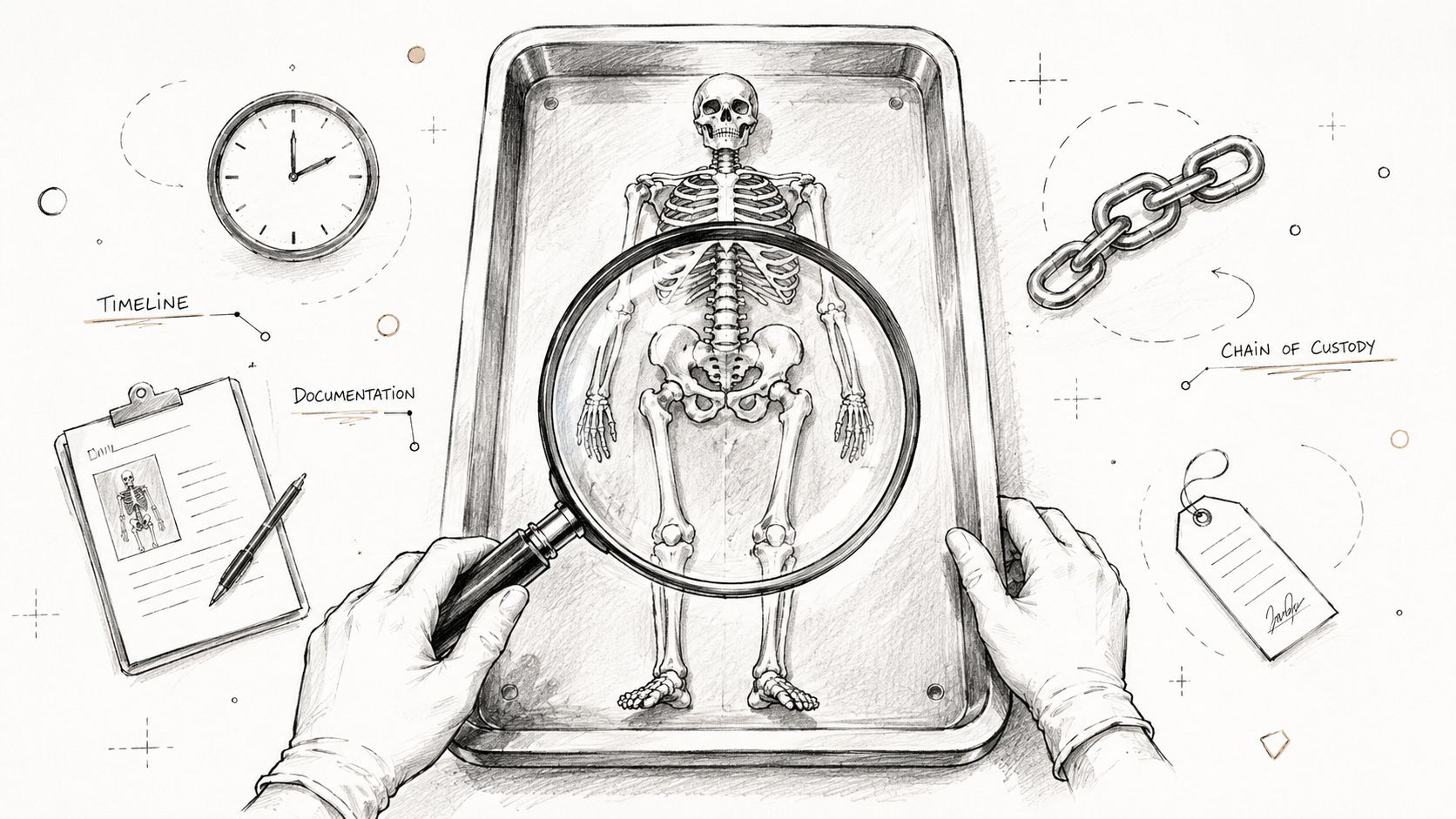
The final cause of death on a death certificate isn’t a guess. It’s the result of a careful, methodical investigation that weighs evidence from different sources to piece together a person's final medical story. As a forensic pathologist who has performed over 1,000 autopsies, my entire practice is built on this evidence-based approach.
This process rests on a three-part foundation of evidence.
The Three Pillars of a Death Investigation
First is the clinical history. This means gathering all available medical records, doctor’s notes, prescription histories, and speaking with family members who knew about the person’s health. For someone with a long, documented illness, their clinical history often provides a clear path to the cause of death.
The second pillar is the postmortem examination, or autopsy. This is a detailed, systematic examination of the body, both externally and internally, to find any disease, injury, or other abnormality that could have led to death. An autopsy provides physical evidence that medical records alone cannot.
The third pillar involves ancillary studies. These are specialized lab tests that provide crucial details. The most common is toxicology, which screens for drugs, alcohol, and other substances. Another key study is histology, where I examine tissue samples under a microscope to find evidence of disease at the cellular level.
Weighing the Evidence
How I weigh these three pillars depends on the unique circumstances of each case.
- Documented Illness: If someone passes away in a hospital after a long illness like cancer, their medical history is usually the most important evidence. An autopsy may not be needed to determine the cause of death.
- Sudden or Unattended Death: When a person dies suddenly or hasn't seen a doctor recently, the clinical history can be thin. In these situations, the postmortem examination and ancillary studies become essential.
Without a direct examination, a certifier might list a probable cause based on age and known risk factors, but that is still an educated guess. I’ve handled cases where a presumed heart attack turned out to be a pulmonary embolism or a ruptured aortic aneurysm—findings only an autopsy could have uncovered.
An accurate cause of death isn't just about what seems probable; it's about what is medically certain. The investigation must follow the evidence.
A private autopsy is the ultimate tool for achieving that certainty. It replaces doubt with objective, scientific fact. My job is to meticulously gather all the evidence and provide a definitive answer. My detailed article on cause of death determination explores these steps in more detail.
Legal tools like guardianship and advance directives for future care preferences can shape the medical care a person receives, and that information becomes a key part of their final clinical history.
When the Official Cause of Death Seems Wrong
It’s unsettling to look at a death certificate and feel that the official story doesn’t line up with what you know. This is a powerful, nagging feeling that something is missing.
Perhaps a person who seemed healthy passed away suddenly. Maybe you have concerns about their medical care, or you feel that other factors were at play. A second opinion, through an independent and private autopsy, can provide a clear path forward when the initial explanation feels incomplete.
The Value of an Independent Autopsy
My role is to conduct an exhaustive, unbiased investigation, completely separate from the original doctor or coroner. This independence is not about assigning blame; it’s about a relentless pursuit of medical truth.
An independent autopsy is a full-scale investigation. We might confirm the original findings, but we could also uncover a different cause of death or identify crucial contributing factors that were missed. The goal is to give families and their legal counsel a definitive, scientifically backed source of truth.
When questions linger, a private autopsy serves as a powerful tool for verification. It’s a scientific process designed to replace uncertainty with objective, medically sound facts, giving families the solid answers they deserve.
This objective review is vital not only for peace of mind but also for practical reasons. An accurate cause of death on death certificate can be the deciding factor in life insurance claims or potential wrongful death litigation.
Common Scenarios That Warrant a Second Look
I've noticed a few common situations that lead families and attorneys to seek a second opinion.
- Sudden or Unexpected Death: When a seemingly healthy person dies without a clear explanation, a private autopsy can pinpoint specific, undiagnosed conditions.
- Suspected Medical Misdiagnosis: If you believe a medical error or missed diagnosis contributed to the death, a postmortem examination can clarify the true sequence of events.
- No Autopsy Was Performed: Sometimes, a hospital or medical examiner will decline to perform an autopsy. In these cases, a private one is the only way to get a definitive answer.
- Concerns About Toxic or Environmental Exposure: A detailed examination with comprehensive toxicology testing can reveal harmful substances that may have played a role.
Heart Disease: A Common but Complicated Cause
"Heart disease" is one of the most common causes of death on a certificate, but this broad diagnosis can mask a more complex story. For instance, ischaemic heart disease is the world’s leading killer, responsible for 9.1 million deaths in 2021, which is 13% of all global deaths.
Even with something so common, misdiagnoses happen. Studies have revealed that autopsies find major discrepancies in up to 30% of cardiac-related death investigations. In many of those cases, issues like undetected arrhythmias or adverse drug interactions were missed. For Texas families questioning a heart-related death, an independent autopsy can provide certainty. You can learn more from the top causes of death from the World Health Organization.
The Process for Amending a Texas Death Certificate
Receiving a final, evidence-based autopsy report brings clarity. But that clarity leads to a practical question: Now what? A private autopsy provides scientific truth, but getting that truth onto an official state document requires navigating a specific administrative path.
In Texas, the authority for these records lies with the Department of State Health Services (DSHS) Vital Statistics Unit. My role as the forensic pathologist is to provide the solid medical evidence needed to justify the change.
Who Initiates the Amendment Process?
The first step is to return to the original certifier—the physician, medical examiner, or justice of the peace who first signed the death certificate. When new, definitive information from an independent autopsy comes to light, they are the official point of contact.
My detailed report becomes the new, compelling medical evidence. I present my findings in a clear, logical sequence, detailing everything from the postmortem examination and toxicology results to a final, medically sound cause of death.
In most cases, a well-documented private autopsy report gives the original certifier everything they need to submit an amendment. My goal is to make the scientific case for the change airtight.
The certifier reviews my report, and if they agree with the findings, they file an official amendment request with the state. This is the most straightforward way to correct the record.
The Steps for Requesting an Amendment
The general process for amending a cause of death in Texas is as follows:
- Secure New Medical Evidence: The family or their attorney hires me to perform a private autopsy.
- Present the Report to the Original Certifier: My comprehensive report is formally delivered to the official who originally signed the death certificate.
- The Certifier Files the Amendment: If the evidence is accepted, the certifier submits the necessary forms and my report to the Texas DSHS Vital Statistics Unit.
- DSHS Reviews and Approves: The state agency reviews the package to ensure it meets all legal and medical requirements. Once approved, the death certificate is officially amended.
If the original certifier refuses to file an amendment, the next step often involves taking the matter to court. In these situations, my findings can be presented as expert testimony to support a court-ordered change. My commitment is to the scientific facts, giving families a firm foundation to fight for an accurate final record.
Distinguishing Between Cause and Manner of Death

Few things on a death certificate cause more confusion than the terms “cause” and “manner.” They are not interchangeable. In forensics and law, they mean very different things. This distinction can affect everything from insurance payouts to potential criminal charges.
The cause of death is the specific medical reason a person died. It’s the disease or injury that started the chain of events leading to death. It is the biological answer to "what happened?"—such as "complications from pneumonia" or "gunshot wound to the chest."
The manner of death is the legal classification that explains the circumstances behind the cause. It answers the question, "how did it happen?" In Texas, we use five official options.
The Five Official Manners of Death
This classification provides context for the death. My job is to place the death into one of these five categories based on all available evidence.
- Natural: The death was caused solely by disease or the natural aging process.
- Accident: Death results from an unintentional and unforeseen event, like a car crash or an accidental fall.
- Suicide: Evidence shows a person purposefully took their own life.
- Homicide: A person died at the hands of another. This does not automatically imply a crime has occurred; that is for the legal system to decide.
- Undetermined: Used when there isn’t enough information to confidently choose one of the other four manners.
How One Cause Can Have Different Manners
A single medical cause can fit into several different manners, depending entirely on the circumstances.
Take drowning as the medical cause of death. If a person slips and falls into a lake, the manner is Accident. If someone holds them underwater, the manner is Homicide. If they left a note and intentionally entered the water to end their life, the manner is Suicide.
The same applies to a gunshot wound. Was it an Accident during cleaning? A Homicide? A Suicide? The autopsy findings and police investigation guide us to the correct classification.
If you want to explore this topic further, my piece on the difference between cause and manner of death provides more detail.
Frequently Asked Questions About Death Certificates
Families and attorneys often have similar questions about death certificates, the cause of death, and private autopsies. Here are some of the most common ones.
How quickly do we need to request a private autopsy?
This is a time-sensitive issue. Requesting an autopsy before any embalming or cremation takes place will yield the most complete and accurate results. However, meaningful information can often still be gathered even after some time has passed. The key is to act as quickly as you can.
Can a private autopsy report change a death certificate?
My findings from a private autopsy provide objective, powerful medical evidence that can be used to request an amendment. My report is designed to be the scientific foundation for that request. The final decision to change the certificate, however, rests with the original certifying official or a Texas court.
Do you provide services in rural Texas counties?
Yes. As the owner of Texas Autopsy Services, I serve all 254 counties in Texas. I collaborate with trusted partners, like Waterloo Mortuary, to ensure professional and respectful transport and examination, no matter where you are in the state. Every family deserves access to clear answers. For families navigating international matters, understanding the difference between an Apostille vs. Notary Public is often a critical step.
A clinical diagnosis is for a living patient to guide treatment. A cause of death is a conclusion reached after death, based on all available evidence, which may or may not match the diagnoses made during life.
This is a vital distinction. The autopsy creates a complete picture that clinical records alone might not show.
If you are struggling with uncertainty surrounding a loved one's passing, you don’t have to remain in the dark. At Texas Autopsy Services, my focus is on providing medical truth with dignity and respect. Please feel free to reach out to my office for guidance.
You can find clarity at https://www.texasautopsyservices.com.