January 1, 2026 · Texas Autopsy Services
What Info Is On A Death Certificate In Texas
A forensic pathologist explains what info is on a death certificate, from cause of death to final disposition, and why total accuracy is so important.

On this page
- The Three Key Parts of A Texas Death Certificate
- Confirming Identity: The Personal and Demographic Details
- Understanding The Medical Certification Of Death
- Documenting Final Disposition And Arrangements
- Why An Accurate Death Certificate Is So Important
- When a Private Autopsy Can Provide Answers
- Common Questions About Death Certificates In Texas
A death certificate is more than an official record of passing. As a forensic pathologist, I see it as a foundational legal document that tells a story in three distinct parts: who the person was, what caused their death, and what arrangements were made. Each section is vital, playing a role in everything from settling legal affairs to shaping public health data for all Texans.
I often walk families through this document because understanding its structure and purpose can bring clarity during an incredibly difficult time. An accurate certificate provides factual answers, which is the first step toward closure.
The Three Key Parts of A Texas Death Certificate
The information required on a Texas death certificate is mandated by state law for specific legal, administrative, and public health reasons. Knowing what's on it, and why, can make a significant difference for families and attorneys navigating the steps that follow a loss.
I think of the document as a story told in three acts. Each part is completed by different professionals, from funeral directors to physicians or medical examiners, and each contributes their specific knowledge to create a permanent, legal record.
Information Found On A Texas Death Certificate
To give you a clearer picture, here’s a breakdown of the key information you'll find, organized by category.
| Category | Information Included |
|---|---|
| Decedent's Identification & Demographics | Full legal name, date of birth, age, sex, Social Security number, birthplace, parents' names (including mother's maiden name), marital status, surviving spouse's name, and last known residence. |
| Medical Certification | Date and time of death, immediate cause of death, underlying conditions that contributed to death, and the official Manner of Death (Natural, Accident, Suicide, Homicide, or Undetermined). |
| Final Disposition Details | Method of disposition (burial, cremation), date and location of disposition, name and address of the funeral home, and the certifier's information (physician, medical examiner, or justice of the peace). |
| Registrar's Information | The official signature and filing date from the local vital statistics registrar, which legally registers the death with the state. |
This table covers the core components, but let's examine what each part really means.
The Certificate's Core Components
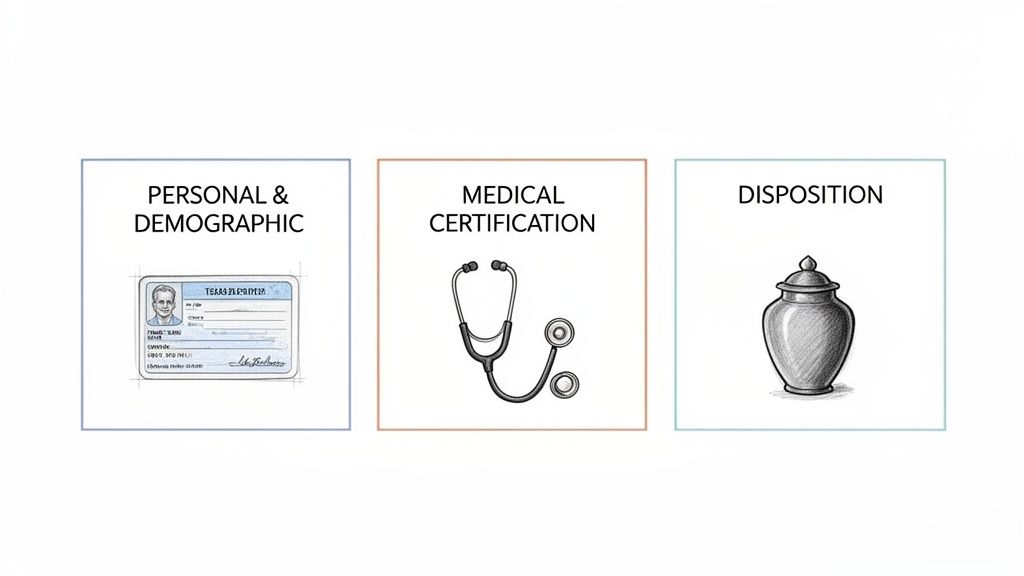
The document is essentially broken down into three main jobs:
- Personal and Demographic Data: This is the biographical snapshot. It paints a picture of the person's life with their full legal name, date of birth, social security number, parents' names, and other identifying facts. A funeral director usually gathers this information from the family or next of kin.
- Medical Certification: As a forensic pathologist, this is the scientific core of the certificate where my expertise is often required. It explains the "why" and "how" of the death, detailing the cause and manner. This part requires careful medical analysis and is completed by a physician, medical examiner, or justice of the peace. When the cause of death is unclear, a private autopsy from an independent expert like me can provide the critical answers needed for this section.
- Disposition and Registrar Details: The final section is all about logistics. It documents the person’s final arrangements—whether they were buried or cremated, and where. It also names the funeral director responsible and includes the official filing stamp from the local registrar.
In my experience performing over 1,000 autopsies, I’ve seen how even a small error in any of these sections can create significant delays for families trying to settle an estate or file an insurance claim. Precision is essential.
Together, these pieces form a permanent, legal record that’s as important for official proceedings as it is for a family's sense of closure.
Confirming Identity: The Personal and Demographic Details
The first part of any death certificate is all about establishing, officially and legally, who has passed away. Think of it as the final, formal chapter of a person's life story on paper. Every detail here is a crucial piece of the puzzle that the surviving family will need to settle their loved one's affairs.
Typically, a funeral director takes on the sensitive task of collecting this information. They work directly with the family or next of kin, guiding them through the necessary questions with a mix of precision and compassion during what is an unbelievably stressful time.
The Foundational Biographical Information
At its core, this section is about the fundamental facts. Getting these details exactly right is non-negotiable. Even a simple mistake, such as a misspelled middle name or a switched number in a birth date, can cause major headaches for the family down the line.
Here’s what you’ll find:
- Full Legal Name: This isn't just a name; it's the official identifier that must match other legal documents like a driver's license or passport. It's how every agency will recognize the person.
- Social Security Number: This is the key to notifying the Social Security Administration to stop payments and prevent any potential fraud. Banks and other financial institutions also rely on it to close out accounts.
- Date of Birth and Date of Death: These two dates officially bookend a person's life. They're used for everything from calculating life insurance benefits to building out family trees for future generations.
- Parents' Full Names: This information, especially the mother’s maiden name, is vital for establishing lineage and can be a lifesaver for confirming identity if other records are hard to find.
A common issue I see causing frustration for families is a mismatch between the name on the death certificate and the name on a bank account or property title. Ensuring absolute consistency across all documents prevents these kinds of legal hurdles.
Demographic Data: More Than Just Personal Details
Beyond the core identifying facts, the certificate also gathers demographic information. While these details feel intensely personal, they serve a much broader purpose for public health and safety. Once this data is anonymized and collected on a large scale, it gives state and national agencies a powerful tool for understanding our communities.
This information helps officials spot mortality trends and decide where to put resources. It includes things like:
- Marital Status and Surviving Spouse's Name: This is a legal necessity for handling inheritance, property rights, and spousal benefits like Social Security.
- Education Level and Usual Occupation: This might seem random, but it helps public health researchers in Texas find connections between certain jobs, socioeconomic conditions, and health outcomes.
- Race and Hispanic Origin: This is crucial for identifying and addressing health disparities between different groups, helping to ensure public health programs are focused where they're needed most.
- Last Known Residence: This confirms the person's final address for legal notices and helps statisticians track mortality rates right down to the county level.
In the end, this first section of the death certificate pulls double duty. It gives families the official key they need to manage their loved one's estate and honor their final wishes. At the same time, it contributes to a massive, ongoing public health study that helps protect and improve the lives of all Texans. Every field, no matter how small it seems, has a job to do.
Understanding The Medical Certification Of Death
While the first half of a death certificate is about a person's life, the medical certification section tells the story of their death. This is where my work as a board-certified forensic pathologist comes into play, and it’s the part of the document that families and attorneys often have the most questions about.
This isn’t just a single line item; it's a detailed medical statement that must be precise. A physician, medical examiner, or, in some Texas counties, a justice of the peace is responsible for completing it. Their certification carries serious legal weight, impacting everything from insurance payouts to potential criminal investigations.
The Cause Of Death: A Chain Of Events
Most people think the "cause of death" is just one thing, but it’s really a sequence of events. I often describe it to families as a line of dominoes. The medical certification is designed to show exactly how one event knocked over the next, ultimately leading to death.
This section is officially broken down into two parts:
- Part I: The Direct Sequence. This lists the chain of diseases or injuries that led directly to the death. It starts with the immediate cause (the final event, like a pulmonary embolism) and works backward to the underlying cause (the condition that started it all, such as deep vein thrombosis from being bedridden).
- Part II: Contributing Conditions. This is for other significant conditions that played a role but weren't in that direct chain of events. For instance, a person with severe diabetes (Part II) would have a much harder time recovering from a heart attack (Part I).
The difference between the immediate and underlying cause is critical. "Cardiac arrest" is an immediate cause, as everyone's heart eventually stops, but it doesn't explain why. A proper certification digs deeper to find the underlying reason, like coronary artery disease, which paints a much clearer and more useful medical picture.
The following diagram shows how these different pieces of information, personal, demographic, and medical, come together to create the final identity record on the death certificate.
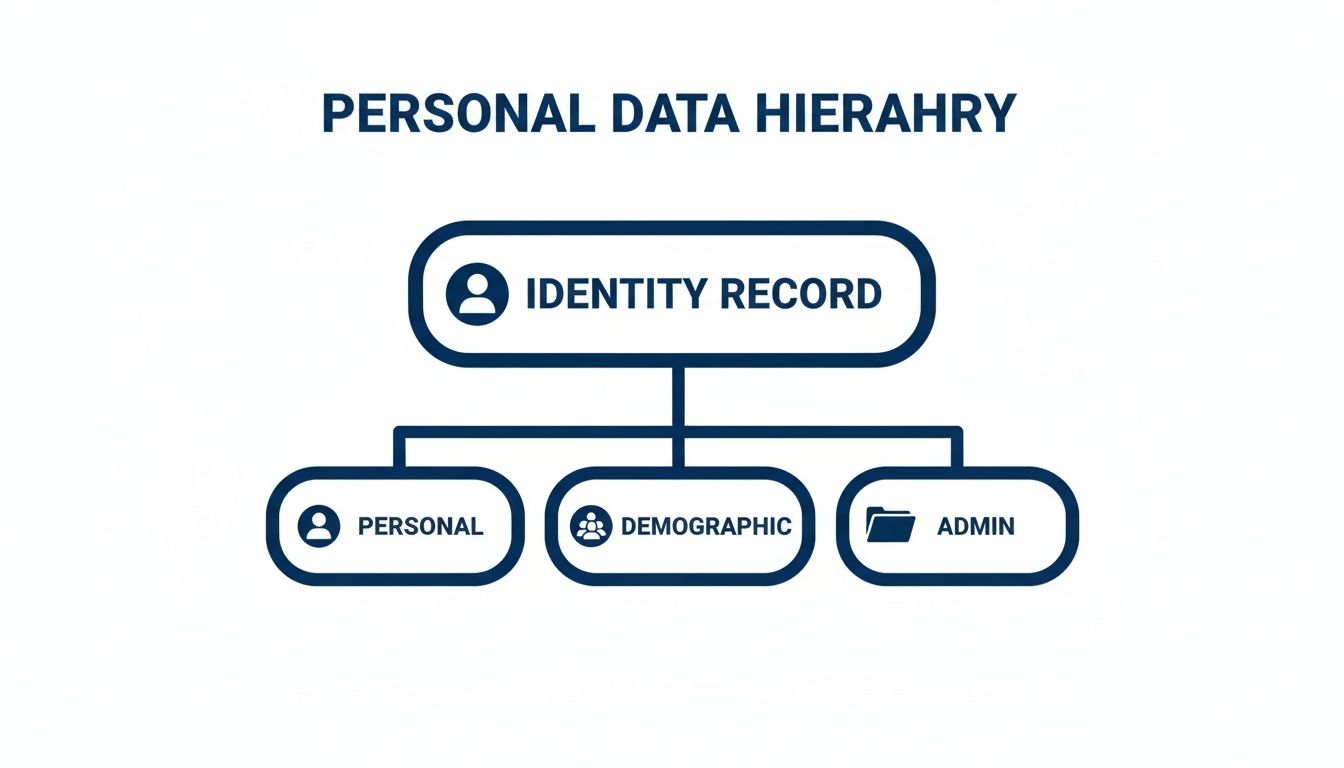
This structured format follows international standards, which helps track public health trends worldwide. In 2023, data from over 3 million U.S. deaths showed heart disease was the top killer. Yet, studies reveal error rates as high as 30% in cause-of-death reporting for cases without an autopsy, especially in sudden deaths where a forensic expert’s input is so important.
Defining The Manner Of Death
After determining the cause, the certifier must also state the manner of death. This isn't a medical diagnosis; it's a legal classification that describes the circumstances surrounding the death. In Texas, like most states, we use five official categories.
It's important to know what each one means:
- Natural: Death resulted solely from disease or the aging process. This is the most common manner of death by far.
- Accident: An unintentional injury or poisoning caused the death. Think car wrecks, falls, or drug overdoses where there was no intent to die.
- Suicide: The death was caused by a deliberate, self-inflicted act.
- Homicide: Another person was responsible for the death. This is a neutral, medical-legal term; it doesn't automatically mean a crime was committed. The legal system decides that.
- Undetermined: There isn't enough evidence to confidently place the death in one of the other four categories. This is often used when skeletal remains are found without any clear signs of injury or disease.
Who signs the death certificate depends on how the person died. If it was a natural death and they were under a doctor's care, their physician usually certifies it. But for any death that's sudden, unexpected, or involves an injury, a medical examiner or justice of the peace must investigate and certify the cause and manner. For a closer look at these timelines, you can learn more about when a death certificate is issued in our related guide.
Documenting Final Disposition And Arrangements
Once the medical side of things is settled, the death certificate takes on one last, very practical role. It becomes the official record of what happened next: the final arrangements. Think of it as the last chapter in the story, closing out the legal and logistical process that begins when someone passes away. This section ensures there's a permanent, clear account of what was done with the person's remains.
This part of the form is almost always handled by a licensed funeral director. They’re the ones who work with the family to carry out their wishes, making sure every step follows Texas state law. When they sign off, they’re officially stating that the final disposition was handled correctly and ethically.

This final section gives clear, straightforward answers to the practical questions that need to be documented for the official record.
Key Information In The Disposition Section
The details here are simple but incredibly important for the legal paperwork. They confirm that the person was laid to rest according to their wishes and the rules set by the Texas Funeral Service Commission.
You’ll typically find these key fields:
- Method of Disposition: This spells out the final arrangement—was it a burial, cremation, donation to medical science, or entombment in a mausoleum?
- Place of Disposition: This names the exact location, like the cemetery, crematorium, or the specific medical school that received the body. A full address is required.
- Date of Disposition: This is the precise date the burial, cremation, or other final arrangement took place.
- Funeral Director Information: The name, license number, and address of the funeral director and their establishment are listed. This creates a clear trail of professional accountability.
This information provides a conclusive end to the administrative journey. It's the proof a family needs that everything was handled properly, and it gives the state the final data point required to close the record.
In my work, I see this section as the final act of dignity for the deceased. It formally documents that their journey has concluded and that every legal and ethical obligation has been met with care and professionalism by the funeral service provider.
Once the funeral director signs this section and files it with the local registrar, the death certificate is officially complete. It goes from being a work-in-progress to a permanent legal document. This final step is what allows families to move forward with settling estates, confident that all requirements have been fulfilled. Every piece of what info is on a death certificate is designed to provide clarity, from the personal details right down to these final arrangements.
Why An Accurate Death Certificate Is So Important
A death certificate often seems like just one last piece of paperwork, a final bureaucratic step after a loved one has passed. But in my years of experience, I've seen firsthand that it's so much more than that. This single document is the bridge between a family's private grief and the public systems of law, finance, and even health that we all rely on. Its accuracy isn’t just a detail; it’s absolutely critical.
For the family left behind, an accurate death certificate is the key that unlocks what comes next. It’s the official proof needed to handle all the practicalities, from closing a bank account and accessing retirement funds to claiming life insurance benefits. A precise cause of death also provides a clear, factual narrative, which can be an essential part of the grieving process and finding closure.
Personal Hardship And Public Health
Even a seemingly small error can create a world of trouble. A misspelled name can bring the transfer of a property title to a grinding halt. An incorrect cause of death can throw a life insurance claim into dispute, forcing a grieving family to fight through red tape when they're at their most vulnerable. For more complex official uses, like immigration, having documents processed correctly through services like USCIS document translation services is vital to ensure everything is accepted by federal agencies.
But the impact goes far beyond one family. These certificates are the foundation of public health. When the data is collected and anonymized, it helps officials here in Texas and across the country spot disease outbreaks, track trends in chronic illness, and decide where to send resources. Widespread errors can skew this data, leading to misguided policies that affect the health of every Texan. Knowing what info is on a death certificate is the first step to understanding its true importance.
The information on a death certificate serves two vital roles. For a family, it provides closure and the legal standing to manage a loved one's final affairs. For society, it provides the data necessary to protect and improve public health for years to come.
The National Impact Of Local Data
Every local death certificate contributes to a massive national database. In the U.S., this information feeds into the National Vital Statistics System (NVSS), which paints a detailed picture of our country's health. For instance, early data from 2023 showed 3,090,582 deaths registered nationwide, with heart disease holding its spot as the leading cause. The reliability of these huge, important statistics hinges on the accuracy of each individual certificate filled out in a local hospital or medical examiner's office.
This data reveals critical shifts. We saw COVID-19 deaths fall by 68.9% in 2023, though it still remained the 10th leading cause of death. But here’s a sobering fact: studies have shown that errors appear on 20-30% of certificates that are completed without an autopsy. This highlights just how crucial a professional postmortem review can be. Every accurately certified death strengthens our collective understanding of community health, ensuring we can spot emerging threats and use our resources wisely. You can learn more about this in our overview of what a death certificate is.
When a Private Autopsy Can Provide Answers
Sometimes, the official cause of death on a certificate just doesn't feel right. It can leave a family with more questions than answers, especially when it contradicts what you knew about your loved one’s health. In my experience, that lingering uncertainty is one of the heaviest burdens a family can carry.
A common red flag is a vague cause of death, like "cardiac arrest" or "natural causes," with no further explanation. While these terms might be technically correct, they fail to answer the most important question: why? What caused the heart to stop? Was it an unexpected heart attack, a hidden genetic condition, or something missed entirely?
When those doubts start to creep in, a private autopsy can be the surest way to find real clarity.
Seeking Definitive, Science-Based Answers
Think of a private autopsy as an independent, science-based investigation. It’s performed by a board-certified forensic pathologist like me, who has no connection to the hospital or the original certifier, guaranteeing a completely objective look at the facts. The entire process is handled with respect, focused solely on uncovering the medical truth.
An independent examination can lead to one of two critical outcomes:
- It can confirm the original findings, giving your family the scientific validation needed to finally have peace of mind.
- It can correct the official record by uncovering new, definitive evidence that changes the entire story.
A private autopsy isn’t about placing blame; it's about establishing medical facts. It gives families and their legal teams the clear, unbiased answers they need to find closure and move forward.
This process ensures the final report is built on a solid foundation of physical evidence and a meticulous review of medical history. If you're grappling with unanswered questions, our guide to private autopsies can walk you through the process of getting the certainty you and your family deserve.
Common Questions About Death Certificates In Texas
As a forensic pathologist, I've spent years talking with families and attorneys who are trying to make sense of this process. A death certificate is a critical document, but the steps to get one, and make sure it's right, can feel overwhelming. Let's walk through some of the most common questions I hear.
How Long Does It Take To Get A Death Certificate In Texas?
Generally, you can expect it to take anywhere from 10 days to a few weeks. The funeral director has a legal deadline to file the certificate with the local registrar within 10 days of the death.
But what if the cause of death isn't straightforward? If a medical examiner is investigating, the process can take longer. They might be waiting on toxicology reports or other lab results to be absolutely certain about the medical certification, which understandably delays things.
Who Can Legally Request A Copy Of A Death Certificate?
For the first 25 years, Texas keeps these records private. Only "qualified applicants" can get a certified copy during this time.
So, who qualifies?
- Immediate family members: This includes a spouse, parents, children, siblings, and grandparents.
- Legal guardians
- A legal representative handling the deceased's estate.
After that 25-year mark, the death certificate becomes public information, and anyone can request a copy.
How Do I Correct An Error On A Death Certificate?
Mistakes happen, but thankfully, they can be fixed. You'll need to file an amendment with the Texas Vital Statistics Unit.
The process depends on what needs correcting. For simple clerical errors on non-medical details (like a misspelled name), a notarized affidavit and some proof will usually do the trick.
Correcting the medical certification, the cause and manner of death, is more involved. The original doctor or medical examiner who signed the certificate must file the amendment. This is often done when new, compelling evidence comes to light, like the findings from a private autopsy. For attorneys or families managing multiple documents in these cases, knowing how to extract information from PDF files can be a real time-saver.
If you're still looking for clarity or have questions about a specific cause of death, please don't hesitate to reach out. At Texas Autopsy Services, my team and I are here to provide the answers and support you need with compassion and precision.
Contact us directly at (806) 230-1889 or learn more at https://www.texasautopsyservices.com.