November 7, 2025 · Texas Autopsy Services
Understanding Cause of Death vs Manner of Death in Texas
Learn the difference between cause and manner of death from a forensic pathologist. See how each is determined and why it matters.
On this page
As a board-certified forensic pathologist, I often explain to families and attorneys two critical terms on every death certificate: the cause of death and the manner of death. They sound similar, but they answer very different questions. Clarifying this distinction is the cornerstone of any death investigation and is essential for families seeking truth after a loss.
Here's what you need to know:
- The Cause of Death is the specific medical reason someone died, like a heart attack or gunshot wound. It answers, "What happened inside the body?"
- The Manner of Death is the legal classification of the circumstances leading to that cause. It answers, "How did it happen?"
- There are five official manners of death: Natural, Accident, Suicide, Homicide, and Undetermined.
- An independent autopsy by a forensic pathologist provides objective medical findings that clarify the cause of death, which is critical for legal cases, insurance claims, and providing families with closure.
The 'What' vs. The 'How'
The most direct way to understand this is to see the cause of death as the specific medical event that stopped the body from functioning. It's the "what." The manner of death is the legal classification describing how that event came to be. It's the "how."
A real-world example I often use involves a gunshot wound. The wound itself is a clear cause of death, but it can fit into several manners of death depending on the circumstances.
- If another person fired the weapon, the manner is Homicide.
- If the person fired it themselves with intent to die, it's Suicide.
- If the weapon discharged unintentionally, it's an Accident.
The medical cause—the injury—is identical in all three scenarios. But the context surrounding it completely changes its legal and official classification. This distinction isn't just a technicality; it has significant legal and emotional implications.
Cause vs Manner A Quick Comparison
| Concept | What It Answers | Example |
|---|---|---|
| Cause of Death | "What was the specific injury or disease?" | A heart attack (myocardial infarction) |
| Manner of Death | "How did that injury or disease happen?" | Natural |
The cause is a medical determination based on scientific evidence. The manner is a legal conclusion based on the complete investigation.
Why This Distinction Matters
The difference between these terms is fundamental to how death investigations proceed in Texas and beyond.
- The Cause of Death is my medical opinion as a forensic pathologist. I base it on findings from the autopsy, toxicology reports, and other scientific evidence.
- The Manner of Death is a legal classification. It's determined by evaluating all available information, including the medical cause, police reports, witness interviews, and scene findings.
The cause of death tells the story of what happened inside the body. The manner of death tells the story of what happened outside of it. In my work at Texas Autopsy Services, my role in a private autopsy is to meticulously document the medical cause. I provide that objective, scientific opinion to the family, their attorney, or the authorities. These findings then become a crucial piece of the puzzle used to determine the official manner of death, ensuring the process is handled with precision and in compliance with Texas law.
The Five Manners of Death Explained
After establishing the medical cause of death, my focus shifts to the circumstances. In forensic pathology, every death is classified into one of five officially recognized categories, known as the manner of death. This isn't just a medical conclusion; it's a legal and statistical one, based on all available evidence.
This infographic helps visualize the difference.
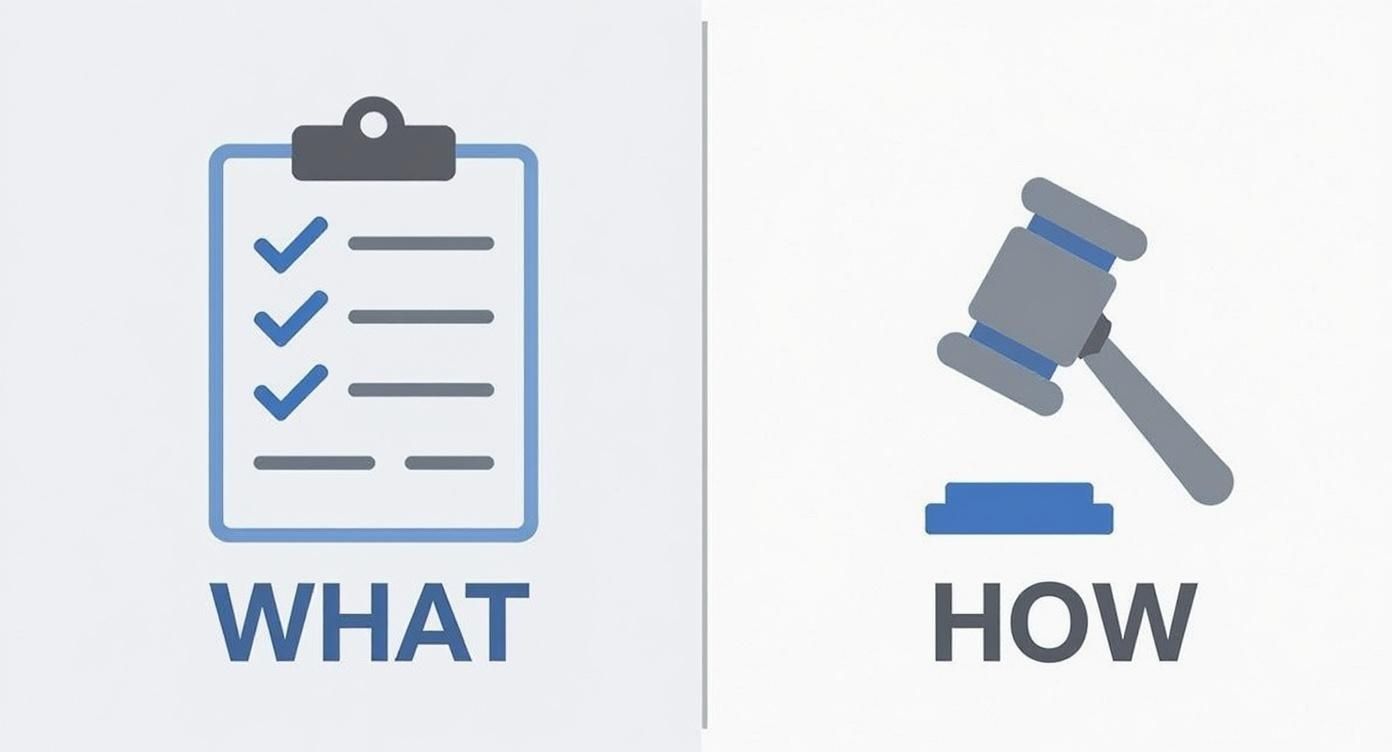
As you can see, the "Cause" points to a medical finding, while the "Manner" is a legal classification based on a full investigation.
Natural
A natural manner of death is the most common classification. It means the body failed because of an internal disease process or the effects of aging. Examples include heart attacks, cancer, strokes, or complications from an illness like pneumonia. The key factor is the absence of any external force or injury. While a death may feel anything but natural to a grieving family, especially if it's sudden, this classification strictly means no non-natural factors contributed.
Accident
The accidental manner of death applies to cases where an unplanned, unintentional event caused a fatal injury. There was no intent to cause harm from any party.
Common examples include:
- A fatal motor vehicle collision.
- An unintentional overdose on prescription or illicit drugs.
- A deadly fall at home or work.
The defining element is the lack of intent. Even if carelessness was involved, the death was not deliberately caused by anyone, including the decedent.
Suicide
A death is classified as suicide only when the evidence clearly shows a person intentionally took their own life. The cause of death must be the result of a deliberate, self-inflicted act. To make this determination, I require proof of intent, such as a note, a documented history of suicidal threats, or scene evidence that leaves little room for doubt. Without sufficient evidence of intent, I cannot classify a death as suicide. You can learn more about how a forensic pathologist determines the manner of death and see how complex this process can be.
Homicide
Homicide is the classification for any death that results directly from the actions of another person. It's important to understand that from a forensic pathologist's perspective, "homicide" is a neutral term. It simply means "death at the hands of another."
A homicide ruling doesn't automatically mean a crime occurred. It's a medical-legal finding that initiates a police investigation. Law enforcement then determines if charges like murder or manslaughter are warranted, or if it was a case of justifiable homicide, such as self-defense. My role is to state the medical facts, not to assign legal blame.
Undetermined
Finally, the undetermined manner is used when, even after a thorough investigation, there isn't enough evidence to confidently select one of the other four categories. It's an honest acknowledgment that we cannot be certain. This can occur in cases with advanced decomposition, where the cause of death itself is unclear, or when evidence for an accident is as strong as evidence for a suicide. While it can be a difficult conclusion for families, it's a necessary one. Speculation has no place on a death certificate; we must adhere strictly to the facts.
How a Forensic Pathologist Uncovers the Truth
Determining the cause and manner of death isn't a single event; it's a methodical process. As a board-certified forensic pathologist with over 1,000 autopsies performed, my work is to synthesize every piece of available information into a medical opinion built on evidence. This process blends hard science with investigative work to tell a complete story.
I follow strict standard operating procedures to ensure every conclusion is accurate, consistent, and can stand up in a court of law. The work doesn't start on the examination table; it begins by gathering crucial context.
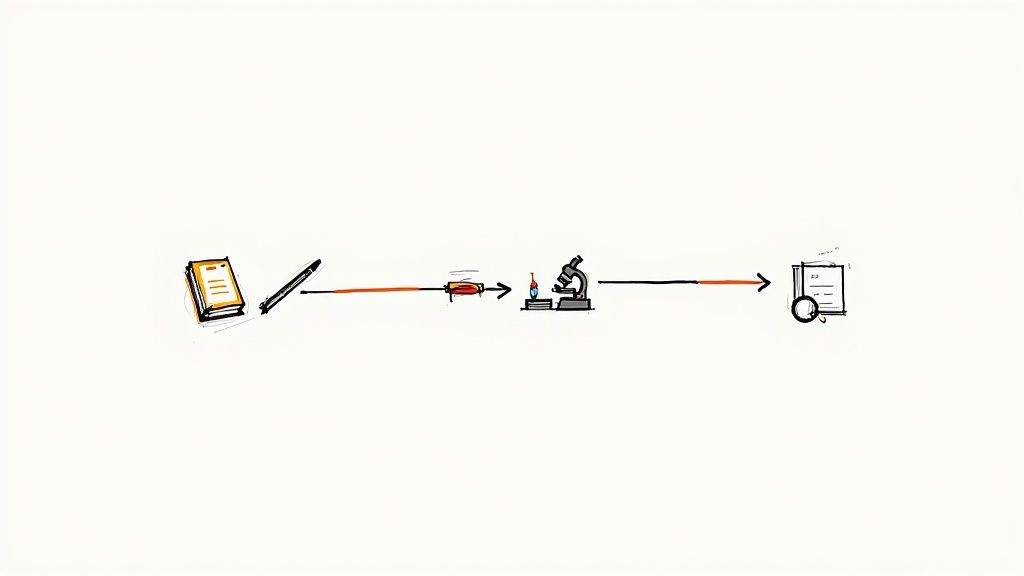
This first phase involves reviewing records and reports. It’s impossible to understand the what without first understanding the who, where, and how.
Building the Complete Picture
An autopsy cannot be performed in a vacuum. The first step is always gathering information from every possible source. To form an accurate opinion, I weave together data that typically includes:
- Medical Records: A person’s health history often holds the key. Past illnesses, recent surgeries, or prescribed medications can explain a sudden death or reveal critical contributing factors.
- Scene Investigation Findings: Reports from the scene provide vital environmental context that can be just as important as my findings during the autopsy.
- Law Enforcement Reports: These documents outline witness statements, timelines, and other circumstances surrounding the death, which are essential for determining the manner of death.
Only after I’ve reviewed this background information do I proceed to the physical examination. You can read more about this in our guide on cause of death determination.
The Autopsy and Scientific Analysis
The autopsy is a systematic search for objective medical facts. The external examination involves documenting every injury, identifying mark, and the overall condition of the body. The internal exam allows me to inspect each organ for signs of disease or trauma not visible from the surface.
The body itself tells a story about a person’s life and the circumstances of their death. My job is to read that story with scientific precision, free from bias or guesswork.
The physical exam is just one part. Scientific testing adds another crucial layer of evidence.
- Toxicology: We analyze bodily fluids and tissues for drugs, alcohol, poisons, or other chemicals. A suspected overdose, for example, is confirmed by toxicology, helping to establish both the cause and manner of death.
- Histology: This involves examining tissue samples under a microscope. It can reveal evidence of diseases like cancer, chronic heart conditions, or hidden infections that would otherwise go unnoticed.
My final opinion is never based on a single finding. It's a conclusion reached by carefully piecing together medical history, scene context, the physical autopsy, and specialized lab tests. My duty is to assemble these facts into a clear, defensible narrative that brings answers to families and clarity to the legal system.
Why This Distinction Is Critical for Families and Legal Cases
The difference between cause and manner of death isn't just a technical detail; it has real-world consequences that affect everything from a family's emotional healing to major legal outcomes. For loved ones dealing with a sudden loss, a clear and accurate answer provides not just a medical explanation but also a sense of closure to painful questions. The stakes are just as high in legal and financial matters.
Financial and Insurance Implications
A single word on a death certificate, like 'Accident' versus 'Suicide', can determine whether a family receives critical financial support.
- Life Insurance Policies: An 'Accident' ruling is often necessary to receive accidental death and dismemberment (AD&D) benefits. Conversely, many policies include clauses that deny payment if the manner of death is 'Suicide', particularly within the first few years of the policy.
- Workers' Compensation: If someone dies on the job, a determination of 'Accident' is essential for their family to receive workers' compensation benefits.
- Estate Disputes: The manner of death can become a pivotal piece of evidence when a will is challenged, especially if there are questions about the person's mental state or suspicions of foul play.
Legal and Investigative Consequences
In the legal realm, the manner of death often directs the next steps. A ruling of 'Homicide' initiates a full criminal investigation. An 'Accident' ruling, however, might lead to a civil lawsuit, especially if negligence was a factor. The legal impact of this distinction is evident in cases like a $25 million award in a dram shop death case in Dallas County, where the specific circumstances of the death were central to the verdict.
The manner of death provides the official narrative of a person's final moments. When that narrative is unclear or disputed, it creates immense distress for families and complicates legal proceedings. This is where an independent autopsy proves its value. At Texas Autopsy Services, my job is to provide an objective, medically sound second opinion. A thorough, independent examination can uncover evidence that was missed or misinterpreted, giving a family the clarity they need to find peace or providing the hard facts required for a civil or criminal case. You can learn more by reading our guide on what a cause of death listed on death certificates truly means.
The Importance of Context in a Death Investigation
A death certificate tells a story, but the medical cause of death is just one chapter. It's the context—the manner of death—that gives that story its meaning. This distinction is crucial for public health, as it allows agencies to spot emerging trends, direct resources effectively, and build prevention strategies.
For example, a sudden increase in deaths where the cause is "opioid overdose" is a serious red flag. But if the manner of death in most of those cases is Accident, it points to a very different problem than if it were Suicide. One signals a public health crisis needing naloxone distribution and treatment programs, while the other might point to a mental health emergency. This level of detail helps us separate purely medical problems from wider societal issues.
Globally, organizations like the World Health Organization (WHO) rely on this data to map major health challenges. The top causes of death worldwide are often conditions like heart disease and stroke, almost always classified as Natural. At the same time, deaths from traffic accidents (Accident) or violence (Homicide) demand focused public safety efforts.
From Data to Action
When a specific cause of death is linked with an accurate manner, it provides actionable intelligence. It’s the difference between knowing what happened and understanding why it happened.
This plays out in the real world:
- Spotting Community Risks: A cluster of accidental deaths from carbon monoxide poisoning can trigger a public awareness campaign about installing detectors.
- Shaping Legislation: Data on homicides can directly inform legislative debates and police strategies.
- Refining Medical Protocols: An increase in unexpected natural deaths at home could reveal gaps in emergency medical response.
The real purpose of a death investigation goes beyond closing a case for one family. It’s about learning from each tragedy to protect and improve the health of the entire community. An accurate determination of both cause and manner ensures we are not just counting deaths, but truly understanding them. The work I do at Texas Autopsy Services is part of this larger effort, providing the precise medical findings that support public health and safety across Texas.
Answering Your Questions About Cause and Manner of Death
After performing over a thousand autopsies, I've found that families and attorneys often face the same questions. When you're dealing with loss, the last thing you need is more confusion. My goal is to provide clarity.
Can the Manner of Death Be Changed on a Death Certificate?
Yes, but it requires significant new evidence. To amend a death certificate in Texas, you must present compelling information to the original certifier, either a Medical Examiner or a Justice of the Peace. This is where an independent autopsy is often vital. A second, thorough examination by a forensic pathologist can uncover details missed initially, providing the objective medical facts needed to formally petition for a change.
What Does It Mean When the Manner of Death Is "Undetermined"?
An "undetermined" ruling means that even after a full investigation, there isn't enough evidence to confidently classify the death as Natural, Accidental, Suicidal, or Homicidal. This isn't a failure; it’s an honest acknowledgment of the limits of the evidence. I understand how frustrating this can be for a family seeking answers. A private autopsy can be a crucial next step, as a fresh set of expert eyes can sometimes reveal the missing piece of the puzzle. An undetermined ruling reflects a commitment to factual accuracy over speculation. A forensic pathologist must never guess; we must only state what the evidence proves.
Does the Cause of Death Automatically Tell You the Manner?
No, and this is a common point of confusion. The cause is the medical reason for death; the manner is the circumstance. For example, the medical cause of death might be "asphyxiation due to drowning." This single cause could have three different manners:
- Accidental: The person slipped and fell into a pool.
- Suicidal: They deliberately walked into the ocean.
- Homicidal: Someone else held them underwater.
The medical finding is the same. The scene investigation and other evidence determine the correct manner.
Who Actually Determines the Manner of Death in Texas?
In Texas, the legal authority to certify both the cause and manner of death belongs to either a county Medical Examiner or a Justice of the Peace, depending on the county. As a private forensic pathologist at Texas Autopsy Services, my role is to provide an independent, expert medical opinion. I focus on clarifying the cause of death with precision. Families and their attorneys then use my detailed report to support legal cases, navigate insurance claims, or provide the foundation needed to request a change to an official death certificate.
If you're looking for answers and guidance, I'm here to help with both compassion and medical accuracy. For a confidential consultation, please contact Texas Autopsy Services directly.