September 19, 2026 · Texas Autopsy Services
Digital Image Quality: A Forensic Guide for 2026
Learn how to assess and optimize digital image quality in forensic practice with this practical guide designed for 2026.

On this page
- Digital image quality matters differently when the image is evidence. A photo taken during an autopsy may later be reviewed by families, attorneys, agencies, and courts.
- The most important capture choices are resolution, lighting, color balance, and file format. Each one affects whether a subtle finding is documented clearly or blurred, distorted, or lost.
- Lossless workflows protect both detail and credibility. File format, metadata, and storage practices all affect court admissibility and chain of custody.
- A technically sharp image can still fail as evidence. If it lacks a scale, accurate color, orientation context, or a documented handling trail, it may not answer the question that matters.
- Every examination we perform is handled with evidence integrity in mind. That includes full chain of custody, direct documentation standards, and medically precise reporting by a forensic pathologist certified by the American Board of Pathology.
A family may be waiting for answers. An attorney may be reviewing photographs line by line before filing a claim. A county official may need images that can withstand scrutiny outside the exam room. In that setting, digital image quality isn't a matter of aesthetics. It's part of the evidence record.
During one recent private autopsy, a faint injury pattern along the back of the scalp was difficult to appreciate under overhead room lighting. Once the lighting angle changed and the image was captured at full sensor resolution, the surface detail became clearer and the finding could be documented in a way that supported later review. That is the practical reality at the bench. Small imaging decisions can shape how well the evidence is preserved.
What Is at Stake When the Image Is Evidence
Forensic photographs carry a different burden than ordinary medical or family photographs. They don't just need to look clear. They need to show the right finding, in the right context, with a record of how the image was made and preserved.
A close-up of an abrasion may be useless if no orientation image shows where it sits on the body. A well-exposed image may still create problems if the color is off and later viewers can't tell whether they're seeing lividity, bruising, pallor, or lighting error. When the image becomes part of a cause of death investigation, those weaknesses don't stay technical. They become legal and evidentiary weaknesses.
Bench choices become legal questions
At the autopsy bench, choices about light position, camera angle, resolution, and file handling seem routine. Later, those same choices may be examined in a deposition or courtroom. Counsel may ask whether the image was compressed, whether white balance was controlled, whether the original file still exists, and whether anyone edited the image after capture.
Practical rule: If the image may need to stand on its own months later, it should be captured as if no one will be able to rely on memory to explain it.
That's why digital image quality in forensic work isn't just about visual sharpness. It includes authenticity, traceability, and enough contextual detail for a third party to understand what the image shows.
Evidence has a different standard than a keepsake
In general imaging, quality is often discussed in terms of resolution, color, noise, and artifacts. The OCLC visual guidance breaks digital image quality into tone reproduction, color reproduction, resolution, noise, and artifacts, and identifies resolution as the ability to capture spatial detail, with modulation transfer function as one accepted metric for it in technical workflows (OCLC visual guidance on digital image quality).
That framework is useful, but evidence work adds another layer. A forensic image must remain understandable after transfer, storage, printing, expert review, and possible courtroom use. In our practice, that means the image is treated as documentation first and illustration second.
Core Capture Decisions for Forensic Images
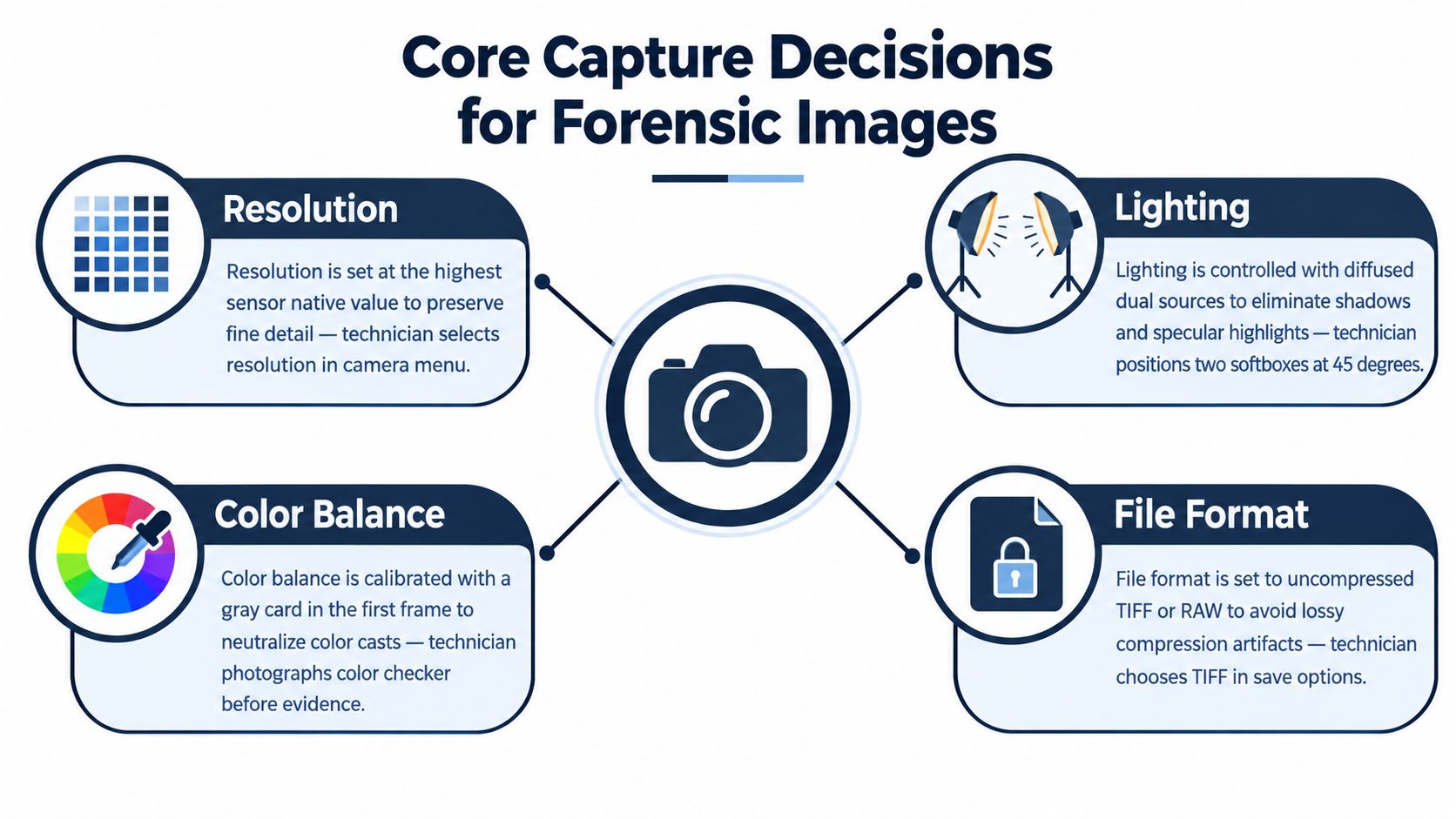
Four capture decisions drive most of the outcome in forensic photography. They are resolution, lighting, color balance, and file format. None of them should be left to automatic settings if the image may become evidence.
For readers who want a workflow-focused companion, our discussion of forensic photography standards in autopsy practice shows how these capture choices fit into a larger documentation process.
Resolution
Resolution determines how much spatial detail the file can preserve. The basic scaling principle is old but still important. A 2,000 × 2,000 image contains 4 million pixels, which is four times as many pixels as a 1,000 × 1,000 image, as discussed in the 1990 SIGGRAPH paper "Image Quality" (SIGGRAPH Image Quality paper).
That doesn't mean more pixels solve everything. If motion blur, poor focus, glare, or noise are present, the extra pixel count won't rescue the image. At the bench, resolution is useful only if focus is exact and the smallest feature that matters can be resolved.
Lighting
Lighting is where many subtle findings are won or lost. Diffuse light helps with orientation images because it reduces harsh shadows. Oblique or raking light can reveal surface texture, contour changes, and faint abrasions that flat overhead lighting can hide.
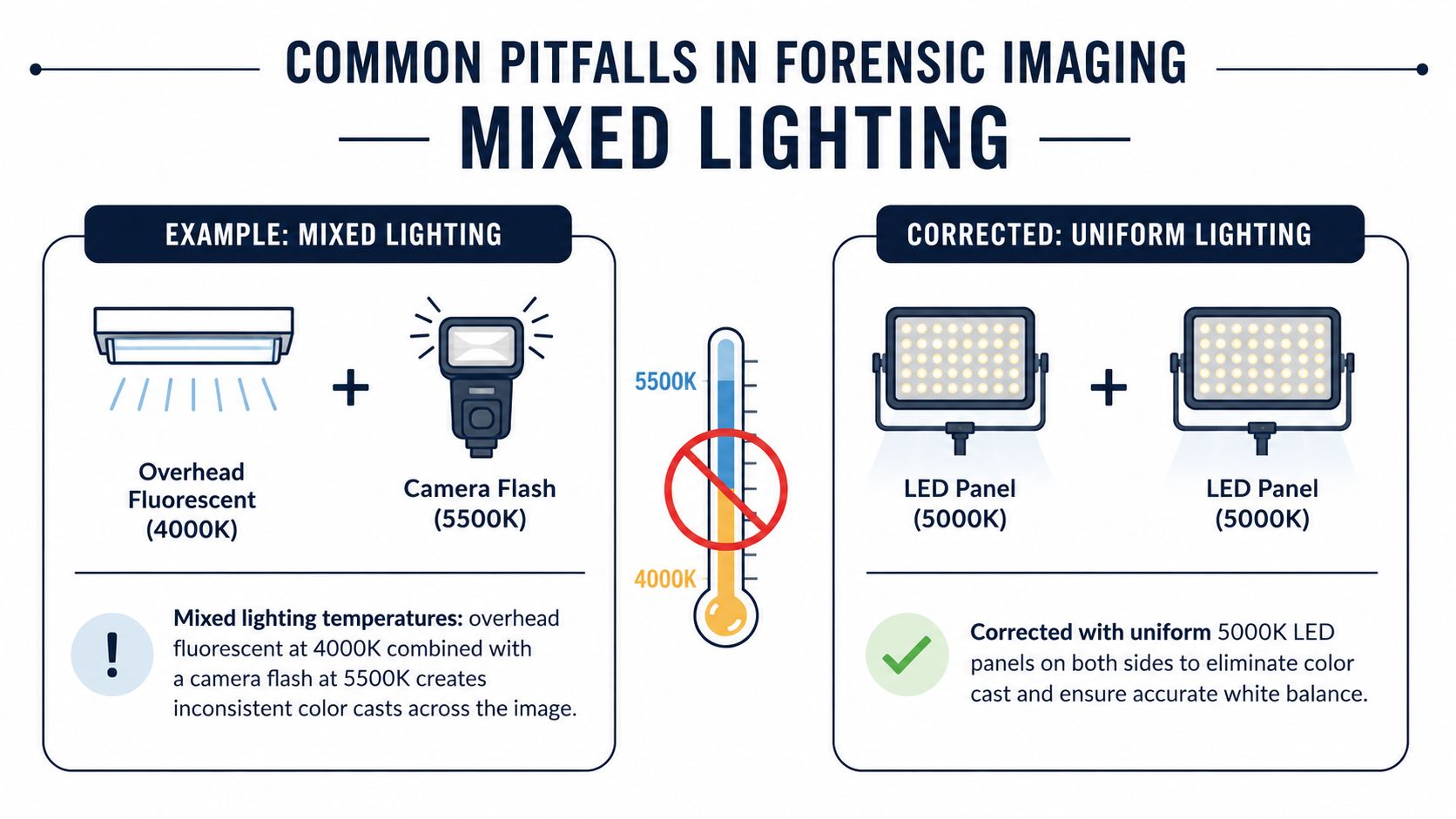
Mixed light sources create their own problems. Fluorescent overheads, flash, and LED panels can each shift color differently. For evidence photography, the point isn't dramatic effect. It's repeatable visibility.
Color balance
Color balance matters because postmortem findings can depend on fine tonal distinctions. A neutral reference in the first frame anchors later review to something known rather than guessed. Without that anchor, later correction becomes interpretive.
A color target doesn't replace judgment, but it does limit avoidable uncertainty. That's exactly what good forensic documentation should do.
File format
File format isn't an afterthought. It determines how much tonal information survives capture and how much flexibility remains if later review requires careful exposure or color adjustment. Once a detail is discarded by compression, it usually can't be reconstructed in a defensible way.
A camera can record a scene faithfully or conveniently. In forensic work, convenience comes second.
File Formats, Compression, and Bit Depth
When people discuss digital image quality, they often jump straight to sharpness. In evidence work, file structure matters just as much as visual appearance. Compression, bit depth, embedded profiles, and metadata all affect whether an image remains useful and credible.
Why bit depth matters before anyone edits the file
Bit depth controls how many discrete brightness or color values each pixel can represent. In practical camera systems, typical bit depths are 8, 10, or 12 bits. An 8-bit monochrome image can represent up to 256 values, and an 8-bit color image can represent about 16.78 million colors (Evident Scientific explanation of digital image basics).
Those numbers matter in forensic imaging because skin tone transitions, bruising, staining, and shadow detail often live in subtle tonal gradations. If tonal steps are coarse, gradients can break apart. If the file is also compressed aggressively, the problem becomes harder to separate from the underlying finding.
JPEG, TIFF, and RAW are not interchangeable
A casual workflow may treat file formats as a storage preference. Evidence work can't. Each format makes a different bargain.
| File Format Comparison for Forensic Images | Compression | Bit Depth | Evidentiary Suitability |
|---|---|---|---|
| JPEG | Usually lossy | Commonly 8-bit | Useful for review copies, but weak as a primary evidence capture format when subtle color or texture matters |
| TIFF | Commonly lossless | Often supports 8 or 16-bit workflows | Strong for preserved master images and controlled exchange |
| RAW or DNG | Sensor-native capture data with processing deferred | Depends on camera workflow and preserved sensor data | Strong when later documented processing may be needed to evaluate shadows, highlights, or color |
JPEG is convenient and widely readable. That convenience is exactly why it gets overused. Lossy compression can smooth transitions and introduce artifacts around edges. In ordinary use that may be acceptable. In a forensic close-up of faint discoloration, it may not be.
TIFF is often the practical middle ground. It supports lossless preservation and can retain richer tonal data than consumer JPEG workflows. The cost is larger files, slower transfer, and more storage discipline.
RAW and DNG preserve the most latitude because they retain sensor data before final rendering choices are baked in. That can help when an examiner later needs to review highlight detail, shadow information, or color rendering under documented conditions. The trade-off is workflow complexity. RAW also requires a clear record of what, if anything, was changed during later processing.
Compression is a quality issue and an integrity issue
Compression artifacts aren't only aesthetic defects. They can mimic or obscure texture boundaries and color transitions. For attorneys or investigators reviewing received files, a practical supplement is using AI Image Detector for artifact checks, especially when an image set appears to have passed through email, messaging, or repeated exports before reaching the case record.
That kind of review doesn't replace forensic judgment, but it can flag a preventable problem early.
Metadata helps the image authenticate itself
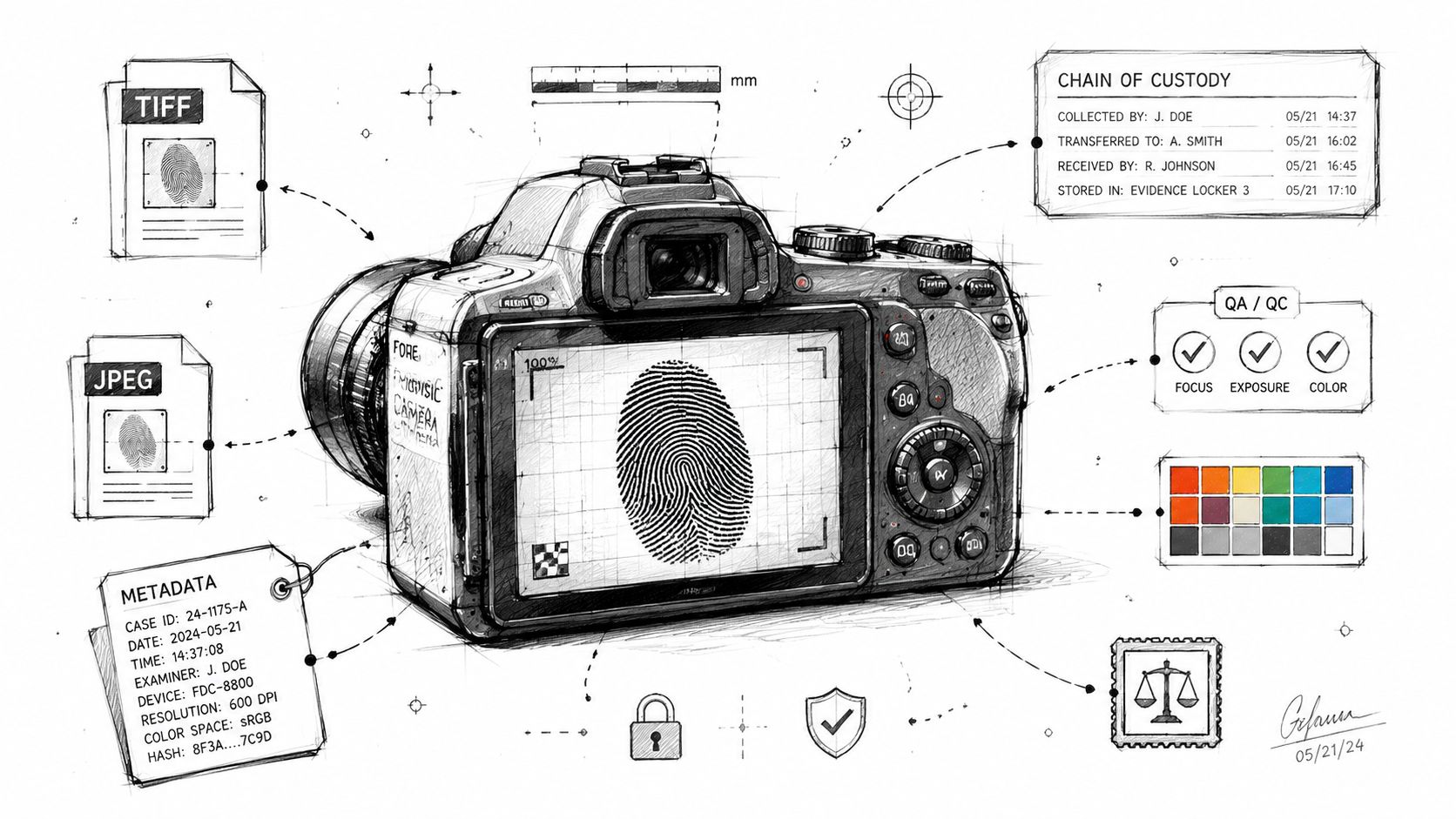
A good forensic image file should carry enough embedded information that later viewers don't have to rely on recollection alone. The exact fields vary by device and workflow, but some categories matter consistently.
- Capture timing: The timestamp should match a documented time source used in the case workflow.
- Device information: Camera body details, serial information where available, and lens data help identify the source device.
- Color information: ICC color profiles should remain attached to the file rather than inferred later.
- Case linkage: Case identifier, examiner initials, and scale reference information help tie the image to the correct record.
- Edit transparency: If any non-destructive processing occurs, sidecar records such as XMP can preserve what changed without overwriting the original.
Our team follows digital handling principles consistent with controlled forensic workflows, including the standards discussed in our guide to digital imaging standards for autopsy documentation.
What is required and what is simply helpful
Not every metadata field is legally required in every setting, and admissibility questions depend on context. What matters most is that the file can be authenticated through ordinary forensic practice. Original capture files, preserved metadata, documented storage, and a clear chain of custody do most of that work.
Helpful additions strengthen interpretation. A visible color target in-scene, a ruler or scale bar, synchronized timestamps, and documented non-destructive edits all make later review easier. They don't replace proper testimony or records, but they reduce avoidable ambiguity.
If a file needs extensive explanation before anyone can trust it, the documentation process was too loose at capture.
Chain of Custody for Digital Images
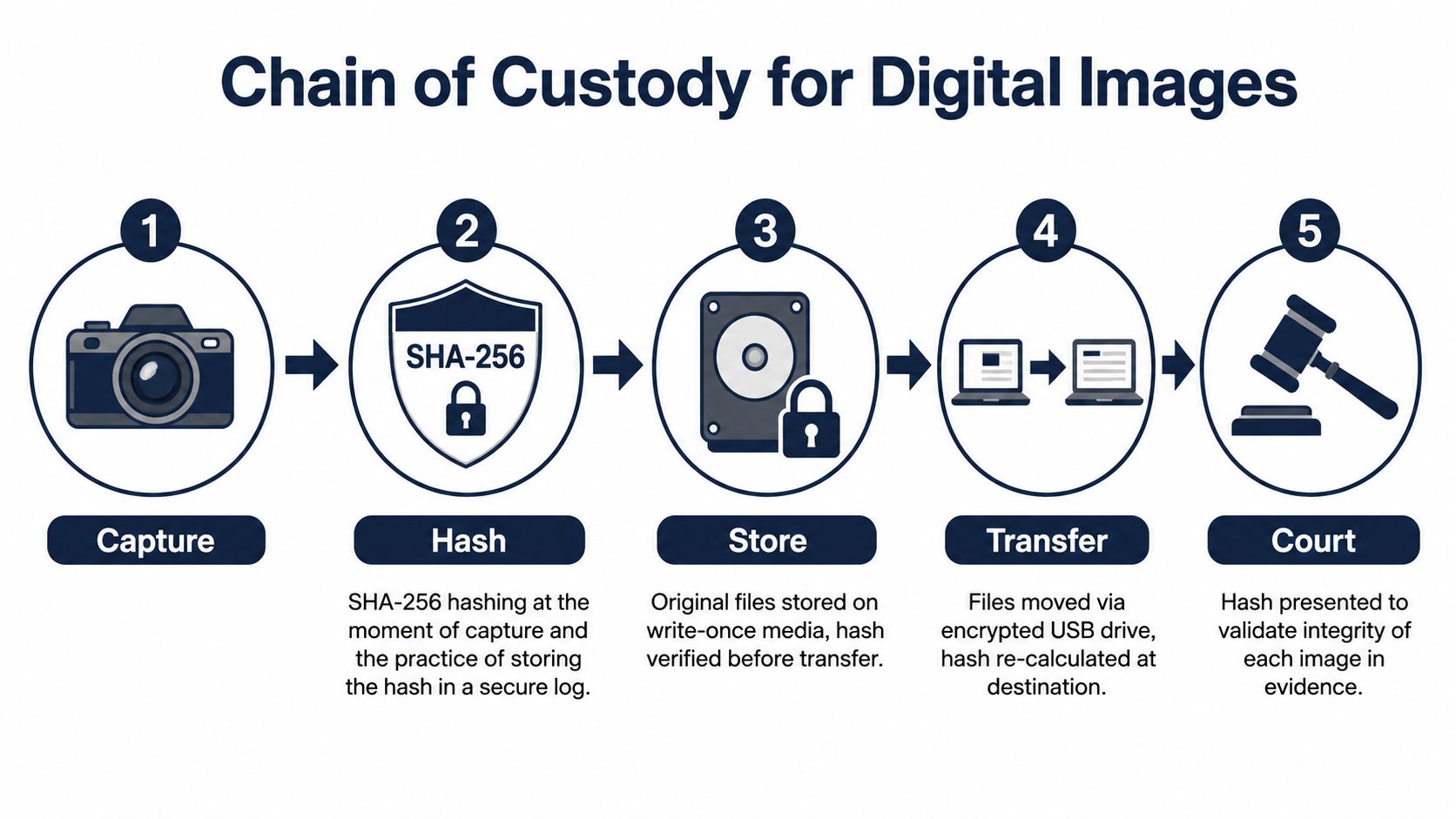
A clear photograph isn't enough. The record also has to show that the file presented later is the same file captured at the examination.
What chain of custody means for images
Chain of custody is the documented record of who handled an item, when they handled it, and what happened to it during transfer or storage. For digital images, that means more than a folder name. It means the original file is preserved, access is controlled, and every export or transfer can be traced.
In practice, we treat original files differently from working copies. Originals are preserved in a protected state. Working copies may be used for review, annotation, or report preparation under controlled conditions.
The workflow that makes images defensible
A courtroom-grade workflow usually includes a cryptographic hash recorded close to the time of capture, a separate custody log, controlled permissions, and immutable activity records showing when files were viewed, copied, or transferred. Original files should remain preserved while any downstream review happens on copies.
Access control matters just as much as storage. If multiple people can alter or overwrite evidence files without a record, image quality becomes secondary because authenticity is already weakened.
For readers comparing documentation tools, our article on a chain of custody form for forensic evidence handling explains how image transfers should be logged when files move between the laboratory, counsel, and outside agencies.
Measuring Quality Without Losing Sight of Purpose
Technical image quality and forensic usefulness overlap, but they are not the same thing. That distinction matters.
Metrics are tools, not verdicts
A major shift in image assessment came with the move from PSNR toward SSIM. PSNR is based on mean squared error and compares pixels directly, while SSIM, introduced in 2004, evaluates luminance, contrast, and structural information, which generally aligns better with human judgment (MathWorks overview of image quality metrics).
That shift was important because viewers don't interpret images as raw pixel differences. They interpret structure.
A strong score can still produce weak evidence
An image can score well on technical measures and still fail the forensic question. If it lacks a scale, uses mixed lighting, or captures the finding from the wrong angle, the image may not answer what the attorney, family, or reviewer needs to know.
| Technical Metrics vs. Forensic Usefulness | What It Measures | What It Misses for Evidence |
|---|---|---|
| PSNR | Pixel-level error against a reference | Whether the image reflects human perception or shows the finding in a legally useful way |
| SSIM | Structural similarity, including luminance and contrast relationships | Whether the frame includes scale, orientation, and correct evidentiary context |
| Spatial resolution | Ability to preserve fine detail | Whether the detail shown is the right detail, at the right angle, with controlled color |
| Scale in frame | Physical size reference | Doesn't measure sharpness or color accuracy by itself |
| Color target in scene | White balance anchor | Doesn't fix focus or missing orientation images |
A Purdue review of digital image quality workflows notes that the most defensible practice combines subjective viewing with objective metrics, using viewer scoring under standardized conditions and then comparing results against metrics across multiple distortion types rather than relying on a single measure (Purdue paper on image quality assessment workflow).
In forensic practice, the equivalent lesson is straightforward. Metrics help diagnose problems. They don't decide whether the image proves what it needs to prove.
Common Pitfalls in Forensic Imaging
The most damaging imaging mistakes usually aren't dramatic. They're ordinary habits that weaken interpretation.
Mixed lighting creates avoidable ambiguity
Skin findings are sensitive to color. If one light source is cool and another is warmer, the image can show inconsistent color across the same anatomical area. Later reviewers may not know whether they're seeing a true finding or a lighting artifact.
The fix is simple in concept and demanding in discipline. Control the light source. Keep it consistent. Document the setup.
Recompression and missing references do lasting damage
Lossy recompression often happens after capture, not during it. A file gets texted, copied into a slide deck, exported from a records platform, or resaved for email. By the time counsel receives it, the image may be smaller, softer, and less trustworthy than the original.
Missing color references create a different problem. If no neutral target appears in at least one frame of the set, later white balance correction becomes more interpretive than measured.
Mixed lighting, undocumented exports, and absent color references don't just lower digital image quality. They weaken confidence in the entire record.
Other mistakes that cost more than they seem
Several smaller errors tend to cluster together:
- Digital zoom instead of optical capture: It enlarges existing pixels rather than recording more real detail.
- Lens contamination: Smudges, residue, and dust reduce contrast and can mimic soft focus.
- Close-up without orientation: A detailed injury photo is much more useful when paired with a wider frame that locates it anatomically.
- Overreliance on automatic settings: Auto white balance and automatic exposure may shift from frame to frame, making comparison harder.
- Editing without a visible record: Even legitimate tonal adjustments should remain documented and non-destructive.
These aren't exotic failures. They're workflow failures. The solution is consistency.
A Quick Quality Check for Any Image Set
Families, attorneys, and county partners don't need to be photographers to spot basic problems in an image set. A short review catches many of the issues that later complicate testimony or document review.
Five checks that matter immediately
Match the files to the index.
Every listed image should be present, and the sequence should make sense. Missing frames can mean interrupted capture, transfer errors, or incomplete production.Review embedded file information.
Look for consistent timestamps, device information, and related metadata. Internal consistency matters more than technical jargon.Inspect the image at full view.
Open the image large enough to see edge behavior and tonal transitions. Obvious blockiness, halos, or smeared gradients may suggest compression or repeated resaving.Confirm there is context, not just detail.
A useful set usually includes overview images, mid-range images, and close-ups. If all you received are isolated close-ups, anatomical interpretation may be harder.Verify integrity records and transfer logs.
If the originating laboratory supplied file verification values or a custody log, compare them with what you received and make sure each transfer is documented.
What to ask if something seems off
If a file looks compressed, the timestamp is inconsistent, or a key image appears to be missing, ask for an explanation in writing. A clear explanation may resolve the issue. Silence usually doesn't.
A practical review should also confirm that at least one frame includes a scale or ruler when measurement matters, and that color control is visible somewhere in the set when color interpretation matters.
Brief FAQ
What is cause of death
Cause of death is the disease or injury that led to death. In a forensic report, it identifies the medical reason death occurred.
What is manner of death
Manner of death is the classification of how the death occurred, such as natural, accident, suicide, homicide, or undetermined. It is separate from the medical cause.
What is chain of custody
Chain of custody is the documented record showing who handled evidence, when they handled it, and how it moved from one person or location to another.
When is an independent autopsy appropriate
An independent autopsy may be appropriate when a family wants clarification, when an attorney needs objective postmortem documentation, or when an official investigation did not address all questions. Families seeking Private Autopsies or counties reviewing options for County Forensic Autopsies often need image documentation that remains understandable outside the original examination setting.
Are these images handled under Texas legal and regulatory requirements
Yes. Autopsy logistics, disposition issues, and related handling obligations may involve the Texas Health & Safety Code, including Chapters 711, 716, and 651, as well as the Texas Funeral Service Commission depending on the issue involved. Specific procedures depend on the case facts and the agency or entity responsible for the step in question. Our transport and facility coordination may also involve partners such as the Waterloo Mortuary Partnership when appropriate to case operations.
Medical and forensic documentation should always be interpreted in context. A photograph can support review, but it does not replace the full postmortem examination, records review, or the final forensic opinion.
When families, attorneys, and counties need independent postmortem answers, Texas Autopsy Services provides private autopsy and forensic pathology services across all 254 Texas counties, with in-house licensed transport, full chain of custody, and examinations performed by a forensic pathologist certified by the American Board of Pathology. If you need help reviewing autopsy documentation, understanding evidentiary imaging, or arranging an independent examination, visit Texas Autopsy Services to contact our team directly.