October 22, 2026 · Texas Autopsy Services
Toxicology Testing Services in Autopsy: A Practical Guide
Learn how toxicology testing services support autopsy investigations, from specimen collection and chain of custody to result interpretation and family FAQs.
On this page
- What Toxicology Testing Services Mean in an Autopsy
- A Brief History of Modern Forensic Toxicology
- Specimens, Collection, and Chain of Custody
- Screening, Confirmation, and What a Negative Result Really Means
- How Texas Autopsy Services Integrates Toxicology
- Interpreting Results Alongside Cause and Manner of Death
- Common Use Cases Families and Attorneys Bring to Our Office
- Practical Questions and How to Reach Our Team
A family member calls our office with a death certificate in hand. A cause is already listed, but a medicine bottle at home, a hospital note, or an unanswered question about alcohol or drugs does not fit the story. That gap between a listed cause and what a family observed is often why toxicology testing services become part of a private autopsy.
- Toxicology supports the autopsy. It does not replace the examination, medical history, or circumstances.
- Screening is not confirmation. A presumptive result needs a more specific method before it carries full weight.
- Detection is not causation. A substance can be present without causing or contributing to death.
- Specimen choice matters. Collection site, timing, preservation, and custody records shape what a result can show.
- Every examination is performed by a forensic pathologist certified by the American Board of Pathology.
What Toxicology Testing Services Mean in an Autopsy
Consider a representative situation our team hears often. A loved one died at home, the death certificate lists heart disease, and a family asks why a Private Autopsies examination would also include toxicology. The question is reasonable, because the certificate can look final even when it was completed without laboratory testing.
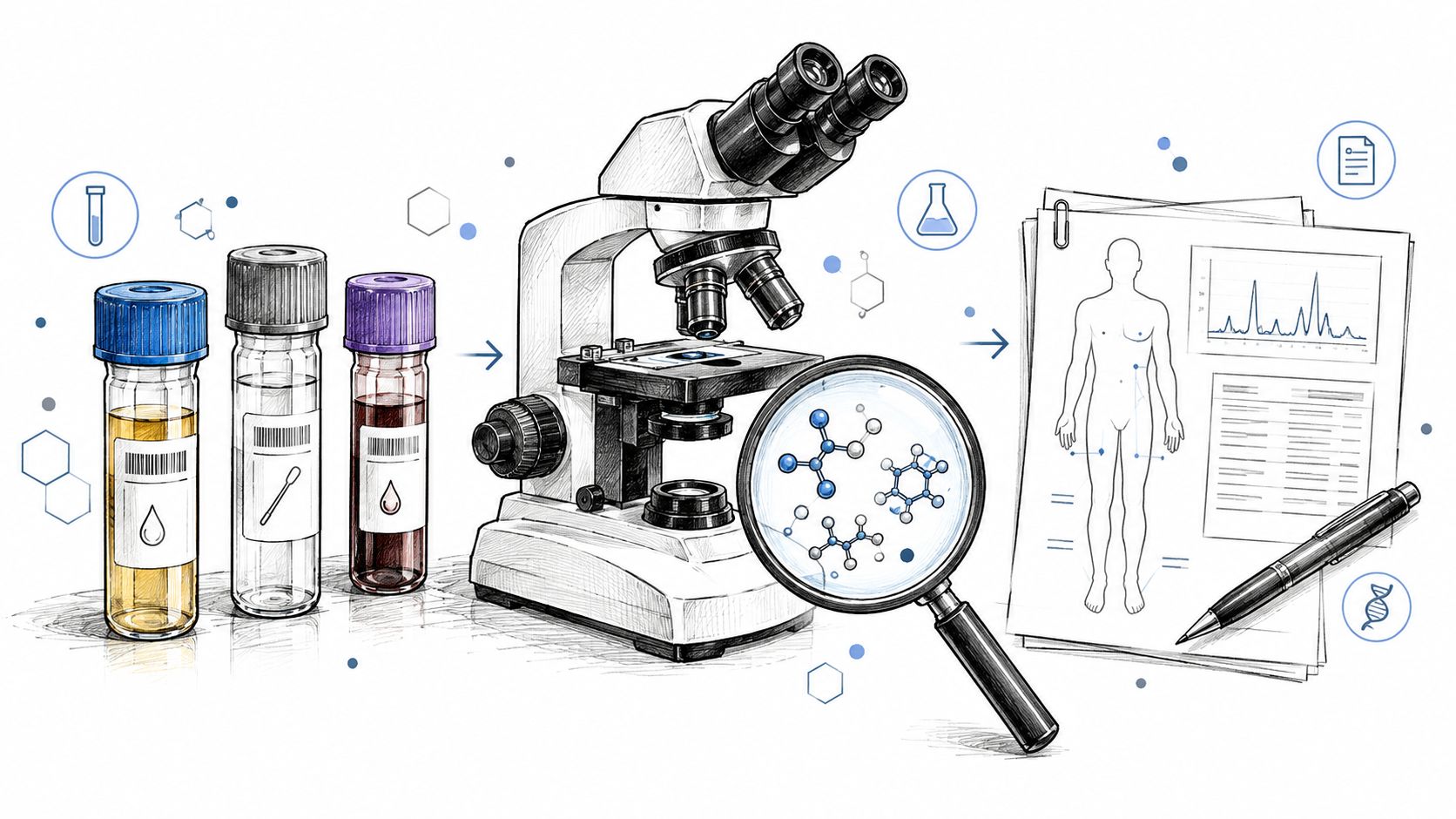
Toxicology testing services mean laboratory analysis of biological specimens for drugs, alcohol, poisons, and their metabolites, the products formed as the body breaks a substance down. Forensic toxicology helps our pathologists assess whether a measured amount is consistent with a therapeutic dose or reaches a potentially harmful level, and whether it may have contributed to death, illness, or impaired functioning, as described in the National Institute of Justice overview of forensic toxicology.
That result is not a standalone answer. Our board-certified forensic pathologists read it beside autopsy findings, prescriptions and medical history, scene information, and any hospital treatment before death. A drug level that is dangerous for one person may reflect long-term prescribed use and tolerance in another. The same finding may also be incidental when the autopsy shows a clear natural disease that fully explains death.
Two terms help families read a report with less confusion.
- Cause of death: The disease, injury, or poisoning that starts the chain leading to death.
- Manner of death: The circumstances classification, such as natural, accident, suicide, homicide, or undetermined.
Toxicology often drives the distinction between those classifications. For example, heart disease may be present at autopsy, but a toxic drug concentration could change the cause, or change the manner from natural to accident. When the evidence does not support a clear classification, undetermined is the honest conclusion. In a cause of death investigation, forcing certainty where the laboratory and autopsy evidence do not provide it would not serve a family or a court.
A toxicology number gains meaning only when our pathologists weigh it with the body, the history, and the circumstances.
A Brief History of Modern Forensic Toxicology
Toxicology became a systematic scientific discipline during the nineteenth century. Before that shift, investigators relied heavily on symptoms and circumstantial evidence. A death that looked like poisoning could be difficult to prove, and a death from natural disease could be wrongly suspected.
A timeline of those early milestones helps show why modern reports are built in stages.
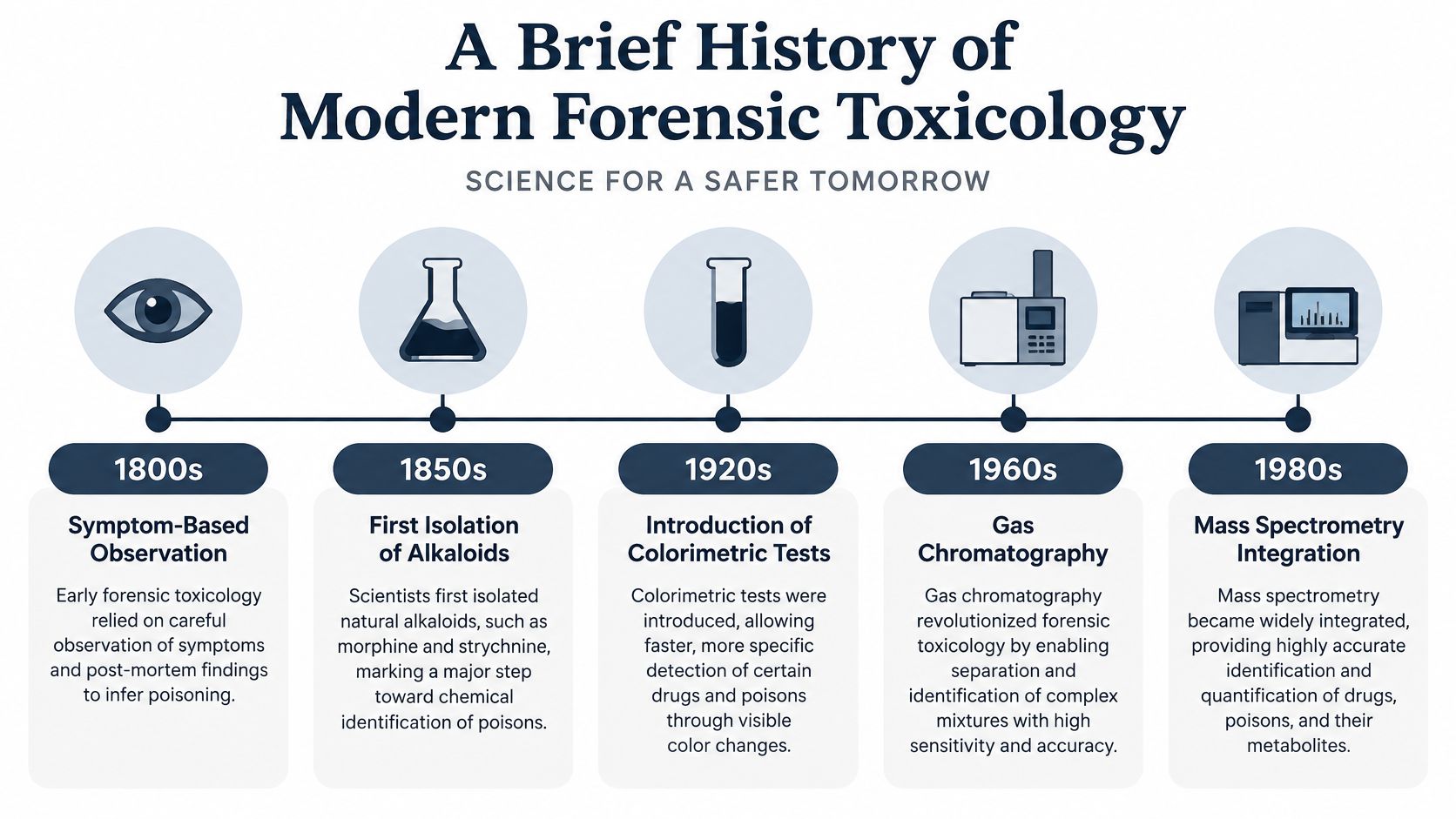
In 1814, French physician Mathieu Joseph Bonaventure Orfila published a major treatise that classified poisons into six groups according to their effects and helped establish modern toxicology as a distinct field. In 1836, English chemist James Marsh developed a more reliable method for detecting arsenic in biological material. The Marsh test generated arsine gas and converted it into a visible arsenic deposit, giving investigators a practical way to demonstrate poisoning in tissue.
Later milestones widened what laboratories could separate from the body. In 1844, chemists Carl Fresenius and Carl von Babo introduced a systematic screening procedure for mineral poisons. In 1850, Belgian chemist Jean Servais Stas developed an extraction method for isolating alkaloids, including nicotine, from human tissue during the Fougnies poisoning case. These steps are traced in a history of forensic toxicology and its early laboratory methods.
Three principles from that period still govern our work. A laboratory must separate a suspected substance from complex biological material, identify it with a validated analytical reaction, and interpret the result in the context of the death investigation. Modern instruments are far more sensitive, and methods later expanded through immunoassay, gas chromatography mass spectrometry, and liquid chromatography tandem mass spectrometry. The logic has not changed, which is why current reports separate screening from confirmation and why specimen handling and documentation remain essential to defensible findings.
Specimens, Collection, and Chain of Custody
At autopsy, our pathologists decide which specimens to collect before any laboratory work begins. That decision depends on the questions in the case, the condition of the body, any hospital care before death, and which specimens remain available and suitable.
The infographic below outlines the basic sequence from selection to documented transfer.
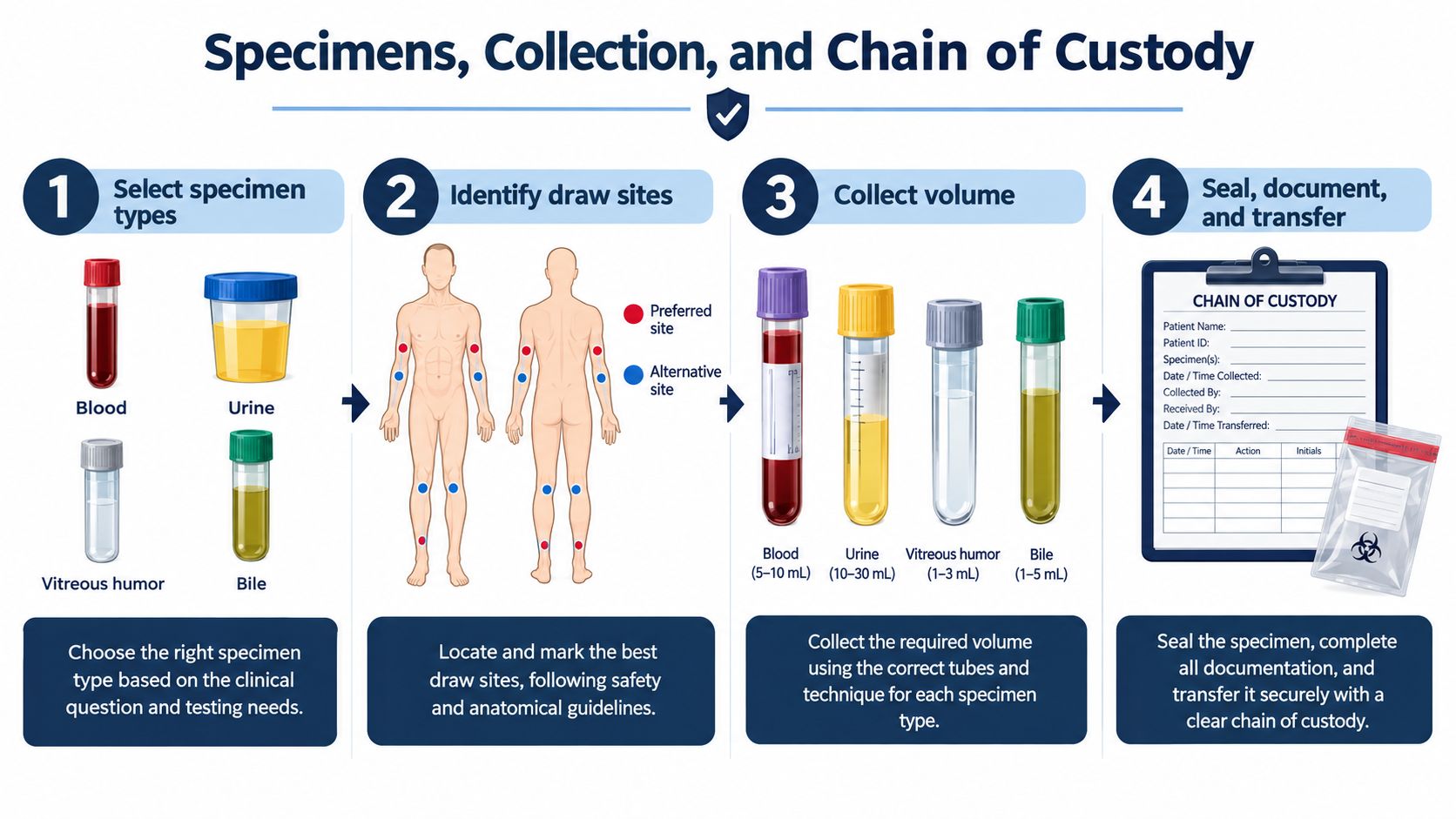
Which specimens our team may collect
- Peripheral blood: Blood from a site such as the femoral vein is commonly prioritized when available because it is generally less affected by redistribution from thoracic organs than heart blood.
- Urine: Often useful for showing prior exposure, since blood generally provides a narrower detection window than urine.
- Vitreous humor: Fluid from the eye can help when blood is limited or altered, and it may support certain chemical measurements.
- Hair and tissue: Hair and oral fluid have expanded testing beyond traditional blood and urine in modern practice, while tissue may help when fluid specimens are unavailable.
Collection site and volume are recorded for each specimen. A result from heart blood, femoral blood, liver tissue, or urine doesn't carry identical meaning, so the report must identify the matrix, meaning the type of specimen tested. Preservation and storage conditions are also documented, because a degraded or poorly stored sample can limit interpretation even when the laboratory instrument performs properly.
When standard blood is missing because of decomposition, embalming, prior hospital treatment, or a disputed collection, unsuitable specimens must be identified and explained rather than tested as if they're equivalent. Our team follows the custody principles described in our chain of custody procedures for forensic specimens, because more testing is not automatically better if a specimen can't support reliable interpretation.
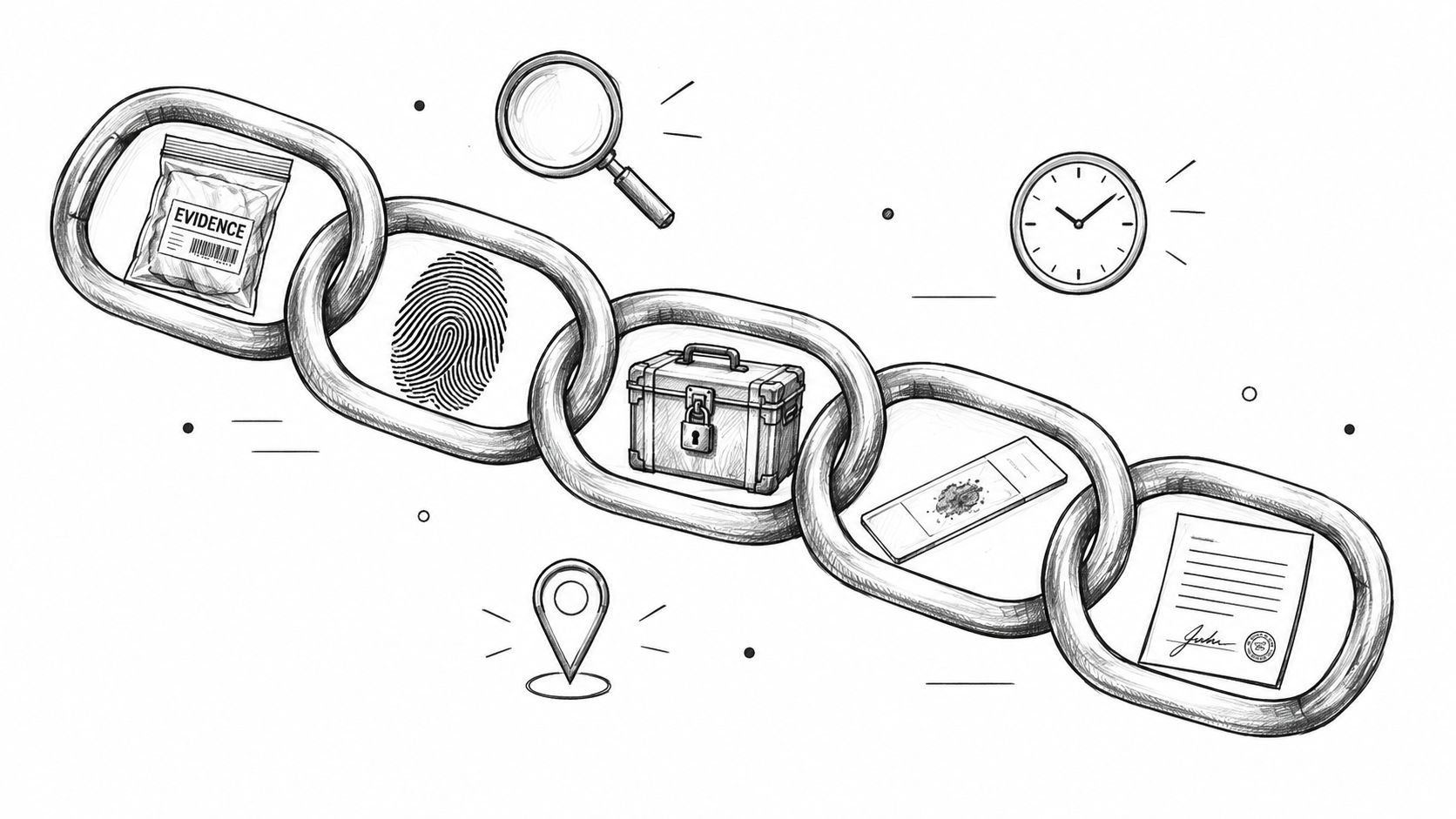
Chain of custody is the continuous written record of who collected a specimen, how it was sealed and labeled, where it was stored, and every transfer until laboratory release. Forensic protocols document each transfer and may include safeguards to detect dilution, substitution, or adulteration. One screening protocol evaluates urine specific gravity, with an expected range of 1.003 to 1.030, and checks creatinine, with a concentration of at least 20 mg/dL, alongside possible oxidant and adulterant testing, as summarized in a clinical review of urine drug screening and specimen validity.
Screening, Confirmation, and What a Negative Result Really Means
Families often use the word positive as if it means a final finding. In laboratory practice, a positive screen and a confirmed result are different steps, and the distinction matters for both medical conclusions and court use.
The comparison below shows the role of each step.
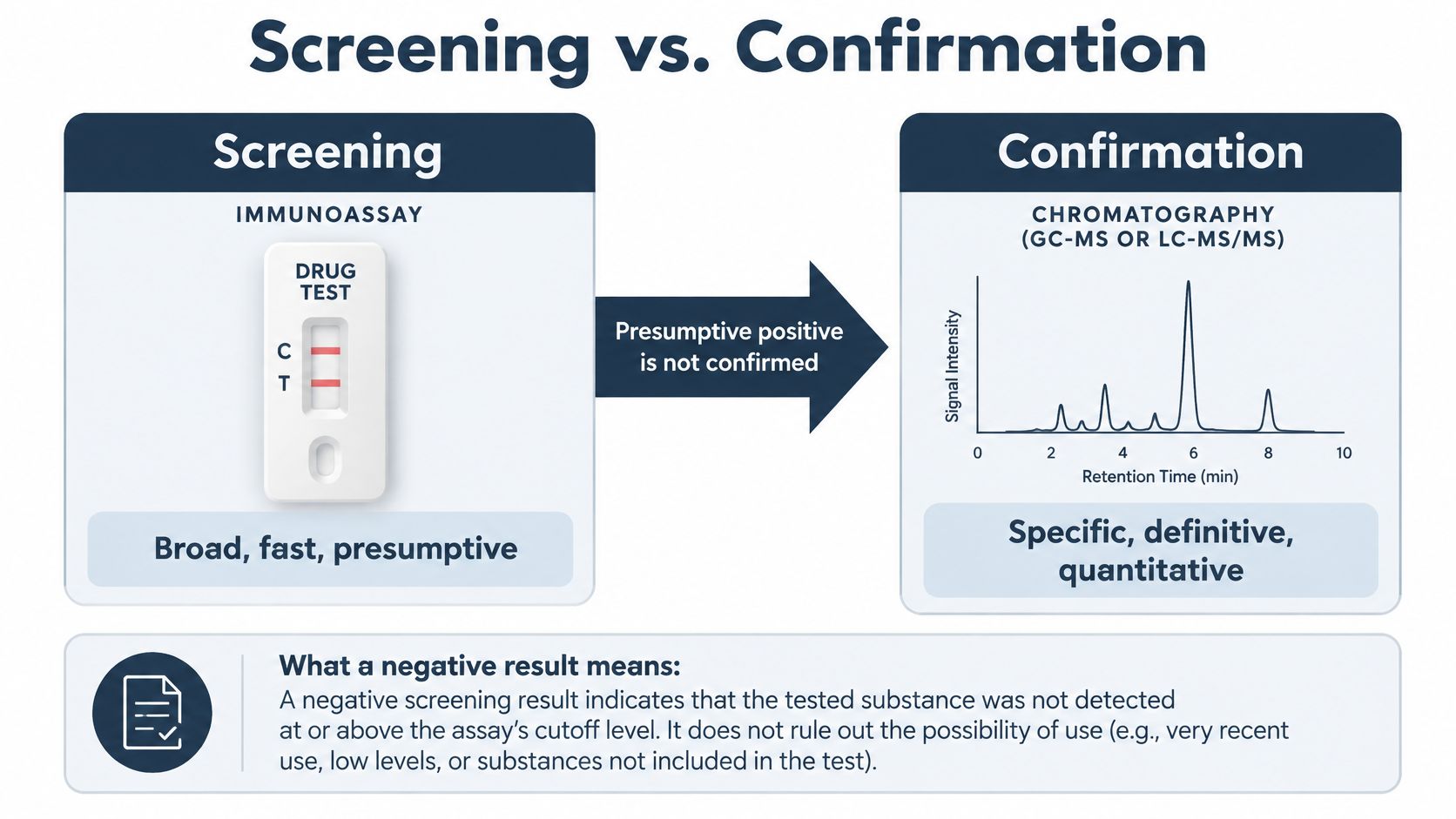
A screen is broad and comparatively fast. An immunoassay can flag a drug class, but that result is presumptive, meaning it requires further testing. A positive screen generally requires confirmation using a more specific method based on a different chemical principle, with gas chromatography mass spectrometry and liquid chromatography mass spectrometry identified as established approaches in federal forensic guidance on confirmatory testing. Confirmation may use a separate portion of the same specimen or a second specimen, and it uses positive and negative controls to check that the system performed properly.
A defensible method also has to be validated for its intended purpose. Validation should address bias and precision, calibration model, carryover, matrix interference, ionization suppression or enhancement, limit of detection, limit of quantitation, dilution integrity, and analyte stability, consistent with SWGTOX validation guidance for forensic toxicology. A quantitative result is meaningful only within its validated calibration range and documented uncertainty, a point our team applies under our laboratory testing standards for private autopsy cases.
The video below gives a plain visual overview of how laboratory confirmation differs from an initial screen.
A negative result causes equal confusion. It doesn't mean every possible drug or toxin is absent. The Virginia Department of Forensic Science toxicology explanation of negative reports states that no test is all-inclusive, and that a negative report means none of the substances covered by the requested methods were found at or above the applicable detection limits. Substances outside the tested categories, or present below those limits, aren't excluded. Attorneys reviewing chemical evidence in other settings face a similar need to examine method limits, which is why readers comparing legal challenges may find Kona DUI defense evidence strategies useful as a separate legal reference.
How Texas Autopsy Services Integrates Toxicology
Our practice is based in Elgin, TX, and our team serves families, attorneys, medical professionals, agencies, and county officials across all 254 Texas counties. Toxicology is integrated into private autopsy services Texas families request, and also into County Forensic Autopsies for officials who need a documented medicolegal examination.
The process begins before the autopsy. Our in-house licensed transport team coordinates transfer, and the deceased is received at our Elgin facility with identification and authorization checked on arrival. Secure, temperature-controlled storage protects the body and retained specimens while the examination is completed. Our licensed professionals also coordinate timing with funeral homes, including through arrangements such as the Waterloo Mortuary Partnership, so family plans are respected where the condition of the case allows.
From specimen to laboratory report
- Collection and labeling: Our pathologists select and label specimens by type, collection site, date, and case identifiers.
- Sealing and documentation: Specimens are sealed, packaged, and entered into custody records before transfer.
- Laboratory analysis: Specimens are sent to an established forensic laboratory for screening, confirmation, and quantitation as the case requires.
- Pathologist interpretation: Results return to our board-certified forensic pathologists, who interpret them with autopsy findings and records rather than releasing a laboratory printout as a conclusion.
Digital documentation follows the specimen through each transfer. Validation records, quality control results, calibration data, and custody forms are preserved so a reviewing pathologist or counsel can assess both the finding and the limits of the method. That record is part of what makes a report suitable for court review rather than a simple summary.
Families receive HIPAA-compliant reporting and direct communication with our team, not a call center. A written report explains findings in plain language, while expert testimony, when requested through proper legal channels, is a separate service in which our pathologists explain those findings under oath. Our operations also follow Texas requirements administered through the Texas Funeral Service Commission and the Texas Health & Safety Code Chapters 711, 716, and 651, with Chapter 716 particularly relevant when cremation authorization affects timing.
For people searching for an autopsy near me or a forensic pathology expert, the practical standard to ask about is custody. If a practice can't explain where a specimen was collected, how it was stored, and who transferred it, the laboratory result alone will not repair that gap.
Interpreting Results Alongside Cause and Manner of Death
A laboratory concentration is not a direct measurement of the drug level at the moment of death. After death, drugs can move between tissues and blood. That process is called postmortem redistribution, and it can alter concentrations over time and vary by specimen site and by the characteristics of the drug.
The concept map below shows three factors that shape a reported concentration.
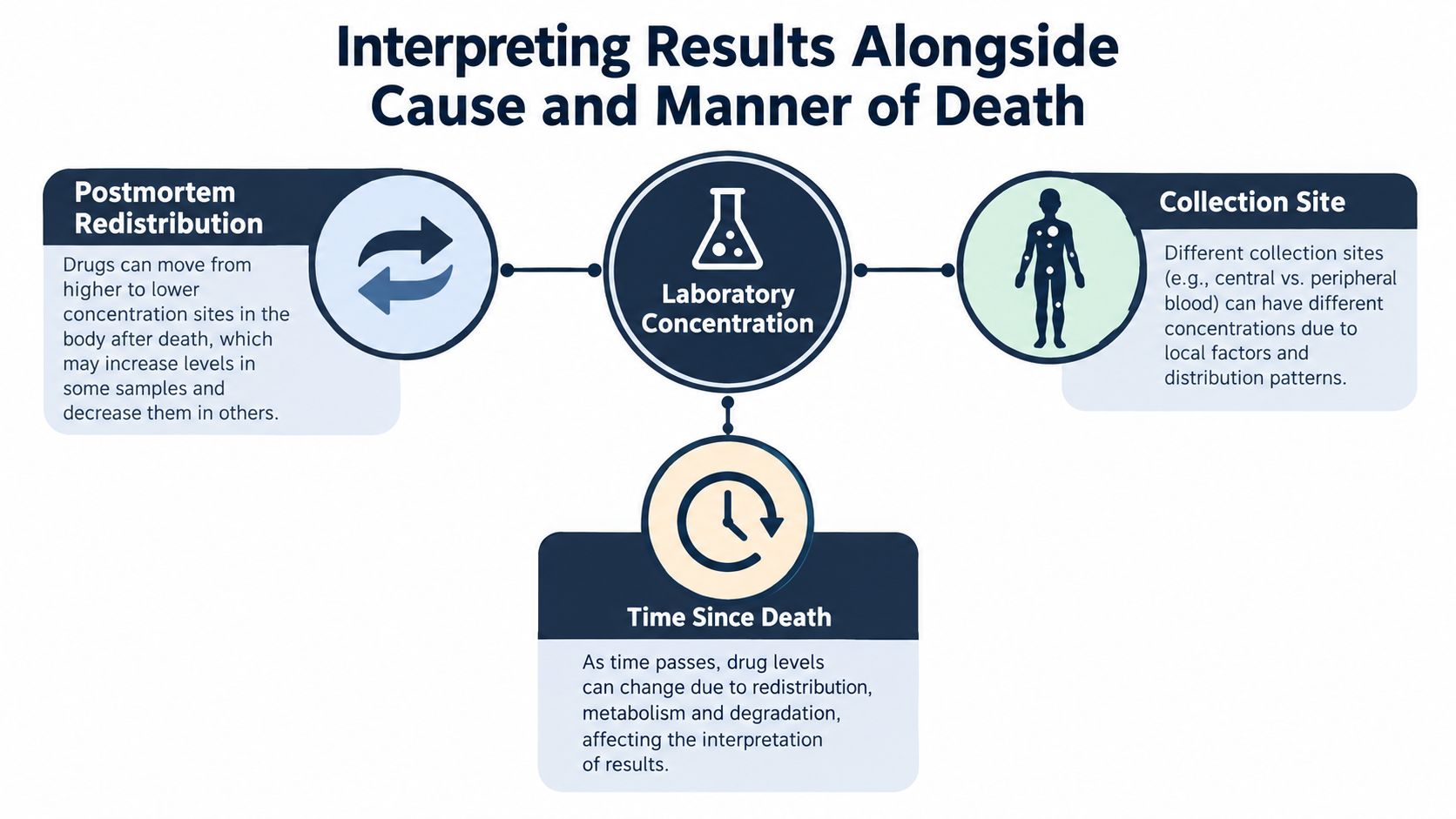
Research on morphine found redistribution across the postmortem interval, including in femoral blood and lung tissue, while concentrations differed among biological matrices. That study also reported heart and femoral blood morphine concentrations were comparable with liver and lung concentrations at approximately eight hours after death, illustrating why timing and sampling location matter, as described in a mechanism-based investigation of postmortem redistribution of morphine.
Our pathologists therefore weigh the parent drug and metabolites together. A pattern can suggest recent use, ongoing metabolism before death, or exposure that ended well before death. Tolerance also changes interpretation. A concentration that may be toxic in a person with no prior exposure may be expected in a person receiving long-term prescribed therapy, though it still requires review against symptoms, records, and autopsy findings.
Detection and causation must stay separate. In a CDC analysis covering 209,166 overdose deaths from January 2021 through June 2025, cannabis was detected in 43,880 deaths, or 21.0%, was listed as involved in 1,687 deaths, or 0.8%, and was the only drug involved in nine deaths, or 0.004%, according to the CDC overdose surveillance analysis of detected and involved substances. Those figures show why a detected substance is not automatically the cause.
Our team explains this distinction to families using the same framework in our guide to cause and manner of death determinations in Texas. Exposure, impairment, toxicity, and causal contribution to death are different conclusions. A sound report states which one the evidence supports, and which ones it does not.
Common Use Cases Families and Attorneys Bring to Our Office
Most requests do not begin with a lab order. They begin with a declined case, a report that doesn't answer the family's question, or a legal dispute in which drug or alcohol findings may matter.
A common scenario involves a medical examiner or justice of the peace declining jurisdiction. The family still needs an independent autopsy because the death was unexpected and toxicology was never performed. Another involves a second opinion autopsy review, where retained specimens, prior laboratory records, or hospital samples may allow our pathologists to assess whether an earlier interpretation fits the evidence. Attorneys may request a full examination for litigation support, where custody documentation and confirmatory testing are needed from the outset.
Fetal and perinatal questions require especially careful specimen selection, because the available blood volume may be very limited and interpretation depends heavily on records and placental or tissue findings where available. Exhumation cases raise different limits, since decomposition, embalming, and time can restrict which specimens remain suitable. In both situations, our team explains the limits before a family authorizes work that may not answer the question they're asking.
Toxicology Approach by Case Type
| Case Type | Typical Toxicology Approach | Why It Fits |
|---|---|---|
| Medical examiner decline | Broad screening with confirmation of positives | Establishes a baseline when no prior testing was done |
| Second opinion autopsy | Targeted review or retesting where suitable specimens remain | Tests the specific finding under dispute |
| Litigation support | Full panel with documented chain of custody | Preserves the record for later review and testimony |
| Fetal or perinatal | Limited, case-specific testing guided by records | Protects scarce specimens and avoids overstatement |
| Exhumation | Testing only where specimen suitability can be explained | Accounts for decomposition and embalming limits |
Turnaround depends on specimen condition, laboratory workload, whether confirmation and quantitation are required, and whether outside records are needed for interpretation. Most cases return within 24–48 hours of laboratory receipt for routine reporting steps, but complex confirmatory work and record review can lengthen that window. Our team explains those factors directly rather than offering an unconditional promise.
Practical Questions and How to Reach Our Team
Can testing proceed after embalming
Sometimes, but it depends on which specimens were collected before embalming or remain suitable afterward. Embalming can alter or dilute blood and limit interpretation, so our pathologists first identify what is available and explain what each specimen can still support. Testing a poor specimen without that warning would create false confidence.
What if only vitreous, urine, or hospital samples remain
Testing may still be possible. Vitreous humor, urine, tissue, or preserved hospital samples can each answer a narrower question than a full set of autopsy specimens, especially if collection time and storage are documented. The report must state the specimen source and its limits, because a hospital admission sample reflects a living patient at that time, not the body after death.
Can clothing or household items help
Nontraditional materials such as clothing, bedding, automotive items, personal hygiene products, and household objects may provide investigative leads when conventional specimens are missing. They're not a substitute for biological specimens when the question is concentration in the body, and their court value is limited by contamination, timing, and custody questions. Our team can advise whether such material is worth preserving for review.
What does flat-rate pricing cover
Our flat-rate, all-inclusive pricing is quoted directly by our team based on the examination requested, transport needs, and the toxicology required for the case. Families and attorneys should confirm what screening, confirmation, reporting, and any later testimony are included before authorization, because testimony and additional record review are separate from a standard written report. We're available 24 hours a day at (806) 230-1889 for guidance.
Preserve first and decide second. Retaining a suitable specimen under documented custody keeps options open, while testing too late or testing the wrong specimen can close them.
This information is educational and does not provide medical advice for a living person. Our role is postmortem examination and interpretation for families, attorneys, agencies, and Texas county officials.
If your family or client needs an independent private autopsy with toxicology testing, clear custody documentation, and a written report explained in plain language, our team can review the circumstances and available specimens with you directly. Please contact Texas Autopsy Services for guidance on next steps, statewide transport, and what testing can realistically answer in your case.