November 22, 2025 · Texas Autopsy Services
Understanding Cause and Manner of Death in Texas
A Texas forensic pathologist explains the cause and manner of death, how they are determined, and what families need to know for legal and personal clarity.
On this page
- The Two Pillars of a Death Investigation
- The Five Official Manners of Death
- How a Pathologist Determines the Findings
- Putting It All Together: Real-World Scenarios
- Why These Findings Matter—Legally and Personally
- When to Consider a Private or Second Opinion Autopsy
- Common Questions About Death Investigations
As a board-certified forensic pathologist in Texas, I often meet with families and attorneys who need clarity during an incredibly difficult time. The foundation of any death investigation rests on two critical terms: the cause of death and the manner of death. While they sound similar, they answer two very different questions. The cause is the medical reason for death, while the manner provides the circumstantial context.
Here’s what you need to know:
- Cause of Death is the specific medical disease or injury that led to death, like a heart attack or a gunshot wound.
- Manner of Death is the legal classification of how the death occurred, categorized as Natural, Accident, Suicide, Homicide, or Undetermined.
- The same cause of death can have different manners depending on the evidence. For example, a drug overdose could be an Accident, Suicide, or even Homicide.
- A complete investigation combines autopsy findings, toxicology reports, and scene evidence to determine both the cause and manner.
- These findings have significant legal and personal implications, affecting everything from insurance claims to criminal investigations.
- A private autopsy can provide definitive answers when the official findings are unclear or incomplete.
A family once contacted me after their father, a seemingly healthy man, died suddenly at home. The initial death certificate listed "cardiac arrest," a term that describes what happens but not why. They needed to know more. My examination revealed severe, undiagnosed coronary artery disease, establishing a clear medical cause. This finding gave them not only peace of mind but also crucial information about a hereditary condition that could affect their own health.
The Two Pillars of a Death Investigation
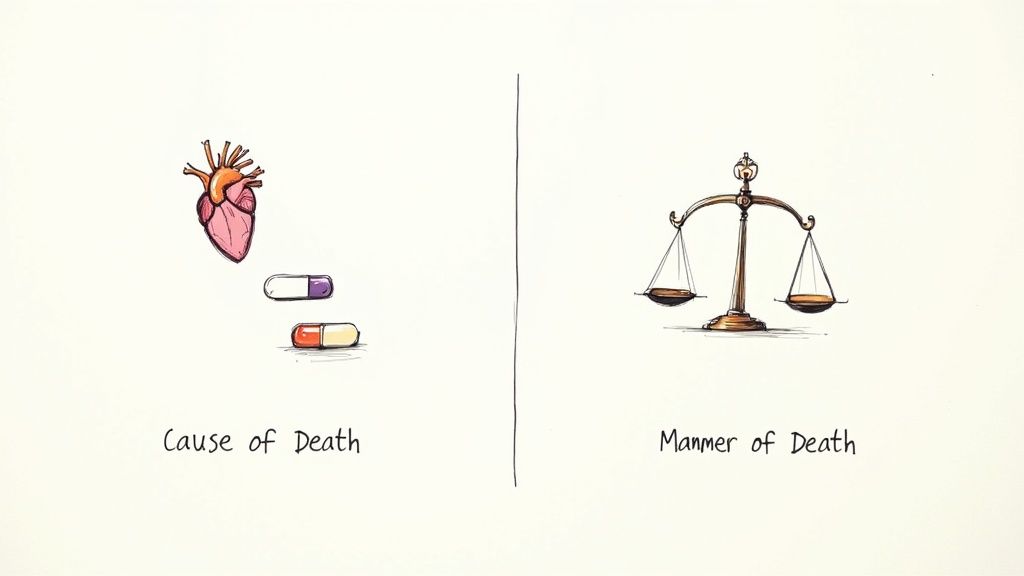
As a forensic pathologist with over 1,000 autopsies performed, my purpose is to provide objective, science-based answers. Understanding the distinction between cause and manner is the first step toward making sense of a death certificate and my final report. Correctly identifying both is essential for legal proceedings, insurance claims, and giving a family a complete account of what happened.
A simple way to remember the difference is that the cause of death is the "what," and the manner of death is the "how."
Cause of Death vs Manner of Death at a Glance
| Concept | Definition | Example |
|---|---|---|
| Cause of Death | The specific disease or injury that initiates the chain of events leading to death. It's a medical diagnosis. | Acute fentanyl intoxication. |
| Manner of Death | The legal classification of the circumstances surrounding the death. It's an investigative opinion. | Could be Accident, Suicide, or Homicide. |
As this table shows, the same medical cause can fit into several manners depending on the evidence. Let's look at each concept more closely.
What Is the Cause of Death?
The cause of death is the precise injury or disease that directly resulted in a person's death. This is a purely medical conclusion I reach based on physical evidence from the autopsy and supporting laboratory tests. It is a scientific diagnosis explaining why the body stopped functioning.
Examples of a cause of death include:
- Atherosclerotic cardiovascular disease (a heart attack)
- Gunshot wound to the head
- Fentanyl intoxication
- Blunt force injuries from a car crash
Sometimes, the cause of death involves a sequence of events. For instance, the immediate cause might be a pulmonary embolism (a blood clot in the lung). My investigation would then determine what caused the embolism, such as deep vein thrombosis in the leg, which in turn was caused by immobility following a broken hip. My report details this entire chain to provide a complete medical picture.
Defining the Manner of Death
The manner of death, in contrast, is a legal classification describing the circumstances that produced the cause of death. It isn't a medical finding. It’s my expert opinion based on all available evidence, including the autopsy, toxicology results, police reports, and scene investigation findings.
In Texas, as in the rest of the country, there are five official manners of death. My role is to review all information and determine which category best explains how the death occurred.
This classification provides the official context required for legal and administrative actions. An accurate manner of death directs everything from police investigations to life insurance payouts. This distinction is the foundation of any credible death investigation.
The Five Official Manners of Death
After identifying the medical cause of death, the next step is determining the manner of death. This official classification contextualizes the cause by explaining the circumstances that led to it. It’s a conclusion I reach only after synthesizing all evidence from my autopsy findings, toxicology reports, and information from law enforcement.
In Texas and across the United States, we use five recognized manners of death. Each one answers the fundamental question of how the cause of death came to be. Understanding these categories helps clarify the terms on a final death certificate.
1. Natural
A Natural manner of death is the most common classification. It means the body failed due to a disease process or aging, without any external influence. This category includes deaths from chronic illnesses, infections, or sudden medical events.
Common examples include deaths from:
- Heart disease (like a massive heart attack or congestive heart failure)
- Cancer that has spread throughout the body
- A major stroke
- Complications from conditions like diabetes or Alzheimer's disease
These noncommunicable diseases are the primary drivers of natural deaths worldwide. Ischemic heart disease, for instance, has been a leading killer for over two decades. If you are interested in broader trends, the World Health Organization provides comprehensive global data.
2. Accident
The manner is classified as an Accident when an injury or poisoning causes death without evidence of intent, either by the deceased or by someone else. These are unforeseen and unintentional events.
My determination hinges on the absence of intent. This category covers a wide range of situations, such as:
- Motor vehicle collisions
- Unintentional drug overdoses
- Falls from a ladder or down stairs
- Drowning or incidents at a workplace
To provide a clearer picture, if the cause of death is blunt force trauma, the circumstances dictate the manner. If the trauma resulted from a car crash with no foul play, the manner is an Accident. If it resulted from an assault, the manner would be Homicide.
3. Suicide
A death is ruled a Suicide when it results from an intentional, self-inflicted act. The key word is intent. This can be one of the most difficult determinations to make, requiring a combination of physical evidence from the autopsy and the circumstances surrounding the death.
Evidence that helps me arrive at a suicide determination might include:
- A suicide note
- A documented history of self-harm or suicidal statements
- The specific nature and location of the fatal injury
- Information gathered from family, friends, and medical records
Without clear proof of intent, I will not certify a death as a suicide. My final opinion must be supported by the totality of the investigation.
4. Homicide
Homicide is the classification used when a death is caused by the actions of another person. It's important to understand that in forensic pathology, "homicide" is a neutral, non-judgmental term. It simply means "death at the hands of another."
The term homicide does not automatically mean murder or any specific criminal charge. It is a medical-legal determination about the manner of death, not a legal verdict of guilt. The criminal justice system ultimately decides if a crime was committed.
Any death where one person’s deliberate act leads to another's death falls into this category, from a gunshot wound inflicted during a fight to intentional poisoning. My job is to document the injuries and provide objective evidence that assists law enforcement.
5. Undetermined
Finally, the Undetermined manner of death is used when, after a complete and thorough investigation, there isn't enough evidence to confidently select one of the other four manners. It’s the least common classification, reserved for cases where evidence is unclear, conflicting, or missing.
This conclusion might be reached in a few scenarios:
- A badly decomposed body is found, and the cause of death itself cannot be established.
- The circumstances are a complete mystery, such as a drowning where it’s impossible to know if it was an accident, suicide, or homicide.
- An infant dies suddenly, and a complete investigation reveals no definitive cause or explanation.
Choosing "Undetermined" is not a failure of the investigation. It’s an honest admission of the limits of the available evidence. My commitment is to the facts, and in these cases, the most factual statement is that we cannot be certain.
How a Pathologist Determines the Findings
Determining how and why someone died isn't a single "aha" moment. It’s a methodical process, a careful reconstruction of a person's final moments built on three distinct pillars of evidence. My final report isn't based on one piece of information; it’s a synthesis of everything I learn from the examination, laboratory results, and the circumstances surrounding the death.
This comprehensive approach is the only way to provide the accurate, defensible answers that families and legal professionals deserve. It combines findings from the autopsy, toxicology, and scene investigation to build a complete, evidence-based picture.
The Three Pillars of Investigation
Think of a death investigation like assembling a complex puzzle. You need all the pieces to see the final image clearly.
The Autopsy: This is the direct, physical examination of the body, both externally and internally. It allows me to meticulously document any injuries, signs of disease, or other abnormalities. The autopsy almost always reveals the direct medical reason for death—the cause of death—such as a ruptured aorta from high blood pressure or a fatal brain injury from trauma.
Toxicology: After the physical exam, I send fluid and tissue samples to the lab for a full toxicology screening. This analysis detects the presence and levels of drugs, alcohol, poisons, or other substances. Toxicology is vital for identifying an overdose or learning if intoxication contributed to an accident or injury.
Scene and Circumstantial Evidence: This pillar provides the context surrounding the death. I review reports from law enforcement, paramedics, and any available medical records. Were there pill bottles found nearby? Was a note left behind? What were the scene conditions? This information is critical for determining intent and correctly classifying the manner of death.
This diagram helps visualize how the investigation leads to one of the five official manner of death classifications.
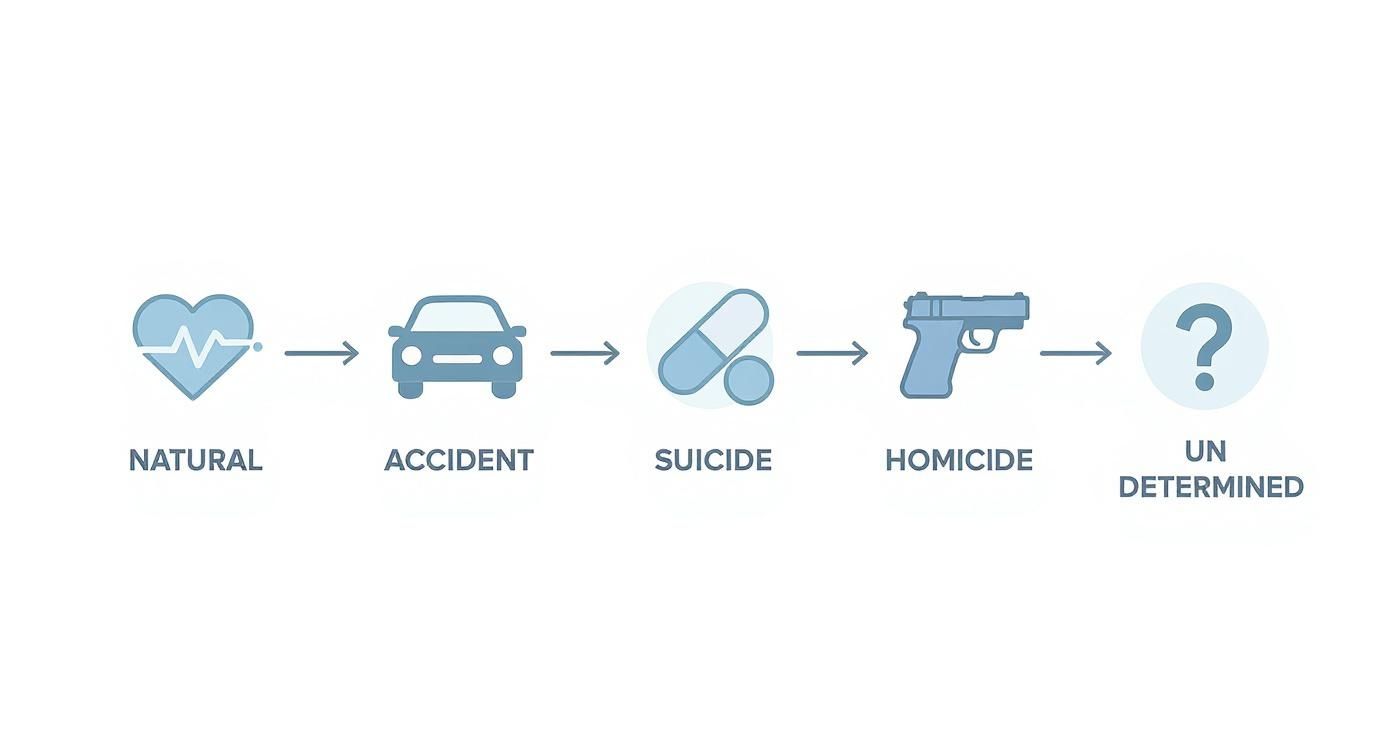
The final determination is a structured outcome based on a rigorous evaluation of all collected evidence.
Integrating the Evidence for a Conclusion
My role is to be an objective interpreter of the facts. For example, an autopsy might show the cause of death was blunt force trauma to the head. That finding alone doesn't tell me the manner of death.
If police reports show the person fell from a ladder while cleaning gutters, the manner is Accident. If evidence indicates they were struck by someone during an assault, the manner is Homicide. The physical finding is identical, but the circumstances completely change the classification. This is why no single piece of the puzzle can stand alone.
The manner of death is ultimately an expert opinion, but it's an opinion I must be able to defend based on a reasonable degree of medical certainty. It’s formed by weighing all evidence and identifying the most logical and scientifically sound conclusion.
The process for a private autopsy follows the same rigorous, evidence-based principles. Whether I am working for a family seeking a second opinion autopsy or providing county forensic autopsies, my commitment to objectivity is unwavering. As you can learn in our guide explaining what a forensic pathologist does, my responsibility is to weigh the autopsy findings, review toxicology, and consider all available history to provide the clearest answers possible.
Putting It All Together: Real-World Scenarios
Definitions are one thing, but seeing how they work in practice is where it all connects. After performing over 1,000 autopsies, I know that cases that look similar on the surface can end with vastly different conclusions once the facts are examined. Let's walk through a few scenarios to see how a forensic pathologist pieces together the puzzle.
First, consider a straightforward case. An elderly woman with a long, documented history of severe heart disease dies in her sleep. Her family finds her, and investigators see no signs of injury or struggle. Her medications are all accounted for.
My autopsy would likely confirm what the scene suggests: advanced coronary artery disease.
- Cause of Death: Atherosclerotic Cardiovascular Disease
- Manner of Death: Natural
The medical evidence, personal history, and circumstances all point in the same direction. Her death was the expected outcome of a progressive disease.
How the Scene Changes Everything
Now, let's change the scenario. A man in his early forties is found dead in his apartment. The autopsy and toxicology report identify the cause of death as acute fentanyl intoxication. But that medical finding is just one piece of the puzzle.
To determine the manner of death, I must rely on what investigators found at the scene.
If the police report describes drug paraphernalia scattered around, suggesting personal use, and there's no evidence that anyone else was involved, the story takes shape.
- Cause of Death: Acute Fentanyl Intoxication
- Manner of Death: Accident
The death was a tragic but unintentional overdose. However, if the scene told a different story—if the investigation revealed that someone else intentionally gave him a dose they knew could be lethal—the manner changes completely to Homicide. This is a perfect example of how the exact same cause of death can result in two different manners, all depending on the circumstances.
When the Evidence Isn't There
Not every case ties up so neatly. Sometimes the evidence is confusing, contradictory, or simply missing. That’s when the "Undetermined" classification is necessary.
Imagine a young, healthy person is found at the base of a cliff. The autopsy shows the cause of death is multiple blunt force injuries from the fall.
But how did they fall? Did they slip? Did they jump? Were they pushed?
If the investigation finds no suicide note, no witnesses, and no signs of a struggle on the cliff edge, I cannot guess. My job is to report the facts, not to speculate. In a case like this, the only honest and accurate conclusion is that the manner of death is Undetermined.
Calling a death "Undetermined" isn’t an admission of failure. It’s an admission that we don't have enough evidence to be certain. It ensures the official record is built on facts, not assumptions.
The cases I handle often reflect broader mortality trends. While heart disease and cancer remain top natural killers, accidents (unintentional injuries) are a leading cause of death overall. You can explore more data on the leading causes of death in the US from Sermo.com. Whether a case aligns with a national trend or is a complete outlier, it demands the same careful, meticulous approach to find the truth.
Why These Findings Matter—Legally and Personally
The cause and manner of death are far more than technical terms on a legal document. For surviving family members, these determinations carry enormous weight. As a forensic pathologist, my findings often become the starting point for legal proceedings, insurance claims, and a family’s personal understanding of their loss.
An accurate ruling on a death certificate can determine whether a life insurance policy pays out, especially since many policies have clauses excluding suicide. Legally, the line between an accident and a homicide is the foundation of a potential criminal investigation.
Legal and Insurance Consequences
When a family navigates the aftermath of a loss, the details on the death certificate are often key. These findings are a cornerstone for understanding wrongful death claims, providing the hard evidence needed for families who feel a preventable death occurred.
An incorrect or undetermined manner of death can delay or block a family from receiving benefits or pursuing justice. This official document is incredibly powerful, which you can learn more about in our guide on what is a death certificate. My job is to ensure every detail on it is precise, evidence-based, and defensible.
When initial findings from a government agency seem unclear or questionable, a second opinion from an independent autopsy can provide the clarity needed to move forward. It’s about ensuring the official record is indisputably accurate.
Mortality data also helps us understand public health trends on a larger scale. Accurate reporting on individual deaths informs policies that can save lives, a principle that is just as important for a single family as it is for a nation.
The Personal and Medical Impact for Families
Beyond legal and financial matters, a clear cause of death provides families with crucial personal information. Sometimes, an autopsy uncovers a hereditary condition, like a previously unknown heart defect or genetic disorder, that could affect living relatives.
This knowledge gives family members the chance to get screened, seek preventive care, and take control of their own health.
Ultimately, families deserve the truth. Whether I'm performing a private autopsy for a family or a forensic one for a Texas county, my commitment is to deliver an unbiased, thorough report that honors the deceased and provides the most accurate answers possible. My professional standards, guided by my board certification from the American Board of Pathology, demand nothing less.
When to Consider a Private or Second Opinion Autopsy
https://www.youtube.com/embed/iWd5pR07Xzw
Not every death automatically requires an autopsy. In Texas, a medical examiner is only required to investigate under specific circumstances, such as a death that is sudden, violent, or occurs without a doctor present. This leaves many families without answers, particularly when a loved one dies in a hospital or from what seems to be natural causes.
A private autopsy can be a powerful tool for finding the truth. Families and their attorneys often turn to an independent forensic pathologist like me for a clear, unbiased examination of what happened.
Scenarios Warranting an Independent Review
You might consider an independent autopsy if the official cause of death is "undetermined" or if you have questions about the medical treatment a loved one received before they died.
Common reasons people seek my services include:
- Unclear Cause of Death: The official report is vague, confusing, or doesn't align with what you know about your family member's health.
- Concerns about Medical Care: You need to explore whether medical malpractice or negligence played a role in the death.
- Legal or Insurance Disputes: An accurate cause and manner of death are essential for a wrongful death lawsuit or collecting on an insurance policy.
- Hereditary Disease Concerns: You want to know if a genetic condition exists that surviving family members should be aware of.
My role at Texas Autopsy Services, which I own and operate, is to deliver an objective, meticulous examination. I handle every case with respect for the deceased and their family, sometimes partnering with facilities like Waterloo Mortuary to ensure the entire process is managed with dignity and professionalism. An independent review can offer peace of mind or uncover vital, overlooked information.
Common Questions About Death Investigations
Over the years, I've answered many of the same questions from families and attorneys. It’s a confusing process, and my goal is to provide clear, straightforward answers.
How Long Does an Autopsy Take to Complete?
The physical examination usually takes a few hours. The wait for the final report is due to additional testing. The biggest delay is almost always toxicology. Depending on the lab's caseload and the complexity of the tests, getting those results back can take several weeks to a few months. I won't finalize a report until all data is in, because those results are often critical to getting the cause and manner of death right.
Will an Autopsy Prevent an Open-Casket Funeral?
This is a common concern, but in almost every case, the answer is no. I take great care to ensure my work does not interfere with a family's wishes for a funeral. All incisions are placed so they won't be visible once your loved one is dressed. I treat every person with dignity and work with funeral directors to make sure an open-casket service is still possible.
My team and I operate with the constant understanding that we are caring for someone's loved one. Dignity and respect are at the forefront of every action we take.
How Much Does a Private Autopsy Cost in Texas?
The cost for a private autopsy can vary. At Texas Autopsy Services, I provide transparent, all-inclusive pricing to avoid financial surprises. A standard fee typically covers my professional services, facility costs, transportation, and all necessary lab work, including toxicology. When you contact my office, you'll receive a clear, upfront quote.
Can a Cause of Death Be Changed on a Death Certificate?
Yes, it can. This is a powerful reason for getting a private autopsy. If my independent examination uncovers new evidence that points to a different conclusion, I provide a detailed report explaining my findings. That report gives you the scientific evidence needed to petition the state, under the provisions of the Texas Health & Safety Code, to amend the death certificate. An accurate record is important for legal matters, insurance, and a family's peace of mind.
When you need definitive answers, my team at Texas Autopsy Services is here to provide them with compassion and medical precision. If you have further questions or need to discuss a case, I invite you to contact my office directly. https://www.texasautopsyservices.com