November 8, 2025 · Texas Autopsy Services
What a Forensic Pathologist Does to Find Answers
Learn what is a forensic pathologist from a board-certified expert. Discover how we determine the cause of death and provide answers for families and justice.
On this page
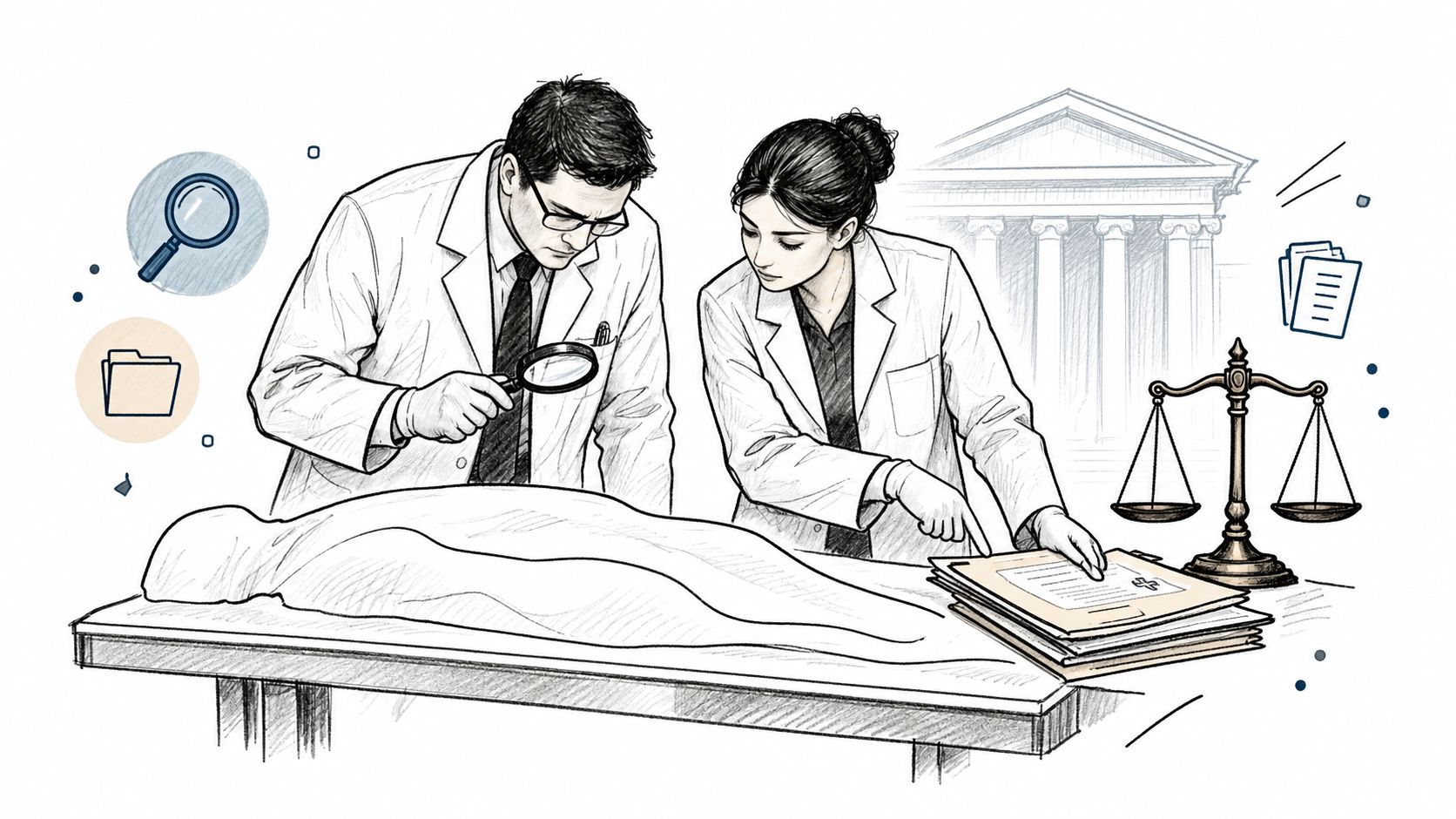
When someone dies unexpectedly or under uncertain circumstances, the questions left behind can be overwhelming for a family. As a forensic pathologist, I am a medical doctor specially trained to find the answers to those questions. My role is that of a medical detective, using science to determine the truth about a person's death.
My work involves performing a postmortem examination, commonly known as an autopsy, to establish both the cause and the manner of death. By piecing together the final chapter of a person's life, I can provide clarity to their family and deliver objective facts to the legal system.
A Voice for the Deceased
I often explain my role as being a voice for those who can no longer speak for themselves. My work begins when a person’s life ends under unclear, sudden, or violent circumstances, and I am tasked with creating a clear medical narrative of what happened.
This isn’t just a clinical procedure; it’s a careful investigation. For a family grieving an unexpected loss at home, my findings might confirm a natural cause, like a sudden heart attack, which can bring a sense of peace. In other situations, the evidence I uncover may point toward something that requires further investigation by law enforcement.
More Than Just an Autopsy
It’s a common misconception that our work happens entirely within the autopsy suite. While the physical examination is a critical piece of the puzzle, it's just one part of a much larger analytical process.
To arrive at a conclusion grounded in evidence, a forensic pathologist must pull together information from many different sources. This typically involves:
- Performing a detailed external and internal examination of the body.
- Reviewing the individual’s medical records to understand their health history.
- Analyzing reports from law enforcement and toxicology to get the full context.
- Synthesizing all these pieces into a single, comprehensive report that clearly explains the cause of death.
This methodical approach ensures our findings are based on solid evidence, not guesswork. The weight of this responsibility is significant, as our conclusions can bring closure to a family or become crucial evidence in a courtroom.
As a board-certified forensic pathologist, I approach every case with the same level of precision and compassion. Families and legal professionals put their trust in my findings, and I take that responsibility very seriously.
Before we move on, here's a quick summary of what a forensic pathologist does.
Forensic Pathologist At a Glance
| Aspect | Description |
|---|---|
| Primary Role | To investigate sudden, unexpected, or violent deaths by performing autopsies. |
| Key Objective | Determine the official cause (e.g., heart attack) and manner (e.g., natural) of death. |
| Core Skills | A deep understanding of medicine, anatomy, toxicology, and investigative procedures. |
| Qualifications | A medical degree (MD or DO) followed by residency and fellowship training. |
| Who They Serve | Families, law enforcement agencies, and the legal system. |
This table provides a snapshot, but the core of the job is about finding the truth.
Ultimately, the goal is to use scientific rigor to tell a person's story with accuracy and respect. You can learn more about the specifics of my work and what a forensic pathologist does in our detailed guide. It all comes back to that unwavering commitment to objective truth, which is the cornerstone of forensic pathology.
The Demanding Journey to Becoming a Forensic Expert
The road to becoming a board-certified forensic pathologist is long and requires well over a decade of intense, focused education and hands-on training. It’s a major commitment, but that’s what it takes to develop the deep expertise needed for a proper cause of death investigation.
It all starts with a four-year undergraduate degree, usually heavy in the sciences. From there, it’s another four years of medical school to earn an M.D. or D.O. Once you're a doctor, the real specialization begins: a demanding four- or five-year residency in anatomic and clinical pathology. This is where you learn the language of disease, mastering how it appears and acts down to the cellular level.
This timeline gives you a sense of our methodical process, from the very first steps of an investigation all the way to delivering the final, conclusive answers.
As you can see, every stage is designed to ensure the answers we provide are built on a solid foundation of evidence and medical science.
Advanced Specialization and Certification
The last major hurdle is a one-year fellowship dedicated entirely to forensic pathology. This isn’t classroom learning; it’s immersive, real-world training inside a medical examiner's or coroner's office, handling the complex cases we see every day. This is where we learn to translate our medical knowledge into the language of the law.
For me, this long journey led to achieving board certification from the American Board of Pathology in Anatomic, Clinical, and Forensic Pathology. This isn't just a plaque on the wall. It’s a promise to every family and attorney I work with that my findings meet the absolute highest standards of competence and objectivity. To see a more detailed breakdown, check out our guide on the steps to becoming a forensic pathologist.
This extensive training is what allows a forensic pathologist to stand in a courtroom and provide expert testimony with confidence, knowing their conclusions are built on a bedrock of medical science and meticulous investigation.
The rigor of this career path is also reflected in the numbers. The field for forensic science technicians is expected to grow by 14% between 2023 and 2033, and the expertise of a forensic pathologist is highly valued, with median salaries often around $262,000 per year. You can learn more about these forensic pathologist career trends at Forensicscolleges.com. The data makes it clear: the need for highly qualified experts in this field isn't going away.
Determining Cause and Manner of Death
At the heart of my work are two critical determinations: the cause of death and the manner of death. They might sound similar, but these are two distinct concepts, and getting them right forms the bedrock of every death investigation. Families, attorneys, and law enforcement all rely on this crucial distinction.
The cause of death is the specific medical reason a person died. It’s the direct, biological event, such as a heart attack, a gunshot wound to the head, or advanced lung cancer. It's the "what" that stopped the body from functioning.
The manner of death, however, is the official classification of how the death came about. This isn't just a medical finding; it's a medicolegal determination that explains the circumstances surrounding the cause.
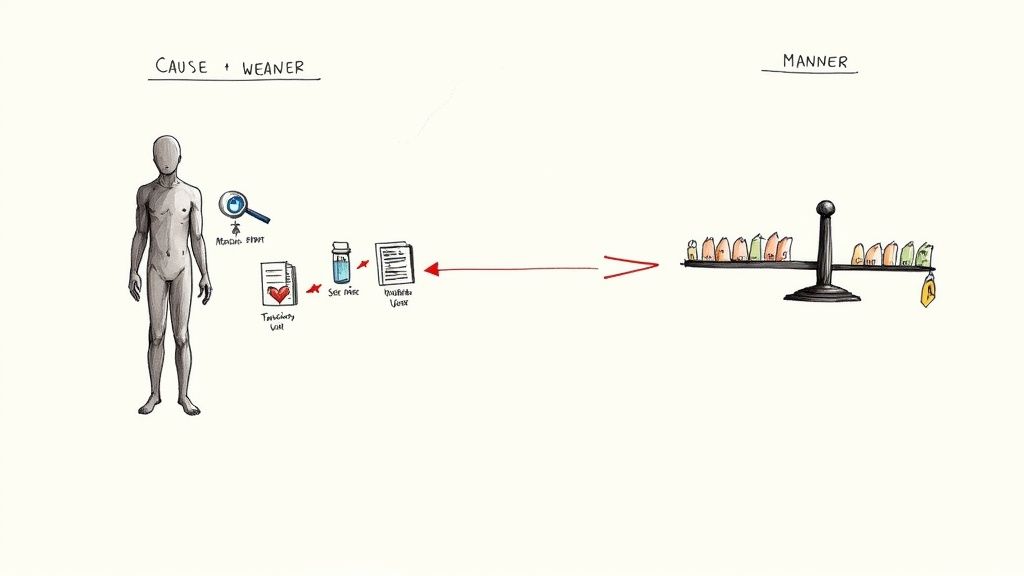
The Five Manners of Death
Every case I investigate must ultimately be classified into one of five categories. This classification provides the official context for everything that follows, from insurance claims to criminal proceedings.
- Natural: The death was caused solely by disease or the natural aging process. No outside factors were involved.
- Accident: The death was the result of an unforeseen and unintentional event, such as a car crash or a fall.
- Suicide: The death was caused by the person's own hand, with the clear intent to end their life.
- Homicide: This means the death was caused by another person. It's a neutral medical term; it doesn't automatically mean a crime occurred. The legal system determines criminal intent.
- Undetermined: This category is used when there isn't enough evidence to definitively place the death into one of the other four categories.
A simple way to understand the difference is that a gunshot wound is the cause of death. Whether that death is ruled a homicide, suicide, or a very rare accident is the manner of death. If you'd like to dive deeper, we have a whole guide explaining the difference between cause and manner of death.
An Evidence-Based Conclusion
After performing over 1,000 autopsies, I can tell you that these conclusions are never a guess. They are the result of a rigorous, scientific process that leaves no room for assumptions. It’s this methodical approach that gives my findings weight and objectivity.
My job is to piece together the complete medical story. I do this by combining the physical findings from the autopsy with a deep dive into medical records, toxicology reports, and all the information gathered from the death scene.
Every detail matters. The final report is a synthesis of all this information. This process mirrors the importance of evidence in investigations across all fields; it’s about letting the facts speak for themselves. This is how I provide clear, unbiased answers to families and legal authorities, ensuring the final death certificate is a true and accurate reflection of what happened.
The Growing Need for Forensic Pathologists in Texas
Across the United States, and especially here in Texas, there is a critical shortage of qualified forensic pathologists. This isn't just a statistic; it’s a problem that directly impacts families and our justice system when they are most vulnerable. The demand for our specialized work has grown significantly, stretching public resources thin.
Several societal challenges are driving this need. The tragic rise in overdose deaths from the ongoing opioid crisis means more cases require careful investigation. At the same time, an increase in complex violent crimes requires the kind of detailed work only a trained forensic expert can deliver. The number of new doctors choosing this demanding field just isn't keeping up.
The Strain on Public Systems
This gap puts a massive burden on government-run medical examiner offices. When a county’s forensic team is overwhelmed with cases, delays are inevitable. For families waiting to understand how a loved one died, that delay adds an unbearable layer of pain and uncertainty. It also slows legal proceedings that depend on our findings.
The national numbers tell the story. In 2022, there were only about 750 full-time forensic pathologists practicing in the entire country. Experts agree that we need at least double that number to handle the current volume of cases effectively. This shortage, which you can read more about in this national pathologist shortage report from TIME, highlights just how strained the system has become.
The Role of Independent Forensic Pathology
This is where a private practice like Texas Autopsy Services can help. I work to fill that gap, ensuring everyone has access to a timely, thorough, and objective death investigation.
My goal isn’t to replace the public system, but to support it. I offer a crucial alternative for people who might otherwise be left without answers, making sure the integrity of the death investigation process is upheld for every family.
For families, I provide a way to get answers when a county medical examiner declines to perform an autopsy. For attorneys, my work can offer an unbiased second opinion that proves essential in both civil and criminal cases. I also work directly with various counties, providing County Forensic Autopsies in jurisdictions that don’t have their own full-time forensic pathologist.
By stepping in, I help lighten the load on public offices and make sure that anyone in Texas who needs clear, expert answers can get them. It’s about providing access to truth and clarity when it’s needed most.
When a Private Forensic Pathologist Is Needed
https://www.youtube.com/embed/iWd5pR07Xzw
So, when does it make sense to hire a private forensic pathologist? Usually, the need arises during some of life's most difficult and confusing moments. For a family, it's often after a loved one dies unexpectedly and the official medical examiner decides not to perform an autopsy. This can leave a family with agonizing, unanswered questions.
In other cases, a family might feel uneasy about the conclusions in an official autopsy report. Getting a second opinion from an independent expert can bring much-needed clarity, either by confirming the original findings or by shedding new light on what really happened.
For attorneys, a private forensic autopsy is a critical tool for building a solid case, whether for a civil lawsuit or a criminal defense. An independent pathologist provides an unbiased, scientific foundation of medical facts that can strengthen a legal argument.
Who I Work With
My practice is built around helping three main groups who all share a common goal: getting to the truth. My job is to provide clear, objective answers by conducting a thorough, independent examination.
Families: When a death is sudden and the government doesn't perform an autopsy, families are left in a painful limbo. A private autopsy can answer vital questions about potential hereditary diseases, confirm or rule out a suspected cause of death, and ultimately provide the closure that only facts can offer.
Attorneys: The legal world runs on evidence. My work provides legal teams with the concrete medical data they need to build their arguments. In personal injury cases, for example, the findings of an independent forensic pathologist can be essential for legal actions, like when drafting a detailed personal injury demand letter.
Texas Counties: I also partner with county officials across Texas, especially in places that don't have their own full-time forensic pathologist. By offering my services, I help ensure that every community, regardless of its size, has access to top-tier death investigation services.
The Value of an Independent Examination
Hiring an independent pathologist brings a few key advantages. First and foremost, it guarantees objectivity. My only allegiance is to the medical evidence in front of me. It also opens up a direct line of communication, allowing families and attorneys to ask questions and get straight answers without bureaucratic delays.
An independent examination provides a level of thoroughness and focused attention that gives all parties confidence in the final report. My sole purpose is to deliver an accurate, unbiased, and comprehensive cause-of-death determination based on the evidence.
Whether you're a grieving family member, an attorney preparing for trial, or a county official needing support, the goal is always the same: find the truth. My role as a private forensic pathologist is to uncover that truth with precision, objectivity, and profound respect for the deceased and their families.
My Commitment to Answers with Compassion
Forensic pathology is much more than a scientific field. At its core, this work is about finding clear answers for people who are going through the most difficult time of their lives. I see it as my deepest responsibility to deliver the truth with both medical accuracy and genuine compassion.
Families deserve clarity. The legal system needs objective facts. My job is to bridge that gap with unwavering professionalism and profound respect for the person who has passed away.
When you work with me, you’re not just hiring an expert; you’re partnering with someone who understands the sensitivity of your situation. My entire focus is on providing honest, evidence-based answers, handled with the dignity everyone deserves.
The science provides the facts, but compassion guides how those facts are delivered. It is a balance I strive for in every single case, ensuring families feel heard and respected throughout the process.
If you are left with questions after the death of a loved one, please don't hesitate to reach out. I'm here to walk you through your options and help you find the clarity you need. My team and I are ready to provide the support and expertise your case demands.
Your Questions About Forensic Pathology Answered
Over the years, I've found that families and attorneys often have many of the same questions when they first contact me. It's a confusing and difficult time, and my goal is to bring some clarity to the process. Here are the answers to the questions I hear most often.
What’s the Difference Between a Coroner and a Forensic Pathologist?
This is a common point of confusion. A forensic pathologist is a physician—a medical doctor who has completed at least 13 years of education and highly specialized training after high school. We attend medical school, complete a residency in pathology, and then an intensive fellowship focused solely on determining how and why someone died. My job is to perform the autopsy and establish the medical cause of death.
A coroner, on the other hand, is usually an elected official. In many places, a coroner is not required to have a medical background. They are an administrator legally responsible for investigating a death. Coroners often rely on forensic pathologists like me to perform the actual medical examination and provide the scientific answers. Here in Texas, most larger counties use a Medical Examiner system, which requires a physician to lead the office.
If We Have an Autopsy Can We Still Have an Open-Casket Funeral?
Yes, absolutely. This is a myth that causes families unnecessary worry.
A professionally conducted autopsy is a surgical procedure performed with the utmost respect for the deceased. We are very conscious of funeral traditions. All incisions are carefully placed so they won't be visible when the person is dressed and resting in a casket. I always take great care to ensure families can have the viewing and funeral they’ve planned.
How Long Does It Take to Get the Results of a Private Autopsy?
The physical examination itself is usually completed in a few hours. The more time-consuming part is the subsequent analysis.
My highest priority is providing a comprehensive and accurate report. I work as efficiently as possible, but I will never rush the analysis. The final answers must be built on a complete and methodical investigation.
The final report takes longer because it includes a deep dive into toxicology results, microscopic analysis of tissue samples, and a careful review of all available medical records. Pulling all that evidence together into a conclusive report typically takes several weeks. I make sure to keep the family and their attorney updated every step of the way.