October 14, 2026 · Texas Autopsy Services
Suicide That Look Like Accidents: A Forensic Guide
Suicide that look like accidents are harder to identify than most people think. Learn how forensic investigators separate accident from intent.
On this page
- Understanding Intent and Mechanism in Death Investigations
- How Medical Examiners Define Accident Versus Suicide
- Evaluating Scene Evidence and Toxicology Reports
- Why an Autopsy Report Alone May Not Determine Intent
- Resolving Uncertainty Through Evidence Standards
- When to Seek an Independent Second-Opinion Review
- Finding Clarity Through Compassionate Forensic Expertise
Forensic classification depends on the totality of evidence and the preponderance of evidence standard, not just the physical mechanism of injury. In the CDC framework, 5,683 U.S. injury deaths were assigned undetermined intent in 2019, compared with 47,511 suicide deaths and 173,040 unintentional injury deaths, which is why a death can look accidental and still require deeper review World Health Organization suicide data.
A loved one can die in a fall, overdose, drowning, or crash, and the scene may still leave intent unresolved. When that happens, the question is not whether the injury happened, but whether the evidence shows it was accidental, suicidal, homicidal, or undetermined.
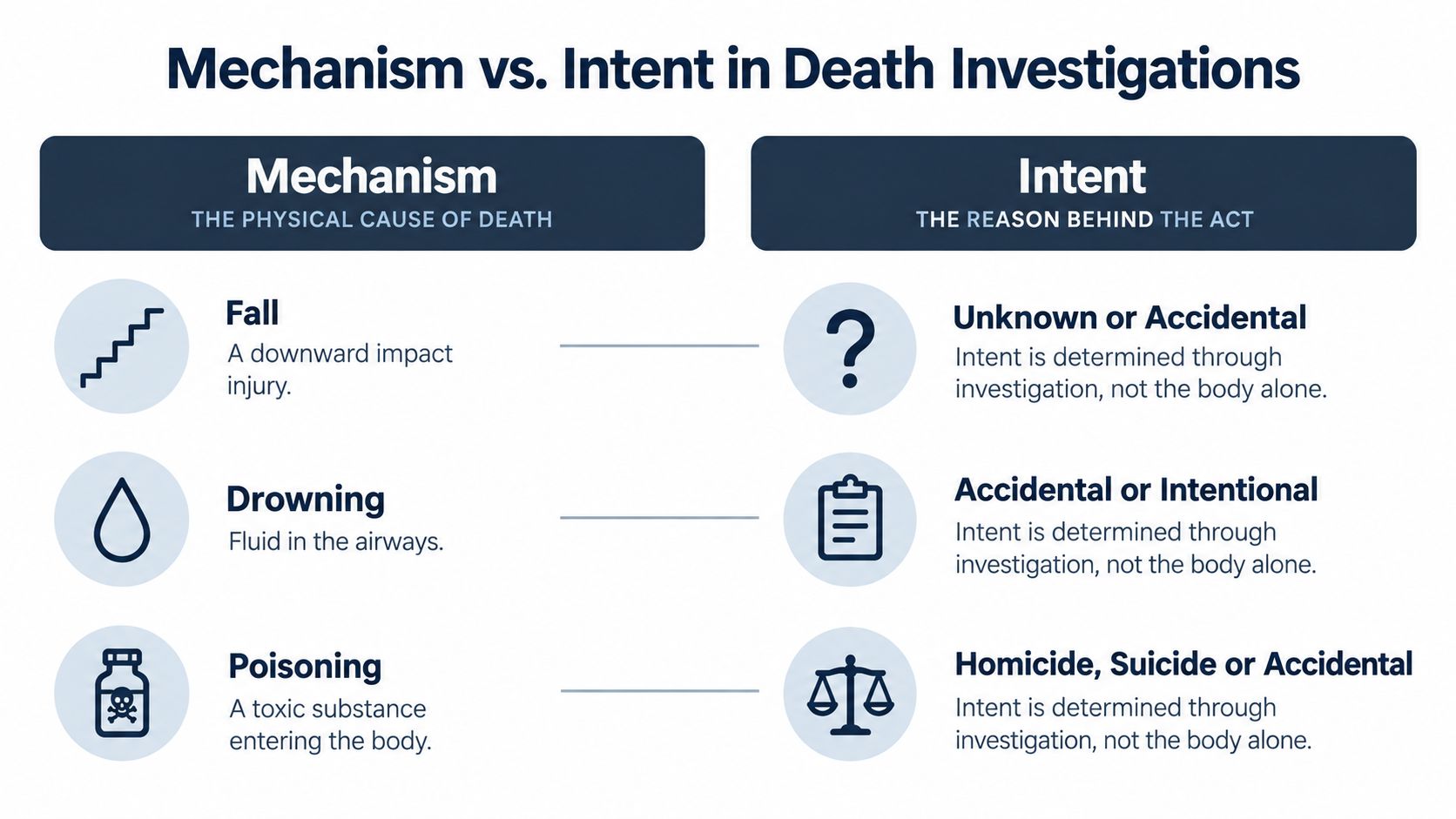
- Mechanism is not intent. The same physical event can arise from accident or self-harm, so the body alone doesn't settle the manner of death.
- Scene and records matter. Intent usually turns on reconstruction, toxicology, communications, and history, not on the autopsy report by itself.
- Uncertainty is real. Some deaths stay unresolved when the available evidence is incomplete or conflicting.
- Independent review can help. A second opinion can clarify whether the original classification fits the full record.
Understanding Intent and Mechanism in Death Investigations
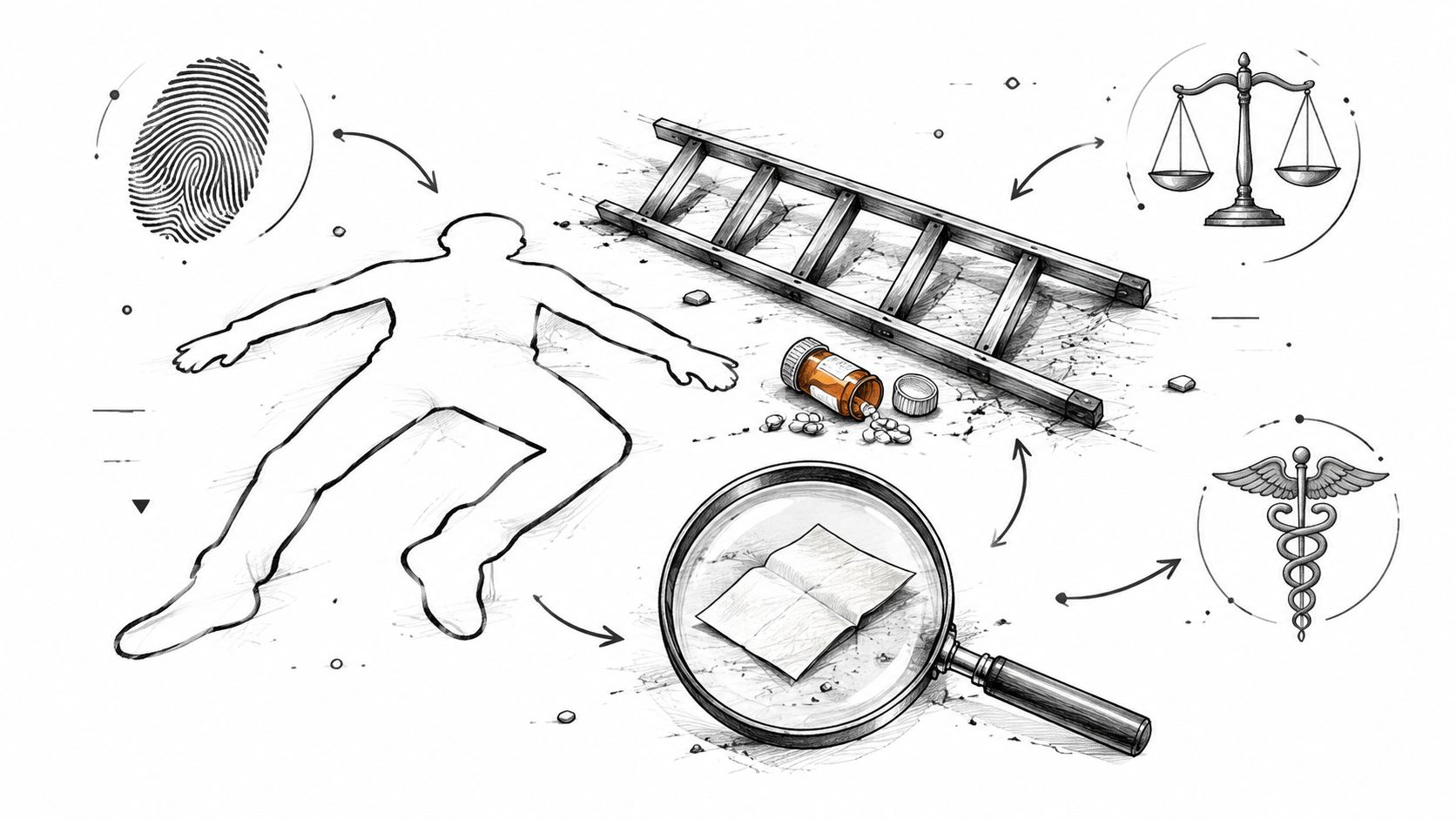
A fall from height can leave the same broken bones whether it was accidental or intentional. The case turns on the evidence around the fall, access to the location, prior messages, witness accounts, and any reconstruction that shows whether the person likely stepped, slipped, or was placed there. The mechanism is the injury pattern. Intent comes from the full investigative record.
That is why an ordinary-looking death can change once the scene is examined closely. A poisoning may read as an overdose until toxicology, prescription history, and communications show a deliberate self-inflicted act. A drowning may look like a water accident until the timeline, clothing, and prior behavior point another way. The path from uncertain to confirmed intent is built on details, not assumptions.
Why the appearance of a death can mislead
A scene can look ordinary even when the surrounding evidence does not. That is why we test the first impression against the record, including timing, access, behavior, and what happened before death.
Practical rule: when the mechanism fits but the surrounding facts do not, the case needs more than a surface reading.
Families often look for context when alcohol or drug use and mood changes appear together, and that can complicate the picture. A careful review of history matters, including resources such as when drinking and low mood mix, because prior substance use and mental state may explain why a death was difficult to interpret at first.
How Medical Examiners Define Accident Versus Suicide
How does a medical examiner decide whether a death is an accident or suicide? The answer comes from the full record, not the injury alone. A death can look like a fall, overdose, drowning, fire, or traffic crash and still be classified differently once intent is examined. In practice, an accident is used when there is little or no evidence that the injury or poisoning was intended to harm or kill, while suicide requires evidence of a self-inflicted act meant to cause death.
That distinction is practical. A drowning with no witnesses may be ruled an accident if the scene, history, and toxicology fit unplanned water exposure. The same case may move toward suicide if toxicology shows a lethal sedative dose, prior messages show intent, or the circumstances point to deliberate self-harm. If the evidence does not support either conclusion, the case can remain undetermined rather than being pushed into a category that the record does not support.
What has to be reviewed before a manner is finalized
A defensible classification depends on the full investigative file. Medical examiners and forensic pathologists review scene reconstruction, witness and emergency-call records, written or electronic communications, medical and psychiatric history, access to the substance or instrument involved, injury-pattern analysis, and complete toxicology CDC forensic classification standards.
The trade-off is real. A fast label is easier to write, but a careful label is more reliable in court and in later review. If the evidence is thin, a final answer can overstate certainty. If the evidence is strong, the classification should match it clearly.
A pending or unresolved case should not be treated as solved just because the mechanism sounds familiar. Independent review often turns on whether the available findings actually support intent, or only show how death occurred.
Evaluating Scene Evidence and Toxicology Reports
When a death looks accidental, the first task is to test whether the scene and the stated cause fit. Death-investigation guidance treats a case as suspicious when the circumstances, scene, or stated cause do not align, including cases that may have been staged as an accident or suicide death-investigation protocol.
The work starts with a walkthrough. We look at body position, possible cause of death, blood, weapons, ligatures, displaced objects, defensive-wound indicators, and any sign that the scene or body may have been altered. We also ask whether the story changes when the physical space is read carefully instead of quickly.
What toxicology and injury review add
Toxicology can show whether the decedent may have been drugged before death, and the protocol also calls for DNA testing beneath fingernails, bruising checks in concealed areas such as the torso or back of the neck, and evaluation for defensive wounds. Those findings matter because they can separate a genuine accident from a death that was arranged to look accidental.
Texas Autopsy Services' forensic toxicology review is one example of how a broader postmortem review can fit into that process when the laboratory data need careful interpretation.
A scene that looks simple can still contain signs of struggle, staging, or drug involvement. The key is not to assume that a lack of obvious chaos means the death was accidental. Quiet scenes can still carry strong evidence if they're documented thoroughly.
Practical rule: the scene should be tested against the story, not arranged to fit it.
Families and attorneys often overlook how much can be learned from small inconsistencies. A displaced object, an unexplained bruise, or a toxicology result that doesn't match the history can move a case from “probably accidental” to “needs deeper review.”
Why an Autopsy Report Alone May Not Determine Intent
An autopsy tells us what the body shows. It does not always tell us why the person died. Published case reports involving people struck by vehicles found that suicide could be determined only by combining autopsy findings with detailed scene examination, vehicle inspection, witness interviews, recorded communications, and family information about psychiatric history, prior attempts, suicidal thoughts, treatment, and events immediately before death forensic case reports on vehicle-related deaths.
That limitation matters because the physical examination can confirm injury, disease, or intoxication, but it usually can't confirm intent by itself. A body can show blunt-force trauma, asphyxia, or toxic exposure, while the central question remains whether the event was accidental, suicidal, or otherwise intentional.
The practical lesson is simple. A report that names injuries is not the same thing as a report that proves manner of death. The strongest conclusions come from concordance, where anatomy, scene findings, history, and records all support the same answer.
What a complete review has to include
A second-opinion review should not stop at the autopsy narrative. It should include the scene, vehicle or equipment inspection where relevant, witness accounts, communications, and the person's known history. That's what turns a body examination into a forensic opinion.
A body can answer how death happened medically. It usually can't answer intent without the rest of the record.
Texas Autopsy Services' forensic pathology review is the kind of record-centered review families and attorneys often need when the first label doesn't seem to match the known facts.
Resolving Uncertainty Through Evidence Standards
Why do some deaths stay uncertain until the evidence is tested against a higher standard? In a CDC report covering 48 states, the District of Columbia, and Puerto Rico, the overall rate of undetermined-intent deaths was 2.1 per 100,000 population, with 2.8 per 100,000 among males and 1.4 per 100,000 among females CDC violent death surveillance report. In 2022, the National Violent Death Reporting System recorded approximately 49,000 suicides CDC violent death surveillance report. Among undetermined-intent deaths, poisoning was the most common mechanism in more than half of cases. Opioids were detected in nearly 80% of decedents tested for those substances.
Those figures matter because they show how often intent stays unclear until the file is complete. Poisoning cases, especially unclear overdoses, require careful review because a lab result without context can point in the wrong direction if the scene, history, and timing are not read together.
How cases get resolved
The CDC's reporting rules use a practical evidence hierarchy. If two sources identify a death as suicide and a third identifies it as undetermined intent, the death is coded as suicide under the surveillance standard. That rule reflects corroboration, not the first label entered into a record CDC violent death surveillance report.
Digital evidence and prior medical records often change the picture. A message, a recent discharge, a treatment history, or a documented prior attempt can give structure to a case that looked ordinary at first. The file has to be weighed as a whole, not reduced to one dramatic detail.
Undetermined means the evidence did not support a more certain ruling. For families, attorneys, and county officials, that distinction matters because a label should rest on the record that can defend it.
When to Seek an Independent Second-Opinion Review
Who should request a second opinion? Families should do so when the official conclusion does not fit the decedent's history, the scene facts, or the medical record. Attorneys and county officials should also ask for one when the file is incomplete or the ruling carries legal weight. Misclassification is a known problem in death certification, especially in deaths involving poisoning, drowning, falls, or motor-vehicle events. A peer-reviewed review of suicide underreporting discusses how deaths can be assigned to undetermined intent, accidents, homicides, or unknown causes when the evidence is incomplete.
A second-opinion review is not about forcing a new result. It is about testing the original ruling against the available evidence and asking whether the classification still holds.
What a complete file should include
An independent pathologist should review the full investigative record whenever possible. That means photographs, toxicology raw data, scene diagrams, dispatch records, digital evidence, medical records, and witness statements. When those materials are missing, the limits of the opinion should be stated plainly.
Request a second-opinion review before accepting an initial accident ruling if the death involved a mechanism that could be accidental or intentional, and the facts known to the family conflict with the report. If you are weighing that decision, should I get a second opinion is the right question to ask, because the answer depends on the record, not on grief alone.
Texas Autopsy Services is one option for that review. Our board-certified forensic pathologists examine the medical and investigative evidence together, so the final opinion rests on the full case file rather than a single report.
A documented review is the right next step when the first ruling still does not make sense.
Finding Clarity Through Compassionate Forensic Expertise
When a death may have been suicide that look like accidents, families are left with more than paperwork. They're left with uncertainty about what happened and whether the record tells the truth. Our work is to read that record carefully, compare the scene with the injuries, and separate what the evidence proves from what it only suggests.
We also know that grief doesn't stop at the exam table. If the broader picture includes depression, compulsive behavior, or substance use, families often need context beyond the death certificate, and resources such as depression and OCD articles can help them understand how mental health patterns may intersect with a difficult death investigation. That context doesn't replace forensic work, but it can help families ask better questions.
At Texas Autopsy Services, every examination is performed by a board-certified forensic pathologist certified by the American Board of Pathology. We provide independent, court-admissible findings with clear communication, full chain of custody, and respect for the deceased and their family.
If you're facing a death that was called an accident but doesn't feel resolved, Texas Autopsy Services can review the full investigative record and help determine whether the evidence supports that classification. Visit Texas Autopsy Services to discuss a private autopsy or second-opinion forensic review, and let our team help you understand the next medically appropriate step.