October 11, 2026 · Texas Autopsy Services
Forensic Death Investigation: What Families Should Know
Learn how forensic death investigation works, from scene assessment and autopsy through cause-of-death determination. A clear guide for families and attorneys.
On this page
- When a Death Raises Questions
- Core Terms Families Often Hear
- How the Investigation Moves from Scene to Report
- What the Autopsy and Lab Work Actually Reveal
- Cause of Death Versus Manner of Death
- Common Misconceptions Worth Correcting
- Texas Legal Framework and Practical Safeguards
- Independent Review, Courtroom Use, and Next Steps
A sudden death can leave a family with two separate burdens: grief and uncertainty. When someone dies outside a hospital, after an accident, in custody, unexpectedly, or under circumstances that don't make sense, the official death investigation may not answer every question the family has.
A forensic death investigation connects the scene, medical history, body examination, laboratory testing, and written conclusions. Texas Autopsy Services is an independent private autopsy and forensic pathology practice based in Elgin, serving families, attorneys, healthcare professionals, agencies, and county officials across all 254 Texas counties.
- A private autopsy can provide an independent medical review when questions remain after an official investigation.
- Cause of death identifies the disease, injury, or condition that started the fatal sequence. Manner of death describes the circumstances, such as natural, accident, suicide, homicide, or undetermined.
- A defensible conclusion depends on more than an autopsy. Scene information, records, toxicology, histology, imaging, and chain-of-custody documentation may all matter.
- Every examination by Texas Autopsy Services is performed by a forensic pathologist certified by the American Board of Pathology.
- A second opinion doesn't automatically overturn an official finding, but it can identify missing evidence, unsupported assumptions, or an alternative explanation that deserves review.
When a Death Raises Questions
A family may receive a call that a loved one has died unexpectedly at home, after a traffic collision, during a medical event, or while under another person's supervision. The first hours can be confusing. Investigators may be gathering information, a justice of the peace or medical examiner may be deciding whether the death falls within the office's jurisdiction, and funeral arrangements may already be under discussion.
In these situations, the body is part of a larger record. The location, position of the body, medications, witness accounts, photographs, medical history, and physical findings can each answer a different part of the same question. If one part is missing or poorly documented, later reviewers may have difficulty understanding how the final conclusion was reached.
The United States uses a decentralized medicolegal death-investigation system. Medical examiner offices, coroner offices, and mixed systems share responsibility, and their staffing, authority, resources, and investigative practices vary by jurisdiction. Nationally, medical examiner and coroner offices investigate approximately 20% of deaths, and in 2018 about 2,000 offices received more than 1.3 million referrals. Approximately 605,000 referrals were accepted for further investigation, representing roughly 46.5% of referred cases, according to the National Center for Biotechnology Information overview of medicolegal death investigation.
Deaths that commonly require forensic review
A forensic investigation may be appropriate when a death is:
- Sudden or unexplained, particularly when the person had no clear terminal illness.
- Accidental, including a fatal crash, fall, drowning, poisoning, or workplace event.
- Suspected to involve violence, whether the concern is homicide, suicide, or another injury.
- In custody or under restraint, where the circumstances and physical findings require careful documentation.
- Unusual or disputed, including cases where the official conclusion doesn't fit the available records or witness information.
A family doesn't need to accuse anyone to seek clarification. Independent review can serve families who want a clearer explanation, attorneys evaluating a potential claim, healthcare professionals examining an unexpected outcome, and Texas county officials who need a qualified forensic service.
Grief can also make ordinary decisions difficult. Families looking for practical support may find resources on coping when tragedy hits close to home, while a forensic team addresses the medical and evidentiary questions with discretion.
Core Terms Families Often Hear
Reports use several terms that sound similar but answer different questions. Understanding the distinction helps families read a death certificate, autopsy report, or attorney's case summary without treating one conclusion as if it answered everything.
Cause of death is the disease, injury, or condition that initiated the fatal process. For example, a gunshot wound, a heart attack, or a drug toxicity may be listed as the cause. Think of cause as the first significant event in a chain.
Mechanism of death is the bodily process that led to death. Examples include blood loss, respiratory failure, or a fatal disturbance of heart rhythm. Mechanism describes what the body did, but it usually doesn't identify why the event occurred. Respiratory failure alone, for instance, may be the final process caused by many different diseases or injuries.
Manner of death classifies the circumstances surrounding the cause. The usual categories are natural, accident, suicide, homicide, and undetermined. Manner isn't a substitute for cause. It's a separate conclusion based on intent, circumstances, investigative information, and the available medical evidence.
The evidence trail
Chain of custody means the documented history of evidence from collection through storage, testing, transfer, and reporting. It functions like a receipt trail for specimens, photographs, clothing, and other materials. A reviewer should be able to determine what was collected, who handled it, where it was stored, and what was examined.
Postmortem interval, often shortened to PMI, is an estimate of the time since death. It isn't a timestamp produced by one test. Temperature, humidity, altitude, burial or submersion, clothing, insect activity, body size, microbial changes, and scavenger access can all affect decomposition. A defensible estimate usually combines scene information with rigor and lividity observations, entomology, anthropology, and validated biochemical or microbiome methods when appropriate.
These terms matter beyond medical records. Cause and manner may affect insurance review, estate administration, public health reporting, workplace or civil litigation, and criminal investigations. When the terminology is unclear, the practical consequences can remain unclear too.
Practical rule: A cause explains the medical event, a mechanism describes the body's final response, and a manner addresses the surrounding circumstances.
How the Investigation Moves from Scene to Report
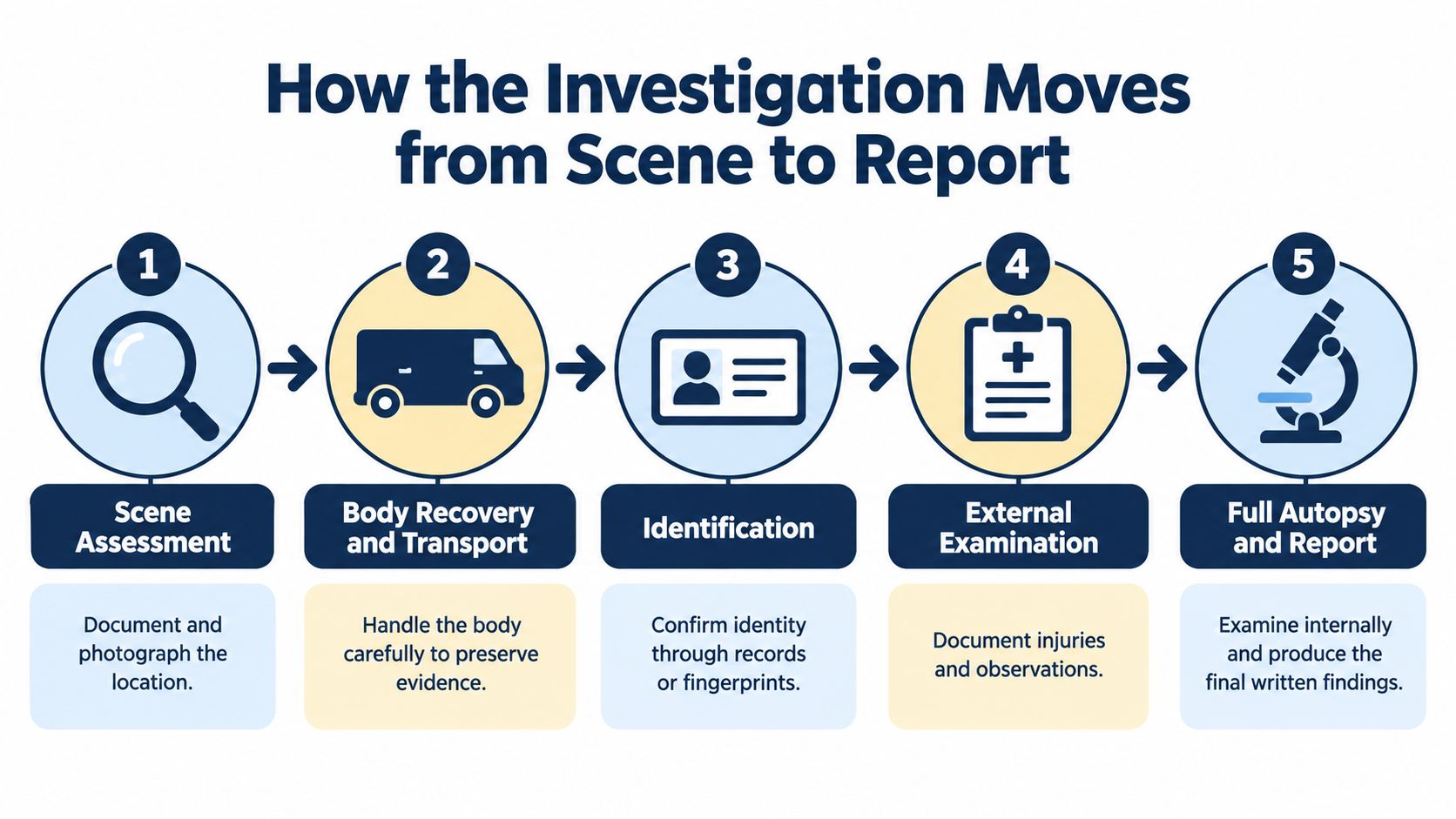
A reliable investigation develops in sequence. The pathologist's conclusion should reflect the combined record, not just what is visible during the examination.
The process often begins at the scene. Investigators document the body's position, surrounding objects, medications, injuries, environmental conditions, and any information that may explain the circumstances. Photographs and contemporaneous notes preserve details that may change after recovery.
Recovery and transport require equal care. Personnel should identify the decedent, protect potential evidence, document transfers, and maintain appropriate storage conditions. The body's recovery position and thermal exposure may be relevant to later interpretation, particularly when investigators assess postmortem interval.
Identification follows its own standards. Records, fingerprints, dental information, or other validated methods may be used, depending on the circumstances. Correct identification is foundational. An accurate examination of the wrong person is still an unusable examination.
Examination and reporting
The external examination records clothing, injuries, medical devices, identifying features, decomposition, and other observations. It may be sufficient in some cases, but an external examination isn't equivalent to a full internal autopsy. The appropriate scope depends on the circumstances, available information, suspected cause, and the jurisdiction's decision-making process.
When a full autopsy is indicated, the forensic pathologist examines the body internally, documents gross findings, collects specimens, and may request histology, toxicology, imaging, or specialized testing. The pathologist also reviews medical records and investigative information because an organ finding can have different meanings in different contexts.
A preliminary communication may address immediate findings while laboratory work remains pending. The final report should identify what was examined, what testing was performed, what limitations apply, and how the findings support the cause and manner of death. Families and attorneys seeking a broader explanation can review how a death scene investigation develops alongside the formal report.
A later laboratory result can refine a conclusion, but it can't replace missing documentation about how evidence was collected and preserved.
The chain is cumulative. A strong toxicology result can't correct an unexplained specimen source. A detailed autopsy can't fully resolve a scene history that was never recorded. A clear report should show how the pieces fit together and where uncertainty remains.
What the Autopsy and Lab Work Actually Reveal
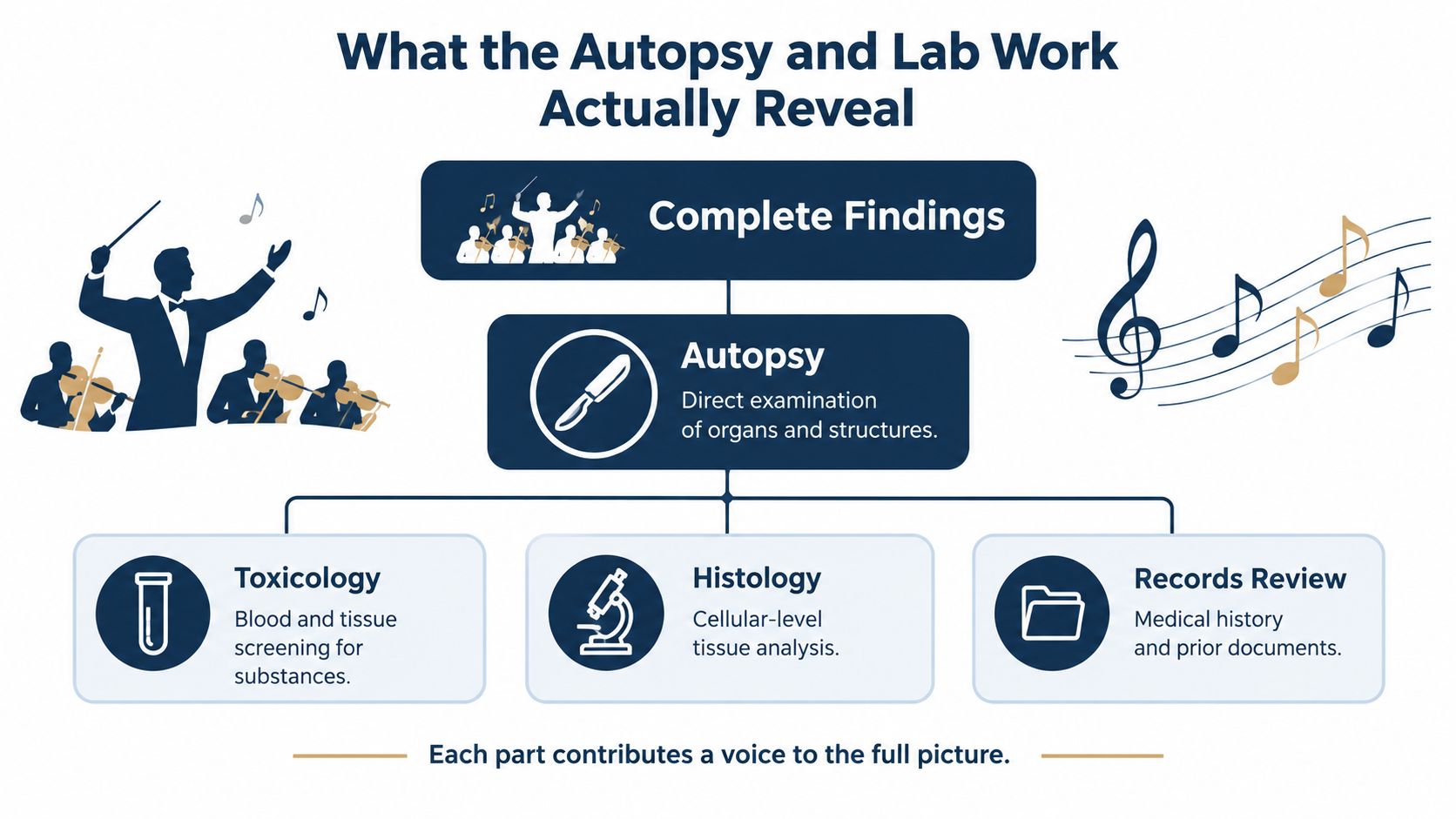
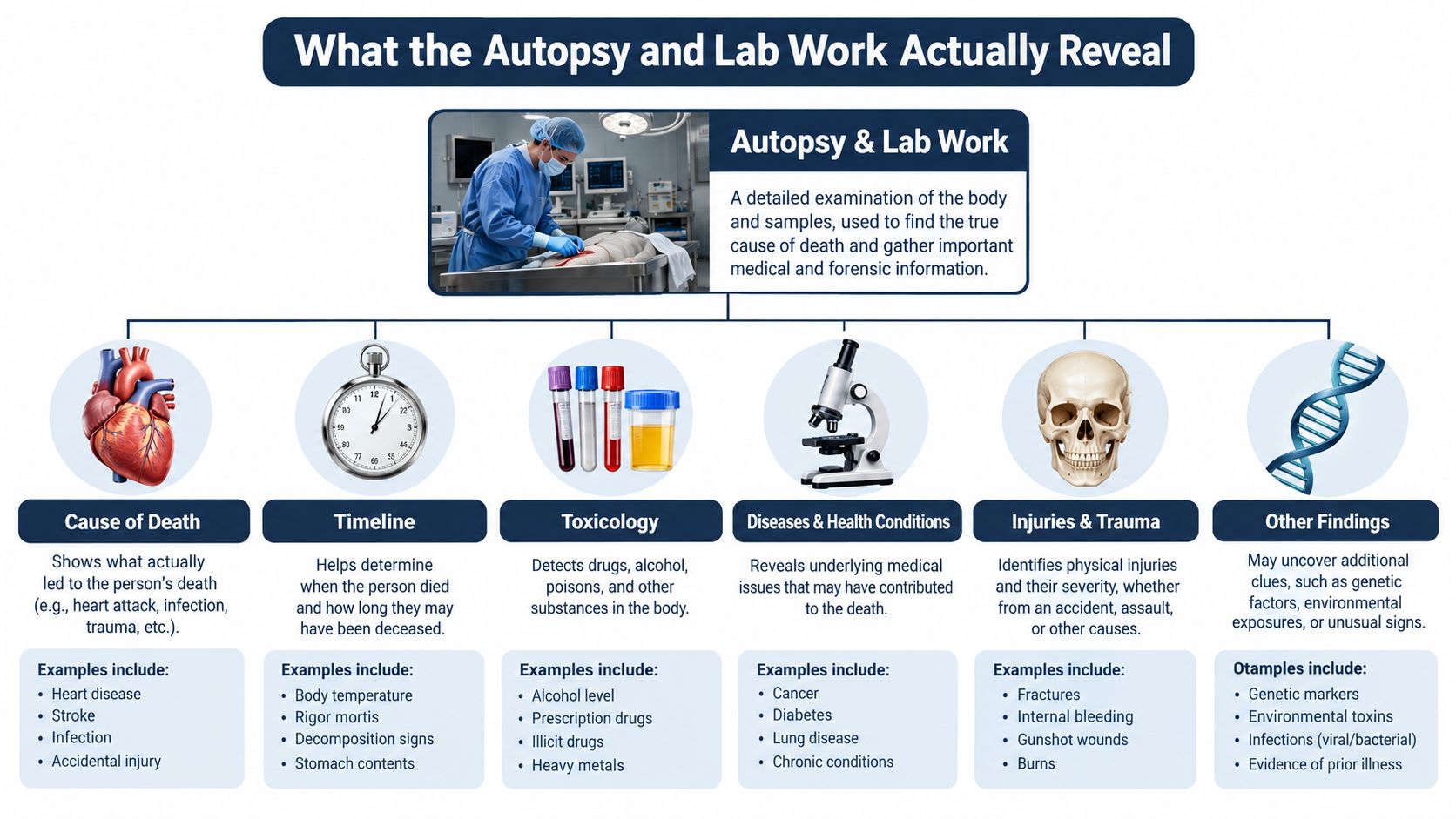
An autopsy is one instrument in an investigative orchestra. It provides direct examination of organs, tissues, injuries, and structures, while toxicology, histology, imaging, and records review contribute other parts of the medical picture.
Histology examines tissue under a microscope. It can help identify inflammation, chronic disease, infection, subtle injury, or other changes that aren't visible during gross examination. Toxicology tests specimens for drugs, alcohol, poisons, or other substances, but the meaning of a finding depends on the specimen, collection site, timing, storage, medical history, and circumstances.
A quantitative toxicology result should not be treated as an exact number that automatically proves impairment or cause of death. ANSI/ASB Standard 056 requires laboratories to evaluate measurement uncertainty by defining the measurand, identifying Type A and Type B sources, converting them into compatible standard uncertainties, combining them through root-sum-square or Monte Carlo methods, and applying a coverage factor when producing expanded uncertainty. A coverage interval near 95.45% is generally suitable for much forensic casework, although the laboratory must determine whether it fits the specific analyte and reporting purpose. These requirements are described in the Journal of Analytical Toxicology discussion of measurement uncertainty.
Why the specimen matters
Blood, urine, vitreous humor, liver, and other matrices answer different questions. Postmortem redistribution, decomposition, contamination, tolerance, therapeutic history, collection site, and storage temperature can change how a result should be interpreted.
That's why a useful report identifies:
- Specimen and collection site, rather than listing a result without context.
- Analytical method, calibration, and quality-control status.
- Quantitative result and uncertainty, or a clear statement of reporting limitations.
- Medical interpretation, including whether the finding supports the cause or manner of death.
A detected drug isn't, by itself, proof of causation. Our team may consider imaging, microscopic examination, molecular testing, or additional records when the standard evidence doesn't resolve the question. Families and attorneys can also review our explanation of postmortem toxicology interpretation for a more detailed discussion of why laboratory findings require context.
Postmortem interval estimation follows the same principle. Environmental variation can make a model developed in one region less reliable in another, so investigators should preserve insect and tissue samples, document conditions, and report a range with explicit assumptions rather than presenting an artificially precise time.
Cause of Death Versus Manner of Death
Families often hear a medical cause and assume the manner follows automatically. It doesn't.
Suppose the medical cause is fentanyl toxicity. The manner may be accident, suicide, or undetermined, depending on evidence about access, intent, circumstances, messages, witness accounts, and investigative findings. The toxicology result contributes medical information, but it doesn't independently establish intent.
The same distinction applies to traumatic injury. A heart injury may result from a collision, an assault, a self-inflicted wound, or another event. The injury is the cause. The surrounding facts determine how the death is classified.
When undetermined is appropriate
Undetermined doesn't mean that no work was done. It means the available evidence doesn't support a more specific manner with sufficient confidence. The category may be used when competing explanations remain medically and factually plausible.
Additional evidence can change the analysis. Investigators may later obtain witness information, body-camera footage, medical records, photographs, toxicology, or other documentation. An independent review can also identify an assumption that wasn't supported by the record or reveal that important information was never considered.
A 2025 independent audit of Maryland cases illustrates why classification deserves careful review. Outside forensic reviewers disagreed with the original determination in 44 of 87 reviewed cases and concluded that 36 deaths initially classified as undetermined, accidental, or natural should have been classified as homicides, according to the Maryland Attorney General's audit findings.aspx). The audit also identified missing photographs, incomplete incident information, absent available body-camera footage, and inconsistent documentation of restraint-related injuries.
This doesn't mean an independent review will overturn an official conclusion. It shows that manner of death depends on documentation and interpretation as well as anatomy. A careful pathologist separates what the body demonstrates from what the surrounding evidence supports.
Common Misconceptions Worth Correcting
An autopsy is always required. It isn't. Jurisdictions may choose an external examination, a full autopsy, or another investigative approach based on the circumstances and available resources. An external examination can provide useful findings, but it doesn't answer every question that internal examination, histology, or specimen collection might address.
The official report is automatically final. The official report is an important legal and medical record, but it can be reviewed when families or attorneys identify unanswered questions. A second opinion may examine the report, photographs, medical records, laboratory results, scene materials, and other documents without requiring a new examination.
A faster report is necessarily more thorough. Speed and completeness are different qualities. New York City's Fiscal 2025 report recorded a 36% decrease in autopsies and a 47% increase in external examinations, with the agency citing workload management amid a nationwide shortage of forensic pathologists. The report also stated that the median time to complete autopsy reports improved from 118 days to 92 days, while median medical-legal investigator scene-arrival time increased to 2 hours and 37 minutes, as described in the New York City Office of the Chief Medical Examiner report.
Review may remain possible after disposition
Burial or cremation can limit some options, but disposition doesn't automatically make every review meaningless. Existing photographs, radiology, histology slides, toxicology samples, medical records, scene documentation, and the original report may still permit a meaningful assessment.
A prompt report is useful only when the underlying examination, evidence preservation, and reasoning are adequate for the case.
The purpose of an independent review isn't to undermine a public office. It's to determine whether the conclusion follows from the documented evidence and whether important limitations were acknowledged.
Texas Legal Framework and Practical Safeguards
Texas law separates several parts of the death-care system. Texas Health & Safety Code Chapter 711 addresses cemeteries, including organization, operation, maintenance, and related disposition matters. Chapter 716 addresses crematories. Chapter 651 governs funeral services and funeral-service regulation.
These chapters shouldn't be treated as one general “autopsy law.” Authorization, disposition, cremation, funeral-service practice, and forensic investigation may involve different legal authorities, local procedures, and jurisdictional requirements. The Texas Funeral Service Commission has a regulatory role in funeral-service matters, while the applicable justice of the peace, medical examiner, law-enforcement agency, or other authority may govern a particular death investigation.
Authorization and evidence handling
Before arranging a private autopsy, families and attorneys should clarify who has authority over the decedent, whether a public investigation is open, whether the body can be released, and whether any evidence must remain available to a government agency. A private examination should never interfere with a lawful forensic investigation.
Chain of custody protects the evidentiary value of specimens and records. Each transfer should be documented, and the report should identify the materials examined and any limitations affecting interpretation. Our team describes these safeguards in chain-of-custody procedures for forensic examinations.
For families dealing with a fatal collision, legal questions may include the distinction between a wrongful-death claim and a survival action. A plain-language explanation of what happens after a fatal crash in Texas can help families identify questions for their attorney, while the forensic pathologist focuses on medical findings and cause and manner of death.
A compliant process includes clear authorization, respectful handling, secure storage, documented transfers, appropriate testing, and a report that distinguishes observed facts from interpretation. Requirements can vary by case, so families should obtain case-specific legal guidance when jurisdiction or disposition is disputed.
Independent Review, Courtroom Use, and Next Steps
A second-opinion autopsy or record review is most useful when a conclusion doesn't fit the available evidence, when important records were not considered, or when the scope of the original examination leaves a significant question unanswered. It may also help when an autopsy was declined, an external examination was performed instead, toxicology remains difficult to interpret, or the manner of death affects a legal dispute.
Families and attorneys should gather the original autopsy or external-examination report, death certificate, toxicology results, histology information, photographs, imaging, medical records, scene documentation, witness information, and correspondence about the investigation. The reviewer can then assess not only the final opinion, but also the steps that produced it.
What makes a review defensible
Every examination performed through our practice is conducted by a forensic pathologist certified by the American Board of Pathology. Certification reflects structured training and documented autopsy participation, not merely a general medical credential. The American Board of Pathology requires applicants to complete at least 30 qualifying autopsies, with participation that may include clinical-history review, external examination, dissection, microscopic correlation, written findings, and a cause-of-death opinion, as specified by the American Board of Pathology requirements.
The written report should explain the records reviewed, examinations performed, specimens tested, limitations encountered, and reasoning behind the cause and manner opinions. It should also preserve the distinction between a medical finding and an investigative conclusion. If testimony is needed, the pathologist should be able to explain the evidence in plain language and identify the assumptions supporting the opinion.
A county may need a forensic autopsy service when it doesn't have an in-house medical examiner or when local resources are limited. Families may need an independent autopsy, a review of an existing case, or help understanding whether meaningful evaluation remains possible after burial or cremation. Our practice provides private autopsies, second-opinion reviews, county forensic autopsy services, licensed transport, laboratory coordination, and written reporting for cases across Texas.
The first conversation should be focused and private. We'll ask what happened, what records are available, whether a public investigation is active, what questions remain, and what timing or disposition decisions may affect the options. We won't promise a particular conclusion. We'll explain what can be examined, what may remain uncertain, and which documents should be preserved.
A clear answer may require patience because the scene, body, laboratory, and records must be considered together. Families deserve communication that respects both the medical complexity and the human circumstances.
Frequently asked questions
Can a private autopsy challenge an official cause of death?
It can provide an independent opinion based on the available body, records, photographs, laboratory results, and investigative materials. It doesn't automatically replace a government determination, but it may identify unsupported assumptions, missing evidence, or a medically reasonable alternative.
Is an external examination the same as a full autopsy?
No. An external examination documents what can be observed from the outside. A full autopsy may include internal examination, organ dissection, specimen collection, histology, toxicology, and additional testing when indicated.
Can a review happen after burial or cremation?
Sometimes. The available options depend on disposition, retained specimens, photographs, imaging, records, and the questions being evaluated. A records-based review may remain useful even when a new physical examination isn't possible.
Who can request a private autopsy in Texas?
The person with lawful authority over the decedent and the relevant case circumstances must be considered. Families should also determine whether a justice of the peace, medical examiner, law-enforcement agency, or court has an active role before arranging an examination.
How should a family begin?
Preserve every report, photograph, laboratory result, medical record, and written communication. Then speak directly with a qualified forensic pathology practice about the available evidence and the questions that remain.
If a death has left your family, legal team, healthcare organization, or county with unanswered questions, Texas Autopsy Services can provide independent autopsy examinations and second-opinion forensic reviews across Texas, with direct communication, licensed transport, documented chain of custody, and plain-language reporting. Visit Texas Autopsy Services to contact our team discreetly and discuss the next appropriate step.