September 8, 2026 · Texas Autopsy Services
Death Scene Investigation: A Guide for Families
Understanding death scene investigation helps families and attorneys navigate the process with clarity. Get essential insights tailored to your role.
On this page
- Why the Scene Matters Before the Autopsy Begins
- What a Death Scene Investigation Actually Involves
- How Investigators Document and Secure the Scene
- How Scene Findings Shape the Autopsy and Final Report
- Common Misconceptions About Death Investigations
- Texas Laws Governing Death Investigations and Autopsies
- When to Seek an Independent Private Autopsy in Texas
- Questions Families and Attorneys Frequently Ask
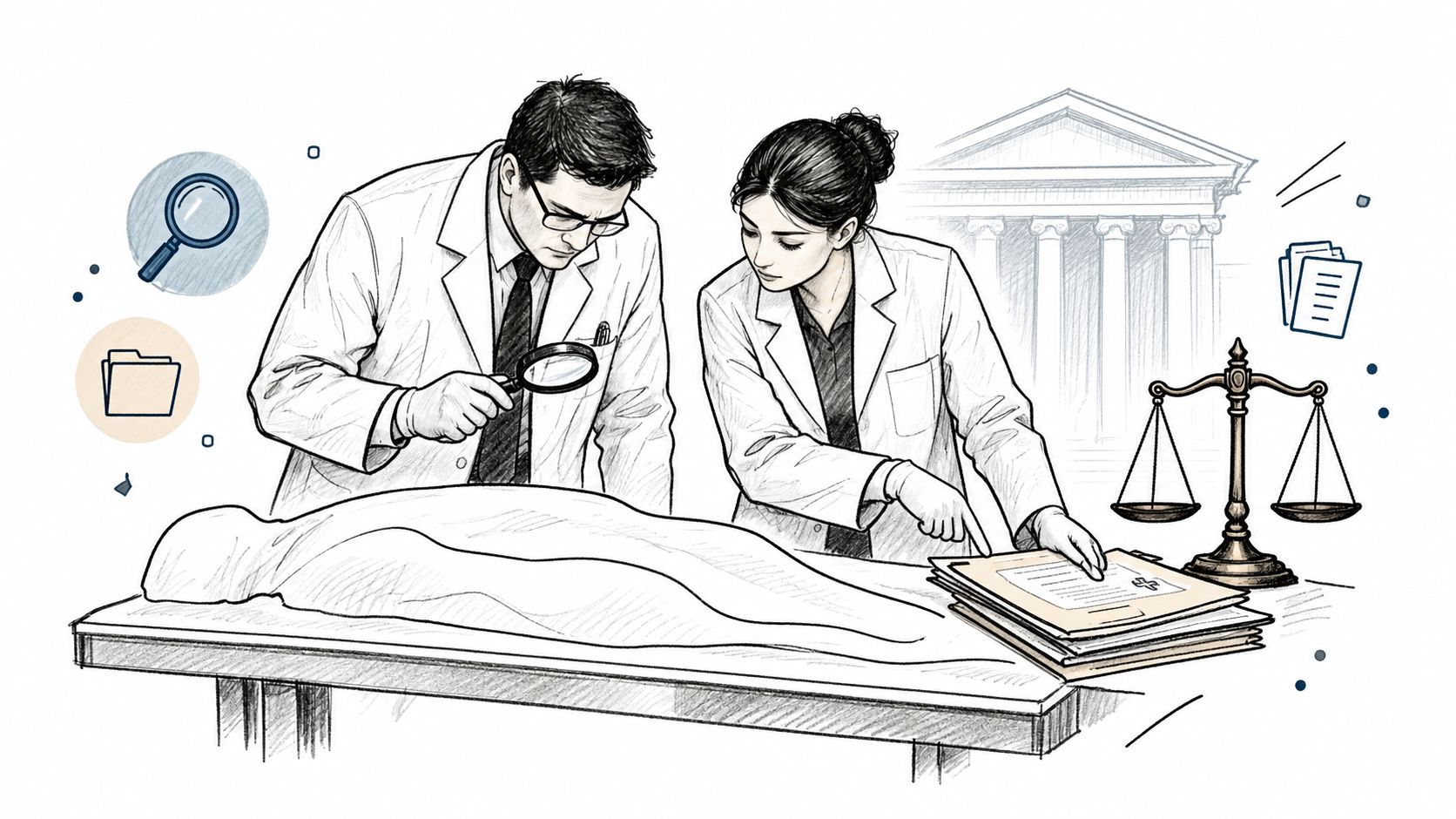
A family may receive a call after an unexpected death and hear that investigators must examine the location before an autopsy can begin. That order matters. The room, vehicle, residence, or outdoor area may contain information that changes how the body is examined, which tests are selected, and whether the final conclusion is natural, accidental, suicidal, homicidal, or undetermined.
Death scene investigation is a core public-safety and legal process, not a specialty reserved for criminal cases. In the United States, nearly 1 million deaths were referred to medical examiner and coroner offices in 2004, representing about 40% of all deaths that year. About 487,000 referrals were accepted for additional investigation, and the system handled investigations for roughly one in five deaths overall. These figures come from the Bureau of Justice Statistics report on medical examiner and coroner offices.
For families and attorneys, the practical lesson is straightforward. The quality of the final autopsy report depends partly on what happened before the body reached the examination room. Organizing medical records, contact information, photographs, and written questions can help families communicate clearly, including through tools that let them manage medical forms online.
Why the Scene Matters Before the Autopsy Begins
A relative may be told that a death investigation is underway while the family is still waiting for basic answers. Officials may be securing the location, speaking with witnesses, reviewing medications, or deciding whether the body requires an autopsy. At that stage, the family often focuses on the examination itself, but the scene work has already started shaping the questions the forensic pathologist must answer.
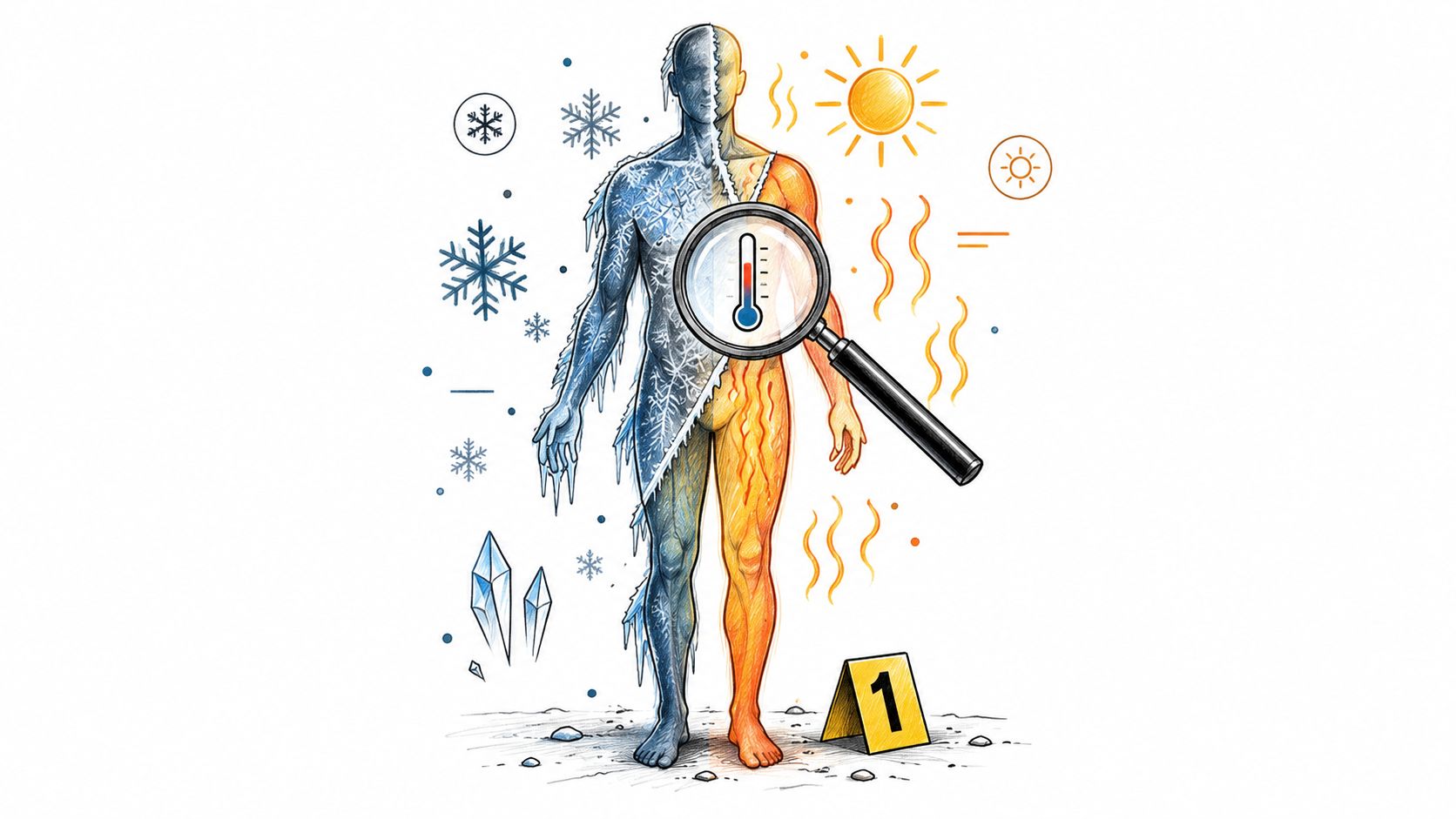
The scene preserves the earliest available account of what happened. The position of the body, nearby medications, blood or other biological material, signs of injury, environmental conditions, witness observations, and emergency medical notes can help distinguish between competing explanations. These details may also identify evidence that is fragile, temporary, or easily altered by movement, cleaning, weather, or ordinary access to the area.
A death scene investigation isn't a visual walk-through conducted for formality. It creates a documented record of the circumstances surrounding the death. Investigators compare that record with the medical history, external body findings, autopsy observations, toxicology, and other testing.
Practical rule: An autopsy examines the body. A death scene investigation examines the relationship between the body, the surroundings, and the reported circumstances.
Poor scene preservation can limit later conclusions even when the autopsy is performed carefully. Missing photographs, incomplete notes, unidentified evidence handlers, or unexplained changes to the location may prevent investigators from answering questions that could have been addressed during the first response.
Our board-certified forensic pathologists therefore treat scene information as part of the medical-legal record, not as background material to be reviewed only if a problem arises. Families and attorneys evaluating a cause of death investigation should ask whether the scene was documented, who attended, what was collected, and how the evidence was transferred before the autopsy began.
What a Death Scene Investigation Actually Involves
A death scene investigation is the structured examination of the location and circumstances surrounding a death. Depending on the jurisdiction, the work may involve a medical examiner's office, a coroner's office, a justice of the peace, law enforcement, forensic investigators, emergency personnel, and medical professionals.
The systems differ. A medical examiner system is medically led, while a coroner system may rely on an elected official who seeks medical assistance when needed. Texas uses justices of the peace and medical examiner systems, with authority and responsibilities defined by statute and local practice.
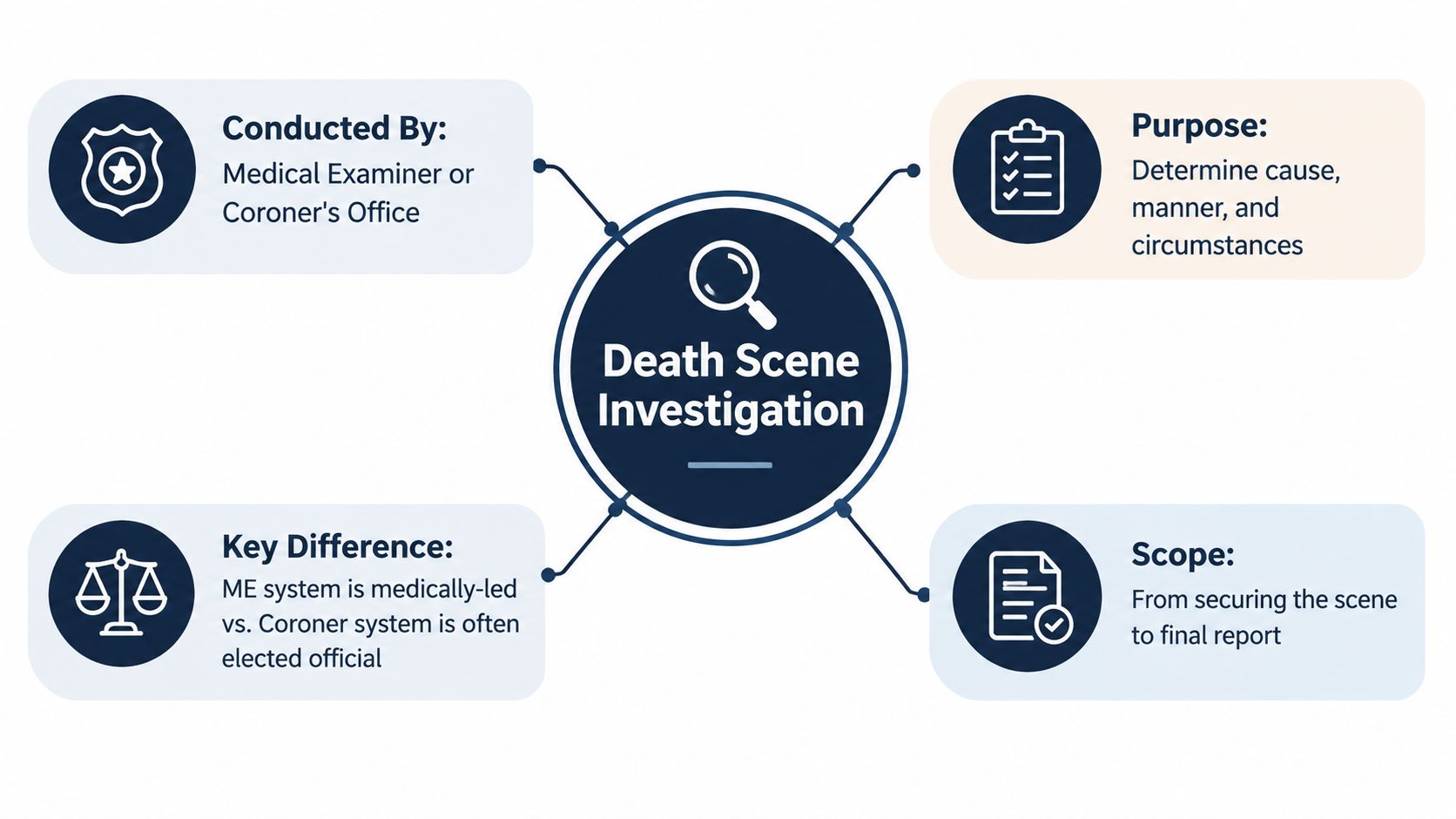
The main questions investigators ask
Investigators generally work to establish:
- What happened at the location: They document the body, surroundings, objects, conditions, and reported events.
- Who handled the scene or evidence: They identify responders, witnesses, family members, caregivers, and other people with relevant access.
- Which medical questions require examination: They gather history that may affect the autopsy or ancillary testing.
- How the death should be classified: The manner may be natural, accidental, suicidal, homicidal, or undetermined.
The scene investigation isn't the autopsy. It doesn't replace internal examination, toxicology, microscopy, radiology, or other studies when those are needed. It provides the circumstances that allow the forensic pathologist to interpret those findings accurately.
Medical examiner and director investigators directly attended the scene in 76% of 4,509 deaths examined in a four-year study involving two nationally accredited offices. That finding demonstrates how central direct scene attendance remains in offices that investigate non-hospital deaths. The historical development of medically informed investigation also reaches back to Maryland, where the first United States law requiring a medically trained physician to participate in a death investigation was passed in 1860. Both points are discussed in the forensic investigation overview.
How Investigators Document and Secure the Scene
The first responsibility is control. Investigators must know who is present, limit unnecessary movement, and protect the location from changes that could affect interpretation. National death-scene guidance emphasizes documenting the scene location and the investigator's arrival time, identifying custody for each item, preserving fragile or transient evidence first, and recording every transfer with the time, place, and responsible person. The National Institute of Justice death investigation guide provides this framework.
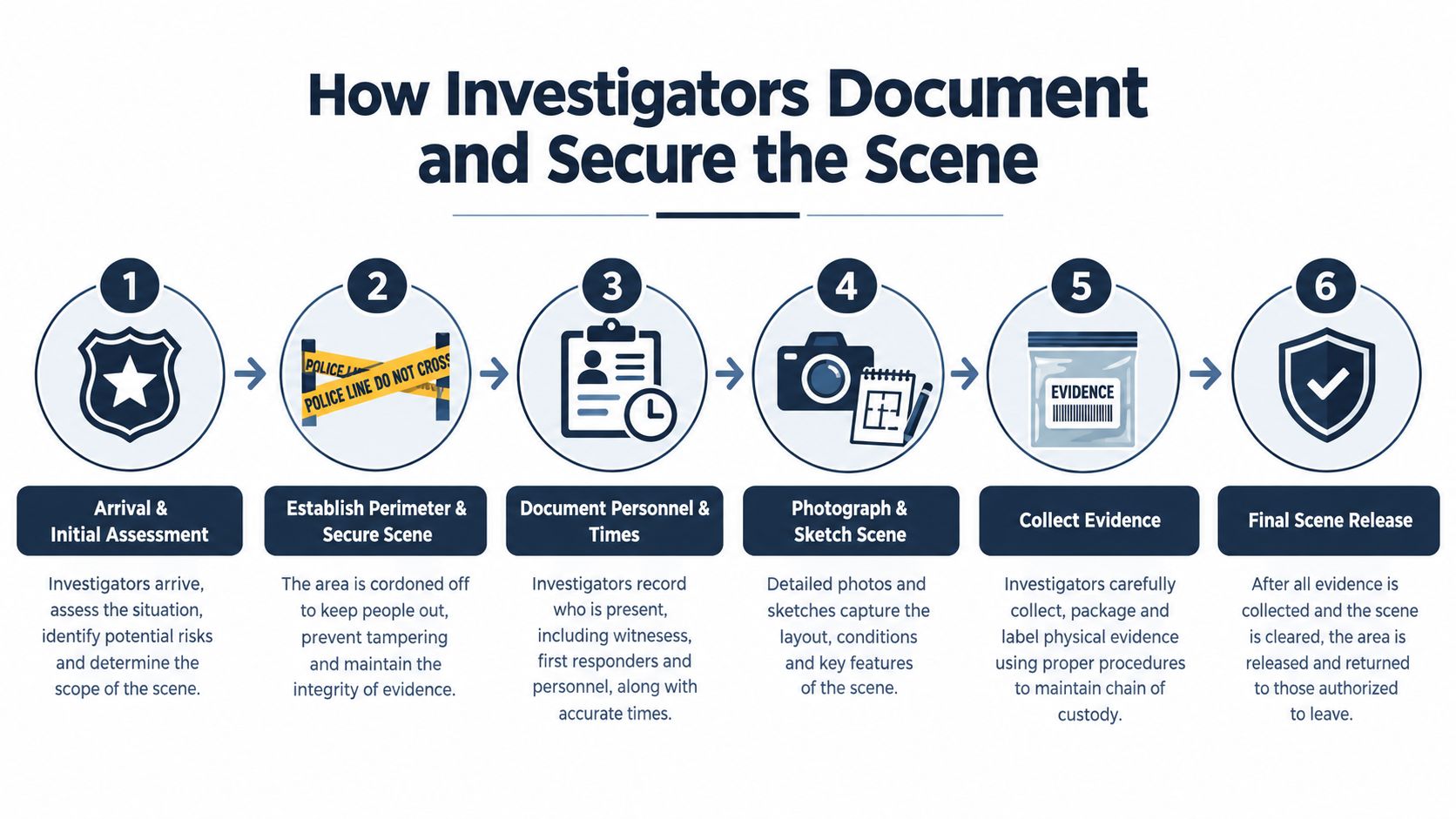
A defensible sequence
Arrival and initial assessment: The investigator records the location, arrival time, visible conditions, safety concerns, and the people already present. Emergency treatment may have changed the scene, and those changes should be identified rather than ignored.
Perimeter and access control: The responsible agency establishes a practical boundary and limits entry. A scene log should identify each person who enters and leaves, including responders, investigators, family members, and service personnel.
Personnel and time records: Notes should show who performed each task and when. This record helps separate firsthand observations from later reports and allows investigators to trace decisions.
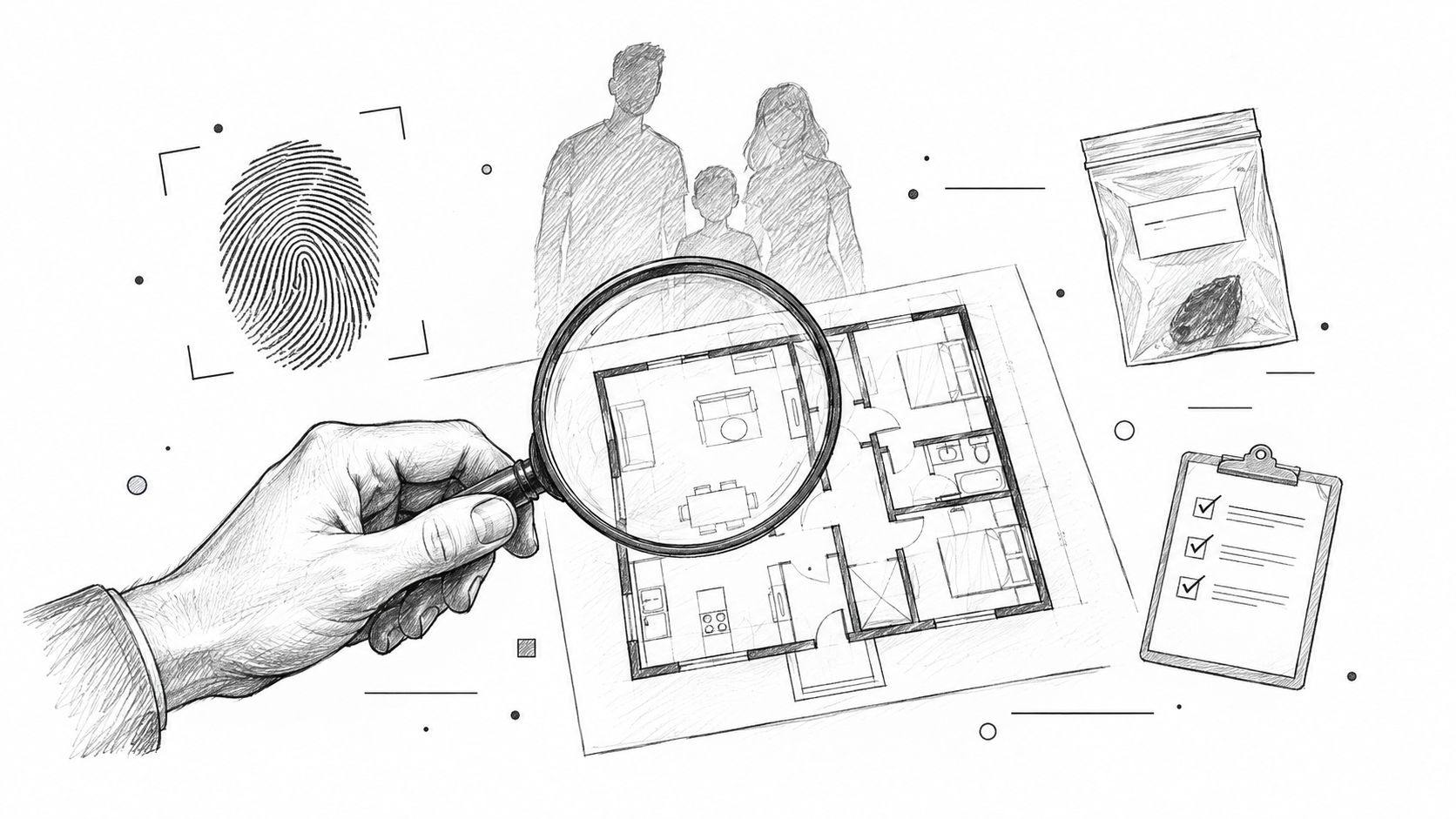
Photographs and sketches: Overview photographs show the location in context. Mid-range images connect objects to one another, while close-up photographs document specific evidence. Investigators should preserve original files and complete a photo log.
Evidence collection: Items are identified, packaged, labeled, and stored in a manner appropriate to their condition. Fragile evidence receives attention before evidence that can safely remain in place.
Scene release: The investigator records what was collected, what remained, who received the location, and when control ended. Releasing the scene without a clear record can create uncertainty later.
Why the chain of custody matters
Chain of custody means the documented history of an item from collection through storage, testing, transfer, and final disposition. It answers a simple question: who had control of this evidence at each stage?
Evidence handling is not complete when an item enters a bag. It is complete only when every transfer can be explained.
Contamination can happen through footprints, moved objects, unrecorded access, improper packaging, or missing digital files. Public reporting about the Epstein investigation described people trampling the scene and cameras failing to record because of a hardware problem, leaving investigators without ordinary DNA and video evidence. That example illustrates the type of early loss families and attorneys should ask about, without assuming that every compromised scene produces the same outcome.
A useful review includes the scene log, photographs, sketches, investigator notes, evidence inventory, transfer records, police reports, witness statements, paramedic notes, and available digital evidence. The forensic evidence collection guidance can help readers understand why each record matters.
How Scene Findings Shape the Autopsy and Final Report
The forensic pathologist doesn't interpret the body in isolation. Scene findings are assessed alongside the person's medical history, body examination, and ancillary studies. This combined review helps determine cause of death, mechanism of death, and manner of death.
The cause of death is the disease, injury, poisoning, or other condition that produced the death. The mechanism is the physiological process, such as respiratory failure or blood loss. The manner of death is the classification of the circumstances, usually natural, accidental, suicidal, homicidal, or undetermined.
The scene directs medical questions
A reported fall may lead investigators to compare the body's injuries with the height, surface, and position of the person. A medication concern may require toxicology to be interpreted with prescription history, pill counts, and witness accounts. An environmental exposure may require correlation between the location, ventilation, temperature, substances present, and postmortem findings.
The scene can also change the direction of the autopsy. A forensic pathologist may look more closely at particular injuries, request targeted toxicology, preserve samples for additional testing, or assess whether an apparently natural disease adequately explains the circumstances.
That doesn't mean scene observations determine the medical conclusion by themselves. They are one part of a larger evidentiary record. A body can show disease, but the scene may reveal that the disease doesn't explain the person's position, injuries, timing, or reported events. Conversely, an alarming scene may be consistent with an accidental or natural death after the medical evidence is reviewed.
When documentation has gaps
A well-documented scene strengthens the final report because it lets the pathologist explain how observations fit together. An incomplete scene record may not make a conclusion impossible, but it can narrow what the evidence supports and leave some questions unresolved.
Our board-certified forensic pathologists review available scene materials before forming an opinion. The final report should distinguish documented facts, medical findings, laboratory results, and professional interpretation. It should also identify meaningful limitations rather than implying certainty that the evidence cannot support.
Common Misconceptions About Death Investigations
An autopsy can answer every question
An autopsy is powerful, but it isn't a substitute for scene information. Some causes of death are established through internal examination, while others require toxicology, medical records, witness accounts, environmental information, or digital evidence. When the scene has been altered or poorly documented, the pathologist may have less information available for interpretation.
Every death requires a full autopsy
Not every investigation requires a complete internal examination. Texas law allows a limited autopsy involving blood, fluid, tissue, or organ sampling when a full autopsy isn't necessary to determine the cause of death or whether a crime occurred. The appropriate decision depends on the facts, jurisdiction, available history, and statutory authority.
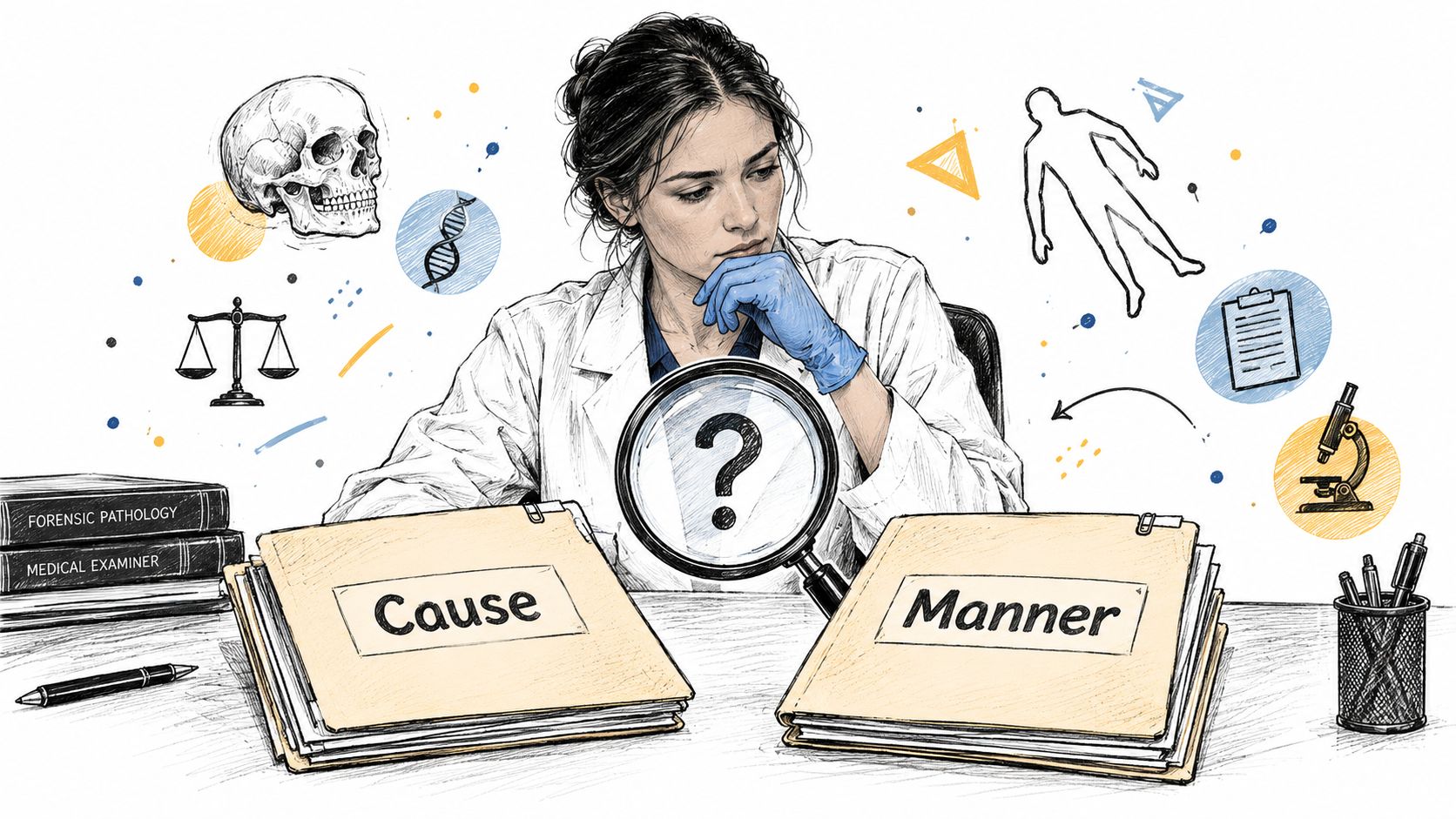
Cause and manner mean the same thing
They don't. A heart disease may be the cause of death, while the manner is natural. A drug toxicity may be the cause, while the manner depends on the circumstances and evidence surrounding the exposure. These terms answer different questions and shouldn't be used interchangeably.
Private autopsies are only for suspicious deaths
Families may seek an independent autopsy after a natural death, a sudden death, an unexpected medical outcome, or a disagreement with an existing report. Attorneys may request a second opinion autopsy review when the medical records, scene information, or official findings leave a material question unresolved.
A private examination doesn't automatically replace the county's investigation. It offers an independent medical review based on the remains, records, photographs, laboratory results, and other materials legally available to the examining practice.
Texas Laws Governing Death Investigations and Autopsies
Texas death investigations involve statutory responsibilities assigned to medical examiners, justices of the peace, prosecutors, and other officials. Families should distinguish the authority that controls the official investigation from the separate services available for an independent review.
Under Texas Code of Criminal Procedure Article 49.25, when a medical examiner determines the cause of death beyond a reasonable doubt from the investigation, the examiner must file a report stating the cause with the appropriate district attorney, criminal district attorney, or county attorney. If an autopsy is needed, it must be performed immediately by the medical examiner or an authorized deputy. The statute also permits a limited autopsy involving blood, fluid, tissue, or organ samples when a full autopsy isn't necessary to determine cause or whether a crime occurred. A detailed findings report is required after completion. These statutory provisions are summarized in the Texas autopsy requirements guide.
Justice of the peace authority
Texas gives the justice of the peace broad discretion in death investigations. The justice of the peace may seek the opinion of a county health officer or physician about whether an autopsy is needed to determine or confirm the nature and cause of death. Texas training materials also explain that an autopsy or more limited testing may be used to determine cause, manner, or identity, and that the justice of the peace generally decides whether to order an autopsy, subject to statutory exceptions. The Centers for Disease Control and Prevention Texas coroner-law resource describes this framework.
Records and special infant provisions
Article 49.25 requires the medical examiner to keep complete records for each investigated death, including the person's name if known, where the body was found, the date, and the cause and manner of death. The medical examiner must issue a death certificate, and the full autopsy report and detailed findings become part of the record. Copies must be promptly delivered to the appropriate prosecutor when further investigation is advisable. The Texas statute on medical examiner records contains these requirements.
Under Texas Health and Safety Code Section 673.002, the sudden or unexplained death of a child 12 months old or younger must be reported immediately to the justice of the peace, medical examiner, or another proper official. The official must inform the parents or legal guardian that an autopsy will be performed. The state reimburses the county $500 when the primary cause of death is sudden infant death syndrome. The Texas Health and Safety Code provision provides the statutory details.
Texas Funeral Service Commission requirements and Texas Health & Safety Code Chapters 711, 716, and 651 also matter to funeral, disposition, and professional-service issues. Specific legal questions should be directed to a qualified Texas attorney.
When to Seek an Independent Private Autopsy in Texas
An independent private autopsy may be appropriate when the official investigation doesn't answer an important question, when the medical examiner declines an autopsy, or when an attorney needs an independent forensic pathology opinion for litigation. It may also help when the family wants a second review of an existing report, photographs, toxicology, medical records, or other evidence.
The decision should be made promptly because disposition, embalming, cremation, and the passage of time can affect what examination or testing remains possible. Families should ask whether the remains are still available, which agency has legal custody, what records exist, and whether an independent pathologist can review the case before disposition.
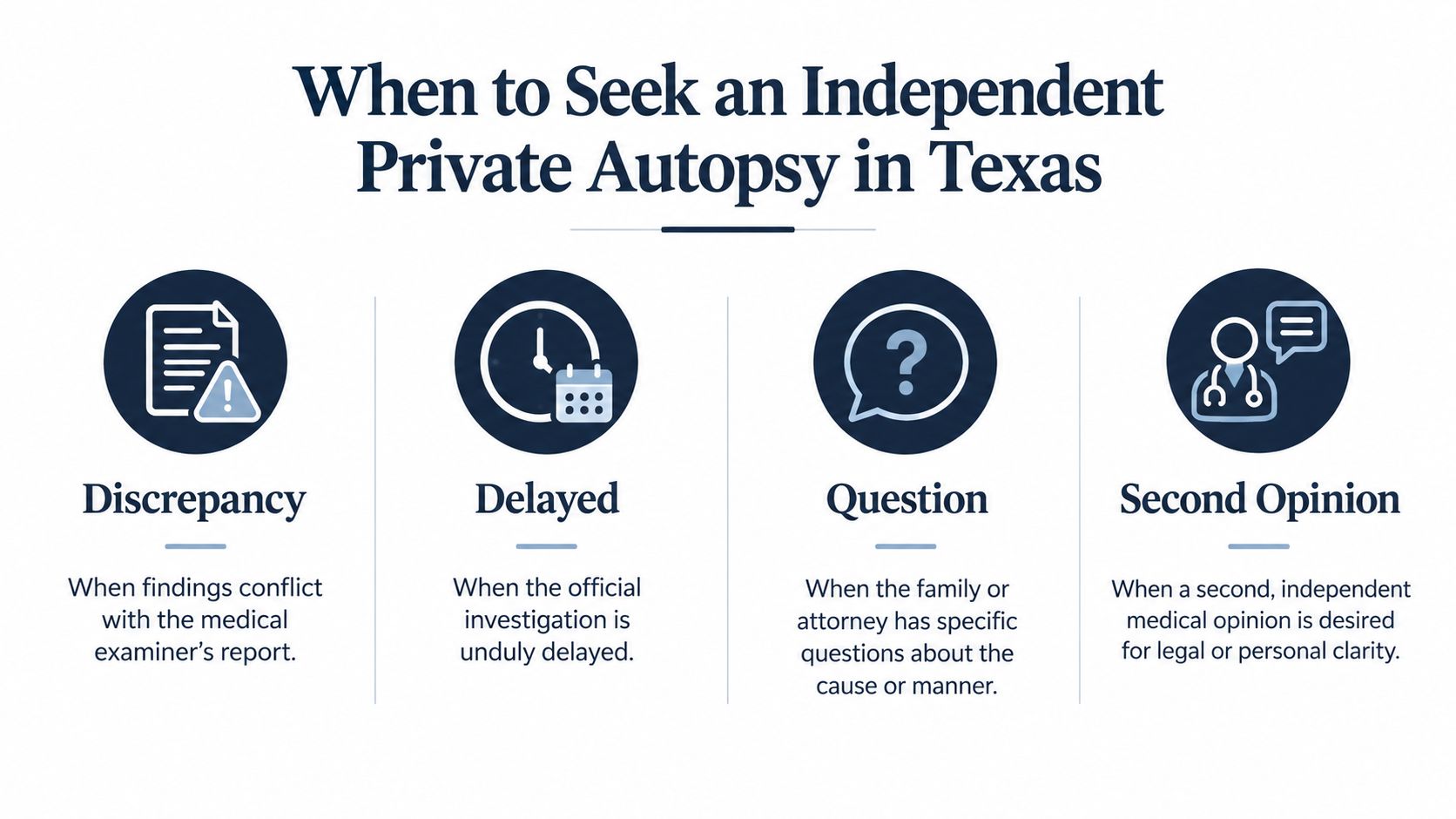
What the service should provide
A responsible private forensic pathology service should explain its role without promising a particular conclusion. Families and attorneys should expect:
- Qualified examination: Every examination is performed by a forensic pathologist certified by the American Board of Pathology.
- Independent analysis: The opinion should be based on medical findings and available evidence, not on the desired outcome of a family member or legal party.
- Documented custody: Transportation, storage, examination, retained samples, and transfers should be recorded.
- Clear reporting: The written report should explain cause, mechanism, manner when supportable, findings, testing, and limitations.
- Direct communication: Families and attorneys should be able to ask the examining team how records and evidence affect the opinion.
- Transparent logistics: Texas Autopsy Services offers flat-rate, all-inclusive pricing and in-house licensed transport across all 254 Texas counties, with direct communication from the team.
A private autopsy and a county forensic autopsy aren't identical services. The county or justice of the peace controls the official medicolegal investigation, while a private practice provides an independent examination or review under an arrangement with the authorized next of kin or legal representative. The two records may be compared, and the private pathologist may identify areas requiring clarification, additional testing, or testimony.
Texas Autopsy Services is one option for families, attorneys, healthcare professionals, and counties seeking private autopsy services in Texas, second-opinion review, or county forensic autopsy support. The practice operates from Elgin, serves statewide, and reports findings in a court-admissible format when the evidence supports that conclusion.
Questions Families and Attorneys Frequently Ask
How long does a death investigation take?
The time depends on scene access, agency records, medical history, toxicology, histology, identification issues, and other testing. Most cases within 24–48 hours may be completed when the examination and available materials support that pace, but no responsible practice should guarantee a result before the necessary evidence is reviewed.
Can a family request a private autopsy if the county declines?
A family may be able to arrange an independent examination, but authorization, custody, disposition status, and applicable Texas requirements must be addressed first. Contact the practice promptly, before embalming or cremation if possible, so the available options can be explained.
What does a second-opinion review involve?
Our team may review the official autopsy report, photographs, toxicology, histology, medical records, scene materials, and other relevant documents. A review can support the existing conclusion, identify limitations, or recommend additional evaluation. It doesn't guarantee a different opinion.
How can a family obtain the official report?
The appropriate medical examiner, justice of the peace, prosecutor, or records office controls access to official records. A Texas attorney can help determine which agency holds the materials and whether additional requests are appropriate.
When a death leaves your family or legal team with unanswered questions, direct communication can help clarify what evidence still exists and which review is possible. Texas Autopsy Services provides independent forensic pathology examinations and second-opinion reviews with licensed transport, documented chain of custody, and plainspoken communication throughout the process. Visit Texas Autopsy Services to contact the team and discuss the circumstances confidentially.