August 6, 2026 · Texas Autopsy Services
Unattended Death Autopsy: What Families & Attorneys Need
Understand the unattended death autopsy process in Texas, from chain of custody to toxicology. Clear guidance for families and attorneys.
On this page
A family can do everything right after a quiet loss and still feel unprepared for the paperwork, transport, and legal steps that follow an unattended death. When someone is found dead at home without a treating physician present, the question is rarely just medical. It becomes a matter of documentation, jurisdiction, consent, and whether a forensic exam can answer the cause-of-death question that no living clinician can certify.
Families and attorneys often need clear guidance fast. The process can involve law enforcement, a medical examiner, a justice of the peace, a funeral home, and sometimes a private forensic pathologist. Texas Autopsy Services works in that space with board-certified forensic pathologists, full chain-of-custody handling, and direct communication, so the next steps are easier to understand when everything already feels difficult.
When a Loved One Dies Alone
A daughter enters her parent's home, notices the silence, and realizes something is wrong before she fully understands what she's seeing. The first phone call usually goes to 911, then to other family members, and then to the funeral home or attorney once the immediate scene has been addressed. In that moment, the family is dealing with grief, but the law is already asking a separate question, who can certify the death and what evidence has to be preserved.
An unattended death is not only a personal loss, it's also a death investigation. If no doctor can sign the death certificate with a reasonable medical basis, the case usually moves into forensic review. That's why documentation matters so much in the first few hours, because the body's condition, the room, medications, and visible injuries can all affect later findings.
Practical rule: if the death happened without direct medical supervision and no treating physician can certify it, treat the situation as a formal investigation until the jurisdiction says otherwise.
Families sometimes look for estate guidance at the same time they're handling the death investigation. That's sensible, because the legal and medical pieces move together. For people trying to understand how death, authority, and succession can overlap, the 2026 Texas Estate Code insights from The Law Office of Bryan Fagan can provide useful context on related probate issues.
What matters most at this point is not whether foul play seems likely. It's whether the death occurred in a setting where the medical cause is unknown and the scene has to be documented before the body is moved. That distinction decides whether the case stays a routine death certificate matter or becomes an unattended death autopsy question.
What Qualifies as an Unattended Death
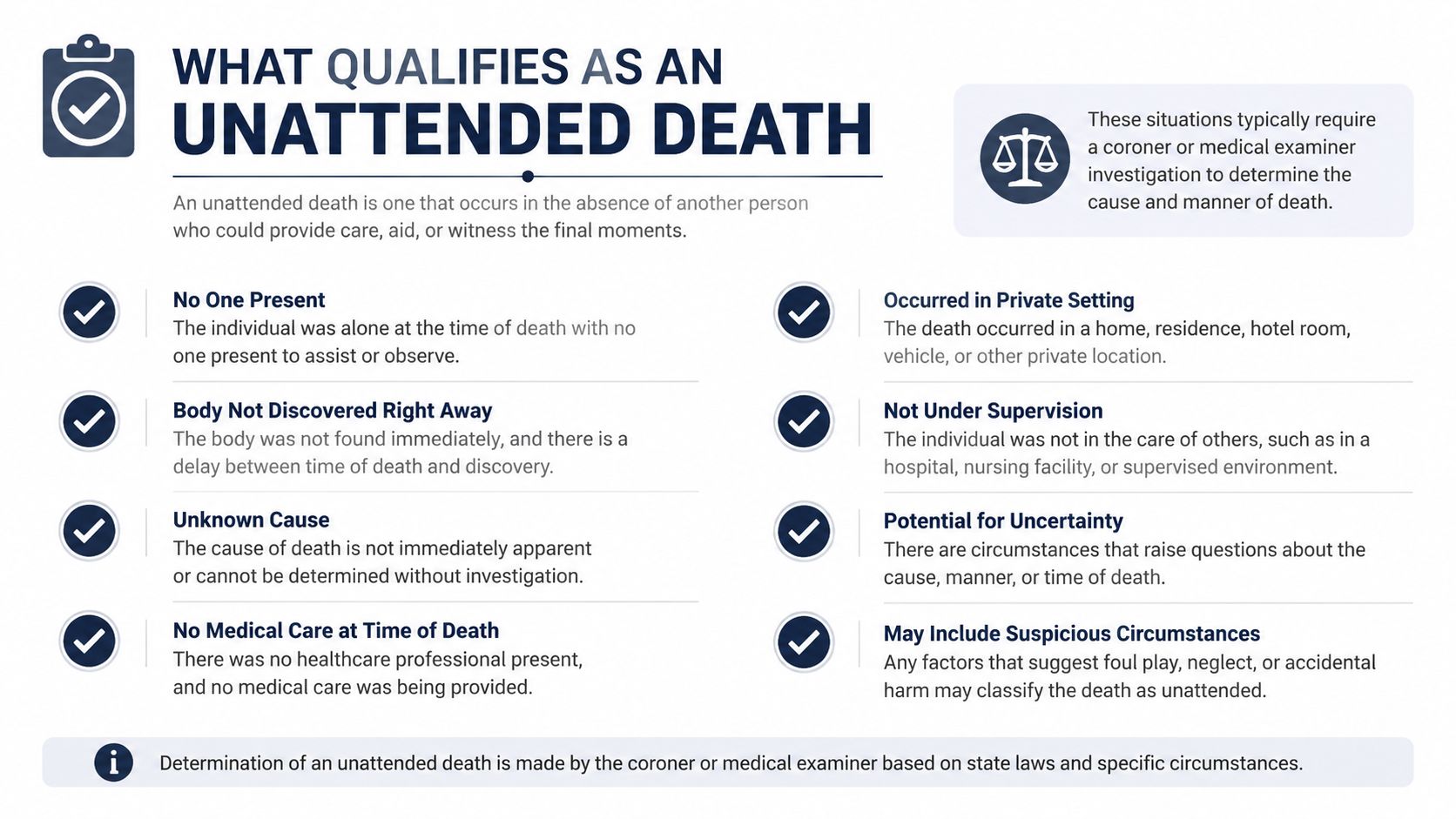
An unattended death is a death that occurs without a treating clinician present to certify the cause, or in circumstances where the cause can't be signed out from the available medical record. That often includes a person found at home alone, but it can also include deaths in other settings where the history is incomplete or the circumstances are unexpected. Hospice death is different, because a physician can usually certify a natural death when the condition and decline are known.
Texas law doesn't treat every natural death the same way. In many cases, deaths that are sudden, unexplained, suspicious, or otherwise reportable are handled by a medical examiner or coroner system, and many jurisdictions treat unattended deaths as cases that need investigation. In Texas, a forensic autopsy may be required when the death is violent, sudden and unexplained, suspicious or unusual, involves a prison or other institution, or is otherwise deemed necessary to determine cause and manner of death. Texas autopsy jurisdiction guidance summarizes those circumstances clearly.
Cause of death and manner of death
Two terms come up again and again. Cause of death is the medical reason the person died, such as a disease, injury, or poisoning. Manner of death is the category used to describe how that cause fits the legal and investigative picture, such as natural, accident, suicide, homicide, or undetermined.
Families often assume that a death with no obvious trauma won't need forensic review. That assumption can be wrong. The evidence shows that autopsy can change the medical conclusion in a meaningful share of uncertain deaths, so a death that looks ordinary from the outside may still need internal examination and testing. The medical literature also notes that a small residual number of cases remain medically unascertained even after careful workup, which is why the process is about evidence, not guesses.
If you're trying to decide whether your situation falls into this category, look at the facts first. Was there a treating doctor who knew the decedent's condition? Was the death expected from a known illness? Was the person found alone, with no one present to witness the final events? Those questions usually determine whether the case goes to a forensic exam or to a standard physician certification.
The Autopsy Process from Start to Finish
An unattended death autopsy begins long before the first incision. Investigators document the scene, photograph the body and surroundings before movement, and preserve clothing and personal effects in a controlled way. That documentation matters because the medical findings only make sense when they're matched to the scene record and the chain of custody.
Transport, receipt, and evidence control
Once authorized, the body is transported to the facility and received under documented custody. The body is assigned a case number, stored securely, and kept ready for examination. At every transfer point, the record needs to show who had the body, when it changed hands, and what condition it was in.
The National Institute of Justice emphasizes preserving the body and scene record, including photographs before movement and a documented chain of custody through transport and receipt at the facility. That protects both admissibility and interpretation. In practical terms, it means the later report can be trusted to reflect what happened, not a gap in handling.
External exam, internal exam, and sampling
A forensic autopsy is more than a visual check. Standard practice includes an external examination, internal dissection, and retention of tissue, body fluids, and other samples for ancillary testing such as toxicology and histopathology. Cause-of-death conclusions often depend on how the gross findings line up with microscopic, chemical, and microbiological evidence. The medical reference text on autopsy practice explains that these components are part of normal forensic method, not optional extras. Autopsy practice overview describes that standard scope.
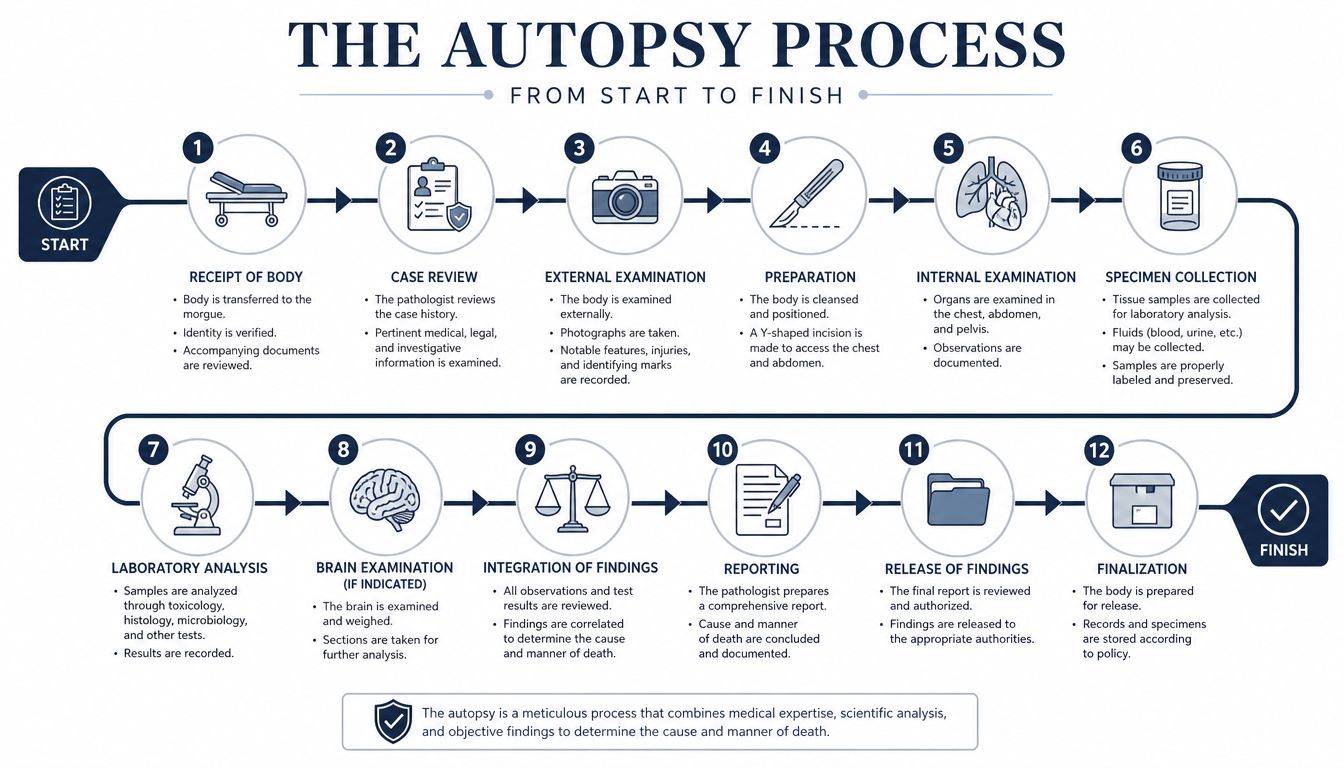
What families usually receive
Families usually want to know two things, how long it will take and what they'll get back. Timelines vary with the condition of the body, the complexity of the case, and whether additional tests are needed. The final package typically includes a written report, and in many cases, results from toxicology or other ancillary studies are added later.
A detailed walkthrough of the stages can help attorneys and families understand where the delays come from, especially when more than one lab is involved. A practical overview is available in these steps of autopsy, which aligns with the way forensic facilities document and complete the case.
Chain of custody matters because every gap creates a question later. If a body, sample, or personal effect isn't tracked carefully, the medical findings can be harder to explain in court or to the family.
Texas Autopsy Services performs every examination through a board-certified forensic pathologist, and our team handles transport and reporting with the same custody standards that support court-admissible work. In a private case, that can mean the family has a clearer line of communication while the examination is still underway.
When Autopsy Findings Remain Inconclusive
Families often expect autopsy to produce a single clean answer. Sometimes it does, and sometimes it doesn't. That isn't the same thing as failure. Even a well-conducted forensic examination can end with an inconclusive or undetermined result, especially when the body is decomposed, medical history is incomplete, or toxicology and microscopic findings don't align neatly.
A classic study of uncertain deaths found that the cause differed in 30% of cases after autopsy and chemical analysis, while suspected acute myocardial infarction was confirmed in only 50% of cases, and malignancy was missed in 4% of all cases study summary. More recent forensic literature still recognizes a residual gap, with well-conducted autopsies leaving 2–5% of cases without a definitive cause of death. That range is important because it shows the limits of the method, not a lack of care.
Why uncertainty happens
Some deaths are hard to classify because the body has changed after death, the person had serious underlying disease, or multiple possible causes overlap. Toxicology can take time, and some findings only make sense when paired with pathology or microbiology. The medical literature also notes that toxicology, microbiology, and genetic testing may be needed before a death is labeled unascertained. What inconclusive means on an autopsy gives a plain-language explanation of that outcome.
Families should hear this clearly, an inconclusive autopsy is sometimes a medically valid conclusion. It means the available evidence didn't support a defensible final cause, not that the examiner stopped too soon. Attorneys and county officials need that distinction because the legal record has to match the medical record, even when the medical record ends with uncertainty.
What can happen next
Additional testing may still be useful after the primary exam. Specialized toxicology, genetic analysis, or microbiology can sometimes resolve a question that gross examination alone can't answer. In a second-opinion setting, the new pathologist may review the original report, slides, photographs, and available records to see whether the conclusion holds or needs refinement.
Legal Authority and Consent Requirements
Autopsy authority in Texas depends on the jurisdiction of the death and who is legally authorized to act. In some cases, government authorities can order an autopsy without family agreement when the death falls under medical examiner or coroner jurisdiction. In other cases, if no autopsy has been ordered by the medical examiner, a physician can't perform one without consent from the person assuming custody of the body for burial purposes, and that person must be at least 18 years old Connecticut General Assembly summary.
Who can consent and who can order
Texas law can give government authorities the power to order an autopsy in some circumstances even without next-of-kin approval autopsy rights overview. That's the key point families miss. Consent from the family matters in private work, but it doesn't always control a case that falls under statutory medical examiner or coroner jurisdiction.
A person with custody of the body for burial purposes may include a parent, spouse, child, guardian, next of kin, friend, or another legally responsible person, depending on the governing framework. That person's authority is limited by law, and the order of priority can matter when relatives disagree. Families trying to resolve those questions often benefit from a clear consent workflow, and automating client consent forms can help explain how structured intake reduces confusion while the legal decision is being made.
Why jurisdiction matters in Texas
Jurisdiction can vary by county, which is why a justice of the peace may be involved in one case while a medical examiner handles another. The practical issue is simple, the person making the order has to have legal authority to do so, and the body has to stay within a defensible custody trail. If the county has already taken jurisdiction, a private request doesn't override that process.
Families still have options. In many situations, they can request a private autopsy or second opinion after the county case is complete, especially if they need a more detailed explanation for litigation, estate administration, or peace of mind. The legal question isn't whether anyone cares enough to ask. It's who has authority at each step and what record supports the decision.
For a deeper breakdown of the request process, see who can request an autopsy.
Private Autopsy Services Versus County Examinations
County examinations and private autopsies both seek the truth, but they usually serve different needs. A county medical examiner or coroner may handle reportable deaths as part of public duty, while a private autopsy is requested by the legal next of kin or another authorized party to clarify cause of death, support civil claims, or obtain a second opinion.
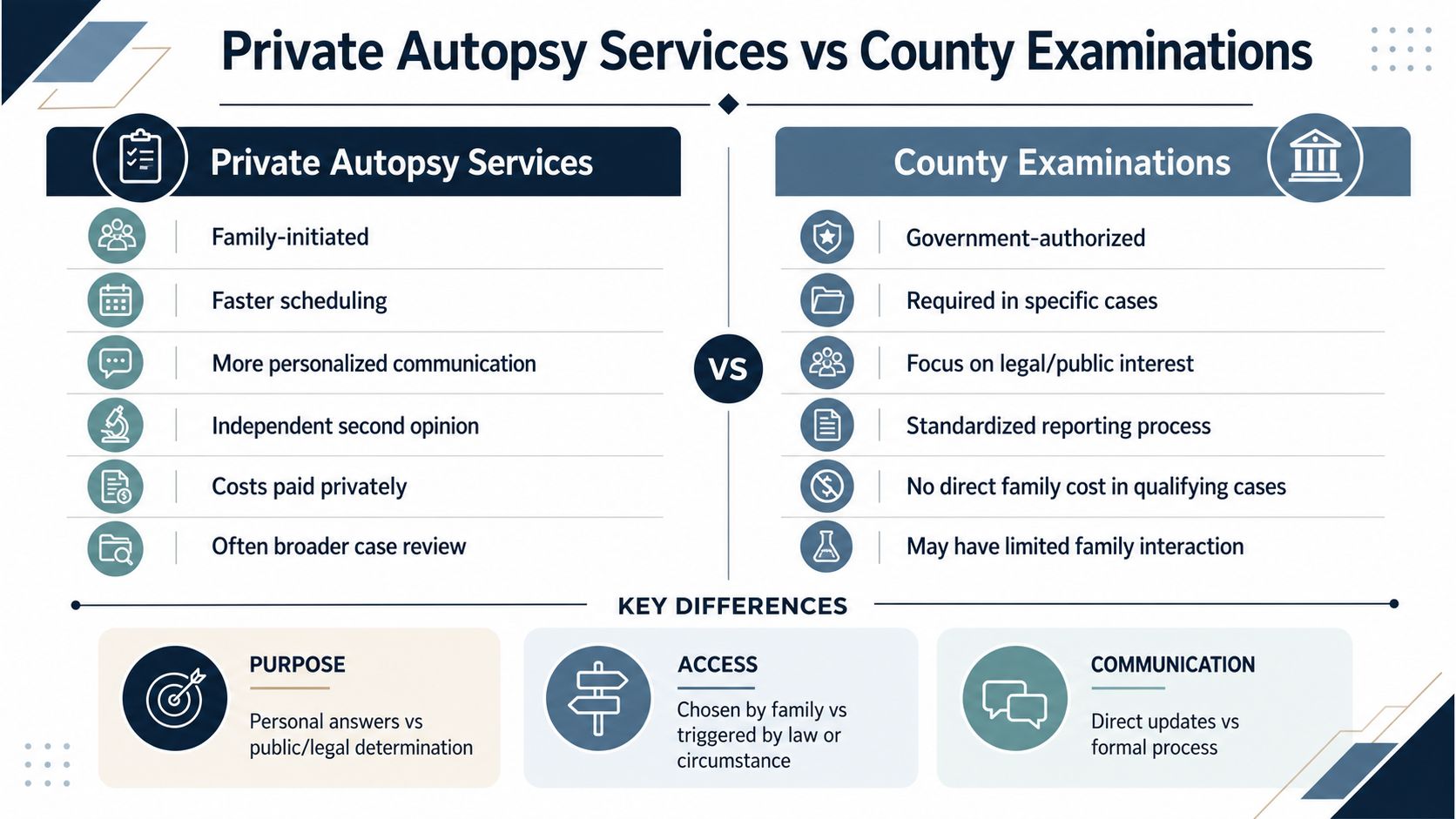
What the family gets in each path
A county case often begins with statutory reporting and ends with a public authority's findings. Communication may be limited by workload and legal process. A private case allows the family or attorney to coordinate directly with the forensic pathologist, ask for specific focus areas, and often receive more personalized communication about testing and reporting.
A private examination can be useful when a family needs a second opinion on a county report, especially in a contested estate, insurance dispute, or wrongful death matter. It can also help when the family wants a more detailed review of prior records, slides, or imaging. In Texas, Texas Autopsy Services provides that kind of independent forensic review, along with in-house transport and direct case coordination.
Logistics, admissibility, and practical limits
The practical side matters as much as the medical side. The body has to be transported, the custody trail has to stay intact, and funeral arrangements may need to wait until the examination is complete. Private reports can be used in legal proceedings when the documentation supports the methodology and handling, but the final weight of the report always depends on the facts and the court's rules.
One difference families feel immediately is communication. With a private service, they usually know who is handling the case and how the information is moving. That can reduce uncertainty during a very difficult time. It doesn't change the medical standard, but it does change the experience of getting to the answer.
Answers to Common Questions from Families and Attorneys
Can we still request a private autopsy after the county has the body?
Often, yes, if the body is available and the legal authority to release it is in place. The timing depends on jurisdiction, custody, and whether additional testing has already been done by the county.
What happens to personal effects?
They should be documented and maintained with the same chain-of-custody care as the body whenever they are relevant to the investigation. Clothing, medications, and other items can matter when cause-of-death questions involve overdose, injury, or environmental factors.
Can cremation still happen after an autopsy?
Usually yes, once the examination and any needed testing are complete and the death certificate or release process is finished. If a second opinion or additional samples are anticipated, the cremation decision should wait until those needs are clear.
How do attorneys get the report for litigation?
They usually need a proper authorization and a secure way to receive the records. A practical guide to handling protected records is available in the HIPAA fax guide 2026 from SendItFax, which is helpful when legal teams are moving medical documentation quickly and securely.
Does decomposition make the exam useless?
No, but it can limit what the pathologist can conclude. The findings may still answer important questions, even if the final cause remains uncertain or needs to be stated with caution.
Families also ask about faith and culture. Those concerns matter and should be discussed early, but they don't always stop a forensic exam when the law requires one. Attorneys should treat that as a jurisdictional issue, not a casual preference.
If you need a private autopsy, a second-opinion review, or clear guidance after an unattended death, Texas Autopsy Services can help coordinate the next step with care and precision. We serve families, attorneys, and county officials across Texas, and we keep the process direct, documented, and respectful. Visit Texas Autopsy Services to speak with our team about the case and the options available.