July 7, 2026 · Texas Autopsy Services
Forensic Fungal Identification in Autopsies
Discover forensic fungal identification in autopsies. Learn about specimen collection, molecular testing, and its significance in post-mortem analysis.
On this page
- The Unseen Factor in Cause of Death Investigations
- Ensuring Accuracy from the Start Specimen Collection
- Histology and Special Stains The First Look
- Culture and Molecular Methods Identifying the Culprit
- Interpreting the Results Correlation vs Causation
- Timelines and When to Consider Further Testing
- Frequently Asked Questions About Fungal Identification
What Families Should Know About Fungal Identification in Autopsies
- Fungal identification can matter in a private autopsy when infection may have caused death, contributed to death, or appeared only as an incidental finding.
- A reliable answer depends on careful specimen collection, microscopic review, and sometimes culture or molecular testing.
- Every examination is performed by a forensic pathologist certified by the American Board of Pathology, which is essential for medically sound and legally defensible findings.
- A positive fungal result doesn't automatically prove causation. The full case context matters.
- In Texas, a final private autopsy report is typically 6 to 8 weeks, and cases needing specialty studies may take 8 to 12 weeks or longer according to independent autopsy turnaround information in Texas.
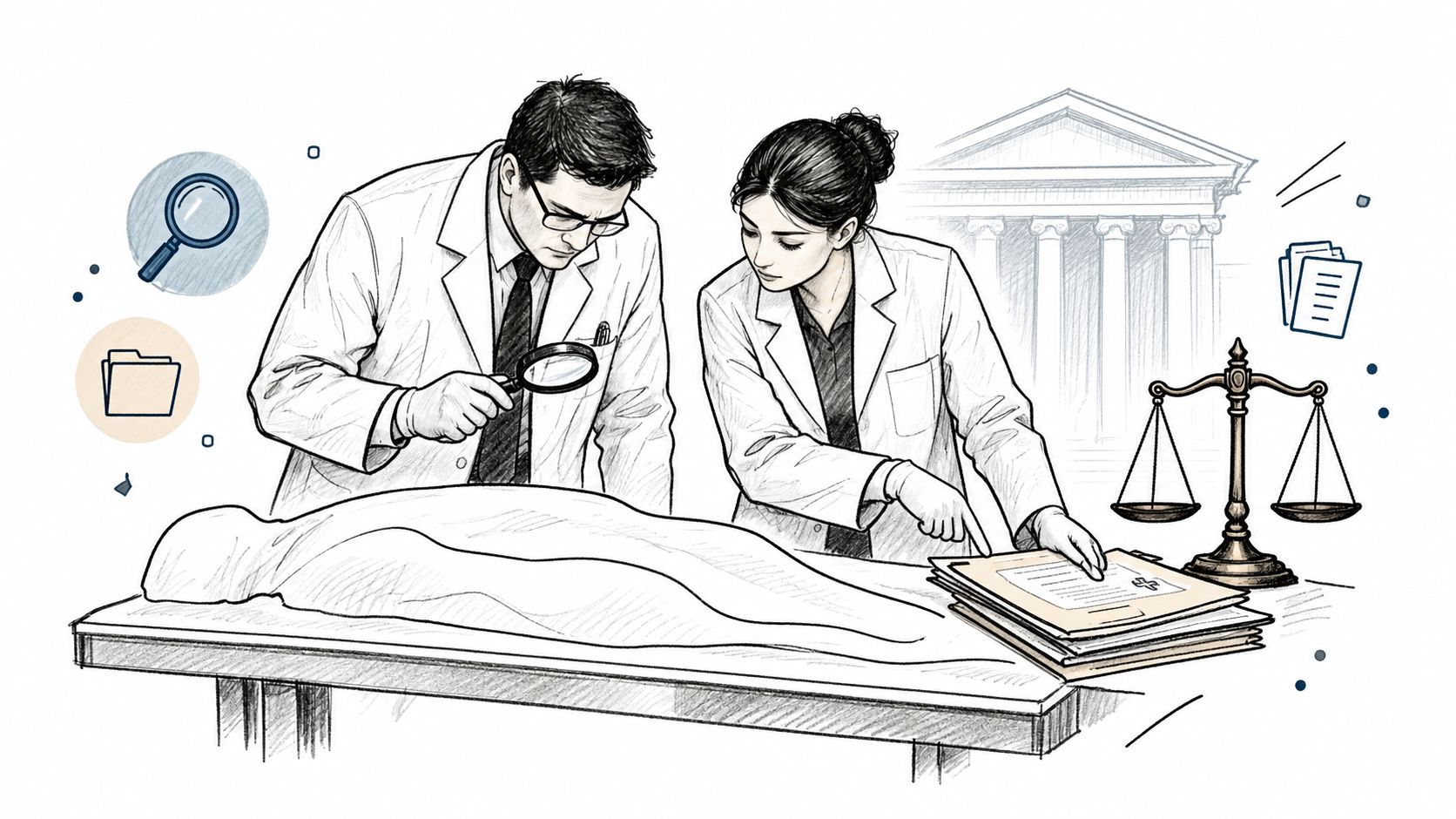
A family may come to us after an unexpected death with a difficult concern. The hospital record mentions infection, the death certificate language feels incomplete, and an attorney needs to know whether a missed diagnosis, an opportunistic infection, or a natural disease process played a role. In some of these cases, the answer turns on something too small to see without a microscope.
Fungi can complicate death investigation in ways that aren't obvious at first glance. They may produce a severe invasive infection, they may take advantage of a weakened immune system, or they may be present without causing the death. That distinction matters to families, to counsel, and to any cause of death investigation that needs to stand up to scrutiny.
The Unseen Factor in Cause of Death Investigations
Why fungi matter in death investigation
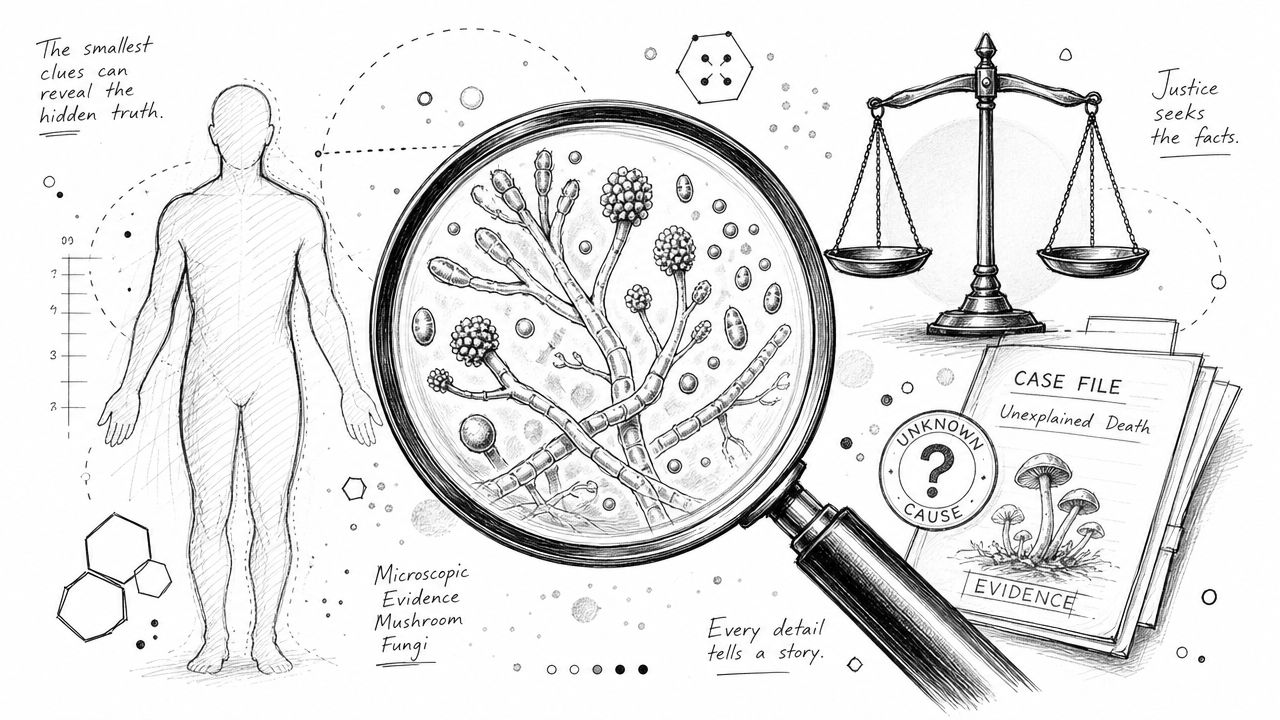
Fungal disease often receives less public attention than bacterial or viral illness, but the burden is substantial. In the United States, fungal diseases are associated with approximately 7,300 deaths and 130,000 hospitalizations each year, with an estimated total national cost of $19 billion, according to the CDC's fungal disease statistics. That scale helps explain why a careful postmortem review may need to include fungal identification when the medical history points in that direction.
In a forensic setting, we don't stop at finding an organism. We need to determine its role. A fungus in lung tissue may reflect a serious invasive process. The same finding in a different setting may reflect contamination after death or a harmless surface colonizer. Families are often told a fungus was "present," but that phrase alone doesn't answer the legal or medical question.
Practical rule: Presence is not the same as causation. A medically sound opinion requires context, tissue findings, and careful interpretation.
Primary cause, contributing factor, or incidental finding
In this context, forensic pathology and clinical pathology intersect. We look at the body itself, the organs, the tissue slides, and the available medical records. Then we ask a narrow question with broad consequences: did the fungal process cause death, contribute to death, or have no meaningful role?
A cause of death is the disease or injury that started the fatal sequence. A manner of death is the legal classification, such as natural, accident, suicide, homicide, or undetermined. If fungal disease is involved, the manner is often natural, but the analysis still has to be rigorous.
A concerned family member may understandably focus on one lab result. An attorney may focus on whether earlier treatment could have changed the outcome. Our field has to address both concerns without overstating what the evidence can prove. That's especially important when the organism is microscopic, the symptoms before death were non-specific, and the records contain competing explanations.
Ensuring Accuracy from the Start Specimen Collection
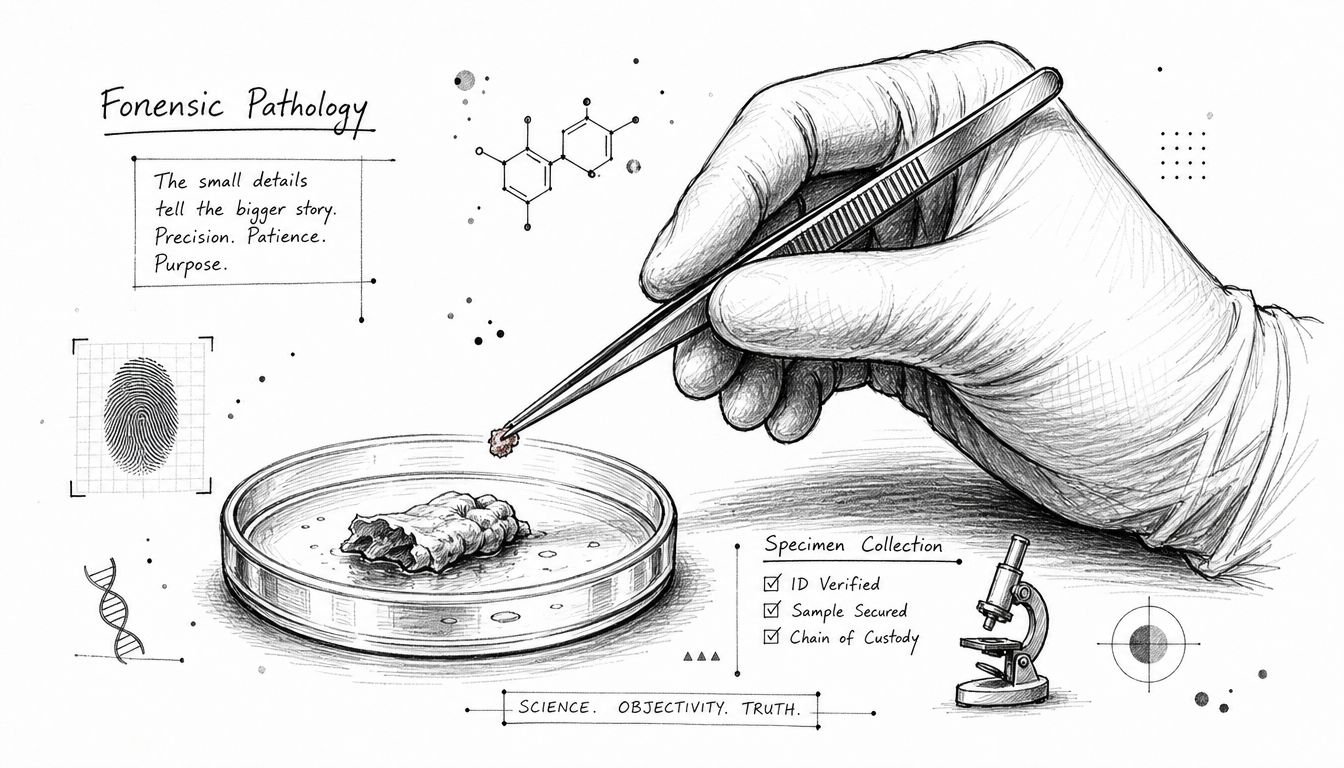
What chain of custody means
A fungal answer is only as reliable as the specimen behind it. In a private autopsy, specimen collection has to serve two purposes at once. It must support sound medical interpretation, and it must preserve legal integrity if the findings are later reviewed in court or in a formal dispute.
Chain of custody means documenting who collected a specimen, how it was labeled, where it was stored, and who handled it afterward. Think of it as the evidence trail for medical material. If that trail is incomplete, even an accurate laboratory result may face avoidable challenges.
To ensure legally defensible and court-admissible findings, the examination must be performed by a physician with board certification by the American Board of Pathology in forensic pathology, as explained in this discussion of board certification requirements for forensic autopsy practice.
Why sterile collection matters
Fungi are part of the environment. That makes contamination a practical concern from the first step. If tissue is collected carelessly, an environmental organism can be introduced and later mistaken for a meaningful medical finding.
Sample selection depends on the case. In suspected fungal disease, the pathologist may collect tissue from organs that show visible abnormalities or organs commonly involved in systemic infection. The exact locations depend on the history, the gross examination, and the circumstances of death.
A sound collection process usually includes these principles:
- Targeted sampling: Tissue is taken from areas most likely to answer the medical question, rather than using a one-size-fits-all approach.
- Sterile handling: Clean instruments and careful technique reduce the chance that outside organisms will distort the picture.
- Separate documentation: Each specimen is labeled and tracked so later reviewers can connect the result to the exact tissue source.
For readers who want a practical overview of how careful evidence handling starts at the bench level, our discussion of specimen collection procedures gives useful context.
A specimen isn't just a sample. In a forensic case, it's evidence.
Histology and Special Stains The First Look
What histology shows
Histology is the first close look at tissue under the microscope. Thin sections of organ tissue are placed on glass slides so the pathologist can examine architecture, inflammation, hemorrhage, necrosis, and any visible microorganisms. In fungal cases, this step often answers the most important preliminary question: is there actual fungal material in the tissue?
Fungal identification isn't only about naming an organism; understanding its placement is key. A mold sitting on a surface means something very different from fungal elements crossing into living tissue or blood vessels.
What special stains add
Routine stains don't always make fungi easy to see. That's why pathologists may use special stains such as Grocott's methenamine silver and Periodic acid-Schiff. These stains help fungal structures stand out against the surrounding tissue.
A useful way to think about histology is this. It is the visual inspection that tells us whether a suspect is inside the building, not just near it. We can often see shape, branching pattern, and tissue reaction. We can also assess whether the organism appears to be invading, which is far more significant than simple presence.
Readers who want a plain-language overview of how slide interpretation works may find this explanation of what a histology report is helpful.
Still, histology has limits. It can strongly support invasive fungal disease, but it often can't provide precise species-level identification on its own. That's why additional methods may be needed when the exact organism affects the final interpretation.
Culture and Molecular Methods Identifying the Culprit
Culture as a traditional method
Once histology suggests a fungal process, a traditional next step is culture. A piece of tissue is placed on a growth medium, and the laboratory watches to see whether a fungus grows. If it does, the organism can sometimes be identified from colony appearance and microscopic features.
This method is useful, but it has drawbacks. Some fungi grow slowly, and some don't grow well from postmortem material at all. Culture can also be affected by prior treatment, sampling conditions, and overgrowth by other organisms.
To understand why sterile technique matters so much at this stage, even outside the forensic setting, a practical guide for beginner mushroom growers gives a simple explanation of agar handling and contamination control. The setting is different, but the core lesson is the same. Clean technique protects the meaning of what grows.
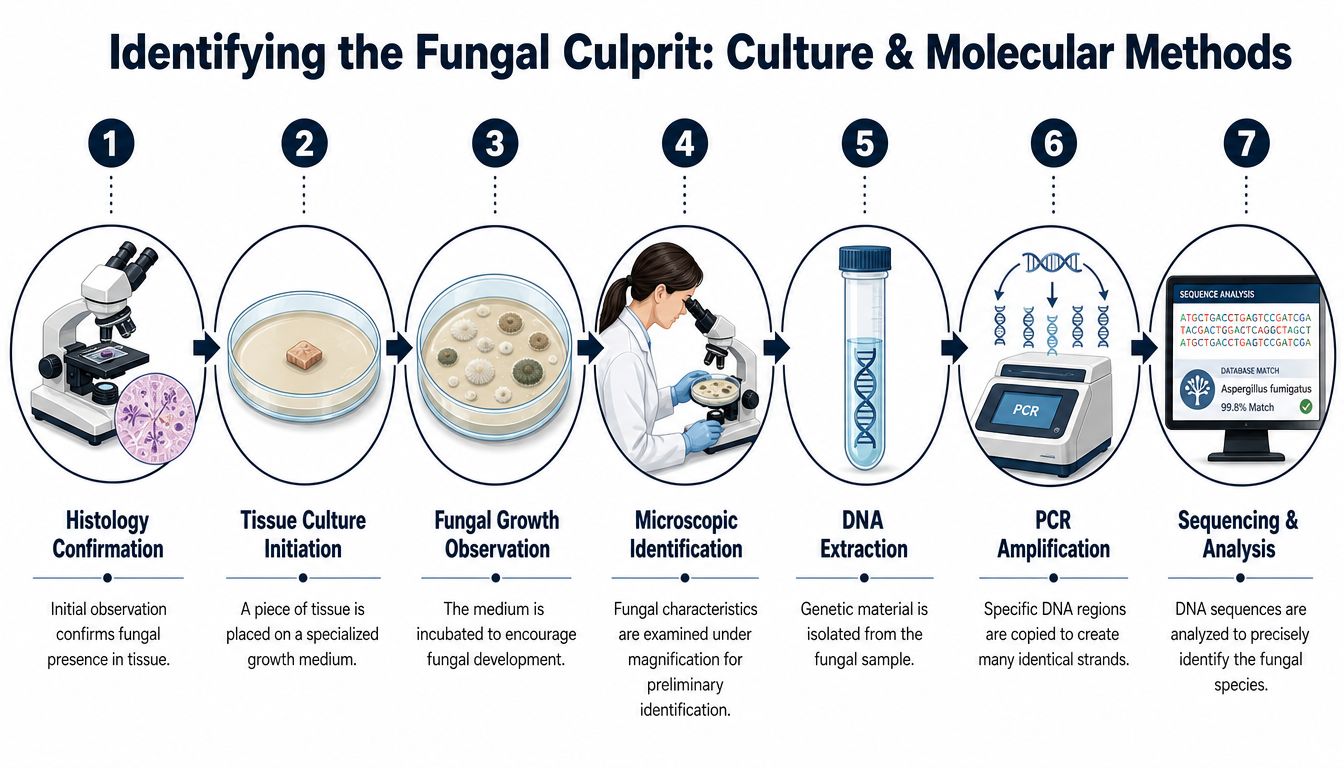
DNA methods for species-level answers
Molecular testing is often the clearest path to species-level fungal identification. In plain terms, the laboratory extracts genetic material from the sample, copies selected regions, and then reads those sequences. That sequence can be compared against reference material to narrow the identity of the organism.
The internal transcribed spacer, or ITS region, is the official fungal barcode marker and the most widely used method for DNA barcoding and species differentiation, but it is often better for preliminary identification than as the primary phylogenetic marker according to this review of molecular fungal identification methods. The same review notes that species-level identification accuracy for filamentous fungi varies widely from 30.2% to 100% depending on database and methodology, while recent studies show high accuracy for Aspergillus species specifically between 80% and 98.1%.
In forensic work, marker choice matters. Molecular identification in forensics relies on genetic sequencing, with the tef-1 gene often providing superior species-level resolution for challenging genera like Aspergillus compared to the standard ITS barcode, as outlined in this overview of fungal identification in forensic science.
That distinction can be important when two molds look similar on a slide but carry very different medical implications.
A short visual summary can help make the workflow easier to follow:
One other point deserves caution. Databases are not perfect. GenBank remains widely used for fungal sequences, but the review above notes a documented 20% error rate, which is why specialized databases may be important when taxonomic precision matters. In other words, a sequence isn't self-explanatory. The quality of the comparison system affects the quality of the answer.
Interpreting the Results Correlation vs Causation
Contamination, colonization, and invasion
The most difficult part of fungal identification is often not the lab test. It's the interpretation afterward. A report may identify a fungus with impressive technical precision, but the central forensic question remains unresolved until the findings are placed in context.
There are three broad possibilities. The first is contamination, where the fungus entered the sample from the environment or handling process. The second is colonization, where the organism was present on a body surface or airway without causing destructive disease. The third is true invasive infection, where the fungus entered tissue, triggered damage, and played a role in death.
A simple comparison helps:
| Finding | What it may mean |
|---|---|
| Fungus on a surface only | Possible contamination or colonization |
| Fungus within damaged tissue | More concerning for true infection |
| Fungus invading vessels or organs | Stronger support for a significant disease process |
The species name matters, but the tissue reaction often matters more.
How cause of death is determined
A board-certified forensic pathologist provides value that a stand-alone test cannot, by synthesizing the scene history, medical records, organ findings, histology, laboratory results, and timing. A fungal result is one piece of evidence. It doesn't speak for itself.
A cause of death opinion links the medical facts into a coherent sequence. If fungal pneumonia caused respiratory failure, that may be the cause. If a patient died from another process and fungal colonization was merely present in the airways, it may not enter the causal chain at all. If the evidence is mixed, the report must reflect that accurately.
For families and attorneys trying to understand how final opinions are reached, our discussion of cause of death determination explains the framework in plain language.
This is also why isolated findings can mislead. A strong autopsy opinion doesn't come from one positive test. It comes from disciplined correlation.
Timelines and When to Consider Further Testing
What affects the timeline
Families usually want two things at once. They want careful work, and they want answers quickly. Those goals can coexist, but specialty testing takes time.
The standard timeline for finalizing a private autopsy report in Texas, including toxicology and histology results, is typically 6 to 8 weeks, while cases requiring extensive specialty studies can extend to 8 to 12 weeks or longer, according to this summary of independent autopsy timing in Texas. That range matters in fungal cases because culture, special stains, and molecular analysis don't all move at the same speed.
The physical examination itself happens much earlier than the final report. The delay usually comes from laboratory processing, microscopic review, outside specialty consultation when needed, and integration of all findings into one defensible opinion.
When a second opinion autopsy may help
Further testing becomes more important when the original investigation left a significant gap. That may happen when infection was suspected but no fungal studies were ordered, when tissue was available but not fully examined, or when the report language is too broad to answer the actual legal question.
A complete forensic autopsy must include systematic examination of all internal organs and the brain, while limited autopsies are inadequate for determining cause and manner of death in medical examiner practice, as explained by the Harris County Institute of Forensic Sciences FAQ. That principle is relevant because incomplete examinations can leave no reliable way to assess whether infection was localized, disseminated, incidental, or entirely missed.
Situations that often justify a closer review include:
- Unresolved hospital course: Records mention infection, but no species-level testing was completed.
- Limited original examination: Key organs or tissues were not fully evaluated.
- Litigation concerns: Counsel needs an opinion supported by documented methods and full chain of custody.
- Need for statewide access: Some families and agencies need independent review outside the local system, including county forensic autopsies.
Frequently Asked Questions About Fungal Identification
Can an autopsy prove a fungal infection caused death
Sometimes yes, but not from one result alone. The strongest opinions come from a combination of tissue findings, special stains, culture or molecular work when appropriate, and the surrounding medical history. If the fungus is seen invading tissue and the organ damage fits the clinical course, the conclusion is much stronger than a positive swab or isolated lab finding.
What is the difference between cause of death and manner of death
Cause of death is the medical reason the person died. Manner of death is the legal classification of how the death occurred, such as natural or accident. In fungal cases, the manner is often natural, but the cause can still require detailed investigation to define correctly.
Will fungal testing be done in every autopsy
No. It should be guided by the facts of the case. If there is no medical history, organ finding, or microscopic clue suggesting fungal disease, broad fungal workup may not be appropriate. If there are warning signs, targeted testing becomes far more useful.
Can prior materials be reviewed if an autopsy already happened
Often yes. A second opinion autopsy may involve review of records, reports, photographs, retained slides, or available tissue blocks. The practical question is whether enough material exists to answer the unresolved issue with scientific confidence.
Why do attorneys often ask for species-level fungal identification
Because legal questions are usually narrower than medical summaries. Counsel may need to know whether the organism was one commonly associated with invasive disease, whether it plausibly fit the timing of symptoms, or whether a finding is more consistent with contamination than with true pathology.
For readers who want a broader plain-language overview of infectious agents and how fungi fit among them, VirusFAQ's deep dive into pathogens is a useful general reference.
When families and attorneys review a fungal finding, the most important question is not "Was a fungus present?" It is "What did that finding mean in this death investigation?"
When a death remains medically or legally unclear, careful postmortem review can bring needed clarity without speculation. Texas Autopsy Services provides independent private autopsy services Texas families, attorneys, medical professionals, and county officials can use when they need a thorough cause of death investigation, a second opinion autopsy, or guidance from a forensic pathologist. Every examination is performed by a forensic pathologist certified by the American Board of Pathology, with full chain of custody, direct communication, and service across all 254 Texas counties. If your family or client needs clear information about the autopsy process, fungal identification, or what additional review may be possible, contact our team directly.