September 21, 2026 · Texas Autopsy Services
Medical Records Review Expert: A Practical Guide
Learn what a medical records review expert does, when to hire one, and how board-certified forensic pathologists deliver second-opinion reviews in Texas.

On this page
- What a Medical Records Review Expert Actually Does
- How the Review Process Works Step by Step
- Qualifications That Define a Credible Reviewer
- Preparing Records for an Effective Review
- Common Misconceptions About Record Reviews
- How Our Team Provides Second Opinion Reviews
- Frequently Asked Questions Before You Reach Out
Medical Records Review Expert for Texas Death Cases and Second Opinions
- A medical records review expert does more than summarize a chart. The job is to reconstruct a defensible timeline and explain what the records do, and do not, support.
- In death cases, records review works best when it includes the full record set, preserves chronology, and ties every opinion back to specific source material.
- Reliability depends on method. In a landmark retrospective record review study, inter-reviewer agreement for adverse events was only moderate at kappa 0.40 to 0.41, and agreement for negligent adverse events was even lower at 0.19 to 0.23, which shows why structured review matters (medical record review statistics summary).
- Missing records do not always mean missing care. Sometimes they reflect fragmented systems, vague requests, or export problems rather than a true treatment gap.
- In Texas, records review often intersects with private autopsy work, second opinion autopsy review, and county death investigation rules. Every examination we perform is done by a forensic pathologist certified by the American Board of Pathology.
A family often calls after a hospital death and says the same thing in different words. They have records, but they still don't know what happened. An attorney often faces the same problem from the other side. The chart is thick, the timestamps conflict, and the discharge summary reads cleaner than the actual course of care.
That is where a medical records review expert becomes useful. The work is not clerical. It is forensic. Our job is to take scattered notes, medication records, imaging, lab trends, EMS documentation, pathology material, and prior autopsy findings if they exist, then turn them into a chronology that can survive scrutiny.
For families, that may support a second opinion about cause of death. For attorneys, it may support causation analysis, autopsy reconciliation, or a more focused question about whether the chart supports the story being told.
What a Medical Records Review Expert Actually Does
A wife receives 1,800 pages from two hospitals, EMS, and a rehabilitation facility after an unexpected death. The records arrive out of order. Several notes repeat the same language. The discharge summary makes the admission sound straightforward, but the bedside course was not straightforward at all.
A medical records review expert reconstructs what happened, in sequence, from the underlying sources. In forensic practice, that means more than reading physician notes. The review may need medication administration records, nursing flowsheets, lab trends, monitor strips, imaging, operative reports, pathology, EMS records, and death investigation material. The job is to determine which events are documented, which are only repeated, which are missing, and which conflicts matter.
In Texas cases, this often overlaps with second-opinion autopsy review, private autopsy work, and questions about whether the certified cause of death fits the charted clinical course. A board-certified forensic pathologist approaches the file as a timeline reconstruction problem first, because timing changes interpretation. A potassium result drawn after a code does not carry the same weight as a result drawn six hours earlier. A consultant note signed at 6 p.m. may describe an exam done at noon. Those distinctions affect causation analysis.
The day-to-day work usually includes:
- Rebuilding the chronology from source documents. We line up admissions, transfers, procedures, medication doses, code events, imaging, and documented changes in condition by actual date and time.
- Checking whether entries are original, copied, or late. Repeated language can make a chart look cleaner and more consistent than it was in real time.
- Finding the records that carry the most evidentiary weight. A medication administration record may matter more than a later narrative note. A nursing entry may resolve a timeline dispute that a summary note obscures.
- Flagging conflicts that need explanation. Common examples include mismatched timestamps, conflicting accounts of mental status, undocumented gaps in monitoring, and discharge language that does not fit the final hours.
- Defining the question the review can answer. Cause of death, timing of deterioration, correlation with autopsy findings, and record completeness are different questions. They require different methods and different caution.
This work produces a source-based opinion, not just a cleaner file.
Families and attorneys often begin with a broad concern, then narrow it once they understand what medical review means in practice. That usually improves the review. A focused question leads to a report that can be tested against the chart, the pathology, and the timeline.
The final work product should identify the key facts, cite where each fact came from, explain the significance of conflicts or gaps, and state the limits of the opinion. If the records do not support a firm conclusion, the report should say that plainly. If they do support one, the reasoning should be traceable back to the chart.
Analysts at MedRecords.ai found that inter-rater agreement in retrospective chart review can be low, including a kappa range of 0.19 to 0.23 for negligent adverse events, which is one reason review method and reviewer judgment matter so much (medical record review statistics summary).
How the Review Process Works Step by Step
A death review usually starts with a box of PDFs that do not agree with each other. The emergency record says one thing, the nursing flowsheet suggests another, and the medication record places a drug at a time that does not fit the clinical decline. The job is to reconstruct what happened in sequence and determine what the chart can support.
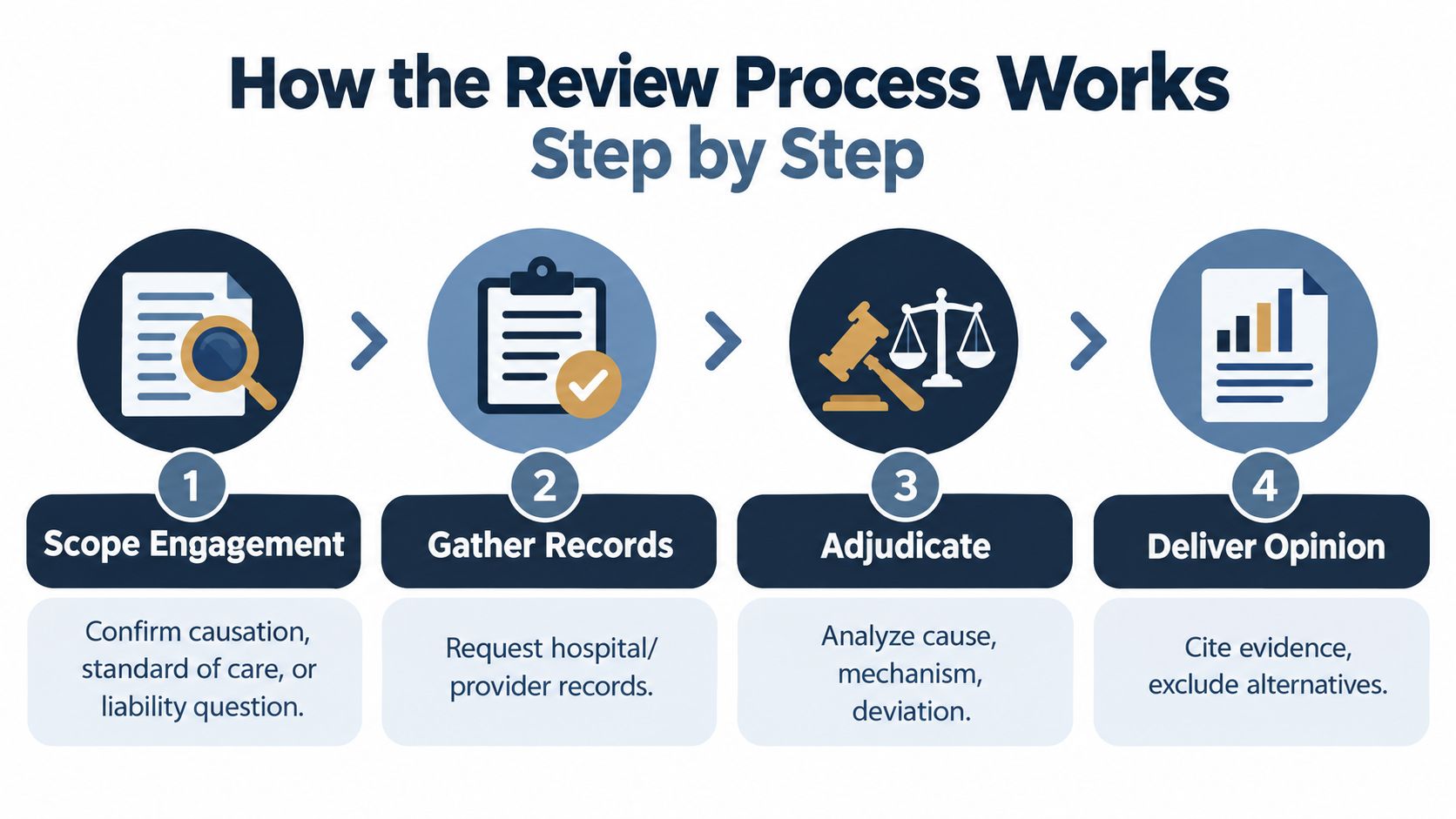
A sound review works like a forensic timeline reconstruction. In Texas practice, that means treating the chart as evidence, not just paperwork. Dates, times, signatures, addenda, and missing records matter because they shape any later opinion on deterioration, causation, and consistency with postmortem findings.
Step one and step two
Define the exact review question
The first step is to pin down the decision the review needs to support. A family may want to know whether the final hospitalization makes sense. An attorney may need to know whether the documented decline matches the certified cause of death. A records-only second opinion asks different things than a review that also includes autopsy findings, toxicology, or tissue slides.Build the full record set before analysis begins
Partial files create false confidence. A proper record pull often includes hospital records, EMS run sheets, medication administration records, monitor strips when available, imaging and radiology reports, operative notes, lab trends, pathology, hospice or nursing facility records, and prior death investigation material. In many cases, the missing document is the one that explains the change in condition, or shows that it was never explained at all.
Step three and step four
Construct a source-cited chronology
This is the core task. Every event goes on a timeline with its source attached, including presentation, assessments, medication administration, procedures, consultant input, changes in mental status, oxygenation, code events, and pronouncement details. A usable chronology also separates charted fact from later summary language, because those are not the same thing.Test the chronology for medical and forensic meaning
Once the sequence is clear, the review turns from organizing to judging. The reviewer looks for inflection points: delayed response to deterioration, treatment that does not match the documented problem, unexplained gaps in observation, late entries, contradictory descriptions of the patient, and timing problems between symptoms, interventions, and death. Some conflicts are harmless documentation noise. Some change the entire opinion.
Practical rule: If a conclusion cannot be traced to a specific entry, it is a weak conclusion.
What comes next
After the timeline is stable, the records are compared against any postmortem material that exists. That may include autopsy findings, toxicology, histology, scene information, or the death certificate. A chart summary becomes an opinion. The question is no longer only what the record says. The question is whether the record fits the pathology and whether both support the stated cause and manner of death.
The review also has to account for what is missing. The strongest reports identify absent source material, duplicate exports, and sections that appear incomplete or out of order. The gap analysis issue is practical, not clerical. If telemetry is absent, medication times are inconsistent, or outside records never made it into the hospital chart, the limits of the opinion need to be stated plainly.
The final product is usually a signed written opinion prepared for one of three audiences:
- Families who need a clear explanation of what the records do and do not show
- Attorneys who need reasoning tied to specific entries and stated in defensible medical language
- Agencies or county stakeholders who need a chronology that aligns the treatment record with the death investigation file
Qualifications That Define a Credible Reviewer
Not every clinician who can read a chart should be offering cause-of-death opinions. Records review in a death case is not the same as utilization review, coding review, or a nursing chronology.
What credentialing does and does not mean
The American Board of Pathology describes certification as a voluntary evaluation process designed to assure the public and other physicians that the candidate has the knowledge, skills, judgment, and other abilities needed for pathology practice. For forensic pathology, the pathway requires primary certification in anatomic pathology or combined anatomic and clinical pathology, completion of an accredited forensic pathology fellowship, and an active unrestricted medical license (American Board of Pathology certification standards).
That matters because a death review may require the reviewer to connect bedside care, pathology, injury patterns, toxicology, and formal cause-of-death language. A general medical background is not always enough.
Documentation standards separate experts from summarizers
A credible reviewer should produce a report that is signed, limited to the materials reviewed, and tied to specific entries. The report should also preserve confidentiality and controlled handling of source material. Independent documentation guidance emphasizes records that are legible, accurate, concise, logically organized, and consistent, and it stresses confidentiality and controlled handling because poor structure increases interpretive error and weakens reliability (WHO medical record documentation guidance).
| Credential Area | Generalist Reviewer | Forensic Pathologist Reviewer |
|---|---|---|
| Scope of work | Often summarizes treatment course | Can analyze cause of death and chart-pathology correlation |
| Death investigation training | Usually limited or outside scope | Specialty training in medicolegal death investigation |
| Report style | Narrative summary may be enough | Opinion-bearing report tied to specific records |
| Court posture | More vulnerable if asked to opine outside training | Better suited for deposition and testimony in death cases |
| Postmortem correlation | Often unavailable | Can correlate records with autopsy, histology, and toxicology |
The question is not whether someone can read the chart. The question is whether they can defend the opinion that follows.
Preparing Records for an Effective Review
A records review usually goes off course before the reviewer reads page one. The family sends the discharge summary, a few lab pages, and a death certificate. The attorney has a narrow deadline and a broad question. The missing piece is the timeline.
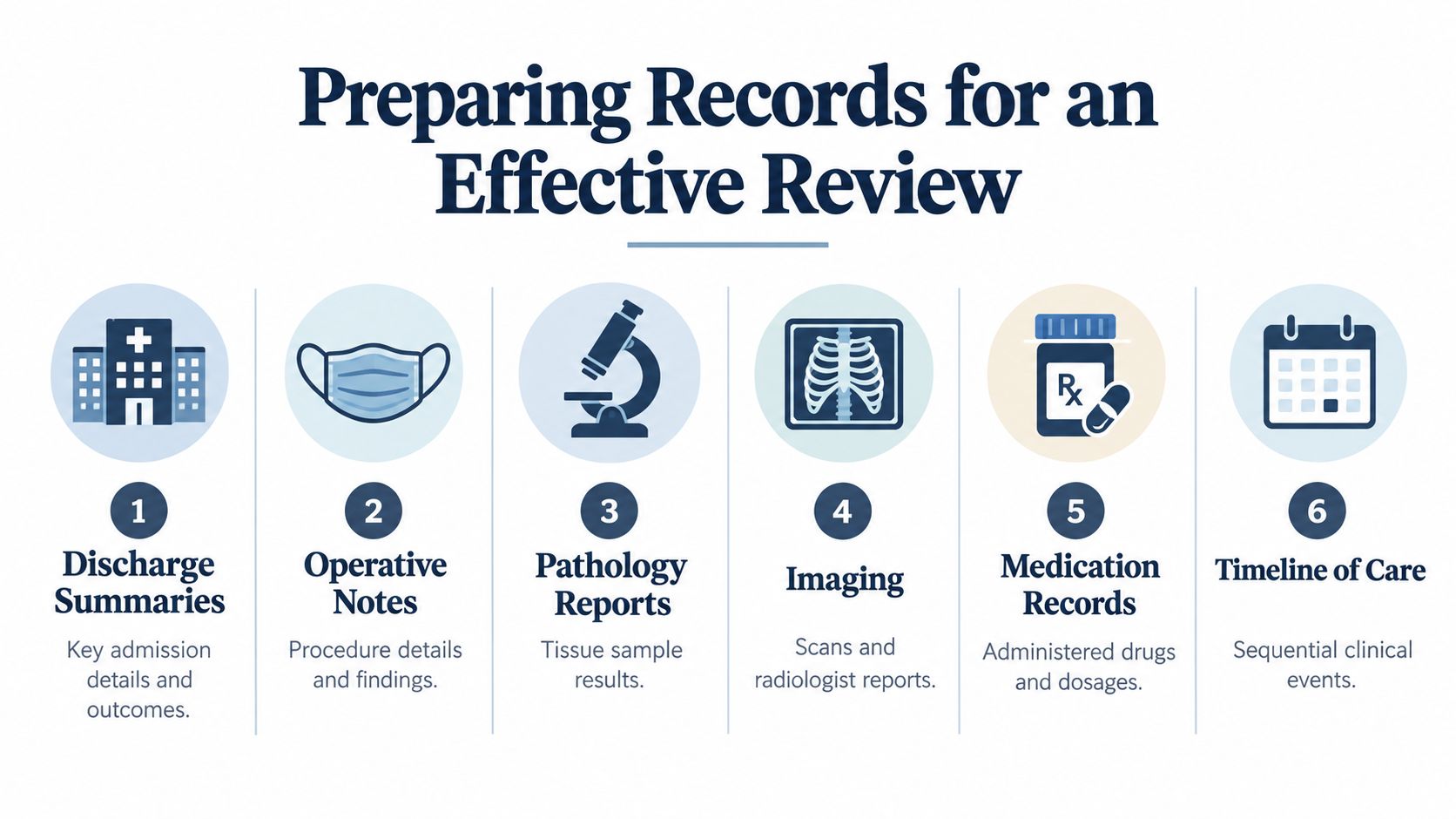
In death and injury cases, record preparation is not clerical cleanup. It is the first pass at forensic reconstruction. The reviewer has to determine what happened, in what sequence, who documented it, and where the gaps begin. A polished chart summary can still miss the central issue if medication timing, nursing observations, transfer delays, or pathology findings are sitting in a different packet.
What to request before the review starts
Send full copies of the major record groups, not selected excerpts that appear favorable or familiar:
- Hospital records: admission note, history and physical, progress notes, consults, discharge summary, nursing notes, flowsheets, and medication administration records
- Procedure material: operative reports, anesthesia records, consent forms when relevant, catheterization reports, and endoscopy or interventional reports
- Diagnostic data: laboratory reports, microbiology, EKGs, imaging reports, and imaging media if the question turns on anatomy, bleeding, stroke, fracture, or line placement
- Pathology and death records: surgical pathology, cytology if relevant, prior autopsy report, death certificate, and investigator or medical examiner documentation
- Out-of-hospital sources: EMS run sheet, nursing facility chart, hospice notes, home health records, and pharmacy dispensing data
If the case turns on what was given, held, or discontinued, a focused medication history review is often more useful than the medication list copied into a discharge summary.
How to organize the file
Group records by facility and by encounter. Label each file with the date range. If there was a transfer, keep each institution separate instead of merging everything into one large PDF with no bookmarks.
Certified copies are preferable, but the practical priority is completeness and legibility. Audit trails, fax headers, print timestamps, and duplicate pages can matter. I have seen timing disputes turn on a second copy of the same note that showed an updated time stamp or an addendum entered hours later.
A short case chronology also helps. One page is enough. List the known events in order: symptom onset, EMS contact, emergency department arrival, procedures, transfer, deterioration, code event, and death. That gives the reviewer a framework to spot silent intervals and to identify what still needs to be requested.
Practical checklist before sending records
- Confirm the date range: include the days or weeks before the final admission if prior treatment, recent discharge, anticoagulation, infection, or worsening symptoms may matter
- Request the native source when possible: portal summaries and attorney packets often leave out attachments, image quality, and metadata
- Keep duplicates and label them: repeated pages can show source differences, corrected entries, or later print histories
- Identify known missing items: say what was requested but not produced so the reviewer does not assume the event never happened
- Preserve readability: blurred scans and dark fax copies can erase medication times, handwritten orders, and signatures
- Separate factual questions from opinion questions: “Was he hypotensive before transfer?” is different from “Did delayed transfer contribute to death?”
Good preparation shortens the path to a useful opinion. It prevents the reviewer from mistaking an incomplete production for an uncomplicated medical course.
Common Misconceptions About Record Reviews
Confusion usually starts with the word “review.” People hear it and think administrative sorting, not forensic analysis. That assumption causes problems early.
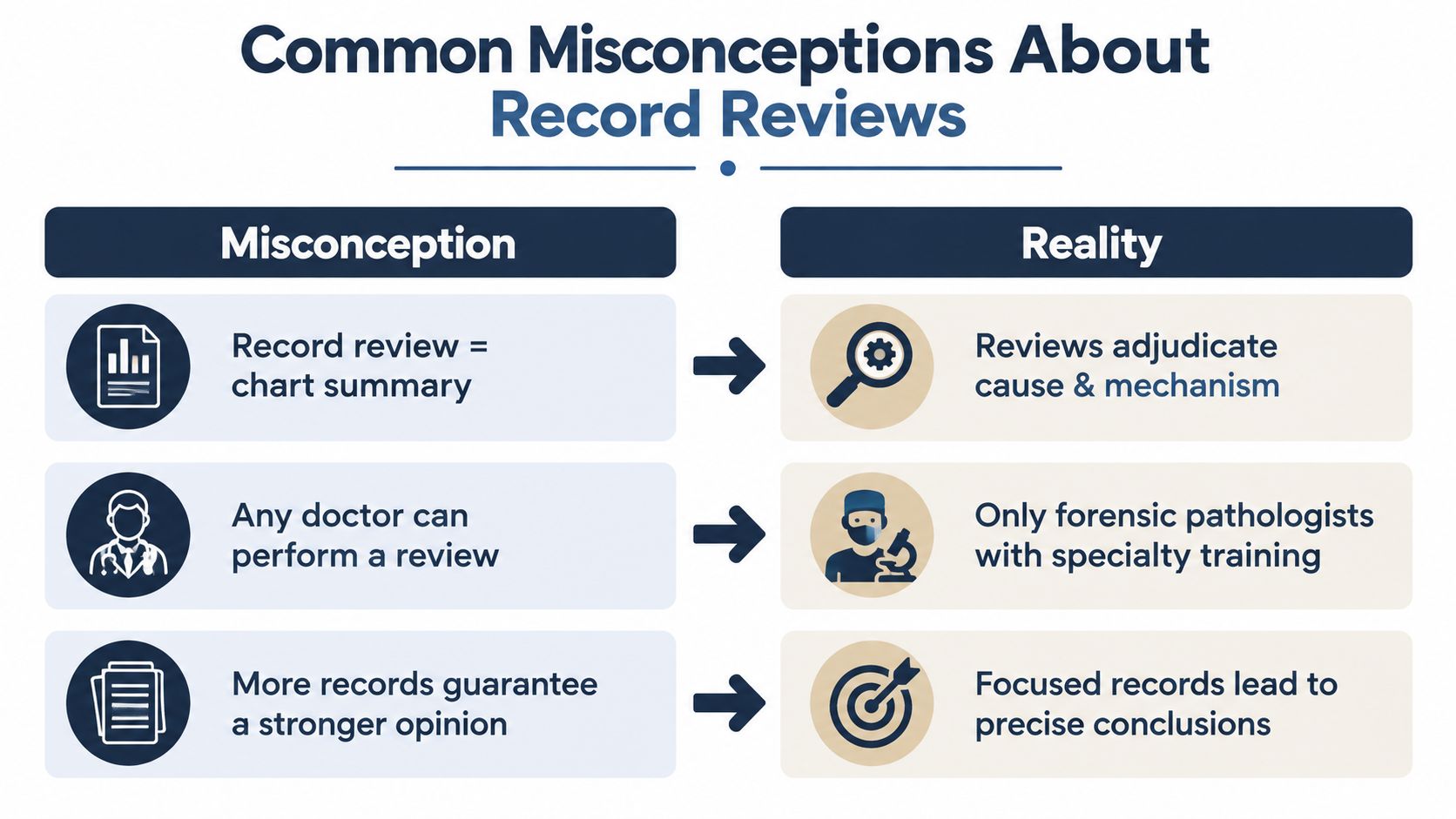
Misconception one and two
The first misconception is that a record review is the same thing as a chart summary. It is not. A summary describes. An expert review weighs causation, mechanism, chronology, and alternative explanations.
The second is that any physician can provide a durable forensic opinion from the chart alone. Some physicians can speak competently within a narrow clinical lane, but death review often requires interpretation of pathology, terminal physiology, trauma patterns, postmortem correlation, and medical-legal wording. That is a different task.
Misconception three and four
A third misconception is that records review can replace an autopsy. It can't. A records-only opinion can be valuable, but it cannot directly inspect organs, injuries, histology, or hidden disease. If the core issue is structural heart disease, occult trauma, embolism, hemorrhage, or a missed anatomical finding, the limitation has to be stated clearly.
A fourth misconception is that more pages automatically produce a stronger opinion. In reality, unfiltered mass production can make review worse if duplicates, export errors, and copied-forward text are not sorted out.
More records are only better when the reviewer can identify provenance, sequence, and relevance.
The field is also changing. Commentary on litigation-focused review notes a shift toward structured, machine-assisted review of large electronic record sets, including metadata, audit trails, access logs, and production-format completeness, while still stressing the need for human oversight as AI use expands (medical record review in litigation and AI context).
That means the modern medical records review expert may need to explain not just what the notes say, but how the electronic record behaves. A duplicated export, OCR error, or absent audit trail can matter as much as a disputed progress note.
How Our Team Provides Second Opinion Reviews
A second opinion review starts with a narrow question and a documented record path. Without those two things, the process becomes harder to defend later.
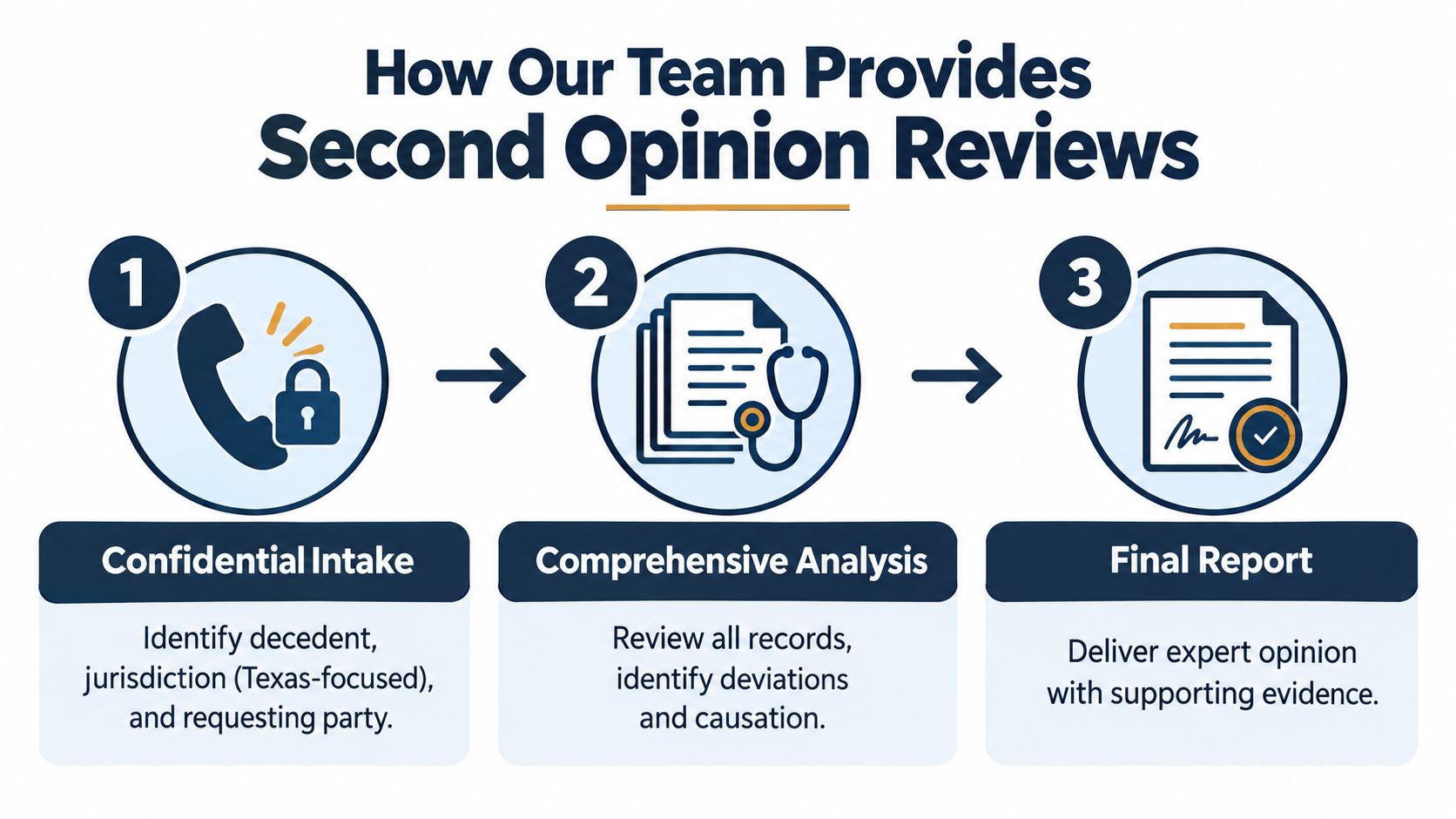
Intake and chain of custody
We begin with confidential intake to identify the decedent, the requesting party, the Texas jurisdiction involved, and the exact question to be answered. Some matters are family requests for clarity. Others involve counsel seeking a records-only second opinion, autopsy reconciliation, or support for formal litigation review.
From there, records are logged and handled under chain of custody. Chain of custody means the documented history of who received, transferred, stored, and reviewed the materials. In forensic practice, that protects the integrity of both the records and any downstream opinion.
The review itself
Our board-certified forensic pathologists reconstruct the clinical timeline, identify missing intervals, and correlate the chart with prior autopsy findings, histology, toxicology, or imaging when those materials are available. If the file is incomplete, we identify that before giving a firm opinion.
For readers who work with counsel, medical record review for law firms often centers on a simple rule. The report should answer the legal question being asked, but it cannot skip the medical steps required to get there.
What the report includes
The written report generally includes:
- An executive summary: A concise statement of the question, materials reviewed, and bottom-line opinion
- An annotated chronology: Key events in sequence with source references
- Medical analysis: Discussion of causation, alternative explanations, and the limits of the available data
- Opinion language: Conclusions expressed clearly and within the scope of the materials reviewed
When appropriate, Texas Autopsy Services can provide this type of second-opinion medical records review as part of a broader forensic pathology case evaluation, including cases that also involve Private Autopsies, County Forensic Autopsies, or coordination through the Waterloo Mortuary Partnership.
In Texas practice, legal context also matters. State law defines an autopsy as a postmortem examination that includes X-rays and examination of internal organs and structures after dissection, and the purpose is to determine cause of death or pathological changes contributing to death. In inquest cases, whether the justice of the peace or a county medical examiner directs that process depends on county structure (Texas Code of Criminal Procedure Chapter 49).
Frequently Asked Questions Before You Reach Out
What does a family or attorney receive at the end
Most often, the final work product is a written report. Depending on the assignment, that may be a plain-language explanation for a family, or a medical-legal opinion suitable for litigation support. Some matters also need follow-up consultation, affidavit review, or testimony.
A cause of death is the disease or injury that started the fatal sequence. A manner of death is the classification of how the death occurred, such as natural, accident, suicide, homicide, or undetermined. Those are postmortem terms, not general medical advice.
How long does a review take
The answer depends on record volume, number of facilities, image quality, and whether outside materials still need to be obtained. We don't promise fixed timelines because some delays come from production gaps, duplicate exports, or missing outside records.
If a review is tied to autopsy procedure in Texas, there are also legal details that can affect timing in specific settings. For example, Texas law allows a limited autopsy when a full autopsy is unnecessary, including taking blood, body fluids, tissues, or organs to determine cause of death or whether a crime was committed (Texas Code of Criminal Procedure Article 49.25 Section 9). In cases involving organ donation, Texas law also requires timely release and timely autopsy sequencing when donation will not interfere with the investigation (Texas Health and Safety Code Section 693.002).
Can a records-only review change a death certificate
Not by itself. A posthumous review does not directly amend a death certificate. It can, however, support a meaningful request for amendment or further investigation if the evidence justifies it.
What should a client provide to get started
The most useful starting package includes authorization documents, the known date range, facility names, any prior autopsy report, the death certificate if available, and the specific questions that need to be answered. If the issue involves cremation, burial, transport, or disposition, Texas families should also understand that practical handling requirements may intersect with the Texas Funeral Service Commission and the Texas Health & Safety Code.
Is privacy protected during review
Yes. Sensitive records should be handled confidentially and in a controlled manner. That is not just a courtesy. It is part of competent medical-legal practice, especially where protected health information, imaging, pathology materials, and family communications are involved.
When a death is recent, early guidance often matters more than a rushed opinion. It helps define what records exist, what records are missing, and whether the question calls for a records-only review, a second opinion autopsy review, or a full independent autopsy.
If you need help understanding a death, questioning a prior conclusion, or organizing records for a second opinion, our team can review the circumstances and explain the next forensic step in plain language. Texas Autopsy Services serves families, attorneys, medical professionals, and county officials across all 254 Texas counties, and every examination is performed by a forensic pathologist certified by the American Board of Pathology. To learn more or request a confidential intake conversation, visit Texas Autopsy Services.