August 27, 2026 · Texas Autopsy Services
Medical Record Review for Law Firms: A Practical Guide
Learn how to commission a medical record review for law firms, from gathering documents to working with forensic pathologists for court-admissible findings.
On this page
- Why Law Firms Need Structured Medical Record Reviews
- Gathering the Right Documents and Authorizations
- The Staged Review Workflow From Screening to Validation
- Separating Clinical Facts From Template Noise
- In-House Review Versus Outsourced Forensic Partners
- Commissioning a Review and Working With Forensic Pathologists
- Frequently Asked Questions
A lawyer receives a large medical file shortly before a demand deadline. The packet includes emergency care, operative reports, imaging, therapy notes, medication records, and billing documents. The central issue may appear straightforward, but the chronology contains missing dates, copied language, conflicting assessments, and records that don't clearly establish whether a condition began with the alleged event or existed beforehand.
That situation is common in personal injury, medical malpractice, and wrongful death litigation. Medical record review for law firms must do more than reduce page count. It must show what the records establish, what they leave uncertain, and which conclusions require clinical validation. A fast summary can support triage, but a defensible opinion depends on source verification, disciplined organization, and documented reasoning.
- Structured review turns scattered records into a usable chronology.
- Complete authorizations and source tracking protect privacy and evidentiary reliability.
- AI can accelerate sorting and extraction, but it shouldn't replace clinical validation.
- Gap-hunting often matters more than producing a polished summary.
- A staged workflow helps attorneys separate documented fact from medical interpretation.
Why Law Firms Need Structured Medical Record Reviews
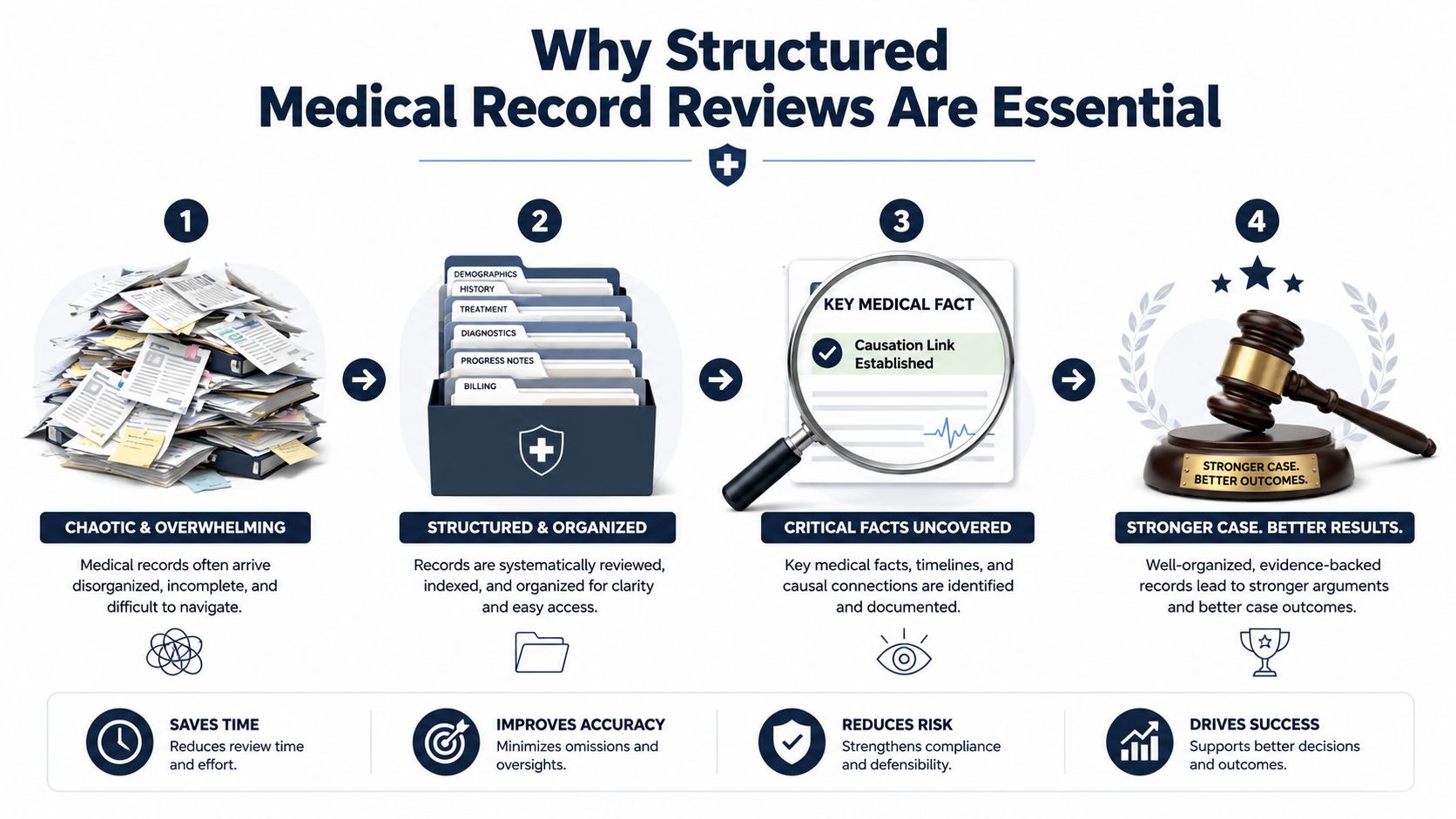
A disorganized file creates legal problems before anyone reaches an expert report. Treatment dates may be unclear, diagnostic findings may be separated from the notes that explain them, and billing records may not match the clinical documentation. Without a structured method, an attorney can miss evidence supporting causation or overlook a weakness that opposing counsel will identify first.
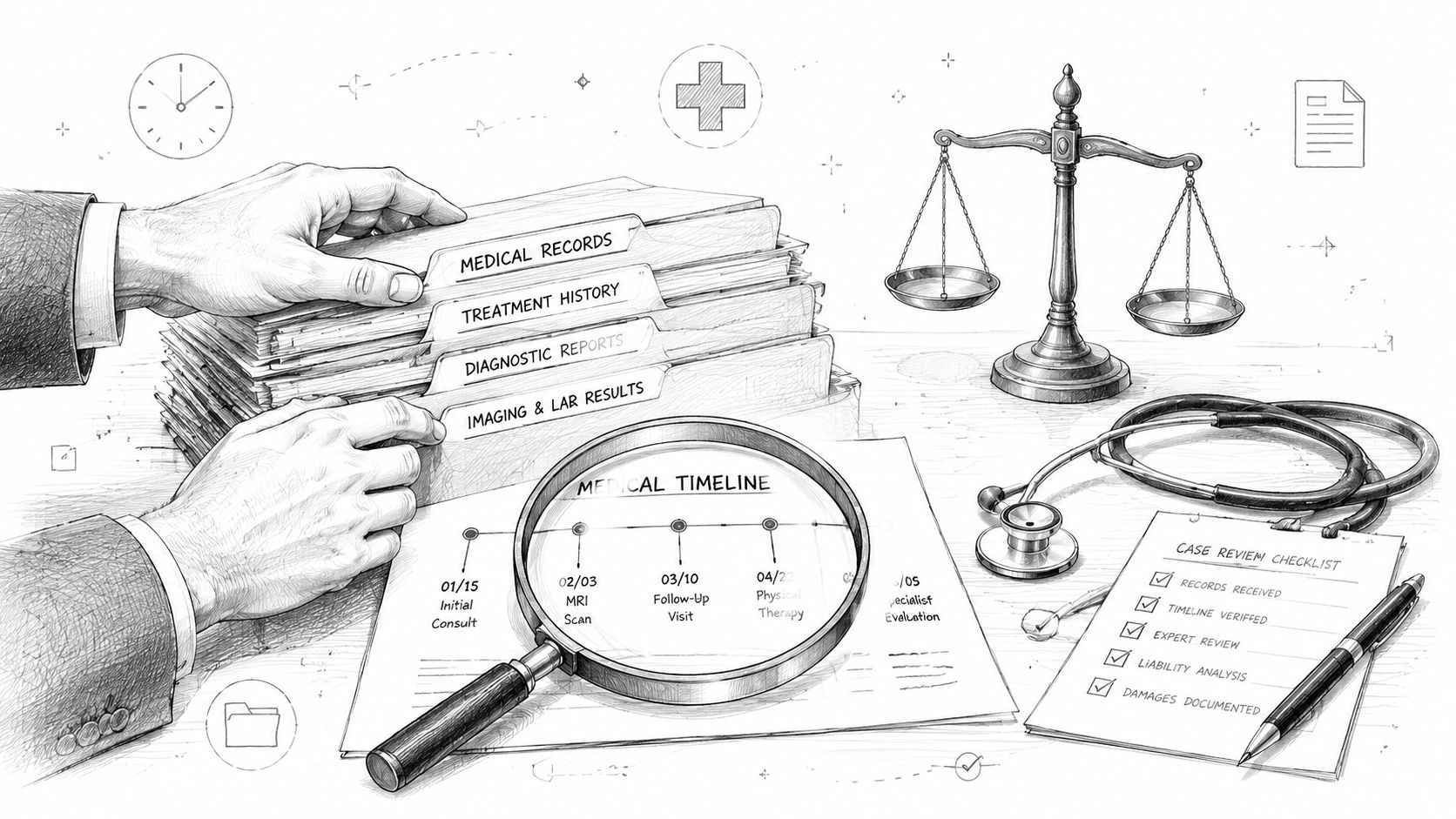
A proper review creates a defensible medical chronology. It organizes records by date and provider, identifies the clinical event, links the event to its source document, and distinguishes an objective finding from a patient's reported symptom or a provider's provisional assessment. The resulting work product can help counsel evaluate case viability, prepare settlement materials, frame deposition questions, and decide whether broader forensic proof is necessary.
Retrieval is part of the analysis
Medical record retrieval has become a routine operational function for law firms. In 2024 survey data, 47.40% of firms relied on external vendors for medical record retrieval, 26.46% used vendors for most cases, and 13.7% used vendors for every case. The same data showed that 14.08% used a single vendor, compared with 11.23% in 2023, while 45.14% used two to four selected vendors, an indication that firms are consolidating around trusted partners. These figures are reported in medical record review litigation guidance.
Those retrieval choices matter because an incomplete packet produces an incomplete analysis. A missing imaging report, medication administration record, operative note, or specialist consultation can change the interpretation of injury progression and causation. Secure handling also matters because medical records contain protected health information, making resources such as Ciphar for secure health comms relevant when firms evaluate transmission and communication practices.
Our team also sees value in a review that states what the file doesn't prove. For attorneys evaluating methods and organization, our guidance on reviewing medical records for attorneys addresses the practical relationship between chronology, source records, and forensic interpretation.
Practical rule: A chronology should make it easy to locate both the supporting record and the missing record.
Speed changes case pacing
Traditional manual workflows often take 60 to 90 days or longer, while modern AI-enabled platforms report turnaround in about 10 to 12 days, a difference of roughly 50 to 80 days depending on complexity. Those figures and the related litigation benchmark are discussed in medical record access statistics. The same source reports that the average personal injury firm has a demand delay of more than 100 days on 42% of its cases.
Speed can affect settlement preparation and litigation pacing, but it doesn't establish accuracy. The useful question is whether the workflow produces a traceable chronology, preserves source citations, and exposes uncertainty rather than hiding it behind confident language.
Gathering the Right Documents and Authorizations
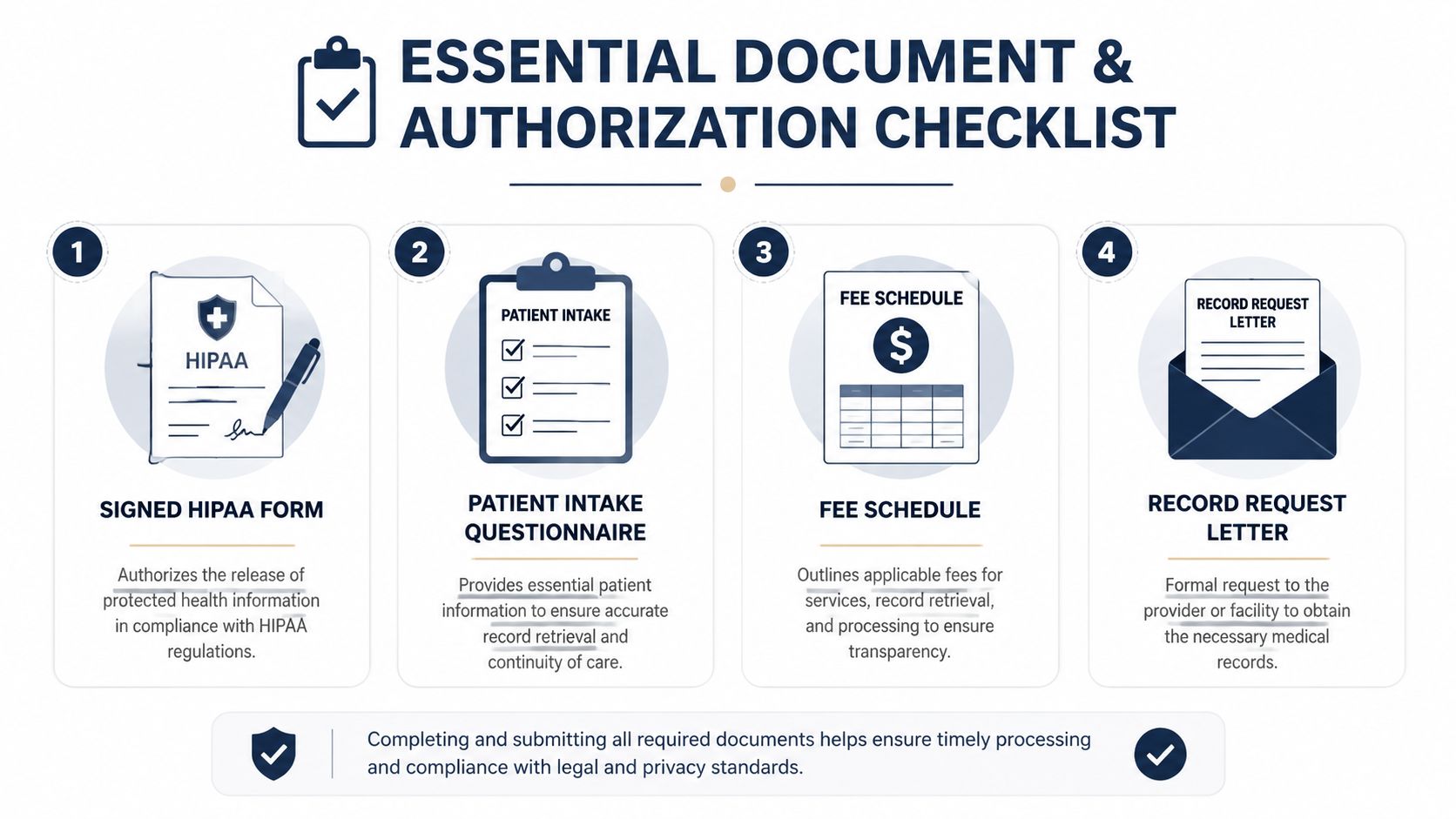
A review should begin with the legal authority to obtain records and a provider map that reflects the patient's complete treatment history. A valid authorization commonly needs to identify the records to be disclosed, the date range, the recipient, the purpose, an expiration date, and revocation language. Requests may also involve a subpoena with proof of authorization, a qualified protective order, or notice-and-objection procedures. The applicable requirements should be evaluated with counsel familiar with the matter and Texas law, rather than assumed from an informal release.
Build the provider map first
Start with every known treating source, then test the list against the client's account and the documents already received. Include emergency medical services, emergency departments, hospitals, primary care offices, specialists, imaging centers, laboratories, pharmacies, physical therapy providers, and facilities that supplied durable medical equipment when relevant.
The packet may need to include:
- Clinical notes: Emergency, admission, discharge, progress, consultation, nursing, and therapy records.
- Procedure materials: Operative reports, anesthesia records, procedure notes, and recovery documentation.
- Objective testing: Imaging studies and radiologist interpretations, laboratory results, pathology materials, and relevant diagnostic reports.
- Medication information: Medication administration records, prescription histories, reconciliation lists, and pharmacy documentation.
- Financial records: Itemized bills and related materials that can be compared with the clinical timeline.
- Death investigation records: Autopsy reports, toxicology results, and death certificates in wrongful death matters.
The HIPAA compliance guidance for medical record review explains why authorization details and disclosure procedures require careful attention. Privacy compliance isn't a clerical formality. An improperly limited or incomplete authorization can delay retrieval, while an overbroad request can create unnecessary privacy concerns.
Verify completeness before interpretation
Maintain a request log showing the provider, date requested, response status, date range received, and file characteristics. Organize documents by provider and date, remove duplicate pages without discarding original source information, paginate the working file, and record any missing ranges.
Compare dates across sources. If a later note refers to an earlier scan, operation, admission, or medication change, confirm that the underlying document is present. Guidance on medical record review for personal injury emphasizes chronological organization, pagination, document classification, and comparison against the claimed treatment timeline.
A practical review packet should contain notes, imaging, operative reports, therapy records, discharge materials, itemized bills, and other supporting documents before attorney handoff. Medical record review guidance for attorneys outlines this completeness check. Law firms can also use principles from implementing document management in law firms to standardize naming, access controls, version management, and secure storage.
The Staged Review Workflow From Screening to Validation
A defensible workflow separates organization from clinical interpretation. The first reviewer shouldn't be expected to answer every causation question, and a physician shouldn't have to spend clinical time repairing basic document disorder. Each stage should produce a record of what was done, what was found, and what still requires attention.
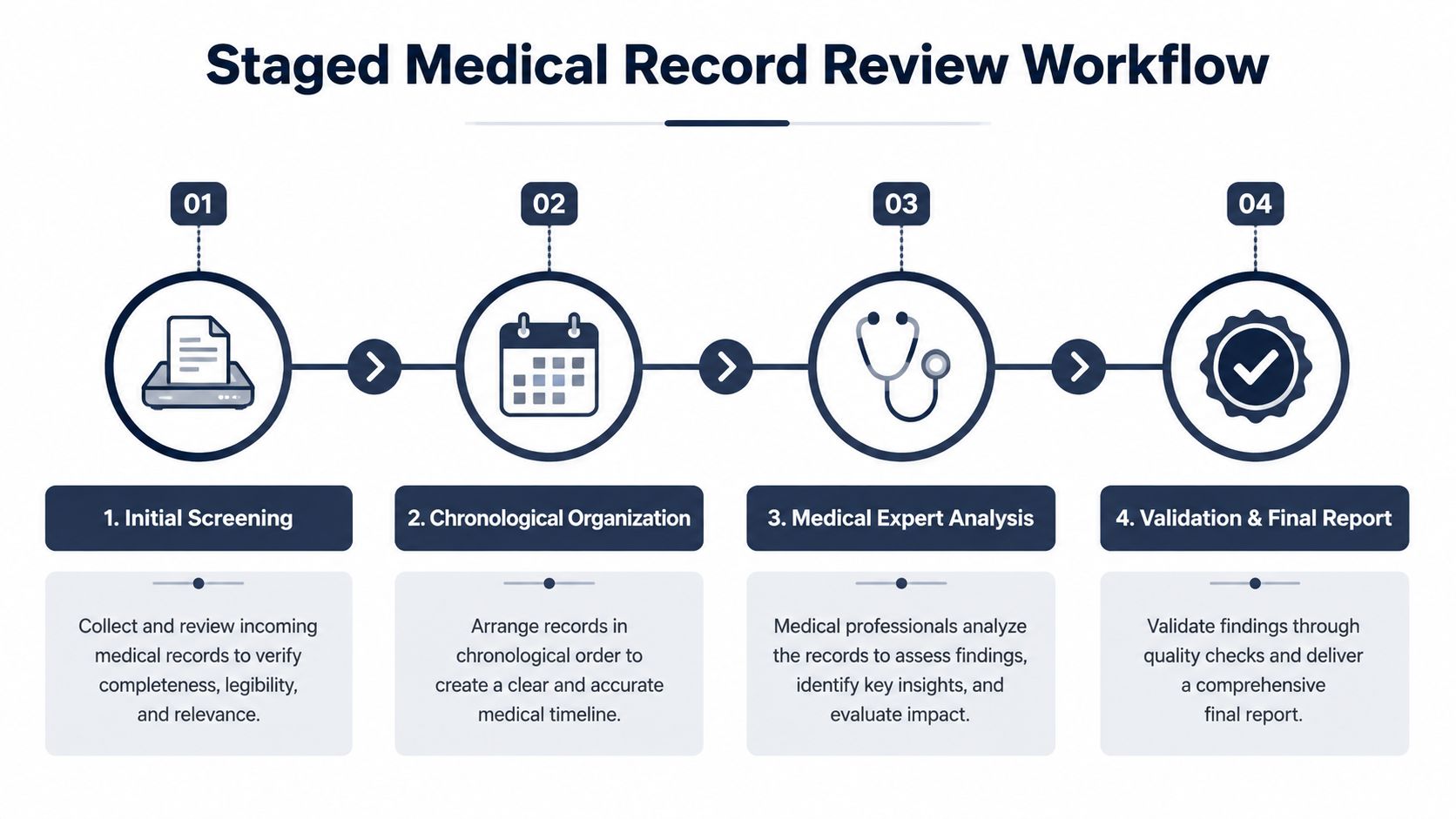
The workflow commonly includes four connected stages:
- Initial screening: Identify the legal and clinical question, confirm the record set, and flag obvious gaps, duplicates, and key events.
- Chronological organization: Arrange records by provider and date, then extract diagnoses, symptoms, procedures, tests, medications, and outcomes into a traceable timeline.
- Medical expert analysis: Have a qualified physician interpret clinical significance, assess competing explanations, and distinguish documented findings from assumptions.
- Validation and reporting: Re-check important entries, document limitations, preserve citations, and finalize a report or opinion that reflects the evidence.
Screening should be structured, not conclusory
Trained legal staff or medical record analysts can identify providers, sort documents, flag missing dates, and extract the preliminary treatment sequence. They can also mark contradictions for escalation. Their role is not to convert an automated summary into a medical opinion.
A useful coding plan defines the variables before extraction begins. It may include incident timing, first complaint, objective findings, diagnostic testing, treatment decisions, changes in condition, prior conditions, intervening events, and documented limitations. Methodological guidance recommends standardized collection instruments, reviewer training, and a re-check sample of about 10% to identify coding errors and reviewer drift. These methods are discussed in methodological guidance on medical record review.
Physician validation adds clinical context
The second stage should examine whether the chronology accurately represents the medical record and whether the proposed interpretation follows from the evidence. Our board-certified forensic pathologists may evaluate the relationship between clinical findings, treatment, imaging, laboratory results, medication history, and the circumstances under review. A postmortem question, an injury question, and a standard-of-care question may require different records and different expert disciplines.
The Agency for Healthcare Research and Quality describes a two-stage trigger-tool model in which trained screeners identify records for possible harm and physicians perform thorough validation. Its suggested review order begins with diagnosis and procedure codes, followed by the discharge summary, history and physical, medication administration record, laboratory and radiology reports, prescriber orders, operative record, progress notes, skin and wound assessments, and other relevant documents. The toolkit is available through the National Library of Medicine repository.
This structure doesn't guarantee that an opinion will be admitted. It does create a documented analytical path that attorneys and opposing experts can examine.
Separating Clinical Facts From Template Noise
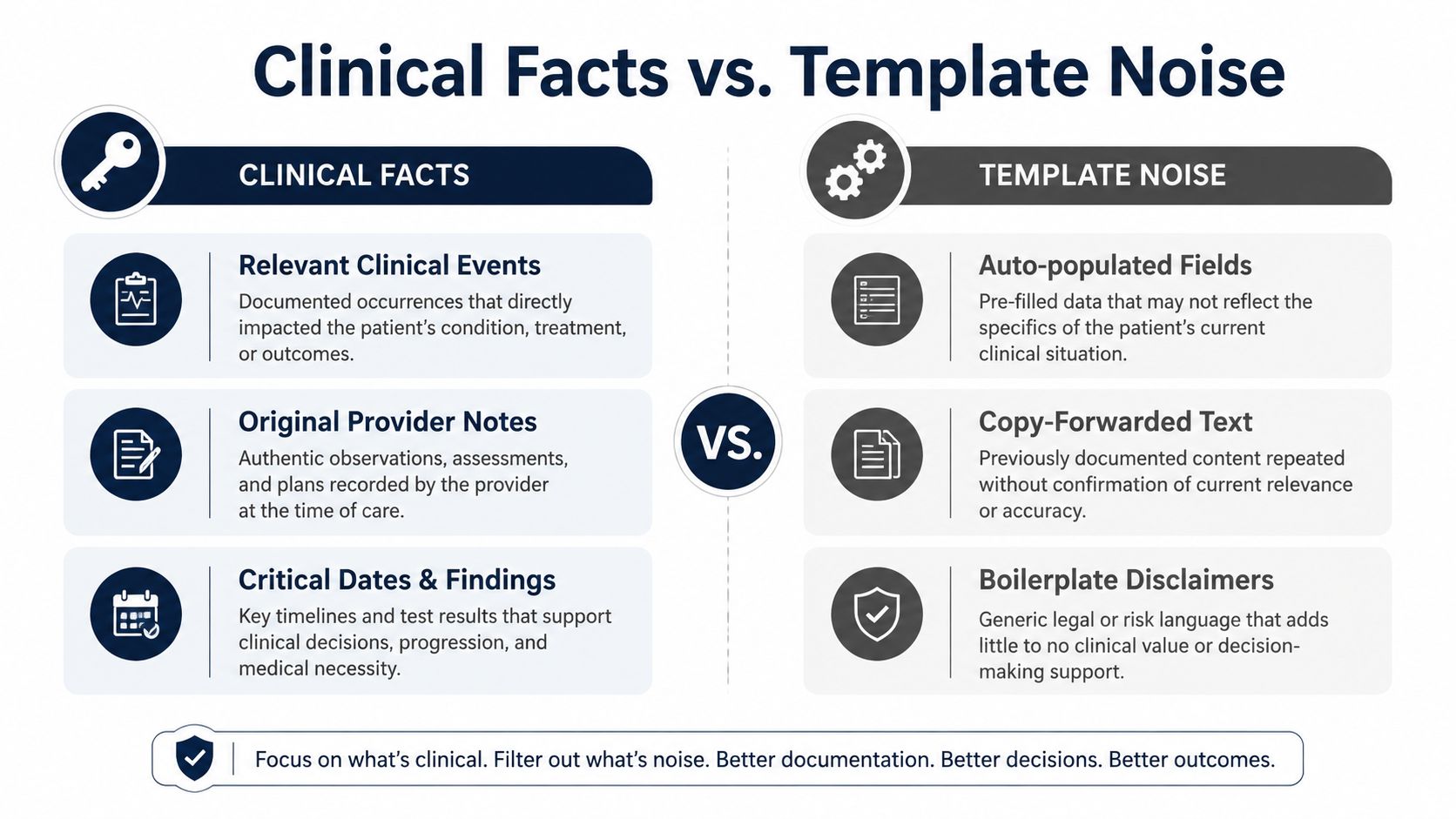
Electronic health records contain information that looks precise but may not describe a new clinical event. Auto-populated fields, copied-forward progress notes, default normal examinations, and medication reconciliation lists can repeat earlier content after the patient's condition has changed. A summary system may reproduce that language accurately while still producing a misleading account.
A clinical review therefore asks more than whether a phrase appears in the chart. It asks whether the entry reflects a contemporaneous observation, whether the provider took an action consistent with it, and whether objective data support or contradict it.
What reviewers should test
A note describing a patient as stable may sit beside vital signs, laboratory results, or imaging that indicate deterioration. A normal physical examination may be copied into several visits even though a procedure, new complaint, or medication change suggests a different clinical picture. The inconsistency itself may be important, but it shouldn't be labeled negligence without appropriate medical and legal analysis.
Reviewers should compare:
- Clinical language with actions: Did the provider order testing, change medication, admit the patient, or recommend follow-up?
- Repeated text with new data: Does the note contain new findings, or does it reproduce earlier language?
- Medication lists with administration records: Was a listed medication prescribed, given, discontinued, or merely carried forward?
- Narrative statements with objective material: Do imaging, laboratory results, vital signs, and procedure records support the written assessment?
- Claims with gaps: Is the alleged symptom documented at the expected point in the treatment sequence?
The polished summary isn't the evidence. The source record and the method used to interpret it are the evidence.
AI tools can sort pages, identify terms, and propose chronologies. They can also miss a clinically meaningful absence, flatten a contradiction, or give equal weight to a copied template and an original operative finding. Commentary on medical record review for attorneys and AI validation highlights the need for validation workflows, spot-checking, and gap-hunting.
Medication history deserves separate attention
Medication records often reveal changes in symptoms, treatment response, adherence concerns, or transitions between care settings. They can also contain discrepancies between prescribed medications, administered medications, discharge instructions, and later reconciliation lists.
Our discussion of medication history review addresses why those records should be assessed against the surrounding clinical documentation rather than copied into a chronology without context. A medication entry may support an inference, but it doesn't establish the reason for the prescription or the patient's actual use unless the surrounding evidence supports that conclusion.
In-House Review Versus Outsourced Forensic Partners
In-house review gives a firm immediate control over file access, issue selection, and communication with counsel. It works well for straightforward records when the team has the necessary medical literacy, enough protected time, and a defined quality-control process. It becomes less reliable when complex files arrive during active discovery, when multiple providers use inconsistent documentation, or when an attorney must later defend the review methodology.
Outsourcing can add clinical expertise and capacity, but it doesn't remove the firm's responsibility to define the legal question, provide complete records, protect privilege, and assess whether the resulting opinion fits the case. The strongest arrangement assigns each task to the person qualified to perform it.
| Factor | In-House Review | Outsourced Forensic Partner |
|---|---|---|
| Control | Direct access and immediate internal coordination | Defined intake, transmission, and reporting procedures |
| Clinical interpretation | Depends on internal medical knowledge or consultants | Physician-led analysis when the matter requires clinical expertise |
| Capacity | Limited by current staff workload | Adds outside capacity during complex or high-volume matters |
| Methodology | May vary by reviewer unless the firm standardizes it | Can provide a documented review protocol and validation path |
| Continuity | Attorney and staff remain familiar with the file | The partner can support review, supplemental analysis, and testimony planning |
| Risk management | The firm must identify and correct reviewer limitations | The firm must vet credentials, scope, confidentiality, and deliverables |
Survey data cited in industry guidance indicate that manual workflows may take 60 to 90 days or longer, while AI-enabled platforms report about 10 to 12 days in some workflows. Those figures should be treated as context, not a promise for a particular case, because record volume, complexity, missing documents, and expert availability affect the result.
A firm can improve its internal process by defining naming conventions, assigning a custodian for the master file, and using a written coding manual. Resources such as remote healthcare paralegal tips may help firms clarify staff responsibilities, but paralegal organization shouldn't be presented as physician-level causation analysis.
Commissioning a Review and Working With Forensic Pathologists
Before commissioning a review, counsel should provide a focused question rather than only a general request to “review the records.” The question may concern cause of death, injury chronology, treatment response, an alleged delay, competing explanations, or the limits of what the file can establish. The scope determines which records, specialists, and deliverables are appropriate.
Intake checklist for counsel
- Define the assignment: State the incident, disputed issue, procedural posture, and intended use of the report.
- Confirm authority: Provide the applicable authorization, subpoena materials, protective order, or other disclosure documentation.
- Transmit the record securely: Preserve original files, identify the source of each document, and maintain a clear transfer history.
- List missing materials: Separate records received from records requested, pending, unavailable, or disputed.
- Identify expected work product: Discuss a chronology, source-cited report, annotated timeline, written opinion, supplemental review, or testimony support.
- Coordinate disciplines: Identify whether pathology, radiology, toxicology, nursing, billing, engineering, or another specialty is also required.
For medical records used as exhibits, chain of custody means documenting who possessed the materials, when they were transferred, how they were stored, and whether the working copy changed. Chain-of-custody documentation doesn't prove the medical conclusion, but it supports confidence that the reviewed records are the records identified by the parties.
A cause of death is the disease, injury, or condition that initiated the fatal sequence. The manner of death describes the circumstances classification, such as natural, accident, suicide, homicide, or undetermined, when the governing authority makes that determination. A private review can assess medical evidence and identify limitations, but it doesn't replace the authority of the agency or official authorized under Texas law to make a formal determination.
Texas Autopsy Services performs attorney-focused reviews that organize medical records, build timelines, and identify inconsistencies or omissions. Every examination is performed by a forensic pathologist certified by the American Board of Pathology. For broader background on medical case review, counsel can review how a forensic practice approaches records, clinical questions, and documented limitations.
Most cases are completed within 24 to 48 hours when the necessary records, authorization, and logistical conditions are in place, but no fixed timeline applies to every matter. Record volume, testing, consultation needs, agency involvement, and the condition of the available evidence can affect completion.
Frequently Asked Questions
What does a medical record review for law firms include?
It commonly includes source identification, document organization, chronology development, review of diagnoses and treatment, analysis of gaps or contradictions, and a written explanation of supported findings and limitations. The scope should match the legal question and the type of expert opinion required.
Can AI-generated medical summaries be used as final evidence?
AI can assist with sorting, extraction, and preliminary chronology building, but an automated summary shouldn't be treated as a final medical opinion. Human reviewers must compare important entries with source documents, investigate missing or contradictory information, and document the validation process.
When should a firm involve a forensic pathologist?
A forensic pathologist may be appropriate when the case involves death, disputed cause or manner of death, complex injury mechanisms, medical treatment questions related to a fatal outcome, or a need to interpret pathology and postmortem evidence. The appropriate expert depends on the question, and some cases require additional specialists.
What is the chain of custody for medical records?
It is the documented history of possession, transfer, storage, and handling of the records used in the review. A clear chain helps show that the materials presented for analysis are authentic and have been preserved without unexplained alteration.
Does a private review replace an official Texas investigation?
No. A private autopsy or record review is independent analysis. The agency or official granted authority under applicable Texas law remains responsible for the formal process within its jurisdiction. Counsel should consider the Texas Funeral Service Commission and relevant provisions of the Texas Health & Safety Code, including Chapters 711, 716, and 651, when evaluating a matter.
For families and attorneys, a careful review can reduce confusion without overstating what medicine can prove. Our team at Texas Autopsy Services provides independent forensic pathology review, private autopsy services, and second-opinion analysis with direct communication, secure handling, and attention to documented limitations across all 254 Texas counties.
- For families: We explain the available options and the records needed to address a postmortem question.
- For attorneys: We organize medical evidence, identify omissions and inconsistencies, and provide clinically grounded forensic analysis.
- For counties and agencies: We support forensic autopsy needs with in-house licensed transport and documented chain-of-custody procedures.
If a death investigation or disputed medical timeline leaves important questions unresolved, please contact our team directly to discuss the records, authorization, and scope of review that may be appropriate. Visit Texas Autopsy Services to request confidential guidance.