March 4, 2026 · Texas Autopsy Services
A Forensic Pathologist's Guide to Medical Case Review
Learn how a forensic medical case review can provide clarity on cause of death. A guide for families and attorneys seeking answers and expert opinions.
On this page
- What Is a Forensic Medical Case Review?
- When a Medical Case Review Becomes Necessary
- Case Review vs. Second Autopsy: What's the Difference?
- The Medical Case Review Process Step by Step
- What Documents Do I Need to Conduct a Review?
- Understanding the Legal and Financial Aspects
- Answering Your Questions About Medical Case Reviews
As a forensic pathologist, I often get calls from families and attorneys who have an autopsy report in their hands but still feel they don’t have the full story. A forensic medical case review is what I do to help them find those answers. It’s my independent, in-depth look at all the existing medical records, autopsy findings, and other evidence after a death has occurred. Think of it as a methodical search for clarity.
TL;DR: Key Takeaways
- An independent medical case review is a non-invasive analysis of existing records to confirm or clarify the cause and manner of death.
- I perform every review as a board-certified forensic pathologist, ensuring an objective, expert opinion based solely on evidence.
- This process is critical for families seeking closure and for attorneys evaluating the merits of a legal case.
- A thorough review requires gathering all relevant documents, including medical charts, lab results, and the full, original autopsy report with photos.
What Is a Forensic Medical Case Review?
Many people assume a cause of death is the final word, but that’s not always true. Sometimes, crucial questions remain. A forensic medical case review is an expert second opinion based on the paper trail left behind. Unlike a new autopsy, my work here focuses entirely on analyzing the existing documents to provide an unbiased, expert perspective.
My job is to be a fresh set of expert eyes, applying my experience as a board-certified forensic pathologist to the case facts. I’m not connected to the hospital or government agency that performed the initial investigation. That independence is crucial. It means I can assess the evidence without any institutional bias or preconceived ideas.
The Purpose of an Independent Review
The reason for a review often depends on who is asking. For a family, it might be about finding peace. For an attorney, it might be about building a case. My analysis is always tailored to a few key goals:
- Confirming the Facts: I painstakingly review all the documents to ensure the original investigation's conclusions are sound and consistent.
- Spotting Discrepancies: I search for any contradictions, like when an autopsy finding doesn't quite line up with the person's documented medical history.
- Finding What Was Missed: Medical records are incredibly dense. It's not uncommon for a small but critical detail to be overlooked, and my job is to find it.
- Providing a Defensible Opinion: For legal cases, I deliver a clear, evidence-based opinion on the cause and manner of death that can stand up in court.
It’s important to know that a review doesn’t always mean we’ll find an error. In many cases, my work simply confirms the original findings. While that might not sound dramatic, it provides something incredibly valuable: peace of mind. Knowing that a second, independent expert has validated the conclusions can be a powerful source of closure for a grieving family.
As a forensic pathologist with over 1,000 autopsies performed, I’ve learned that the truth is found in the details. A thorough review ensures no detail, no matter how small, is left unexamined in the pursuit of accurate answers for your family or your client.
Ultimately, a medical case review is about making sure the complete and honest truth comes out. Whether you need personal closure or support for a legal matter, my role is to provide an objective, medically sound analysis based purely on the evidence. It’s a path to clarity when you need it most.
When a Medical Case Review Becomes Necessary
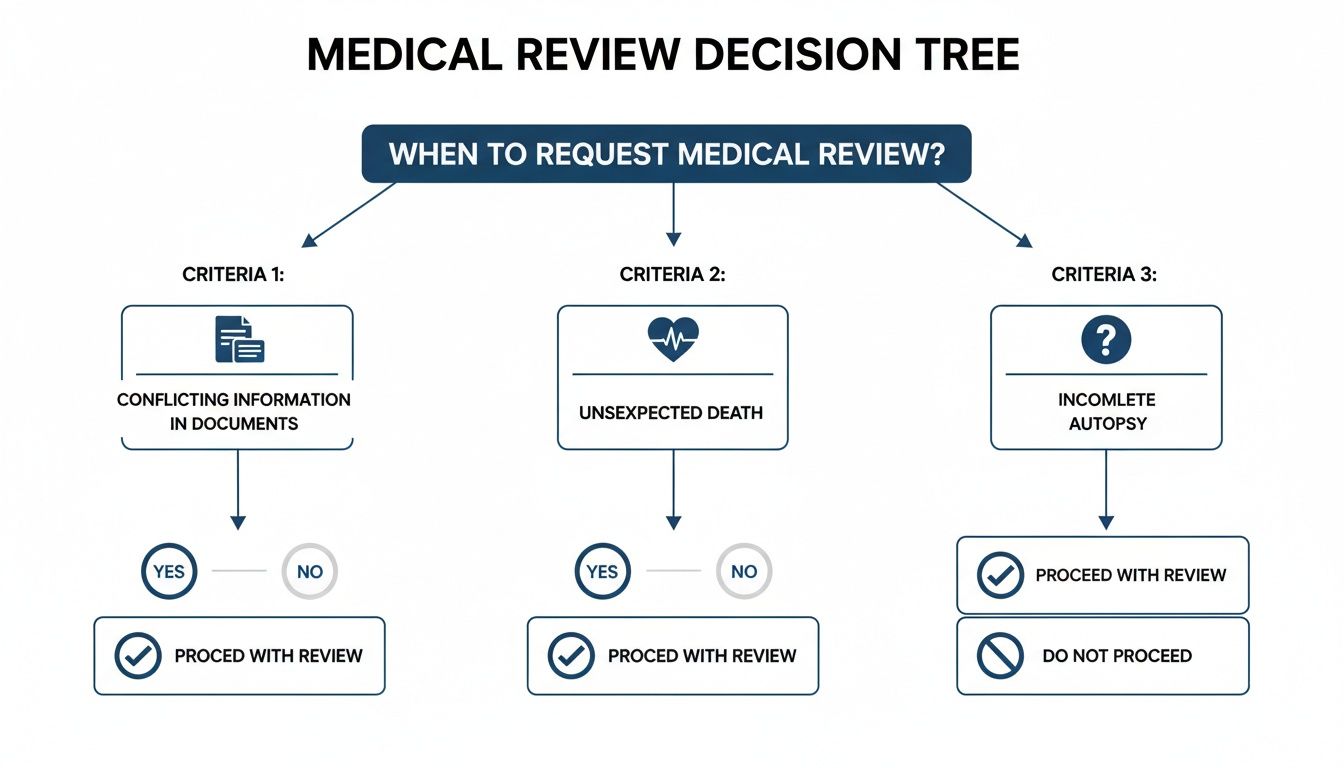
Families and lawyers often ask me when it's the right time to request a medical case review. There isn't a single answer, but a few common threads usually point to it being the right next step. It becomes essential when the story just isn't adding up. You might be getting conflicting information from different doctors, or the official autopsy report doesn't seem to match what you knew about your loved one’s health. These are the moments where an independent forensic pathologist can bring much-needed clarity.
Triggers for Families Seeking Answers
For a family, the decision is deeply personal. It’s about getting to the truth of what happened to someone you love. In my experience, the push for a review often comes from a few key situations:
- An Unexpected Outcome: Your loved one went in for what was supposed to be a routine procedure, or they were considered stable, and then things took a sharp, unexplained turn for the worse.
- Contradictory Information: You’re hearing one thing from the nurse, another from the attending physician, and something else entirely from a specialist. The timeline of events feels muddled and inconsistent.
- Incomplete or Vague Autopsy Findings: The cause of death on the report might be listed as something general, like "cardiac arrest," which doesn't really explain why. It leaves you with more questions than answers.
- Concerns About Quality of Care: You have a nagging feeling that the medical care provided wasn't what it should have been. You need an expert to look at the records and tell you if your concerns are valid.
In these cases, a medical case review provides an objective, professional analysis of the facts. My job is to piece together the medical journey and give you a clear, straightforward explanation based purely on the evidence.
Why Attorneys Request a Case Review
For legal professionals, the purpose is a bit different but just as crucial. A case review is often the first step in building a solid, evidence-based legal strategy. Attorneys usually bring me in when they need to:
- Evaluate a Potential Malpractice Claim: Before ever filing a lawsuit, a review is critical to determine if the standard of care was breached and, more importantly, if that breach directly caused the patient's death. My findings help establish medical merit from the start.
- Clarify Cause of Death in a Wrongful Death Case: Whether the case stems from a car accident, a workplace incident, or something else, my review can help draw a firm, scientific line connecting the event to the death.
- Dispute an Official Autopsy Report: If the cause of death from a county medical examiner is in question, my independent analysis provides the board-certified, credible evidence needed to challenge the official findings.
- Incorporate New Evidence: Sometimes, new information comes to light long after an initial exam. A review can incorporate this new data to create a more complete and accurate medical picture.
A forensic pathologist's review can be the critical element that transforms a case from speculation into a solid, defensible position. My analysis provides attorneys with the unbiased, scientific foundation needed to effectively advocate for their clients.
Ultimately, whether you're a family member seeking peace of mind or an attorney building a case, the decision comes down to a need for certainty. My role is to cut through the confusion, provide definitive answers, and make sure every medical detail is accounted for.
Case Review vs. Second Autopsy: What's the Difference?
When families or attorneys reach out to me for help, one of the first questions they often ask is about getting a “second autopsy.” While that’s an option in some cases, it’s not always the best or most necessary step. It's crucial to understand the difference between a medical case review and a second autopsy. They are two very different approaches, and choosing the right one can save you time, money, and emotional strain.
The Document Detective vs. The New Examination
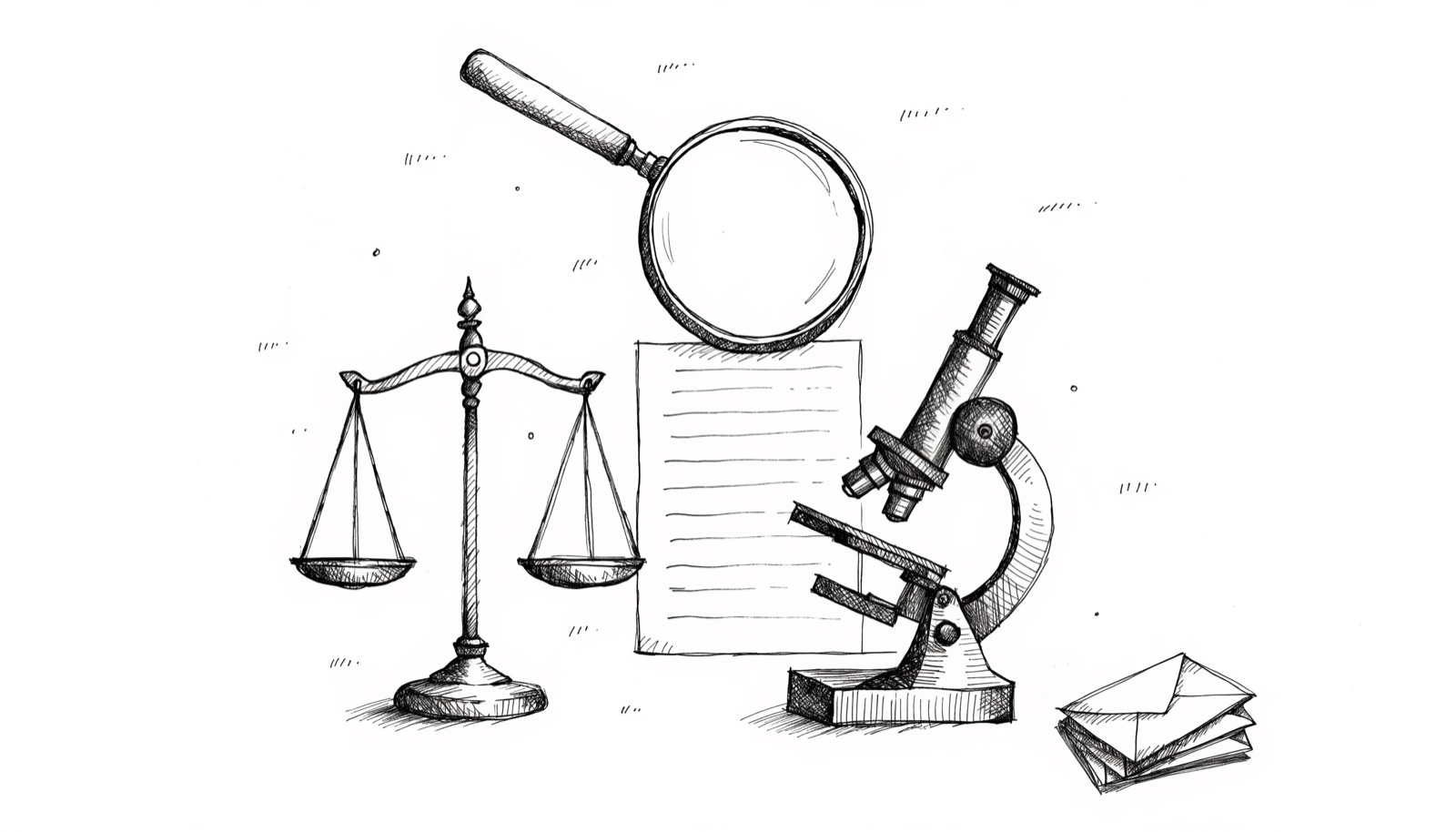
Think of a medical case review as a "documentary investigation." My job is to be a detective, but my evidence is the paper trail. I go over every available document—hospital charts, paramedic reports, toxicology results, tissue slides, and the original autopsy report with any photos. It's a non-invasive process focused entirely on analyzing the information that already exists.
A second autopsy, on the other hand, is exactly what it sounds like: a new, hands-on physical examination of the deceased. This is done to gather fresh information directly from the body. However, its success is highly dependent on timing, the thoroughness of the first autopsy, and whether the body has been embalmed or buried.
Choosing the Right Path
In my experience, starting with a medical case review is almost always the most logical first move. It allows me to get a clear picture of the initial investigation's quality without taking the significant step of a second physical exam. Often, this review reveals that the answers were there all along, just hidden in the records.
Here’s a quick breakdown of what sets them apart:
- The Foundation: A review works with existing documents and evidence. A second autopsy is about creating new physical evidence.
- The Procedure: A review is analytical work done at a desk. A second autopsy is a hands-on, surgical procedure.
- The Timing: A review can be performed anytime, as long as the records are available. A second autopsy is extremely time-sensitive and isn't always possible.
Comparing a Medical Case Review and a Second Autopsy
To make the choice clearer, I've put together a table that directly compares a document-based review with a new physical autopsy. This should help you understand which approach might be better suited for your specific needs.
| Aspect | Medical Case Review | Second Autopsy |
|---|---|---|
| Primary Goal | To analyze and interpret existing data, identify inconsistencies, and provide an expert opinion on the original findings. | To conduct a new physical examination to gather fresh evidence, collect new tissue samples, and document findings independently. |
| Material Required | Complete medical records, toxicology, histology, original autopsy report, and photographs. | The body of the deceased, which must be accessible and in a condition that permits a meaningful examination. |
| Invasiveness | Non-invasive. The entire process is a review of paperwork and digital files. | Invasive. It is a surgical procedure that requires proper facilities and handling of the deceased. |
| Typical Outcome | A detailed expert report summarizing findings, confirming or challenging the original cause of death based on the provided evidence. | A new autopsy report with independent findings, which may require comparison to the original report to identify discrepancies. |
| Best For | Cases with extensive medical records, concerns about the interpretation of data, or when a second physical exam is not feasible. | Cases where the original autopsy was limited, key organs were not examined, or there is strong reason to suspect missed physical evidence. |
A medical case review is the essential first step to see if the answers you need are already waiting in the existing records. More often than not, a careful and objective review of the documents is all it takes to find the truth, avoiding a more invasive and difficult process.
Ultimately, my goal here at Texas Autopsy Services is to guide you to the most direct and compassionate path to the truth. For many families and legal teams, that journey begins with a meticulous medical case review—a focused analysis that frequently provides the definitive answers needed to close a case or bring peace of mind.
The Medical Case Review Process Step by Step
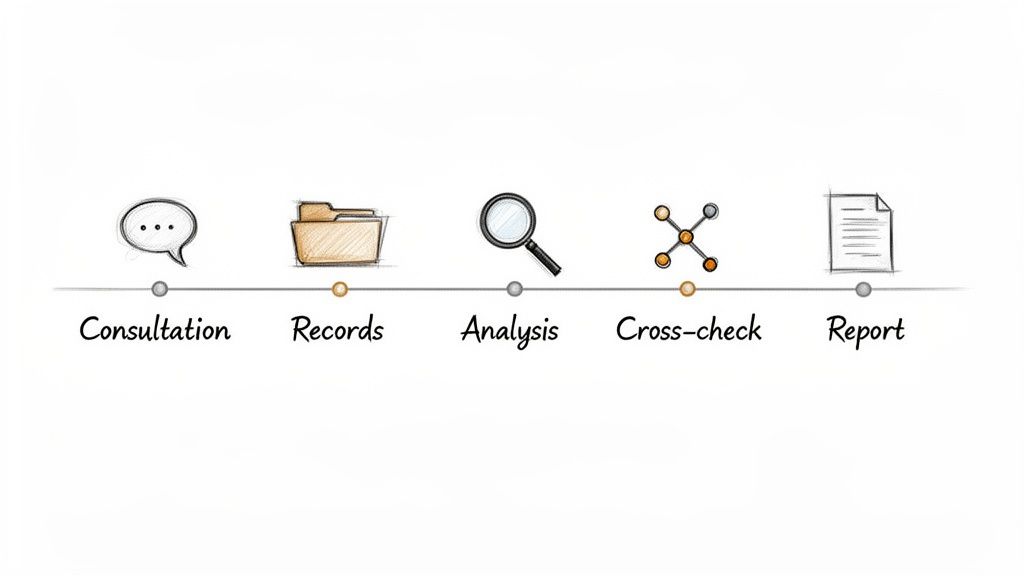
To give families and attorneys the answers they need, I follow a very deliberate process for every medical case review. It’s not just about reading documents; it’s about piecing together a story. I’ve refined this system over years of practice to make sure no stone is left unturned and that the final report is clear, objective, and directly addresses your questions. Each step builds on the last, turning what often looks like a mountain of confusing paperwork into a coherent medical narrative.
Step 1: Initial Consultation
Everything starts with a conversation. In our first talk, I focus on listening to you to understand exactly what you need to know. Are you a family member trying to find peace of mind about a loved one’s final days? Or are you an attorney trying to determine if a case has merit? This discussion is absolutely critical. It helps me focus my review on what matters most to you and gives me a chance to be upfront about what we can realistically find out from the available information.
Step 2: Comprehensive Record Gathering
After we decide to move forward, the next job is to gather all the relevant documents. Honestly, this is the most important part of the entire process. The quality of my analysis is directly tied to how complete the records are. My team and I will help you round up everything needed for a thorough review. This usually means collecting:
- Complete medical histories from every doctor and hospital involved.
- Emergency services reports, like notes from paramedics or first responders.
- The full, unredacted autopsy report, which must include all photos and toxicology results.
- Police or law enforcement reports if an investigation was part of the case.
Getting these records can sometimes be a hurdle, but it’s a necessary one. The more complete the paper trail, the stronger and more definitive my findings will be. For legal professionals, digging into the details of these documents is crucial, and you can see more on my approach in our guide on reviewing medical records for attorneys.
Step 3: Meticulous Analysis and Timeline Construction
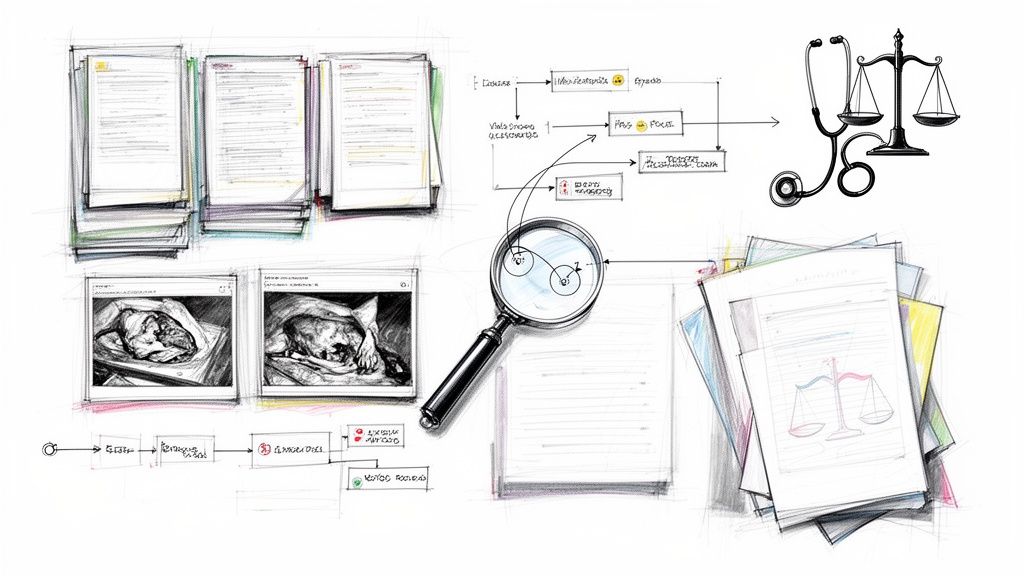
Once I have all the materials, the real analytical work begins. I go through every single document, page by page. My first task is to build a detailed timeline, mapping out every event, treatment, and clinical decision from the moment of admission to the time of death.
This is where the story starts to take shape from the raw data. I carefully compare the autopsy findings with the doctor's notes, lab work, and any witness accounts to see how everything fits together.
Step 4: Discrepancy and Consistency Checks
As I create the timeline, I’m constantly on the lookout for two things: consistencies and discrepancies. Do the physical findings in the autopsy report match the symptoms that were documented in the hospital? Are there strange gaps in the medical chart? Are there any contradictions between what different reports say? This cross-checking process is often where the most important insights are discovered.
Step 5: The Final Expert Report
The last step is to pull all of my findings together into a single, comprehensive report. This isn't just a summary; it's a detailed analysis where I provide my professional opinion on the cause and manner of death. I write it to be clear, factual, and ready to stand up to legal scrutiny. Most importantly, the report gives you direct answers to the questions we discussed in our very first conversation. My goal is to provide you with the certainty you deserve, backed by board-certified expertise and a commitment to getting to the truth.
What Documents Do I Need to Conduct a Review?
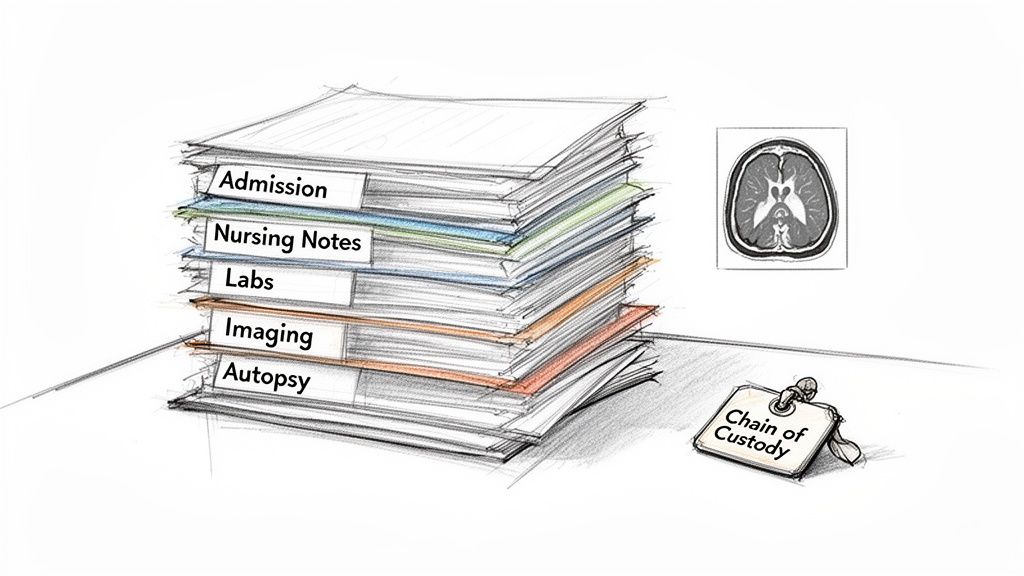
The quality of any medical case review I perform hinges entirely on one thing: the completeness of the records you provide. My analysis is only as strong as the information I have to work with. Think of me as a detective putting together a complex puzzle. Each medical document is a crucial piece. A lab report gives me a snapshot of a specific moment, while nursing notes offer a running narrative of a patient's condition over hours or days. Only by seeing how all the pieces fit together can I uncover the full story. That’s why gathering every single relevant file is the most critical first step we’ll take.
Core Documentation Checklist
To get started, my team and I request a standard set of documents. This list covers the fundamentals and provides the core of my investigation.
- Hospital Admission and Discharge Summaries: These act as bookends for a hospital stay, detailing the reason for admission and the final outcome.
- Physician’s and Nursing Notes: I find these day-to-day entries invaluable. They provide a real-time window into the patient's condition, the treatments they received, and how they responded.
- Complete Laboratory Results: Every bit of blood work, culture, and other lab test is essential for understanding what was happening inside the body.
- Imaging Scans and Reports: This includes all X-rays, CT scans, MRIs, and ultrasounds, along with the official interpretations from the radiologist.
- The Full Autopsy Report: If an autopsy was done, I need the entire, unedited report. This must include all photographs and toxicology results, as they often contain the most revealing details.
This systematic approach is much like using a professional due diligence checklist template; it ensures we methodically gather and account for every piece of the puzzle. When we’re searching for the truth, nothing can be left to chance.
Special Considerations for Legal Cases
When a case review is part of a legal matter, like a potential malpractice claim or a wrongful death lawsuit, the bar for documentation gets even higher. Here, the process becomes much more formal.
For any legal review, establishing an unbroken chain of custody is non-negotiable. This is especially true for physical evidence like histology slides or tissue blocks. A solid chain of custody guarantees that the evidence is admissible and its integrity can’t be challenged in court.
The final report I write is only as credible as the documents that back it up. To see how I synthesize this information into a cohesive analysis, you might find it helpful to look at an example of a pathology report on our blog. It shows exactly how I bring all the evidence together to provide clear, definitive answers.
Understanding the Legal and Financial Aspects
When you're looking for answers in a complex medical situation, you naturally have questions about the legal and financial side of things. My job is to give you a clear, defensible medical opinion, and that starts with being upfront about what the entire process involves. Legally, my role is to act as an independent expert. My analysis and conclusions are based entirely on the evidence found in the medical records, lab results, and other documents provided. This independence is what makes my findings credible and able to stand up to scrutiny. As a board-certified forensic pathologist, I prepare every report with the understanding that it might be challenged in a legal setting.
Legal Standing and Expert Opinion
My final report is more than just a summary of medical records. It’s a professional medical opinion designed to be clear, factual, and defensible in court. The goal is to explain the complex medical science to judges, juries, and attorneys in a way that everyone can understand. It's also important to be clear about where my expertise begins and ends. I provide the medical-legal foundation for a case—the scientific facts—but I don't give legal advice. My work is meant to arm your legal team with solid, evidence-based medical science.
Financial Investment and Value
The cost of a medical case review is a practical consideration. I believe in being transparent here. The final fee depends on three key factors:
- Volume of Records: A case with a few hundred pages of records is very different from one with thousands. The more there is to review, the more time it takes to do it right.
- Case Complexity: Some cases are straightforward. Others involve long hospital stays, multiple specialists, or conflicting reports that require a much deeper dive to untangle.
- Expert Testimony: The initial review and report is one step. If the case moves forward and requires me to provide testimony in a deposition or at trial, that is a separate service.
The financial structure is often related to that of a private autopsy. If you're interested, you can learn more about who pays for autopsies in our guide on the topic.
An independent medical case review is an investment in certainty. It provides the clarity needed to make informed decisions, whether for personal closure or for pursuing a legal claim.
This investment is especially critical today. With the cost of care always on the rise, the financial stakes in cases involving medical treatment are higher than ever. In fact, these global medical cost trends from WTW project that medical trend rates will hit 10.4% in 2026. This economic reality makes an accurate, unbiased review essential, particularly when future medical costs or damages are part of a legal dispute. My commitment is to make sure you understand both the process and the investment, so you can move forward with confidence.
Answering Your Questions About Medical Case Reviews
Over the years, I've had countless conversations with families and attorneys who are trying to make sense of a difficult situation. A medical case review often comes up, but the process can feel confusing. I've put together answers to some of the most common questions I hear. My hope is to give you the straightforward information you need to decide what’s right for you.
How Long Does a Medical Case Review Take?
The honest answer is: it depends. The timeline for a medical case review really comes down to two things: how complex the medical history is and how quickly we can get all the necessary records. For a more straightforward case where the documents are organized and readily available, I can often deliver my findings in a few weeks. But if we're dealing with a long medical history spanning years and multiple hospitals, or if we have to formally request things like original tissue slides from another lab, it will naturally take longer. I always prioritize being thorough over being fast. Once I have a chance to understand your specific situation, I can give you a much clearer timeline.
Can a Review Change the Official Cause of Death?
This is a big one, and something I get asked all the time. While I can't personally walk into a government office and change a death certificate, my review can be the critical piece of evidence needed to make that change happen. If my investigation uncovers compelling proof that points to a different cause of death than what’s on record, I will document it all in a detailed, board-certified report. That report becomes a powerful tool for your attorney. It gives them the solid medical-legal footing they need to petition the court or vital statistics office to amend the official record. Think of my findings as the scientific backbone for their legal argument.
What if the Autopsy Report Is Unavailable?
An autopsy report is incredibly helpful, but a case isn't a dead end without one. I can still perform a deep and meaningful review using all the other information available. This includes hospital charts, lab results, imaging scans, and even first-responder notes. In these situations, my job is to piece together the entire medical story from the available data. From there, I can determine the most probable cause and manner of death. The final opinion might be stated with a bit more qualification, but it can still provide the crucial answers you're looking for, especially when an autopsy was never performed or the report is being withheld. In these complex cases, the guidance of medico legal experts can be especially important for navigating the legal and financial landscape.
At Texas Autopsy Services, my goal is simple: to provide the clarity and answers you deserve. If you still have questions or feel a medical case review could help your family or your client, please reach out to my office for a confidential conversation.
You can learn more about my services at https://www.texasautopsyservices.com or at my practice through our partnership with Waterloo Mortuary. I also regularly consult on private autopsies and for Texas counties needing forensic pathology support for their county forensic autopsies.