January 22, 2026 · Texas Autopsy Services
An Attorney's Guide to Reviewing Medical Records
Discover practical steps for reviewing medical records for attorneys and learn how a forensic pathologist can bolster your case.

On this page
Medical records in a legal case can feel like a chaotic puzzle. As a forensic pathologist who has performed over 1,000 autopsies, I’ve seen firsthand how a single, overlooked detail in a patient’s chart can change the outcome of a case. The truth is often buried in stacks of physician’s orders, nursing notes, and lab reports. Your first job is to bring order to that chaos. A methodical approach from the beginning is essential. A single handwritten note from a triage nurse can sometimes be as important as the final autopsy report itself. My goal here isn't just to help you organize a file, it's to help you build a powerful strategic asset. How you structure these records at the outset lays the foundation for expert consultation, depositions, and trial.
- TL;DR: Key Takeaways
- A structured medical record review is the foundation of any strong medical-legal case.
- The process involves organizing records, building a clear timeline, and identifying inconsistencies or omissions.
- Engaging a medical expert early, like a forensic pathologist, can clarify causation and standard of care issues.
- Missing records or conflicting entries are often critical red flags that can become central to your legal argument.
- Understanding the difference between cause of death and manner of death is fundamental in wrongful death litigation.
Organizing the Initial Medical Record Review
Before analysis can begin, you must obtain a complete set of records. This is a precise administrative and legal task. Mistakes here can cause significant delays or even compromise your case. First, ensure you have the proper legal authority, which is typically a HIPAA-compliant medical authorization signed by the patient or their representative, or a legal instrument like a subpoena. When you draft the request, be specific. A generic request often results in an incomplete file. To avoid follow-ups, be explicit and ask for all relevant documents, including:
- Physician’s Orders and Progress Notes: These documents reveal the clinical thought process and patient care plan.
- Nursing Notes: Often the most detailed, minute-by-minute account of a patient's condition.
- Diagnostic Imaging and Lab Results: Objective data such as X-rays, CT scans, blood work, and toxicology reports.
- Consultation Reports: Notes from any specialists involved in the patient's evaluation.
- Medication Administration Records (MAR): A log of every drug administered, including the dose, time, and route.
- Pathology and Autopsy Reports: In cases involving a death, these are cornerstone documents for establishing the cause and manner.
Once the records arrive, triage is the next step. Not every page holds the same weight. Separate clinically significant documents from administrative filler like billing statements. This allows you to build a preliminary timeline and focus on the key medical events that will shape your legal strategy.
As a forensic pathologist, I cannot overstate the importance of a well-organized file. It allows me to go directly to the core medical facts, which saves attorneys time and provides a clearer path to the answers they need.
For law firms managing large volumes of documents, new tools can make this initial sorting more efficient. Technologies like intelligent document processing are designed to extract and organize key data from large, unstructured files, which can improve efficiency.
An Essential Checklist for Initial Triage
After separating the core documents, the next step is to organize them into a logical structure. Building a system that prioritizes the most impactful information is key. I've developed a detailed process for this, and you can learn more about my approach to these comprehensive medical records reviews on our blog. To get you started, here is a simple checklist of the first documents I always look for. This table breaks down the essential records you should prioritize at the beginning of any case involving medical evidence.
Essential Documents for Initial Record Triage
| Document Type | Why It's Critical | What to Look For |
|---|---|---|
| Admission & Discharge Summaries | Provides a high-level overview of the entire hospital stay, including final diagnoses and patient disposition. | Discrepancies between the admitting diagnosis and the final diagnosis; reasons for admission. |
| Physician's Orders | Shows the direct commands for patient care, including medications, tests, and procedures ordered. | Changes in orders, STAT orders, or orders that were not carried out by nursing staff. |
| Nursing Notes | Offers the most detailed, real-time chronicle of the patient’s condition and responses. | Changes in vital signs, patient complaints, communications with family, and nursing interventions. |
| Pathology & Lab Reports | Contains objective data that confirms or contradicts clinical impressions. | Abnormal values, critical results that were not addressed, and inconsistencies with physician notes. |
This initial triage isn't just about creating a neat file; it's about building the narrative of your case from the ground up, one critical document at a time.
Building a Clear Medical Narrative and Timeline
Once the records are organized, the real work begins. This is not just about listing dates and procedures. It’s about taking raw information and weaving it into a coherent story of a patient's medical journey. You are translating complex medical jargon into a clear, chronological narrative that a judge or jury can understand. A disorganized file can hide the truth; a well-constructed timeline brings it to light. This initial process, from obtaining the records to structuring them for review, sets the stage for everything that follows.
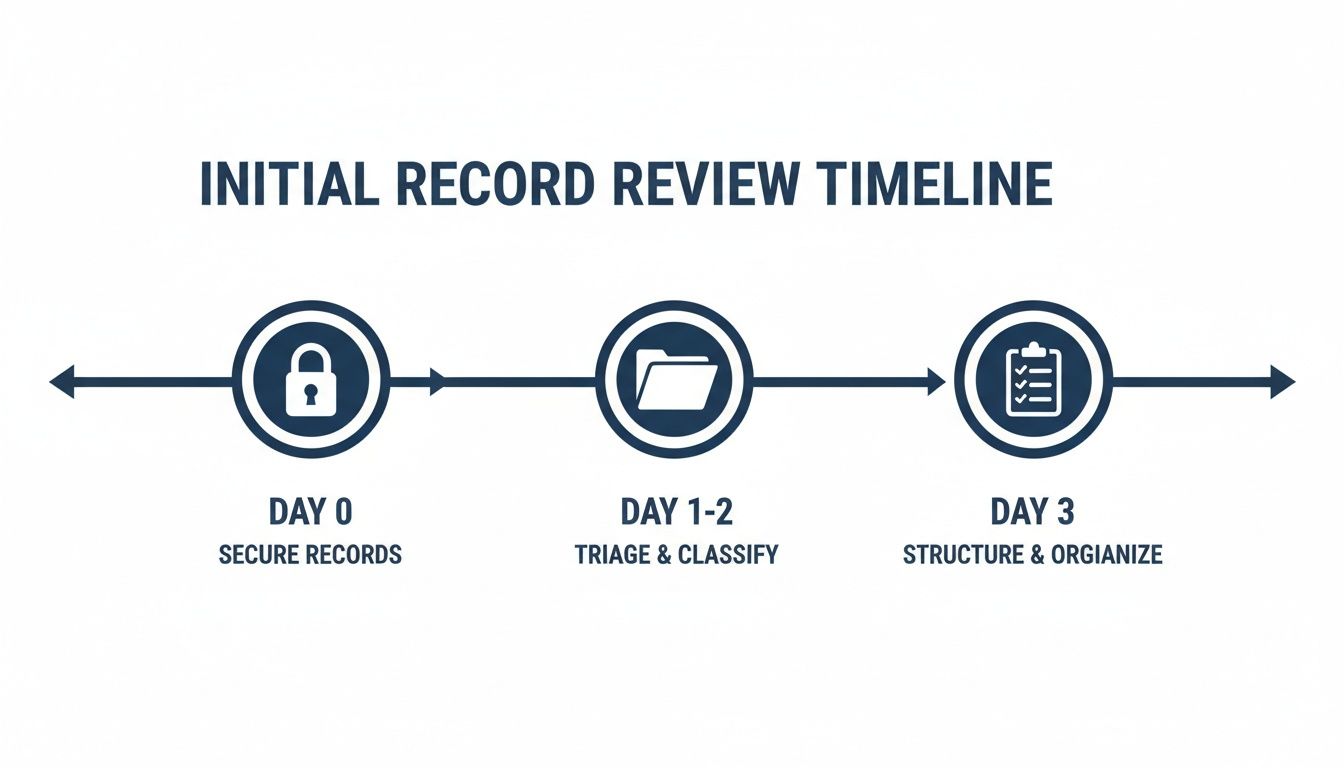
With this structure, a chaotic mountain of paper transforms into an organized, analyzable asset, perfectly primed for expert review.
Establish the Patient's Baseline Health
Before you can argue that a specific event caused harm, you must establish the patient’s health before that event. This baseline is your anchor for comparison. It’s how you demonstrate a sharp deviation from their normal state of health. For example, in a case involving a suspected medication error that led to kidney failure, the first thing I would look for are historical creatinine and BUN levels. If the patient's kidney function was stable for years and then suddenly declined after a hospital stay, that contrast creates a powerful timeline. Without that baseline, the defense may argue the condition was pre-existing.
Connecting the Dots Chronologically
With a baseline established, I move forward in time, building the narrative. This is a step-by-step process of linking clinical observations, diagnostic data, and treatment decisions. It is about establishing cause and effect. At every point on this timeline, I focus on a few critical questions:
- What did the clinical team know? This information is found in nursing notes, physician progress reports, and consultant findings.
- When did they know it? Timestamps are crucial. A critical lab value is meaningless if you can't prove when it was reported.
- What did they do about it? Here I cross-reference lab results with physician’s orders and medication administration records. Did a critical alert trigger a timely and appropriate response?
This method brings a static record to life, turning it into a dynamic story. You start to see the human decisions and potential deviations from the standard of care.
Identifying Pivotal Inconsistencies
The true leverage in a medical narrative often comes from uncovering inconsistencies. These are the cracks in the official story. A trained eye is crucial here, as these contradictions are rarely obvious. For instance, a physician’s note might describe a patient as "alert and comfortable," while nursing notes from the same hour detail agitation and a spike in blood pressure. That's not a minor discrepancy; it's a significant red flag that requires focused investigation.
A well-built timeline doesn't just organize facts; it exposes contradictions and reveals the untold story of your case. It’s often in these discrepancies that the core of a legal argument is found.
To effectively piece together a cohesive story from these scattered entries, it helps to adopt a structured analytical mindset. Many of the same principles used in qualitative research analysis methods apply here, synthesizing disparate pieces of information into a logical whole. The speed at which we can do this has changed significantly. Manual medical record reviews that once took months can now be completed much faster with advanced platforms. Ultimately, while technology helps with gathering and sorting, it takes human expertise to build the final narrative. An experienced pathologist can spot subtle clinical nuances that software might miss.
Spotting Red Flags and Critical Omissions
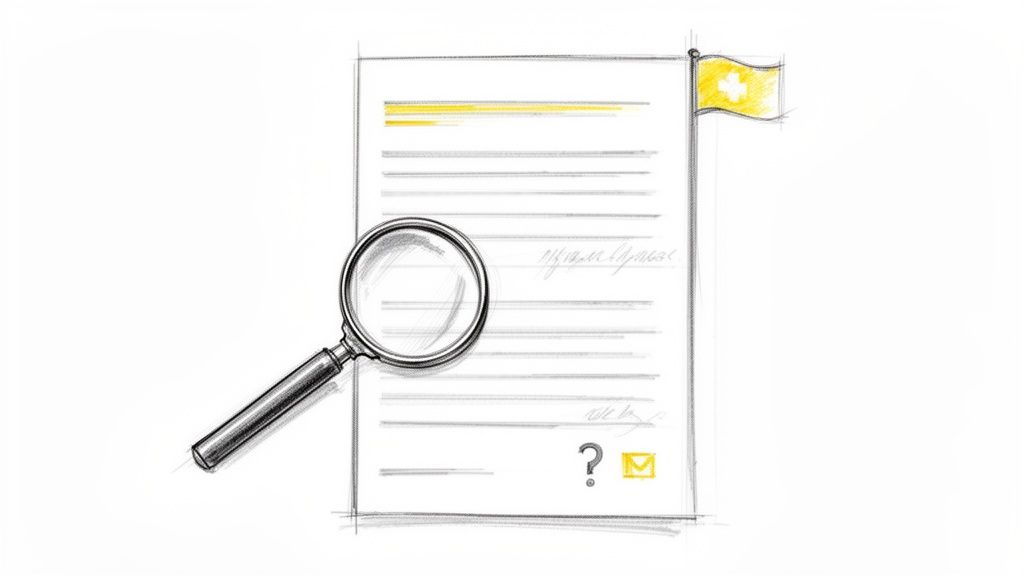
Having a complete, organized set of medical records is just the first step. The real work is reading between the lines to find what isn't there. After performing more than a thousand autopsies, I can tell you that gaps and inconsistencies in a patient's chart often tell a more compelling story than the official entries. This is where a trained medical eye becomes a valuable legal asset. Attorneys are skilled at finding contradictions in testimony, but medical records present a different challenge. The red flags are often subtle, such as suspicious patterns, illogical timelines, and critical omissions that suggest a deviation from the standard of care.
Uncovering What's Missing
Often, the most powerful evidence lies in what is missing. A missing form or a quiet period in the chart during a critical event can suggest negligence more strongly than any written note. The first thing I do is look for what should be in the records but isn't. Here are some of the most telling omissions I consistently look for:
- Missing Nursing Notes: A gap in nursing documentation, especially during a critical event like a code blue or a sudden patient decline, is a massive red flag. Nurses are trained to document thoroughly during high-stakes moments. A blank space may suggest chaos or a conscious decision to obscure events.
- No Informed Consent: A risky procedure performed without a properly signed consent form can be problematic. The documentation must show the patient or their proxy was informed of the risks, benefits, and alternatives.
- Delayed or Missing Critical Lab Follow-Up: A lab result flagged as "critical" demands immediate physician action. If I see a critical value in the chart with no corresponding note, order, or intervention for hours, it points to a potential breach in the standard of care.
Identifying Altered or Inconsistent Entries
Beyond gaps, I look for signs of alteration or contradictions. Even with the audit trails in modern electronic health records (EHRs), inconsistencies appear, especially when comparing different sections of the chart. A classic example is when a physician’s progress note clashes with the nursing flow sheet from the same time. The doctor might write, "patient resting comfortably," while the nurse’s notes detail escalating pain and unstable vital signs. This is not just a minor discrepancy; it's a direct challenge to the doctor's credibility. I also scrutinize medication administration. Does the timing of a drug dose in the Medication Administration Record (MAR) align with the doctor's order and the patient's documented symptoms? A delay in administering a crucial antibiotic can become the central pillar of a negligence claim.
A forensic pathologist’s review isn’t just about the cause of death. It’s a comprehensive analysis of the entire clinical picture. An overlooked toxicology detail or a subtle finding in a perinatal autopsy can completely reframe a case.
Scrutinizing the Autopsy Report
When a death is involved, the official autopsy report itself can contain red flags. An incomplete or overly simplistic report may signal the need for a second-opinion autopsy or an independent review. At Texas Autopsy Services, I frequently review reports where the stated cause of death does not align with the clinical history or the pathologist's own findings. For instance, a report might list "cardiac arrest" as the cause of death. That's a mechanism, not a cause. The real question is why the heart stopped. A thorough autopsy answers that question. Vague language or findings that contradict the medical records are clear signs that a deeper investigation is needed. Spotting these red flags requires a blend of medical knowledge and an investigative mindset. It’s about knowing what should have happened, comparing it to what was documented, and methodically questioning every gap.
How to Work with Medical Experts
Once you've organized the medical records into a coherent timeline, it's time to bring in a medical expert. You bring the legal knowledge, and they bring the medical insight. Combining those two perspectives is what builds a strong case. Understanding when and how to engage an expert, like a forensic pathologist, is about turning clinical data into a clear, persuasive legal argument.
Knowing When to Call a Forensic Pathologist
While a treating physician can be valuable, a forensic pathologist offers a different perspective, especially in cases involving death, catastrophic injury, or complex questions of causation. My role isn't just to perform an autopsy; I'm trained to assemble the entire puzzle, including medical history, records, and circumstances, to determine not just the cause of death, but the manner of it. Consider bringing in a forensic pathologist when you face:
- An Ambiguous Cause of Death: The official report is vague or doesn't align with the clinical history.
- Suspected Medical Negligence: You need an objective analysis of whether the standard of care was breached and if that breach directly caused harm.
- Complex Causation: The case involves a mix of pre-existing conditions, new injuries, and multiple potential factors.
- A Second Look at an Autopsy: You suspect the original findings are incorrect and need an independent review.
My work at Texas Autopsy Services is built on providing attorneys with these objective, evidence-based opinions that can withstand the pressure of depositions and trial.
How to Prepare Records for Your Expert
Sending an expert a disorganized dump of thousands of pages is a waste of time and money. To get the most value from our collaboration, you need to be prepared. A thoughtfully curated package will help us get to the heart of the matter quickly. All I need to start is:
- A one-page summary of the case facts and the key legal questions you're trying to answer.
- The core medical records you've already triaged, such as admission/discharge summaries, key physician and nursing notes, and pivotal lab or imaging reports.
- The official autopsy report and death certificate, if available.
This focused approach lets me concentrate on the most critical evidence right away, saving you time and reducing costs.
Key Questions for Your First Consultation
During our first call, my goal is to help you determine if you have a medically sound case. We need to be specific.
A strong expert collaboration is a central pillar of a successful medical-legal case. The initial consultation is where we lay the foundation.
Come prepared to discuss questions like these:
- Standard of Care: Based on these records, did the medical team deviate from the accepted standard of care?
- Causation: Can we draw a direct, probable line from the alleged negligence to the patient’s injury or death?
- Alternative Causes: What else could have caused this outcome? Let’s discuss the evidence and rule out other possibilities.
The answers to these questions will provide a medically grounded assessment of your case's strengths and weaknesses. For a closer look, you can learn more about how a pathology expert witness can fit into your legal strategy. The demand for record reviews is growing. Meticulous expert reviews build strong timelines, expose gaps in care, and substantiate claims. This pressure makes specialized services like ours at Texas Autopsy Services more critical than ever.
Turning Medical Evidence into Legal Actions
You’ve organized the records, built the timeline, and flagged key issues. Now it's time to translate that medical evidence into a legal strategy. The insights you’ve gained are the building blocks for discovery requests, deposition questions, and a compelling case narrative. This transition from review to action is where a case finds its footing. For instance, a nursing log entry noting a delayed response to a critical lab value is the setup for a deposition question: "Dr. Smith, the records show the lab reported a critically high potassium level at 2:15 PM. Can you point me to where you addressed this finding before the patient arrested at 4:30 PM?" That specificity turns a static record into a tool for accountability.
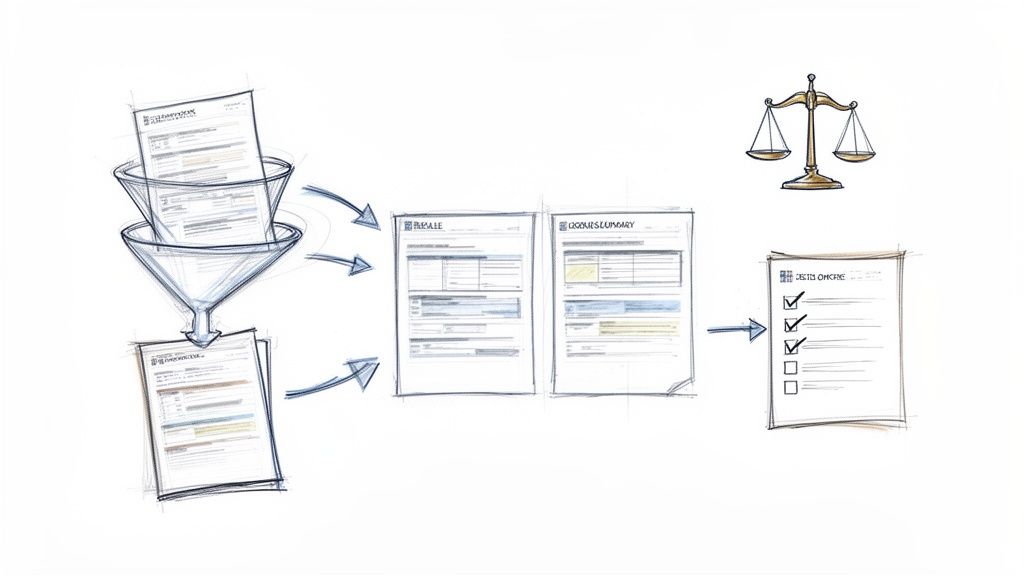
From Chronology to Courtroom Strategy
The medical chronology you assembled is your strategic roadmap. At mediation or trial, you can transform it into a demonstrative exhibit. A clear, visual representation of events is often more impactful than a verbal description. Summary reports from your medical experts serve a similar purpose. They distill dense data into a concise, authoritative opinion. These documents are critical for:
- Drafting discovery requests that focus on specific policies or personnel.
- Preparing for depositions by providing evidence-backed questions.
- Structuring your case narrative around key medical turning points.
A Critical Distinction: Cause vs. Manner of Death
One of the most vital concepts for any attorney to grasp is the difference between cause of death and manner of death. Understanding this distinction is fundamental.
- Cause of Death is the specific injury or disease that resulted in death, such as a "myocardial infarction." This is a purely medical determination.
- Manner of Death is the legal classification of how the death occurred. The five categories are Natural, Accident, Suicide, Homicide, and Undetermined. This determination requires considering the circumstances.
A patient may die from a fentanyl overdose (the cause), but was the manner an accident, suicide, or homicide? The answer is paramount in wrongful death and medical malpractice litigation. A well-supported expert opinion on the manner of death can completely change a case's direction. You can learn more about how a medical malpractice expert witness can clarify these points.
Converting findings into legal steps is the objective. Here’s a quick-glance table showing how to translate findings into actions.
Converting Medical Findings into Legal Actions
| Medical Finding (Example) | Associated Red Flag | Resulting Legal Action |
|---|---|---|
| An ICU patient's vital signs were not charted for a 4-hour period. | Potential patient neglect; deviation from standard monitoring protocols. | Draft interrogatories targeting nursing staff ratios and hospital policies on ICU monitoring frequency. |
| A surgeon used a medical device that was later recalled. | Use of a known faulty product; failure to inform the patient of risks. | Subpoena the hospital’s device procurement records and all communications with the manufacturer. |
| A pathologist’s autopsy report contradicts the treating physician’s stated cause of death. | A major discrepancy suggesting a potential cover-up or misdiagnosis. | Retain an independent forensic pathologist to review the findings and prepare an expert report. |
| A medication known to cause allergic reactions was administered despite a documented allergy. | Blatant breach of the standard of care; failure to review patient history. | Prepare pointed deposition questions for the prescribing doctor and administering nurse. |
Ultimately, this all comes back to a single goal.
The point of reviewing medical records isn't just to find facts. It's to take meticulous, objective analysis and convert it into a clear, persuasive, and evidence-backed legal argument that can win your case.
The process of obtaining and analyzing records has become a significant industry. The global medical records retrieval market recently reached a valuation of $1.1 billion, driven largely by attorneys in personal injury, medical malpractice, and wrongful death cases. With 47.40% of law firms now outsourcing this task, the demand for fast, accurate retrieval and expert analysis has never been higher. You can read more about this growing demand at GetCodesHealth.com.
Frequently Asked Questions
Over the years, I've sat across from countless attorneys, and the same questions often arise. Let's tackle them head-on, based on my experience as a forensic pathologist. My aim is to provide straightforward, practical advice.
"What do I do if the records are incomplete?"
This is a common and frustrating problem. Your first move should be to send a specific follow-up letter that pinpoints exactly what you need, such as, "Requesting all nursing flow sheets from St. Mary's Hospital for Jane Doe, specifically from 10:00 PM on May 1st to 6:00 AM on May 2nd." If that doesn't work, consider a subpoena.
An incomplete record isn't just an administrative headache. It can be a massive red flag. Sometimes, glaring omissions are intentional, pointing to an effort to hide something. That gap can become a central point in your case.
"When should I bring in a medical expert?"
Many lawyers wait too long. Engaging an expert early, even for a preliminary review, is a smart move. We can help you spot medical strengths and weaknesses right away, identify missing records, and focus your discovery requests. Finding out months into a case that it has a fatal medical flaw is a difficult lesson to learn.
"How should I handle conflicting opinions within the records?"
It’s common to see physicians disagreeing in the chart. The ER doctor’s initial impression might conflict with a specialist’s later opinion. Don’t be discouraged by this. These conflicts expose medical uncertainty and often point to a potential break in the standard of care. This is where a forensic expert can be valuable. We can analyze those disagreements and explain which opinion is better supported by the evidence. Finding and exploiting these friction points is a core part of reviewing medical records for attorneys.
At Texas Autopsy Services, my practice is built on bringing clarity to these complex medical puzzles. If you're an attorney in Texas facing a tough case, I'm here to provide the forensic insight you need.
Let’s talk about how we can support your case. You can learn more at https://www.texasautopsyservices.com.