December 8, 2025 · Texas Autopsy Services
What Families and Attorneys Should Know About a Pathology Expert Witness
As a forensic pathologist, I explain the vital role of a pathology expert witness in legal cases, what qualifications matter, and when to retain one in Texas.
On this page
When the cause of a person's death becomes a legal question, families and attorneys need objective, scientific clarity. My role as a forensic pathologist is to interpret complex medical evidence and explain it in straightforward terms for judges, lawyers, and juries. The goal is simple: to ensure legal decisions are based on solid facts, not guesswork.
- A pathology expert witness provides an independent, objective analysis of the cause and manner of death.
- My findings are based on a meticulous review of medical records, evidence, and sometimes, a second-opinion autopsy.
- As a board-certified forensic pathologist in Texas, my duty is to the scientific truth, regardless of who retains my services.
- The process is transparent, confidential, and fully compliant with Texas legal and ethical standards.
- My team and I are here to provide clear, compassionate guidance when you need answers.
The Essential Role of a Pathology Expert Witness in Texas
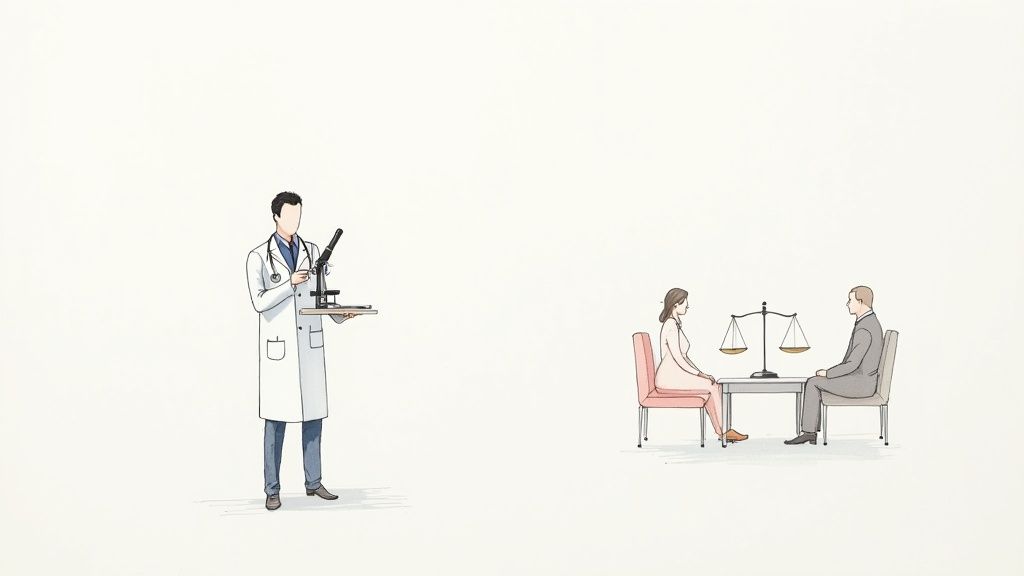
I am often called into cases where there’s a dispute—perhaps an unexpected death during medical care or a workplace accident where the official story doesn't seem complete. In those moments of confusion, my role is to bring an unbiased, scientific perspective to the table. I'm not on anyone's "side." My only allegiance is to the truth revealed by the medical evidence.
A large part of my work involves helping the court understand the difference between two key concepts:
- Cause of Death: This is the specific injury or disease that resulted in death, such as a heart attack or blunt force trauma.
- Manner of Death: This describes the circumstances that led to the death. It is categorized as natural, accident, suicide, homicide, or undetermined.
Getting this right is crucial. By offering a clear, impartial interpretation of the medical facts, I help build a reliable foundation for legal proceedings.
The Pathologist's Contribution to Legal Clarity
Relying on hard science in the courtroom has a long history. Research shows the use of autopsy reports in criminal trials jumped from just 17.9% in the mid-1700s to 61.7% about a century later. That trend has only grown.
My process involves a deep review of the available evidence. I'll examine all medical records, look at tissue samples under a microscope, or even perform a second-opinion autopsy to form my own independent conclusions. This work often uncovers critical context that was either missed or misinterpreted initially. This is part of a broader field of specialized medico-legal consultancy that provides essential support across many types of legal cases.
Why Independence Matters
As a board-certified forensic pathologist, I have a professional duty to provide an impartial assessment based on my training and the evidence before me. It doesn't matter if I'm retained by the plaintiff, the defense, or a family seeking answers—my findings are my findings. They don't change.
This commitment to objectivity is what makes my testimony credible and able to withstand rigorous cross-examination. My purpose is to clarify, not to convince. By breaking down complicated medical science into something everyone can understand, I help the legal system reach a fair and well-informed outcome.
To get a better handle on this specialized field, you might find our guide on what a forensic pathologist expert witness does helpful.
How to Know You're Hiring a True Expert

When an attorney or family is searching for answers, the credibility of a pathology expert witness is everything. Trust isn't just a feeling; it’s built on a solid foundation of verifiable qualifications, deep experience, and unwavering professional standards.
Not every pathologist is equipped for the unique demands of medico-legal work. Any opinion offered in court will face intense scrutiny, so it must be built on a specialized understanding of disease, injury, and the postmortem process. Board certifications are the benchmark of this expertise.
Board Certifications: The Gold Standard in Pathology
In the United States, the American Board of Pathology is the certifying body that sets the standard. While many pathologists hold one or even two certifications, a board-certified expert brings a uniquely comprehensive perspective to a case.
My own credentials include certifications from the American Board of Pathology in:
- Anatomic Pathology: The core skill of studying organs and tissues to diagnose disease. It's fundamental to understanding the physical evidence left behind in the body.
- Clinical Pathology: This specialty involves analyzing bodily fluids like blood and urine, providing critical data on toxicology, infections, or metabolic conditions that could have contributed to death.
- Forensic Pathology: This is the specialized training needed to investigate sudden, unexpected, or violent deaths. It bridges the gap between medicine and law, combining anatomic and clinical pathology with legal procedure.
This combination of training allows me to build a complete picture, connecting what I see under the microscope to the larger circumstances of the death. You can learn more about the demanding journey involved by reading about the education requirements for a forensic pathologist.
The table below breaks down these key credentials and explains why they are so important in a legal setting.
Key Credentials for a Pathology Expert Witness
| Credential | What It Signifies | Why It Matters in Court |
|---|---|---|
| Medical Doctor (MD/DO) | Completion of medical school and foundational medical knowledge. | Establishes the expert as a qualified physician before any specialization. |
| Board Certification: Anatomic Pathology | Expertise in diagnosing disease by examining tissues and organs. | Crucial for identifying the direct physical cause of death. |
| Board Certification: Clinical Pathology | Expertise in analyzing lab results from bodily fluids (toxicology, etc.). | Uncovers contributing factors like poisoning, infection, or metabolic issues. |
| Board Certification: Forensic Pathology | Specialized training in medico-legal death investigation. | This is the specific skill set for determining cause and manner of death in legal contexts. |
| State Medical License | Active, unrestricted license to practice medicine. | Confirms the expert is in good standing with state medical authorities. |
| Fellowship Training | At least one year of intensive, hands-on training in a subspecialty like forensics. | Goes beyond residency to provide deep, practical experience in complex cases. |
These credentials work together, creating a foundation of knowledge and credibility that can withstand the rigors of cross-examination.
Experience That Goes Beyond the Textbook
Certifications are non-negotiable, but they must be paired with years of practical, hands-on experience. Having performed over 1,000 autopsies, I’ve seen a wide range of cases—from seemingly straightforward natural deaths to complex homicides and difficult pediatric cases.
This volume of work develops a crucial instinct. It trains you to recognize subtle patterns and details that might otherwise be missed.
An expert’s value in the courtroom is measured not just by what they know, but by how many times they have applied that knowledge under real-world pressure. Each case builds a deeper library of experience to draw upon.
When vetting a pathology expert witness, always ask about the number and types of autopsies they've performed. An expert who is actively working in the field brings a level of insight that an academic pathologist might not have. Their opinions aren't just theoretical; they've been tested and refined by years of practice, ensuring their testimony is both scientifically sound and relevant to the court.
When Should You Call in a Pathology Expert?
Knowing the right moment to engage a pathology expert witness can alter the course of a legal case or a family's search for answers. It's about recognizing when you need a higher level of clarity—when medical facts are murky, disputed, or simply missing.
My phone often rings when the official cause of death doesn’t sit right with someone. These aren't always dramatic cases. Sometimes, the need for a second look comes from a single, overlooked detail in a medical chart or a timeline of events that just doesn't add up. The point isn’t to create conflict, but to ensure that conclusions are based on a complete and objective scientific analysis.
Scenarios That Require an Expert Review
Some situations almost always demand an independent forensic examination. These are times when the stakes are incredibly high and there's no room for error. If you're an attorney or a family member facing one of these moments, it's time to consider calling an expert.
- Medical Malpractice & Wrongful Death: Did a patient die unexpectedly during or after medical treatment? Questions about negligence are almost inevitable. An independent pathologist can meticulously review all medical records and, if necessary, perform a second-opinion autopsy to see if the standard of care was breached.
- Suspicious or Contested Deaths: What if a death is officially ruled an accident or natural, but the family has a feeling that something is wrong? An expert provides an unbiased set of eyes. I’ve worked on cases where a death in a nursing home was initially attributed to old age, only for a postmortem exam to reveal clear signs of neglect.
- Criminal Investigations: In criminal court, both the prosecution and the defense rely on forensic pathologists. An independent expert can review the state's work, spot potential weaknesses, and ensure every medical detail is presented accurately.
- Insurance & Liability Claims: When a large insurance payout depends on the cause of death—such as an accidental death policy—an independent review can either confirm or challenge the initial findings, ensuring the outcome is fair.
The sheer volume of cases tells the story. Over just an 11-year period, one forensic pathology department handled 8,122 accidental deaths, 3,451 natural deaths, 444 homicides, and 103 suicides. Each one of those required a precise, legally defensible analysis. To learn more, you can read about the diverse societal role of forensic pathology and its broad impact.
A Real-World Example: Being Proactive
Consider a situation I've seen play out many times. An elderly person passes away in a nursing home, and the death certificate reads "natural causes." The family is heartbroken but also confused—they remember their loved one being in good spirits just days before, though they did have some unexplained bruises. They feel like something is off.
In these situations, an independent autopsy is not an accusation; it is a search for truth. It provides a definitive, science-based answer that either confirms the initial finding or uncovers evidence that requires further investigation.
By calling in an expert, the family is taking control. My examination might confirm a heart attack, consistent with the official report, which finally gives them peace of mind. Or, it could uncover signs of severe dehydration or an undocumented fall, completely changing the legal picture.
Bringing a pathology expert witness into the process early is a powerful strategic move. It ensures that crucial evidence is preserved and that the path to justice is built on a solid foundation of medical science.
How the Expert Witness Process Works
Engaging a pathology expert witness is a straightforward, methodical process I’ve refined to ensure clarity from start to finish. From our first conversation to potential testimony in court, my job is to deliver objective medical facts in a way that is clear, defensible, and understandable.
It begins with an initial consultation. This is where an attorney or a family member walks me through the details of the case. This first conversation helps me determine if my expertise is the right fit and what the scope of my work would look like.
The Foundational Steps
If we agree it’s a good match, we formalize it with a retainer agreement. This document outlines the terms, fees, and expectations so there are no surprises. Once that's handled, the work begins. I start by reviewing every piece of documentation available, which often includes:
- Medical records and hospital charts
- The original autopsy report and any associated photos
- Police reports and witness statements
- All existing lab work or toxicology results
This initial review is critical. It's where I assess the quality of the information we have and identify any missing pieces.
Investigation and Reporting
Next comes the hands-on investigation. Depending on the case, this could mean re-examining microscopic slides, analyzing toxicology findings, or performing a full second-opinion autopsy. Throughout this phase, I maintain a strict chain of custody for all evidence to ensure its integrity for legal proceedings.
After my examination is complete, I create a detailed and unbiased report. I write my reports in plain English, avoiding dense medical jargon so that attorneys, judges, and jurors can easily understand my findings. This report becomes the bedrock of my expert opinion.
The infographic below illustrates common situations that prompt legal teams or families to bring in an expert for this kind of detailed analysis.
This visual helps clarify when a pathology expert is needed, whether it's a case of possible medical malpractice, a death with lingering questions, or simply the need for a definitive second opinion. For a more detailed breakdown, our blog post on the role of a forensics expert witness provides even more context.
Deposition and Testimony
The final steps involve presenting my findings within the legal system. This usually begins with a deposition, where lawyers for both sides question me about my report and how I arrived at my conclusions. My job here isn’t to take a side; it's to state the medical facts clearly and defend my opinion with objective evidence.
If the case goes to trial, I will provide testimony in the courtroom. Knowing the legal landscape, including things like the procedures for witness summons, is a critical part of an expert's role. On the stand, my only function is to be a teacher—to translate complex medical science into simple truths that help the judge and jury make a fully informed decision based on solid, scientific evidence.
Why Objective and Unbiased Analysis Is Crucial
As a pathology expert witness, my job is to follow the evidence wherever it leads. That’s it. It makes no difference whether I’m hired by a plaintiff’s attorney, a defense team, or a family seeking answers. My conclusions are built on scientific and medical facts, completely separate from any outside pressure.This dedication to objectivity is everything. In any legal case, an expert's true value comes from their impartiality. If an opinion can be influenced by who signs the check, it’s not an expert opinion.
The Myth of the Hired Gun
Let's clear something up. There's an idea that an expert witness is a "hired gun" who shows up to say whatever the lawyers want to hear. A genuine professional builds their career on the opposite principle. My board certification from the American Board of Pathology is more than a piece of paper; it’s a promise to adhere to a rigid code of professional ethics.
My professional standing and my entire practice at Texas Autopsy Services depend on unwavering objectivity. Any deviation from the facts would not only damage my reputation but would be a disservice to the legal system and the families who place their trust in me.
My role isn’t to argue a case. It's to explain medical truths as clearly and honestly as I can. This unbiased approach is what makes my testimony hold up under the intense pressure of a courtroom.
Navigating a Field Under Pressure
The need for truly independent experts has never been more urgent. There's a well-documented global shortage of qualified pathologists, which has a direct impact on the justice system.
For instance, a recent survey in the UK revealed that only 3% of pathology departments had enough staff to handle their workload. This scarcity makes it incredibly difficult to find a highly qualified, independent pathology expert witness when one is needed for a legal case. You can learn more about the global challenges in pathology staffing.
This situation puts even more pressure on practicing pathologists to uphold the highest ethical standards. When you bring me onto your case, you aren't hiring an advocate. You are bringing in a neutral scientific expert committed to giving you the unvarnished truth of the medical evidence. That commitment is the only way to ensure a fair process for everyone involved.
Answering Your Questions About Pathology Expert Witness Services
When people first call me, whether they're an attorney deep in a case or a family member trying to make sense of a tragedy, they usually have many questions. I've gathered some of the most common ones here to give you a clearer picture from the start.
Think of this as a starting point. Every case is unique, but the answers below should help you understand the process and what to expect.
How much does it cost to retain an expert witness?
The cost depends on the complexity of the case. The process starts with an initial retainer, which covers the crucial first step—a deep dive into all case files, medical records, and existing reports. This allows me to understand the case and determine what is needed. After the initial review, my work is billed at an hourly rate. This includes everything from performing a second autopsy, if required, to analyzing slides, writing my final report, and providing deposition or courtroom testimony. I am always upfront about my fee schedule, which I provide right after our initial consultation.
Can an autopsy be performed long after burial?
Yes, it's possible through a process called exhumation, but it comes with challenges. The quality of information we can uncover depends on how much time has passed since burial and, critically, whether the body was embalmed. A court order for an exhumation is a significant legal step. However, a second examination, even years later, can still uncover critical evidence that was overlooked. I can walk you through the procedural hurdles and provide a realistic expectation of what we might find.
What happens if your findings contradict the initial report?
My job is to be an objective, independent voice. If my findings don't line up with the original report, I don’t just state my disagreement. I lay out, in detail, the precise medical and scientific reasons why my conclusions are different. My report will build a logical, evidence-based case explaining why my findings are different, grounded in the physical evidence from my examination. This detailed explanation can be a turning point in a case, providing clarity on what actually happened.
Do you only work for plaintiffs or defense attorneys?
I work for anyone who needs the objective medical truth. That includes plaintiff's attorneys, defense counsel, families, and insurance companies trying to validate a claim. My only allegiance is to the scientific evidence. This impartiality is the bedrock of my credibility and the integrity of my work as a forensic pathologist at Texas Autopsy Services. My role is to clarify the medical facts, no matter who retained me to find them.
If you have other questions, or if you feel that an independent medical-legal review could bring clarity to your situation, please reach out. My team at Texas Autopsy Services is ready to help you find the answers you need with professionalism and compassion.