June 6, 2026 · Texas Autopsy Services
What Is Accidental Suicide: Expert Explanation
Discover what is accidental suicide from an expert. Learn how manner of death is determined and how an independent autopsy can provide clear answers
On this page
“Accidental suicide” is not a formal manner of death. In modern public-health reporting, a death is classified as suicide only when there is evidence of intent to die, and the United States recorded 48,824 suicide-related deaths in 2024, with a suicide rate of 13.7 per 100,000 and a rate still 32% higher than in 2000 according to the CDC suicide facts page.
I often speak with families after a death that looks self-inflicted but doesn't yet make sense. A scene may suggest one story, the medical history another, and the toxicology results something else entirely.
At Texas Autopsy Services, every examination is performed by a board-certified forensic pathologist experienced in medicolegal death investigations. Our work centers on one principle: follow the evidence carefully, explain it plainly, and treat the deceased and their family with respect.
- “Accidental suicide” is not a recognized death classification. The formal question is whether there is evidence the person intended to die.
- Manner of death and cause of death are different. Cause is the medical reason someone died. Manner is the legal-medical category applied to that death.
- Intent is built from evidence, not assumption. Autopsy findings, toxicology, scene review, records, and history all matter.
- Some deaths are difficult to classify. When the evidence doesn't clearly support accident or suicide, an investigator may certify the death as undetermined.
- A private autopsy or second-opinion review can help when families or attorneys need a clearer, independent explanation of an ambiguous death.
The Critical Difference Between Suicide and Accident
A mother once asked me a question I hear often in Texas casework: “Could this have been accidental suicide?” By the time that question reaches my office, the family has usually already lived through the hardest part. They have seen a scene that suggests self-harm, heard different opinions from police, hospital staff, or relatives, and still do not have a clear answer about intent.
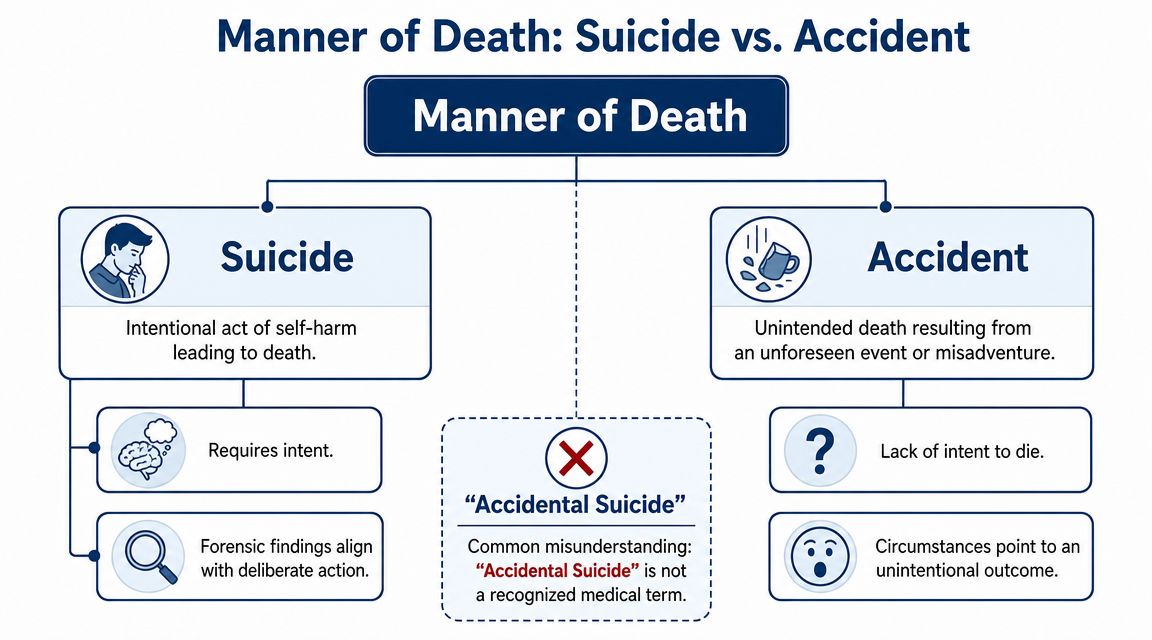
In forensic pathology, “accidental suicide” is not a formal manner of death. It is a lay phrase people use when a death appears self-inflicted but the evidence for intent is uncertain. In practice, the medical-legal categories are accident, suicide, homicide, natural, and undetermined. If you want a clearer explanation of how those categories differ from the medical cause itself, I discuss that separately in this article on manner and cause of death.
The dividing line is intent to die. If the evidence supports that conclusion, the manner is suicide. If the death resulted from an unintended act, misuse, or exposure, the manner is accident. If the available facts do not support one conclusion more strongly than the other, undetermined may be the most accurate certification. Families sometimes find that frustrating, but accuracy is more important than forcing certainty where the evidence does not support it.
The Importance of Classification
Classification affects more than wording on a death certificate. It can influence insurance disputes, civil litigation, public-health reporting, and, most personally, how a family understands what happened. Attorneys also rely on this distinction because a case framed as accident raises different questions from a case framed as suicide.
A self-inflicted injury, by itself, does not prove suicide.
That point becomes especially important in deaths involving medications, alcohol, or other drugs. I have reviewed cases where the pill count looked alarming, but the history suggested chronic misuse rather than a deliberate plan to die. I have also seen the opposite. A scene may look accidental until records, messages, prior threats, or toxicology place the death in a different context. Treating “accidental suicide” as a formal conclusion is a mistake. In most cases, the phrase signals that the death needs a more careful reconstruction.
What families often mean by the phrase
In my experience, families usually use this term for one of three patterns:
- A self-inflicted death without direct proof of intent. There may be a wound, ligature, or ingestion, but no note, no statement, and no clear history explaining state of mind.
- A poisoning or overdose with mixed evidence. The person may have taken a dangerous amount of a substance, but the investigation still has to sort out misuse, impaired judgment, escalating tolerance, and suicidal intent.
- A death during risky behavior. Some acts are reckless and tragic without showing a settled intent to die.
Medication deaths are a good example of the trade-offs investigators face. A high drug level can explain the mechanism of death, but it does not answer intent by itself. Dose history, refill timing, witness accounts, prior mental-health records, and scene findings often carry as much weight as the laboratory result. For readers trying to understand one narrow medication scenario, this guide to identifying trazodone overdose may help frame what clinicians and investigators examine, though it cannot replace a case-specific forensic review.
In private autopsy work, this is often the point where families and attorneys ask for an independent opinion. They are not looking for a softer label. They are looking for a defensible one.
How Forensic Pathologists Determine Manner of Death
A manner-of-death opinion should never be a guess. It should be the end result of a disciplined review of the body, the circumstances, and the available records.
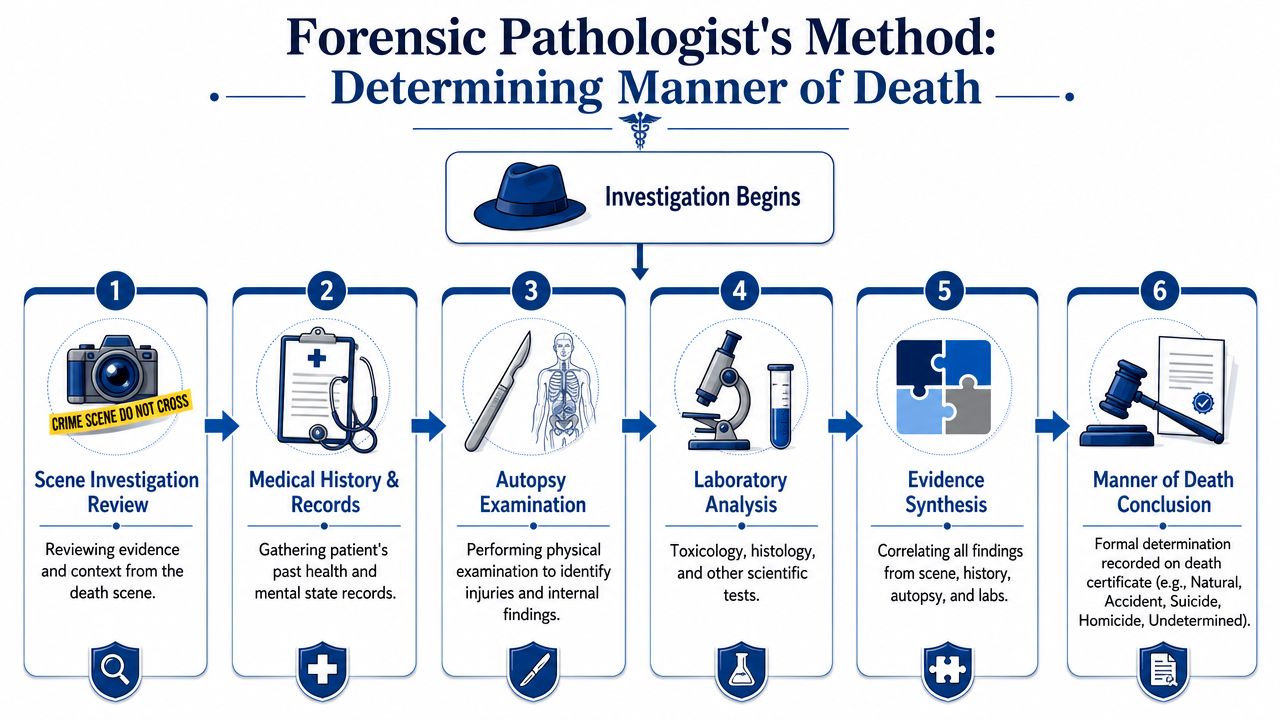
In death certification, suicide requires evidence of intent to die, while accident is an unnatural death resulting from an inadvertent chance happening. Investigators may assign undetermined when the evidence does not clearly preponderate toward one manner over another, as explained by the Snohomish County cause and manner of death guidance.
The three pillars I rely on
The first pillar is the postmortem examination. An autopsy documents injuries, disease, natural findings, and patterns that may support or contradict the reported circumstances. In some cases, the body strongly supports the scene narrative. In others, it does not.
The second pillar is laboratory testing, especially toxicology. Drugs, alcohol, and other substances can alter behavior, cause death directly, or complicate the interpretation of intent. Toxicology rarely answers the whole question on its own, but it often changes the weight of the evidence.
A short video can help families understand how a formal death investigation is assembled from multiple parts.
The third pillar is circumstantial and historical information. That includes scene photographs, witness statements, emergency records, prior medical history, mental health history when available, prior attempts, communications, and any note evidence. I discuss that broader process in more detail in this article on how a coroner determines cause of death.
What helps and what doesn't
Some practices improve accuracy. Others create confusion.
What helps
- A complete scene review: The position of the body, presence of medication containers, firearm location, and environmental hazards all matter.
- Records from multiple sources: Hospital charts, EMS narratives, and prior treatment records often clarify context.
- Collateral history: Family members, friends, and attorneys sometimes provide facts not present in the initial file.
What doesn't
- Assuming the mechanism tells the whole story: A poisoning can be accidental or intentional. So can some firearm deaths.
- Relying on one document in isolation: A death certificate draft, a police summary, or a single toxicology line is rarely enough.
- Forcing certainty where the evidence is mixed: Some deaths remain properly classified as undetermined.
Good forensic work is cumulative. One fact rarely decides the manner of death by itself.
For attorneys who work across jurisdictions, standards for expert review and testimony can vary in procedure even when the core forensic principles are familiar. This overview of UK expert witness practice offers useful context on how experts are expected to support courts with independent analysis.
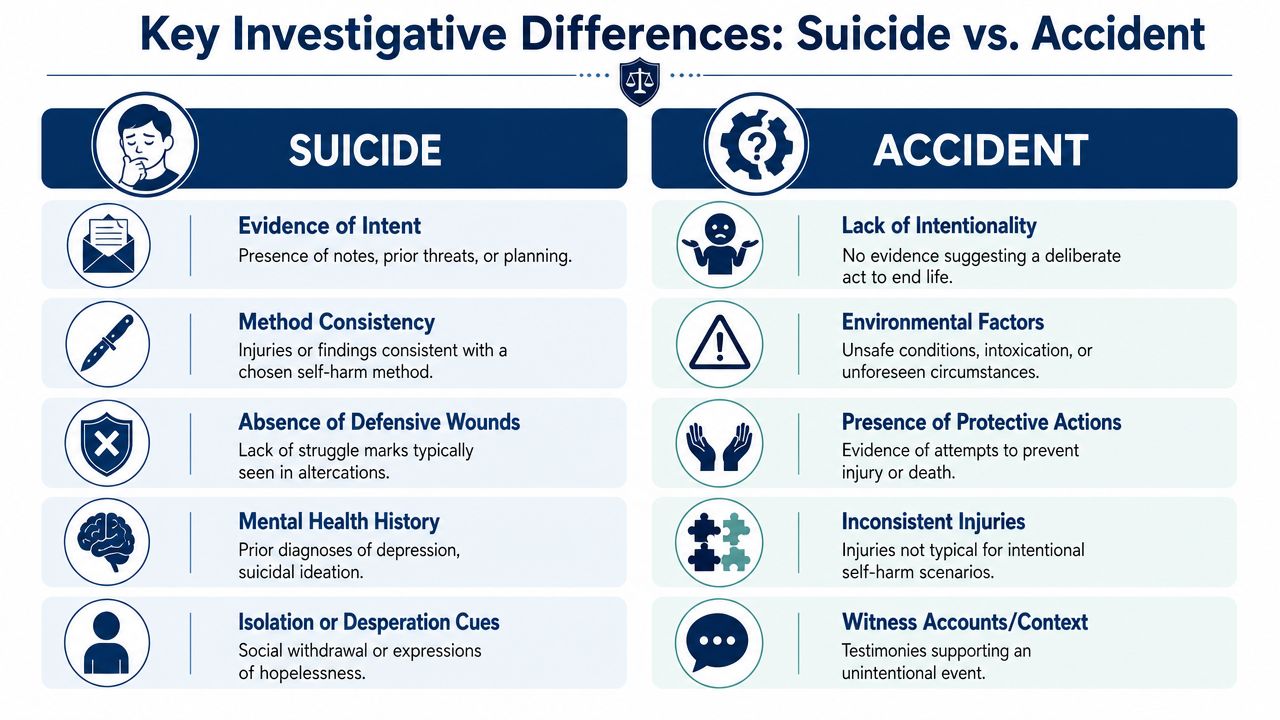
Suicide vs Accident Key Investigative Differences
I have seen families walk into my office after an overdose or gunshot death with the same question: “How can anyone know what this was?” The answer is that no single fact decides it. In ambiguous deaths, the distinction between suicide and accident comes from how the medical findings, scene evidence, and personal history fit together.
Overdose deaths
Overdose cases often create the most confusion because the physical examination may be relatively quiet. There may be no significant trauma, no obvious struggle, and no single injury that explains intent. What matters is whether the evidence supports purposeful self-harm, unsafe use, or a death where the available facts never fully resolve the question.
A comparative forensic study found meaningful differences among accidental, suicidal, and undetermined deaths, including patterns involving alcohol problems, impulsiveness, and prior self-harm, as described in this forensic study on accidental, suicide, and undetermined deaths. In practice, I treat those findings as context, not shortcuts. A history of substance misuse does not rule out suicide. Prior mental health concerns do not prove it.
The harder work is specific. I look at dose escalation, recent refill timing, access to multiple substances, witness accounts, prior nonfatal overdoses, text messages, internet searches, and whether the decedent took any step suggesting rescue was expected or impossible.
Firearm deaths
Firearm deaths require the same discipline. National patterns matter far less than the details of the individual case.
For a self-inflicted gunshot wound, I examine wound location, trajectory, range of fire, soot or stippling, blood distribution, weapon position, and whether the injury is anatomically reachable. I also want to know who found the body, what was moved before law enforcement arrived, whether there were prior threats or farewell statements, and whether the reported sequence of events matches the physical evidence.
Accidental firearm deaths usually arise from a different pattern. Common examples include handling a weapon believed to be unloaded, intoxicated play, cleaning mishaps, hunting incidents, or a discharge during reckless behavior. A suicide ruling becomes stronger when the findings show deliberate preparation and intentional self-infliction. An accident ruling becomes stronger when the evidence supports unintended discharge without persuasive proof of suicidal intent.
Side-by-side clues
| Investigative feature | More consistent with suicide | More consistent with accident |
|---|---|---|
| Intent evidence | Notes, prior threats, planning, farewell communications | No clear evidence of planning or desire to die |
| Scene pattern | Deliberate setup or actions that support self-harm | Unsafe handling, environmental hazard, or misadventure |
| History | Prior attempts, self-harm history, expressed hopelessness | Substance misuse or risk-taking without clear suicidal evidence |
| Behavior near death | Steps that reduce interruption or rescue | Signs the person expected survival or tried to stop the harm |
One point deserves emphasis. A death can be self-inflicted and still be accidental. That is why forensic pathologists are asked to determine manner of death, not just mechanism.
Families and attorneys often benefit from reviewing examples where early impressions were misleading. This discussion of cases where suicide can initially appear to be an accident shows why careful reconstruction matters so much in private autopsy review.
When to Consider a Private Autopsy Investigation
Sometimes the official investigation answers the central question. Sometimes it leaves a family or attorney with a file full of facts but no confidence in the conclusion.
A private autopsy investigation becomes worth considering when the death is ambiguous and the available findings don't seem to account for all the known circumstances. That may happen when the manner of death is listed as undetermined, when an accident ruling appears inconsistent with known history, or when a suicide ruling seems unsupported by the family's understanding of events and records.
Situations where a second review can help
- The scene and medical findings don't align: For example, the reported history may not fit the injury pattern or toxicology profile.
- Key records were not reviewed early: Mental health records, prior emergency visits, or communications may emerge later.
- The family has unresolved factual questions: That can include concerns about timing, medication access, or whether another contributing event was missed.
- A legal or insurance dispute requires a fully reasoned report: Attorneys often need a medical opinion that explains not just the conclusion, but how the evidence supports it.
In these settings, the value of independence is straightforward. An independent forensic pathologist doesn't function as an advocate for a preferred answer. The job is to reassess the medical evidence, the investigative record, and any additional materials with fresh eyes.
What a private review can and cannot do
A private autopsy or second-opinion review can reexamine the body when feasible, review retained slides and records, recommend additional toxicology or histology, and provide a written opinion on cause of death and manner of death. Cause of death means the disease or injury that led to death. Manner of death means the category assigned to that death, such as accident, suicide, or undetermined.
It cannot guarantee that the answer will change. In some cases, a careful independent review confirms the original ruling. That still has value, because certainty based on full review is different from uncertainty left unaddressed.
Families usually do best when they seek review early, preserve records, and write down their unanswered questions before memories and documents begin to scatter.
In Texas, practical issues also matter. Body release, consent, transport, and cremation timing can affect whether a full independent examination is still possible. Those steps should be handled in compliance with applicable Texas law and funeral service requirements.
What to Expect from Texas Autopsy Services
When a family or attorney contacts my office, the first step is a direct conversation about the known facts. I want to understand what has already been done, what records exist, whether the body is available for examination, and what specific questions remain unanswered.
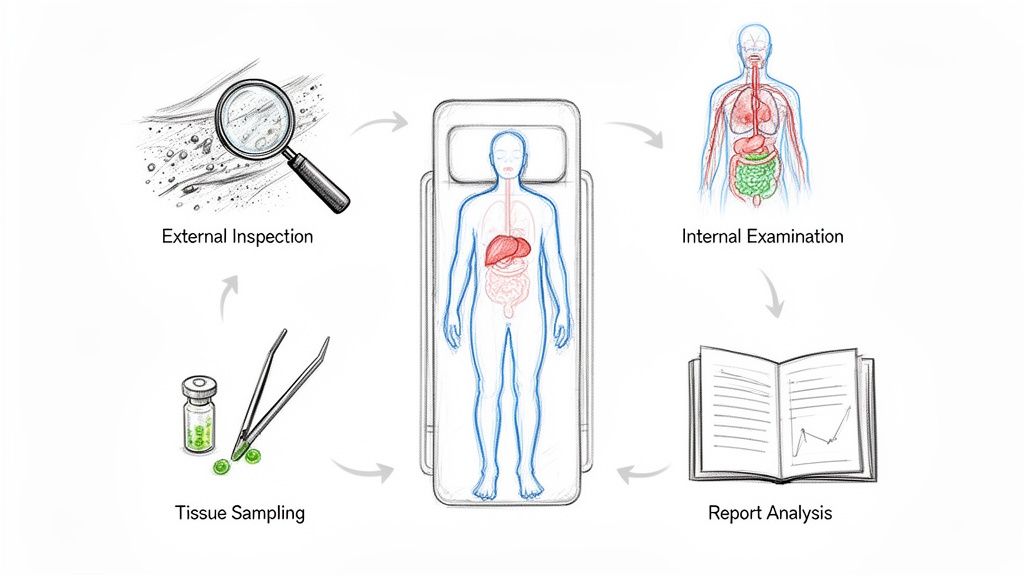
A private autopsy through Texas Autopsy Services may include external and internal examination, specimen collection, toxicology coordination, record review, and a written report. Examinations are carried out with respect for the deceased and with attention to legal authorization, documentation, and chain of custody when needed. Chain of custody means documenting who handled evidence or specimens, when they handled them, and how they were transferred, so the integrity of the material can be defended later if necessary.
The process families and attorneys usually see
The consultation comes first. We identify the decision-makers, review any county findings, and determine whether the issue is a full autopsy, a records review, or a second-opinion forensic pathology review.
The logistics come next. If an examination is appropriate, transport and facility coordination must be arranged lawfully and promptly. For families in Central Texas, that may involve our Waterloo Mortuary pathology partnership, depending on the circumstances of the case.
The final step is reporting. A proper report should explain the findings in plain language while preserving medical precision. If a case remains uncertain, the report should say that clearly rather than overstating confidence.
Questions worth asking any private autopsy service
- Who performs the examination: Ask whether the physician is board-certified in forensic pathology and whether that physician signs the opinion.
- What materials will be reviewed: Records, scene information, photographs, toxicology, and prior reports all matter.
- How is evidence handled: Ask how specimens are tracked, stored, and documented.
- What deliverable will you receive: A verbal summary is not the same as a formal written report suitable for legal use.
What works is transparency. What doesn't work is vague language, unclear qualifications, or promises about outcomes before the evidence is reviewed.
Frequently Asked Questions About Death Investigations
Can a death certificate be changed after new forensic findings
Sometimes. In Texas, the path depends on who certified the death, what new evidence is available, and whether the medical findings change the cause or manner of death. A second opinion does not revise a certificate by itself, but a well-supported forensic review can become part of the record considered by the proper authority.
Why are overdose deaths so difficult to classify
Because toxicology rarely answers the whole question. The same drug level can appear in an accidental misuse, a chronic substance use history, or an intentional self-poisoning. In these cases, I look closely at scene findings, prescription history, prior overdoses, messages, witness accounts, and timing. One lab result without context can mislead both families and lawyers.
What if the evidence never clearly points to accident or suicide
Then undetermined may be the medically appropriate manner of death. That conclusion reflects the limits of the available evidence. It does not reflect a lack of effort.
A trustworthy opinion aligns with the available evidence, even when the answer is not definitive.
Does a private autopsy replace the county investigation
No. A private autopsy is an independent medical examination or records-based forensic review. It may support the official conclusion, identify gaps in the original investigation, or offer a different interpretation, but the county still controls the governmental certification process.
What should families gather before requesting a second opinion
The most useful materials are the records that show both the medical facts and the surrounding circumstances:
- Official documents: Death certificate, autopsy report, police report, EMS report, and hospital records
- Contextual material: A written timeline, medication lists, witness names, and relevant texts, emails, or notes
- Focused questions: A short list of what seems inconsistent, incomplete, or medically unexplained
For families facing an ambiguous death, a clear medical explanation can make the next step easier to choose. Contact Texas Autopsy Services for a direct discussion of the case, the records on hand, and whether an independent forensic review or private autopsy is still possible under Texas requirements.