January 29, 2026 · Texas Autopsy Services
How a Forensic Pathologist Determines Cause of Death
Discover how does a coroner determine cause of death: A forensic pathologist explains the step-by-step process from scene review to autopsy and lab tests.

On this page
- A Forensic Pathologist's Investigative Approach
- Gathering Information and Analyzing the Scene
- The Autopsy A Detailed Postmortem Examination
- Using Ancillary Studies to See Beyond the Obvious
- Distinguishing Between Cause and Manner of Death
- Understanding When to Consider a Private Autopsy
- Common Questions About the Cause of Death Investigation
When a loved one passes away unexpectedly, the most pressing question is almost always, "Why?" As a board-certified forensic pathologist, my entire professional focus is on providing clear, science-backed answers to that question. Determining the cause of death is a methodical investigation, not a single discovery. It requires piecing together a person's history, conducting a detailed physical examination, and using specialized laboratory tests to connect all the dots.
- An investigation combines four key elements: the scene and circumstances, medical history, physical examination (autopsy), and ancillary lab tests.
- Cause of death is the specific medical reason for passing (e.g., heart attack), while manner of death is the legal classification (e.g., natural, accident).
- An autopsy is a respectful, systematic procedure that includes both external and internal examinations to document injury or disease.
- Ancillary studies like toxicology and histology provide objective data that reveal what the naked eye cannot see.
- A private autopsy offers an independent, second-opinion investigation when official findings are unclear or families need more specific answers.
A Forensic Pathologist's Investigative Approach
For families trying to make sense of a tragedy, understanding how this process works can demystify what often feels like an intimidating procedure. It’s not about one single finding. It’s about weaving together different streams of information to create a complete picture. This entire process rests on four fundamental pillars of investigation.
The Four Pillars of a Death Investigation
To find the truth, a forensic pathologist can't just look at one piece of evidence. I must bring together information from the scene, the body itself, and the laboratory to form a complete and accurate conclusion.
| Investigative Pillar | What It Includes | Why It's Important |
|---|---|---|
| Scene & Circumstances | Police reports, witness statements, paramedic notes, and photos from where the person was found. | This provides the context. It tells us what was happening around the person at the time of death, which can be just as crucial as the medical findings. |
| Medical History | Past medical records, prescriptions, recent doctor visits, and conversations with the family doctor. | The person's health history gives us vital clues about pre-existing conditions that may have contributed to their death. |
| Physical Examination (Autopsy) | A thorough external and internal examination of the body to document any signs of injury or disease. | This is the direct evidence. It allows me to see things like heart disease, internal injuries, or tumors that wouldn't be visible otherwise. |
| Ancillary Laboratory Testing | Toxicology (drugs/alcohol), histology (microscopic tissue analysis), microbiology (infections), and other specialized tests. | Lab tests provide objective data that can confirm what I see, uncover hidden factors like an overdose, or identify a specific disease process. |
Each pillar supports the others. Only by evaluating them all together can I arrive at the most accurate and scientifically sound cause of death.

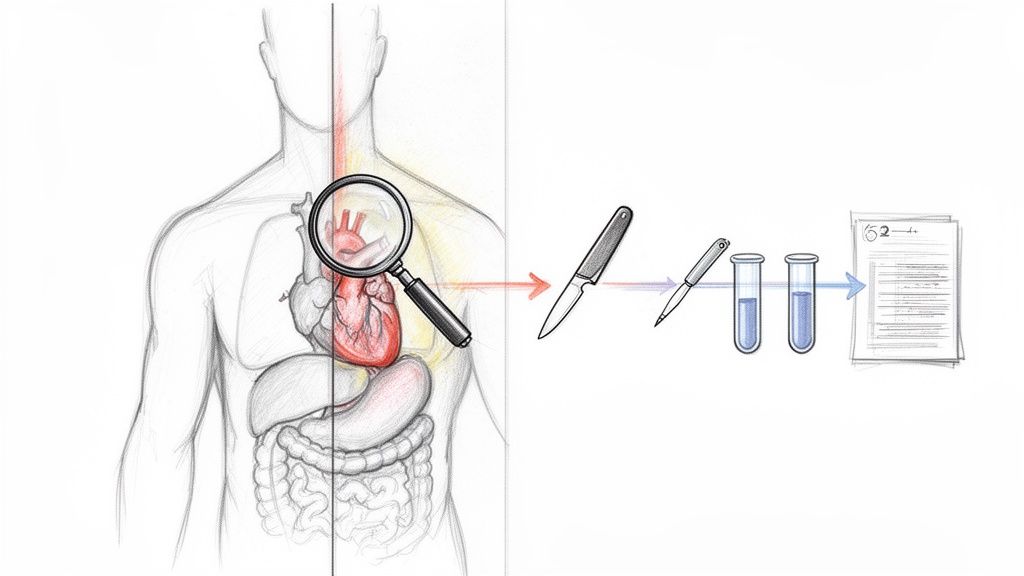
As this flowchart shows, it's a step-by-step process. Each stage builds on the last, ensuring I leave no stone unturned in the search for answers.
Why a Systematic Process is So Important
Every step I take is deliberate. A rush to judgment can lead to the wrong conclusion, which only adds more pain to a family's grief.
For example, what looks like a simple heart attack might be complicated by an undetected drug interaction that only toxicology would reveal. Or, a fall down the stairs might not have been an accident, but the result of a sudden stroke I discover during the internal exam.
My commitment is to follow the evidence wherever it leads. This methodical approach ensures that the final cause of death is grounded in verifiable medical science, providing the most accurate answers possible for the family.
This scientific rigor is non-negotiable. The final autopsy report becomes a critical legal and medical document. It can impact everything from insurance claims and criminal proceedings to public health data. This is how we move from the uncertainty of "why" to the clarity of an answer.
Gathering Information and Analyzing the Scene
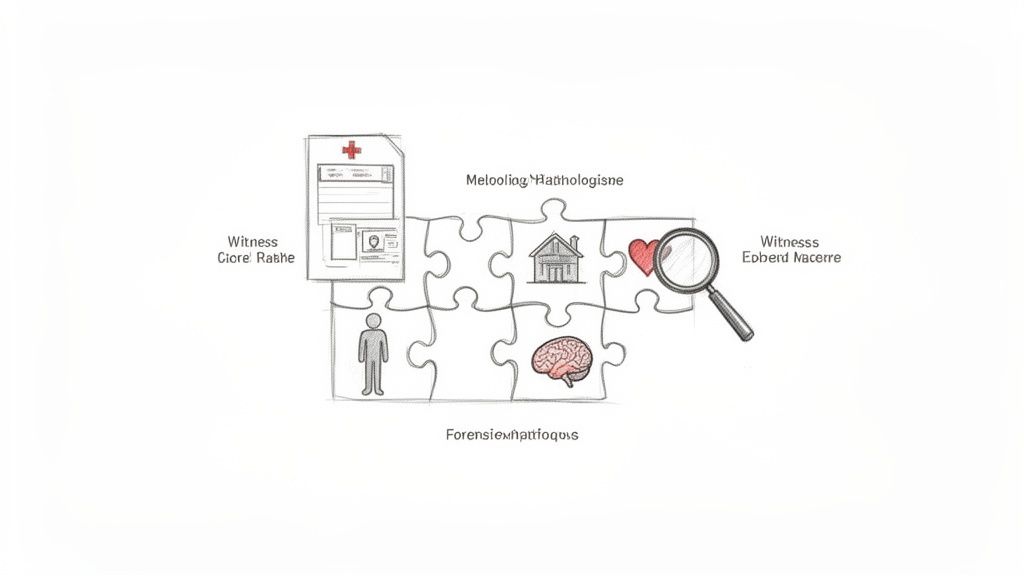
A death investigation rarely starts in the autopsy suite. It begins the moment I get the call, with the critical first step of gathering every piece of available information. What I might see later during the physical examination is just one piece of a much larger puzzle.
The circumstances surrounding the death give me the first few chapters of the story. This initial phase means carefully reviewing reports from first responders, like police officers and paramedics. What they saw at the scene, the position of the body, and any clues from the immediate environment are essential.
Building a Preliminary Picture
Before an examination begins, I spend a lot of time collecting and analyzing information from several key places. It's all about understanding the person's life and the final moments that led to their death. Every detail helps me build a working theory.
The main sources I rely on are:
- Official Reports: Documents from police or other agencies that lay out the timeline of events and how the person was found.
- Witness Statements: Conversations with family, friends, or anyone who was nearby can provide crucial insights into the person's recent activities, state of mind, or any symptoms they were having.
- Medical History: A deep dive into past and present medical records, prescriptions, and recent doctor visits is vital for identifying pre-existing conditions.
- Scene Photographs and Evidence: Photos and physical evidence from the location can reveal clues that might be missed in a written report, giving me a much clearer picture of what happened.
Just as with the importance of accident scene documentation, getting the scene right is foundational. The environment often holds the key to understanding the physical evidence I find later.
The Role of Medical History
One of the most critical parts of this early stage is getting a handle on the person's health history. For example, an elderly person with a long history of severe heart disease found deceased in bed points me down a very different path than a young, healthy individual who died without warning.
I'm trying to answer specific questions:
- Did they have any chronic illnesses, like diabetes or high blood pressure?
- Were they recently put on any new medications?
- Had they complained to anyone about new symptoms, like chest pain or trouble breathing?
This medical background creates a baseline. It helps me differentiate between the long-term effects of a chronic disease and a sudden, acute event that may have caused the death. At Texas Autopsy Services, I work closely with officials and families to make sure no stone is left unturned. It’s about listening to the story the circumstances are telling long before the body tells its own.
The Autopsy A Detailed Postmortem Examination
Once I have a solid understanding of the person's history and the circumstances surrounding their death, the investigation often moves to the autopsy. An autopsy is a systematic medical procedure designed to uncover internal evidence of injury or disease. I approach every examination with profound respect for the individual, always mindful that my work is about finding definitive answers for their family.
The entire process is incredibly methodical, broken down into two main parts: the external examination and the internal examination. Each one provides a different layer of clues.
The External Examination
Before any incision is made, I conduct a meticulous external examination. This is not a quick once-over; it's a detailed documentation of the body's condition exactly as it was received.
My first step is to record basic identifying information such as height, weight, and any unique features like scars or tattoos. These details are crucial for confirming identity. From there, I carefully search for any signs of external injury, like bruises, cuts, or scrapes, noting their exact size, shape, and location. These initial findings can offer early hints about what may have happened.
The Internal Examination
With the external review finished, I move on to the internal examination. This is where I can directly inspect each organ system, searching for abnormalities that aren't visible from the outside.
I perform this with precision and care, looking at each organ both by itself and in relation to the others. From the brain to the heart, lungs, and abdominal contents, I am searching for signs of disease like coronary artery blockages, hidden tumors, or internal bleeding. It's a careful process of discovery. For example, a heart that looks normal on the surface might reveal subtle but clear evidence of a previous heart attack upon closer inspection.
An autopsy is a hands-on evaluation. It's often the only way to truly understand the physiological events that led to death, revealing truths that medical history alone cannot.
During this phase, I also take small tissue samples from major organs for microscopic analysis. This process, called histology, lets me see disease at a cellular level. These tiny samples are vital for confirming diagnoses like cancer, an underlying infection, or the specific type of damage from a heart attack. You can see how this all fits together in our detailed guide on a step-by-step autopsy.
Maintaining Objectivity and Chain of Custody
Throughout every stage, I maintain a strict chain of custody for all evidence and biological samples. This means every sample is carefully labeled, tracked, and secured to guarantee its integrity. This is a non-negotiable standard that ensures all findings are scientifically sound and defensible in legal cases.
This entire procedure is the cornerstone of medicolegal death investigation. In the United States, coroners and medical examiners investigate approximately 20% of all deaths each year, which adds up to around 450,000 investigations annually. These cases typically involve deaths that are unnatural, sudden, or suspicious. Autopsies are considered the gold standard in these complex situations, providing definitive answers in up to 90% of cases where the cause isn't immediately clear. You can explore more about the scope of medicolegal death investigations at NCBI.
By piecing together the external and internal findings, I can begin to build the medical story. This detailed, respectful examination is what moves the investigation from questions to answers, providing the clarity that families need.
Using Ancillary Studies to See Beyond the Obvious

The physical examination gives me a great deal of direct evidence, but some of the most important questions can only be answered in the lab. These specialized tests, known as ancillary studies, are my tools for seeing what is invisible to the naked eye.
Think of them as the supporting cast in the investigation. They provide hard, objective data that can turn a suspicion into a scientific certainty and help me connect the dots between what I see physically and what was happening biochemically.
Toxicology Uncovering Chemical Clues
One of the first and most critical ancillary studies I almost always order is toxicology. This is where we analyze blood, urine, and sometimes tissue samples for any sign of alcohol, prescription medications, or illicit substances.
The toxicology screen can be a game-changer. It might point to an overdose as the direct cause of death, or it could reveal how certain substances played a role in an accident or a medical crisis. For families, understanding this piece of the puzzle can bring needed context. We have a detailed guide on how to interpret a toxicology report from an autopsy that can help make sense of the findings.
Histology Examining Tissues Under the Microscope
Another cornerstone of the process is histology, the microscopic examination of small tissue samples taken from the major organs. Looking at tissues on a cellular level allows me to spot evidence of disease or injury that would be completely missed otherwise.
Histology is how I confirm what I suspect. It shows me the specific damage to heart muscle cells that proves a heart attack happened, or it can uncover the subtle signs of a widespread infection that wasn't obvious from the outside.
This microscopic view is incredibly powerful. It helps me distinguish between a long-term chronic condition and the final, acute event that actually caused the death. It adds a layer of precision that ensures my final conclusions are built on solid, irrefutable evidence.
Other Specialized Tests
Every case is unique, and sometimes the circumstances call for more specialized tests to explore every possibility. These additional studies help me leave no stone unturned.
- Microbiology: When an infection is a possible factor, these tests help me hunt for specific bacteria or viruses. This is how I can pinpoint the exact pathogen responsible in cases of suspected pneumonia or sepsis.
- Genetic Testing: In some rare situations, especially a sudden death in a young, healthy person, genetic testing can be a vital tool. It can identify inherited conditions, like certain heart rhythm disorders, that not only explain the death but also give crucial health information to living family members.
Each of these tests provides another piece of the puzzle. By putting the findings from these studies together with the physical evidence from the autopsy and the context from the death scene, I can build a complete and scientifically sound conclusion. It’s this painstaking work that brings clarity and gives families the answers they deserve.
Distinguishing Between Cause and Manner of Death

Once all the puzzle pieces are on the table, my job is to put them all together. I need to synthesize every bit of information to form a single, coherent conclusion. A huge part of that is drawing a clear line between the cause of death and the manner of death. People often use these terms interchangeably, but in my field, they have specific and very different meanings.
The cause of death is purely medical. It’s the specific disease or injury that directly led to the person’s passing. Think of it as the biological reason the body stopped functioning.
The manner of death, however, is the legal classification of how the death happened. This isn't just about the medical findings; it’s where I must step back and look at the big picture, incorporating everything from police reports to witness statements.
Understanding Cause of Death
When I document the cause of death on the certificate, it’s not just a single phrase. It’s often a sequence of events. For instance, the immediate cause might be "acute respiratory failure." But what caused that? The line below might say "pneumonia," which in turn was due to an underlying cause like "chronic obstructive pulmonary disease." This chain of events tells the full medical story.
This level of detail is crucial. While a family doctor certifies most natural deaths, medical examiners and coroners investigate the other 20%. These are the sudden, unexpected, or unnatural deaths, which add up to roughly 450,000 cases every year in the U.S.
The Five Manners of Death
For legal and public health purposes, every death is sorted into one of five categories. This classification is the manner of death.
- Natural: The death was caused entirely by disease or old age. Think heart disease or cancer.
- Accident: The death was the result of an unforeseen and unintentional event, like a car crash, a fall, or an accidental drug overdose.
- Suicide: The death was caused by an intentional act the person inflicted on themselves with the intent to die.
- Homicide: This means the death occurred at the hands of another person. It's a neutral medical term and does not automatically imply a crime was committed; that’s for the legal system to determine.
- Undetermined: This is the category I use when there just isn’t enough information to confidently choose one of the other four.
The cause of death answers the question, "What medically happened?" The manner of death answers the question, "How did it happen?" Both are essential for a complete and accurate death certificate.
This distinction becomes incredibly important in legal situations, as these findings are often the foundation for understanding how to prove wrongful death where negligence is a factor. As a forensic pathologist, my role is to provide the objective medical facts that clarify both. For a deeper dive, you can read our article explaining the differences between manner and cause of death. My conclusion gives families, attorneys, and public health officials the clear and complete story of what happened.
Understanding When to Consider a Private Autopsy
Sometimes, a death does not trigger an official investigation by the county coroner or medical examiner. This is especially common if the death appears natural, for instance, when an elderly person passes away or someone has a well-documented, serious illness.
Because an autopsy is not legally required in these cases, the official process might end right there. This can leave families grappling with doubt and a painful lack of answers. That's when a private autopsy becomes a crucial option for finding clarity and peace of mind.
Why Families and Attorneys Seek a Second Opinion
So, what leads a family or their legal team to seek out a private autopsy? It almost always comes down to a need for certainty that the official channels did not provide.
Here are a few of the most common reasons I see:
- Suspected Medical Misdiagnosis: The family might feel that a medical error or a missed diagnosis played a role. A private autopsy can either validate the official cause of death or uncover overlooked conditions.
- Understanding Disease Progression: For someone who had a long-term illness like cancer or Alzheimer's, an autopsy can offer insight into how the disease affected the body. This often brings a sense of closure and can even provide vital genetic information for relatives.
- Deaths in Care Facilities: When a loved one dies in a hospital, nursing home, or another care facility, families understandably have questions about the quality of care. An independent review can offer an objective look at the circumstances.
- Need for Legal Evidence: Attorneys frequently request a Private Autopsy when the cause of death is a critical fact in a legal matter, like an insurance dispute or a wrongful death claim.
An Objective and Rigorous Process
When I conduct a private autopsy at Texas Autopsy Services, the scientific standards are exactly the same as they would be for any official investigation. As a board-certified forensic pathologist, I apply the same meticulous procedures to my private cases as I do for my County Forensic Autopsies. My only job is to follow the medical evidence, wherever it leads.
A private autopsy is about empowerment. It gives families and their legal counsel the ability to seek the truth with a process that is independent, objective, and dedicated entirely to their questions.
The entire goal is to produce a comprehensive, unbiased report that clearly lays out the medical findings. This document can finally provide the closure a family is searching for or serve as the critical evidence needed to move forward with a legal case.
Through my partnership with trusted facilities like Waterloo Mortuary, I ensure the whole process is handled with the utmost dignity and respect. It's a confidential path to getting clear answers when you need them most.
Common Questions About the Cause of Death Investigation
When I'm working on a case, families and their attorneys always have questions about what's happening and what comes next. It's completely understandable. Over the years, I've found that giving direct, clear answers to these common concerns can help lift some of the fog during an incredibly tough time.
Here are a few of the questions I hear the most.
How Long Does It Take to Determine a Cause of Death?
This is usually the first thing families want to know, and the honest answer is: it depends on how complex the case is. Sometimes, the physical evidence from the autopsy is so clear-cut that I can give a preliminary cause of death fairly quickly.
But getting to a final, certified cause of death often takes longer. The main reason for the wait is that we must send out for other specialized tests, especially toxicology. Those results can take several weeks or even a couple of months to come back. While my reports at Texas Autopsy Services tend to move faster than government agencies, my absolute priority is getting it right. Rushing the process could mean missing a tiny but crucial detail, so that time is essential to make sure the conclusion is rock-solid and scientifically sound.
Will an Autopsy Prevent an Open Casket Funeral?
This is a personal and important worry for so many families. I want to reassure you that in almost every single case, an autopsy does not prevent an open-casket viewing. I treat every person I examine with the utmost care and respect.
All incisions are placed where they won't be seen and are carefully closed. I work hand-in-hand with skilled funeral directors, like our respected colleagues at Waterloo Mortuary, who are experts at preparing a loved one for viewing. My team and I are always mindful of the family's wishes and the deep need to preserve the dignity of the person entrusted to our care.
What Is the Difference Between a Coroner and a Medical Examiner?
People often use these terms as if they mean the same thing, but in reality, there are major legal and professional differences. It's helpful to know who is in charge of an investigation.
- A medical examiner is a physician, almost always a board-certified forensic pathologist, who is appointed to their position. They use their medical training to figure out the cause and manner of death.
- A coroner is typically an elected official who may or may not be a doctor. In a coroner's system, they run the investigation but will hire a forensic pathologist, like me, to perform the actual autopsies and provide the medical findings.
At Texas Autopsy Services, I bring that specialized medical expertise to families who need an independent autopsy and to counties that need a forensic pathologist on contract.
What If I Disagree with the Official Cause of Death?
If the findings from an official autopsy don't sit right with you, or if you still have unanswered questions, you have the right to get a second opinion by arranging for a private autopsy. This is one of the main reasons families and attorneys call me. A fresh, independent examination provides a completely new look at all the medical evidence.
My goal in a second-opinion case is not to argue with the first report. It's to conduct a brand new, unbiased, and incredibly thorough investigation from scratch.
This second look might end up confirming the original findings, which can bring a sense of closure. Or, it could uncover new information that was missed the first time. Either way, it gives you a clear, comprehensive, and well-documented medical opinion to help you get to the truth.
If you're facing this kind of uncertainty after losing someone, please know you do not have to figure it all out by yourself. The team at Texas Autopsy Services is here to provide the clear, compassionate, and medically sound answers you deserve. Please call our office directly for a confidential consultation to discuss your specific situation.