May 24, 2026 · Texas Autopsy Services
Autopsy Report Blank Form and Guide for Texas Families
Download a sample autopsy report blank template and get a section-by-section guide from a Texas forensic pathologist on how to read and request one.

On this page
- TL;DR
- Guidance for Families Navigating an Uncertain Loss
- A Sample Autopsy Report Template for Your Reference
- Anatomy of an Autopsy Report A Section-by-Section Explanation
- Private Reports vs County Medicolegal Reports
- How to Officially Request an Autopsy Report in Texas
- Privacy Legal and Ethical Considerations
- Understanding Your Next Steps After Receiving the Report
- Frequently Asked Questions About Autopsy Reports
When families call me after an unexpected death, they usually are not asking for paperwork. They are asking what happened, whether the report will make sense, and how to tell the difference between a real answer and a form filled with medical language.
At Texas Autopsy Services, every examination is performed by a board-certified forensic pathologist experienced in medicolegal death investigations. Our work centers on one principle: follow the evidence carefully, explain it plainly, and treat the deceased and their family with respect.
TL;DR
- An autopsy report blank is not just a form. It is a structured medico-legal record built to document identity, findings, and the medical opinion in a way that can be reviewed later.
- A complete report usually includes identifying information, history, external examination, internal examination, ancillary studies, findings, and the final opinion.
- County medicolegal reports and private autopsy reports serve different purposes and follow different access rules.
- Final reports often take time because microscopy, toxicology, and other testing may still be pending.
- In Texas, the right office to contact depends on whether the case went through a county Medical Examiner or a Justice of the Peace.
- If the report leaves important questions unresolved, an independent review may help a family or attorney understand whether the conclusions are well supported.
Guidance for Families Navigating an Uncertain Loss
A common situation looks like this. A family is told that their loved one died suddenly, the death certificate is pending, and someone mentions an autopsy report. They search for a blank form because they hope that seeing the layout will make the process less opaque. That instinct makes sense.
What is often discovered is that the blank version is only the shell of a much more serious record. An autopsy report is designed to document facts in a standardized way so those facts can be reviewed by physicians, courts, investigators, public health systems, and families. As noted in Statistics Canada's description of standardized medico-legal data collection, consistent fields such as name, case number, body measurements, and cause of death allow findings to be audited and compared across cases.
That standardization matters because grief and legal uncertainty do not mix well with vague documentation. If a report is missing identifiers, lacks a clear opinion, or does not track specimens and findings carefully, the family may be left with more confusion rather than less clarity.
A report should help answer questions, not create new ones because the format is inconsistent or the language is imprecise.
I write reports with two audiences in mind at the same time. One is the professional reader, such as a court, clinician, or attorney. The other is the family member who has never seen an autopsy report before and is trying to understand what happened to someone they love. Those two needs are not in conflict. In good forensic work, precision and compassion belong together.
A Sample Autopsy Report Template for Your Reference
Sometimes it helps to see the shape of the document before you read an actual report. A representative blank template can show you where the identifying information appears, where the examination findings are listed, and where the pathologist states the final opinion.
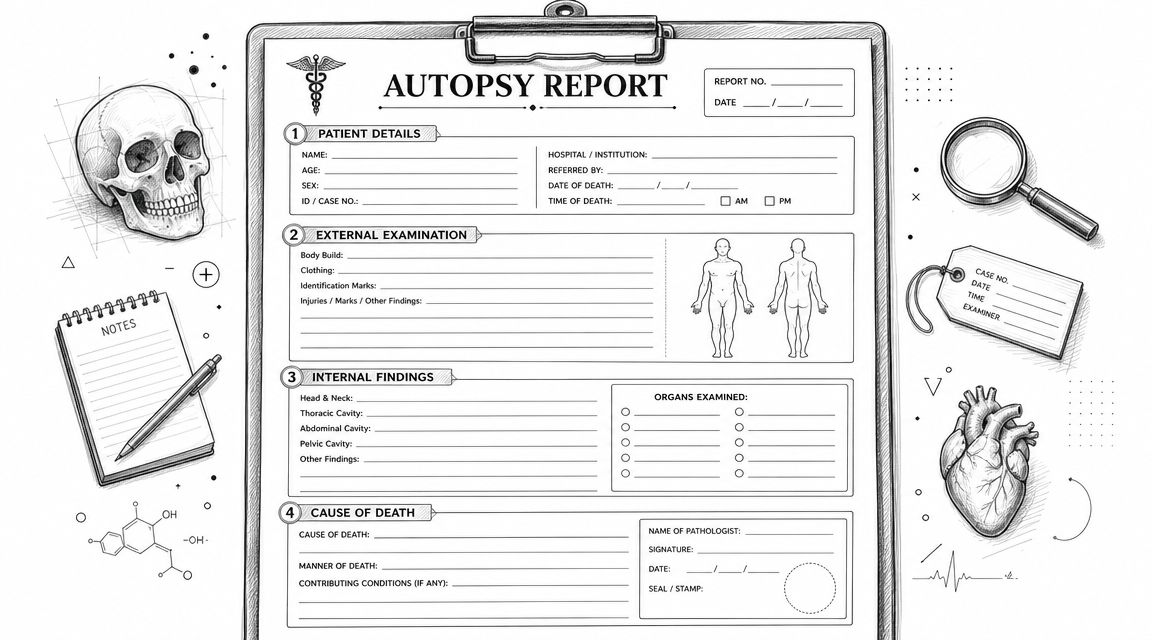
For a visual reference, you can review sample pathology reports that show how medical reporting is structured. Use that material as an educational guide only. It is not an official state filing form, and it is not something a family should try to complete on its own.
A useful sample should let you identify the major sections at a glance:
- Case details that establish who was examined
- Examination sections that separate outside findings from inside findings
- Testing sections for toxicology, histology, or other studies
- Opinion language that states cause and manner of death clearly
What works is a template that mirrors real workflow. What doesn't work is a one-page checklist that leaves no room for detail, measurements, or interpretation.
Anatomy of an Autopsy Report A Section-by-Section Explanation
A strong autopsy report is a defensible evidence record. It is not a narrative memo, and it is not a casual summary. The structure exists for a reason.
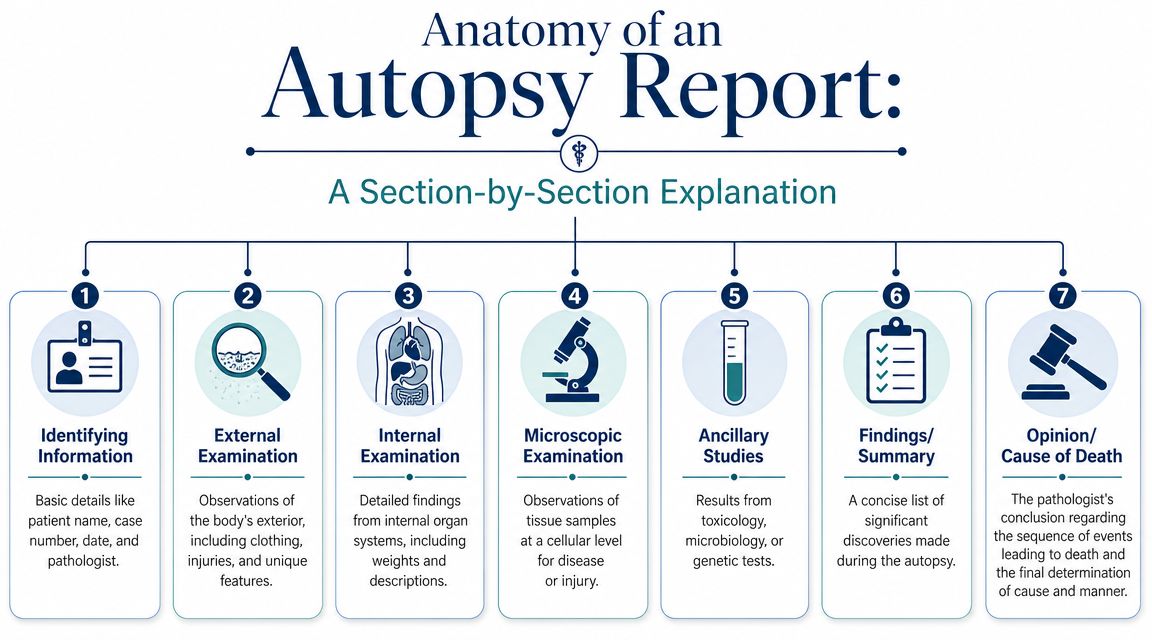
If you want a second reference point while reading this breakdown, this overview of what an autopsy report contains can help place the terminology in context.
Identifying Information
This section confirms who the decedent is and anchors the report to the case. It commonly includes name, case number, age, sex, date of autopsy, and location of autopsy. Depending on the setting, it may also include race, body measurements, and other identifiers.
For a family, this section may seem routine. For an attorney or court, it is foundational. If the identifiers are wrong or incomplete, every later finding becomes harder to rely on.
History and Circumstances
This part summarizes what was known before the examination began. It may include scene information, available medical history, witness accounts, and the reason the autopsy was performed.
This section matters because pathology does not happen in a vacuum. The same physical finding can carry a different meaning depending on the circumstances of collapse, injury, hospitalization, or treatment. A sparse history can limit interpretation. An overloaded history can bias interpretation if it is not handled carefully.
Practical rule: History should inform the examination, not dictate the conclusion.
External Examination
The external exam documents what can be observed on the outside of the body. Clothing, identifying marks, medical devices, scars, tattoos, visible injuries, postmortem changes, and evidence of treatment may all appear here.
Families often focus on this section first because it feels the most concrete. Attorneys often do the same. What you should look for is objectivity. The report should describe injuries by size, location, and appearance rather than by assumption. Terms like rigor mortis and livor mortis may also appear because they help describe postmortem change.
Internal Examination
This is the organ-by-organ portion of the report. It usually follows a system-based sequence, such as head, chest, cardiovascular system, lungs, abdomen, liver, kidneys, and brain. Organ weights, lesion sizes, hemorrhage, disease, and trauma are documented here.
A high-quality report uses measurements and specific observations. General statements such as “normal organs” without supporting detail are less helpful than a report that documents what was examined and what was found.
Microscopic Examination and Ancillary Studies
Not every important conclusion can be reached with the naked eye. Tissue slides may clarify infection, inflammation, heart disease, or subtle injury. Toxicology may detect alcohol, drugs, or medications. Other studies may be added when needed.
Forensic reporting standards discussed by NCEPOD, including requirements attributed to NAME, emphasize that reports should include diagnoses, cause of death, the forensic pathologist's name and title, and signatures and dates. In practice, a strong blank template also includes fields for collected specimens and a clear manner of death selection such as natural, accident, suicide, homicide, or undetermined.
Findings and Opinion
Near the end of the report, the pathologist moves from raw observations to conclusions. This often includes a summary of major findings, the cause of death, and the manner of death.
These are related but different terms:
| Term | Plain-language meaning |
|---|---|
| Cause of death | The injury or disease that set the fatal process in motion |
| Manner of death | The classification of how the death occurred, such as natural, accident, suicide, homicide, or undetermined |
| Chain of custody | Documentation showing who handled evidence or specimens and when |
The opinion section should connect the findings to the conclusion in a way that can be followed. If the report jumps to a conclusion without explaining the basis, that is a problem. If it states that testing is pending, that is not necessarily a problem. It may mean the pathologist is waiting for information needed to finalize the opinion.
Private Reports vs County Medicolegal Reports
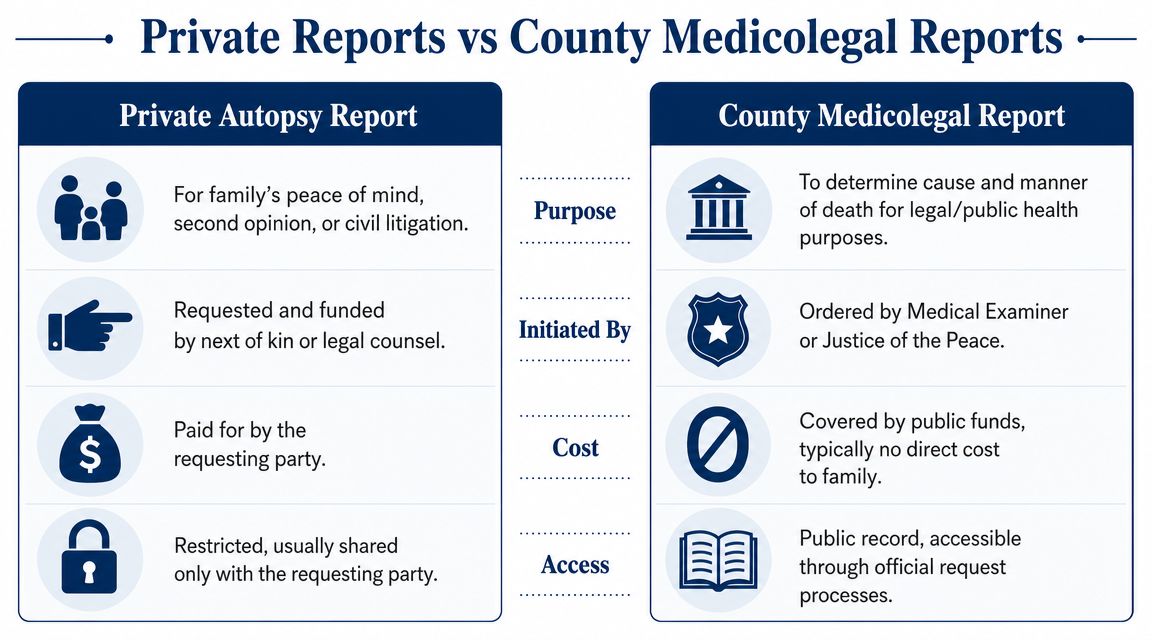
Families often assume all autopsies serve the same function. They do not. The purpose of the case usually determines who authorizes the examination, who receives the report, and how the findings are used.
County medicolegal reports
A county medicolegal autopsy is performed under government authority when the circumstances of death require public investigation. The purpose is not primarily family closure, though families often benefit from the findings. The purpose is to determine cause and manner of death for legal and public purposes.
In Texas, this may involve a county Medical Examiner system or a Justice of the Peace, depending on the county structure. The investigating authority controls the process. The family does not direct the scope of the examination.
Private autopsy reports
A private autopsy is typically requested by the legal next of kin or by counsel acting with proper authority. The report is usually intended to answer unanswered medical questions, provide an independent review, or support civil litigation and family decision-making.
Private reports and county reports may both be medically rigorous, but they arise from different legal paths. A private report is not a substitute for a county's statutory role. A county report is not always a substitute for an independent second look when the family or attorney needs one.
The trade-offs that matter
- Authority matters first. County cases are ordered by public officials. Private cases require lawful family authorization.
- Access differs. Public agencies may release records through formal request channels. Private reports are usually shared with the authorizing party and designated representatives.
- Scope may vary. A county office answers the public investigation question. A private pathologist may be asked to focus on unresolved medical issues, review records, or provide a second opinion.
- Funding differs as well. County work is publicly funded. Private examinations are paid for by the requesting party.
What works is choosing the route that matches the legal posture of the death. What doesn't work is assuming one format answers every need.
How to Officially Request an Autopsy Report in Texas
If a county performed the autopsy, the first practical task is identifying which office has custody of the record. In Texas, that may be the county Medical Examiner's office or the Justice of the Peace connected to the case.
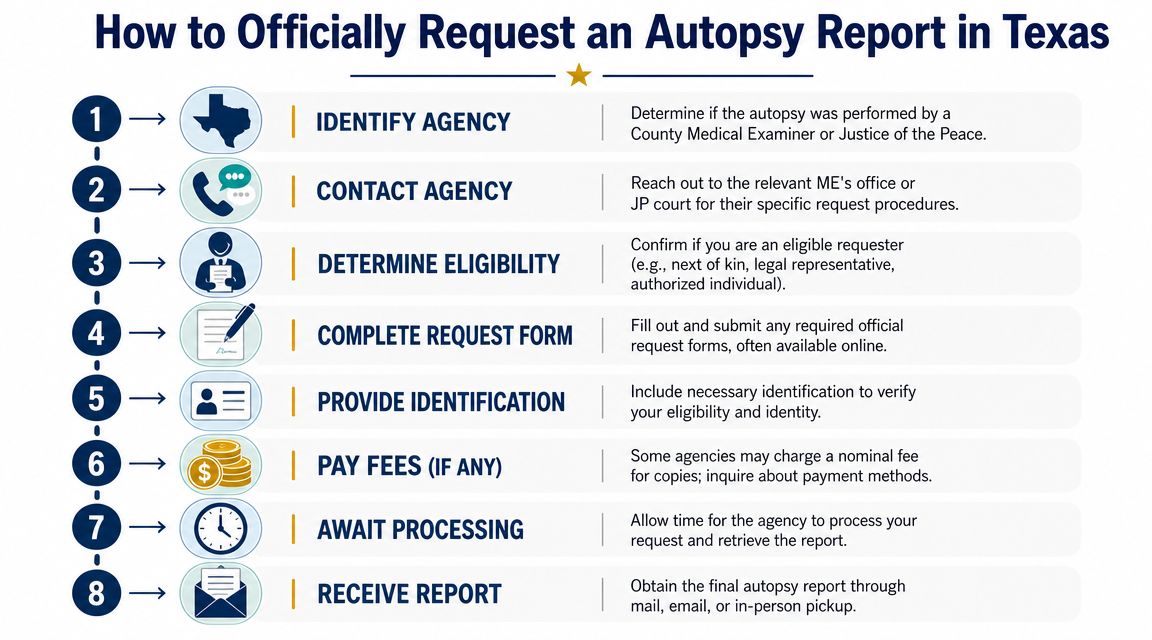
A more detailed procedural guide is available in this Texas autopsy report request resource. Procedures differ by county, so always confirm the local office's own requirements before submitting paperwork.
The basic request process
Identify the agency
Find out whether the case was handled by a county Medical Examiner or a Justice of the Peace.Contact the correct office
Ask for the records procedure for an autopsy report, not just the death certificate.Confirm your eligibility
Some records are available through formal request channels, while some supporting materials may be restricted or redacted.Submit the required information
Offices commonly ask for the decedent's identifying information, date of death, your relationship to the decedent, and proof of identity.
The process can feel bureaucratic when you are grieving, but these steps exist to protect privacy and preserve the record.
This brief video may help orient you to the process before you contact the county office.
Why the report may not be ready yet
Many families hear that the autopsy has been completed and assume the report should already be available. Often, the physical examination is only part of the work. Toxicology, microscopy, and other studies may still be pending.
A publicly released example from the Los Angeles County Medical Examiner shows how reports and related records may appear as separate, redacted documents. That is a useful reminder that the final file is part of a larger records process, not a simple fill-in form.
If the office says the report is pending, that usually means the pathologist is waiting for additional information before signing a final opinion.
Privacy Legal and Ethical Considerations
Autopsy reports contain intensely personal medical information. They may also contain investigative details, family history, photographs, and specimen records. That is why access is governed by law, office policy, and professional ethics rather than by convenience.
Who can authorize and receive information
For a private autopsy, authorization should come from the legally appropriate next of kin or another person with lawful authority. The report is then released to that authorizing person or to a designated representative such as an attorney.
For county cases, the governing office controls release according to applicable records rules and local procedure. That is one reason families sometimes encounter redactions or are told that some materials are not included with the initial response.
Why redactions happen
Redactions are not always a sign that something is being hidden improperly. They may reflect privacy obligations, investigative limits, or agency record-handling rules. Photographs, scene details, and certain identifiers may be handled differently from the narrative report itself.
From an ethical standpoint, restraint matters. A medically precise report should still avoid needless speculation and should separate observation from inference. That protects both the decedent and the surviving family.
The record must be traceable
A careful autopsy file should account for specimens, photographs, and evidence handling. That is where chain of custody becomes important. In plain language, chain of custody means the documentation that tracks who handled evidence or collected specimens, when they handled them, and how they were transferred.
Professional guidance summarized in this discussion of autopsy documentation practices stresses objective language, precise measurements, documentation of ancillary testing, and image logs for significant findings. Those are not cosmetic preferences. They are part of making the record defensible if questions arise later.
I take this point seriously in private work as well. At Texas Autopsy Services, privacy, authorization, and record integrity are part of the service itself, not an administrative afterthought.
Understanding Your Next Steps After Receiving the Report
Receiving the report often brings relief, but it can also open a second stage of decision-making. A report may clarify what happened. It may also reveal that earlier assumptions were incomplete.
When the report answers the central question
Sometimes the report resolves the issue cleanly. The cause of death is clear, the manner of death is supported, and the family can move forward with fewer unknowns. In those cases, the report may help with estate matters, insurance questions, or simple peace of mind.
When the report creates a need for review
Other times, the report contains technical language, pending studies, or conclusions that do not seem to fit the known facts. That is when an attorney or family may request an independent review of the report, records, photographs, or retained materials.
This is not unusual. Autopsy remains one of the few tools that can uncover major diagnostic error after death. An analysis summarized by the National Academies review on autopsy practice estimated a 10.2% probability that autopsy would reveal a misdiagnosis affecting outcome, with the probability of detecting any major error estimated at 25.6%.
That does not mean every disagreement proves negligence or every difference changes the legal result. It means autopsy findings can materially change the understanding of what happened.
An autopsy report is not only about the past. It can shape legal strategy, family understanding, and whether further medical review is warranted.
Practical next steps to consider
- Ask for a conference if the wording is unclear. A pathologist can often explain why a term was used and whether anything remained pending at sign-out.
- Compare the report with other records such as hospital documentation, emergency response records, and scene information.
- Consider an independent review if the conclusions appear unsupported or incomplete.
- Preserve documents carefully if litigation, insurance disputes, or professional review may follow.
In some cases, a family seeks a second opinion autopsy or a forensic pathology review because they need a fresh evaluation from someone outside the original system. That can be appropriate when the situation is critical and the record leaves unresolved concerns.
Frequently Asked Questions About Autopsy Reports
Common questions families and attorneys ask
| Question | Answer |
|---|---|
| Is an autopsy report blank the same thing as the final report | No. The blank version is only a framework. The final report contains case-specific findings, measurements, interpretations, and the signed medical opinion. |
| Why do reports from different offices look different | Offices vary in format, headings, and depth of narrative. Even so, most comprehensive reports follow the same core sequence of identification, history, examination findings, studies, and opinion. |
| Can a family read the report without medical training | Yes, but some sections are technical. The most useful approach is to read the identifying information, findings, and opinion first, then ask for clarification on medical terms that affect the conclusion. |
| Does a pending report mean the case is being ignored | Usually not. Pending status often means the pathologist is waiting for toxicology, microscopy, or other information needed for a defensible final opinion. |
A few final clarifications
The first pages are not always the most important pages. Families often focus on the opening identifiers, while attorneys often jump straight to the opinion. Both approaches miss part of the picture if they skip the findings in between.
A short report is not automatically a poor report, and a long report is not automatically a strong one. Quality comes from objective description, complete documentation, and a conclusion that is supported by the recorded findings.
If you are comparing reports from different jurisdictions, expect variation in wording and layout. That inconsistency is one reason many non-medical readers feel lost when they search for an autopsy report blank in the first place.
Read the report in layers. Start with identity and opinion, then return to the findings that support the conclusion.
Terms worth knowing
- Cause of death refers to the disease or injury that started the fatal sequence.
- Manner of death is the classification of how the death occurred.
- Ancillary studies are additional tests such as toxicology or histology.
- Chain of custody documents who handled evidence or specimens and when.
If you're facing an unanswered death and need clear, medically grounded guidance, you can contact Texas Autopsy Services. I understand that families and attorneys often reach this point while under significant strain. A direct conversation can help you sort out whether you need the county record, a careful explanation of an existing report, or an independent forensic review.