May 19, 2026 · Texas Autopsy Services
Suicide or Accident? What a Forensic Exam Reveals
A death can be ruled accident or suicide, and the distinction rests on evidence. How a forensic examination separates the two, and what families can ask.
On this page
- An Unsettling Question After an Accidental Death
- Why an Intentional Act Can Be Mistaken for an Accident
- Clarifying Cause of Death vs Manner of Death
- Forensic Indicators That Point to Suicide
- The Independent Autopsy Process A Step by Step Guide
- Legal and Insurance Implications of an Amended Death Certificate
- Frequently Asked Questions About Private Autopsies
When Suicide Looks Like an Accident
- A death can look accidental and still require deeper forensic review. That is especially true in crashes, falls, overdoses, and other events where intent is not obvious at first.
- Cause of death and manner of death are not the same thing. The body may show how someone died medically, while the broader investigation addresses whether the death was accidental, suicidal, homicidal, natural, or undetermined.
- An autopsy alone usually doesn't settle intent. The most reliable opinions come from concordance between injuries, scene findings, toxicology, records, and history.
- Families and attorneys often need the same thing. They need a clear, objective explanation of what evidence supports the original ruling, and what evidence does not.
- A careful independent review may confirm the original conclusion, change it, or leave it undetermined. The value is clarity grounded in forensic medicine.
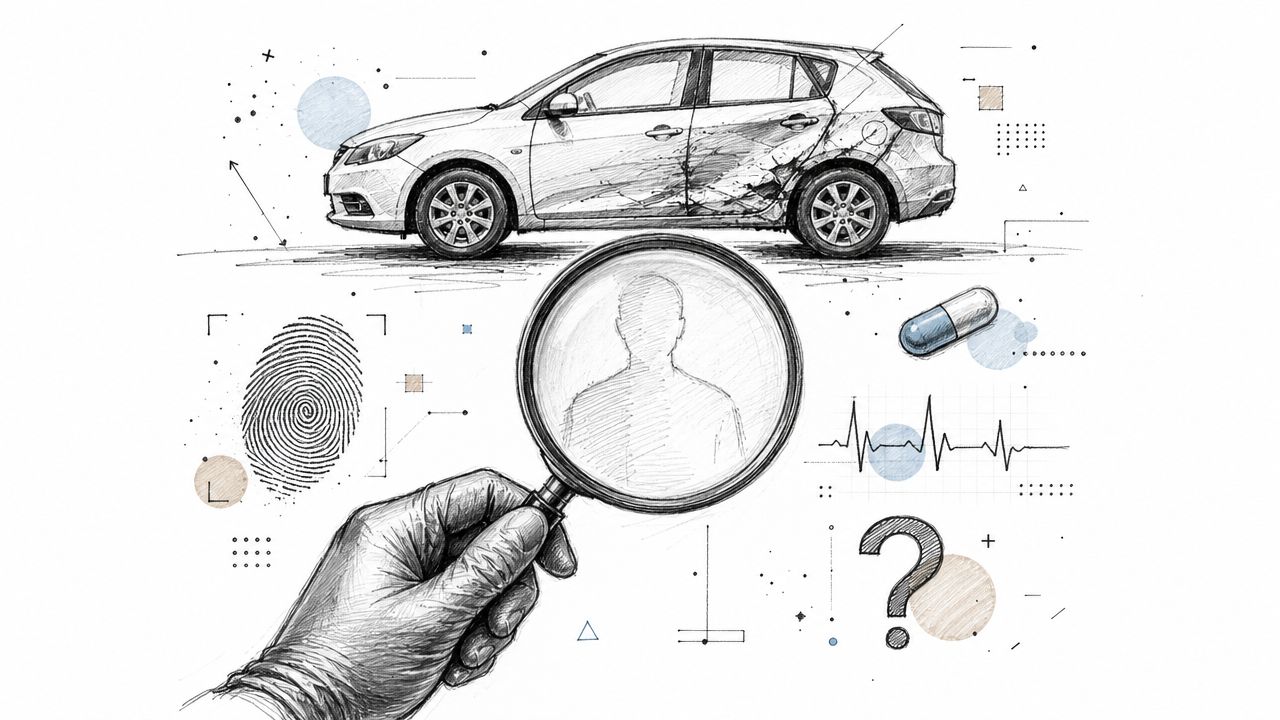
A family calls after a fatal single-vehicle crash. The death certificate says accident. The police narrative may be brief. The injuries are severe, but that alone doesn't answer the hardest question. In the days before death, there may have been depression, a recent crisis, or statements that now feel important. Sometimes there was no note. Sometimes there was no obvious scene evidence that clearly pointed one way or the other.
That is where uncertainty becomes heavy.
At Texas Autopsy Services, every examination is performed by a board-certified forensic pathologist experienced in medicolegal death investigations. Our work centers on one principle: follow the evidence carefully, explain it plainly, and treat the deceased and their family with respect.
When suicide looks like accident, the task is not to prove a theory first and gather facts later. The task is to test every available fact against anatomy, injury pattern, toxicology, records, and scene evidence. In forensic pathology, truth usually appears through consistency or through the lack of it.
An Unsettling Question After an Accidental Death
A common situation starts with ordinary paperwork and an extraordinary doubt. A loved one dies in a crash, a fall, or an apparent overdose. The initial ruling is accident. The family tries to move forward, but details keep surfacing that don't sit right. A recent psychiatric admission. A phone message left unanswered. Prior self-harm. Statements that sounded final only in hindsight.
None of that proves suicide. It does mean the case deserves careful, disciplined review when the medical and investigative record feels incomplete.
Families are often reluctant to say this aloud. They worry they'll sound disloyal, or that asking harder questions will increase suffering. Attorneys face a different version of the same problem. They may be looking at insurance issues, probate disputes, or a civil claim, but before any of that can be addressed, they need to know whether the manner of death was classified correctly.
What people notice first
The first concern is usually not a dramatic revelation. It is a mismatch between the story and the known facts.
- The scene feels too simple: A brief account may not explain why a person was in that location, using that vehicle, or exposed to that particular danger.
- The timeline doesn't settle cleanly: Family members may discover missing hours, conflicting witness accounts, or unexplained digital activity.
- The decedent's recent behavior matters: A change in mood, isolation, or prior self-harm history can become relevant when viewed alongside the physical evidence.
- The medical review seems narrow: Sometimes there was no autopsy. In other cases, the examination answered the physical injury but not the larger question of intent.
Uncertainty after a sudden death isn't, by itself, evidence of error. It is a reason to ask how the conclusion was reached.
My role in these cases is not to amplify suspicion. It is to separate what can be shown medically from what remains assumption. That difference matters deeply when a family is living with the phrase suicide looks like accident and trying to understand whether it applies to their case.
Why an Intentional Act Can Be Mistaken for an Accident
Some deaths are difficult to classify because the mechanism itself is common in true accidents. Vehicle crashes happen accidentally every day. So do falls and poisonings. When the same mechanism is used intentionally, the body may not contain a simple label announcing intent.
A recognized example is traffic death. A Monash University review of suicide and natural deaths in road traffic found that literature estimates driver suicides may represent between 1% and 7% of all motor vehicle crash fatalities, while official statistics often show a much lower figure, indicating likely underclassification. That same review noted that about half of these victims had a known mental disturbance and 24% had prior suicide attempts.
Why the initial ruling may stay broad
The first classification after a sudden death is often made with incomplete information. If there is no note, no witness to an intentional act, and no direct statement of suicidal intent, the scene can look ordinary at first glance. A single-vehicle collision may be recorded as a crash before anyone has gathered mental health history, prior attempts, or broader context.
A second problem is that human behavior doesn't always divide neatly into accident versus clear self-destruction. Some people place themselves in danger in ways that blur recklessness and intent. That is one reason public discussion of suicidality often benefits from mental health perspectives such as this male counsellor's view on suicidal thoughts, which helps explain why outward behavior may not fit simple assumptions.
The evidence may be scattered
In many disputed deaths, no single finding resolves the case. The key evidence may be spread across different places and people:
- Scene facts: skid marks, vehicle position, witness statements, point of impact
- Medical history: depression, prior attempts, recent discharge, medication changes
- Toxicology: alcohol or drug involvement that may affect both behavior and interpretation
- Records outside medicine: phone activity, search history, messages, location data
Practical rule: When suicide looks like accident, the absence of obvious proof is not the same thing as proof of accident.
That is why independent review can matter. In county systems, resources and available information differ from case to case. For jurisdictions needing broader forensic support, county forensic autopsies can become important when the initial presentation of a death may not reflect the full investigative picture.
Clarifying Cause of Death vs Manner of Death
People often hear one phrase and assume it answers everything. It usually doesn't. In forensic pathology, cause of death and manner of death are separate conclusions.
Cause of death is the medical reason the body stopped functioning. That may be blunt force trauma, toxic drug effect, asphyxia, or a natural disease. Manner of death is the legal classification of the circumstances in which that cause occurred.
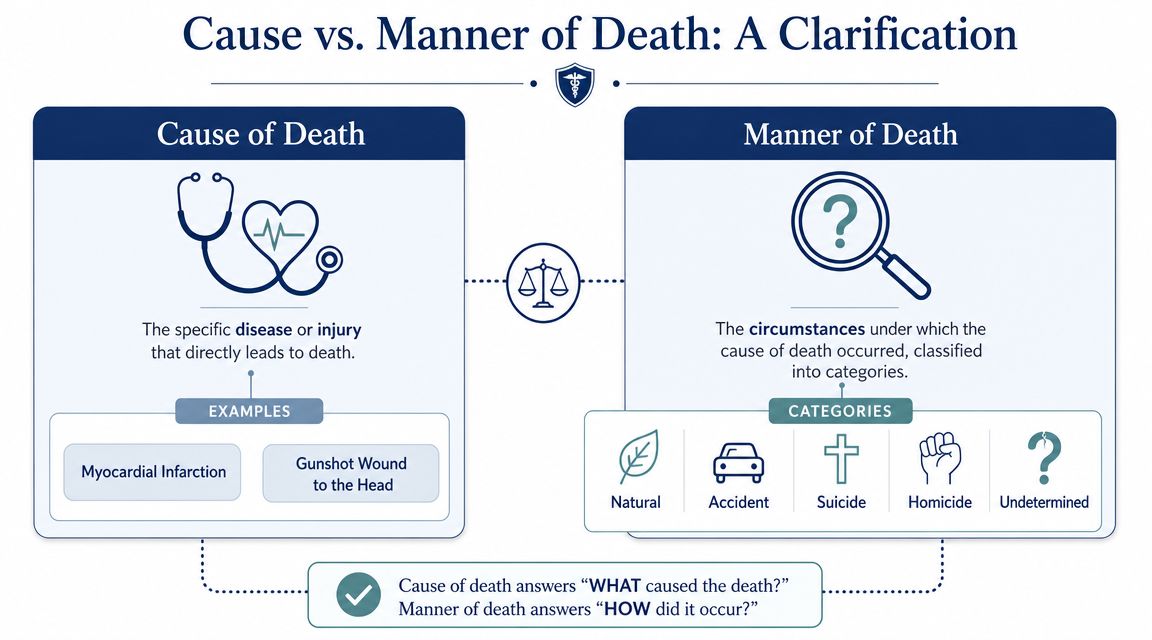
The distinction in plain language
A crash victim may die of blunt force injuries. That is the cause. But those same injuries could arise from an accident, a suicide, or in rare cases another manner depending on the evidence. The body may tell me what injuries occurred. It does not always tell me, by itself, why the event happened.
That is why I place so much importance on concordance. In forensic pathology, the key principle is that the injury pattern, scene context, toxicology, and decedent history must all align with the proposed mechanism of death. When those data streams do not converge, the manner of death may need to be re-evaluated, even if the scene initially suggested an accident, as discussed in this explanation of manner and cause of death.
What independent review adds
An independent forensic pathologist does not begin with loyalty to the original label. The obligation is to the evidence. That can mean confirming the initial ruling. It can also mean concluding that the manner is better certified as suicide or undetermined if the original account doesn't hold up.
A private review is often most useful when the family or counsel needs a fresh analysis of whether the findings fit together. Services such as private autopsies are one route to that review when the issue is not merely what the injury was, but whether the death was classified correctly.
The strongest forensic opinion is not the most forceful one. It is the one in which the medical findings and the surrounding facts support each other.
Forensic Indicators That Point to Suicide
The most important forensic work in these cases is comparative. I compare the claimed mechanism against the body, the scene, the records, and the laboratory results. If those pieces fit, the conclusion becomes stronger. If they conflict, the original manner may need to be questioned.
A few findings are especially useful because they bear directly on self-infliction.
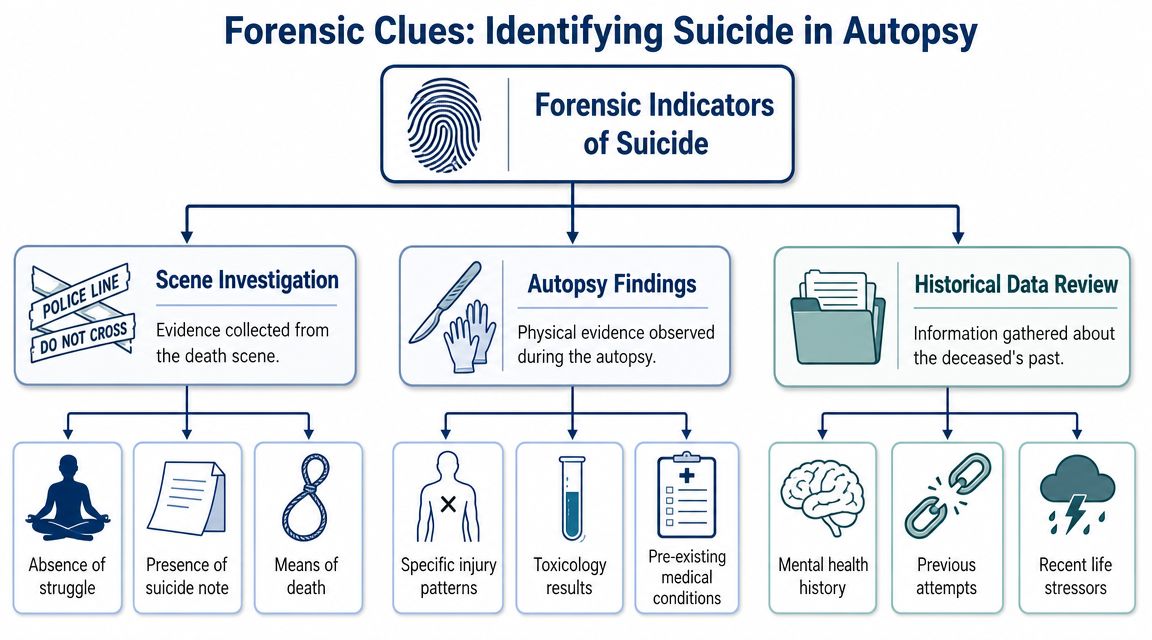
Wounds that suggest self-infliction
Forensic pathologists look for technical markers such as hesitation wounds, which are tentative, superficial injuries near the fatal wound and strongly suggest self-infliction. We also evaluate wound geometry, because self-inflicted wounds often show a distinctive trajectory that differs from accidental or assault-related injuries, as summarized in this research overview on hesitation wounds and suicide.
That does not mean every suicide has hesitation wounds. Many do not. It means that when such findings are present, they carry real interpretive weight.
Toxicology and physical findings have to agree
Toxicology often changes the direction of a case. A result is never just a list of substances. The question is whether the substances, their concentrations, the route of exposure, and the postmortem findings fit the reported circumstances.
For example, an overdose classification should align with the autopsy, the specimen results, the medication access, and the history. Families and attorneys who want a clearer sense of how those interpretations work often benefit from reading about post-mortem toxicology.
A short visual explanation can help frame the investigative process:
Scene review and history matter more than many people realize
The body rarely answers intent alone. I also look at whether the scene supports self-directed action, whether there are signs of struggle, whether a note or recorded statement exists, and whether records show prior attempts or recent suicidal communication.
This is also where newer forensic methods can help. Digital reconstruction, device review, and specialized analytical methods continue to expand what investigators can assess. For readers interested in how laboratory and data analysis are entering broader forensic practice, this overview of applications of bioinformatics in forensics offers useful context, even though those tools do not replace basic scene and autopsy correlation.
What does not work
Several approaches create more confusion than clarity:
- Relying on one dramatic fact: A prior threat, a note fragment, or a toxicology finding may matter, but none should stand alone.
- Treating appearance as conclusion: A death scene can look accidental and still be intentional. It can also look suspicious and still be accidental.
- Ignoring contradictory details: Small inconsistencies often become decisive when they repeat across the medical and investigative record.
A manner-of-death opinion should survive contact with every available record, not just the first report written after the death.
The Independent Autopsy Process A Step by Step Guide
When families or attorneys seek an independent review, the most helpful thing I can do at the start is make the process clear. Unknowns create anxiety. A private autopsy process should be transparent, respectful, and legally proper.
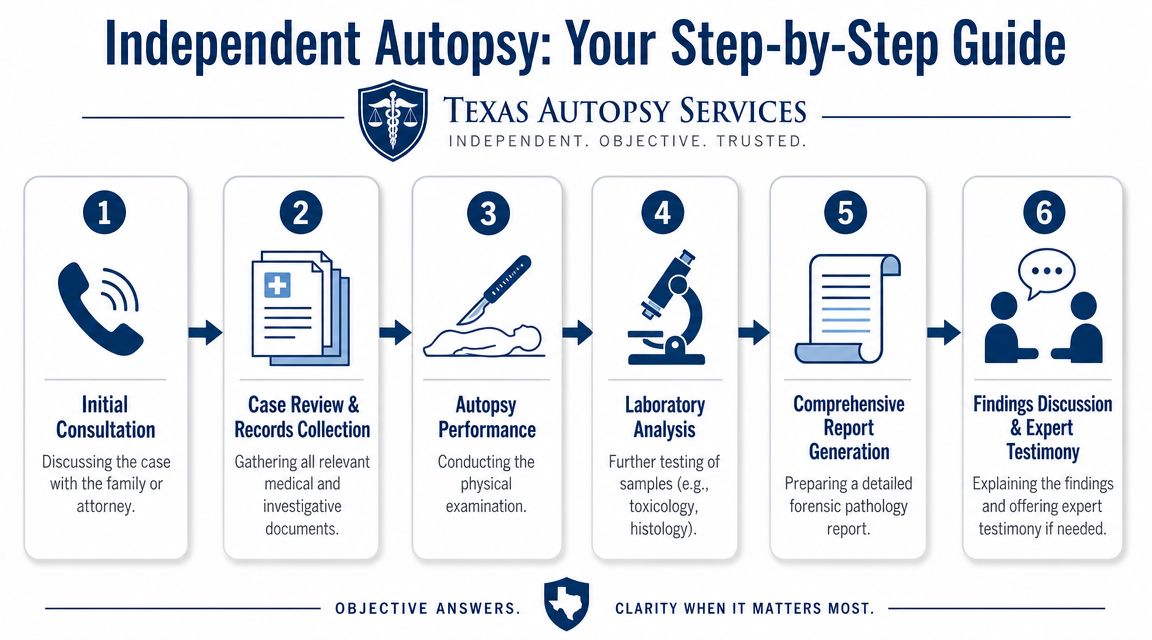
How the review usually unfolds
Initial consultation
The first conversation focuses on the known facts, the current official findings, and the family's or attorney's specific concerns. I also clarify what an autopsy can answer and what may remain uncertain.Authorization and logistics
In Texas, the legal authority to authorize a private autopsy depends on who has the right to make decisions after death. Transportation and facility coordination are handled carefully and in compliance with applicable Texas requirements.Records and document collection
The strongest opinions come from complete files. That may include hospital charts, EMS records, scene photographs, toxicology, prior reports, and witness statements.
The examination itself
A proper postmortem examination includes an external exam, internal exam, documentation of injuries and disease, and collection of samples when needed for toxicology or histology. Chain of custody matters here. In plain language, that means a documented record of who collected each specimen, how it was labeled, how it was stored, and who handled it next.
For families in Central Texas, logistics may involve coordination with facilities such as the Waterloo Mortuary pathology partnership, depending on the circumstances of the case.
For a fuller overview of how each phase is handled, I often direct people to this step-by-step autopsy guide.
What the final work product should provide
The final report should do more than name injuries. It should explain the findings, the laboratory studies, and the reasoning behind the forensic opinion on cause and manner of death. In some matters, that report is then reviewed by counsel, presented to insurers, or used in litigation.
One available option in Texas is Texas Autopsy Services, which provides private autopsy and second-opinion forensic pathology review for families, attorneys, and agencies seeking an independent medical analysis.
Legal and Insurance Implications of an Amended Death Certificate
An amended death certificate can have immediate practical consequences. Families usually feel the emotional impact first, but attorneys often see how quickly the classification of death affects insurance, probate, and civil litigation.
Why the wording matters legally
If a manner of death changes from accident to suicide, or from suicide to accident, the effect may reach well beyond public records. Insurance carriers may evaluate the claim differently. Probate strategy may change. A civil case may also depend on whether intent can be medically supported.
The difficulty is that the line between high-risk accidental death and suicide can be forensically ambiguous. Public guidance often under-explains how newer evidence from vehicle data recorders, telematics, and digital footprints can help clarify intent where the autopsy alone cannot, as discussed in this piece on whether someone can die by suicide and look accidental.
How attorneys usually use the forensic report
A sound forensic report helps in several ways:
- It identifies what is medically supported: not just what was alleged
- It shows where the evidence converges or conflicts: which is often critical in contested claims
- It gives a defensible basis for challenge or confirmation: especially if the original certification appears incomplete
When an insurance dispute is already underway, legal guidance specific to the claim process may also be necessary. For example, families dealing with denials may find practical direction in this Austin-focused guide on challenging insurance claim denials in Austin.
In legal settings, the strongest forensic opinion is usually the one that states both its conclusions and its limits with equal clarity.
Frequently Asked Questions About Private Autopsies
Families usually ask practical questions first. Attorneys often do the same, but with an eye toward documentation and admissibility. The answers should be plain, careful, and realistic.
Private Autopsy FAQ
| Question | Answer (as our pathologist) |
|---|---|
| Can a private autopsy still be performed if the death has already been called an accident? | Yes, sometimes it can. The key issue is whether the body is available for examination and whether the legally authorized person consents. Even when a full new examination is no longer possible, a second-opinion forensic review of records, photographs, toxicology, and prior reports may still be useful. |
| Will an independent autopsy automatically change the death certificate? | No. A private report does not guarantee any amendment. It may support the original ruling, support a different manner of death, or conclude that the manner remains undetermined. The value is an objective medical opinion grounded in the available evidence. |
| Is embalming the end of the process? | Not always. Embalming can limit some aspects of postmortem examination and toxicology interpretation, but it does not make all review impossible. The answer depends on what questions need to be addressed and what records and specimens already exist. |
| What is chain of custody? | Chain of custody is the documented handling of specimens and evidence from collection through testing and reporting. It matters because families and courts need confidence that samples were properly identified, preserved, and tracked. |
| How long does the process take? | There is no single timeline that fits every case. Timing depends on transportation, record collection, laboratory testing, and whether the case also requires extensive scene or document review. A careful report should not be rushed at the expense of accuracy. |
A final point for families and counsel
A private autopsy or second-opinion review is not a commitment to one theory. It is a commitment to testing the official story against the evidence. Sometimes that process confirms the original conclusion. Sometimes it exposes gaps. Sometimes it narrows the question but does not eliminate all uncertainty.
That last outcome can be frustrating, but it is still honest forensic work. In some cases, "undetermined" is more accurate than a confident answer that the evidence does not support.
If you're carrying unresolved questions after a death that was labeled accidental, direct conversation often helps more than online searching. Texas Autopsy Services can discuss the facts of the case, explain what type of review may still be possible, and help you understand the next medically appropriate step with care and respect.