January 2, 2026 · Texas Autopsy Services
A Guide to the Exhumation of a Body in Texas
Learn the legal and medical process for the exhumation of a body in Texas. A guide from a forensic pathologist on finding answers after burial.
On this page
TL;DR: Key Points on Exhumation
- An exhumation is the court-ordered removal of a body from its grave for a postmortem examination.
- It's typically initiated due to new evidence in a criminal case, unresolved family questions, or civil litigation needs.
- The process in Texas is strictly governed by the Texas Health & Safety Code, requiring a court order and a disinterment permit.
- As a board-certified forensic pathologist, my role is to provide an independent, objective cause-of-death investigation.
- Even after burial and embalming, a specialized autopsy can uncover critical evidence regarding trauma, toxicology, and underlying medical conditions.
For years, I worked as a forensic pathologist in a county medical examiner’s office where we handled a case involving a man whose death was initially ruled an accident. His family never accepted that conclusion. They knew his history and character, and the official story didn’t align with the man they knew. After years of persistent effort, they secured a court order for an exhumation. My subsequent examination revealed subtle injuries that had been missed, leading authorities to reclassify the death as a homicide.
That case reinforced a core truth of my profession: sometimes, the only path to peace is to revisit the past. An exhumation isn't about disturbing a resting place; it's about a commitment to finding answers when serious doubts remain.
Seeking Truth When Questions Linger

I understand that considering the exhumation of a body is an incredibly difficult step. It’s a decision made only when new information or persistent doubts can’t be ignored. As a forensic pathologist with over 1,000 autopsies performed, my work is to conduct a clear, medically sound investigation that honors the deceased while providing objective answers for the living.
These situations are never simple. They always stem from a deep need for certainty, and it's my responsibility to provide that clarity through a precise and respectful process.
Common Triggers for an Exhumation
While every case is unique, most requests for exhumation arise from a few critical situations:
- Emergence of New Evidence: In a criminal investigation, new information can change everything. A witness may come forward, or previously unknown evidence surfaces, making it necessary to re-examine the deceased to confirm or challenge the original findings.
- Persistent Family Doubts: It’s not uncommon for a family to feel that the official cause of death doesn’t make sense. It might contradict what they knew about their loved one’s health or the circumstances surrounding the death. An independent second opinion autopsy can provide much-needed clarity.
- Civil Litigation Requirements: The outcome of a wrongful death lawsuit, an insurance claim, or an inheritance dispute often depends on the specific cause and manner of death. An independent forensic examination provides the objective evidence needed to move forward.
- Misidentification Concerns: In rare and tragic situations, a question might arise about whether the correct person was buried. Exhumation allows for definitive identification through DNA testing and other forensic methods.
This guide will explain the methodical and respectful steps of an exhumation in Texas. My goal is to demystify the process and show that, when handled with professional care, it can provide vital clarity for legal cases and emotional closure for families.
What Is an Exhumation and Why Does It Happen?
An exhumation is the process of removing a body from its grave. While it sounds straightforward, it’s a medically supervised and legally complex act that is never undertaken lightly. In Texas, this requires specific legal authorization before any work can begin. The purpose of taking such a significant step is to find answers that can only be obtained by re-examining the deceased.
The reasons for this serious procedure almost always fall into a few key categories. A criminal investigation might be revitalized by new evidence or a confession. A civil lawsuit, like a wrongful death claim, could depend entirely on information that only a new examination can provide. Sometimes, a family initiates the process, seeking an independent autopsy because the original cause of death remains questionable.
The Reasons for Disinterment
The motivation for an exhumation usually boils down to a need for absolute clarity for legal, medical, or personal reasons.
- Criminal and Forensic Investigations: Law enforcement may need to reopen a grave if new evidence suggests foul play was missed. A fresh examination can uncover hidden signs of trauma, allow for new DNA collection, or run toxicology tests that weren't performed initially.
- Civil Litigation: When it comes to lawsuits over insurance claims or wrongful death, the exact cause of death is foundational. An exhumation provides the objective medical facts needed to help a court make an informed decision.
- Family-Initiated Requests: Families may have nagging doubts about an official cause of death. They might feel the initial report doesn't align with their loved one’s health history or the circumstances of the death. An exhumation can provide definitive answers and a sense of closure.
- Historical and Identification Purposes: Though less common, exhumations are sometimes used to solve long-standing mysteries of identity or to correct the historical record.
The Power of a Second Look
The ability to re-examine a body has changed the outcome of high-profile cases, proving its value time and again. A well-known example is the case of outlaw Jesse James, killed in 1882. For over a century, people questioned whether the man in the grave was truly him. A court-ordered exhumation in 1995 put the rumors to rest. Using dental records and modern DNA analysis, experts compared the remains to living descendants and found a 99.7% match. You can read the full research about identity confirmation to see how forensics brought clarity to a historical legend.
This isn’t just about history. In my experience, a significant percentage of exhumation cases lead to important new findings or reclassification. That’s the power of a second look.
As a forensic pathologist, my role is to provide an unbiased, medically sound evaluation of the available evidence. An exhumation isn't about second-guessing past decisions; it's about applying every available tool to find the most accurate answer for the family and the legal system.
Making the decision to exhume a loved one involves emotional, legal, and financial hurdles. For a deeper look into these factors, you can read our detailed post about why a corpse might be exhumed. Understanding the reasons is the first step in a careful process where dignity, respect, and the truth are the top priorities.
Navigating The Legal Process In Texas
Before any physical work can begin, an exhumation of a body must clear significant legal hurdles. The process in Texas is carefully controlled for good reason. It’s a formal legal proceeding that respects the finality of burial while making it possible to find the truth when necessary.
The entire system is outlined in the Texas Health & Safety Code, particularly Chapter 711, which details the rules for disinterment. These legal guardrails prevent casual requests and protect the dignity of the deceased. For any family or attorney considering this path, understanding this legal framework is the essential first step.
Who Can Authorize A Disinterment
Texas law is very clear about who can request or order an exhumation. The power to start the process lies with a few specific individuals or entities.
The table below breaks down who can initiate an exhumation in Texas and the legal basis for their request.
Who Can Request An Exhumation In Texas
| Requesting Party | Typical Legal Basis | Governing Statute Context |
|---|---|---|
| Next of Kin | Petition for a private autopsy or relocation of remains | Texas Health & Safety Code § 711.004 allows close family to seek a court order for valid reasons. |
| District Court Judge | Court order issued during criminal or civil proceedings | A judge can compel exhumation if it's crucial to resolving a legal matter. |
| District/County Attorney | Petition to the court for a criminal investigation | Prosecutors can seek an order if new evidence suggests foul play or requires forensic analysis. |
These legal pathways ensure every request is weighed carefully.
To put it more simply, here are the main players:
- The Next of Kin: A surviving spouse, adult child, or parent can petition a court for an order. This often happens when a family needs answers and decides to pursue a private autopsy. Our guide explains more about who can request an autopsy in these situations.
- A District Court: A judge has the authority to issue a direct order for exhumation. This typically occurs during a lawsuit or criminal case when evidence buried with the deceased becomes critical.
- A County or District Attorney: If a death is suddenly viewed as suspicious or a cold case is reopened, the prosecutor’s office can ask a judge for an order to exhume the body for a new forensic examination.
This flowchart illustrates how these different triggers all lead to the same formal legal process.

No matter the reason for an exhumation, the path forward always requires approval from the state's official legal system.
The Formal Application Process
The process begins with filing a sworn written application with the district court in the county where the person is buried. This document must clearly state who you are, your relationship to the deceased, and why the exhumation is needed.
A judge will review the petition and may schedule a hearing. If they agree the reason is compelling, they’ll issue a court order. That signed order is the key to moving forward.
With the court order in hand, the next step is obtaining a disinterment permit from the local registrar or city secretary. They won’t issue this permit without seeing the judge's signed order. This two-step system, court order then permit, is a final check to ensure every exhumation is fully vetted and legally sound. The Texas Funeral Service Commission (TFSC) also provides oversight to ensure all licensed professionals involved adhere to state regulations.
The Medical Examination After Disinterment

Once the court authorizes the exhumation of a body, my role as a forensic pathologist begins. This is where we shift from legal procedure to scientific investigation. The goal is to conduct a methodical, unbiased examination to determine the truth while preserving the integrity of the remains.
Everything hinges on maintaining a strict chain of custody. This is a documented, unbroken line of possession. From the moment the casket is lifted, every step is recorded. The remains are securely moved to a proper facility, like our partner Waterloo Mortuary, which is equipped for these complex cases. This process ensures any evidence we find will be admissible in court.
The Specialized Postmortem Examination
An autopsy after disinterment is not a standard procedure. We face unique challenges introduced by time, the burial environment, and prior embalming. Despite these hurdles, a significant amount of information can still be found.
My examination is meticulous and adapted to the condition of the remains.
- Initial Documentation and Imaging: We start by documenting everything as it arrives. We often begin with digital X-rays or CT scans, which provide a non-invasive first look to spot old fractures, foreign objects like bullets, or other signs of trauma not visible to the naked eye.
- Detailed Gross Examination: This is a careful, hands-on physical inspection. I methodically examine the body for evidence of injury to bones, signs of disease, or anything unusual that might indicate the cause of death. Skeletal trauma, for example, is remarkably well-preserved over time.
- Toxicology and Ancillary Testing: Embalming fluids can complicate toxicology, but they don't make it impossible. We can still test samples from hair, bone, and nails, which can retain evidence of heavy metals, certain poisons, or long-term drug use. These tissues act as a historical record.
Overcoming Technical Challenges
Decomposition and embalming are the two biggest obstacles. They alter the body, but they don't erase every clue. Embalming, for instance, can preserve organs to some degree, which might still allow us to identify certain diseases or anatomical issues.
A critical part of my job is knowing how to interpret these changes and distinguish between artifacts from decomposition and genuine pre-death injuries. This specialized skill is crucial for accurate findings.
The purpose of this detailed examination is not to find fault but to find facts. By systematically analyzing the available evidence, no matter how degraded, we can often reconstruct a clearer picture of what happened.
Meticulous record-keeping is critical throughout this process. You can review essential medical documentation guidelines to see how rigorously findings must be logged to ensure legal integrity.
A well-known historical example of this is the 1991 exhumation of President Zachary Taylor. For 141 years, rumors persisted that he was poisoned with arsenic. Forensic experts exhumed his body, tested samples of his hair and bone, and found only normal background levels of arsenic, disproving the poisoning theory. While exhumations are rare, they can provide the final word in a high percentage of disputed cases.
Ultimately, a medical examination after disinterment is a patient search for the truth. By combining modern forensic techniques with an understanding of postmortem changes, we can often bring the clarity that families and the legal system need.
What Families and Attorneys Can Expect
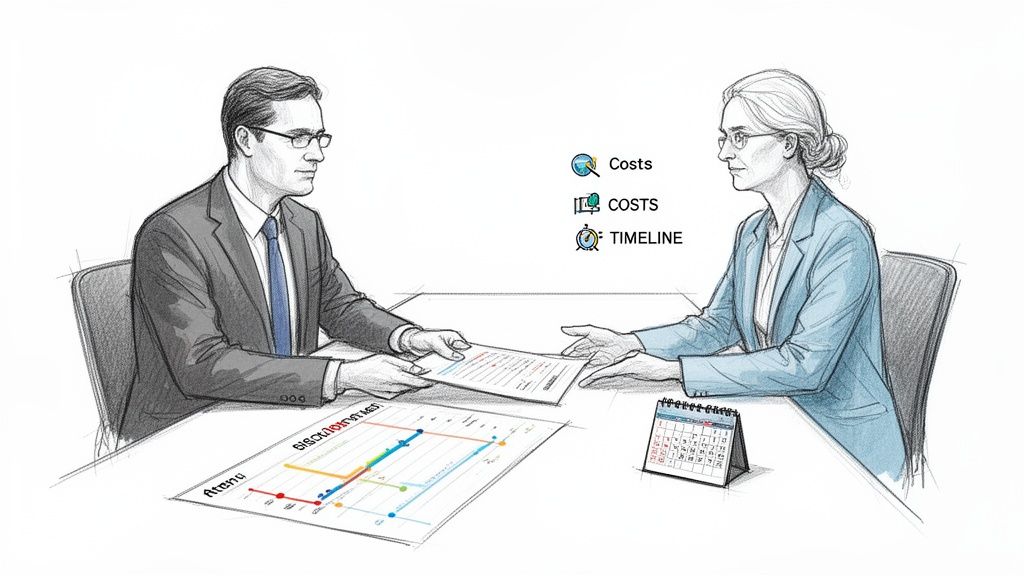
Beginning the exhumation of a body involves logistical hurdles and significant emotional weight. My role as a forensic pathologist is to provide a clear, straightforward map of the road ahead. I ensure that everyone, from the family to their legal team, knows what to expect at every stage.
This is a carefully coordinated effort between lawyers, cemetery staff, mortuary professionals, and my office. Open and honest communication is essential to ensure the entire process is handled with professionalism and respect.
Understanding the Timeline
"How long will this take?" is usually the first question I'm asked. The honest answer is: it varies. The timeline is influenced by a few key factors.
- Legal Proceedings: The biggest variable is securing a court order. This step alone can take anywhere from a few weeks to several months, depending on the court's schedule and the specifics of the case.
- Logistical Coordination: Once we have court approval, things move more quickly. We can usually schedule the physical disinterment with the cemetery within a matter of days.
- The Examination: The forensic examination itself is typically completed within a day of the remains arriving at our facility.
- Final Reporting: Compiling the comprehensive report, especially when it involves complex toxicology or histology tests, can take several more weeks.
Patience during the initial legal phase is key.
A Transparent Look at Costs
The financial aspect of an exhumation is a major consideration. The total cost is composed of several different services, and it’s important to understand what you're paying for.
At Texas Autopsy Services, my commitment is to provide a clear, all-inclusive quote for the forensic examination. Families and attorneys deserve total transparency, with no surprise fees or hidden charges.
The main expenses include:
- Legal and Court Fees: This covers the cost of hiring an attorney and filing the required court documents.
- Cemetery Charges: The cemetery has its own fees for the physical work of disinterment and reinterment.
- Transportation: A licensed funeral director is required to transport the casket from the cemetery to the examination facility and back.
- Forensic Examination Fee: This is my professional fee, which covers the autopsy, any necessary lab tests, and the creation of the detailed final report.
My Role and Commitment
My work extends beyond the examination table. I serve as a trusted resource for legal teams and county officials, ensuring every piece of evidence is managed with strict adherence to protocol.
Most importantly, I never forget the human element of this work. I understand how difficult this process is for families. Every interaction, from our first phone call to the delivery of the final report, is handled with dignity. My goal is to provide objective, medically sound answers while showing the utmost respect for the deceased and their family.
The Value of an Independent Forensic Review
When a family or legal team proceeds with an exhumation, they are seeking the truth. That clarity can only come from an objective, expert review of the evidence, completely independent of the original investigation. As an independent, board-certified forensic pathologist, I have one obligation: to follow the medical evidence wherever it leads.
An independent review isn't about challenging prior work. Sometimes, it confirms the original findings, which brings a powerful sense of certainty. Other times, it can change the understanding of a case by uncovering missed details or reinterpreting evidence with advanced testing. This is the core of my work, both at Texas Autopsy Services and when providing county forensic autopsies.
Ensuring Unbiased Answers
Our independence is our greatest strength. When a family is troubled by unanswered questions or a legal case depends on a single medical fact, there is no substitute for an impartial examination. It’s the only way to guarantee a final report built on science, free from outside influence.
The final report must be impeccable. Every observation and conclusion is carefully documented, often with the support of tools like medical transcription software, to ensure every word is precise and defensible. That commitment to unbiased truth gives the process its power.
Medical Insights From Historical Data
We can learn a remarkable amount, even years after burial. Exhumations have a history of providing critical health information, not just for the family but for public health as well. For families navigating the complex grief of fetal and perinatal loss, these answers can be invaluable. You can discover more insights about these findings on esurf.copernicus.org.
My commitment is simple: to deliver a clear, medically sound, and completely independent analysis. Many families come to us seeking a second opinion autopsy for that fresh, unbiased perspective. This isn't just about professional standards; it's a promise to provide definitive answers grounded in fact.
Common Questions About the Exhumation Process
When families and attorneys consider an exhumation, they have many questions. It’s a serious step, and the process can seem complicated. Having clear, straightforward answers makes a significant difference.
Here are some of the most common questions I hear.
How Much Does an Exhumation and Second Autopsy Cost?
There isn't a single price for this process. The total cost is a combination of several services, and it’s important to understand what each one covers.
- Legal Fees: This pays for an attorney's time to file the court petition and handle legal paperwork.
- Cemetery Charges: The cemetery has its own fees for the labor involved in opening and closing the grave.
- Transportation: A licensed funeral director must be hired to move the remains from the cemetery to the examination facility and back.
- Forensic Examination: This is the fee for the private autopsy, specialized tests like toxicology, and the final detailed report.
At Texas Autopsy Services, I provide a clear, all-inclusive quote for our part of the process. I always advise getting a detailed cost breakdown from every party involved so there are no surprises.
How Long Does the Entire Process Take?
The biggest variable is the legal system. Obtaining a court order takes the most time; it can be a few weeks or, if complicated, several months. This part requires the most patience.
Once a judge signs the order, things move much faster. The actual exhumation, transportation, and examination can often be done in a few days. The final report will take longer, usually several weeks, especially if we need to run extensive tests to get a complete picture.
Can a Meaningful Examination Be Done After Embalming?
Yes, absolutely. This is a significant concern for many families, but the answer is yes. While embalming alters soft tissues and can complicate some blood toxicology tests, it doesn’t prevent a thorough examination.
We can still uncover a wealth of information. Evidence of physical trauma like broken bones, bullet paths, or other skeletal injuries remains visible. We can also test tissues like hair, bone, and nails, which can retain evidence of certain drugs or heavy metals for a long time. Embalming adds complexity, but a skilled forensic pathologist knows how to work around it to find the facts.
What Happens If Family Members Disagree?
Family disagreements can unfortunately halt the process and push the issue into a courtroom. Texas law is clear about the hierarchy of next-of-kin and who has the right to make these decisions.
If individuals with equal legal standing, like two siblings, cannot agree on whether to proceed, a judge will have to make the final decision. The court will hear arguments from both sides and issue a ruling based on the facts. In these situations, having an experienced attorney is essential.
If you are a family member or an attorney in Texas with more questions about the exhumation of a body or need an independent autopsy, please don't hesitate to contact my office. The team at Texas Autopsy Services is here to offer confidential and compassionate guidance.