April 7, 2026 · Texas Autopsy Services
How to Request a Forensic Review My Case in Texas
Need to review my case? A step-by-step guide from a Texas forensic pathologist on requesting a second opinion autopsy or forensic case review.
On this page
- Answering the Unanswered A Guide to Forensic Case Reviews
- When a Second Opinion Becomes Essential
- Preparing Your Case The Necessary Documentation
- The Forensic Review Process From Start to Finish
- Understanding Your Report and Its Legal Power
- Frequently Asked Questions About Case Reviews
- A Path Toward Certainty and Resolution
When an autopsy report arrives, many families and attorneys expect clarity. Instead, they often find unfamiliar language, unanswered gaps, or conclusions that do not seem to match what they know happened.
At Texas Autopsy Services, every examination is performed by a board-certified forensic pathologist experienced in medicolegal death investigations. Our work centers on one principle: follow the evidence carefully, explain it plainly, and treat the deceased and their family with respect.
A forensic case review is not an accusation. It is not a dramatic last resort. It is a careful second look at the medical and investigative record to determine whether the original conclusion is fully supported.
TL;DR
- A forensic case review is a structured second opinion on cause of death, manner of death, and the evidence behind those conclusions.
- A review becomes especially important when the report feels incomplete, the findings conflict with known facts, or legal questions depend on medical detail.
- Strong reviews depend on complete records, including the autopsy report, medical records, toxicology, scene information, and available images or slides.
- The process works best when handled methodically, with clear consent, documented chain of custody, and careful reporting.
- Families can seek answers with dignity, and attorneys can use a sound review to better understand whether the medical evidence supports their case.
Answering the Unanswered A Guide to Forensic Case Reviews
Some of the most difficult conversations I have are with people who say a version of the same thing: “We got the report back, but it doesn’t answer what we needed to know.”
That may mean a family cannot reconcile the findings with the events before death. It may mean an attorney sees a record that raises questions about timing, injury interpretation, intoxication, or medical treatment. It may mean the official paperwork uses terms that feel final, while the actual facts still feel uncertain.
A second opinion is a normal part of medicine. It also has an important role in forensic pathology. Death investigation sits at the intersection of medicine, law, and family concerns. That makes precision especially important.
What a case review is
A forensic case review is an independent examination of the available materials from a death investigation. Depending on the case, that may include records, photographs, slides, tissue blocks, toxicology, imaging, and scene reports.
The goal is not to create conflict. The goal is to answer a disciplined question: do the available facts support the stated conclusions?
Plain language terms that matter
Three terms often cause confusion:
- Cause of death means the disease or injury that led to death.
- Manner of death means the category of death, such as natural, accident, suicide, homicide, or undetermined.
- Chain of custody means the documented handling of evidence or specimens so there is a clear record of who had them, when, and under what conditions.
Key point: A review is most useful when it focuses on specific unanswered issues, not a general feeling that “something seems off.” Clear questions lead to clearer opinions.
When people search “review my case,” they are usually asking for clarity, not argument. That is the right starting point.
When a Second Opinion Becomes Essential
There are cases where a second opinion is helpful. There are others where it becomes difficult to justify going without one.
A large study of 630 medicolegal autopsy cases found that pathological expertise was required in 19.2% of cases, and in those reviewed cases it changed the cause of death in 22% and the manner of death in 19% (PMC article on medicolegal autopsy review). That does not mean every case will change. It does mean review work can materially affect the final answer.
Situations that should prompt a review
Some patterns come up repeatedly.
The findings do not fit the known history
A family may describe a sudden collapse after a medical procedure, an unexpected death after a minor injury, or a rapid decline that seems out of proportion to the report’s explanation.
In those cases, the issue is not emotion alone. It is internal consistency. A forensic pathologist compares the medical history, the timing, the injuries or disease process, and the laboratory findings to see whether they align.
The manner of death is undetermined or disputed
An undetermined manner of death is sometimes the correct conclusion. It can also signal a case that needs deeper review, especially when civil or criminal questions depend on the distinction between accident, homicide, suicide, or natural death.
Attorneys often need to know not only what the report says, but how strongly the evidence supports that classification.
The legal case turns on medical detail
Wrongful death, medical negligence, insurance disputes, and criminal defense or prosecution matters often depend on details that are easy to miss in summary language.
Examples include:
- Timing questions involving whether a complication began before or after a medical event
- Injury interpretation where the pattern may support one mechanism and not another
- Toxicology context where a listed substance may or may not explain the death
- Natural disease overlap when severe illness complicates trauma or intoxication findings
Independence matters
A second opinion has value because it is independent. The reviewer is not trying to defend the original report, and is not trying to produce a predetermined alternate answer either.
That distinction matters. A proper review can confirm the original findings. It can also identify where the evidence is thinner than the wording suggests.
For families and counsel looking for a formal second opinion, second opinion autopsy review services are designed around that narrower and more disciplined task.
What works and what does not
A productive review usually starts with a defined concern. “The timeline does not make sense.” “The toxicology seems incomplete.” “The injury description seems inconsistent with the scene.” Those are reviewable issues.
A less productive approach is asking for a new opinion while withholding records that might undermine your preferred theory. Forensic pathology is evidence-based. A reviewer needs the difficult records too.
Practical guidance: If you are considering a review, write down the two or three exact questions you need answered. That helps focus the analysis and reduces confusion later.
Families and attorneys often notice different warning signs
| Concern type | What families often notice | What attorneys often notice |
|---|---|---|
| Timeline | Symptoms or decline do not match what they were told | Gaps between treatment, transport, and death |
| Report language | Terms feel vague or overly broad | Conclusions appear stronger than supporting facts |
| Scene context | Personal knowledge seems missing | Investigative records do not appear fully integrated |
| Testing | They expected more explanation | They want to know whether additional testing was warranted |
The common thread is the same. If the conclusion is going to carry medical or legal weight, it needs a foundation that can withstand careful review.
Preparing Your Case The Necessary Documentation
Most review delays do not happen because the medicine is unusually difficult. They happen because the file is incomplete.
That problem is especially important in rural settings. Recent reporting noted that 25% of Texas rural deaths lack timely autopsy reviews due to record retrieval delays (report on rural healthcare access and delays). When records are scattered across hospitals, counties, law enforcement agencies, and laboratories, a review can stall before it starts.
The core documents to gather
If you want a meaningful answer, start with the complete paper trail.
Original autopsy report
This is the foundation. It states the findings, the opinion, and often the rationale.Death certificate
It helps identify what was formally certified and whether it matches the autopsy conclusion.Toxicology report
The listed substances matter, but so do the specimen type, collection details, and interpretive comments.Hospital and clinic records
These show the person’s baseline health, treatment course, symptoms, procedures, and timing.EMS, police, or investigative reports
Scene context often changes how physical findings should be interpreted.Autopsy photographs, radiology, slides, and tissue blocks if available
These materials allow a deeper review of injuries, disease, and microscopic findings.
Why each document changes the analysis
A forensic opinion is built by comparing sources, not by reading one report in isolation.
For example, a hospital chart may document a sudden change after treatment. A scene report may describe a collapse pattern inconsistent with a simple natural death. A toxicology sheet may list substances that require careful interpretation in context rather than automatic blame.
That is why an experienced review rarely starts with “What is the diagnosis?” It starts with “What materials exist, and what can they reliably show?”
A simple preparation checklist
Some families feel overwhelmed by the request list. Breaking it into categories helps.
Medical records
Ask for:
- emergency department records
- admission and discharge summaries
- operative reports
- nursing notes
- medication records
- imaging reports
- laboratory results
Death investigation records
Request:
- the final autopsy report
- investigator narrative
- scene reports
- witness statements if released
- death certificate
- toxicology report
Physical review materials
If a deeper pathology review may be needed, ask whether the agency or hospital pathology department holds:
- glass slides
- paraffin tissue blocks
- radiology files
- autopsy photographs
A practical resource for this step is how to get an autopsy report in Texas, especially when families are trying to sort out which office holds which records.
Tip: Keep a dated list of every request you send, the office you sent it to, and what you received back. A clean request log reduces duplicated effort and helps your reviewer see what is still missing.
What families should know about delays
Some delays are unavoidable. Different institutions release records through different departments. Some materials require formal authorization. Some counties have separate procedures for reports versus images or specimen release.
What does not work is waiting until all records are perfectly assembled before contacting a reviewer. A reviewer can often identify which missing items matter most and which are less urgent.
What attorneys should do differently
Attorneys usually move faster when they identify the legal issue early. A review for trial testimony is not organized exactly the same way as a review for pre-suit screening or internal case assessment.
If counsel knows the core question is timing, causation, restraint injury, intoxication, pediatric pathology, or treatment complication, that should be stated at the outset. It sharpens the file request and the eventual opinion.
The Forensic Review Process From Start to Finish
People often assume a case review means reading one report and issuing a reaction. It should be far more disciplined than that.
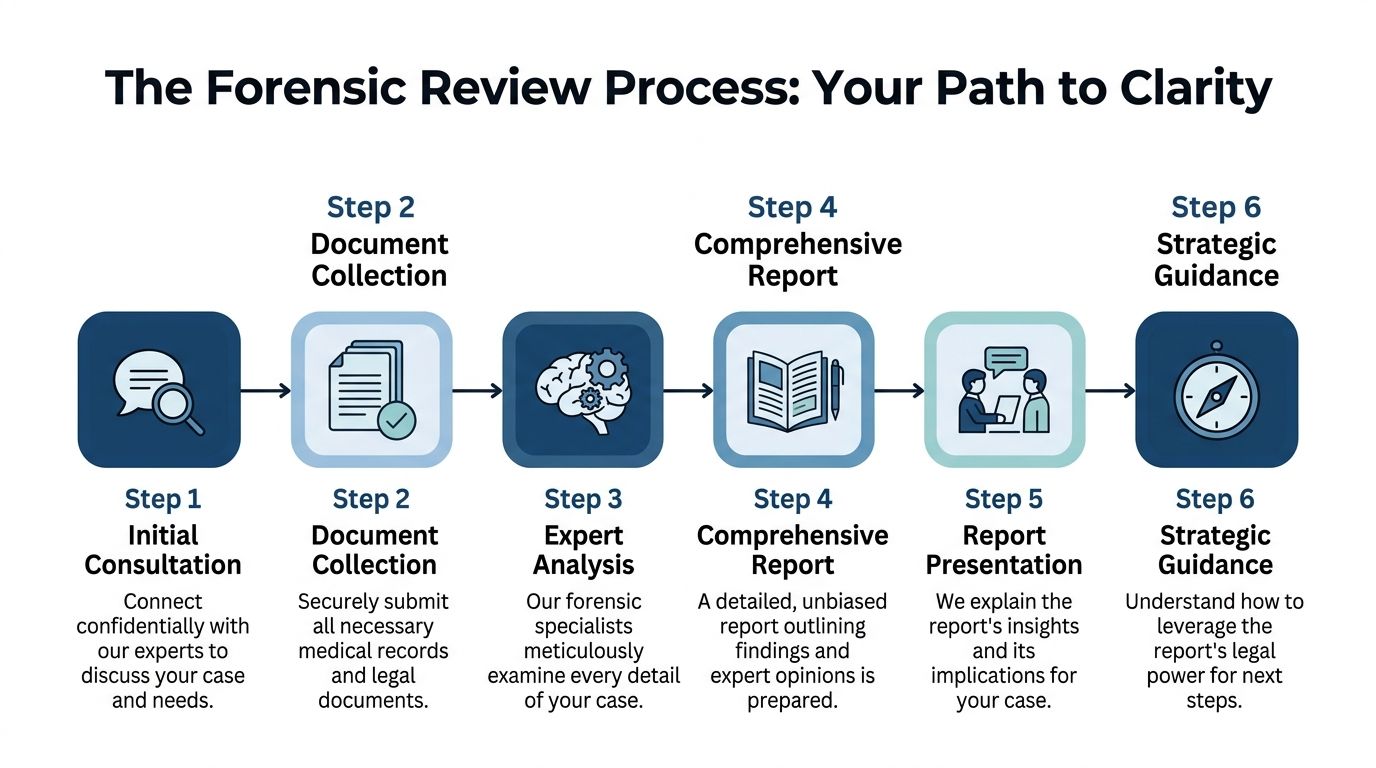
A reliable methodology follows a structured path. In expert review practice, that is often described as a Prefield Phase, Field Phase, and Reporting Phase, with attention to standards relevant to admissibility such as the Daubert framework (overview of reliable expert methodology and Daubert considerations). In plain terms, that means the reviewer gathers the right material, tests the right questions, and explains the result in a way that can be evaluated.
Step one begins with the question, not the conclusion
The first conversation should identify what needs review.
Sometimes the request is broad. A family may say they do not understand the report. Sometimes it is specific. An attorney may ask whether the pathology supports aspiration, sepsis, blunt force injury, overdose, neglect, or a complication of care.
That opening matters because it sets the scope. A focused review is usually stronger than an unfocused search for anything arguable.
Consent and legal authority
Before any records or materials are reviewed, the reviewer needs proper authorization.
In Texas, postmortem work sits within a legal framework that includes the Texas Health and Safety Code and rules affecting release, handling, and disposition. The exact paperwork depends on the kind of review being requested and who has authority to release records or specimens.
For families, that usually means identifying the legally authorized next of kin or representative. For attorneys, it often means confirming representation and securing the necessary releases.
The Prefield Phase
This is the document phase.
The reviewer studies the available written and visual materials before drawing conclusions. That can include autopsy reports, hospital records, investigative summaries, toxicology, death certificates, radiology, and photographs.
What I look for first
I start by asking a few disciplined questions:
- Do the medical history and the autopsy findings agree?
- Does the scene information support the proposed mechanism of death?
- Are there missing tests or unresolved contradictions?
- Is the wording of the final opinion stronger than the evidence justifies?
This phase is less dramatic than people expect. It is usually quiet, methodical, and document-heavy. That is exactly how it should be.
The Field Phase
If the materials support deeper review, the next stage may involve direct examination of retained evidence.
That may include microscopy review of tissue slides, reconsideration of photographs, review of imaging, or additional laboratory consultation. In some cases, the most important part of the field phase is not discovering something new. It is verifying whether the original interpretation is reproducible.
Chain of custody in plain language
Chain of custody is the documented path of an item from one custodian to another.
If tissue blocks, slides, or other specimens are transferred for review, every handoff should be documented. That protects the integrity of the material and makes it possible to explain exactly what was reviewed if the case later enters litigation.
Why chain of custody matters
For families, it provides confidence that the materials reviewed are the correct materials.
For attorneys, it provides a clear record that can matter if the case is challenged. A technically sound opinion is stronger when the handling of evidence is also well documented.
Safe handling of slides and blocks
If pathology materials are being sent, they should be packed to prevent breakage, labeled clearly, and accompanied by an inventory. A reviewer should confirm receipt and document the condition of the materials on arrival.
What does not work is informal transfer with incomplete labeling or no inventory list. That creates avoidable problems.
Practical point: If original materials are limited, ask the holding institution what can be released, for how long, and under what documentation requirements. Those details matter before shipment, not after.
Supplemental testing and judgment
Not every case needs more testing. Some do.
A careful reviewer may determine that the existing pathology is enough, or may conclude that a consult in toxicology, neuropathology, pediatric pathology, or another area would materially help. The right decision depends on the question being asked and the materials available.
That is one reason I advise families and counsel not to confuse “more testing” with “better review.” A good review orders what is justified, not everything possible.
The Reporting Phase
The final phase is where the opinion is written clearly and tied to the evidence.
A proper report should identify the materials reviewed, summarize the relevant facts, explain the reasoning, and state the conclusions in language that distinguishes firm findings from limitations.
Strong reports do three things
They show the path of reasoning
The reader should understand how the reviewer moved from records and findings to the final opinion.They acknowledge limits
Missing materials, decomposition, incomplete scene information, or restricted specimen access should be stated plainly.They separate medicine from advocacy
The pathology opinion should remain a medical opinion, even when the case has legal consequences.
That separation is important. The best forensic review is not the one that sounds most forceful. It is the one that remains careful under scrutiny.
Understanding Your Report and Its Legal Power
Once the review is complete, individuals typically want to know two things: What exactly does the report say, and what can be done with it?
Forensic pathology is a high-volume specialty with high responsibility. The College of American Pathologists notes that forensic pathologists commonly perform 300 to 400 autopsies per year as a benchmark established by NAME (forensic pathology overview from the College of American Pathologists). That workload helps explain why final opinions must be organized, readable, and medically disciplined.
What a review report usually includes
A useful report is more than a conclusion paragraph.
The materials reviewed
This section lists what was examined. That may include records, photographs, toxicology, slides, tissue blocks, imaging, and investigative materials.
The strength of an opinion depends in part on the materials behind it.
The factual summary
A concise factual summary places the key history, medical events, and scene information in order.
A strong summary does not argue. It establishes the record.
The findings and analysis
Here, the reviewer explains the pathology reasoning. If there are conflicts in the record, they should be addressed directly.
If the original conclusion is supported, the report should say so. If it is not fully supported, the report should explain why.
The final opinion
The opinion should address the specific question asked. That may involve cause of death, manner of death, whether a mechanism is medically plausible, or whether the available evidence is insufficient for a stronger conclusion.
How these reports are used
Families and attorneys use reports differently.
For families, a report may provide a clearer medical explanation than they have received before. It can also clarify whether the official wording reasonably fits the evidence.
For attorneys, the report may guide case screening, settlement evaluation, pleadings, deposition strategy, or testimony planning. A practical next step for litigation-focused readers is learning how a pathology opinion functions in court through a pathology expert witness overview.
What the report can and cannot do
| The report can | The report cannot |
|---|---|
| Clarify medical evidence | Guarantee a legal outcome |
| Identify support or weakness in a prior conclusion | Replace the role of the court or jury |
| Explain pathology findings in plain language | Create certainty where key materials do not exist |
| Document limits and unanswered questions | Fix missing records after the fact |
Important: A forensic review is a medical analysis. It may become part of a legal case, but it should never promise a result in litigation.
A word about private services
When families or counsel need an independent postmortem opinion, options may include public records review, retained expert consultation, or formal private review through a service such as Private Autopsies. The right path depends on whether the issue is explanation, litigation support, additional pathology examination, or a combination of those needs.
Frequently Asked Questions About Case Reviews
Can you review a case if my loved one was cremated
Yes, in many cases a review is still possible.
A case review does not always require a new physical examination. Reports, photographs, toxicology, hospital records, imaging, and retained pathology materials can still provide meaningful information. The limitations should be stated plainly, but cremation does not automatically end the possibility of a useful review.
Is there a time limit for asking someone to review my case
Sooner is usually better, but older cases can still be reviewed.
The reason to act early is practical. Records are easier to gather, memories are fresher, and physical materials are more likely to be available. Even so, delayed reviews can still help when the documentation is adequate and the medical question is well defined.
What if the original report seems reasonable, but I still have doubts
That is a valid reason to ask for review.
Sometimes the concern is not that the report is obviously wrong. It is that the wording is too broad, too brief, or not well connected to the known facts. A careful review may confirm the original opinion. That confirmation can be valuable in itself.
Can a review help with new or unusual drug concerns
In some cases, yes.
Private autopsy reviews can include advanced toxicology assessment for emerging synthetic drugs. A 2025 source noted that modern labs may detect novel substances missed in up to 30% of standard county autopsies, and referenced a 40% rise in Texas opioid-related deaths in 2025 CDC data (article discussing advanced toxicology and emerging drug detection). The practical point is not that every case needs expanded testing. It is that toxicology must match the actual question being asked.
Will a reviewer always change the cause or manner of death
No.
A sound reviewer follows the evidence where it leads. Sometimes that means confirming the original report. Sometimes it means refining the reasoning. Sometimes it means concluding that the available evidence supports a different opinion or supports less certainty than the original wording suggests.
What should I do before contacting a forensic pathologist
Start with three items:
- Write down the main concern in one or two sentences.
- Gather the records you already have rather than waiting for a perfect file.
- Identify who has legal authority to request records or authorize review.
That preparation makes the first conversation far more productive.
A Path Toward Certainty and Resolution
A forensic case review exists for one reason. To replace confusion with a medically grounded answer, when that answer can be reached, and to state the limits when it cannot.
That matters for grieving families. It also matters for attorneys and institutions making decisions that depend on accurate pathology. The work must remain careful, objective, and respectful to the person whose death is being reviewed.
Seeking a second opinion is not an overreaction. In the right case, it is the most responsible next step. It says that the final answer should be supported by the record, explained clearly, and handled with dignity.
If you are reading this because a report left you with doubts, that concern deserves a serious response. The right review will not promise more than the evidence can support. It will give the evidence the careful attention it deserves.
If you need to discuss a death investigation, autopsy report, or second-opinion review, you can contact Texas Autopsy Services for a confidential conversation about the records, materials, and questions in your case.