May 22, 2026 · Texas Autopsy Services
Drowning Autopsy Findings a Forensic Pathologist Explains
Our forensic pathology team, a forensic pathologist, explains drowning autopsy findings, the investigation process, and when to consider a private autopsy in Texas.
On this page
- TL;DR
- Understanding a Drowning Death Investigation
- The Medicolegal Framework Cause Manner and Exclusion
- Typical External and Internal Autopsy Findings
- The Role of Ancillary Tests in a Drowning Case
- Diagnostic Limitations and Drowning Mimics
- Your Autopsy Report What the Findings Mean
- Questions for Families and Attorneys
When a death happens in or near water, families often hear one word very early: drowning. It sounds definite. In practice, it often isn't.
At Texas Autopsy Services, every examination is performed by a board-certified forensic pathologist experienced in medicolegal death investigations. Our work centers on one principle: follow the evidence carefully, explain it plainly, and treat the deceased and their family with respect.
TL;DR
- Drowning autopsy findings are supportive, not standalone proof. There is no single autopsy sign that by itself proves drowning.
- A drowning diagnosis is usually a diagnosis of exclusion. The pathologist must consider the autopsy, toxicology, and the circumstances of the death together.
- Classic findings are common, but not universal. Some cases show the expected pattern, while others are altered by resuscitation, decomposition, or prolonged time in water.
- Water deaths can mimic other causes. A person may die of heart disease, seizure, intoxication, or trauma and then be found in water.
- A clear report matters. Families and attorneys need a final opinion that explains what was found, what was not found, and how the conclusion was reached.
Understanding a Drowning Death Investigation
A family may come to me after a loved one was pulled from a pool, lake, river, or bathtub. They often want a simple answer. Did he drown, or did something else happen first? That's a fair question, and it deserves a careful answer.
In forensic pathology, drowning is one of the clearest examples of why death investigation is a process, not a single test. A body recovered from water may show findings that support drowning, but those same findings can overlap with other circumstances. Some signs can also fade, change, or become less reliable with time.
Why the answer is rarely one sign
The core issue is simple. There is no single definitive drowning marker that always appears and only appears in drowning. That's why I build the conclusion from multiple sources of information, including the body, the scene, and laboratory testing.
A careful investigation usually asks questions such as these:
- What was the setting. Pool, bathtub, pond, coastal water, floodwater, or another environment.
- What was the sequence. Witnessed submersion, unwitnessed collapse, delayed recovery, or attempted rescue.
- What else could explain death. Cardiac disease, seizure disorder, intoxication, trauma, or natural disease.
- How was the body handled. Resuscitation, transport, refrigeration, and recovery conditions can all affect findings.
Practical rule: In a suspected drowning, the strongest opinion comes from the combined pattern, not from any one organ finding.
For families trying to understand how a medical examiner or forensic pathologist reaches that conclusion, a plain-language guide to how a coroner determines cause of death can help frame the process.
Why context matters so much
Water-related evidence often extends beyond the body itself. Clothing, debris, fluid distribution, and recovery circumstances can all matter. In forensic facilities, preservation and handling of wet evidence must also be thoughtful. For readers who work with law offices, agencies, or evidence teams, resources on specialized forensic drying solutions can be useful because wet materials can degrade or cross-contaminate if they are not managed properly.
What families usually need most is not speed. It's a conclusion that can withstand scrutiny.
The Medicolegal Framework Cause Manner and Exclusion
Two terms cause confusion in almost every death investigation: cause of death and manner of death. They are related, but they are not the same.
The cause of death is the medical reason the person died. In a water case, that might be written as asphyxia due to drowning, or it may be something else entirely if the person died of heart disease, trauma, or intoxication before entering the water. The manner of death is the medicolegal classification, such as accident, natural, suicide, homicide, or undetermined.
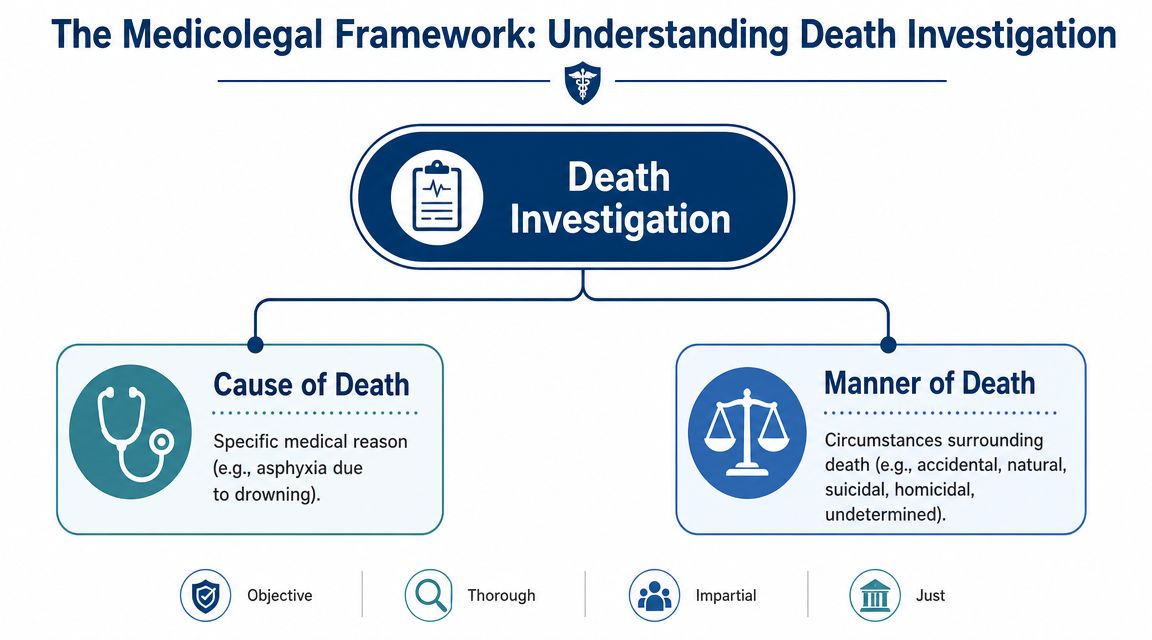
Cause and manner are not interchangeable
Families sometimes hear that a person "died by drowning" and assume that also answers whether the death was accidental. It doesn't. The autopsy addresses the medical mechanism and contributing disease or injury. The broader manner determination depends on the scene, witness accounts, history, and investigative facts.
A simple way to separate the two is this:
| Term | Plain-language meaning | Example in a water death |
|---|---|---|
| Cause of death | The medical reason death occurred | Asphyxia due to drowning |
| Manner of death | The surrounding classification | Accident, suicide, homicide, natural, or undetermined |
Why drowning is a diagnosis of exclusion
Forensic literature is very clear on this point. Drowning is a diagnosis of exclusion, and a proper opinion requires a full autopsy, toxicology, and scene investigation because there are no pathognomonic signs unique to drowning, as explained in this forensic review of drowning investigation.
That means a death in water is not automatically a drowning. The body may be in the water, but the fatal event may have been a heart rhythm problem, a stroke, a seizure, an intoxication event, or trauma. The pathologist's task is to test those alternatives against the evidence.
Later in the case, visual explanation can help non-medical readers follow that reasoning. This overview is useful for that purpose.
The most honest forensic opinion sometimes sounds less absolute than families expect. That is not weakness. It is accuracy.
Chain of custody and scene integration
Another term worth defining is chain of custody. That means the documented handling of the body, samples, clothing, and related evidence from collection through testing and reporting. In contested cases, chain of custody protects the integrity of the findings.
In water deaths, the pathologist's opinion is strongest when autopsy findings and scene facts point in the same direction.
Typical External and Internal Autopsy Findings
A family may hear that the lungs were heavy, foam was present, or water was found in the airway and assume the diagnosis should be simple. In practice, this part of the autopsy is more careful than dramatic. I look for a constellation of findings, then weigh how well that pattern fits drowning compared with injury, intoxication, natural disease, resuscitation effects, decomposition, and the conditions of recovery.
External findings
The external examination starts with documentation, not assumptions. Clothing, body position at recovery, lividity, skin changes, and visible injuries all matter because they help place the body in context before dissection begins.
Foam at the nose or mouth is one of the findings non-medical readers hear about most often. It can support drowning, especially when it is fine, persistent, and associated with frothy fluid in the airways, but it is not unique to drowning. Pulmonary edema from other causes can produce a similar appearance.
Immersion changes also have limits. Wrinkling of the hands and feet, washerwoman change, and skin slippage may show that the body was in water for some period of time. They do not answer the harder question of whether the person was alive when submersion occurred.
External injuries deserve disciplined interpretation. Abrasions and bruises may reflect a fall into the water, contact with rocks or pilings, boat structures, propeller strike, recovery efforts, or an assault. The same mark can point in very different directions depending on the scene and internal examination.
Common external observations include:
- Foam or froth at the mouth or nose. Supportive, but not specific.
- Immersion-related skin changes. Helpful for timeline and exposure, not for diagnosis by themselves.
- Injuries. Relevant only after correlation with scene history, internal findings, and recovery circumstances.
Internal findings
Inside the body, the lungs usually receive the most attention. In many drowning cases they are enlarged, heavy, and edematous. The airways may contain froth. Fluid, silt, algae, or other debris may be present in the upper airway, trachea, bronchi, stomach, or paranasal sinuses. A forensic autopsy study discussing these patterns is available in this large forensic study of drowning autopsy findings.
Those findings can be persuasive. None is a stand-alone answer.
That point matters for families and attorneys. A water death often feels as though it should leave one unmistakable signature at autopsy. It usually does not. The pathologist is judging whether the overall internal pattern fits active submersion and aspiration better than the competing explanations.
Freshwater and saltwater are not identical
Water environment can influence what the body looks like at autopsy. Saltwater cases often show particularly heavy, waterlogged lungs, but organ weights vary with body size, underlying disease, decomposition, and the interval before recovery.
Freshwater and saltwater also differ in particulate content, buoyancy, and postmortem change. For that reason, the textbook picture of drowning is less uniform than many readers expect. The findings may overlap substantially, and the environment helps shape interpretation rather than providing a formula.
Supportive findings and realistic limits
Water in the stomach or sphenoid sinus is often discussed because it may support submersion while the person was still alive. I treat those findings cautiously. They can add weight to the overall opinion, but they do not settle the case on their own, particularly when decomposition is advanced or recovery conditions were complex.
The practical takeaway is straightforward. Drowning autopsy findings are usually cumulative. The diagnosis becomes stronger when external observations, internal examination, scene facts, and later laboratory results point in the same direction.
The Role of Ancillary Tests in a Drowning Case
Ancillary testing often decides whether a water death remains a possibility, becomes a supported opinion, or points somewhere else entirely. In practice, these studies help answer the question families ask most often: did the person die from drowning, or did something happen first and the body end up in water afterward?
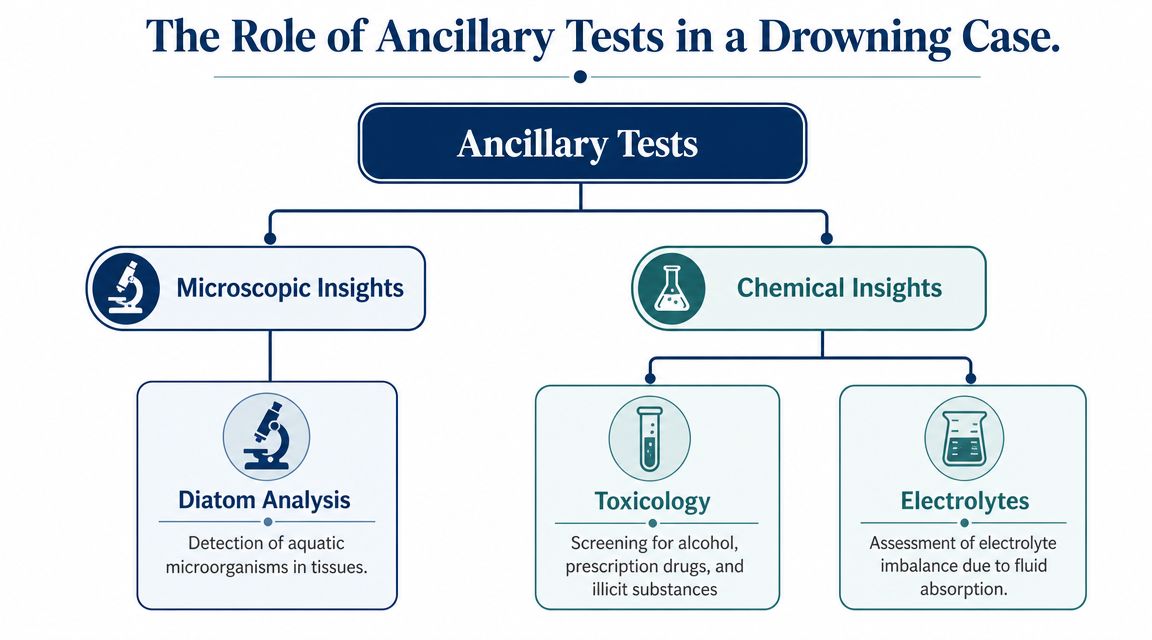
No laboratory test proves drowning by itself. That is why drowning remains a diagnosis built from exclusion and correlation. The autopsy findings, scene information, medical history, and ancillary studies must fit together.
Toxicology
Toxicology addresses impairment, incapacitation, overdose, and competing causes of death. Alcohol, sedatives, opioids, stimulants, and certain prescription drugs can all affect judgment, balance, swimming ability, consciousness, or breathing. In some cases, intoxication helps explain how an accidental submersion occurred. In others, the toxicology results raise a different primary cause, such as a fatal overdose or a mixed-drug event with water exposure after collapse.
Interpretation takes restraint. A positive result does not answer the whole case, and a negative result does not rule drowning in or out. Postmortem redistribution, survival interval, treatment before death, and specimen quality all affect what the numbers mean. Readers who want a practical framework can review this example of how to read a toxicology report.
Histology and microscopy
Microscopic examination helps test the gross impressions from autopsy against the actual tissue changes. In the lungs, histology may show edema, intra-alveolar material, and other findings that are consistent with aspiration of fluid, but those changes are not unique to drowning. Resuscitation, cardiac disease, drug toxicity, and decomposition can produce overlap.
Other tissues are just as important. Cardiac sections may reveal hypertensive heart disease, old scarring, myocarditis, or conduction-system related concerns suggested by the history. Brain examination can identify hemorrhage, seizure-related injury, or other natural disease. Liver and kidney findings may support chronic alcohol use, metabolic disease, or toxic exposure. In difficult water deaths, microscopy often matters less for "confirming drowning" than for excluding a stronger alternative explanation.
That distinction is central to good forensic practice.
Diatoms and other specialized testing
The diatom test is one of the most discussed and most misunderstood studies in drowning investigations. The theory is straightforward. If a person aspirates water while still alive, microscopic aquatic organisms may pass into the circulation and later be identified in distant tissues such as bone marrow. The practical problem is reliability. Environmental contamination, laboratory contamination, and background exposure can complicate interpretation.
For that reason, I treat diatom results as supportive at best, not dispositive. A concordance between the water sample and tissue findings may add weight in a carefully controlled case. A positive test does not override contradictory pathology, and a negative test does not exclude drowning.
Other ancillary studies may be ordered selectively:
- Microbiology may help if pneumonia, sepsis, or another infection is under consideration.
- Vitreous chemistry and other postmortem chemistries can sometimes clarify dehydration, diabetic crisis, or electrolyte disturbance, but they require careful case-specific interpretation.
- Radiology may identify occult trauma, fractures, foreign material, or medical devices that change the differential diagnosis.
Ancillary tests do not deliver a verdict. They help the forensic pathologist decide whether drowning remains the best explanation after the reasonable alternatives have been examined.
For attorneys handling records, slides, and outside laboratory reports, organized transfer of protected health information matters. Resources on compliant faxing in healthcare can help reduce avoidable delays in case review. In unresolved cases, Texas Autopsy Services may perform a second-opinion review with microscopy and selected ancillary testing, particularly when the original certification does not fully address the competing possibilities.
Diagnostic Limitations and Drowning Mimics
The public often imagines drowning as a recognizable, uniform pattern. Real cases are more uneven than that.
One large case series found classical drowning in 73.3% of water-death autopsies, atypical drowning in 19.6%, and non-drowning causes in 7.1%, showing that a substantial minority of cases do not fit the textbook picture, as reported in this review of atypical drowning findings.
Why classic signs may be absent
Some bodies do not show the expected pattern clearly. The same forensic literature notes that features such as emphysema aquosum can be altered by resuscitation, prolonged time in the water, and putrefaction. In practical terms, that means the findings may be blunted, distorted, or partly lost by the time of autopsy.
Three common reasons for diagnostic difficulty are:
- Resuscitation effects. CPR, ventilation, and emergency interventions can change foam patterns and lung appearance.
- Prolonged submersion. Time in water can wash away or alter external findings and complicate internal interpretation.
- Decomposition. Putrefaction changes tissues, creates gases, and reduces the reliability of some classic signs.
Conditions that mimic drowning
A person can die in water without dying from drowning. That distinction is central.
Common mimics include natural cardiac death, seizure-related collapse, stroke, intoxication, and traumatic injury. If a person has a fatal arrhythmia while swimming and then sinks, the body may still be recovered from the water, but the primary cause of death may be cardiac. A careful examination of the heart, brain, and other organs is what separates these scenarios.
A water location tells you where the body was found. It does not, by itself, tell you why the person died.
That is why an experienced cause of death investigation matters in disputed cases. The job is not to force the evidence into a drowning label. The job is to exclude alternatives impartially.
Why uncertainty should be stated plainly
Families sometimes worry that uncertainty means incompetence. In forensic pathology, the opposite is often true. A pathologist who acknowledges a limitation is showing discipline.
The report should make clear whether the findings strongly support drowning, remain equivocal, or favor another cause. That transparency is especially important in civil litigation, insurance disputes, and criminal investigations.
Your Autopsy Report What the Findings Mean
By the time the report is issued, the pathologist has moved from raw observations to a final opinion. That report should document the external examination, internal examination, and any laboratory testing in a way that is medically precise and understandable.
The most important part for most readers is the final opinion. That section explains the cause of death, lists significant contributing conditions if present, and addresses the manner of death when appropriate to the medicolegal setting.
What families and attorneys usually see in the report
A well-written report generally includes:
- Observed findings. What was present on the body and within the organs.
- Negative findings. What was specifically looked for and not found. These can be just as important as positive findings.
- Ancillary results. Toxicology, microscopy, and other testing that shaped the conclusion.
- Final diagnostic opinion. The integrated explanation based on the totality of the evidence.
For families reviewing records after the fact, a guide on how to read a pathology report can make the terminology less opaque.
What the wording means
If the report states asphyxia due to drowning, that means the pathologist concluded the total evidence supports drowning as the medical cause. If the report also lists alcohol intoxication, heart disease, or seizure disorder as contributory conditions, those are not minor details. They can explain how the event happened and may matter in legal or insurance settings.
Secure communication also matters more than many people realize. When reports, authorizations, and medical records move between law offices, funeral homes, and healthcare entities, guidance on compliant faxing in healthcare can be useful because privacy and documentation standards still apply.
Bottom line: the report should show the reasoning, not just the conclusion.
I write reports for two audiences at once. They must stand up to professional review, and they must also be readable by people living through a difficult loss.
Questions for Families and Attorneys
When should a private autopsy be requested
A private autopsy is worth considering when no official autopsy is planned, when the family wants an independent review, or when the existing explanation does not match the known facts. In water-related deaths, that can be especially important if the case may involve intoxication, a possible medical event before submersion, or disputed circumstances.
How is a private autopsy different from a county autopsy
The core medical methods are similar. The difference is often the scope of review, the questions being asked, and the degree of direct communication with the family or attorney. I also perform county forensic autopsies for jurisdictions that need forensic pathology support.
Can an autopsy determine whether the drowning was accidental
The autopsy determines the medical cause of death and identifies disease, injury, or intoxication that may have contributed. The broader classification of accident, suicide, homicide, natural, or undetermined depends on the total investigation, including scene evidence and witness information.
What if an existing report is confusing or incomplete
A second-opinion review can help. That may involve the report itself, autopsy photographs, histology slides, toxicology, and other records. For law firms organizing large expert files, tools related to automating expert witness review can help manage materials, but the medical value still comes from case-specific interpretation by a qualified forensic pathologist.
If you're dealing with a water-related death and need a careful, independent review, contact Texas Autopsy Services. I know these cases bring both grief and uncertainty. A clear forensic opinion cannot remove the loss, but it can help families and attorneys understand what the evidence does, and does not, support.