April 8, 2026 · Texas Autopsy Services
Expert Insights: What Does a Pathology Report Show?
What does a pathology report show - Understand what a pathology report shows from an expert. This guide details key sections, medical terms, & how to interpret
On this page
- Receiving the Report Understanding Its Purpose
- Anatomy of an Autopsy Report Key Sections Explained
- The Examination Process From Gross to Microscopic Findings
- Translating Medical Jargon A Plain-Language Guide
- Synthesizing the Findings The Diagnosis and Cause of Death
- Understanding the Report's Limits and Timelines
- How to Act on the Report A Guide for Families and Attorneys
- Frequently Asked Questions About Autopsy Reports
What Does a Pathology Report Show
- A pathology report is the medical record of what a pathologist observed with the naked eye, under the microscope, and through any additional laboratory studies.
- In an autopsy case, the report does more than describe tissue. It helps explain cause of death, supports the determination of manner of death, and documents findings that may matter to families, attorneys, and courts.
- Most online explanations focus on cancer biopsies. Autopsy reports are broader. They can include organ findings, injuries, toxicology, and discrepancies between the clinical history and the postmortem findings.
- The most important sections for many readers are the gross description, microscopic description, final diagnosis, and comments.
- Some reports answer the central question clearly. Others still contain uncertainty. An undetermined manner of death can remain appropriate even after a careful review.
A family often receives the report at a difficult moment. The envelope is opened, the first page is scanned, and the words feel dense and remote. What people are really looking for is not jargon. They want a clear answer about what happened, whether anything was missed, and whether the findings support the story they were told before death.
At Texas Autopsy Services, every examination is performed by a board-certified forensic pathologist experienced in medicolegal death investigations. Our work centers on one principle: follow the evidence carefully, explain it plainly, and treat the deceased and their family with respect.
When people search what does a pathology report show, they usually find explanations built around cancer biopsies. That information is useful, but it does not fully prepare someone to read an autopsy pathology report. An autopsy report may include gross and microscopic descriptions of organs, evidence of natural disease, external injuries, or drug levels. It also has to address difficult outcomes such as an undetermined manner of death, which occurs in 5 to 10% of cases in U.S. death investigations according to the CDC data summarized by Mercy’s guide on pathology reports (https://blog.mercy.com/how-to-read-a-pathology-report/).
Receiving the Report Understanding Its Purpose
The first thing to understand is that an autopsy pathology report is not a cold administrative form. It is a structured medical record created to answer specific postmortem questions with as much precision as the evidence allows.
For a family, that purpose is personal. For an attorney, it may also be evidentiary. For a physician, it may clarify whether the clinical diagnosis before death matched what the body showed.
Why an autopsy report feels different from a biopsy report
A surgical biopsy report usually addresses a limited specimen. It asks a narrower question about a piece of tissue. An autopsy report is broader. It reviews the body as a whole, the medical history that was available, and the findings that may connect one disease process to another.
That difference matters. In an autopsy, the report can help explain whether severe coronary artery disease was present, whether an infection spread through multiple organs, whether trauma contributed to death, or whether toxicology is needed before a final opinion is responsible.
What the report is meant to do
The report should give a reliable record of what was examined and what was found. In practical terms, that usually means:
- Identifying the decedent correctly: The basic demographic and case details have to be accurate before anything else matters.
- Documenting observations carefully: The report records what was seen externally, internally, and microscopically.
- Supporting medical-legal conclusions: The findings should support, limit, or contradict possible explanations for death.
- Preserving the record: In many cases, the report becomes a permanent record that may be reviewed later by physicians, attorneys, insurers, or courts.
A good autopsy report does not begin with a conclusion and work backward. It begins with documented findings and builds the conclusion from them.
Families who want a basic orientation before reading line by line often benefit from a simpler overview of a pathology report’s purpose and parts. A plain-language reference from Texas Autopsy Services is available at https://www.texasautopsyservices.com/blog/2025/12/define-pathology-report/.
Anatomy of an Autopsy Report Key Sections Explained
Most pathology reports follow a standardized structure because structure reduces confusion. It also helps when the report may be used both for clinical review and as legal evidence.
The National Cancer Institute’s pathology report fact sheet describes a structured format with five main sections and notes that the comments section is especially important when documenting pending tests, abnormal findings, or discrepancies between the clinical history and the pathological findings (https://www.cancer.gov/about-cancer/diagnosis-staging/diagnosis/pathology-reports-fact-sheet).

Patient and case information
This section contains the identifying information. In practice, that includes the decedent’s name and other case identifiers. In any pathology setting, accurate identifiers are foundational because the rest of the document depends on proper specimen and case matching.
For families and attorneys, this is the first quality-control checkpoint. Verify the identifying information before focusing on the findings.
Clinical history and circumstances
This section summarizes what was known before the examination. In an autopsy report, that may include the reported events before death, medical history, hospital course, scene information, or why the examination was requested.
This context matters because pathology findings do not interpret themselves. The same microscopic change may carry different significance depending on the clinical setting.
Gross and microscopic descriptions
These are the technical core of the report.
The gross description records what the pathologist observed directly. In a general pathology setting, this includes things like size, color, and appearance. In an autopsy report, it can also extend to organ findings, injuries, and visible disease patterns.
The microscopic description records what selected tissues showed under the microscope. This section often explains whether the tissue changes support acute injury, chronic disease, infection, healing, inflammation, or other disease processes.
Diagnosis and comments
The diagnosis section distills the observed findings into formal medical conclusions. The comments section often contains the most helpful context for non-physicians because it may explain what remains pending, what did not fit neatly, or why one interpretation was favored over another.
If a report seems internally inconsistent, do not stop at the diagnosis line. Read the comments. That is often where the pathologist explains the difficult part of the case.
The Examination Process From Gross to Microscopic Findings
Autopsy pathology moves from direct observation to tissue-level confirmation. That progression is one reason the report can answer questions that a death certificate alone cannot.
What the pathologist sees first
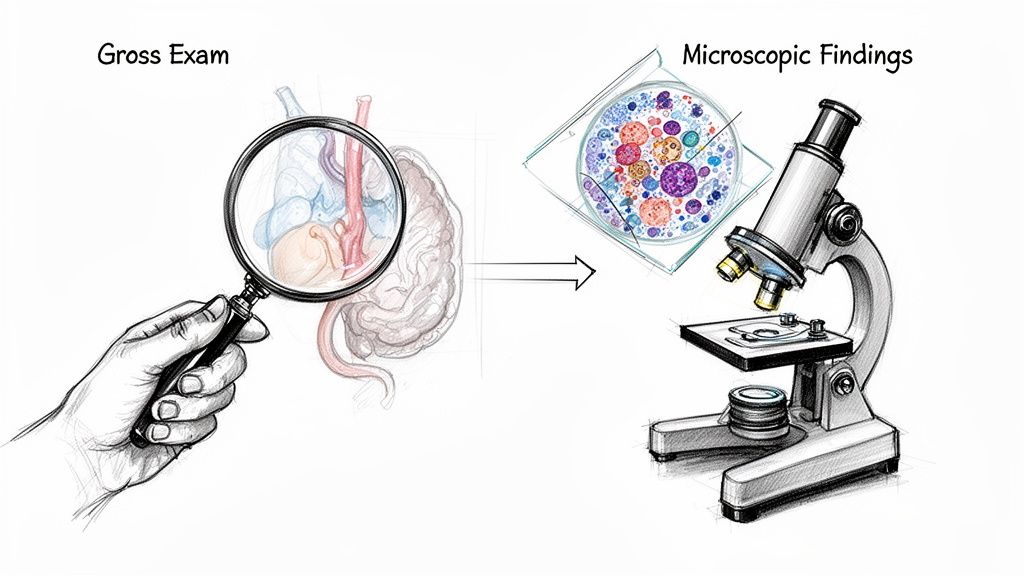
The early portion of the examination documents what can be seen without a microscope. In pathology, that is the macroscopic or gross level. The verified pathology guidance used in oncology explains that gross description includes details such as color, weight, size, and appearance of tissue to the naked eye, while microscopic evaluation compares abnormal cells with normal ones under stains such as hematoxylin and eosin, or H&E (https://www.oncologynurseadvisor.com/features/pathology-reports-fact-sheet/2/).
In an autopsy setting, that same logic applies to organs and tissues throughout the body. The report may describe the lungs as heavy and congested, the heart as enlarged, the liver as pale or nodular, or the brain as swollen. Those gross findings do not stand alone, but they direct the next stage of examination.
How tissue confirmation works
Selected tissues are sampled, processed, embedded, sliced thinly, stained, and examined under the microscope. In this stage, broad observations are tested.
A gross impression of pneumonia, for example, may or may not be supported microscopically. A clot seen in a vessel may need microscopic review to distinguish a true antemortem thrombus from postmortem artifact. A suspicious lesion in an organ may turn out to be inflammation, scarring, infection, or a tumor.
A step-by-step overview of the autopsy workflow is available here: https://www.texasautopsyservices.com/blog/2025/12/how-is-an-autopsy-performed-step-by-step/
Why both levels matter
Gross and microscopic findings answer different questions.
- Gross findings help map the problem. They show distribution, severity, and relationships between organs or injuries.
- Microscopic findings help confirm mechanism. They show cellular injury, inflammation, healing, hemorrhage, infection, and disease patterns that cannot be seen reliably with the naked eye.
- Additional studies may follow if the case calls for them, including toxicology or other laboratory work.
This short video gives a general visual sense of how pathology findings are analyzed and communicated:
What does not work is relying on one striking finding in isolation. A single organ abnormality can be important, but it becomes medically meaningful only when it fits the history, the full autopsy examination, and the microscopic evidence.
Translating Medical Jargon A Plain-Language Guide
Many autopsy reports are difficult for non-physicians because the language is designed for medical precision, not casual reading. The right way to approach that language is to translate terms in context, not to guess from a search result.
Common Autopsy Report Terms and Their Meanings
| Medical Term | Plain-Language Explanation | What It Often Indicates |
|---|---|---|
| Atherosclerosis | Hardening and narrowing of arteries from plaque buildup | Long-standing vascular disease that may reduce blood flow |
| Myocardial infarction | Heart muscle damage caused by loss of blood supply | A heart attack or evidence of one |
| Pulmonary embolism | A blood clot lodged in the arteries of the lungs | Sudden impairment of blood flow in the lungs |
| Cerebral edema | Swelling of the brain | Brain injury, lack of oxygen, infection, or another serious process |
| Sepsis | A severe body-wide response to infection | A serious infection affecting multiple organs |
| Acute inflammation | Recent inflammatory response | A newer or active injury, infection, or irritation |
| Chronic inflammation | Longer-standing inflammatory change | A process that has been present over time |
| Hypertrophy | Enlargement of a tissue or organ | Increased workload or chronic stress on that tissue |
| Atrophy | Shrinking or loss of tissue | Disuse, aging, chronic illness, or nerve-related change |
| Necrosis | Tissue death | Significant injury from loss of blood flow, infection, toxins, or trauma |
| Fibrosis | Scarring in tissue | Prior injury or a healing response |
| Reactive changes | Non-specific cellular changes responding to stress or irritation | A response pattern, not necessarily a distinct disease by itself |
| Nonspecific findings | Findings that are real but not diagnostic of one single cause | Changes that need correlation with the rest of the case |
How to read terms without overreading them
Some words sound more conclusive than they are. Reactive changes and nonspecific findings are common examples. They do not mean the pathologist is guessing. They mean the tissue shows a response, but that response is not unique to one diagnosis.
The safest reading of technical language is this. A term describes what was observed first. Its significance comes from the rest of the report.
For families, the most useful question is often not “What does this word mean?” but “How did this finding affect the final cause-of-death opinion?”
Synthesizing the Findings The Diagnosis and Cause of Death
The diagnosis line is the product of synthesis. It is not a list of random abnormalities. It is the pathologist’s reasoned conclusion after reviewing the history, the examination, the tissue findings, and any relevant studies.
Cause of death and manner of death
Cause of death means the disease or injury that led to death. Manner of death is the classification of how the death occurred. In forensic practice, that may be natural, accident, suicide, homicide, or undetermined.
Those two terms are related, but they are not the same. “Atherosclerotic cardiovascular disease” may support a natural death. A drug intoxication may support an accident in one case and a suicide in another, depending on the evidence.
How pathologists move from findings to opinion
The College of American Pathologists introduced synoptic reporting protocols in the 1990s to standardize structured findings. A 2015 CAP study reported that these protocols increased report completeness from 52% to 92% and correlated with 15 to 20% better adherence to treatment guidelines. The same verified source also notes that, in autopsies, a structured approach provides cause-of-death clarity in about 80% of ambiguous cases (https://honcology.com/blog/how-to-read-a-pathology-report).
That matters because final opinions should be reproducible and well supported. A careful pathologist considers competing explanations before settling on one. If you want a simple explanation of that reasoning process, this overview of differential diagnosis is useful. The same principle applies after death. We compare plausible causes and determine which one best fits the full evidence.
What works and what does not
What works is a report in which the diagnosis follows directly from documented findings.
What does not work is a conclusion that ignores contradictory evidence, leaves major discrepancies unexplained, or uses vague language where the report should be specific.
When I review a report for a second opinion, I look for a clean chain of reasoning:
- History: What was reported before the examination
- Findings: What the body and tissues showed
- Correlation: Whether those findings support the proposed cause
- Exclusions: Whether reasonable alternatives were considered and addressed
If that chain is intact, the report is usually trustworthy even when the conclusions are difficult.
Understanding the Report's Limits and Timelines
Families often expect one report to answer every question. Sometimes it does not, and that is not always a sign of poor work. It may reflect the limits of medicine, the need for additional testing, or the fact that some deaths remain difficult to classify even after a thorough examination.
What a pathology report cannot show
An autopsy pathology report cannot read intent, reconstruct every moment before death, or tell us what a person was thinking. It may also be unable to fix an exact time of death from tissue findings alone.
A report may identify disease, injury, or intoxication. It may not fully explain the social or behavioral circumstances around the death unless other investigative records are also available.
Why some language stays cautious
Pathology reports are not only for cancer. They also help diagnose infections, transplant rejection, and other non-neoplastic diseases. The Cleveland Clinic background material notes that reports may include terms such as reactive changes or nonspecific findings, and that AI-assisted tools may reduce some diagnostic errors but can still misclassify trauma patterns, which is why board-certified pathologist oversight remains important in medico-legal cases (https://my.clevelandclinic.org/health/diagnostics/pathology-report).
That caution is appropriate. In autopsy work, overconfidence creates avoidable errors.
Why finalization can take time
Microscopy, toxicology, and other ancillary studies do not always return at the same pace. A preliminary impression may be possible early, but a responsible final report may need to wait for outside laboratory work or further histologic review.
If you need a plain-language explanation of the factors that affect report timing, this discussion is helpful: https://www.texasautopsyservices.com/blog/2026/02/how-long-does-a-pathology-report-take/
Delays are frustrating, but a delayed answer is often better than a premature one. In forensic pathology, certainty has to be earned.
How to Act on the Report A Guide for Families and Attorneys
Once you have the report, the next step is not to reread the most alarming sentence. The next step is to identify what is clear, what remains open, and what needs follow-up.
Questions worth asking
A productive follow-up conversation usually focuses on a few concrete points:
- Ask about the central conclusion: What exact finding supported the stated cause of death?
- Ask about competing explanations: Were other possible causes considered and ruled out?
- Ask about pending studies: Did toxicology, histology, or another test materially affect the final opinion?
- Ask about discrepancies: Did the pathological findings differ from the hospital diagnosis or family understanding of events?
- Ask about wording: If the report uses qualified language, what level of certainty does the pathologist intend?
Red flags that deserve a closer look
Some reports are straightforward. Others justify an independent review.
Concerns include internal inconsistencies, a final diagnosis that does not appear supported by the gross or microscopic findings, major omissions in the clinical history, or comments that raise unresolved questions without explaining how they affected the conclusion.
In that setting, a second opinion can be useful for families, attorneys, and agencies. One option is Texas Autopsy Services, which provides private autopsy and review services in Texas. In some cases, outside consultation may also involve hospital pathology departments, academic forensic specialists, or subspecialty reviewers depending on the issue.
Independence matters
An independent review is not a challenge to medicine as a whole. It is a standard way to test whether the record supports the conclusion.
That is especially important in a medical-legal setting. Families may need clarity. Attorneys may need a defensible opinion. Facilities such as Waterloo Mortuary Partnership may also play a practical role in coordinating the handling required for postmortem examinations.
If you are grieving, it is reasonable to pause before making decisions. If you are representing a client, it is reasonable to seek clarification before relying on the report. Careful review serves both purposes.
Frequently Asked Questions About Autopsy Reports
Who usually receives a private autopsy report in Texas
That depends on who authorized the examination and the legal context of the case. In private autopsy practice, the authorizing next of kin or legally authorized representative commonly receives the report. Attorneys may receive it when properly authorized.
If there is a question about release, the controlling issue is legal authority, not curiosity. Texas procedures can also be affected by the circumstances of death and any government investigation.
Is a private autopsy the same as a medical examiner autopsy
No. A private autopsy is an independent examination requested outside the government death investigation system. A medical examiner or justice of the peace examination serves a governmental function under applicable law.
The scope, authority, and purpose can overlap, but they are not identical. A private review may still be useful when a family wants an additional opinion or a more detailed explanation.
What is the comments section and why does it matter
In many difficult cases, the comments section is where the pathologist explains pending results, unexpected findings, or why the final interpretation was not simple. If the diagnosis is the bottom line, the comments are often the reasoning around the edge of that line.
For attorneys, this section is often worth reading as closely as the diagnosis itself.
Can an autopsy report still be inconclusive
Yes. A careful autopsy can still leave a cause or manner of death undetermined. That does not mean the examination failed. It means the available medical evidence did not support a more specific conclusion.
In some cases, that restraint is the most accurate opinion.
Should families ask for a second opinion
Sometimes yes. A second opinion is particularly reasonable when the report seems inconsistent, the conclusions have major legal consequences, or the family’s understanding of the death differs sharply from the pathological findings.
A second review should focus on the evidence, not on finding a preferred answer.
If you have received an autopsy or pathology report and need help understanding what it shows, Texas Autopsy Services can discuss the findings, explain the medical language in plain terms, and outline whether an independent review may be appropriate. These conversations should be handled with accuracy, patience, and respect for the deceased and the people left behind.