December 28, 2025 · Texas Autopsy Services
What Is a Pathology Report A Guide for Texas Families
Learn how to define pathology report in simple terms: a clear guide to its sections and what medical terms really mean.

On this page
As a forensic pathologist, I often explain that a pathology report is the final, detailed chapter of a person's medical story. It’s not just a clinical document; it’s a source of definitive, evidence-based answers assembled with care after someone has passed away. My role is to provide those answers with precision and compassion.
- A pathology report is a medical document detailing the examination of tissues after death.
- In forensic cases, it establishes the cause and manner of death.
- The report serves as objective, scientific evidence for legal and insurance matters.
- Families often find closure and crucial answers within its findings.
- As a board-certified forensic pathologist, I ensure every report is thorough, unbiased, and clear.
What Exactly Is a Pathology Report?
A pathology report is the official medical document I write after a detailed examination of tissues and, in some cases, fluids. Whether it’s from a simple biopsy at a hospital or a comprehensive private autopsy, the goal is always the same: to provide clarity.
Think of it as a final summary where every piece of the puzzle is meticulously documented. It includes everything from what I can see with the naked eye to what I can only find under a high-powered microscope. My job at Texas Autopsy Services is to translate complex scientific information into a clear, understandable narrative for families and their legal advisors.
This examination is the bedrock for diagnosing diseases and determining why someone died. The findings can be significant. In a forensic setting, a thorough postmortem examination can uncover such crucial new information that it leads to changes in the initial death certificate in up to 25% of cases. This is especially vital for families seeking a second opinion or for attorneys working on complex legal cases. You can read more about the role of pathology reports in medicine on the National Cancer Institute's website.
What Is the Purpose of a Pathology Report?
At its core, a pathology report exists to give a definitive answer to a medical question. It serves several critical functions, each helping to paint a complete picture of a person's health at the time they died.
Establishing the Cause of Death: This is the most fundamental goal, especially in a forensic autopsy. The report lays out the specific injury, disease, or combination of events that ultimately led to death.
Documenting Disease or Injury: It creates a complete and permanent record of any underlying conditions, like chronic illnesses, hidden infections, or trauma, that were present in the body.
Providing Legal Evidence: For attorneys and county officials in Texas, the report is an unbiased, scientific document. It can become essential for settling insurance claims, resolving inheritance disputes, or providing facts for criminal investigations.
Giving Families Peace of Mind: For many families, this report is what brings closure. It helps answer those painful, lingering questions about a loved one's final health and what truly happened.
Ultimately, every report I prepare is crafted to deliver truth and clarity, helping families navigate an incredibly difficult time with factual, compassionate guidance.
Unpacking the Core Components of a Report
An autopsy report is a scientific narrative that moves logically from what we know at the beginning to the final conclusions drawn from the evidence. Each section builds on the one before it, creating a transparent and complete medical record.
It all starts with identifying details: the person's name, age, and the unique case number assigned to the examination. This step ensures we’re documenting the correct individual and establishes the official record for any future medical or legal needs. It’s the administrative foundation for all the science that follows.

This logical flow, from the visual exam to the microscopic analysis, is what ensures every final conclusion is built on a solid foundation of evidence.
What the Pathologist Sees: Gross and Microscopic Descriptions
Next, we get into the heart of the examination. The first major section is the gross description, which is a detailed account of everything observed with the naked eye. I carefully document the condition, weight, and appearance of each organ, noting any visible injuries, abnormalities, or signs of disease. It’s an objective, descriptive narrative of the physical evidence.
From there, we move to the microscopic description. This is where I explain what the cells and tissues look like under a high-powered microscope. This is often where the most important clues are found—subtle signs of infection, cellular changes that point to a chronic illness, or damage completely invisible to the eye. The story the cells tell is often the key that unlocks the entire case.
To help you understand how these pieces fit together, here's a breakdown of the standard sections you'll find in most autopsy reports.
Anatomy of a Pathology Report Key Sections Explained
| Section Name | What It Tells You | Example Information |
|---|---|---|
| Clinical History | A summary of the decedent’s known medical background and the circumstances leading to the exam. | "65-year-old male with a history of hypertension and diabetes, found unresponsive at home." |
| Gross Description | A detailed, objective description of what was observed with the naked eye during the examination. | "The heart weighs 450 grams and shows severe hardening of the coronary arteries." |
| Microscopic Description | A technical description of what was seen when tissue samples were viewed under a microscope. | "Sections of the lung show inflammation and fluid accumulation consistent with pneumonia." |
| Final Diagnosis | The conclusive list of diseases, abnormalities, and injuries identified from all evidence. | "1. Severe Coronary Artery Disease. 2. Acute Pneumonia. 3. Evidence of old stroke." |
| Cause & Manner of Death | The pathologist’s final opinion on what caused the death and the circumstances surrounding it. | "Cause of Death: Heart Attack due to Coronary Artery Disease. Manner of Death: Natural." |
Each part plays a crucial role in building the complete picture, leading from the known facts to the final, evidence-based conclusions.
The Final Diagnosis: Putting It All Together
Everything I've documented—from the initial visual check to the microscopic findings—comes together in the final diagnosis. This isn't just a summary; it's the conclusion of the entire scientific investigation. It lists the definitive medical conditions and injuries that were identified.
This section is what directly supports the ultimate determination of the cause of death. It connects every piece of evidence into one coherent medical explanation.
This systematic process ensures that every conclusion is backed by clear, documented evidence. To see how these sections look in a real document, I encourage you to review an example of a pathology report. Seeing a sample can help you visualize how each piece of information contributes to the final answers you're seeking.
Translating the Medical Language
Medical jargon in an autopsy report can feel like a foreign language. It's often the most overwhelming part for families and even attorneys. These documents are written with a high degree of scientific precision, which is necessary, but that precision can create a wall of confusion. My job is to help you break down that wall.
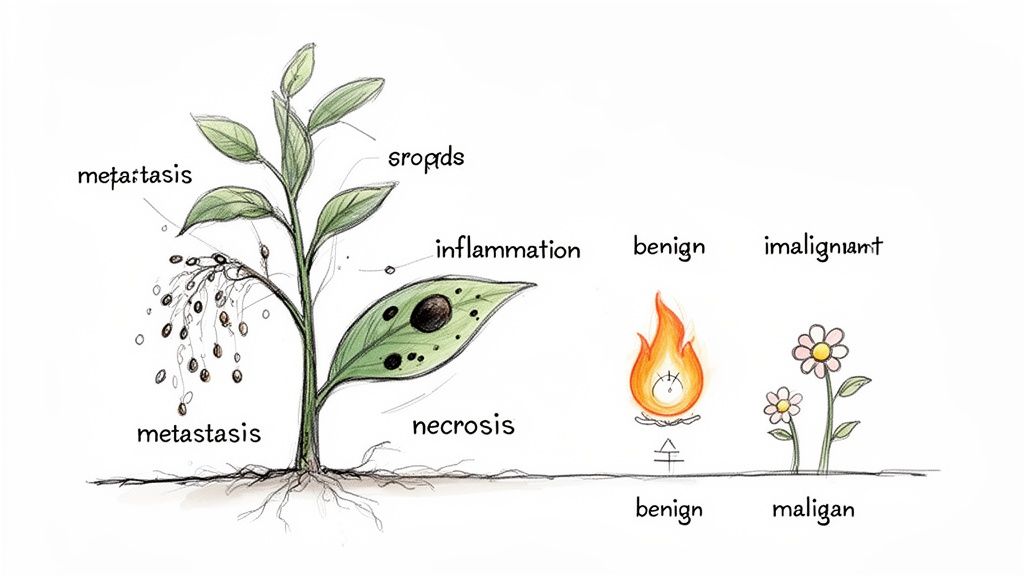
It all starts with a few key distinctions. When you see the word benign, it means a finding is not cancerous and not considered life-threatening. The flip side of that is malignant, which signals the presence of cancer—a disease where cells grow out of control and can spread. Understanding that core difference is the first major step to understanding the report’s main conclusions.
Common Terms and Simple Analogies
I find that the best way to explain these complex terms is by connecting them to things we already understand. Medical language doesn't have to be a mystery.
- Metastasis: This means that cancer has spread from where it started to a new part of the body. Think of a dandelion in a garden. When the wind blows, its seeds scatter and can start growing in a different spot. That's essentially what metastasis is.
- Inflammation: This is the body’s natural reaction to an injury or infection. It’s like the body’s internal first responders rushing to a scene. That activity is what causes classic signs like swelling and redness.
- Necrosis: This is a technical word for cell or tissue death. Picture a leaf on a plant that turns brown and shrivels up because it stopped getting water and sunlight. A similar process can happen inside the body.
You’ll almost always see a phrase like "clinical correlation is recommended." This is the pathologist's way of saying, "What I see under the microscope needs to be viewed in the context of this person's entire medical history and the situation surrounding their death." It's the critical link between the science in the lab and the person's real-life story.
Making Sense of the Findings
Other terms you might encounter describe what the cells themselves look like. If a report mentions "atypia," it means the cells look a little unusual but not definitively cancerous. It's a gray area that might need more context.
You may also see words like "differentiated," which describes how much the cancer cells look like normal, healthy cells. A "well-differentiated" cancer closely resembles normal tissue, whereas "poorly differentiated" cells look very abnormal and often behave more aggressively.
Each of these terms is a piece of the puzzle. The pathologist puts them all together to form the final diagnosis. While this is a good starting point, we go into more detail in our guide on how to read a pathology report. I will always ensure you're never left feeling lost in the terminology; you deserve to understand the answers this report holds.
Clinical Reports vs. Forensic Reports
Pathology reports aren't all the same. This is one of the first and most important things I explain to families and attorneys—the vast difference between a clinical report from a hospital and a forensic report from a postmortem exam. While both are written by pathologists, they are built to answer entirely different questions.
A clinical report is a roadmap for treating a living patient. Its purpose is purely diagnostic. It helps a doctor figure out what's going on with a disease, like cancer or an infection, so they can map out the best treatment plan. It’s all about managing health and looking forward.
A forensic report, however, looks backward. Its job is to figure out the cause and manner of death after someone has passed away. This document is crucial for providing legal clarity, giving a family much-needed answers, or satisfying the requirements of an official cause of death investigation.

Different Goals Mean Different Rules
Because their purposes are so different, their scope and the legal standards they follow are also worlds apart. A clinical report might focus on a single tissue sample from a biopsy. A forensic autopsy report, on the other hand, is a top-to-bottom examination, documenting the entire body to piece together the full story.
The biggest difference is the legal framework. Forensic reports require a strict chain of custody. Every piece of evidence, from tissue samples to toxicology results, is meticulously tracked. This is non-negotiable, as it ensures the findings can stand up in a court of law. This level of rigor just isn't necessary for routine clinical work.
This is why a report from an independent forensic pathologist at Texas Autopsy Services often looks much more detailed than a standard hospital report. Objectivity isn't just a goal; it's a requirement under Texas law.
Why It Matters in Texas
Knowing the difference helps you know what to expect. A family searching for answers after a loss needs a document designed for one thing: providing definitive conclusions after death.
Even though national autopsy rates have fallen from around 40% in the 1970s to just 5-10% today, their value is undeniable. These exams can still clarify the cause of death in about 30% of cases where it was initially missed. You can learn more about the critical role of pathology from sources like the UH Hospitals' health library.
At the end of the day, a forensic report is built to give you final, unbiased answers when you need them most.
How a Forensic Pathologist Provides Answers
As a board-certified forensic pathologist with the American Board of Pathology, I believe my job is about much more than just writing reports. My work is giving clear, concrete answers to families and attorneys across Texas who find themselves in a difficult time. A good report isn’t just a medical document—it’s a source of truth and closure when everything else feels uncertain.
This becomes especially clear when a family comes to me for a second opinion or a private autopsy. In those cases, my duty is to provide a completely independent conclusion based only on the medical evidence in front of me. Sometimes that means re-examining evidence from an earlier autopsy; other times, it means starting a comprehensive new examination from the ground up.
An Unbiased and Objective Conclusion
My absolute priority is delivering an objective conclusion, free from any outside pressures or preconceived notions. This independent viewpoint is critical for either confirming what was already found or, when the evidence points elsewhere, for correcting the official record.
A comprehensive and clearly written report can provide peace of mind by answering lingering questions and offering the solid factual foundation required for any legal proceedings that may follow. My work is about delivering difficult truths with both precision and respect.
It's also helpful to see how these findings fit into a larger picture. Families and their legal teams should understand the broader role of medical experts in personal injury cases and other legal matters, where a pathologist's report often serves as a cornerstone of the entire case.
Supporting Families Through the Process
Here at Texas Autopsy Services, I make it a point to ensure every family feels heard, respected, and supported. That means I take the time to sit down and explain complex medical details in plain English, answering every single question with patience. I firmly believe that delivering this information with compassion is just as vital as the scientific accuracy of the examination itself.
Ultimately, my role is to bring clarity. Being a forensic pathologist means blending medical science with a profound sense of duty to both the person who has passed and the loved ones they've left behind. You can learn more about my background and what is a forensic pathologist in our detailed guide. From the first moment of the examination to the final page of the report, my entire focus is on delivering the definitive, fact-based answers that families deserve.
What to Do When You Still Have Questions
Getting an autopsy report can feel like the final chapter, but often it opens a new set of questions. Even a well-written report might leave you feeling uncertain or with a nagging sense that something is missing. That’s a completely normal reaction. You have every right to pursue complete clarity.
This is particularly true when the report’s conclusions don't seem to fit with what you knew about the person or the circumstances surrounding their death. When you find yourself in that position, getting a second opinion from an independent expert isn't just a good idea—it’s a crucial step toward getting the peace of mind you deserve.
Taking the Next Step Toward Clarity
If you're a family member or an attorney in Texas trying to piece everything together from a report, you don't have to do it alone. An independent consultation can shed light on confusing details and provide much-needed context.
Here’s how I can help:
- Report Interpretation: I will take a report from another medical examiner or pathologist and walk you through it, translating dense medical jargon into plain English so you understand exactly what the findings mean.
- Second Opinion: If you have doubts or questions about the official conclusion, I can conduct my own independent analysis. By reviewing the original evidence, like tissue slides and photographs, I can either confirm the initial findings or offer a different perspective based purely on the evidence.
- Actionable Guidance: I can also help you understand what the report’s conclusions mean for any legal or insurance claims and guide you on what questions you should be asking next.
My goal is simple: to give you a complete, unbiased understanding of the facts. An independent review makes sure the conclusions are built on solid scientific evidence, without any outside influence.
This is about more than just checking a box. It's about ensuring the final medical record is accurate, complete, and tells the whole story. If you’re struggling with a report that feels unclear or incomplete, please know that expert help is available to find the answers you need.
Frequently Asked Questions About Pathology Reports
Over the years, having performed over 1,000 autopsies, I've sat down with countless families and attorneys to go over these reports. It’s a dense document to receive during an already overwhelming time, and it’s completely natural to have questions. Here are the answers to some of the ones I hear most often.
How Long Does It Take to Get a Final Report After a Private Autopsy?
This is probably the first question everyone asks. While it varies from case to case, you can generally expect a final report within several weeks. That might sound like a long time, but it's crucial for getting the answers right.
The timeline accounts for the meticulous work of examining tissues under a microscope and sending samples out for specialized tests, like toxicology. Rushing these steps isn't an option. At Texas Autopsy Services, we keep families in the loop the entire time, so you’re never left wondering where things stand.
Can a Pathology Report from a Private Autopsy Be Used in Court?
Absolutely. A report from an independent, board-certified forensic pathologist isn't just a medical document; it's a formal legal one. It's built to be objective, scientifically sound, and thorough enough to be admissible—and often essential—in court.
We see these reports used in all sorts of legal situations in Texas, from insurance claims and medical malpractice suits to criminal investigations. A critical piece of this is maintaining a strict chain of custody for all evidence, which guarantees its integrity for legal proceedings. It's a standard I never compromise on.
The entire report is constructed to be a source of unbiased, factual evidence that can withstand legal scrutiny. That scientific and procedural rigor is what gives it authority.
What if I Disagree with the Findings in Another Report?
It's not uncommon to read a report from a hospital or a medical examiner and feel that something is off. If you find yourself in that position, getting a second opinion is a perfectly reasonable step to take.
An independent forensic pathologist can review the original report, look at the tissue slides and photos, and re-examine all the evidence. Sometimes, we can even perform a new autopsy. This independent review, which is a big part of my work with both County Forensic Autopsies and private clients, can either confirm the original findings or offer a new, evidence-based conclusion. It’s all about getting the clarity and certainty your family deserves.
The answers in a pathology report should bring clarity, not more confusion. If you're struggling to understand a report or thinking about getting an independent examination, my team at Texas Autopsy Services is here to offer expert, compassionate guidance. Please reach out to us to discuss your situation in confidence.
Find out more about how we can help at https://www.texasautopsyservices.com.