March 23, 2026 · Texas Autopsy Services
Who Can Perform an Autopsy A Texas Guide
Uncover who can perform an autopsy in Texas. This guide explains the role of a forensic pathologist and the legal requirements for a private autopsy.
On this page
- The Experts Behind the Examination
- The Critical Role of a Board-Certified Forensic Pathologist
- Hospital Pathologists vs Forensic Pathologists
- Understanding Texas Law on Autopsy Authorization
- When to Request a Private Autopsy
- How to Choose the Right Expert for an Autopsy
- Frequently Asked Questions About Autopsies
- The most qualified professional to perform a medicolegal autopsy is a board-certified forensic pathologist.
- While any licensed physician can legally perform an autopsy in Texas, specialized training is critical for accurate, defensible findings.
- A private autopsy is an independent investigation requested by a family or attorney to get clear answers about cause of death, separate from any government or hospital-led inquiry.
- The autopsy process, when done correctly, does not interfere with funeral plans, including open-casket viewings.
- Choosing the right expert means verifying board certification, relevant experience, and a commitment to transparent communication.
I recently worked with a family whose loved one, a construction worker, had died suddenly at home. The initial cause of death was listed as a heart attack, but the family suspected it was connected to a recent fall at his job site. The county declined an autopsy because the death appeared natural. By performing a private autopsy, I was able to identify a slow brain bleed that was a direct result of his workplace injury. This finding provided the family not only with the truth but also the evidence needed to secure benefits they were entitled to.
This scenario highlights a critical question many families face: When answers are needed, who is truly qualified to find them? Legally, any licensed physician in Texas can perform an autopsy. But for an examination to provide the clear, accurate, and defensible answers you need, the expert you want is a board-certified forensic pathologist. There’s a world of difference between meeting the legal minimum and having the right expertise.
The Experts Behind the Examination

While Texas law sets a baseline, it doesn’t account for the highly specialized training required for a proper postmortem investigation. Pathology is a broad medical field, and the type of pathologist handling the examination directly affects the quality and focus of the findings.
My own background is an example. I am board-certified by the American Board of Pathology in three distinct areas: Anatomic, Clinical, and Forensic Pathology. This combination allows me to see the complete picture—how a disease progressed inside the body, what laboratory results tell us, and how external factors may have played a role in the death.
Different Types of Pathologists
An autopsy is more than a medical procedure; it’s a detailed investigation. The pathologist is the lead investigator, and their specialty is the lens they use to examine the evidence.
- Forensic Pathologist: This is my primary area of focus. We are specialists trained to determine the cause and manner of death in cases that are sudden, violent, or suspicious. Think of us as medical detectives, piecing together the story when accidents, injuries, or other external factors are involved in a
cause of death investigation. - Anatomic Pathologist: These experts diagnose diseases by examining tissue and organ samples under a microscope. They typically perform autopsies in a hospital to confirm a diagnosis, such as the extent of cancer, or to help clinicians understand why a specific treatment was not effective.
- Clinical Pathologist: These pathologists manage the medical laboratory. They analyze bodily fluids like blood and urine to find clues about a person's health. While they don’t perform autopsies, their toxicology and lab work are critical pieces of the puzzle that a forensic pathologist uses to draw conclusions.
The table below breaks down these roles to provide a clearer picture.
Key Professionals Authorized to Perform Autopsies in Texas
Here's a summary of the physicians who conduct autopsies, their typical roles, and the context in which they operate.
| Professional Title | Primary Role and Context | Board Certification Focus |
|---|---|---|
| Forensic Pathologist | Investigates sudden, unexpected, or violent deaths for legal or public interest. Determines cause and manner of death. Works with Medical Examiners, Coroners, and private clients. | Anatomic, Clinical, and Forensic Pathology |
| Anatomic Pathologist | Diagnoses disease by examining tissues and organs. Primarily performs hospital autopsies to confirm clinical diagnoses or assess disease progression. | Anatomic Pathology |
| Clinical Pathologist | Analyzes bodily fluids in a laboratory setting. Does not typically perform autopsies but provides crucial toxicology and lab data. | Clinical Pathology |
As you can see, while all are pathologists, only the forensic pathologist has the specialized training to investigate the full circumstances surrounding a death, especially when legal questions are on the table.
Government-Mandated vs. Private Autopsies
That brings us to another key point: who requests the autopsy? Sometimes, the government does. A county medical examiner or justice of the peace can order an autopsy when a death is a matter of public interest—such as suspected homicides, workplace accidents, or deaths in custody.
But families have another choice: a Private Autopsy. This is an independent examination requested directly by the next of kin or their attorney.
People pursue this option for many reasons. They might need to understand a possible genetic condition, get a second opinion for an insurance claim, or investigate concerns about potential medical negligence. When you arrange a private autopsy, you select your own expert, ensuring the investigation focuses entirely on answering your questions.
The Critical Role of a Board-Certified Forensic Pathologist
When a death is sudden, unexpected, or tied to legal questions, you need more than a doctor—you need a specialist. A board-certified forensic pathologist brings the highest level of training to the examination, and that expertise is vital for finding clear, defensible answers.
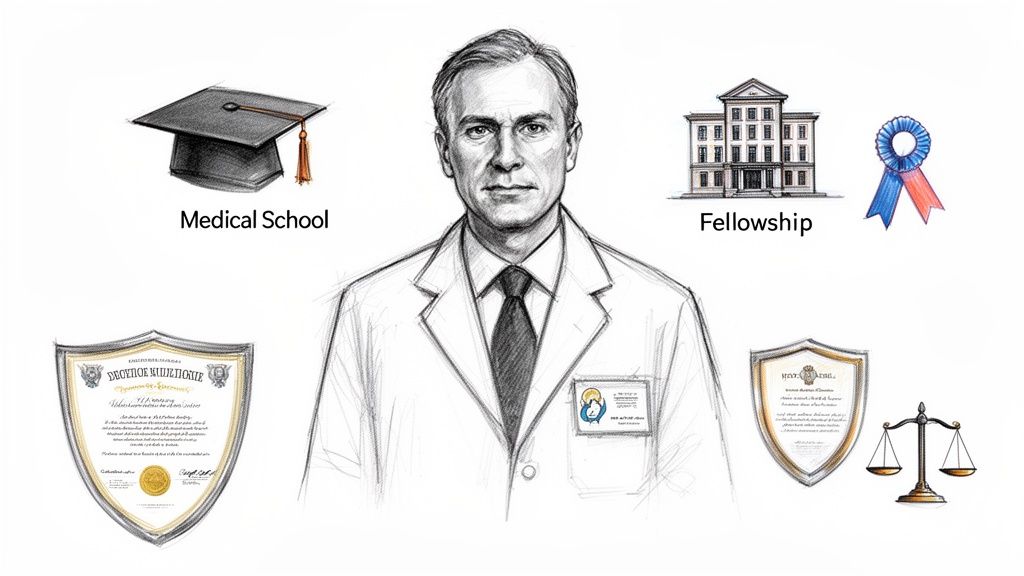
The road to becoming a forensic pathologist is a marathon. It's a commitment of more than a decade designed to build a solid foundation in medicine and its specific application to the law.
The Path to Specialization
The training is like building a pyramid. Each level of education and hands-on experience adds a new layer of specific knowledge.
- Medical School: It all starts with earning a medical degree (MD or DO). This is the broad base of the pyramid, covering all aspects of the human body.
- Pathology Residency: After medical school, we spend years in a pathology residency. This is where we learn the fundamentals of diagnosing diseases by examining tissues and interpreting complex lab results.
- Forensic Pathology Fellowship: This final year is the capstone. It’s an intensive, specialized training where we focus entirely on investigating suspicious or unexplained deaths, learning to interpret injuries, and mastering toxicology under the guidance of senior experts.
This entire process ensures that we have the complete skill set to handle even the most challenging cases.
Why Board Certification Matters
Passing the exams to become board-certified by the American Board of Pathology is the ultimate seal of approval in our field. It is an independent confirmation that a pathologist has not only completed all necessary training but has proven their expertise.
I am board-certified in Anatomic, Clinical, and Forensic Pathology. This means my training covers the full spectrum, from recognizing disease at a cellular level to understanding complex trauma and chemical evidence.
This specialized training is what allows a forensic pathologist to determine not just the cause of death (the specific injury or disease) but also the manner of death—was it natural, an accident, a suicide, a homicide, or is it undetermined? This distinction is often what families, lawyers, and courts need most.
Getting this right is everything. For example, finding that a person died from a medication overdose is only the first step. The real work is using all the evidence to help determine if that overdose was accidental, intentional, or caused by someone else. If you want to dig deeper into what this involves, I’ve written more about what a forensic pathologist does in our dedicated article.
A Specialized and Demanding Field
Forensic pathology is a small, highly specialized field. According to the National Association of Medical Examiners, there are only about 750 full-time forensic pathologists practicing in the entire United States. The demand is nearly double that to keep up with the workload.
This shortage highlights how unique the required skill set is. It’s not just about medical knowledge; it’s about a deep commitment to objectivity and ethics. You can learn more about the broader scope of physicians to see how this specialty fits into the larger medical community.
When a family or an attorney hires me for a private autopsy, they are trusting me to provide answers that will hold up under intense scrutiny. It’s a responsibility I take seriously with every case I handle.
Hospital Pathologists vs Forensic Pathologists
It’s a common misconception that any pathologist can perform any autopsy, but these are two distinct specialties. I often explain the difference to families, and the best way I’ve found to clarify it is with a simple analogy.
Think of a hospital pathologist as a specialist in natural disease. Their expertise is in looking at tissue from biopsies or performing autopsies to see exactly how a known illness, like cancer or heart disease, affected the body. Their work is crucial for medical quality control, confirming clinical diagnoses, and helping doctors learn more about disease progression.
A forensic pathologist, on the other hand, is an investigator. We are trained as medical detectives, piecing together the story behind an unnatural, sudden, or unexplained death. Our focus is on interpreting injuries, collecting evidence that can stand up in court, and determining both the cause and manner of death when foul play, an accident, or negligence might be involved.
Different Questions Require Different Experts
Ultimately, it comes down to the questions you need answered. A hospital autopsy is designed to answer purely medical questions, like, "How advanced was the cancer?" or "Did the heart attack damage the expected areas?"
A forensic autopsy, including a private or second opinion autopsy, is built to answer complex medicolegal questions. These are the kinds of questions families and attorneys often bring to me:
- Was the death a direct result of the car accident last month, or was it caused by a later medical complication?
- Are the injuries on the body consistent with a simple fall, or do they suggest an assault?
- Could an undiagnosed allergy or a mistake with medication have played a role in the death?
Answering these questions requires a unique understanding of injury patterns, toxicology, and evidence preservation. According to the Association of American Medical Colleges, there were 21,215 active physicians in pathology in 2022, but only a fraction have the specialized training for medicolegal cases. You can see more data about the physician workforce from the Association of American Medical Colleges to get a better sense of the field.
While both types of pathologists are brilliant physicians, only a forensic pathologist has completed the specialized fellowship training needed to answer these tough medicolegal questions with authority. This role is also quite different from the administrative functions of coroners and medical examiners, which we cover in our guide on the differences between a coroner and a medical examiner.
Understanding Texas Law on Autopsy Authorization
When a loved one passes away, the legal questions that follow can feel daunting. As a forensic pathologist in Texas, I often speak with families and attorneys who are trying to make sense of the laws around autopsies. My goal is to explain things simply. The laws are there to ensure every death investigation is handled with care, respect, and legal clarity.
In Texas, the authority to order an autopsy boils down to two distinct paths: one driven by the government and one initiated by the family. They serve different purposes and fall under separate state codes.
Government-Ordered Autopsies in Texas
Think of this as the state's responsibility. When a death is sudden, unexpected, or happens under violent or suspicious circumstances, it automatically becomes a matter of public concern.
The Texas Code of Criminal Procedure, Chapter 49, gives specific officials the power to order an autopsy. This isn't a suggestion; it’s a legal mandate to protect public health and see that justice is served.
The authority rests with a Medical Examiner in larger counties or a Justice of the Peace acting as coroner in more rural areas. It’s their job to investigate these deaths, and an autopsy is a critical tool for finding answers. Because it's a legal investigation, they are not required to get permission from the family to proceed.
A Family's Right to Seek Answers
While the state has its legal duties, Texas law also recognizes that families have a right to find their own answers. This is where a private autopsy becomes an option.
The Texas Health & Safety Code gives the next of kin the right to authorize a postmortem examination. This is most common when the death doesn’t fall under the medical examiner's jurisdiction, but the family still has unanswered questions about the cause of death.
This simple chart helps show which type of pathologist is usually needed depending on the situation:

As you can see, a hospital pathologist typically handles known natural diseases, while a forensic pathologist is the specialist for any death that is unexplained or involves an injury.
To make this distinction clearer, the table below breaks down the key differences between government-mandated and privately requested autopsies in Texas.
| Autopsy Type | Legal Authority in Texas | Typical Purpose | Initiated By |
|---|---|---|---|
| Government-Mandated | TX Code of Criminal Procedure, Ch. 49 | Public health, criminal investigation, determining cause/manner of death in specific circumstances (e.g., unattended, violent). | Medical Examiner or Justice of the Peace (acting as Coroner). |
| Privately Requested | TX Health & Safety Code | Clarify cause of death for family, address insurance claims, investigate potential medical malpractice, or provide peace of mind. | The legal next-of-kin or their designated representative (e.g., an attorney). |
This table highlights that while the government acts out of legal necessity, a family acts based on their right to know.
Who Can Legally Give Consent
For a private autopsy to happen, consent must come from the right person. Texas law is specific about this, creating a clear order of priority to ensure the decision is made by the person closest to the deceased.
The legal hierarchy for authorization is:
- A person named in a written document signed by the decedent.
- The surviving spouse.
- Any of the surviving adult children.
- Either of the surviving parents.
- Any of the surviving adult siblings.
This structure removes any guesswork. To go deeper on this topic, you can find a complete breakdown in our guide on who is legally able to request an autopsy. It gives families the confidence that moving forward with a private investigation is a legally sound process.
It’s crucial to understand that a private autopsy doesn't go against state law—it's a right protected by it. Families have every right to seek this option for peace of mind, to resolve insurance disputes, or to look into possible medical negligence.
Here at Texas Autopsy Services, my mission is to make this process as clear as possible. I work directly with the family's legal next of kin or their attorney to ensure all paperwork is handled correctly and every step complies with Texas law. This lets families focus on what truly matters: getting the answers they deserve.
When to Request a Private Autopsy
A medical examiner's autopsy answers official questions for legal or public health reasons. But what about your questions? When a death happens outside the strict rules that trigger a government investigation, families are often left with a painful silence instead of answers.
This is exactly where a private, independent autopsy can be a crucial step toward finding the truth. Over the years, I've worked with countless families and attorneys who needed that deeper look—a medically sound, unbiased review of the facts, completely separate from any hospital or institutional interests.
Common Scenarios That Warrant an Independent Examination
While every family's story is different, certain situations almost always leave lingering doubts that a death certificate just can't resolve.
Here are a few of the most common reasons people come to me:
- Sudden or Unexplained Death: When someone passes away unexpectedly without a clear medical cause, and the case doesn't fall under the medical examiner’s jurisdiction, a private autopsy is often the only way to find out what really happened.
- Concerns About Medical Care: If you have a feeling that a medical error, a missed diagnosis, or negligence in a hospital or care facility played a role in a loved one's death, an independent examination is the only way to uncover the facts.
- Workplace or Environmental Exposures: A private autopsy can be the key to connecting a death to toxic substances or hazardous conditions at work, establishing a link that might otherwise be missed.
- Clarification for Insurance Claims: A vague or disputed cause of death can cause insurance companies to deny life insurance or accidental death claims. An autopsy provides the hard medical evidence needed to clear up those disputes.
- Need for a Second Opinion: Sometimes, the findings from an official autopsy just don't seem right or feel incomplete. A second-opinion autopsy can either confirm the original report or, in many cases, uncover critical new information.
For families in Texas, knowing the precise cause of death is also the cornerstone of building strong wrongful death lawsuits, where medical certainty is absolutely essential.
A private autopsy is more than a medical procedure; it’s a tool for resolution. It provides families with the concrete facts they need to grieve, make informed decisions, and, when necessary, seek justice.
The need for these services is widespread. For example, the Ontario Forensic Pathology Service in Canada documented 10,374 total autopsies in its 2022–2023 report, covering everything from criminal investigations to complex medical cases. It's a stark reminder of how often a postmortem exam is needed to find the truth. You can see the full scope of their work in the full report from the Ontario Forensic Pathology Service.
At Texas Autopsy Services, we provide this focused, independent service to give families and their legal teams the definitive answers they deserve.
How to Choose the Right Expert for an Autopsy
Once you’ve made the difficult decision to seek a private autopsy, the next step is just as critical: finding the right professional. You're not just hiring a doctor. You’re entrusting someone with a profound responsibility to find the answers your family needs.
The right expert will have an ideal blend of impeccable credentials and the ability to communicate with clarity and compassion. It can feel overwhelming, so I've put together a straightforward guide to help you ask the right questions and make a confident choice.

Verify Board Certification
First, the most important credential to look for is board certification in Forensic Pathology. This is the gold standard, issued by the American Board of Pathology. It’s a guarantee that the pathologist has gone through a rigorous, specialized fellowship focused entirely on investigating complex and non-natural deaths.
While any licensed physician can legally perform an autopsy in Texas, only a board-certified forensic pathologist has the specific training needed to interpret subtle injuries, understand complex toxicology reports, and deliver findings that hold up under legal or insurance scrutiny. Don't be afraid to ask for this credential directly—it’s that important.
Evaluate Relevant Experience
Experience isn’t just about the number of years someone has been working; it’s about the type of work they’ve done. You need a pathologist whose background aligns with the questions you have. I have personally performed over 1,000 autopsies, which has given me a deep well of experience across a huge range of cases, from adult and pediatric deaths to complex forensic investigations.
When you talk to a potential pathologist, ask about their experience with situations like yours. A truly seasoned expert will have no problem speaking confidently about their background and how it can help you find the clarity you need.
Insist on Transparency
The entire process should be clear from the start. A trustworthy provider will be upfront and transparent about their procedures, timeline, and cost. There should be no surprises.
You deserve a clear explanation of:
- The Scope of the Examination: What specific tests and procedures are included?
- The Reporting Process: What will the final report look like, and when will you receive it?
- The Total Cost: Are there hidden charges for transportation, toxicology, or tissue analysis?
Here at Texas Autopsy Services, we make this simple by providing a single, all-inclusive price. This way, you can avoid financial uncertainty during an already stressful time.
Choosing a pathologist is an act of trust. You are entrusting them with the care of your loved one and the pursuit of truth. The right expert will honor that trust with professionalism, precision, and profound respect for the gravity of their work.
Assess Communication and Compassion
Finally, don’t overlook the human element. The best forensic pathologists are more than just brilliant scientists; they are also skilled and patient communicators. They should be able to walk you through complex medical findings in plain, understandable language.
When you speak with them, how do you feel? Do they listen to your concerns? Do they answer your questions with respect and without rushing you? A compassionate approach is essential. You need an expert who understands the grief you’re navigating and is committed to providing clarity, not more confusion. This balance of medical precision and human understanding is the cornerstone of my practice.
Frequently Asked Questions About Autopsies
Over the years, I've noticed that families and attorneys often have the same fundamental questions. The idea of an autopsy can feel intimidating, so my first job is to clear up any confusion and provide straightforward answers.
How long does an autopsy take to complete?
The physical examination typically takes between two to four hours, depending on the complexity of the case. The complete investigation also involves additional tests, like toxicology or tissue analysis, which can take several weeks. Once all information is gathered and analyzed, a final, comprehensive report is issued.
Will an autopsy interfere with funeral arrangements?
No, it will not. We handle every examination with deep respect for the deceased and their family. Any incisions are carefully placed so they will not be visible once the body is dressed. Our entire process is designed to allow for an open-casket viewing if that is your wish. We coordinate directly with the funeral home to ensure there are no delays or interferences with your plans.
What is included in the final autopsy report?
The final report is a detailed medical and legal document that presents all findings in a clear, organized manner. It typically includes a thorough description of the external and internal examinations, results from all lab work, a summary of the person’s medical history, and a final diagnosis that states the cause and manner of death. The goal is to provide solid, evidence-based answers in a way that is understandable to families, attorneys, and other medical professionals.
If you have other questions or need to discuss your situation, please don’t hesitate to get in touch. At Texas Autopsy Services, my role is to provide the clear, compassionate, and medically sound answers you and your family deserve.