February 22, 2026 · Texas Autopsy Services
What Families Should Know About Harris County Autopsy Reports
Learn how to access and understand Harris County autopsy reports. A forensic pathologist's guide to the official process, key terms, and private autopsies.
On this page
When a loved one passes away, sorting through official documents like an autopsy report can feel overwhelming. As a board-certified forensic pathologist, I've spent my career explaining these documents to families. I’ve seen how this report can be vital for seeking closure, navigating a legal case, or understanding potential genetic health risks. The first step is always knowing who can legally request the report and where to send that request.
- Who can request: In Texas, autopsy reports are protected documents. Access is generally limited to the surviving spouse, adult children, parents, adult siblings, or the executor of the estate.
- Where to request: All official reports for the area are managed by the Harris County Institute of Forensic Sciences (HCIFS).
- What to expect: The process involves submitting a formal request and waiting for the investigation to conclude, which can take several months.
- When to seek help: If the county did not perform an autopsy or if you have questions about the official findings, a private autopsy can provide the specific answers your family needs.
Your First Steps to Request an Autopsy Report
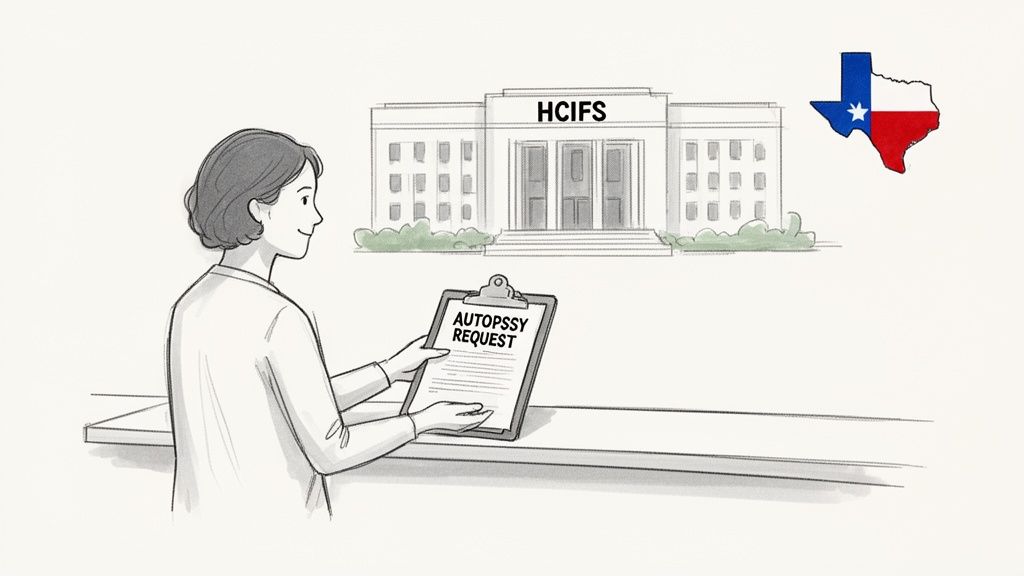
Before you do anything else, you need to know who is in charge. In this region, all Harris County autopsy reports are handled by the Harris County Institute of Forensic Sciences (HCIFS). They are the official government body that investigates and determines the cause and manner of death for specific cases in the county.
It’s important to remember that not every death requires an autopsy. The HCIFS becomes involved only under circumstances defined by Texas law, such as sudden, unexpected deaths or those that occur under violent or suspicious circumstances. If your loved one passed from known natural causes under a doctor's care, the county medical examiner likely wasn't involved, and there won't be a report to request.
Who Is Eligible to Make a Request
The Texas Public Information Act is very clear about who can get a copy of the final autopsy report. This isn't just bureaucratic red tape; it's about protecting the privacy of the deceased. The law limits access to the closest relatives.
Generally, you are eligible to request the report if you are:
- The surviving spouse
- An adult child
- A parent of the deceased
- An adult sibling
- The designated administrator or executor of the estate
This hierarchy ensures that sensitive information is shared only with those most directly impacted. Of course, government bodies like a police department or the District Attorney's office can also access these records if they are part of an active investigation. For a more detailed walkthrough, you can learn more about how to request an autopsy report and what each part of the process entails.
Making sure you're eligible is the absolute first move. It saves you time and frustration and ensures your request goes to the right place—the HCIFS—without getting stuck in a legal dead end.
How to Officially Request the Report from HCIFS
Once you've determined you are the legal next-of-kin, it's time to formally request the autopsy report from the Harris County Institute of Forensic Sciences (HCIFS). The county has a specific process to protect the family’s privacy while getting the report into the right hands. From my experience helping families through this, knowing exactly what to do can make a difficult time a little bit easier.
Your first step is to get the official request form from the HCIFS website. It's a fairly standard document asking for information about the person who passed away, your relationship to them, and your own contact details. Take your time and fill it out completely, as any missing information will almost certainly cause a delay.
Submitting the Form and Waiting for the Report
You have a few options for submitting the completed form: email, fax, or mail. I always suggest using a method that gives you proof of delivery. Certified mail or an email with a read receipt gives you a paper trail and peace of mind that your request actually made it to the right desk.
After you send it in, the waiting begins. This can be the hardest part.
One of the first questions I always get is, "How long will this take?" While the HCIFS says most reports are ready in 90 to 120 days, that’s really just an estimate. The final timeline for a Harris County autopsy report depends on several factors, all of which are critical to getting the investigation right.
Here are a few things that can slow down the process:
- Waiting on Lab Work: Toxicology testing, which looks for substances in the body, is incredibly detailed and can take weeks, sometimes even months. The medical examiner can't finalize the report until those results are in.
- A Complicated Case: Homicides, complex accidents, or cases where the cause of death isn't immediately obvious just take more time. Law enforcement might also place a hold on the report until their own investigation is finished.
- Detailed Tissue Analysis: Looking at tissue samples under a microscope, a process called histology, is painstaking work that adds to the overall time.
Costs, Copies, and What Happens If Your Request is Denied
The good news is that the HCIFS provides one copy of the autopsy report to the legal next-of-kin for free. If you need extra copies, or if an attorney is requesting one, there's usually a small fee involved. It’s always a good idea to check the HCIFS website for their current fee schedule so there are no surprises.
It's rare, but sometimes a request is denied. This typically happens for two reasons: either the person requesting it isn't the legal next-of-kin as defined by Texas law, or the report is sealed as part of an active criminal case.
If your request is denied, the HCIFS will tell you why. Your next move might be to supply whatever documentation they need or, in more complex situations, talk to a lawyer to figure out your options.
The Reality of Caseloads in Harris County
To get a real sense of why autopsy reports can take time, you have to look at the scale of the work happening in a place like Harris County. As a forensic pathologist who serves all 254 counties in Texas, I've seen firsthand the intense pressure my public-sector colleagues are under. Harris County is one of the busiest jurisdictions in the entire country, and its workload is immense.
This isn't just about shuffling paperwork. It's about the meticulous, painstaking effort that goes into every single death investigation. When you understand the systemic backlogs and common delays in Harris County that affect all sorts of legal matters, the timelines for forensic reports start to make more sense.
The Impact of Volume on Timelines
The numbers tell the story. Back in 2020, the Harris County Institute of Forensic Sciences (HCIFS) handled 5,595 medical legal cases. That was a 23% jump from the year before.
Think about that. It's an immense volume for a team serving more than 4.7 million residents.
To give you a better idea of how that breaks down, here's a look at the types of investigations they conducted.
HCIFS Case Breakdown by Investigation Type
This table shows the distribution of full autopsies versus external-only examinations for medical legal cases handled by HCIFS in a high-volume year.
| Investigation Type | Number of Cases | Percentage of Total Cases |
|---|---|---|
| Full Autopsy | 4,588 | 82% |
| External Examination Only | 1,007 | 18% |
| Total Cases | 5,595 | 100% |
Even with a strategy to manage demand by performing external-only exams when possible, the vast majority (4,588 cases) still required a full, in-depth autopsy. This data comes directly from the official 2020 HCIFS report and paints a clear picture of the relentless pace.
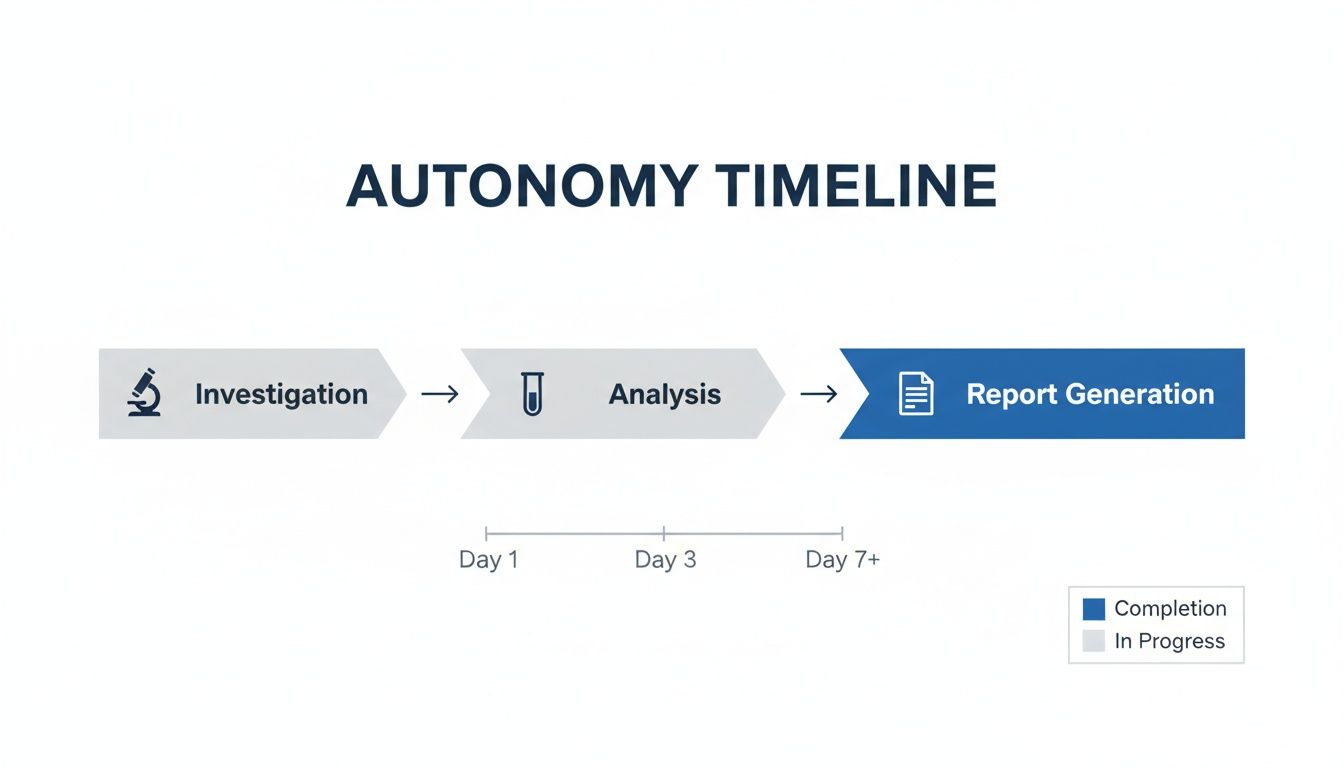
Each stage in that process demands precision. When the caseload is this high, pathologists and their teams are in a constant balancing act between moving things along and maintaining absolute accuracy.
Every case, whether it seems simple or incredibly complex, deserves the same level of diligence. The challenge for any large public institution is delivering that quality consistently while managing an unceasing inflow of new cases, each with its own set of unique scientific and legal questions.
Different Cases Demand Different Resources
Not all death investigations are the same. The manner of death, be it natural, accidental, suicide, or homicide, dictates the resources and time needed.
Accidents and Homicides: These cases are often the most complex. They usually require extensive scene investigations, the careful collection of trace evidence, and close coordination with law enforcement, all of which can stretch out the timeline considerably.
Natural Causes: While some are straightforward, a sudden death in an otherwise healthy person can trigger a deep dive. This might involve detailed microscopic analysis of tissues and comprehensive toxicology testing to find the underlying cause.
Unidentified Individuals: This adds another layer of complexity. In 2020, HCIFS received 411 unidentified decedents. These cases often require specialized work from forensic anthropologists, DNA testing, and public outreach just to give a person their name back.
This heavy demand on resources is exactly why the methodical, and sometimes lengthy, approach isn't just common. It's essential to ensure every family gets the accurate, definitive answers they deserve.
How to Read and Interpret an Autopsy Report
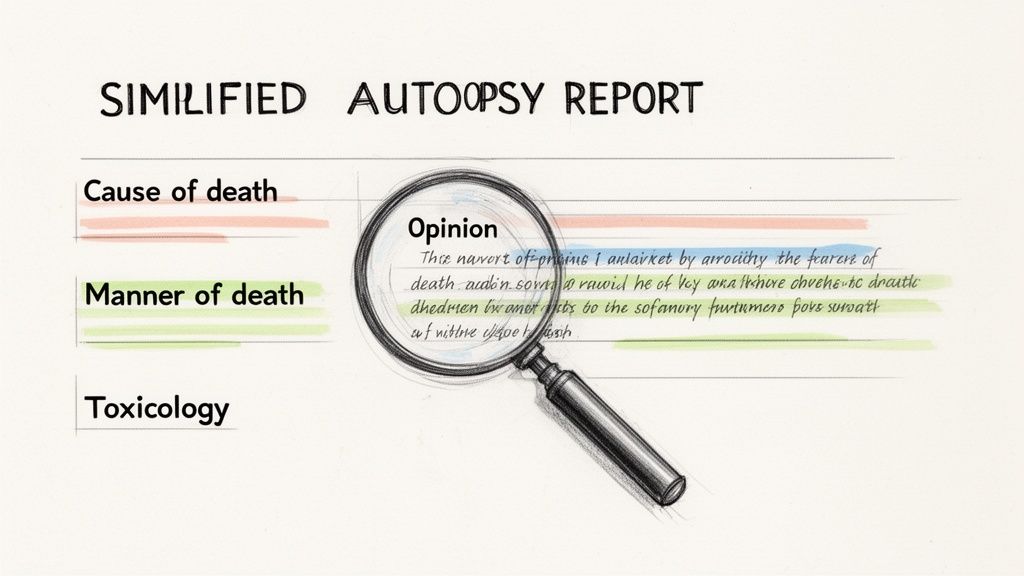
When you finally receive the Harris County autopsy report, it can feel like trying to read a foreign language. The document is filled with dense medical jargon. As a forensic pathologist, I write these reports, but I also believe it's important to help people understand them. Think of an autopsy report not as a single conclusion, but as a story told in a very structured way. Each section is a chapter, building on the one before it to paint a complete medical picture of what happened.
Key Terms You Need to Know
Before you read the full report, you need to get a firm grip on three critical terms. They sound similar, but they mean very different things, and they are the foundation of every death investigation.
Cause of Death: This is the what. It's the specific disease or injury that started the chain of events leading to death. Examples are fairly straightforward: a heart attack, a gunshot wound, or complications from cancer.
Mechanism of Death: This is the how on a physiological level. It's the final process inside the body that resulted from the cause. For instance, if the cause was a stab wound, the mechanism might be exsanguination (fatal blood loss).
Manner of Death: This is the legal classification. It isn't just based on the autopsy; it considers the entire investigation, including the scene and circumstances. In Texas, there are five possibilities: Natural, Accident, Suicide, Homicide, and Undetermined.
Grasping the difference between these three concepts is the key to unlocking the rest of the report. For a more detailed guide, you can also review information on how to read a pathology report.
Breaking Down the Sections of the Report
A formal autopsy report, whether from Harris County or another jurisdiction, follows a standard medical format. Here’s a quick tour of what to expect as you read through it.
The report will always start with the basics, such as the deceased’s name, case number, and other identifying details. From there, it gets into the medical findings.
Pathological Diagnoses This is the executive summary. It’s a bulleted or numbered list of all the significant medical findings, from the direct cause of death to incidental conditions. It gives you a quick overview before you dive into the details.
External Examination This is a head-to-toe description of everything on the outside of the body. I document height, weight, identifying marks like scars and tattoos, and any signs of external injury. Every detail is noted.
Internal Examination Here, we go organ by organ. Each organ system (cardiovascular, respiratory, etc.) is examined, weighed, and described in detail. This is where you'll find notes on disease, internal injuries, or other abnormalities.
The Opinion section is where it all comes together. This is the pathologist's final conclusion, where I formally state the cause and manner of death based on every piece of evidence, from the physical exam to the lab results.
Toxicology Report This report often comes in later, but it’s a crucial piece of the puzzle. It lists any drugs, alcohol, or other substances found in the body. It’s important to know that the mere presence of a substance doesn’t mean it contributed to death; that’s an interpretation made in context with all the other findings.
Reading an autopsy report requires patience. It’s a scientific document built for medical and legal precision, but with this roadmap, you'll be much better equipped to find the answers you're looking for.
When a Private Autopsy Might Be the Right Choice
The official report from the Harris County medical examiner serves an essential public purpose, but sometimes it doesn't provide the specific answers a family is searching for. In these situations, getting a private, independent autopsy—or even a second opinion on the county's report—is often the best path forward.
This need frequently comes up when the county decides not to perform an autopsy in the first place. This is common in deaths believed to be from natural causes, especially when there aren't any red flags. A private autopsy can also be the right move if a family has lingering doubts about the official cause of death or if they are considering legal action.
A private autopsy is a different kind of service. It’s initiated by the family, for the family, and is completely centered on answering their unique questions through a dedicated investigation.
Why Families Seek an Independent Examination
Choosing to pursue an independent autopsy is a very personal decision. In my experience as a forensic pathologist, families and their attorneys usually reach out for a handful of common reasons.
- The County Didn't Perform an Autopsy: If someone passes away at home or in a hospital from what seems to be natural causes, the medical examiner might not get involved. But the family may still want confirmation or wish to check for hereditary diseases that could impact other relatives.
- Doubts About the Official Report: Sometimes, the official findings just don’t sit right. They might seem incomplete or conflict with what the family knows about their loved one's final days or overall health. An independent look can either validate the county’s conclusions or bring overlooked details to light.
- Legal or Insurance Needs: A private autopsy provides unbiased, in-depth evidence that can be vital for building a case in lawsuits related to medical malpractice, on-the-job accidents, or insurance claim disputes.
- Needing to Know: For many, the most powerful motivator is simply getting clear, definitive answers. It's about finding closure and peace of mind.
The Value of a Dedicated Investigation
A private autopsy from a provider like Texas Autopsy Services in Harris County offers a depth of focus that a public agency, juggling thousands of cases, simply cannot match. This isn't a criticism of their work; it's the reality of their overwhelming caseload.
To put it in perspective, in 2021 alone, the Harris County Institute of Forensic Sciences handled 13,868 reported deaths, with its investigators going to more than 4,143 scenes. That intense demand shows the immense pressure on the public system and makes it clear why a private service can provide a more tailored approach. You can see the full numbers in the 2021 HCIFS annual statistics.
At its heart, a private autopsy is about providing clarity. It means a board-certified forensic pathologist is devoting their full attention to your case, using specialized tests, and taking whatever time is necessary to create a thorough, easy-to-understand report that addresses your family's concerns.
Ultimately, this path is about giving you control. It puts your questions at the center of the investigation and delivers medically sound answers with the compassion and respect every family deserves.
Frequently Asked Questions About Autopsy Reports
When families and attorneys are trying to get answers, many of the same questions come up time and again. I've compiled some of the most common ones I hear in my practice to give you clear, direct information. These answers come from my experience as a board-certified forensic pathologist and my deep understanding of the legal and procedural side of things here in Texas.
Can I Get an Autopsy Report for a Death That Happened Years Ago?
Yes. Autopsy reports are permanent legal records, so you can request one from a past case. The Harris County Institute of Forensic Sciences (HCIFS) keeps a detailed archive. You'll follow the same official process as you would for a recent death. Just be aware that pulling older records might take a little extra time.
Will an Autopsy Prevent an Open Casket Funeral?
This is a major concern for many families, and it's completely understandable. The good news is that in almost every case, a properly performed autopsy will not prevent an open-casket viewing. Forensic pathologists are trained to conduct these examinations with the highest level of respect. We use techniques specifically designed to be unnoticeable once the body is prepared for funeral services.
A core tenet of my practice, and that of my colleagues, is ensuring the deceased is always treated with dignity. We work closely with funeral homes, like our partners at Waterloo Mortuary, to make sure a family's wishes for viewing can be fully honored.
What if I Disagree With the Findings in the Report?
If you're reading the official Harris County autopsy report and something doesn't seem right, you have options. A good first step is to contact the HCIFS and ask if you can speak with the pathologist who handled the case. Sometimes, a simple conversation can clear up a misunderstanding. If you still have serious concerns, getting a second opinion from an independent forensic pathologist is a reasonable next step. A qualified expert can review the original report, photos, and any tissue slides to give you an impartial analysis. In some situations, it may be possible to perform a full private autopsy if the body has not been cremated or embalmed.
Is It Possible to Get a Report Without a Cause of Death?
Yes, it can happen, though it isn't common. You might see the cause and manner of death listed as "Undetermined." This means that even after a thorough investigation, a specific cause couldn't be established with medical certainty. It doesn't mean the process failed. On the contrary, it shows a commitment to scientific accuracy; a pathologist will only state what the evidence proves.
While an autopsy report can provide clarity, I know that the emotional toll of loss is immense. Professional services like grief and loss counselling can offer valuable support as you navigate this journey.
If you have more questions or feel that an independent review could bring your family the peace of mind you deserve, please reach out to my team at Texas Autopsy Services. We are here to provide guidance and help you find a clear path forward. You can contact us through our website at https://www.texasautopsyservices.com.