March 30, 2026 · Texas Autopsy Services
Are All Murders Homicides A Forensic Pathologist Explains
Are all murders homicides? A Texas forensic pathologist clarifies the critical differences to help families and attorneys understand the cause of death.
On this page
As a forensic pathologist, I’ve sat with countless families and attorneys who are navigating the most difficult times of their lives. One of the first and most common points of confusion I see is the difference between the words homicide and murder. It’s an easy mistake to make, but the distinction is critical for understanding the path ahead.
The core of it is this: every murder is a homicide, but not every homicide is a murder.
Homicide Is Not Always Murder
Let me offer a simple analogy. All squares are rectangles, but you wouldn’t call every rectangle a square. Homicide is the broad category—the rectangle. It’s a neutral, medical term that simply means a person died at the hands of another. That’s it.
Murder, on the other hand, is a very specific type of homicide—the square. It's a criminal act with specific legal elements, like intent. My job is to explain how my work as a forensic pathologist fits into this picture, especially when a family is considering a private autopsy to get definitive answers.
The Medical vs. The Legal View
When I perform an autopsy at Texas Autopsy Services, my role is to determine the medical cause of death. Was it a gunshot wound? A heart attack? Poison? From there, I classify the manner of death, which is one of five categories: natural, accident, suicide, undetermined, or homicide.
You can read more about how those two concepts work together in my post on the differences between cause and manner of death.
It’s vital to understand that classifying a death as a homicide on an autopsy report isn't an accusation. It's a medical finding based on evidence. It simply means the actions of another person led to the death.
A finding of homicide by a medical examiner is not a finding of guilt. It's a statement of medical fact that tells the legal system, "This death was caused by another person, and it requires your attention."
This is where the legal world takes over. My report provides the "what"—the physical evidence of how the person died. It's up to prosecutors to use that evidence to argue the "why" and determine if a crime, such as murder, was committed.
The Line Between Lawful and Unlawful Homicide
So, what separates a homicide that is a crime from one that isn't? The law.
Unlawful homicides are what we typically think of as crimes—murder and manslaughter. On the other hand, lawful homicides (also called justifiable homicides) are deaths caused by another person but are permitted by law. The most common examples are a legitimate act of self-defense or a lethal action taken by a police officer in the line of duty.
This distinction is recognized worldwide. For example, the United Nations Office on Drugs and Crime (UNODC) defines intentional homicide as an unlawful death purposefully inflicted on a person by another person, explicitly excluding deaths from self-defense or legal intervention. You can explore how these definitions are applied globally by reviewing data on homicide rates and definitions from Our World in Data.
Understanding this divide is the first step in making sense of a tragic event. It clarifies why some deaths that are ruled homicides never result in criminal charges, and it helps families and their legal teams know what to expect as they move forward.
To help you see the differences side-by-side, here is a quick comparison of the key concepts.
Homicide vs Murder At a Glance
| Attribute | Homicide | Murder |
|---|---|---|
| Definition | The death of a person caused by another person. | The unlawful and intentional killing of another person; a specific type of criminal homicide. |
| Scope | Broad and neutral. Can be lawful or unlawful. | Specific and criminal. Always unlawful. |
| Determined By | A medical examiner or forensic pathologist, based on autopsy findings. | The legal system (prosecutors, judge, jury), based on evidence and intent. |
| Example | Self-defense, police action, manslaughter, or murder. | Premeditated killing, killing during the commission of another felony. |
This table shows how homicide is a factual, medical classification, while murder is a legal conclusion that requires proof of criminal intent. Grasping this helps everyone involved understand the distinct roles of the medical examiner and the justice system.
Understanding the Different Categories of Homicide
Now that we're clear that homicide is the broad, neutral term for one person causing another’s death, we can unpack what that means. In my work, I see homicides fall into two main buckets: non-criminal (which you might hear called justifiable or excusable) and criminal. This is the most important distinction, as it’s what separates a tragic but lawful act from an illegal one.
This diagram helps visualize how it all fits together. Think of "homicide" as the main umbrella.

As you can see, every death caused by another person is a homicide. But only one of those branches—the unlawful one—leads down the path to criminal charges. My job as a pathologist is to provide the objective, scientific evidence that helps the legal system figure out which path a particular case belongs on.
Lawful or Justifiable Homicide
A justifiable homicide is a death caused by another person that the law permits under specific, necessary circumstances. These situations are always tragic, but they don't result in criminal charges for the person who caused the death. The most common examples I see related to my work are:
- Lawful Self-Defense: Someone uses lethal force because they genuinely believed they or someone else was in immediate danger of being killed or severely injured.
- Actions by Law Enforcement: A police officer causes a death while lawfully carrying out their duties, like stopping a violent felony.
Even in these cases, my autopsy findings are crucial. Details like defensive wounds on the deceased, the path of a bullet, or the distance from which a weapon was fired can all help tell the story. This physical evidence can either support or contradict the official account, helping confirm if the act was one of necessity.
Unlawful or Criminal Homicide
This is the category most people think of when they hear the word "homicide." A criminal homicide is an unlawful killing—one that society has decided is punishable by law. This is where the legal details get even more important, and where we find the clear answer to our main question. In Texas, criminal homicides are sorted into different types based on the person's intent and state of mind.
A finding of homicide on an autopsy report is a medical determination, not a legal one. It's my job to document the "what" and "how" of the death; it's the court's job to determine the "why"—the intent that separates a lawful act from a crime.
This isn’t just a local distinction; it's a global standard. When organizations like the World Health Organization report on violence, their data reflects this. Of the estimated 475,000 global homicide victims in 2019, that number includes only intentional, unlawful killings. You can dig deeper into this in the WHO's global violence information.
Murder
Murder is the most severe form of criminal homicide. What defines murder is intent. The law sometimes calls this "malice aforethought," but it means the person knowingly or intentionally caused someone’s death. This doesn't require weeks of plotting—that intent can be formed in a split second.
Manslaughter
Manslaughter is also a criminal homicide, but it’s different from murder because deliberate intent is missing. Instead, manslaughter involves a death caused by recklessness. A classic example is a drunk driver who causes a fatal car crash. They never intended to kill anyone, but their reckless decision to drive drunk directly caused a death, which makes it a criminal act.
During a cause of death investigation, my findings can bring critical clarity. The specific nature of injuries, the presence of drugs or alcohol, or the absence of defensive wounds can help the legal system distinguish a deliberate act from a reckless one. That final classification has life-altering consequences for everyone involved.
How a Forensic Pathologist Determines Manner of Death
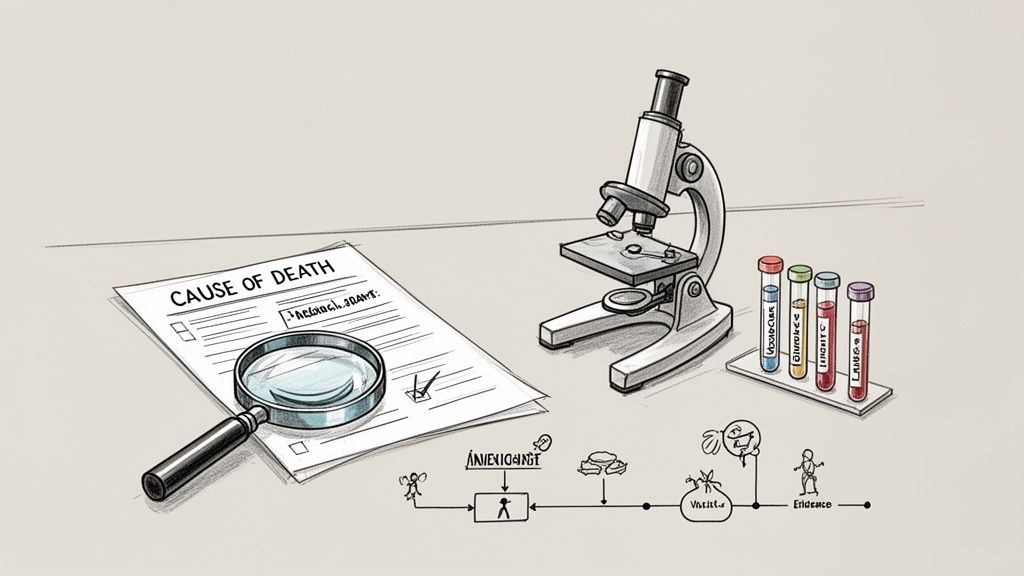
As a forensic pathologist, my work is to find the objective medical facts that explain how a life ended. It’s important to understand the two key questions I answer. The first is the cause of death—the specific medical reason, like a heart attack or a gunshot wound to the chest.
The second, and often more complex, is the manner of death. This is a classification of the circumstances surrounding the cause. In Texas, and across the U.S., every death certificate must list one of five official manners of death:
- Natural: The person died solely due to disease or the natural aging process.
- Accident: The death was the result of an unforeseen and unintentional event.
- Suicide: The person died from a purposeful, self-inflicted act.
- Homicide: The death was caused by the actions of another person.
- Undetermined: There isn’t enough evidence to confidently place the death into one of the other four categories.
While I'm the one who signs the death certificate, my classification of the manner of death is a medical opinion based on the sum of all the evidence. Those findings create the foundation for law enforcement and the courts to determine if a crime occurred.
Building a Narrative from Physical Evidence
Every autopsy tells a story, and it’s my job to read it. It’s a meticulous process where the body itself provides the clues. For instance, the wounds speak volumes.
The angle of a stab wound can give hints about an attacker's position. The presence of gunpowder stippling—or the lack of it—around a bullet entry wound tells me how close the firearm was when it was discharged. I also look for defensive injuries on the hands and arms, which are powerful signs of a struggle.
What’s not there can be just as telling. The absence of defensive wounds might suggest a surprise attack, or that the deceased was incapacitated and unable to fight back. Each detail adds a new chapter to the narrative.
The Role of Toxicology and Internal Examination
The story rarely ends with what we can see on the outside. A full internal examination and toxicology screening are essential for getting the complete picture.
Toxicology results can change the entire context of a case. The presence of alcohol, illicit drugs like fentanyl, or even prescription medications can help explain behavior, establish a timeline, or reveal an entirely unexpected cause of death.
This level of detail is why a thorough, professional autopsy is so critical. For example, finding a lethal dose of a drug in someone who also has a minor head injury might shift the cause of death from trauma to an overdose. These are the crucial distinctions that have profound legal consequences. For a deeper look, I’ve written a guide on how a coroner determines the cause of death.
The evidence I collect—from the obvious to the microscopic—forms an unbiased, scientific record. My final report presents these facts without any speculation about guilt or innocence. It is a neutral document built on data.
This is where the legal system takes over. Attorneys and judges use my medical findings to determine if a death I classified as a homicide legally qualifies as murder, manslaughter, or a justifiable act. The line between homicide and murder isn't drawn in the autopsy suite; it's drawn in the courtroom. But the path to that decision starts with the evidence I uncover.
Navigating Homicide Laws in Texas
While it’s helpful to know the general definitions of homicide and murder, the only thing that really matters in a case is the law where the death happened. In my work across Texas, I’ve seen how the precise wording of the Texas Penal Code shapes an entire investigation. For families and attorneys trying to get to the truth, understanding these local laws is everything.
So, is every murder a homicide? Yes, absolutely. But it’s not that simple in the eyes of the law. Texas law creates several categories of criminal homicide, and each one has a different standard of proof and carries vastly different consequences. As a forensic pathologist, my job is to deliver the objective physical evidence that helps the legal system figure out which box a death fits into.
The Degrees of Criminal Homicide in Texas
The Texas Penal Code sets up a clear hierarchy for criminal homicide. The key difference between these charges almost always comes down to the person’s mental state—what they were thinking, what they intended, or what they reasonably should have known. The autopsy findings often become the foundation for arguing which category a specific death falls into.
Here’s a breakdown of the main classifications, from most severe to least:
- Capital Murder: This is the most serious charge in Texas, reserved for murder with specific "aggravating factors." For example, killing a police officer, a child under 15, or committing murder in the middle of another felony (like a robbery or kidnapping) can elevate a case to Capital Murder.
- Murder: This charge fits when someone intentionally or knowingly causes another person's death. It also covers situations where the intent was only to cause serious bodily harm, but the act was so dangerous that it resulted in death.
- Manslaughter: This involves recklessly causing a death. In legal terms, recklessness means the person knew there was a major and unjustifiable risk but went ahead anyway. A classic example is someone dying after being hit by a "celebratory" gunshot fired into a crowd.
- Criminally Negligent Homicide: This is the least severe homicide charge. It applies when a death is caused by criminal negligence—meaning the person should have recognized a substantial risk but didn't.
How Autopsy Findings Inform Texas Law
My examination provides the hard data that attorneys use to build their case around these legal definitions. For instance, physical evidence of a long struggle or multiple, carefully placed injuries can strongly support a Murder charge by showing clear intent.
On the other hand, the absence of defensive wounds, combined with a specific toxicology report, might paint a different picture. The exact location of an injury, a bullet's path, or an unknown natural disease can completely redirect the legal narrative.
In a Texas courtroom, the line between a Murder charge and a Manslaughter charge can be drawn by a few millimeters on a wound track or a few nanograms of a drug in a toxicology report. This is why the precision of an independent autopsy is so critical.
Justifiable Homicide and Texas Self-Defense Law
Texas law also makes room for justifiable homicide, most often in cases of self-defense. The state’s "Stand Your Ground" laws allow a person to use deadly force if they have a reasonable belief that it's the only way to protect themselves from someone else's unlawful deadly force.
In these cases, the autopsy is an essential tool for sorting out the facts. The findings can help answer crucial questions: Was the deceased person armed? Were they facing the shooter or turned away? What was the distance between them? The evidence I uncover during the autopsy process can either support or contradict a self-defense claim, bringing objective facts to an emotional and legally tangled situation.
Why a Private Autopsy Can Provide Crucial Clarity
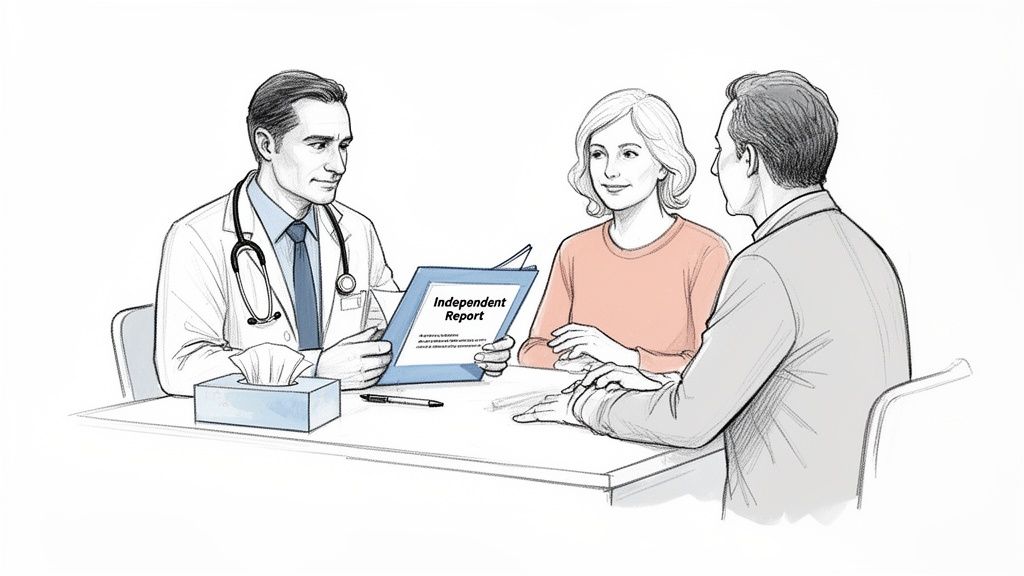
When a county medical examiner performs an official autopsy, their primary duty is to the state. They work to answer questions vital to public health and potential criminal cases. But what happens when the family is left with more questions than answers? This is the reason I founded Texas Autopsy Services.
A private autopsy is a different kind of investigation, requested by the next of kin or their legal counsel. It’s a focused, independent examination designed to find answers specifically for the family, free from the overwhelming caseloads and jurisdictional limits of a government office. My mission is to deliver truth through science.
Families often come to me when an official manner of death is ruled "undetermined," leaving them in a painful state of limbo. Other times, they might feel that a ruling of "accidental" doesn't tell the whole story. They need a more thorough and compassionate explanation than a standard government report can provide.
Seeking an Objective Second Opinion
In my years of experience, I’ve seen how a fresh, independent review can bring profound clarity. An objective second look from a board-certified expert can confirm the initial findings, giving a family much-needed peace of mind. Or, more critically, it can uncover new evidence that refines or even challenges the original conclusion.
Imagine a death is initially ruled an accident. A detailed second examination might reveal subtle injuries, toxicological clues, or other evidence missed the first time. These findings can completely change the narrative and are essential for families seeking justice or for attorneys building a solid case.
This is especially true when distinguishing between different types of homicide. Globally, this distinction is crucial. A 2023 study from the UNODC identified 458,000 unlawful homicides worldwide in 2021, a figure that specifically excludes lawful killings like self-defense. This highlights how vital a thorough forensic examination is to get the facts right. You can read more about this in the UNODC's global homicide research.
Benefits of an Independent Examination
Opting for an independent autopsy puts control back in the family’s hands during a process that can feel impersonal and overwhelming. It guarantees a dedicated, comprehensive investigation focused solely on your questions.
The advantages are clear:
- Undivided Attention: Your loved one’s case gets the full, dedicated focus of a forensic pathologist, not just another file in a long line of county cases.
- Comprehensive Reporting: You receive a detailed report written in plain language, followed by a personal consultation where I walk you through the findings and answer every question.
- Objectivity and Trust: The entire process is handled by an independent expert with no ties to the hospital, law enforcement, or any other institution involved in the case.
A private autopsy is a search for truth, conducted with compassion and scientific precision. It empowers families with the definitive answers they need to find closure and allows the legal system to act on a foundation of solid evidence.
Deciding to pursue a private autopsy is a major step, often made during a time of incredible grief. But if you feel there is more to the story of your loved one's death, a private autopsy service can deliver the answers you deserve. My role is to make sure that science has the final word.
Common Questions About Homicide and Autopsies
After performing over 1,000 autopsies at Texas Autopsy Services, I've found that families and their attorneys often grapple with the same tough questions. It's a confusing time, and my job is to provide clear, direct answers based on my experience in both the medical and legal systems in Texas.
Let's walk through some of the most frequent concerns I hear.
Can an autopsy prove a death was murder?
This is a common point of confusion, and the answer is no—not directly. An autopsy can prove a death was a homicide, which is the medical determination that a person died at the hands of another. But murder is a legal term, and it requires proving intent.
My role as a forensic pathologist is to uncover the "what" and "how." For example, my examination might conclude the cause of death was a gunshot wound, and I would classify the manner of death as homicide. The question of why—the intent—is what lawyers and juries will determine in a court of law, using my report as a key piece of evidence.
What if the manner of death is listed as undetermined?
Receiving a report that says "undetermined" can be deeply frustrating for a family searching for answers. This classification means there isn't enough objective evidence to point conclusively to homicide, suicide, accident, or natural causes.
This often happens when a body is discovered long after death, or when toxicology results are ambiguous. It doesn't mean the investigation is over, but it does mean the medical evidence isn't clear-cut. This is one of the most common reasons families seek out a second opinion autopsy. A fresh set of eyes can sometimes spot subtle clues missed the first time.
How long does a homicide investigation take after the autopsy?
The autopsy is just one of the first steps in a much longer process. Once my report is complete, law enforcement takes that information and continues to build their case.
A homicide investigation doesn’t follow a set timeline. It can take weeks, months, or even years, depending on crime lab backlogs, witness cooperation, and the overall complexity of the case.
My findings provide a factual, medical foundation for the investigation, but the legal journey that follows moves at its own speed.
It's also important to remember the practical realities families face. After the police release the scene, the family is often left to handle the physical aftermath. This is where services like professional homicide cleanup services come in—a necessary and difficult step that many people don't know they need to consider.
Why would a family need a private autopsy if the county already did one?
This is a great question. If the county medical examiner or coroner has already performed an autopsy, why would you need another one? There are a few key situations where a private, independent autopsy provides immense value.
- You Have Unanswered Questions: The official report might be technically correct but may not address specific concerns your family has. A private autopsy is tailored to answer your questions.
- You Need a Deeper Look: County autopsies are conducted for the state's purposes. A private pathologist can spend more time on nuanced or subtle findings that could be crucial for your peace of mind or a legal case.
- You Disagree with the Findings: If your family or attorney feels the official cause or manner of death is wrong, an independent autopsy provides a credible, objective second opinion to challenge that conclusion.
- You're Building a Legal Case: For attorneys, the detailed evidence from a private autopsy can be the cornerstone of a civil or criminal case, providing a depth of information that goes beyond a standard report.
If you're looking for clarity about a loved one's death, you don't have to navigate this alone. Please feel free to reach out to my office. At Texas Autopsy Services, we're here to help you find the answers you deserve.
You can learn more by visiting us at https://www.texasautopsyservices.com.