November 14, 2025 · Texas Autopsy Services
Private Autopsy Services in Texas: What to Expect
Learn how a private autopsy service provides families and attorneys with clear, independent answers on the cause of death. Authored by a Texas pathologist.
On this page
- A private autopsy provides an independent, objective cause-of-death determination when official explanations are unclear.
- The examination is performed by a board-certified forensic pathologist, ensuring expertise and impartiality.
- The entire process is confidential, respectful, and fully compliant with all Texas legal and ethical standards.
- Families receive a comprehensive, easy-to-understand report that delivers definitive medical answers.
- An autopsy does not prevent an open-casket funeral; the procedure is handled with surgical care and dignity.
A few years ago, a family contacted me after their father, a man in his late 60s who seemed healthy, passed away unexpectedly in a hospital. The official report cited cardiac arrest, but the family felt something wasn't right. They had unanswered questions about his recent medication changes and the care he received. They needed certainty. This search for truth is why I founded Texas Autopsy Services. In my work as a board-certified forensic pathologist, my role is to provide definitive, fact-based answers during a time of profound uncertainty. A Private Autopsies service exists for moments just like this, offering a path to clarity when it's needed most.
Why Families Seek a Private Autopsy
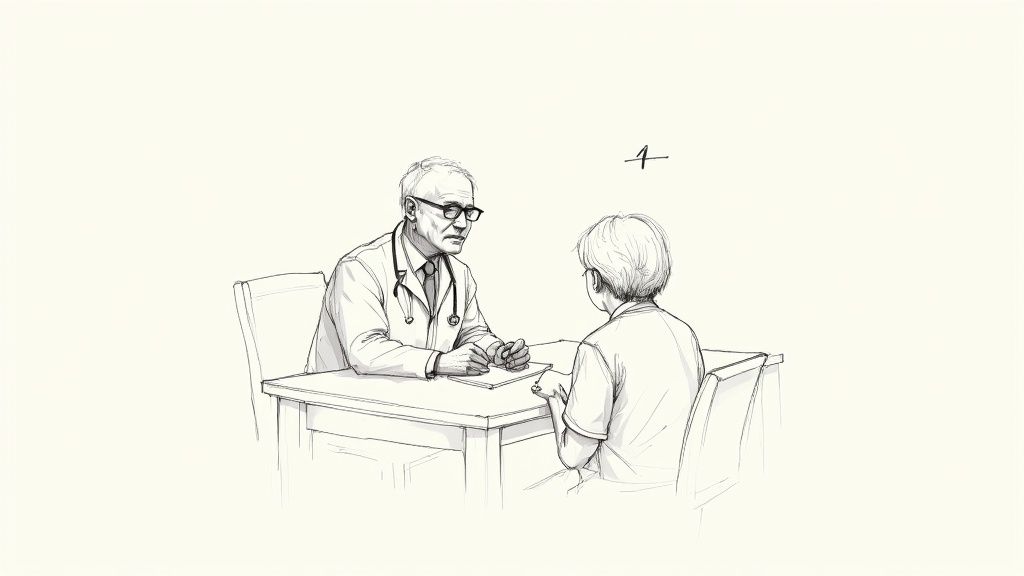
The decision to request an independent autopsy comes from a fundamental need for answers. It happens most often when the circumstances around a death are unclear or when the official explanation feels incomplete. It's a path families and their legal counsel take when questions persist and closure feels out of reach.
The true value of a private autopsy service is the independent, objective, and thorough investigation it provides. Unlike an autopsy performed by a government agency or a hospital, a private examination is initiated by and serves only the family. This independence eliminates potential conflicts of interest and ensures the process is focused solely on the facts. For many, it's the critical step toward finding resolution.
Common Scenarios for an Independent Examination
Grieving families and their attorneys turn to a private autopsy service for several compelling reasons. In every instance, they are searching for factual certainty.
- Unexpected or Sudden Death: When a person who appeared healthy dies without an obvious cause, a private autopsy can determine precisely what happened.
- Conflicting Medical Information: If a hospital's explanation doesn't align with what you knew about your loved one’s health, an independent examination can resolve the contradictions.
- Concerns About Medical Care: When there are questions about the quality of medical treatment received prior to death, an unbiased investigation can provide critical insights.
- Hereditary Disease Identification: Determining the cause of death can sometimes reveal a genetic condition, which is vital health information for surviving family members.
- Legal and Insurance Matters: A definitive cause of death is often essential for settling insurance claims, resolving inheritance issues, or pursuing legal action.
My job is to conduct a meticulous examination and deliver a clear, comprehensive report. Having performed over 1,000 autopsies, I understand that providing a final, scientifically backed answer is a crucial part of the grieving process. It helps build trust, brings clarity, and ensures the last chapter of a person’s life is recorded accurately. I handle this responsibility with the utmost respect and professional care.
What a Private Autopsy Is
A private autopsy is a thorough medical examination requested by the family or their legal representative to determine the cause of death. It is performed independently of any hospital or government agency. This service is for situations where you have lingering questions, such as concerns about medical care, a suspected hereditary condition, or the need for clarification when official channels don't provide it.
Unlike a government-mandated autopsy, our focus is entirely on your family's specific questions. This independence is what guarantees the findings are unbiased and centered on delivering the truth.
How a Private Autopsy Differs from a Public One
It's easy to confuse the two, but they serve different functions. An autopsy conducted by a county Medical Examiner's office is a public investigation mandated by law, while a private one is for a family’s personal understanding and peace of mind.
Understanding the differences in purpose, authority, and who receives the final report helps you determine which path is appropriate for your situation.
Private Autopsy vs. Medical Examiner Autopsy A Comparison
| Aspect | Private Autopsy Service | Medical Examiner (Public) Autopsy |
|---|---|---|
| Purpose | To answer a family's specific questions about the cause of death, often related to medical care, genetic concerns, or legal disputes. | To investigate deaths that are sudden, violent, or unattended, serving the public interest as defined by state law. |
| Initiation | Requested and authorized by the legal next-of-kin or their designated representative, such as an attorney. | Mandated by law under specific circumstances; the family's consent is not required and they cannot prevent it. |
| Cost | Funded directly by the family or requesting party. At Texas Autopsy Services, we provide a clear, all-inclusive fee. | Funded by the county or state government; there is no cost to the family. |
| Scope | Tailored to address the family's specific concerns. The examination can be comprehensive or limited based on the family's wishes. | Focused on determining the cause and manner of death as required by statute. The scope is not customizable by the family. |
| Report Recipient | The detailed report is a confidential document provided directly to the family or their legal representative who authorized it. | The report is a public record, accessible by law enforcement, attorneys, and sometimes the general public. |
| Pathologist | Performed by an independent, board-certified forensic pathologist chosen by the family, ensuring complete objectivity. | Conducted by a government-employed pathologist who reports to a public agency, such as the Medical Examiner's office. |
As you can see, the two services are structured for fundamentally different needs. A private autopsy service places control and confidentiality in your hands. The final report is a private document created for you, not for a public file.
The Private Autopsy Process Explained
When you’re considering a private autopsy, knowing the process can bring a sense of control during a difficult time. I am committed to a transparent, step-by-step approach, ensuring families and their legal teams understand what to expect from the first call to the final report.
It begins with a direct consultation where we discuss your specific questions. Once you decide to proceed and we have legal authorization from the next of kin, we coordinate all logistics.
Initial Steps Consultation and Transportation
The first formal step is completing the necessary authorization forms in strict accordance with the Texas Health & Safety Code. This legal requirement provides the clear consent needed to proceed.
With the paperwork complete, my team and I arrange for the respectful and dignified transportation of your loved one to our facility. We often coordinate with funeral homes, including our trusted partners at Waterloo Mortuary Partnership, to ensure this transition is handled smoothly.
This graphic outlines the simple, three-phase structure of our service, showing the journey from your initial call to the final report.

This process was designed to be as straightforward as possible for families navigating a challenging period.
The Examination A Meticulous Investigation
An autopsy is a detailed medical evaluation performed with the same meticulous care as any major surgical operation. My approach is systematic. I begin with a thorough external examination to document physical findings. I then proceed to the internal examination, where I carefully inspect each organ for signs of disease, injury, or abnormality that could have contributed to the death.
Throughout the examination, I collect small tissue and fluid samples for laboratory analysis. These are essential for microscopic examination and toxicology tests, which can reveal details not visible to the naked eye. The core of a cause of death investigation is evidence. Every observation is documented, and every finding is analyzed in the context of the individual’s medical history.
Maintaining a strict chain of custody for every sample is non-negotiable. This legal process guarantees the integrity of all evidence, which is vital if the findings become part of a court case. For a closer look at the technical details, you can read our guide that outlines the steps in an autopsy.
Compiling and Delivering the Final Report
Once the physical examination and all lab tests are complete, I synthesize the findings into a single, comprehensive report. The document is written in clear language and delivers a definitive medical opinion on the cause of death. It integrates findings from the external and internal exams, microscopic analysis, toxicology results, and a review of the deceased's medical history.
The report provides two key conclusions:
- Cause of Death: The specific injury or disease that directly resulted in death, such as coronary artery thrombosis (a heart attack) or pneumonia.
- Manner of Death: A classification of the circumstances, categorized as natural, accident, suicide, homicide, or undetermined.
This final report is a confidential document, delivered only to the individual who authorized the autopsy. I am always available to review the findings with you, answer your questions, and clarify medical terms. My goal is to provide a complete, unambiguous understanding of what happened.
Why an Independent Forensic Pathologist Matters
When a family seeks a private autopsy service, they are searching for an unbiased answer. In forensic pathology, objectivity isn't just a goal; it's the foundation of my work. As an independent, board-certified forensic pathologist with the American Board of Pathology, my sole obligation is to provide the facts without the institutional pressures that can exist in a hospital or government setting.
This independence is critical when questions arise about medical care or if legal action is a possibility. A hospital pathologist is a skilled professional, but they are also an employee of the institution where the death occurred. An independent examination provides a crucial check and balance, ensuring the final report is based on medical evidence alone.
A Commitment to Unbiased Truth
The role of a forensic pathologist is to be an impartial fact-finder. My loyalty is to the evidence. Whether I am working with a family in Central Texas or consulting with attorneys on a complex case, the process remains the same. I follow the evidence to determine a cause of death that is both scientifically sound and legally defensible.
This commitment to objectivity offers several advantages:
- Complete Impartiality: An external pathologist has no connection to the physicians or hospitals involved, which guarantees a neutral review.
- Specialized Expertise: My training in Anatomic, Clinical, and Forensic Pathology provides specific skills that are crucial in complex cases.
- Legal Credibility: A report from an independent expert carries significant weight in legal settings because it is free from potential conflicts of interest.
An independent cause of death investigation isn't about placing blame; it's about establishing facts. It creates a clear, unbiased medical narrative that families can trust and legal teams can build upon. This integrity is what gives families the certainty they deserve.
Common Misconceptions About Autopsies
Television and movies often present a dramatic and misleading picture of autopsies. This can cause unnecessary worry for families during an already difficult time. My goal is to replace these myths with facts so you can make decisions based on reality.
One of the most common concerns is that an autopsy will be disfiguring and prevent an open-casket funeral. This is not true. An autopsy is a respectful surgical procedure. Incisions are made with surgical precision and are carefully closed, similar to any major operation on a living person. The entire process is designed to be discreet and will not interfere with your plans for a viewing or funeral service.
An Autopsy Is Not Just for Crime Scenes
Another frequent assumption is that autopsies are only for criminal investigations. While a cause of death investigation is vital in forensic cases, the value of an autopsy extends much further. For many families, it provides the definitive answers needed for emotional closure.
A private autopsy service also plays a significant role in public and family health. These examinations often:
- Identify hereditary diseases, giving living family members crucial information about their own health risks.
- Clarify complex medical histories, providing understanding when a person's clinical diagnosis was not straightforward.
- Contribute to medical knowledge, offering insights that help physicians improve patient care.
The work we do provides answers that are both deeply personal and medically important.
Legal and Ethical Standards in Texas
When you choose a private autopsy, you place immense trust in the pathologist. At Texas Autopsy Services, everything we do is guided by strict legal and ethical standards. We operate in full compliance with Texas regulations, including those established by the Texas Funeral Service Commission (TFSC) and the Texas Health & Safety Code. This commitment is about ensuring dignity for the deceased and providing reliable information to their families.
A key part of my job is to clarify the language of a death investigation. Two terms that often cause confusion are cause of death and manner of death.
- Cause of Death: The specific medical reason a person died, such as coronary artery thrombosis (a heart attack) or pneumonia.
- Manner of Death: The classification of how the death occurred. There are five categories: natural, accident, suicide, homicide, or undetermined.
Distinguishing between these two is critical, especially when legal or insurance matters are involved. A proper private autopsy service provides clarity on both.
The Importance of Chain of Custody
Another term you may hear is chain of custody. This refers to the unbroken, documented trail of all evidence, from tissue samples to toxicology reports. We must be able to demonstrate, without doubt, who handled each piece of evidence and when.
A sound chain of custody is a legal necessity. It ensures our findings are admissible in court and gives our conclusions unquestionable integrity. If this chain is broken, the evidence may be compromised. I ensure our process is airtight so that the families and attorneys I work with receive findings they can depend on.
Frequently Asked Questions
When facing the unexpected loss of a loved one, having questions is natural. My job as a forensic pathologist is to provide clear, direct answers to help you navigate this process.
Here are some of the most common questions about the logistics, costs, and procedures of a private autopsy service.
How Much Does a Private Autopsy Cost?
I believe in complete transparency. We operate on a flat-fee basis, which means the price we quote is the final price. This fee covers everything: the transportation of your loved one, the autopsy examination, all necessary laboratory work, and the final, detailed report. There are no hidden charges. For a detailed breakdown, please see our guide on how much a private autopsy costs.
How Long Does the Process Take?
The physical examination is typically completed within 24 hours of your loved one's arrival at our facility. However, the comprehensive analysis required for the final report takes longer. While the hands-on examination is swift, I prioritize accuracy and thoroughness over speed to ensure the report is complete and irrefutable. Microscopic examination and toxicology results can take several weeks. I will provide a realistic timeline upfront and keep you informed throughout the process.
Do I Need an Attorney to Request an Autopsy?
No, an attorney is not required. The legal next-of-kin has the authority to consent to a private autopsy, and my team will guide you through all the necessary paperwork. However, we frequently collaborate with legal teams. An attorney's involvement can be helpful, especially if there is a potential for legal action, as they can ensure evidence is documented to support a future case.
Can an Autopsy Be Performed After Embalming?
Yes. While it is preferable to perform the examination before embalming, a skilled forensic pathologist can still uncover critical information afterward. The embalming process may alter some tissues and interfere with certain toxicology tests, but a thorough evaluation of the body's organs and structures can still determine a cause of death.
If you have more questions or need to discuss your specific situation, please contact my office. My team and I at Texas Autopsy Services are here to provide the clarity you need with compassion and professionalism. You can find more information at https://www.texasautopsyservices.com.