April 14, 2026 · Texas Autopsy Services
A Guide to Forensic Pathology Associates in Texas
Learn what forensic pathology associates do, the private autopsy process in Texas, and when families or attorneys should engage their expert services.

On this page
- Answering the Unanswered The Need for Clarity After Loss
- What Forensic Pathology Associates Do
- The Private Autopsy Process From Start to Finish
- Comprehensive Services Offered for Complex Cases
- Our Commitment to Ethical and Legal Standards in Texas
- How to Choose a Qualified Forensic Pathology Expert
- Frequently Asked Questions About Private Autopsy Services
Families usually contact me when something feels unfinished.
A death certificate may list a cause that doesn’t answer a key question. An official autopsy may not have been performed. A hospital explanation may describe what happened in broad terms but not why. Attorneys often come in at the same point, when medical records, scene facts, and reported injuries don’t line up cleanly.
At Texas Autopsy Services, every examination is performed by a board-certified forensic pathologist experienced in medicolegal death investigations. Our work centers on one principle: follow the evidence carefully, explain it plainly, and treat the deceased and their family with respect.
When people search for forensic pathology associates, they’re usually looking for more than a job title. They want to know who can examine a death independently, explain findings clearly, and handle a loved one with dignity. In Texas, that need is especially practical. Families, lawyers, hospitals, and county officials often need an experienced forensic pathologist who can step in when public resources are limited or when a second opinion matters.
TL;DR
- Forensic pathology associates provide independent medical evaluation of death, including private autopsies, second opinions, record reviews, and testimony when needed.
- A private autopsy can help when the cause of death is unclear, when no official autopsy was done, or when the family or legal team needs an objective review.
- The process should be transparent, lawful, and respectful, from authorization and transport through examination, testing, and final reporting.
- In Texas, careful attention to chain of custody, next-of-kin authorization, and postmortem legal requirements is essential.
- When choosing a forensic expert, look first at board certification, relevant autopsy experience, communication, and workload discipline.
- If you need guidance after a death, direct contact with a qualified forensic pathologist can help you understand your options without pressure.
Answering the Unanswered The Need for Clarity After Loss
A family may be told that a loved one died suddenly, but the details remain unsettled. The death certificate might say undetermined. It might list a mechanism that describes a final event, such as cardiac arrest, without identifying the underlying disease, injury, or toxic exposure that caused it.
That gap matters.
For families, uncertainty can delay mourning. For attorneys, it can affect civil claims, probate disputes, insurance questions, or potential negligence review. For physicians and facilities, it can leave a chart closed without the kind of postmortem clarification that medicine sometimes needs.
When the official answer isn’t enough
I often see a similar pattern. The family has already asked basic questions and received sincere but limited answers. They know the decedent’s medical history. They know the timeline. They know what looked normal and what did not. Yet the records still don’t form a complete picture.
A private forensic review becomes useful in situations like these:
- No official autopsy was performed and the circumstances remain unclear
- An official conclusion exists but the family or counsel needs an independent second opinion
- The medical records are complex, with multiple diagnoses, medications, or treatment events
- The death has legal implications, where objective documentation may later matter
A careful postmortem examination doesn’t create certainty where evidence is absent. It does something more honest. It narrows possibilities, documents what is present, and explains what can and cannot be concluded.
Why independence matters
A private forensic pathologist is not there to advocate for a family, a hospital, or a lawyer. The job is to evaluate the body, records, and laboratory findings.
That distinction is important. People in grief sometimes fear that asking for an autopsy means starting a fight. It doesn’t. In many cases, it means asking medicine to finish its work.
Clarity after loss is not about suspicion alone. It’s also about accuracy, accountability, and respect for the person who died.
What Forensic Pathology Associates Do
The phrase forensic pathology associates can refer to a group practice, an independent service, or physicians who work in association with attorneys, families, counties, and institutions on death investigation matters. The central task is the same. We apply pathology to answer medical-legal questions about death.
The core role
A forensic pathologist is a physician trained to determine, when possible, the cause of death and manner of death through examination of the body, review of records, and correlation with investigative facts.
That work may include:
- Autopsy examination of injuries, disease, and anatomical findings
- Specimen collection for toxicology, histology, and other laboratory studies
- Review of medical records to compare clinical care with postmortem findings
- Second-opinion analysis of prior autopsy reports, photographs, and slides
- Expert consultation for attorneys, agencies, and county officials
A hospital pathologist and a county medical examiner may each examine death from a different procedural angle. A private forensic pathologist works independently, usually at the request of next of kin, legal counsel, or an agency that needs outside expertise.
How this differs from public death investigation
A county medical examiner or justice-directed investigation serves a statutory function. Those offices determine whether a death falls within their legal jurisdiction.
Private work is different. It usually begins because someone with lawful authority wants an independent medical evaluation. That may happen when the public system declines jurisdiction, when no autopsy was ordered, or when a second look is needed.
The difference is not quality versus quality. It is purpose and access.
Why independent services matter right now
The United States does not have enough full-time forensic pathologists to meet current demand. About 750 full-time board-certified forensic pathologists are in practice, while the estimated need is 1,500 or more, and around 37 new forensic pathologists are certified annually while many leave the field, according to a report discussed by Forensic at Stopping the Shortage Cycle Ways to Fortify the Forensic Pathologist Workforce.
That shortage affects real cases. Public offices carry heavy caseloads. Some regions have limited local access. Some deaths that trouble a family may not receive the level of review they hoped for through public channels.
Practical rule: A private forensic evaluation is most useful when the question is specific. Not “tell me everything,” but “was this natural disease, intoxication, trauma, complication of care, or something still undetermined after full review?”
What works and what doesn’t
Some approaches help. Some create confusion.
| Approach | What tends to happen |
|---|---|
| Early consultation with a forensic pathologist | Preserves options for examination, specimen collection, and record review |
| Clear authorization from lawful next of kin | Prevents avoidable delays and disputes |
| Gathering records before speculation spreads | Keeps the case anchored in evidence |
| Relying on internet summaries of autopsy findings | Often leads families away from the actual medical issues |
| Assuming every unexplained death proves wrongdoing | Can distort the investigation and the interpretation |
The standard is objectivity
The most important feature of a forensic pathology associate is not speed or branding. It is disciplined neutrality.
If the death was natural, the evidence should support that plainly. If trauma, intoxication, neglect, or complication played a role, the evidence should support that plainly too. If the evidence is limited, the report must say so without stretching beyond what the body and records can show.
That is what families deserve. It is also what courts, physicians, and public agencies need.
The Private Autopsy Process From Start to Finish
The private autopsy process is often less mysterious than families expect, but it does require coordination. A well-run case moves in an orderly sequence, with each step documented and explained.
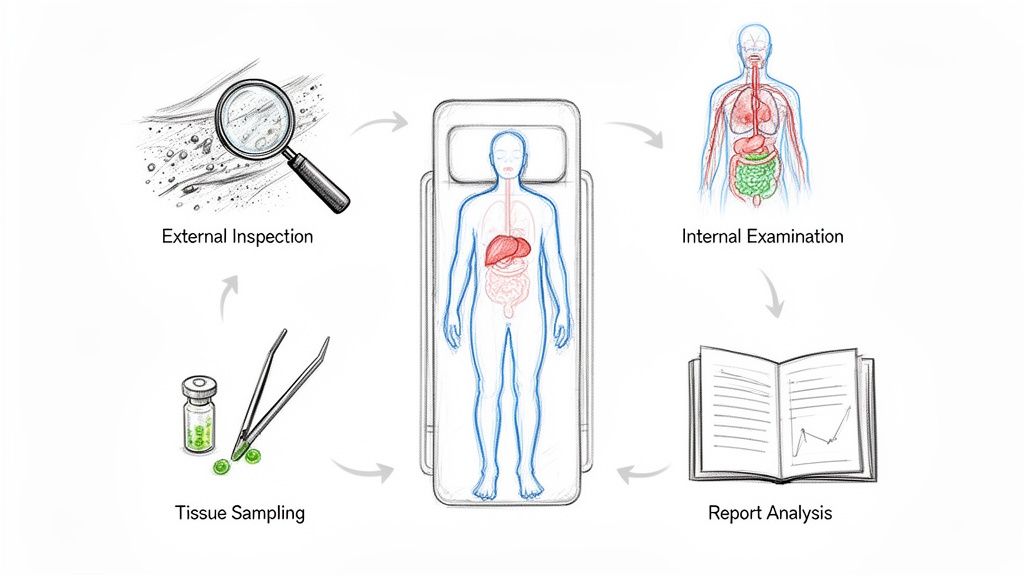
Near the beginning of that process, a visual roadmap often helps:

Step one begins with authorization
A private autopsy starts with a confidential conversation. The first questions are practical.
Who has legal authority to authorize the examination? Has a county office assumed jurisdiction? Has the body been released? Has embalming occurred? Are there urgent concerns about burial or cremation timing?
If a private autopsy is appropriate, the next-of-kin authorization must be obtained before any examination proceeds. In Texas, that legal step matters just as much as the medical one.
Transportation and facility coordination
Once authorization is in place, transportation and facility logistics follow. The body must be moved respectfully and lawfully. In many cases, this requires coordination with the family’s chosen funeral home or mortuary partner, including facilities such as the Waterloo Mortuary Partnership.
A practical point often overlooked is timing. The best process is not rushed, but delay can limit certain options. Toxicology, tissue condition, embalming status, refrigeration, and prior handling all affect what can be examined and how findings are interpreted.
What the examination includes
The autopsy itself has several parts.
External examination
This documents identifying features, body condition, medical interventions, injuries, scars, and anything visible on the surface.Internal examination
Organs are examined systematically. This includes evaluation for natural disease, trauma, hemorrhage, infection, congenital abnormalities, or treatment-related complications.Specimen collection
Blood, urine, vitreous, tissue, and other appropriate samples may be retained for toxicology and microscopic examination.Documentation
Findings are recorded carefully, often with photographs and diagrams where appropriate.
For readers who want a more detailed medical walkthrough, I’ve written separately about the procedure of an autopsy.
The purpose of an autopsy is not simply to look for an obvious injury. It is to test explanations against anatomy, tissue changes, and laboratory evidence.
A short educational overview may also help orient families before they speak with a pathologist:
Laboratory work after the examination
Many of the most important answers do not come from the gross examination alone.
A heart may appear enlarged, but microscopy can clarify the nature of disease. A death may raise concern for intoxication, but toxicology is required to identify substances and interpret their significance. A lung may look congested, but tissue sections can help distinguish edema, infection, aspiration, or other pathology.
This is one place where families sometimes become anxious. They expect the final answer immediately. Sometimes that happens. Often it does not, because a responsible report waits for the science that is still pending.
What families and attorneys receive
The reporting process usually unfolds in stages:
- Initial discussion of preliminary findings when appropriate
- Pending notice for laboratory studies such as toxicology or histology
- Final report once all reviewed materials are integrated
The final report should explain:
- Cause of death, meaning the specific injury or disease that led to death
- Manner of death, meaning the medical-legal classification of the circumstances
- Significant contributing conditions, when present
- Limits of interpretation, if evidence is incomplete or altered
Trade-offs families should understand
A private autopsy can still be valuable after hospital care, embalming, or a prior official examination. But each circumstance affects the case.
| Situation | Likely effect on interpretation |
|---|---|
| Embalming before autopsy | Some toxicology and tissue interpretations become more limited |
| Hospital treatment before death | Medical intervention may alter injury patterns or lab context |
| Long interval before examination | Decomposition may reduce precision in some findings |
| Prior autopsy already performed | Second-opinion review may focus more on records, photos, retained tissue, and prior documentation |
The best process is candid. Families should know what the examination can answer, what it may only clarify in part, and what may remain unresolved even after careful work.
Comprehensive Services Offered for Complex Cases
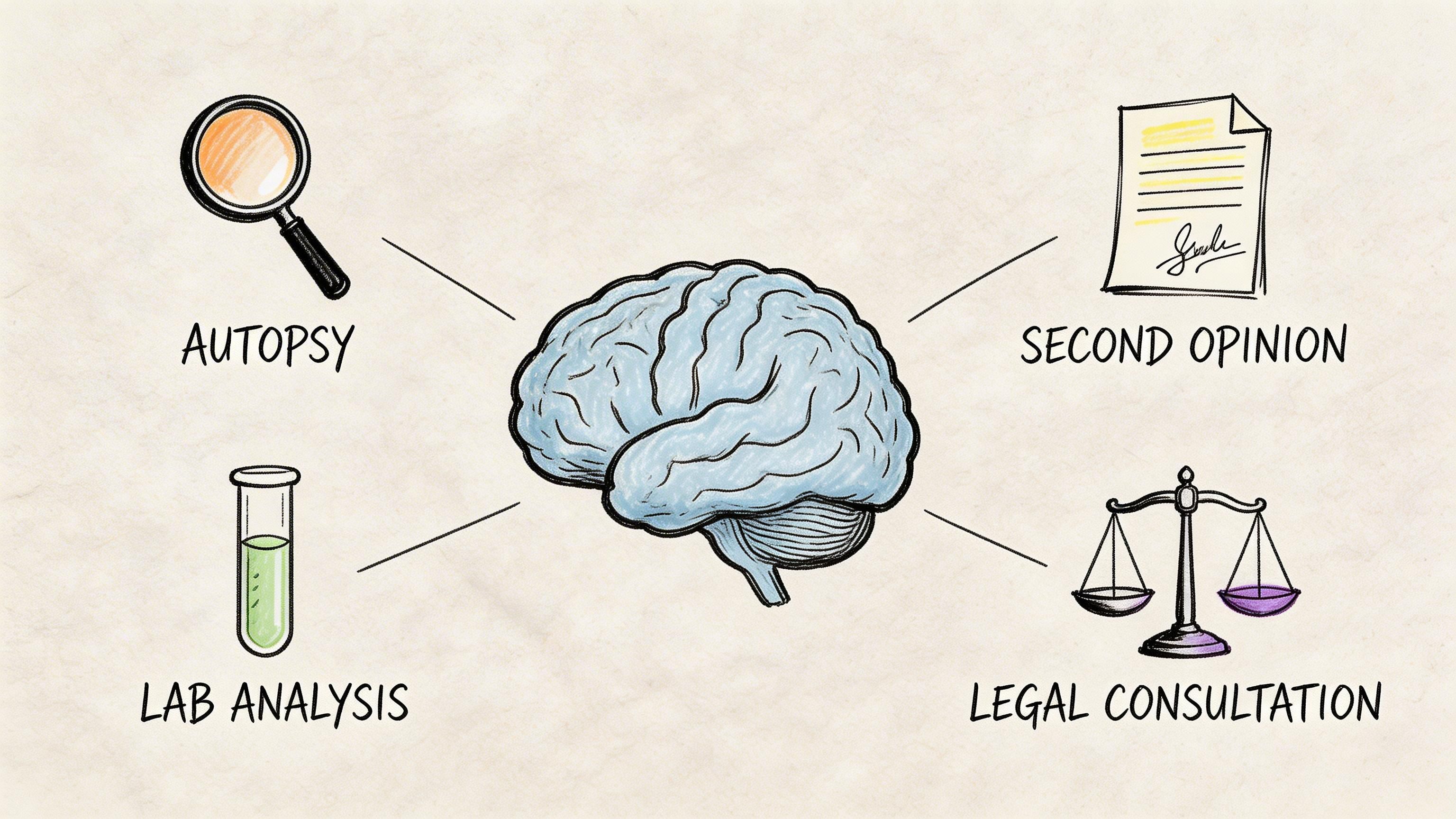
A private autopsy is only one part of forensic practice. Complex deaths often require a combination of examination, laboratory interpretation, and focused review of prior materials.
Second opinions and record-driven review
A second opinion autopsy review does not always require a new full examination. Sometimes the most useful work involves studying the prior autopsy report, scene materials, photographs, histology slides, toxicology, and complete medical record.
This is especially important when the issue is not whether an autopsy occurred, but whether its conclusion is medically persuasive.
Useful second-opinion questions include:
- Does the documented anatomy support the stated cause of death
- Was toxicology interpreted in proper clinical and postmortem context
- Were significant injuries or diseases weighed appropriately
- Did the original report separate findings from assumptions
Perinatal and pediatric examinations
Fetal, perinatal, and infant deaths require a different level of diagnostic focus and communication. Parents deserve careful answers, but they also deserve honesty about the limits of pathology.
These cases may involve congenital anomalies, placental pathology, infection, developmental conditions, birth-related complications, or sudden unexplained death. The examination must be technically precise and emotionally measured.
Toxicology and integrated laboratory access
In many deaths, toxicology is not an add-on. It is central.
Accredited practices such as Forensic Pathology Associates in Pennsylvania maintain 24/7 on-call access to laboratory services including histology, molecular diagnostics, and toxicology, which supports rapid and accurate cause-of-death determination in complex cases. Their model is described by HNL Lab Medicine at Forensic Pathology Associates.
That integrated approach matters in real work. A death involving possible polydrug intoxication, for example, cannot be interpreted responsibly from a drug list alone. The pathologist has to correlate substance findings with anatomy, known medical history, and the circumstances of death.
Some of the hardest cases are not the ones with no findings. They are the ones with many findings, where only a disciplined correlation can tell you which findings mattered and which did not.
Other services that often matter
The most effective forensic pathology associates usually provide more than one route to clarity:
- Medical record review for suspected treatment complication, missed diagnosis, or unexplained collapse
- Consultation for attorneys who need objective interpretation before litigation decisions are made
- Tissue and slide review when original autopsy materials exist
- Neuropathology-focused assessment when brain injury, seizure disorder, or developmental abnormality is in question
Physical evidence handling still matters
Families sometimes think forensic pathology is only microscopy and reports. In reality, proper handling of materials shapes case quality from the beginning.
For example, when clothing or biologic materials need to be preserved before downstream testing, agencies often rely on specialized equipment such as forensic evidence drying cabinets to reduce contamination risk and maintain orderly evidence processing. That kind of upstream discipline supports the same goal as the autopsy itself. Reliable interpretation.
A full-spectrum forensic service is not about doing every possible test. It is about selecting the right examination, the right specimens, and the right consultation for the question in front of you.
Our Commitment to Ethical and Legal Standards in Texas
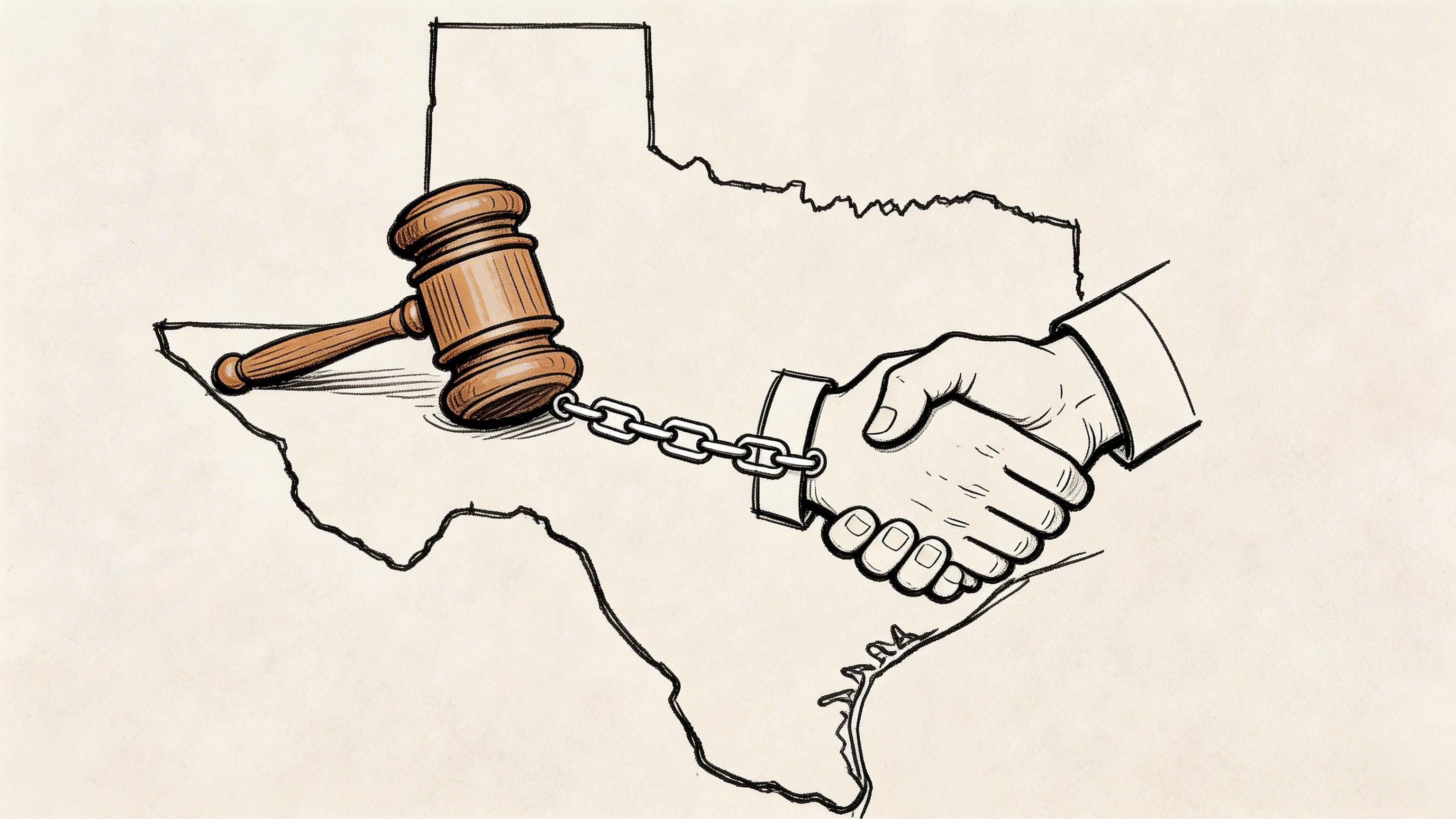
Trust in forensic work does not come from confidence alone. It comes from method, documentation, and legal compliance.
Plain-language terms that matter
Families deserve direct definitions.
Cause of death means the disease or injury that started the fatal sequence.
Manner of death means the medical-legal classification of how the death occurred, such as natural, accident, suicide, homicide, or undetermined.
Chain of custody means the documented control of specimens, records, and evidence from collection through transfer and analysis.
Those are not just technical labels. They shape how a report is understood by courts, agencies, insurers, and families.
What chain of custody looks like in practice
Chain of custody is often misunderstood as something only police use. In forensic pathology, it is broader than that.
It means we document what was collected, when it was collected, who handled it, where it was stored, and where it was sent. If toxicology samples leave the autopsy suite for a laboratory, that transfer should be traceable. If records are transmitted for review, privacy and identity controls should be maintained.
For secure document exchange, law offices and medical facilities often still use faxed records in addition to encrypted digital transfer. A simple operational tool like a HIPAA Compliant Fax Cover Sheet helps reduce avoidable privacy errors during that process.
Record integrity matters as much as specimen integrity. A sound opinion depends on knowing that the medical chart, laboratory submission, and retained materials all belong to the same case and remained intact throughout review.
Texas law and procedural discipline
Private autopsy work in Texas must be handled in compliance with applicable postmortem and disposition rules, including the Texas Health & Safety Code, with special attention to provisions that affect authorization, remains, cremation timing, and facility handling.
This is one reason informal arrangements often fail. Families under stress may receive conflicting advice from hospitals, funeral homes, or well-meaning relatives. The right process is to identify the lawful decision-maker first, then confirm whether any county authority has jurisdiction, then proceed in a documented sequence.
Questions about report access also come up frequently. The legal treatment of autopsy records can differ depending on who performed the examination and under what authority. I address some of those distinctions in my discussion of whether an autopsy report is a public record in Texas.
Rural Texas and access to justice
Access is not equal across the state.
Many rural areas in Texas face a serious shortage of forensic pathology services, and the state’s 254 counties include many communities without local access to timely expert death investigation, as discussed by the American Society for Clinical Pathology in its report on forensic pathology rotations in underserved areas.
That shortage creates practical ethical problems. Delayed examinations can affect evidence quality. Limited local resources can leave coroners, families, and attorneys without ready consultation. Independent forensic services can help bridge that gap, including through county-focused work such as county forensic autopsies.
The ethical center of the work
Objectivity is not a slogan in forensic pathology. It is the job.
A pathologist should never shape conclusions to satisfy the person who paid for the review. The report belongs to the evidence. If the findings don’t support a suspected theory, the report must say so. If they do support it, the reasoning must be clear enough that another trained physician can follow it.
That is how trust is earned in this field.
How to Choose a Qualified Forensic Pathology Expert
When someone searches for forensic pathology associates, the primary question is usually who is qualified to do this work well. Credentials are not everything, but in forensic pathology they matter a great deal.
Start with board certification
A physician performing independent death investigation work should be able to explain training clearly. The strongest baseline is board certification by the American Board of Pathology in the relevant specialties.
In my own practice, I hold board certifications in Anatomic Pathology, Clinical Pathology, and Forensic Pathology. That combination matters because cause-of-death work often requires gross pathology, microscopic pathology, and laboratory interpretation in the same case.
For readers who want a fuller overview of training pathways, I’ve explained the education required for a forensic pathologist.
Ask about actual case volume and case mix
Experience should be specific.
A pathologist who has handled adult sudden deaths may not have the same experience in pediatric cases, perinatal loss, intoxication deaths, blunt trauma, or medical treatment complications. Ask what kinds of cases they regularly review and whether they personally perform the examination or mainly supervise others.
I also advise asking how they approach uncertainty. A seasoned forensic pathologist does not promise certainty in every case. They explain what the evidence can reasonably support.
Look at workload discipline
Quality depends on time, focus, and structure.
Leading NAME-accredited forensic pathology groups set workload guardrails so individual physicians do not exceed three autopsies per day or roughly 15 to 25 per month, according to the National Association of Medical Examiners job board description at Forensic Pathologist Job Board Description. That kind of limit protects accuracy and attention to detail.
A practical way to ask this is simple: Who will perform the autopsy, and how many cases are they responsible for in a typical period?
High-quality forensic work requires enough time to examine, correlate, dictate, review slides, interpret toxicology, and revise the opinion if new evidence appears.
Communication is part of competence
A good forensic expert can explain findings to different audiences without changing the science.
Families need plain language. Attorneys need precise reasoning. Courts need neutral testimony. Physicians need medically coherent documentation. If a pathologist cannot explain a conclusion without jargon or defensiveness, that becomes a problem later.
Use a short vetting checklist
- Confirm certification: Ask which boards the physician holds and whether forensic pathology is included.
- Clarify personal involvement: Find out whether the named pathologist will perform the work directly.
- Ask how reports are built: A serious report should integrate anatomy, records, and laboratory data.
- Discuss communication: Ask whether findings will be explained in plain English after the report is complete.
- Review process transparency: Authorization, specimen handling, costs, and limitations should be clear from the start.
The right expert is not the one who sounds most certain on day one. It is the one who shows disciplined judgment from first contact through final opinion.
Frequently Asked Questions About Private Autopsy Services
When is a private autopsy appropriate
A private autopsy is appropriate when the death remains medically unclear, when no official autopsy was performed, or when a family or attorney needs an independent review of prior findings. Families often turn to these services because public systems are overburdened and training pipelines remain strained, as discussed in the NIST document on increasing the supply of forensic pathologists in the United States.
Can an autopsy still be done after embalming
Often, yes. But embalming can limit some forms of toxicology and can alter certain tissue interpretations. That does not automatically make the examination useless. It means the pathologist should explain the limits before proceeding.
Who receives the report
The report is typically provided to the person or party with legal authority who retained the service, subject to applicable law and authorization. If attorneys are involved, distribution should be clarified in writing at the outset.
What is the difference between cause and manner of death
Cause of death is the specific disease or injury that led to death. Manner of death is the category that describes the surrounding circumstances, such as natural or accident. Those terms sound similar, but they answer different questions.
Can a private forensic pathologist review an existing autopsy without repeating it
Yes. In many cases, a second-opinion review of the prior autopsy report, photographs, slides, toxicology, and medical records can be very useful. Whether that is enough depends on the specific question and what materials are available.
If you need clear guidance after a death, Texas Autopsy Services can help you understand the available options for a private autopsy, second-opinion review, or county forensic case. The goal is simple. Careful medicine, lawful process, and honest answers delivered with respect for the person who died and for the people left to carry the loss.