November 17, 2025 · Texas Autopsy Services
Coroner vs Medical Examiner What Texas Families Need to Know
Discover the difference between coroner and medical examiner, including qualifications, duties, and legal authority shaping death investigations.
On this page
When a loved one passes away unexpectedly, families need clear answers. In my work as a forensic pathologist, I often speak with families and attorneys who hear the terms "coroner" and "medical examiner" used interchangeably. While it's an understandable confusion, the difference between these two roles is significant and directly impacts the quality and reliability of a death investigation.
Here are the key takeaways:
- A medical examiner is always a physician, specifically a forensic pathologist with years of specialized medical training, who is appointed to their role.
- A coroner is often an elected official who may not have any medical background.
- In Texas, we have a mixed system. Large urban counties use medical examiners, while most smaller counties rely on a Justice of the Peace who functions like a coroner and must hire a pathologist for autopsies.
- The medical examiner system integrates medical science directly into the legal investigation, which generally leads to more accurate cause-of-death determinations.
- An independent autopsy from a private forensic pathologist can provide clarity and definitive answers when official investigations leave questions unresolved.
A few years ago, I consulted on a case where a county coroner, who was a respected local businessman with no medical training, had signed off on a death certificate listing the cause as a heart attack. The family was skeptical. An independent autopsy I performed revealed a subtle but fatal medication overdose, information that was critical for both their emotional closure and a subsequent insurance claim. This case highlights why the distinction isn't just academic; it has real-world consequences for families seeking the truth.
The Core Difference Medical Doctor vs Elected Official
The primary distinction between a medical examiner and a coroner comes down to professional qualifications. I am a board-certified forensic pathologist. My path involved medical school, years of residency training in Anatomic and Clinical Pathology, and an additional fellowship in Forensic Pathology. This extensive medical education is a requirement for any medical examiner. We are appointed to our positions based on proven medical and scientific expertise.
A coroner, in contrast, is typically an elected official. The qualifications for the job vary by jurisdiction and, in some places, require little more than being of voting age and winning an election. While many coroners are dedicated public servants, they are not required to be doctors. Their role is primarily administrative.
The infographic below summarizes this fundamental split.
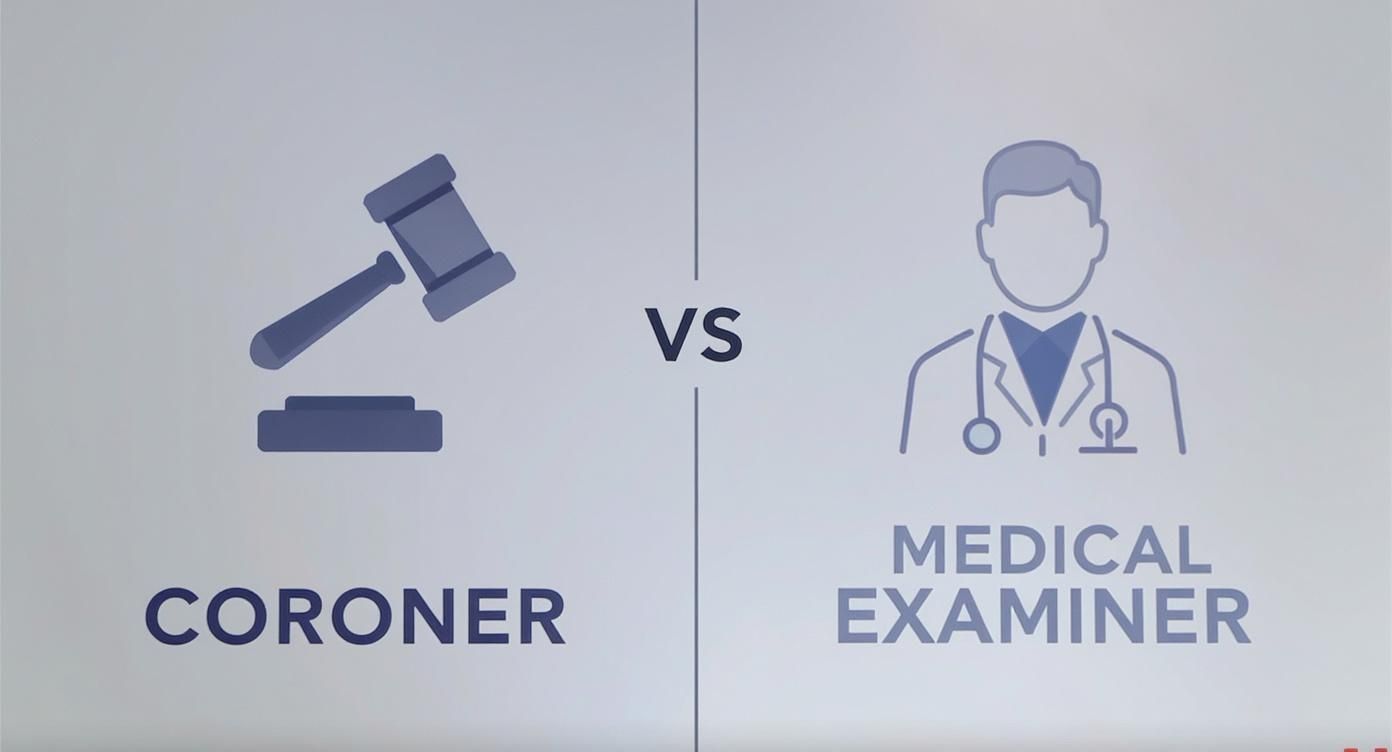
When an autopsy is necessary, a medical examiner like myself performs the examination. A coroner must hire an outside forensic pathologist to do so. This separation can create a disconnect between the person with legal authority and the person performing the scientific analysis.
Coroner vs Medical Examiner At a Glance
Let's break down the most important distinctions in a direct comparison.
| Attribute | Coroner | Medical Examiner |
|---|---|---|
| Primary Role | An administrator, often an elected official, who oversees death investigations. | A physician, typically a board-certified forensic pathologist, who medically investigates deaths. |
| Qualifications | Varies by jurisdiction; often no medical training is required. | Must be a licensed physician with specialized training in forensic pathology. |
| Selection Process | Usually elected by the public. | Appointed based on professional medical qualifications. |
| Autopsy Authority | Can order an autopsy but must hire a pathologist to perform it. | Has the medical training and legal authority to perform the autopsy personally. |
The medical examiner system is designed to keep the legal authority and the medical science under one roof. My work as a forensic pathologist is to ensure that every part of an investigation, from initial examination to microscopic analysis, is anchored in objective medical fact. This is the only path to an accurate cause of death determination.
Comparing Qualifications and Professional Backgrounds
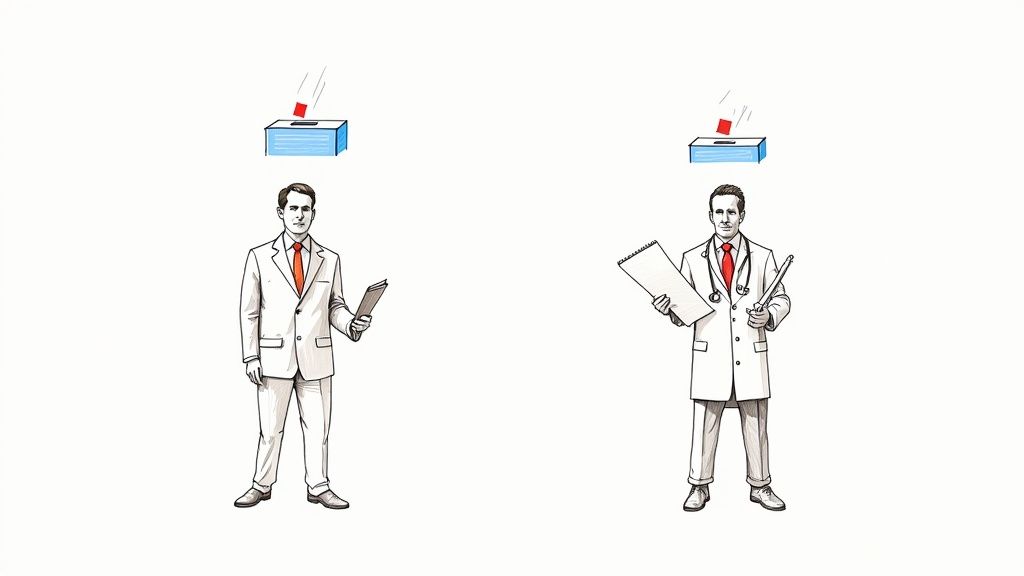
The single greatest difference between a coroner and a medical examiner stems from our professional backgrounds. One role is rooted in years of intensive medical science, while the other is often based on public administration. This split in training shapes every aspect of a death investigation.
A medical examiner must be a physician. The journey to becoming a forensic pathologist is a long and demanding one that requires a deep commitment to medical education.
The Path to Becoming a Medical Examiner
It begins with an undergraduate degree, followed by four years of medical school to earn a Doctor of Medicine (MD) or Doctor of Osteopathic Medicine (DO) degree. After graduation, a future medical examiner must complete a residency in pathology, which takes another three to four years and focuses on diagnosing disease by examining tissues and fluids.
In my own case, I completed residencies in both Anatomic and Clinical Pathology. My training didn't stop there. I pursued a fellowship, an extra year of subspecialty training, in Forensic Pathology. This is where a pathologist learns to apply medical knowledge directly to legal investigations, mastering the specific skills needed for medicolegal autopsies.
The final step is passing rigorous board certification exams. I hold three certifications from the American Board of Pathology in Anatomic, Clinical, and Forensic Pathology. This isn't just paperwork; it is proof that my expertise has been tested and verified by national experts in the field.
This entire process, taking well over a decade, is what ensures every investigation rests on a solid foundation of medicine, disease, and injury analysis. For those interested, I cover the specifics in my guide explaining what a forensic pathologist is.
Coroner Qualifications A Contrasting System
The requirements for a coroner could not be more different. They are set by local laws and vary widely from one jurisdiction to another. In many counties across the U.S., a coroner is an elected official who may not have any medical training.
The only requirements in some places are being a certain age, often just 18 or 21, being a U.S. citizen, and winning an election. While some coroners bring valuable experience from law enforcement or healthcare, it’s not always a prerequisite for the job.
This boils down to a fundamental difference in function:
- A medical examiner is the medical expert who personally conducts the scientific investigation into a death.
- A coroner is a public official who manages death investigations and must hire an outside pathologist when an autopsy is needed.
This is precisely why the medical examiner system is now viewed as the standard for quality in death investigation. It places scientific and medical expertise at the core of the process, ensuring that the final word on cause and manner of death is based on objective evidence.
How Their Authority and Day-to-Day Work Are Different
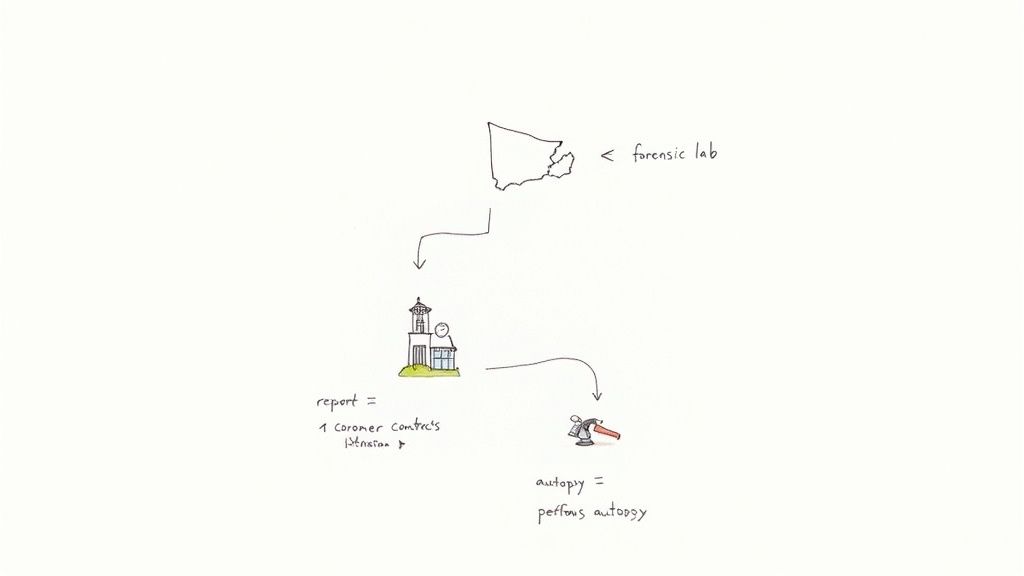
While both coroners and medical examiners investigate deaths, our daily work is very different. The core distinction lies in who holds the legal authority versus who performs the medical investigation. This is especially true in Texas, which has a mixed system of medical examiners and Justices of the Peace.
In a traditional coroner system, the coroner holds the legal authority. They take jurisdiction over a death, can hold an inquest to hear testimony, and sign the death certificate. Their role is primarily administrative and judicial. If a coroner decides an autopsy is needed, they do not perform it themselves. Instead, they must hire an outside forensic pathologist to conduct the medical examination.
This setup creates a clear divide between legal power and hands-on medical work. The coroner makes the final call, but they rely on the expert report from someone else.
The All-in-One Role of a Medical Examiner
The medical examiner system is different because it merges these two functions. As a forensic pathologist, I hold both the legal authority over a case and the medical expertise to personally handle every part of the investigation.
My daily work reflects this combined role. On any given day, I'm:
- Performing the Autopsy: I personally conduct the entire examination, from the initial external inspection to the detailed internal analysis.
- Analyzing Tissue Samples: I am the one looking through the microscope at tissue slides to find evidence of disease or injury invisible to the naked eye.
- Interpreting Toxicology Reports: I personally review lab results to determine what role, if any, drugs or other substances played in the death.
- Synthesizing the Evidence: Ultimately, it's my responsibility to connect every piece of evidence—from the scene, the autopsy, and the lab tests—to reach a scientifically sound conclusion.
This process is seamless. The person signing the death certificate is the same person who performed the medical investigation, which eliminates the risk of miscommunication between an administrator and a consulting doctor.
How It Works in Texas
Texas has a unique setup. The state's largest counties, like Harris and Dallas, have a full medical examiner system with a chief medical examiner and a team of forensic pathologists.
But in most of Texas's 254 counties, the job falls to the local Justice of the Peace (JP). A JP is an elected official who acts much like a coroner, holding the legal power to investigate and certify deaths.
When a Justice of the Peace requires an autopsy, they cannot perform it. By law, they must arrange for the deceased to be brought to a qualified forensic pathologist for the examination.
This is where my work at Texas Autopsy Services is critical. I regularly provide County Forensic Autopsies for JPs across the state. We give them access to the same high level of medical expertise found in a large city ME's office. This hybrid system allows smaller counties to ensure their death investigations are backed by solid forensic science without the cost of running their own full-time medical examiner's office.
How Each System Affects Families and Legal Outcomes
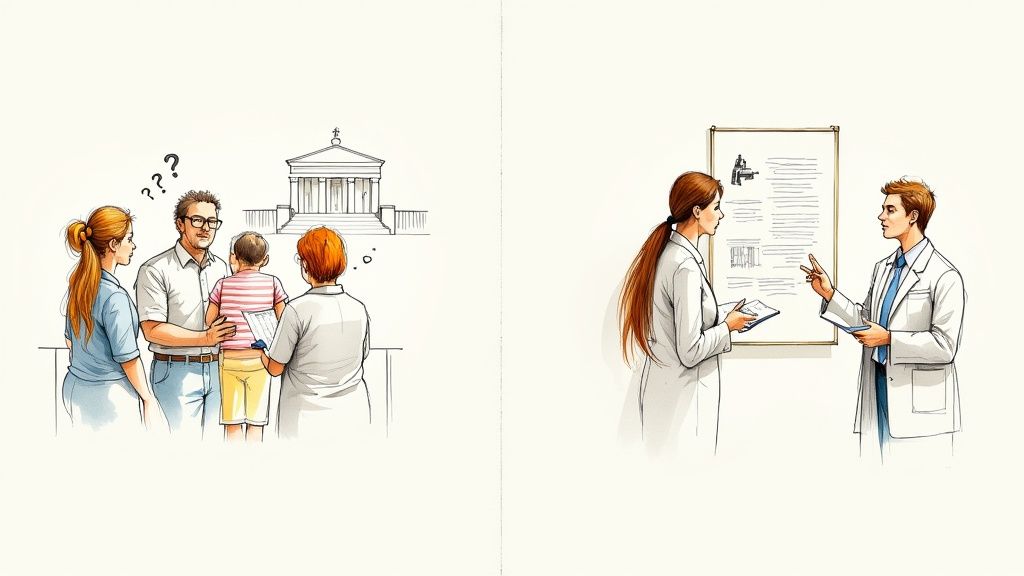
When a family is coping with an unexpected loss, they need clear, honest answers. The system in place for investigating that death, whether it’s run by a coroner or a medical examiner, directly shapes the quality of those answers and impacts everything from insurance claims to legal proceedings.
A medical examiner system is built on a foundation of science and medicine. Since a forensic pathologist personally oversees the investigation and performs the autopsy, the final report is a direct result of meticulous medical analysis. In my own work, every conclusion is based on objective evidence and designed to withstand scrutiny in a courtroom.
The Impact of Medical Expertise
In a coroner system, things can become more complicated. Many coroners are dedicated public servants, but their lack of a medical background can be a significant hurdle. The coroner, an elected official, has the final say on the cause of death but must rely on a consulting pathologist to interpret the medical evidence.
This creates a separation between legal authority and medical analysis, which can sometimes open the door to outside pressures, whether political or administrative. In my professional opinion, the person performing the science should be the one interpreting it. That direct line of responsibility is what gives the findings their strength.
Accuracy in Cause and Manner of Death
This isn't just a theoretical difference. Studies have consistently shown that states with medical examiner systems report cause and manner of death with greater accuracy. For example, one important study found that states with county coroners underreport suicide deaths by 8.6% to 16% compared to states with MEs.
Socioeconomic factors also play a role. As the same research points out, medical examiner systems are more common in densely populated urban centers with higher state incomes. You can read the full study on death investigation systems to explore the data. For families, the takeaway is clear: a medical examiner system is statistically more likely to deliver a conclusion that matches the true circumstances of a death.
When a family receives a cause of death, they deserve to know it was determined through an objective, scientific process, free from external influence. The medical examiner model is built to deliver that certainty.
Seeking a Second Opinion
This potential for inconsistency is a major reason why families and attorneys seek Private Autopsies. If an official investigation leaves questions or feels incomplete, an independent examination is a powerful tool. A second-opinion autopsy by a board-certified forensic pathologist like me can bring closure by confirming the state's findings or, in some cases, uncovering new evidence that provides a more complete picture.
Impact on Investigation Outcomes
The table below shows how these two systems can lead to different outcomes, impacting a family’s understanding and a case's legal standing.
| Aspect | Coroner System | Medical Examiner System |
|---|---|---|
| Scientific Rigor | Dependent on the hired pathologist; final say rests with a non-medical official. | Integrated medical expertise guides the entire investigation from start to finish. |
| Consistency | Can vary significantly between counties based on the coroner's background and resources. | Follows standardized medical and scientific protocols, ensuring higher consistency. |
| Legal Defensibility | Findings may be harder to defend if the coroner's conclusion diverges from the pathologist's report. | Conclusions are directly supported by the performing pathologist's expert testimony. |
| Clarity for Families | Risk of ambiguity if administrative or political needs conflict with medical findings. | Provides clear, science-based answers directly from the medical expert. |
Ultimately, the purpose of any death investigation is to find the truth through objective, evidence-based analysis. A system led by a physician specifically trained for that complex task is simply better equipped to deliver it.
How Death Investigation Works in Texas
Texas is a vast state, and our approach to death investigation reflects that. We don't have a single, statewide system. Instead, it’s a county-by-county decision, which has resulted in a unique hybrid model that blends both the medical examiner and coroner concepts.
Our most populated counties, like Harris, Dallas, Travis, and Bexar, have established Medical Examiner's Offices. These are fully staffed with board-certified forensic pathologists who lead investigations for their large urban areas. In these counties, the system is straightforward: a physician is in charge.
The Justice of the Peace as a Coroner
However, that's not the case for most of Texas's 254 counties. In the more rural parts of the state, the legal authority for investigating a death falls to the local Justice of the Peace (JP). In this capacity, the JP functions much like a traditional coroner. They have the legal power to investigate the circumstances of a death, determine the cause and manner, and order an autopsy if necessary.
A Justice of the Peace is an elected official, not a doctor. Their background is judicial, not medical. This setup creates a vital need for them to consult with medical experts to ensure their final rulings are grounded in scientific evidence. When a JP orders an autopsy, they are legally required to have it performed by a qualified pathologist.
This is the core of the Texas hybrid system. It places legal authority in the hands of a local official but mandates that the medical examination itself must be done by a trained physician. It’s a built-in safeguard to maintain the integrity of the investigation.
Bridging the Gap in Forensic Services
This legal requirement presents a logistical challenge. Smaller counties don't have the budget for a full-time medical examiner's office. They need a reliable way to get expert forensic pathology services when a case demands it. This often means contracting with a regional ME's office or partnering with an independent forensic pathologist.
That’s where a service like mine is essential. A significant part of what I do at Texas Autopsy Services is provide these crucial County Forensic Autopsies. We work directly with Justices of the Peace across the state, giving them access to the same level of forensic expertise found in a major city's ME office. This partnership model is a practical solution. It ensures every death investigation in Texas, regardless of the county's size, can be supported by the scientific rigor that only a forensic pathologist can provide.
Why an Independent Autopsy Is Sometimes Necessary
Even when a death is investigated by a county medical examiner or a Justice of the Peace, families can be left with unanswered questions. The primary goal of an official investigation is public: to determine if a crime occurred, identify public health threats, or finalize a death certificate for legal records.
While these official inquiries are necessary, they are not designed to answer every specific, personal question a family might have. This is precisely where a private, independent autopsy offers its greatest value.
A Focus on Your Family's Questions
As an independent forensic pathologist, my entire focus during a private examination is on the family's needs. The process is completely confidential and is guided by the questions you have. I don't work for the state or a county; I work directly for you to provide medically sound, objective answers.
A second opinion from a private autopsy can be invaluable in several ways:
- Confirmation and Peace of Mind: It can independently verify an official report's findings, giving families the confidence and closure they need.
- Discovery of New Information: A fresh examination can uncover new medical evidence or offer a different interpretation of the facts.
- Support for Legal Matters: Clear, unbiased results are often critical in legal disputes, insurance claims, or workers' compensation cases.
- Understanding Hereditary Conditions: An autopsy can reveal genetic diseases or conditions that may have serious health implications for surviving family members.
Gaps in the Public System
The public death investigation system, while essential, is often under immense strain. A 2022 survey found that the 2,071 medical examiner and coroner offices in the U.S. handled over 1.4 million cases in 2021 alone. That volume can naturally limit the scope of any single investigation.
The same report revealed a large difference in practices depending on the jurisdiction. For example, about 80.8% of offices in large jurisdictions routinely performed autopsies, but that number dropped to just 64.9% in medium-sized ones. These figures show that the depth of an investigation can depend on local resources. You can review the full public health report on death investigations to see these operational patterns.
When a family is left with uncertainty, it's not a criticism of the public system. It's an acknowledgment that the system's purpose is broad, while a family's need for answers is deeply personal.
When to Consider a Private Examination
Deciding on an independent autopsy is a significant step, especially during a time of grief. It might be the right choice if you find yourself in one of these situations:
- The death was sudden and unexpected, but an official autopsy was not performed.
- You have doubts or serious questions about the official cause of death.
- You need more detailed information for legal proceedings or to clarify insurance benefits.
- You're concerned about a missed medical diagnosis or a potential hereditary illness that could affect other family members.
My role is to be a source of objective medical truth. I perform a comprehensive examination, provide a detailed report, and make myself available to explain the findings in clear language. To learn more, you can read our guide on the private autopsy service we provide. My goal is simple: to give families the clear, unbiased answers they deserve so they can move forward with certainty.
Frequently Asked Questions
As a forensic pathologist, I've spent years speaking with families and attorneys trying to make sense of a sudden loss. It's a confusing and overwhelming time, and having questions is completely normal. My goal here is to offer straightforward answers to the questions I hear most often.
Can A Coroner Perform An Autopsy?
No. A coroner's job is to investigate a death, and they have the legal power to order an autopsy if they believe it's necessary. But they don't perform the procedure themselves. The actual autopsy must be performed by a qualified forensic pathologist, a medical doctor with specialized training. The coroner is the administrator of the investigation; they rely on the pathologist's medical expertise to provide the scientific facts needed to make a final ruling.
Which System Is Better A Coroner Or A Medical Examiner?
From a scientific standpoint, the medical examiner system is considered the best practice in death investigation. The reason is simple: it puts medical science at the forefront of the entire process. A medical examiner is required to be a physician and, in almost all cases, a board-certified forensic pathologist. This means that every step of the investigation is guided by deep medical knowledge, which leads to more accurate and scientifically sound conclusions about the cause and manner of death.
In a medical examiner system, the legal authority and medical expertise are one and the same. This crucial difference eliminates communication breakdowns and reinforces the credibility of the entire investigation.
This integration of medicine and law is the key difference between a coroner and a medical examiner, and it's why most medical and legal experts prefer the ME system.
Who Determines The Cause Of Death In Texas?
In Texas, the answer depends entirely on where you live. Our state operates on a hybrid model, which can be confusing for families.
Here’s a simple breakdown:
- Large, urban counties like Harris, Dallas, and Travis have a medical examiner's office. In these places, a forensic pathologist officially determines the cause of death.
- Most smaller, rural counties rely on the local Justice of the Peace (JP), who acts in a role very similar to a coroner. The JP is an elected official who has the legal authority to sign the death certificate.
When a Justice of the Peace decides an autopsy is needed, they are required by law to order one. The JP then uses the detailed report I or another pathologist provides to make their official determination. A large part of my work is performing these essential examinations for JPs across Texas.
At Texas Autopsy Services, my mission is to provide families and legal professionals with clear, definitive answers delivered with compassion and precision. If you have questions about a death investigation or believe an independent examination could bring you peace of mind, please reach out for guidance at https://www.texasautopsyservices.com.